


Have you ever played a game called ‘Telephone’? When a message is passed from one person to another and then to another, it can get muddled until it’s unrecognizable.
For a game, this is fun. For a business, not so much.
No matter how stellar your product or service is, your success depends on how well you communicate it to the world.
Your customers expect a consistent voice and brand message across platforms, as well as efficient and empathetic assistance with their queries and complaints.
Did you know that 98% of customers think it’s essential for a business to communicate effectively with them? So, if you don’t have an external communication strategy, now’s the time to start.
In this blog post, we’ll explore external communication and how to implement a competent strategy for your business.

 Summarize this article for me please
What Is External Communication?
It refers to any exchange of information between a business and its external stakeholders, such as customers, suppliers, investors, government agencies, and the media.
External communication aims to build a brand reputation and craft messages that resonate with the right audience at the right time.
Internal communication vs. external communications
The main difference between internal and external communication is that the latter targets individuals or entities outside the business. In contrast, internal communication focuses on the information exchange within a company.
However, building strong internal alignment between your employees and leadership is essential for successful external communication. This requires clear and structured internal communication that keeps everyone in the loop and fosters diverse perspectives.
For instance, if your goal is to enhance consistency between promotional content and customer service, you need to internally brainstorm how marketing and customer support teams can work together better.
They should ideally communicate regularly to align on brand tone, customer expectations, and messaging strategies. This ensures both teams deliver a cohesive experience, reinforcing the same values and promises throughout the customer journey.
There are several benefits to external communication. These include:
- Creating awareness and visibility for your products or services
- Building a stronger network with business partners and investors
- Strengthening crisis management by maintaining open and honest dialogue
- Expanding market reach through strategic messaging and positioning
- Establishing a greater sense of community through timely and relevant client communication
- Facilitating better supplier relations with clear stakeholder communication on needs and expectations
An example of external communication is when your business shares a press release about the launch of a new product. This informs the media and the general public about your latest offering and opens up avenues for new sales or subscriptions and potential brand partnerships.
Summarize this article for me pleaseTypes of External Communications
External communication comes in many shapes and forms. The main categories include:
1. Social media
By leveraging platforms like Facebook, Instagram, X.com, or LinkedIn, you can actively engage with your audience by sharing crucial information about your products or services, marketing activities, and company updates.
It’s also a good opportunity for two-way communication, as you can respond to any questions or complaints your customers may have on social media platforms and even engage in lighthearted online conversation.
Manage your social media communications smartly with the Social Media Campaign Template by ClickUp. It enables you to efficiently plan, organize, and schedule your social media posts, helping enhance your business’s online presence and influence.

Use the template for the following tasks:
- Track campaign progress with statuses like Approved, Canceled, In Progress, Needs Approval, and Needs Input
- Access custom views, including Schedule, Posts, DACI, and Campaigns, to keep everything organized and accessible
- Enhance your campaign collaboration with screen recording, collaborative editing, automation, AI, and more
2. Digital marketing
Given that the majority of the world operates online, digital marketing techniques like SEO, PPC advertising, content marketing, and CRM campaigns are vital to reaching the consumer groups you want to target.
For instance, you can run a series of paid ads on Facebook promoting your eco-friendly kitchenware to reach customers searching for those products.
Use ClickUp Brain, ClickUp’s AI-powered writing assistant, to generate content ideas and audience personas, translate content into local languages for regional campaigns, and create engaging ad copy.
For example, here’s how ClickUp Brain created a buyer persona for an eco-friendly kitchenware manufacturer in Philadelphia:

💡Pro Tip: Email marketing is also a robust way to nurture leads while informing them about new product launches and promotions. Leveraging A/B testing in email campaigns helps optimize subject lines, content, and send times to boost open rates and conversions.
3. Website content
Your website is often the first point of contact with your business, so it’s crucial to keep its content up-to-date and engaging.
Include important details about your offerings and content that interests visitors, such as interactive product demos or behind-the-scenes insights into your innovation process.
The Content Management Template by ClickUp helps define an end-to-end workflow for refreshing your website. With this template, you can organize different types of website writing tasks, from taking content requests to planning the entire sitemap on whiteboards to maintaining an editorial calendar.

The template also offers the option to measure performance against goals so you can adjust your external business communication strategies accordingly.
Create a list of content requirements, like blog posts, images, videos, podcasts, etc., and assign responsibilities to relevant team members using ClickUp Tasks. It makes progress tracking easier with custom fields and tags, like priority, due date, dependency, etc. You can also use ClickUp Gantt Chart View to monitor progress on a visual timeline and set deadlines for when content should be uploaded, updated, or removed from the website.
4. Public relations
Clear PR goals are key to getting important announcements out to the right audience and safeguarding your brand’s reputation.
A well-timed press release or conference can ensure that media outlets pick up on the latest company updates and spread the word. PR is also important during crises, helping you control the narrative and boost your credibility among stakeholders and the general public.
For example, during a product recall, a well-executed PR strategy can help you quickly address the issue, reassure customers with clear communication, and showcase accountability, ultimately preserving trust and minimizing damage to your brand reputation.
ClickUp’s PR Campaign Template equips you with everything you need to run a successful PR strategy. You can track granular details by utilizing features like:
- Custom Statuses to track campaign progress
- Custom Fields to categorize media contacts and outreach details
- Gantt Chart Views to visualize timelines

The comprehensive, fully customizable framework helps save time and resources while building a business strategy tailored to your needs and objectives. ClickUp Dashboards provide a visual overview of campaign performance, marketing KPIs, project health, and team workloads using charts and graphs, giving you the insights you need to make data-driven decisions.
💡Pro Tip: Marketing plan templates empower you to manage your messaging and ensure that your news gets to the right audience, all while keeping your business reputation intact. Integrate customer feedback loops into your marketing plan to refine your messaging based on real-time insights.
5. Public events
Events are a great way to connect with industry peers, business partners, and potential clients.
In addition to promoting your business as an industry leader and demonstrating offerings to a curated audience, you can also learn from other attendees at the event and gain insights into current market trends.
ClickUp’s Event Management Software helps optimize event planning and execution. With its intuitive features, you can transform the way you organize, promote, and collaborate.

The Calendar View in ClickUp allows you to design clear event timelines, easily assign responsibilities, and work closely with internal teams and vendors. The added benefit of two-way Google Calendar sync ensures all your meetings are effortlessly managed in one place.
Planning a large event?
- Break it down by listing every task, assigning start and due dates, and leveraging automatic global time tracking to calculate billable hours
- Set clear delivery expectations with time estimates, ensuring a smooth workflow from start to finish
- Establish a structured order of operations with task dependencies, ensuring every team member knows their role
- Prioritize tasks and create checklists to guarantee no detail is overlooked, especially on the event day
Best of all, you can streamline your event planning with ClickUp’s Event Marketing Template. This powerful tool offers a structured, repeatable framework, helping you stay organized while inspiring innovative strategies and ensuring no crucial detail is missed.
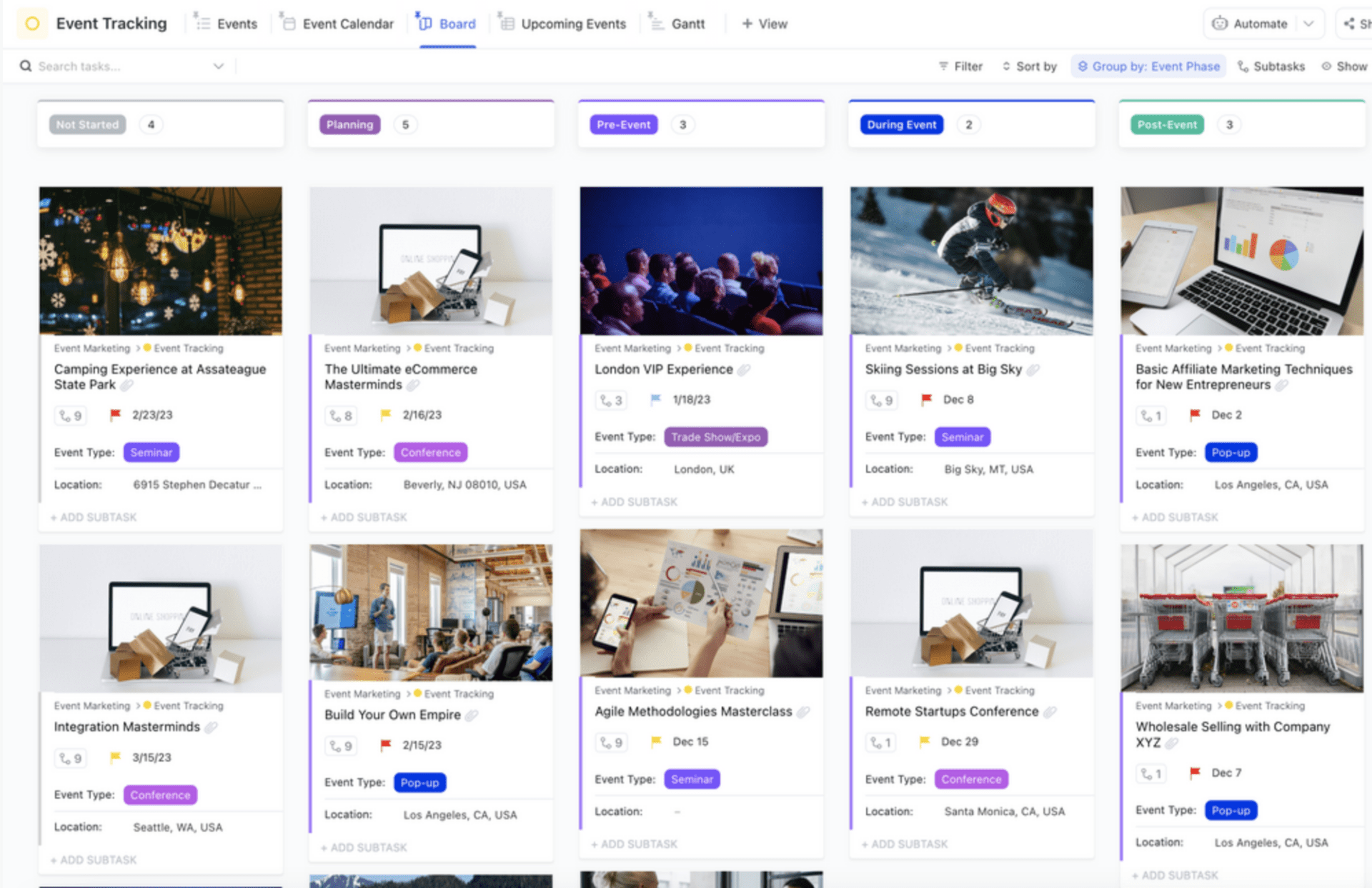
Here’s how the template can be used:
- Collaborate with your team on establishing goals and objectives
- Create a list of potential audience members and their contact information
- Track follow-up tasks and ensure nothing is missed using Milestones in ClickUp
You can also use ClickUp Automations to send automated event reminders and schedule social media posts with venue and schedule details for upcoming events.
6. Partnerships/collaborations
Partnering with influencers or other companies through endorsements or joint branding campaigns can help you tap into new audiences and benefit from mutual credibility.
Red Bull’s partnership with extreme sporting events is a prime example, as it goes perfectly with its image of energy, adventure, and pushing boundaries. These partnerships help reinforce Red Bull’s adventurous and high-energy lifestyle message.
Summarize this article for me pleaseDeveloping an External Communications Strategy
Knowing how to approach external communications is central to a successful marketing communication strategy. Here’s how to get started.
1. Research your audiences
Start by defining each of the external audiences you wish to connect with, such as investors, customers, media outlets, or partner vendors. Then, research each audience type for insights based on the following to help segment them further.
For instance:
- Firmographics (industry, company size, growth stage)
- Demographics (age, role, company size)
- Common pain points (limited budgets, fragmented data, lack of time)
- Buying behaviors (research-driven, budget-conscious, value quality over price)
If you’re a B2B software company, one of your external audiences may include IT managers at mid-sized firms.
Through persona creation, you might discover that they prioritize cost-effectiveness and integration capabilities when choosing software solutions—a critical point that needs to be considered in your external communications plan.
2. Set SMART goals for each audience
Having Specific, Measurable, Achievable, Relevant, and Timely (SMART) goals for each audience segment is important for developing targeted content that resonates with their unique needs.
For media outlets, a SMART goal could be to ‘Secure coverage in three industry-leading publications within the next quarter by sending targeted press releases and arranging interviews with key company spokespeople.’
With ClickUp Goals, you can define clear, specific objectives, refining your goal-setting strategy with quantifiable, measurable targets. For investors, a SMART goal might be: ‘Increase quarterly investor newsletter open rates by 15% within the next six months.’
Use its Targets feature to set precise success metrics, such as numbers, percentages, or currency. You can link tasks or lists to a goal on the platform, and it will automatically track your progress as you complete them.
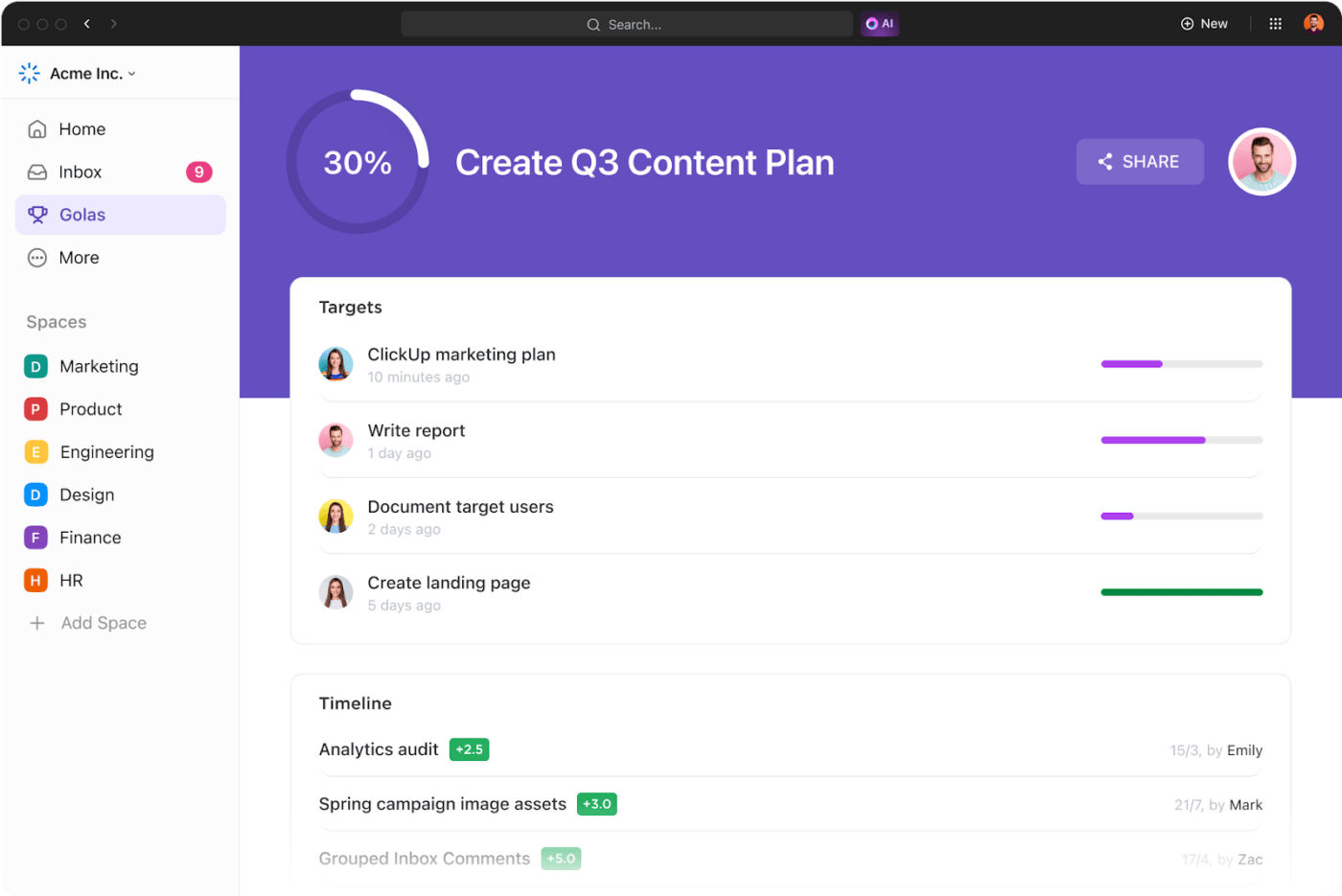
and more to review your progress periodically with ClickUp Goals
For instance, by linking all tasks in a sprint to a single goal, you can easily monitor overall progress in real time.
Keep everything organized with easy-to-use folders, assign due dates to goals and subtasks, and manage access by setting multiple owners and controlling permissions.
ClickUp’s Marketing Project Management Software can help you turn your high-level marketing roadmaps into actionable, day-to-day workflows.
Integrating strategy documents, brainstorming sessions, and pitching calendars into your team’s daily operations allows you to stay agile and respond quickly to each audience’s needs.

ClickUp Docs, in particular, allows your team members to stay informed and focused from initial brainstorming to campaign launch.
Whether you’re segmenting outreach lists by audience type, managing media contact information, or organizing ideas for your business pitches, Docs keeps everything organized in one place.

Real-time collaboration allows you to tag team members, assign tasks, and turn text into trackable action items, ensuring no idea or task is overlooked.
3. Choose the right channels for each audience
Different communication channels offer unique benefits. For instance, while social media is ideal for sharing interactive content and building hype about new launches, webinars provide a more personalized way to engage with your customers in real time.
When picking the best channel for external communication, consider factors like available budget, audience preferences, and message urgency.
For example, an email is more impactful for announcing upcoming sales, while SMS is one of the best email alternatives for more time-sensitive communications.
If you primarily use email for external communication, you can send and receive emails directly within the platform via ClickUp’s Email Project Management Software, eliminating the need to switch between tabs or tools.
Whether it’s a quick reply or a detailed update, you can easily attach documents, forms, or clips to your emails.

You can even automate emails and tasks using rule-based triggers for custom fields, form submissions, and task updates, ensuring timely communication with your audience.
Your inbox then becomes a project hub, allowing you to create and comment on tasks from email notifications, set deadlines by adding start and end dates, link emails to tasks for context, and set up automation for newsletters, drip campaigns, and email forwarding.
This allows you to manage your email outreach alongside other marketing channels, ensuring a coordinated strategy.
4. Draft a communication playbook
This is your go-to document with all the details about your goals, channels, and tone of voice (ToV) for each external audience you’re working with.
It should include editorial guidelines, content pillars, a PR content schedule, and core brand messages—giving your team everything they need to communicate the right way every time.
If you’re a consumer tech company, for instance, the playbook might include instructions on how to handle media inquiries, with pre-approved key messages about product features, company culture, and sustainability initiatives.
5. Build a roadmap for executing outreach efforts
A solid external communications plan keeps you on track, ensuring your messages are clear, your audiences are understood, and your goals are aligned.
The best part is you don’t need to reinvent the wheel. Instead, you can use communication plan templates that typically cover elements like goals, stakeholders, phases, tasks, deadlines, and key messages.
Be sure to continuously update your plan as new insights and feedback come in to stay relevant and on target.
For example, the ClickUp Communication Plan Template helps establish a hierarchy of stakeholders and define how information will be shared efficiently. You can develop your project communication strategy with clients, assign custom roles, manage access and permissions, and decide what should remain public or private.
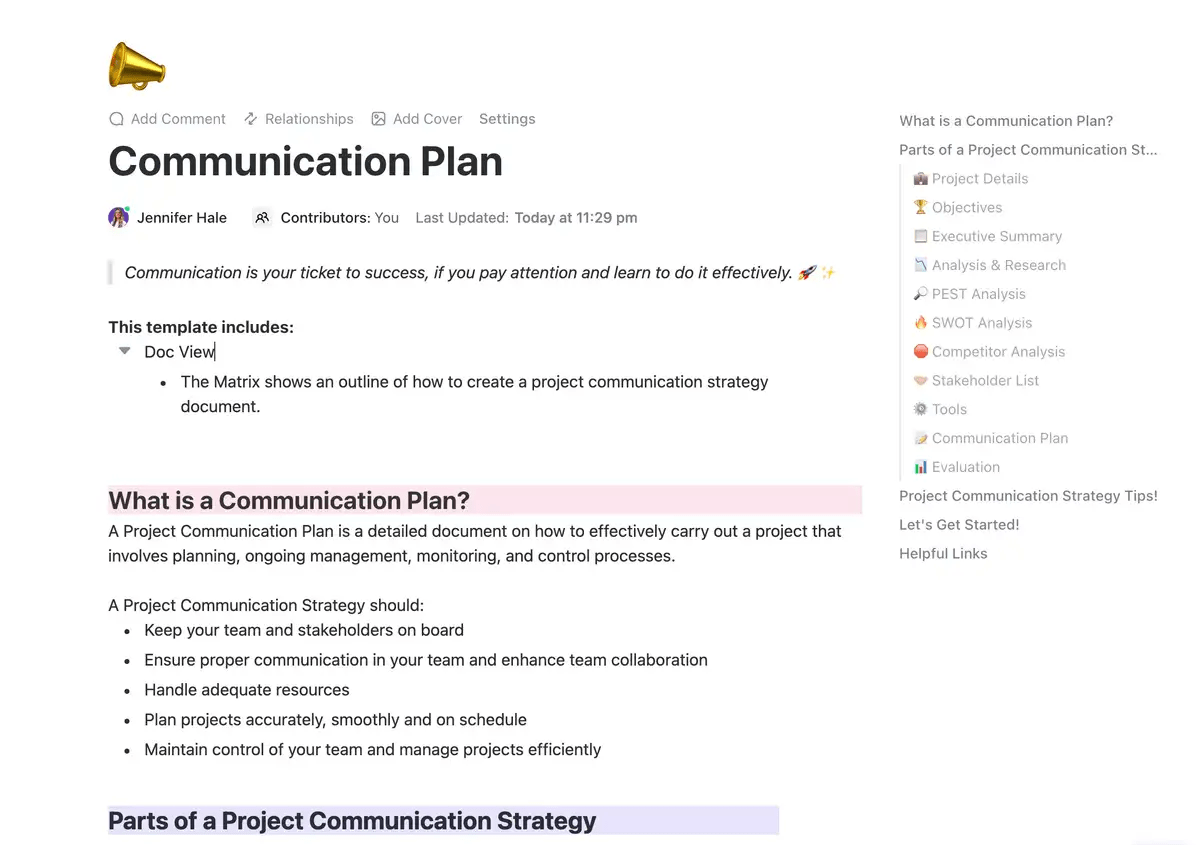
What’s more, you can create a communication workflow customized for your needs with multiple views, such as List, Gantt, Workload, and Calendar, and use task due dates, comments, automation, and more to streamline your communication planning.
Similarly, the Communication Campaign Template by ClickUp helps you effectively communicate with stakeholders and equips your team to deliver the right messages during a campaign, whether it’s a new product launch or an internal initiative.
Here’s what it offers:
- Tracking campaign progress by assigning tasks with customizable statuses
- Organizing and adding key attributes to visualize the various stages of your campaign easily
- Enhancing campaign tracking with comment reactions, automated reminders, multiple assignees, and task priorities

The template helps with the end-to-end planning and execution of campaigns, from initial brainstorming and goal-setting to selecting communication channels and ensuring the tone and voice remain consistent across all platforms.
Summarize this article for me please4 Tips to Enhance Your Branding and External Communications
External communications are critical in how your audience perceives your business. Whether it’s a press release or a Facebook post, every piece of communication contributes to the public’s perception of you, which is why having clear brand awareness KPIs is so important.
Here’s how to do it right:
- Among the first things to prioritize is consistency so that all your external communications across platforms help reinforce a singular brand identity that stays top-of-mind for your target audience
- Maintaining your online presence, including information shared on your external communication channels and prompt responses in your customer interactions, is vital
- Recommendations from trusted supporters of your business, be they industry leaders, influencers, or even happy buyers, carry greater weight in the public’s eyes than paid ads
- Collaborating with noted influencers also helps you unlock new audiences through their fan followings and build engagements with them directly
Summarize this article for me pleaseExamples of Companies Doing External Communications Right
When designing your external communication plan, take inspiration from businesses that are already doing it well. Here are some examples.
1. Patagonia
It’s an outdoor brand known for its commitment to transparency and environmental stewardship. Every year, Patagonia shares an annual report detailing its progress, initiatives, challenges, and opportunities, and it welcomes inputs from the public through its blog and social media channels.
2. Ben and Jerry’s
Ben and Jerry’s, a popular ice cream brand, has always been a strong advocate for social justice. Its website clearly lays out the many causes it supports, and each product page includes a “values-led sourcing” section detailing the plant-based packaging and commitment to fair trade.
3. Netflix
The OTT streamer continuously customizes its offerings based on what viewers want more of. Netflix also communicates regularly with customers via email and is known for its lighthearted social media presence.
4. Starbucks
The coffee chain has demonstrated time and again how to respond to crises. In the 2018 racial profiling incident, Starbucks immediately apologized, closed thousands of stores to conduct anti-bias training, and clearly communicated the actions taken and lessons learned to its stakeholders.
Summarize this article for me pleaseSimplify External Communication for Your Business
In an overcrowded digital space, the right communication at the right time is important.
Whether you’re drafting stakeholder communication documents related to financial performance or a series of social media posts for a CRM campaign, ensure that the content fits in with your overall brand voice and vision for how you want to be perceived.
And it’s never too late to start investing in that presence, especially with a tool like ClickUp that has everything you need to get started.
Use it to consolidate documents, projects, chats, tasks, and notes over a centralized platform. Enjoy seamless team collaboration, eliminate information silos, and create a truly aligned external communication strategy.
Sign up for ClickUp for free to experience the difference.


Everything you need to stay organized and get work done.

Recent Articles
AI Performance Metrics: 50+ KPIs to Measure AI-Driven Efficiency 
AI Performance Metrics: 50+ KPIs to Measure AI-Driven Efficiency

