

Do you feel like you’re being pulled in a million directions? Does your to-do list keep growing faster than a weed patch?
You’re not alone. Getting into a leadership position is fantastic, but it throws its share of curveballs your way, in the form of common leadership challenges.
Maybe your team’s morale is dipping, or you’re facing a conflict that’s snowballing into a workplace drama. Perhaps you’re drowning in tasks and wondering how to delegate without feeling like you’re giving up control.
Whatever the hurdle, this blog post will equip you with the tools and leadership strategies to tackle those internal and external challenges, build a thriving team, and become the effective leader you’re meant to be.
How to Handle Leadership Challenges at Work
- 10 Leadership Challenges and Solutions
- 1. Challenge: Communicating effectively with team members
- 2. Challenge: Inspiring innovation and creative thinking
- 3. Challenge: Motivating employees, especially during tough times
- 4. Challenge: Delegating tasks appropriately and trusting team members
- 5. Challenge: Managing conflicts within the team
- 6. Challenge: Fostering professional growth and career development of employees
- 7. Challenge: Developing a clear vision for the future of the company
- 8. Challenge: Coping with pressure and stress without it affecting the team
- 9. Challenge: Navigating office politics and building alliances
- 10. Challenge: Ensuring compliance with laws and regulations
- Tools for Dealing with Leadership Challenges
- Overcome Leadership Challenges with ClickUp

 Summarize this article for me please
10 Leadership Challenges and Solutions
Leadership challenges are the obstacles and difficulties leaders face when trying to motivate, inspire, and guide their teams toward success.
These challenges can come from internal or external factors and test a leader’s ability to make sound decisions, navigate conflict, and build a positive work environment.
Here are the 10 most common leadership challenges and solutions to overcome them:
1. Challenge: Communicating effectively with team members
Clear and effective communication is an essential leadership skill. Yet, it’s often the very thing that trips leaders up.
Every team member has a preferred way of receiving information, so a one-size-fits-all approach can leave some confused or disengaged.
But, leaders are often busy, and clear communication takes time and effort.
The solution
- Embrace active listening: Consciously try to hear your team members truly. Pay attention to verbal and nonverbal cues, ask clarifying questions, and show genuine interest in their perspectives. One-on-one meetings can provide a great platform to implement this
- Know your audience: Recognize that everyone has a preferred communication style. Some may thrive on detailed reports, while others prefer concise visuals. Adapt your communication style to resonate best with each team member
- Practice clear and concise communication: Before communicating, take the time to structure your message and prioritize key points. Use plain language, avoid jargon, and encourage open dialogue to ensure everyone is on the same page
2. Challenge: Inspiring innovation and creative thinking
Creative leadership isn’t just about managing tasks; it’s about inspiring innovation within your team, also known as change leadership. But inducing creativity can feel like pushing a boulder uphill—resistance to change, fear of failure, and rigid routines can all stifle the flow of fresh ideas.
These factors often combine to create a company culture of ‘playing it safe’ where innovative thinking takes a backseat to tried-and-true methods.
The solution
- Challenge the status quo: Encourage healthy questioning of existing processes and procedures. Ask your team ‘why’ things are done the way they are, and allow them to propose alternative approaches
- Fuel inspiration through collaboration: Break down silos and encourage cross-functional collaboration. Diverse perspectives and experiences can lead to unexpected solutions and lead to new ways of thinking
- Celebrate innovation: Recognize and reward creative thinking, both big breakthroughs and small improvements. This reinforces innovation and motivates your team to keep pushing boundaries
- Lead by example: Demonstrate your commitment to innovation by being open to new ideas and taking calculated risks. Your enthusiasm can be contagious and inspire your team to follow suit
Zappos’ holacracy structure is a case in point.
Large companies struggle to innovate while maintaining efficiency. Surprisingly, startups face a similar challenge as they scale.
Zappos, known for its exceptional customer service, succeeded with its innovative “no shipping costs and relationship marketing” model. However, to reach new market segments, it needed to move beyond its existing model.
Enter holacracy: This novel organizational structure allows teams to form and re-form around specific business challenges. When a recurring problem arises, a new team is assembled to address it. This approach treats recurring problems not as inefficiencies to eliminate but as opportunities for innovation.
By embracing holacracy, Zappos’ former CEO, Tony Hsieh, built a culture that values continuous improvement and exploration of new possibilities. This approach can inspire successful leaders to break free from traditional structures and empower their teams to innovate.
3. Challenge: Motivating employees, especially during tough times
Leadership is tested most during challenging periods. When faced with layoffs, tight budgets, or demanding deadlines, keeping your team motivated and engaged can feel like a lot of wasted effort.
Uncertainty and fear can lead to a dip in morale, causing employees to feel disengaged and less productive. The pressure to perform under difficult circumstances can lead to burnout, further hindering motivation and engagement.
Such internal challenges can chip away at employee confidence and even make leaders doubt themselves, making them hesitant to take risks or suggest new ideas.
The solution
- Offer opportunities for growth: Even during tough times, look for ways to invest in your team’s professional development. This could include training programs, mentorship opportunities, or even temporary assignments in new areas
- Emphasize wellbeing: Recognize that your team’s well-being is crucial for sustained motivation. Encourage healthy work-life balance, offer flexible work arrangements, and promote self-care practices
- Focus on purpose and meaning: Remind your team of the company’s mission and values. Help them see how their work contributes to the bigger picture, even during difficult times. A sense of purpose can rekindle motivation and inspire them to keep pushing forward
Name a formidable, inspiring, and challenging leader who comes to mind when you think of unconventional ways to motivate employees through tough situations?
Steve Jobs’ leadership style is the stuff of business legend, and for good reason.
Naz Beheshti is the CEO of Prananaz and the author of Pause. Breathe. Choose. She credits his unique, exceptional leadership style as the catalyst for her rapid professional growth. She joined Jobs as his executive assistant and asserts that Jobs’ belief in her abilities and his relentless motivation changed her life.
“Steve’s way of showing belief in you was to set the bar high, fully expecting you would hit that bar…When our limits are pushed in a healthy, empowering way, it can help us fulfill our potential and provide us with the drive and motivation to excel.“
In an article for Forbes, she concludes:
“Researchers find that a person’s first boss is likely to be their most influential one, and that was certainly the case for me. Steve remains my most important mentor and inspiration. Keep that in mind as you interact with some of your new hires and youngest employees. Choosing to believe in them can change a life.“
4. Challenge: Delegating tasks appropriately and trusting team members
Delegation is important in effective cross-functional team leadership. Yet, for many leaders, it can be a significant challenge.
Micromanaging leaders feel a constant need to oversee every step of the process. Letting go of control can be nerve-wracking, especially for critical tasks.
Sometimes, leaders doubt their team members’ skills or experience to handle delegated tasks effectively.
The solution
- Use strengths-based delegation: Instead of a one-size-fits-all approach, delegate tasks based on your team member’s strengths and areas for development. This leverages their existing skills while also providing growth opportunities
- Start small: If delegation is a new concept for you, begin with smaller tasks and gradually increase complexity as your team demonstrates their capabilities
- Celebrate successes: Recognize and acknowledge your team’s accomplishments when they complete delegated tasks. This reinforces the value of delegation and motivates them to continue taking ownership
5. Challenge: Managing conflicts within the team
Conflict is inevitable in any team setting. Disagreements over strategy, differing workplace cultures, or clashing personalities can all lead to friction.
The challenge for leaders lies in managing conflict constructively to prevent it from derailing team morale and productivity.
Conflict can also quickly escalate if emotions run high. So, leaders need the skills to de-escalate situations, manage their emotions, and create a space for calm and rational discussion.
Effective leaders need to delve below the surface to identify the core causes of conflict and address them directly.
While doing so, it’s crucial to remain objective and avoid taking sides.
The solution
- Use ‘The Pause Button’: When conflict arises, tap into the leadership philosophy of a ‘pause button’ so that everyone can take a moment to cool down, collect their thoughts, and approach the situation with a clear head
- Set clear ground rules for conflict resolution: Establish team expectations for mutual respect, active listening, and collaboration during conflict situations
- Focus on the issue, not the individual: Keep the focus on the issue, not people. Avoid blaming or shaming team members, and guide the conversation toward finding solutions that benefit the entire team
- Strengthen team members to self-resolve conflicts: For minor disagreements, encourage team members to try resolving conflicts directly with each other. This develops communication skills, builds trust, and allows them to find solutions independently
6. Challenge: Fostering professional growth and career development of employees
As a leader, you understand the importance of a skilled and motivated team. But nurturing professional growth and career development for your employees can be tougher to approach.
Training budgets might be tight, and time carved out for professional development can be scarce. Balancing immediate project needs with long-term employee growth can feel like a zero-sum game.
And not all employees have a clear vision for their career path. Leaders need to identify individual ambitions and tailor development opportunities accordingly and effectively.
Traditional training methods like lectures or lengthy online courses may not be engaging enough. So, keeping employees motivated and actively participating in their development can be difficult.
The solution
- Embrace micro-learning and skill-sharing: Modify your management style to avoid lengthy training sessions and embrace bite-sized learning opportunities. Encourage knowledge sharing within your team through brown bag lunches, peer-to-peer mentoring sessions, or short ‘lunch and learn’ workshops
- Individualized Development Plans (IDPs): Work collaboratively with each team member to create a personalized IDP. This plan should identify their current skill set, career aspirations, and specific areas for growth. Then, curate development opportunities that align with their unique goals, such as online courses, conferences, or project assignments that enhance their abilities
- Internal mentorship programs: Establish a formal or informal mentorship program within your organization. Pair experienced team members with those seeking guidance. Mentors can provide career advice, share industry insights, and offer support and encouragement as mentees navigate their career journey
You can take a leaf out of Amazon’s book. The company launched its Upskilling 2025 initiative in 2021 as a $1.2 billion commitment to empower its 300,000 employees to grow their careers.
It seeks to equip its workforce with in-demand skills through tailored courses, pre-paid tuition programs, apprenticeships, and specialized training in in-demand skills like machine learning and cloud computing.
This not only benefits employees with potential salary increases of up to 48% but also fuels Amazon’s growth by fostering a skilled and adaptable workforce.
7. Challenge: Developing a clear vision for the future of the company
A leader’s most valuable asset? A clear vision for the company’s future. But crafting such a vision can feel like navigating a fog-bound sea.
Even the most well-laid plans can be ruined by rapidly evolving markets, technological advancements, and unexpected disruptions.
So, a good vision must be both aspirational, inspiring innovation and growth, and provide a sense of stability and direction for the team. Striking this balance can be tricky.
And without your team’s buy-in, your company vision exists in a vacuum. The real challenge in such a leadership role lies in crafting a vision that resonates with individual aspirations and motivates everyone to work toward a shared future.
The solution
- Try scenario planning: Instead of focusing on a single, rigid vision, include scenario planning in your strategy. This involves brainstorming potential futures based on different market trends, technological disruptions, or economic conditions
- Focus on ‘why’ more than ‘what’: While outlining strategic goals and objectives is important, a truly inspiring vision delves deeper. Focus on why your company exists—the core purpose, values, and impact you want to make on the world. A strong ‘why’ statement resonates on an emotional level with your team and provides a guiding light even when the ‘what’ of your strategy needs to adapt
- Be open to feedback and iteration: The future is unpredictable, so your vision should be too. Be open to feedback from your team and the market, and iterate on your vision as needed
8. Challenge: Coping with pressure and stress without it affecting the team
Leaders are expected to be the picture of composure, but, in reality, they face immense pressure. Deadlines loom, expectations are high, and the weight of the team’s success often rests on their shoulders.
Under pressure, it can be difficult to maintain focus and prioritize effectively. Leaders drowning in stress may struggle to delegate tasks, make clear decisions, or provide the guidance their team needs to thrive.
And this stress can be passed on to others. A leader who appears anxious or overwhelmed can create a ripple effect of negativity within the team, impacting morale and productivity.
The solution
- Lead with mindfulness and emotional intelligence: Become a better leader. Develop your emotional intelligence by practicing self-awareness and recognizing stress triggers. Mindfulness techniques like meditation or deep breathing exercises can help you manage stress at the moment and maintain a sense of calm under pressure
Leaders like Jeff Weiner, Oprah Winfrey, and Bill Gates meditate regularly. They also attribute their ability to be self-aware and stay in the present moment to meditation
- Build a strong support network: Don’t do it alone. Seek out a mentor, a leadership coach, or a trusted colleague to confide in and receive support during challenging times
- Maintain a sense of humor: Laughter can be a powerful stress reliever. Don’t be afraid to inject some humor into tough situations. A lighter atmosphere can help everyone maintain perspective and approach challenges with a more positive outlook
9. Challenge: Navigating office politics and building alliances
The corporate world can be complex, filled with unspoken rules, power dynamics, and competing interests. As a leader, you need to be strategically aware of this political atmosphere without getting sucked into the drama.
Focusing solely on internal politics can distract from your core objectives, while complete obliviousness can leave you blindsided by power struggles.
Figuring out whom to trust and collaborate with is also essential. If you build alliances solely on a ‘who you know’ basis, valuable team members can feel alienated, creating resentment.
Effective alliances are built on a foundation of shared goals and mutual benefit. Focusing only on personal gain can lead to short-lived partnerships and ultimately hinder your team’s success.
The solution
- Become a master networker: Network authentically and strategically. Build genuine connections with colleagues across departments and levels. Mingle to gather information, gain diverse perspectives, and identify potential allies who share your vision and values. Focus on building rapport, not just collecting contacts
- Champion collaboration over competition: Create a culture of collaboration within your team and across departments. Highlight the benefits of teamwork and shared success. This promotes a more positive and productive work environment, reducing the need for internal competition
- Maintain professional boundaries: While building relationships is important, maintain professional boundaries. Avoid getting entangled in gossip or office drama. Effective leadership focuses on building alliances that are strategically relevant to your goals
10. Challenge: Ensuring compliance with laws and regulations
Laws and regulations evolve constantly, making it difficult to stay current on changes that might impact your business. Missing crucial updates can lead to costly fines and reputational damage.
It’s not that all compliance issues are malicious. Sometimes, unintentional mistakes or a lack of awareness can lead to violations. So, it’s essential to ensure everyone on your team understands their compliance obligations.
We know that compliance can sometimes feel like a bureaucratic burden, disconnected from the day-to-day realities of your team’s work. But as a leader, youmust bridge this gap and demonstrate how compliance contributes to the organization’s overall success and ethical operation.
The solution
- Invest in compliance training: Compliance training doesn’t have to be dry and monotonous. Use interactive training methods like online simulations, case studies, and even gamification to keep your team engaged and actively learning about relevant regulations
- Develop a compliance network: Allow a group of employees from different departments to become compliance champions. These champions can act as internal resources, answer questions from colleagues, and help promote a culture of compliance within their teams
- Regular compliance audits and risk assessments: Conduct regular compliance audits to identify potential risks and areas for improvement. Proactive risk assessments help you stay ahead of potential violations
Identifying your leadership style or challenges and finding solutions on the go becomes easier with collaborative and communication tools. It’s even better to get an all-in-one platform to help your team.
Summarize this article for me pleaseTools for Dealing with Leadership Challenges
Leading a team effectively requires a multifaceted approach. Along with tips and tactics, you need resources to help you nip leadership problems in the bud.
ClickUp, an all-in-one productivity platform, equips leaders with the tools they need to address various challenges and allow their teams to thrive.
Let’s explore how ClickUp tackles some of the top leadership challenges.
1. Improve communication
Overcome misunderstandings, open up communication, and maintain transparency with ClickUp Chat View.
Instead of juggling multiple tools, chat with your team members in real-time, share files with embedded links, comment feedback for solving problems instantly, and create spaces to network with people across the office—all in one platform.

Format any message with rich editing for clear and concise communication. Include code blocks, bulleted lists, and checklists to address the day’s tasks, and save time by formatting with /slash commands shortcuts.
If your team prefers visual communication, try ClickUp Clips to share context quickly without requiring text-based updates.

Record your screen to share snippets of text, code, or even multimedia files directly within tasks, docs, or chats. This allows for instant knowledge sharing and contextualizes communication.
For example, a designer can share a specific color code as a Clip within a design document, ensuring everyone is on the same page. This eliminates the need for lengthy explanations or searching for reference materials scattered across different applications.
Craft a communication plan to improve communication across your organization. The ClickUp Communication Plan Template can help you do this.

Communication is the lifeblood of any organization, and leaders can master it through planning. This template takes the guesswork out of crafting an actionable strategy to communicate well with your team.
Craft a thoughtful communication plan by:
- Creating custom statuses to visualize the communication plan’s progress at a glance
- Categorizing your plans with custom fields, ensuring easy access and clear visibility for your entire team
- Incorporating your unique workflows into the plan. Start with the ListView to visualize all tasks clearly and tailor the template to your needs with diverse options like Gantt, Workload, Calendar, and more
- Using project management features like due dates, task comments, and automations to enhance communication planning and execution. In-built AI tools can further automate tasks
2. Collaborate seamlessly
Collaboration is the key ingredient for innovation and high-performing teams. Yet, many organizations struggle with a persistent foe: information silos.
These isolated pockets of knowledge and communication hinder collaboration, resulting in duplicated efforts, missed opportunities, and unnecessary friction.
Break down information silos and promote seamless collaboration—as a leader, that’s your non-negotiable duty.
Build a central repository where all project documents—from marketing brochures to engineering blueprints—can be created and edited collaboratively in real time. Using ClickUp Docs for this purpose eliminates version control headaches and ensures everyone can access the latest information.

Team members can work on documents simultaneously, see real-time edits, share on chat, and leave comments for clarification. This eliminates the confusion of chasing outdated versions or wondering who has the ‘master’ document.
3. Simplify task management
Teams focus on high-impact tasks and achieve project goals faster by simplifying workflows and information exchange.
Use ClickUp Tasks to facilitate delegation. With customizable task management features, you can plan, organize, and collaborate on any project.

Get total flexibility to run all your projects. Quickly navigate to any task or subtask within your project and visualize your work in multiple views. Customizable subtasks allow you to surface the information you need at the right time.
Choose from 15+ flexible ClickUp Views such as (List, Group, Calendar, Kanban) to customize workflow based on team preferences and project needs. For example, use Gantt charts and make it easy to collaborate on work, track dependencies, and manage priorities on a shared visual timeline with your team.
Create custom task statuses that reflect your specific workflow, providing clear visibility into task progress and potential roadblocks. Simple statuses are treated much like a to-do list and offer an easy way to keep up with simple tasks. Once the task is complete, change the status to done and move on to the next!
Continuous feedback might just be the loop to ensure everyone works in sync.
External feedback can also be helpful, especially for client-facing leaders, to improve products and services. It also proves your commitment to excellence for your team members.
Use the ClickUp Feedback Form Template to customize your feedback collection and view all your feedback in one place to start improving processes and outcomes.

Capturing valuable customer feedback is essential for business growth, but managing it effectively can be challenging. This template streamlines the process, allowing you to collect, organize, and analyze customer data all in one place:
- Use custom statuses like ‘Completed’ and ‘To Do’ to track the progress of addressing customer feedback to ensure no valuable information gets lost in the shuffle
- Custom fields like ‘Service Provider’, ‘Date of Purchase’, and ‘Customer Tier’ allow you to categorize feedback and identify trends within specific customer segments. Gain a deeper understanding of your customer base and tailor your offerings accordingly
- Get six different custom views tailored to analyzing feedback data. Choose from options like ‘Overall Recommendation List’ or ‘Provider Rating Table’ to easily visualize customer sentiment and identify areas for improvement
- Use features like time tracking to monitor response times, tags to categorize feedback by topic, and dependency warnings to ensure timely action is taken
4. Stay on top of everything
Being bombarded with updates, reports, and individual project data can make it difficult to see the bigger picture. Customize your own command center with ClickUp Dashboards.

Design dashboards tailored to your specific needs. In one place, you can see key metrics from various projects, team progress reports, and upcoming deadlines.
Visually identify potential bottlenecks or roadblocks. Focus your energy on the areas that need your immediate attention and delegate tasks confidently.
Track team performance and project health through insightful charts and graphs. Visualize progress over time, and identify and celebrate team members who contribute their best.
Without clear time tracking, projects can easily veer off schedule, and team productivity can suffer. Use ClickUp’s Project Time Tracking to see who’s working on what and if efficiency improvements are required.

Track time spent on tasks easily to build transparency within your team and identify areas for process improvement.
Analyze historical time-tracking data to make more realistic estimates for future projects. This ensures you allocate resources efficiently and prevent project delays.
An organization without a clear vision lacks direction, leading to disengaged teams and unfulfilled potential. Chart your team’s course to success with ClickUp Goals.
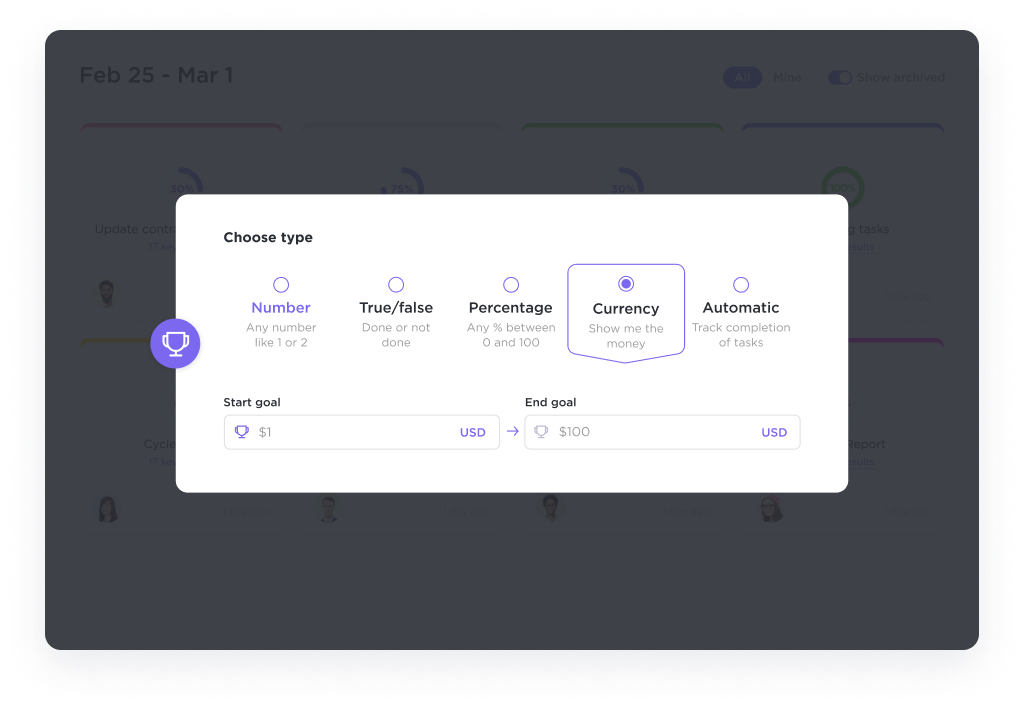
Establish specific, measurable, achievable, relevant, and time-bound goals (SMART goals) for yourself, your team, and the entire organization. This ensures everyone is working toward the same objectives.
Monitor progress toward goals with clear visuals and celebrate milestones along the way. This will keep your team motivated and foster a workplace culture of ownership.
5. Jump-start problem-solving with pre-built tools
Leadership development involves anticipating future challenges and finding creative solutions. However, tackling unique problems can feel overwhelming with limited time and resources,.
Leaders often waste valuable time reinventing the wheel for common tasks.
But with ClickUp Templates and its library of 1000+ pre-built highly customizable layouts, you get a headstart for any project or use case.
For example, monitoring your health is equally important to prevent burnout and set your priorities straight.
Use the ClickUp Leadership Team Health Monitor Template to get a comprehensive overview of your team dynamics.

This template in ClickUp can be a great tool to help ensure your leadership team is well-aligned and working toward a common goal. Here’s how to use it:
- Set up team goals by creating tasks and various custom statuses to ensure everyone works toward the same goal
- Create a dashboard with key performance indicators (KPIs) to track your team’s progress. This should include metrics like team morale, communication, productivity, and more
- When you identify areas of improvement, create action plans to address them. This can include assigning tasks to team members, setting deadlines, and setting clear expectations
Summarize this article for me pleaseOvercome Leadership Challenges with ClickUp
Sounds like not one but many full plates! But the good news is that you don’t have to do it alone.
ClickUp helps you tackle these hurdles head-on with a suite of powerful tools designed to simplify communication, improve workflows, promote transparency, and channel team dynamics in a way that keeps everyone on the same page, chasing after the same big, hairy, audacious goals.
It’s the perfect partner to tackle each leadership challenge smoothly, enhance your leadership skills, and set you up for success.
Sign up for ClickUp today!


Everything you need to stay organized and get work done.

Recent Articles
Managing Creative Teams: How to Lead Your Team to Success 
Managing Creative Teams: How to Lead Your Team to Success
20 SMART HR Goals & Examples for Real Results in 2026
20 SMART HR Goals & Examples for Real Results in 2026
25 Employee Satisfaction Survey Questions to Pulse Check Your Team
25 Employee Satisfaction Survey Questions to Pulse Check Your Team
