Good to Great: Everything You Need to Know about Effective Project Evaluation

Sorry, there were no results found for “”
Sorry, there were no results found for “”
Sorry, there were no results found for “”
For project managers, each project involves multiple moving parts and many stakeholders. Monitoring your project’s real-time progress and performance is the secret to consistent success.
However beautiful the strategy, you should occasionally look at the results.
Project evaluation is your best ally in assessing how effectively your project meets its objectives and delivers value to stakeholders. Uncovering these evaluation insights will help you make smart decisions that significantly improve your business outcomes.
In this article, we’ll guide you through the crucial steps to master your project evaluation process. Plus, we’ll consider the challenges of project evaluation and explore its primary types. We’ll also show you what to check for when assessing different aspects of your project.
Buckle up, and let’s begin!
Simply put, project evaluation involves assessing a project’s success. It is a meticulous process that involves gathering detailed project data and using project evaluation methods to uncover areas for performance improvement.
Project evaluation isn’t just a routine check-in that keeps stakeholders informed about project status. It is a more detailed analysis that uncovers opportunities for enhancement, as well as potential budget or schedule adjustments. ✅
Every part of the project, from expenses and scope to risks and ROI, undergoes analysis to ensure alignment with the initial plan. Any hurdles or deviations along the way become valuable insights that guide future improvements.
Tools like project dashboards and trackers are crucial in facilitating the project evaluation process. They streamline access to crucial quantitative data, making it readily available for informed decision-making and strategic adjustments.
While project evaluation can happen at any time in a project’s lifecycle, there are three particular pivotal points where a detailed evaluation of the project is a must.
We must assess a project’s feasibility for success before starting it. This evaluation typically aligns with the project’s current development stage and is a cornerstone for its effective execution.
In this type of evaluation, you must establish a shared understanding of objectives and goals among all stakeholders before giving the project the thumbs up.
During the project’s lifecycle, it is important to confirm that completed tasks align with benchmarks. This kind of ongoing evaluation includes staying within budget, meeting task completion rates, and ensuring overall work quality.
Keeping the team focused on the initial objectives helps them stay on course as the project evolves.
After project completion, analyzing impacts and outcomes is your number one priority. Outcomes provide a yardstick for measuring the project’s effectiveness in meeting predefined objectives and goals so you can see what worked and what didn’t.
Evaluating project data for impact also helps you effectively address and resolve issues in future projects.
Both qualitative and quantitative methods are used for project evaluation, each serving a different purpose.
Qualitative methods focus on descriptive, subjective, and experience-based evaluations rather than numerical data. These methods help uncover insights into project effectiveness, stakeholder satisfaction, and areas for improvement.
The most common ways to qualitatively assess project effectiveness are:
This method involves structured or unstructured interviews with project stakeholders (clients, team members, executives) to gather feedback on project outcomes, challenges, and successes.
📌 Use case: Best for understanding stakeholder expectations and satisfaction levels.
💡 Pro Tip: Get ClickUp Brain to summarize interview transcripts, extract insights, and create action items for you.
These are small group discussions with project team members, end-users, or other stakeholders to discuss experiences and gather qualitative insights.
📌 Use case: Helps identify collective opinions and areas of concern that may not surface in individual interviews.
This method entails a detailed examination of a specific project to document challenges, best practices, and lessons learned.
📌 Use case: Useful for benchmarking and providing future project teams with insights.
This project evaluation method requires direct monitoring of project processes, team performance, and outcomes in real time.
📌 Use case: Effective for evaluating workplace efficiency, team collaboration, and adherence to workflows.
A SWOT (Strengths, Weaknesses, Opportunities, Threats) analysis is a structured assessment of a project’s internal strengths and weaknesses, as well as external opportunities and threats.
📌 Use case: Helps project managers strategize improvements and risk mitigation.
Quantitative methods of project evaluation use measurable data and statistical analysis to assess a project’s success.
These methods provide objective insights into performance, efficiency, and return on investment (ROI). The most popular types are:
This performance measurement technique compares planned work vs. actual progress using cost and schedule data. Key metrics are:
📌 Use case: Ideal for tracking cost and schedule performance in large projects.
This measures the financial return on a project compared to its cost.
Formula: ROI=(Net Profit from Project/Project Cost)×100
📌 Use case: Helps determine the financial viability and impact of a project.
Running a cost-benefit analysis helps compare the total expected costs and benefits of a project to determine its overall value.
📌 Use case: Best for assessing whether a project is worth pursuing based on financial and non-financial benefits.
This method involves measuring specific success metrics such as:
📌 Use case: Great for tracking project health and performance over time.
NPV evaluates the project’s financial worth by considering future cash flows discounted to the present. On the other hand, IRR measures the project’s expected rate of return.
📌 Use case: Useful for long-term capital projects and investment decisions.
This evaluation method considers the efficiency of project resources, such as:
📌 Use case: Helps identify bottlenecks and optimize workflow efficiency.
Selecting the right project assessment method depends on several factors:
A balanced approach often works best—combining qualitative insights (stakeholder feedback, SWOT analysis) with quantitative project data and metrics (KPIs, cost analysis) gives a holistic evaluation of a project’s success.
The advantages of conducting a project evaluation span from internal team growth to external triumphs. Here’s a rundown of the main benefits:
A successful project evaluation isn’t just about following a checklist—it’s about leveraging the right project management tools to streamline the journey!
There are six essential steps to take during a project evaluation process. Let’s explore! 🧐
Crafting solid goals and objectives for your project is like drawing a map for your team—it sets the course and direction.
Goals also play a crucial role in shaping the evaluation process to your objectives. For instance, if your goal is to enhance customer satisfaction, your evaluation might focus on customer feedback, experience metrics, and service quality.
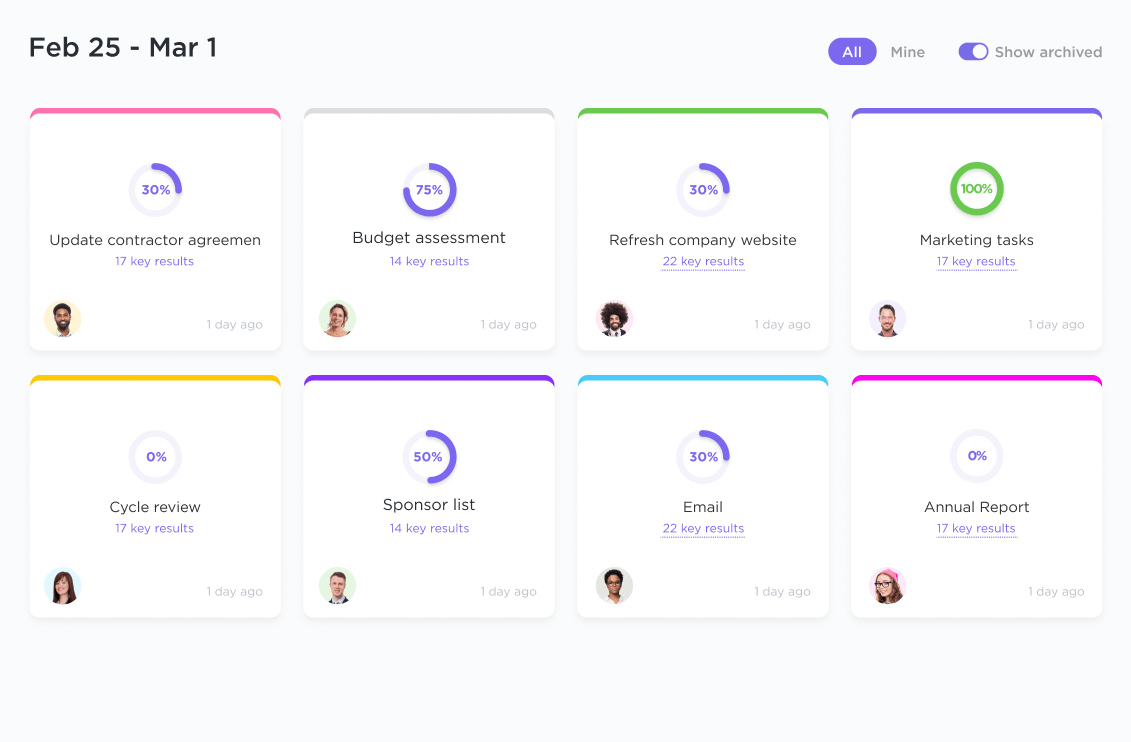
Luckily, the super important step of setting project goals is a piece of cake with a project management solution like ClickUp. This powerful tool streamlines your project endeavors and kickstarts your project journey by helping you define clear goals and objectives—all in one place! 🌟
With ClickUp Goals, nailing your targets becomes effortless. Set precise timelines and measurable goals, and let automatic progress tracking do the heavy lifting. Dive in by adding key details—name your goal, set the due date, assign a team member—and you’re ready to roll!
ClickUp equips you to:
Highlight pivotal moments by tagging them as project milestones and transform large goals into manageable chunks for your team to conquer effortlessly.
The cherry on top? You can group related goals into Folders to track progress across multiple objectives at a glance, leading to simpler decision-making. 🍒
📮ClickUp Insight: 92% of knowledge workers risk losing important decisions scattered across chat, email, and spreadsheets. Without a unified system for capturing and tracking decisions, critical business insights get lost in the digital noise. With ClickUp’s Task Management capabilities, you never have to worry about this. Create tasks from chat, task comments, docs, and emails with a single click!
Start the evaluation process by clarifying why you’re doing it, what you’re aiming for, and what exactly you’re measuring.
Define the evaluation’s scope:
This clarity in purpose and scope sets the stage for a well-organized and effective evaluation, making project planning and execution as easy as pie. 🥧
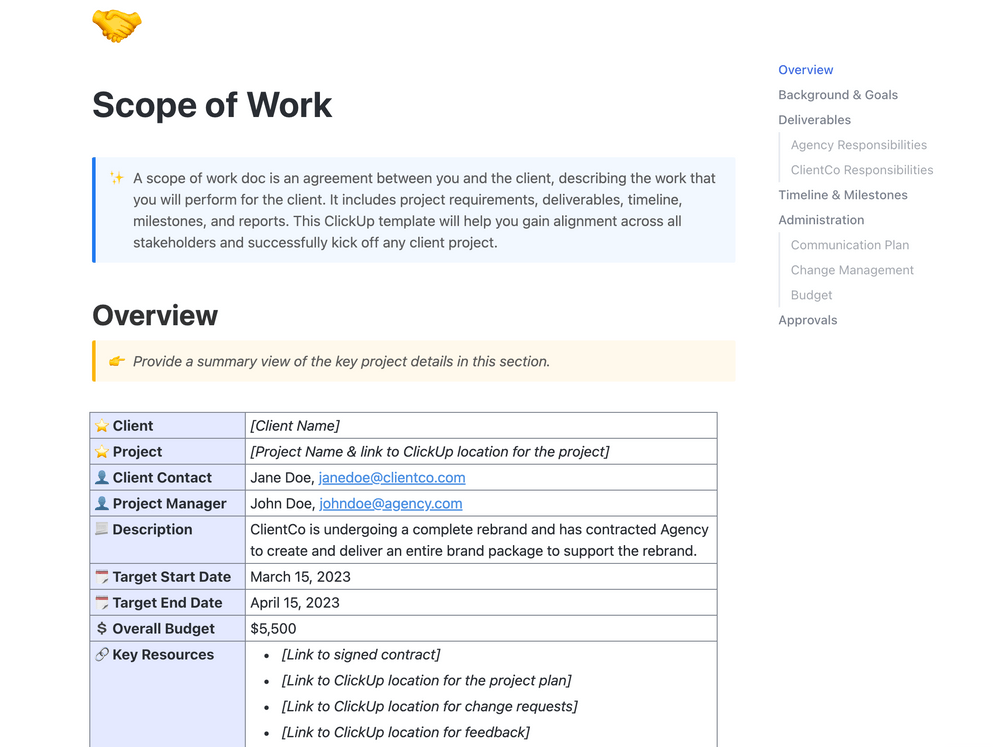
ClickUp has the perfect solution for documenting your scope of work without breaking a sweat. With the ClickUp Scope of Work Template, you get a ready-made framework to plug in all the essentials—covering everything from project background and goals to timelines and budget details.
Customize its handy tables to document the ins and outs of your evaluation process.
For example, imagine your evaluation goal is to boost customer satisfaction. Here’s how you’d document the scope:
Each section comes preloaded with sample content, so personalizing your template will be a breeze.
Now, it’s time to roll up your sleeves and gather the data that answers your evaluation queries. Get creative—there are plenty of ways to collect information:
Variety is key here, so use quantitative and qualitative data to capture every angle of your project.
For invaluable insights on areas for improvement, we recommend heading straight to the source—your loyal customers! 🛒
With the ClickUp Feedback Form Template, you get a customizable form that centralizes all your feedback. It’s ready to capture feedback on everything from product features to customer support and pricing.
The template has a tailor-made feedback Form you can easily distribute to your customers. Once the forms are filled in, turn to the Service Rating List View or the Overall Recommendations board to find invaluable improvement suggestions.
Once the data’s in your hands, it’s analysis time! Pick the right tools from your kit—descriptive statistics, thematic analysis, or a SWOT analysis—to unlock insights and make sense of what you’ve gathered.
Tap into ClickUp Whiteboards to orchestrate a dynamic SWOT analysis, perfect for companies with remote or hybrid teams.

Simply create color-coded shapes representing Strengths, Weaknesses, Opportunities, and Threats. Then, organize your data effortlessly by creating sticky notes and dragging them to the right square, and behold! Your shareable SWOT analysis Whiteboard is ready to roll! 🎲
ClickUp’s digital Whiteboards are like physical whiteboards but better! You can use them to:
Once you’ve analyzed the data, it’s time to bring those insights to light! The next step is to craft a report —a clear, concise summary showcasing your evaluation’s key findings, conclusions, and recommendations. 📝
Reporting is all about delivering the right information to the right people, so customize your project evaluation report to suit your audience’s needs. Whether it’s your project team, sponsors, clients, or beneficiaries, tailor your report to meet their expectations and address their interests directly.
Eliminate the need to start your report from square one using the ClickUp Data Analysis Report Template. This powerful tool provides separate subpages for:
The template is fully customizable, so you can tailor it to your business needs and audience preferences. Tweak tables or create new ones, adding rows and columns for flawless data presentation. ✨
💡 Pro Tip: ClickUp Dashboards are ideal for visualizing data and making data-driven decisions. Choose from over 50 Cards to craft your ideal dashboard that mirrors your vision. Want to see your progress in a pie chart, line graph, or bar graph? Take your pick and make it yours!
Sharing evaluation findings isn’t just a formality—it’s a catalyst for stronger connections and brighter ideas. It sparks discussions, invites innovative suggestions for team enhancements, and nurtures stronger bonds with your stakeholders. Plus, it’s a roadmap for future projects, guiding the way to improvements based on the project’s outcomes and impact.
With ClickUp, you can say goodbye to toggling between project management dashboards and messaging platforms. ClickUp Chat enables real-time conversations and task-specific discussions, all in one convenient thread. It’s the ultimate connection hub, keeping everyone in the loop and engaged. 🕹️
ClickUp Docs ramps up collaboration with team edits, comment tagging, and action item assignments—all in one place. Plus, you can effortlessly turn text into actionable tasks, ensuring organization and efficiency at every turn.

On top of this, ClickUp’s integrations include numerous messaging tools like Zoom and Microsoft Teams, so you can communicate easily, whether directly in ClickUp or through your favorite messaging platforms! 💌
The process of project evaluation assesses various dimensions of a project to determine its success, effectiveness, and overall impact. Below are the most important aspects that project managers should evaluate.
Evaluates whether the project aligns with the organization’s goals, stakeholder needs, and external environment.
Key questions:
Example: A company launching an e-learning platform must ensure it aligns with current educational demands and technology trends.
Measures whether the project achieved its intended goals and objectives.
Key questions:
Example: A software development project aiming to reduce customer complaints should track whether complaints actually decreased after implementation.
Assesses how well the project utilized resources (time, budget, and workforce) to achieve its objectives.
Key questions:
Example: A marketing campaign that generated high engagement with minimal ad spend would be considered efficient.
Examines the broader, long-term effects of the project on stakeholders, the organization, and the industry.
Key questions:
Example: A corporate sustainability initiative may have an impact beyond cost savings, such as improving brand reputation and employee satisfaction.
Evaluates whether the project’s benefits will continue after completion.
Key questions:
Example: A new internal workflow system should be maintainable without excessive long-term IT support.
Determines whether the project can be expanded or adapted to larger audiences or new use cases.
Key questions:
Example: A customer support chatbot that successfully resolves basic inquiries should be evaluated for potential expansion across different markets.
Definition: Assesses how well the project met the expectations of stakeholders (clients, employees, investors, etc.).
Key questions:
Example: A construction project where the client requests frequent changes may indicate misalignment with initial expectations.
Analyzes how well the project identified, mitigated, and responded to risks.
Key questions:
Example: A supply chain project that successfully pivoted after a supplier shutdown demonstrates strong risk management.
Ensures the project adhered to legal, regulatory, and internal governance standards.
Key questions:
Example: A pharmaceutical project must pass regulatory approvals before launching a new drug.
A well-rounded project evaluation should cover multiple aspects, combining financial metrics with qualitative assessments. Relevance, effectiveness, efficiency, impact, and sustainability are core to any evaluation process.
Identifying potential hurdles in your project management evaluation journey helps to navigate this path more successfully. ClickUp’s project management tools and pre-built templates for project evaluation can steer you clear of these missteps. 🧭
Here’s a glimpse into some prevalent project evaluation missteps you should avoid:
To ensure your evaluation hits the bullseye, rely on our six-step project evaluation guide that guarantees a thorough dive into data collection, effective analysis, and collaborative problem-solving.
With ClickUp, all your work—from documentation and data to communication and task management—is centralized in one AI-powered solution. With all the work and communication in one place, teams are no longer siloed or missing context.
Sign up for ClickUp for free today to keep your project evaluation centralized. This powerful tool isn’t just your ally in project evaluation—it’s your ultimate sidekick throughout the whole project lifecycle! 💖
Tap into its collaboration tools, save time with over 1,000 templates, and buckle up for turbocharged productivity with ClickUp AI, achieving success faster than ever! ⚡

Sudarshan Somanathan
Max 30min read

Praburam Srinivasan
Max 20min read
Praburam Srinivasan
Max 19min read

© 2026 ClickUp