
Sorry, there were no results found for “”
Sorry, there were no results found for “”
Sorry, there were no results found for “”
Microsoft Forms works fine until you need it to do something after the submission lands. The free personal plan caps you at 200 responses per form, conditional logic tops out at basic branching, and there’s no native way to collect a payment, route an approval, or score a quote. Once you outgrow it, you’re either paying for a full Microsoft 365 seat or shopping elsewhere.
To help you choose, we tested the nine strongest Microsoft Forms alternatives on what matters most: free limits, conditional logic, AI tools, integrations, and price per response.
So let’s walk through the top contenders: Google Forms, Jotform, ClickUp, Cognito Forms, Tally, Fillout, Typeform, SurveyMonkey, and Formbricks.
| Tool | Best for | Standout feature | Starting price* | Where it taps out |
|---|---|---|---|---|
| Google Forms | Closest free like-for-like swap | Free form building with Sheets responses, quiz mode, branching, validation, file uploads, and Gemini support | Free; Google Workspace from $7/user/mo | Stops at collection; payments, deeper logic, branding, and reporting need another tool |
| Jotform | Payment collection and high submission volume | 40+ payment gateways, signatures, approval workflows, templates, AI form building, and Jotform Tables | Free; paid from $34/mo | Meters forms, submissions, storage, payments, and signed documents separately |
| ClickUp | Turning responses into tracked, assigned work | Forms turn submissions into tasks with Custom Fields, Automations, templates, Dashboards, Brain, and Super Agents | Free; paid from $7/user/mo | More setup than quick form builders and not a dedicated survey product |
| Cognito Forms | Conditional logic and calculations | Calculations, repeating sections, branded PDFs, lookups, Save & Resume, signatures, workflows, and client portal | Free; paid from $19/mo | Best value comes from logic-heavy forms; teamwork and compliance features cost more |
| Tally | Unlimited responses without paying | Unlimited free forms and responses, logic, payments, e-signatures, file uploads, AI, and EU hosting | Free; paid from $24/mo | Advanced polish, analytics, folders, version history, SSO, and audit trails sit higher up |
| Fillout | Writing responses into an existing database | Reads from and writes to Airtable, Salesforce, Sheets, and Notion, with payments, scheduling, PDFs, and workflows | Free; paid from $15/mo | Most useful when a database already sits behind the form |
| Typeform | Completion rates on customer-facing forms | One-question-at-a-time forms with Recall, variables, scoring, multiple endings, branding, insights, and Stripe | Free; paid from $28/mo | Less efficient for dense, data-heavy forms and higher-volume workflows |
| SurveyMonkey | Survey research and benchmarking | Question Bank, research templates, Audience panel, crosstabs, significance testing, and multi-survey analysis | Free; paid from $46/mo | Too research-heavy and expensive for simple forms or high-volume basic collection |
| Formbricks | Self-hosting and data residency control | Open-source surveys, self-hosting, in-app targeting, APIs, webhooks, NPS, CSAT, CES, and GDPR-focused hosting | Free; paid cloud from $74/mo | Self-hosting needs engineering ownership, and managed plans get expensive at scale |
Our editorial team follows a transparent, research-backed, and vendor-neutral process, so you can trust that our recommendations are based on real product value.
Here’s a detailed rundown of how we review software at ClickUp.
Six things decide whether a Microsoft Forms alternative actually replaces it: the response ceiling on your specific plan, how deep the conditional logic goes, what happens to a submission after it lands, whether the form can take payments, where the response data is stored, and whether AI helps you read results.
Almost every builder can ask a multiple-choice question. They separate at volume, under logic, and after submission. Here’s how each criterion plays out, whether you’re replacing a survey, a quiz, or a full questionnaire.
The best Microsoft Forms alternative depends on what the form needs to do after someone submits it. Below, we put Google Forms, Jotform, ClickUp, Cognito Forms, Tally, Fillout, Typeform, SurveyMonkey, and Formbricks head-to-head. Along with each tool’s standout features, pricing, ratings, and limitations, we’ll look at who it suits and when to skip it.
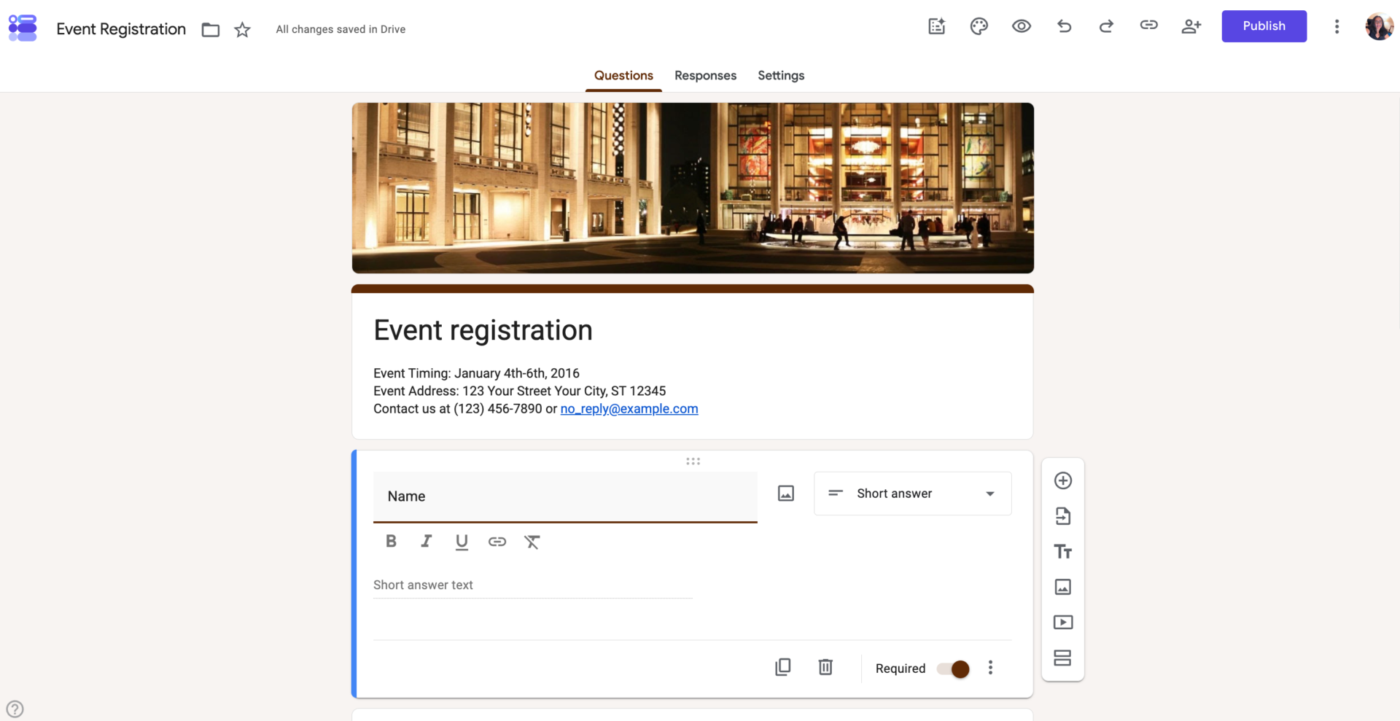
Google Forms is the free form builder most teams already have sitting in their Drive. You build it in a browser tab, share a link, and watch answers pile up in a spreadsheet. It’s best for schools, nonprofits, and small teams that want a form out the door in ten minutes.
The switch costs you about five minutes of relearning. What changes is who gets to use it. Microsoft holds its higher ceilings behind a work or school account. Free personal accounts stop at 200 responses per form. Google Forms is free with any Google account, and answers land in Google Sheets in real time. That means you can sort, filter, and chase replies while the form is still open. And with Gemini, Google’s AI layer, building forms gets easier. For example, it offers a ‘Help me create’ prompt, AI question suggestions, response summarization, and more
The same form then goes out as an email, a short link, or raw HTML you paste into a website or blog, so a signup form can live on your landing page.
Note: Google Forms has no standalone G2 product profile. It’s rather part of the larger Google Workspace.
A Capterra user mentioned:
I like that you can create your own forms for others to fill out. Google Forms is extremely simple to use by the creator and the consumer. You can design and set up your surveys however you want to! It is amazing for collecting info and data among those who you have fill it out.
Where it taps out: Google Forms collects responses cleanly, but it stops at collection. Branded layouts, deeper conditional logic, payments, and reporting past a spreadsheet pivot all need another tool.
Best for: Teams that want a capable form builder at zero cost and are happy doing the analysis in Sheets.
Skip it if: The form is revenue work. Payments, e-signatures, and CRM handoffs all mean bolting on another tool.
Also Read: Google Forms Alternatives
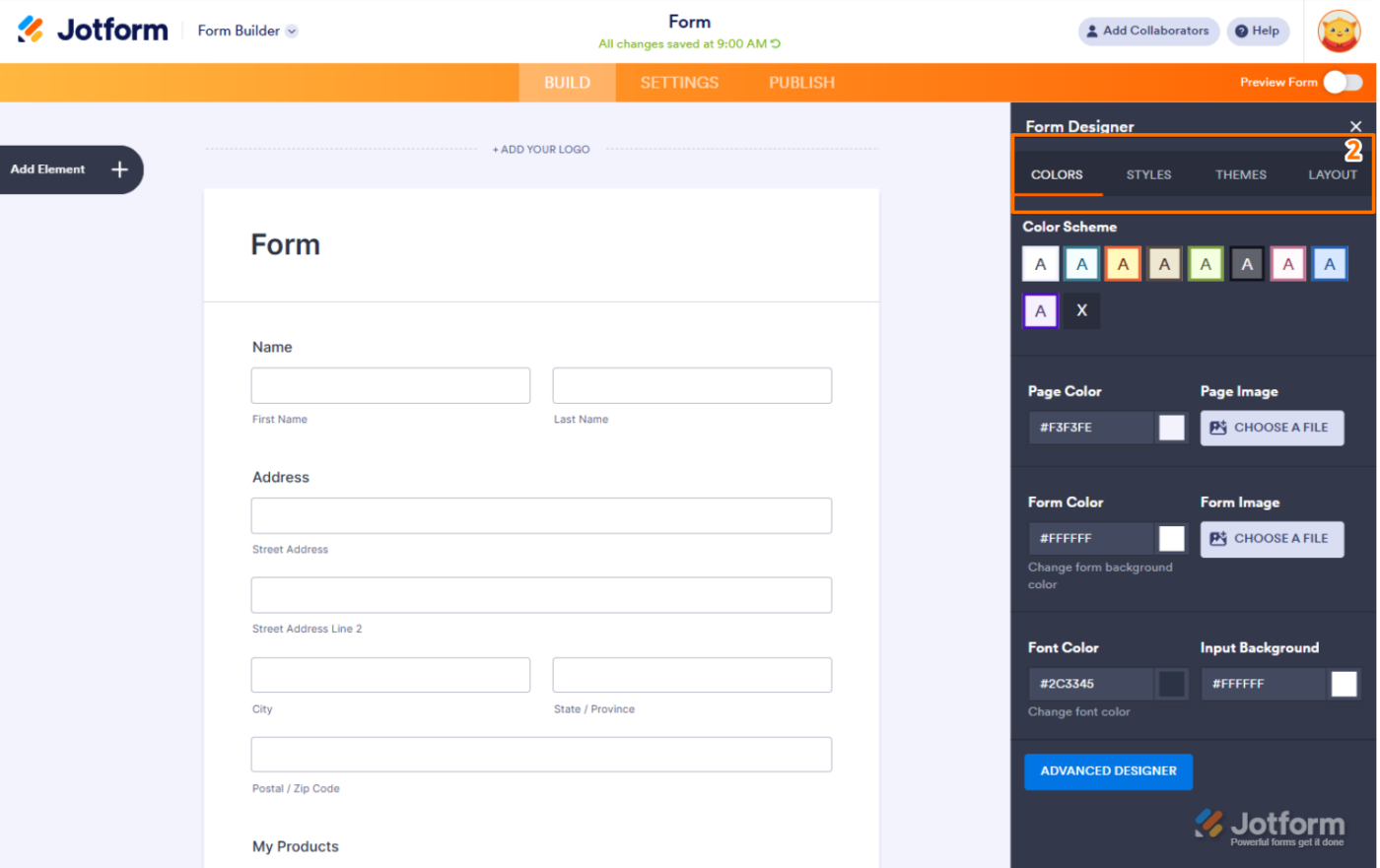
Jotform suits teams whose forms have to act on an answer, beyond just storing it. A single form can accept a card payment, capture a signature, and route the submission to the next approver. Forms can be translated into a second language or handed to a field rep to fill in on your behalf. It’s great for operations, events, healthcare, education, and client-facing teams running more than a handful of forms.
Jotform also connects to more than 40 payment gateways, including Stripe, PayPal, Square, and Authorize.net. So an event registration collects the fee at signup, a waiver collects the signature, and a client intake form lands in an approval queue.
Thousands of templates mean most common forms start half-built, and Jotform’s AI builder will draft one from a plain-English prompt. Submissions then land in Jotform Tables, where the team can filter, assign, and work responses like a shared database.
Note: Monthly submissions and stored submissions are two separate meters. The free Starter plan holds only 500 stored submissions across the whole account, and once it fills, Jotform deletes the oldest entry to make space for the next one. Export and clear old responses before you get near that line.
A G2 user said:
What I like best about Jot Form is how easy it is to use and how flexible it is. The drag-and-drop Builder Maker makes it simple to create professional-looking forms without any coding, and the wide range of templates, integrations, and automation features saves time and improves efficiency. It also offers reliable data collection and an intuitive overall user experience.
Where it taps out: Jotform builds capable customer-facing forms, but it meters almost everything. Forms, monthly submissions, stored responses, payment submissions, storage, and signed documents each have their own cap. Whichever one fills first sets your bill, so pick a plan based on your busiest month.
Best for: Teams charging money or collecting signatures inside the form, where the submission triggers real downstream work.
Skip it if: Your forms are internal and occasional. You don’t need to pay for workflow depth you won’t need.
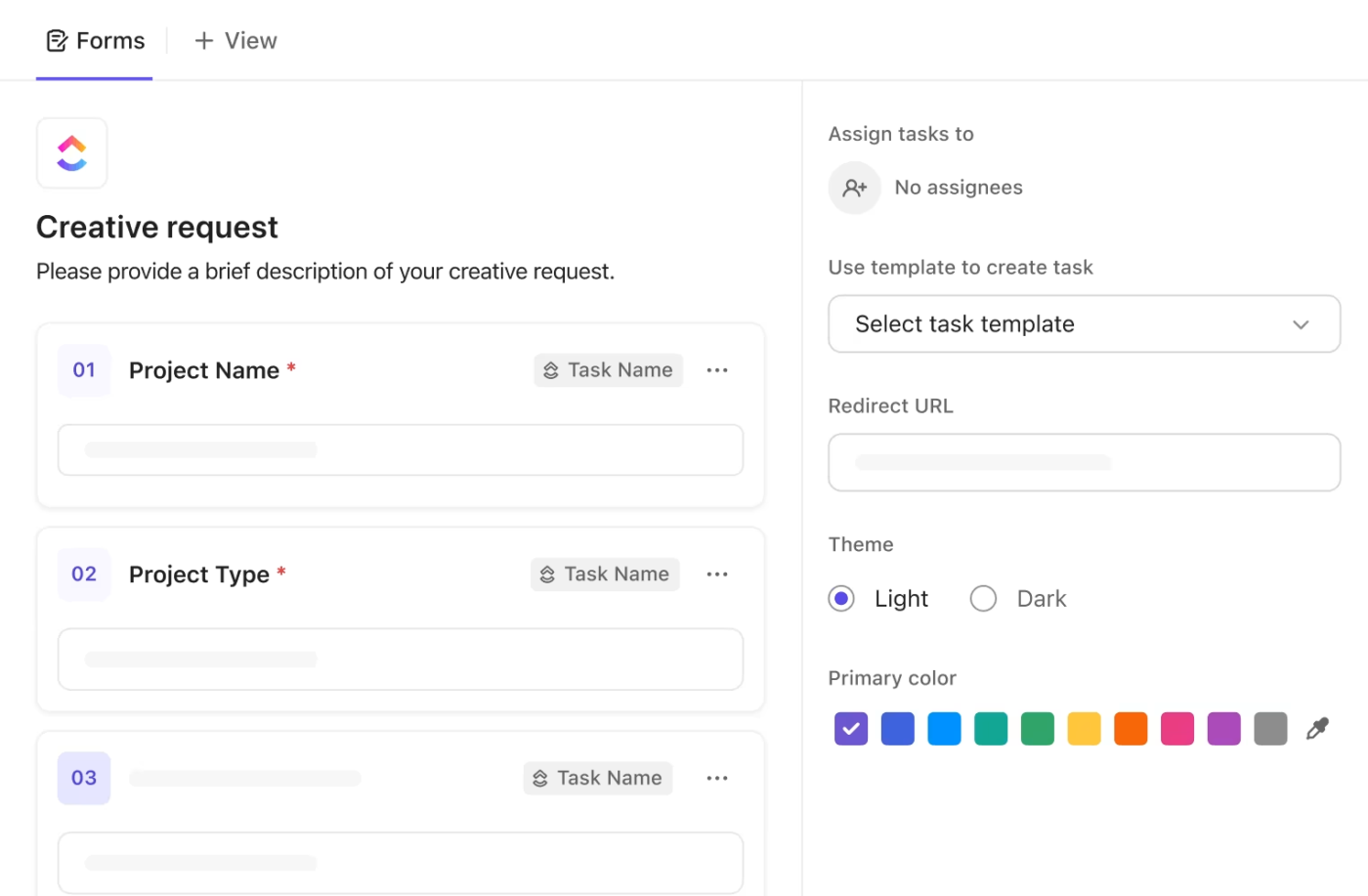
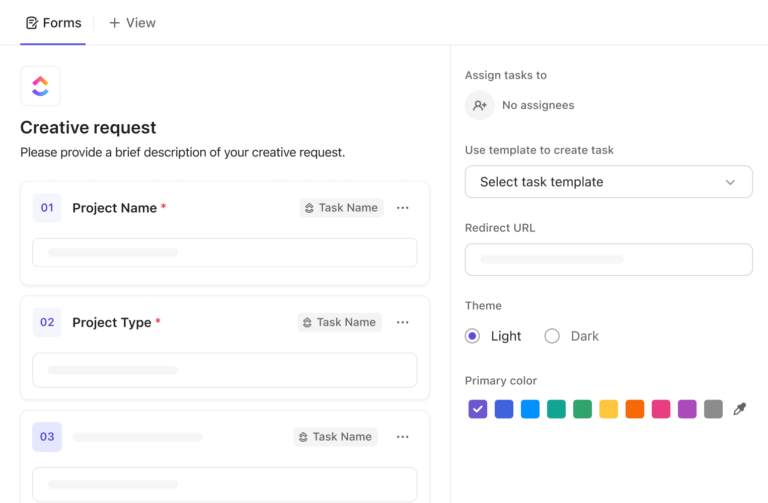
ClickUp Forms sit on a List inside ClickUp’s work management platform, and every submission opens as a task in a live workflow. Questions map to task fields, so an intake request arrives with its priority, budget, contact details, and files already attached. It works best for teams collecting requests that need follow-through.
Where most builders hand you a row in a spreadsheet, a ClickUp submission arrives with an owner, a status, and a due date. Conditional logic shortens the form for each respondent, and custom themes, cover images, redirect pages, and branded thank-you messages keep public forms on-brand. The Forms Hub keeps the library findable as it grows.
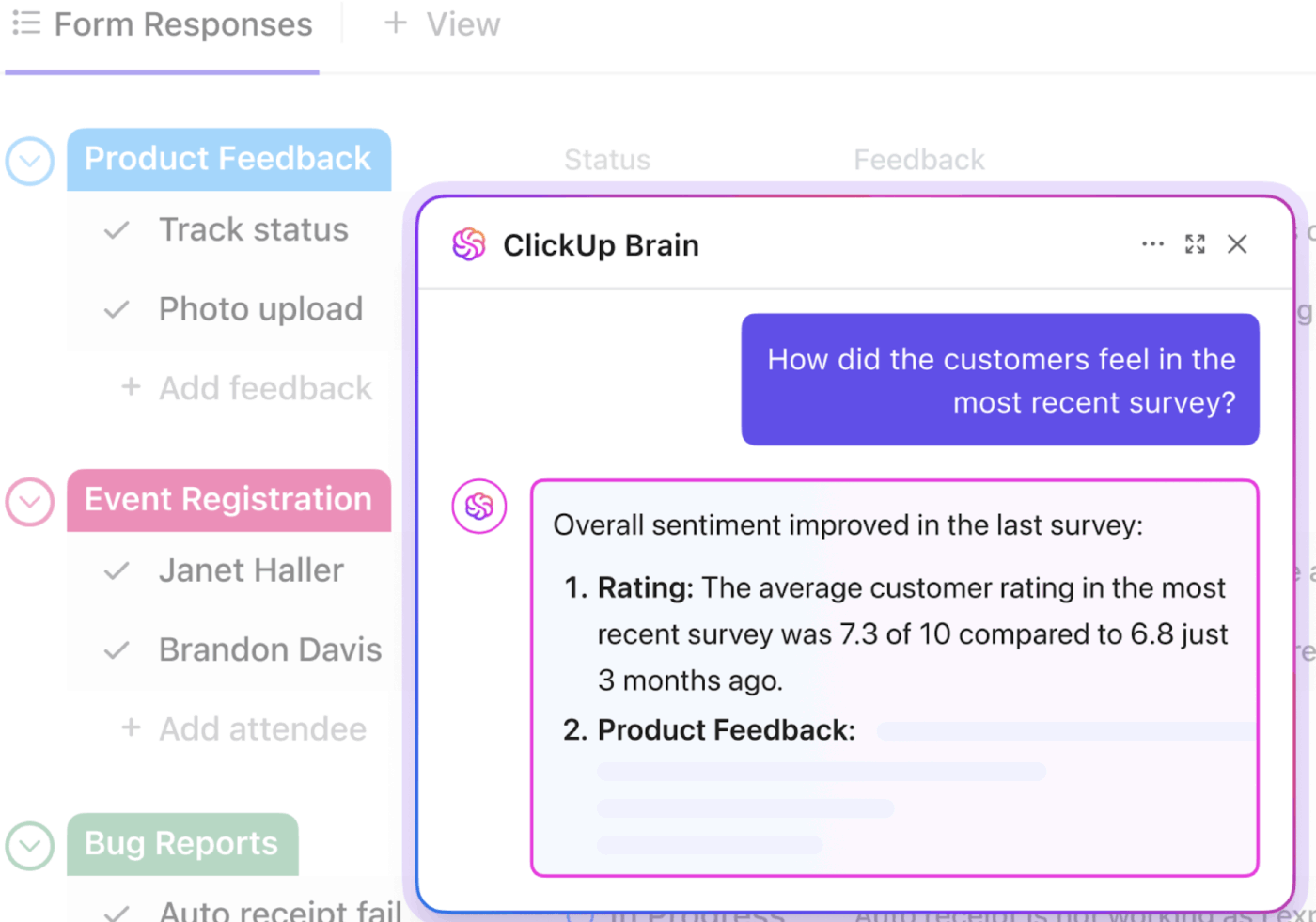
Once submissions stack up, ClickUp Brain can summarize a List, surface recurring complaints, or pull action items out of open-text answers. ClickUp Super Agents work the queue on rules you set, triaging and responding to new submissions as they land.
A G2 user described:
ClickUp has been instrumental for work management in our busy team. We can track tasks and also use its full suite of tools to actually get the work done—docs, forms, statuses, Kanban boards, AI agents, and more. Everything lives in ClickUp, which means we don’t need to rely on many outside tools anymore.
Where it taps out: ClickUp is a work platform with a built-in form builder. It’s not a dedicated survey product. Plus, it takes more setup than Google Forms or Tally.
Best for: Request intake and service queues where every response needs an assigned owner and tracked work.
Skip it if: You want a quick anonymous poll with nothing to manage after the last response lands.
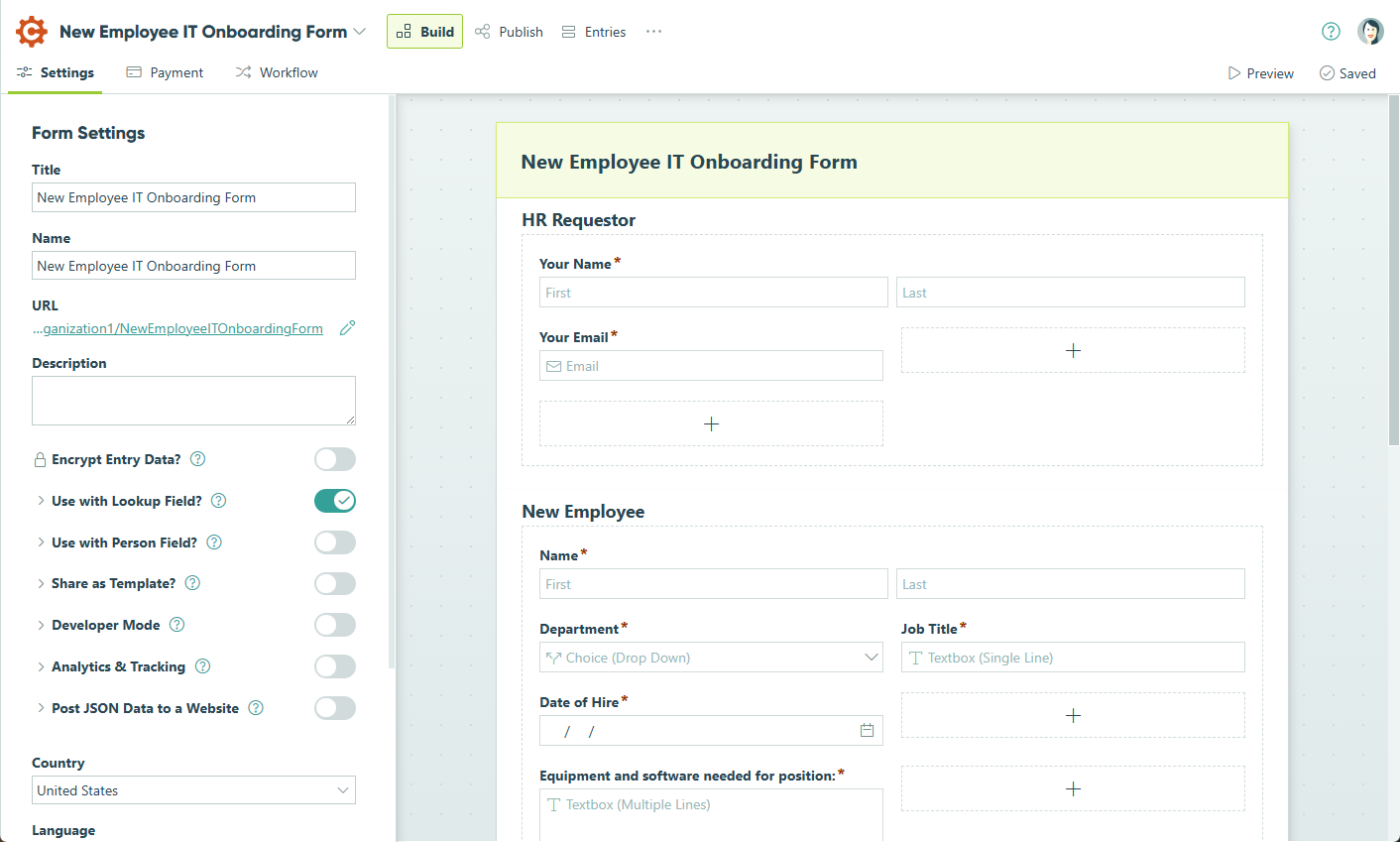
Cognito Forms is a form builder for teams that need calculations built directly into the form. Microsoft Forms can branch to another question or end the survey based on an answer. Cognito Forms prices the order, adds up the line items, and repeats a section for each extra guest. It’s ideal for finance, operations, and other teams that handle forms with numbers.
That depth pays off in the forms that usually take the longest to build. A catering order updates its total as quantities change. A sign-up form adds another guest block on demand instead of forcing five separate entries. Put simply, each one saves somebody a spreadsheet and a follow-up email.
Cognito Forms also writes the paperwork at the end. Entries merge into a branded PDF, so an invoice, contract, or signed form lands ready to file.
A G2 user said:
I use Cognito Forms primarily for work and my arts-based community projects. It handles a variety of tasks for our small nonprofit, including expense forms, invoices, grant trackers, community surveys, volunteer sign-ups, and event registration. I appreciate its form-building capabilities which offer more customization than other software but are not overly complicated.
Where it taps out: Workflow tasks, lookups, and the client portal start on the Team plan, while HIPAA compliance, folder permissions, and single sign-on are Enterprise-only, so a small regulated team pays $129/month to get compliant.
Best for: Forms where the total, the quote, or the line items have to be right at submission time.
Skip it if: Nothing on your form needs calculating. The logic engine you own is the whole value.
An unlimited response allowance sounds generous right up until the wrong people find the form.
One online research project had 4,453 people consent and continue into the survey. The researchers then stripped out bots, speeders, and other junk entries. What they had left were 711 usable responses.
So the response cap deserves less weight than it usually gets. On public surveys, giveaways, and paid research, the number that decides your data quality is a different one: duplicate blocking, identity checks, CAPTCHA, response-time flags, and fraud detection.
A plan that accepts 10,000 responses and leaves you cleaning 8,000 of them has moved the cost off your subscription and onto your team.
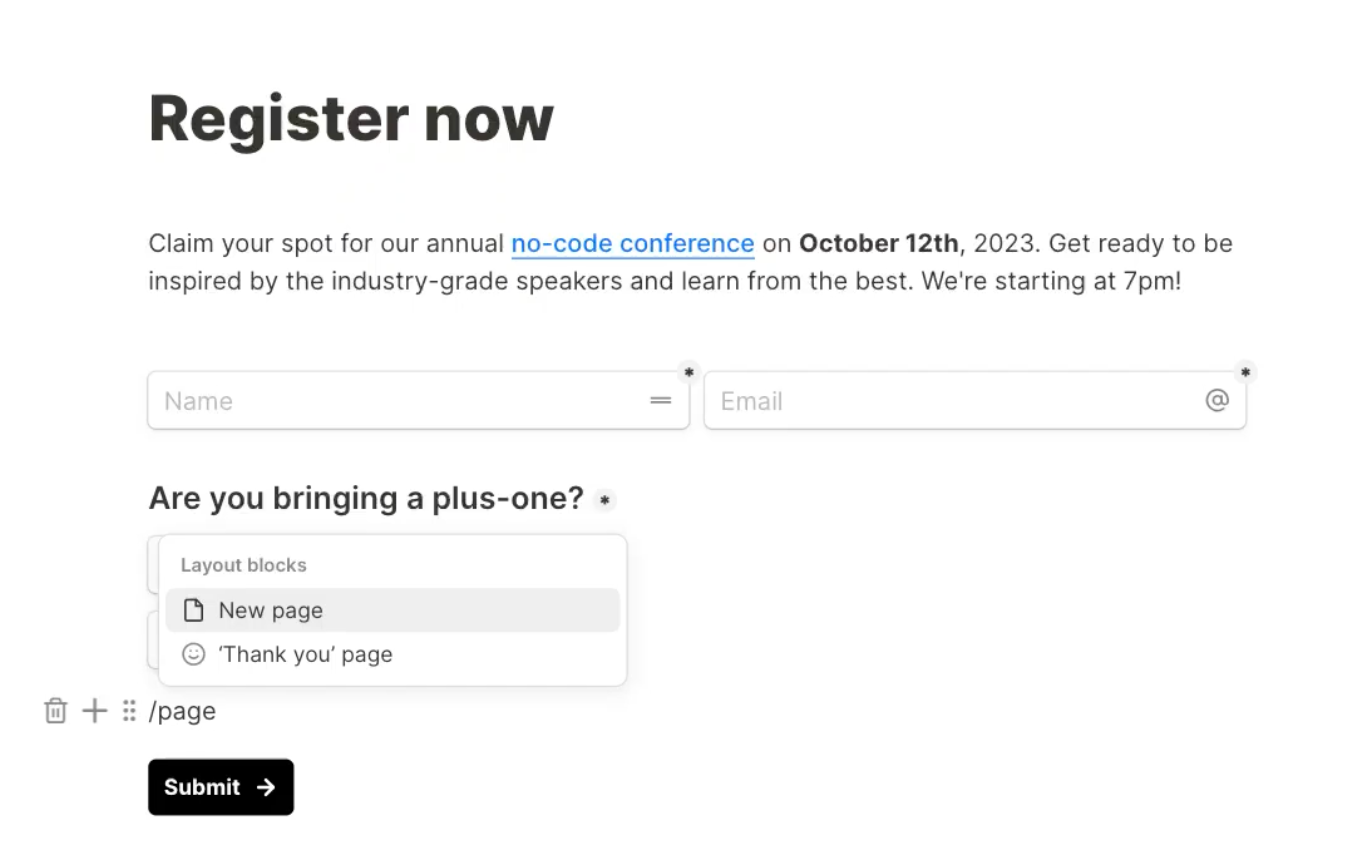
Tally is a form builder that gives away almost everything and charges only for the finish. Its free plan doesn’t cap forms or submissions, as long as you stay inside its published fair-use guidelines. Logic, math fields, e-signatures, payments, and file uploads all come with it. So do answer piping, password protection, duplicate-response blocking, and an auto-close when a form hits a date or a response limit. It’s perfect for founders, creators, charities, and teachers who pay close attention to the budget.
Building one feels like writing a doc. You type your copy, then hit slash to drop in a question, a page break, an image, or an input block, so the finished form reads like something a person wrote. Tally AI will draft, translate, or rebrand a form from a plain-language prompt when you’d rather skip the empty page.
Where the data sits matters too. Tally is built and hosted in the EU, with submissions stored in Europe, which helps teams that have to keep data inside the region.
A G2 user claimed:
Tally.so is a minimalist, no-code form builder that feels a lot like working in a text editor. What makes it stand out is how quickly you can create polished, professional-looking forms using simple slash commands. The setup is genuinely fast and straightforward. Unlike many competitors, it gives you unlimited forms and responses for free, and it still includes advanced options such as conditional logic and payment collection.
Where it taps out: Tally handles collection generously and keeps the polish behind higher tiers, where custom domains, partial submissions, drop-off analytics, folders, and version history all live. So a company that needs SSO, granular roles, and audit trails will need to look for other options.
Best for: High-volume registrations, lead forms, applications, and surveys where budget is tight but logic and design still matter.
Skip it if: You need advanced research analytics, mature enterprise administration, or a deep built-in reporting suite.
If routing submissions after they arrive is your real bottleneck, this walkthrough shows how to automate intake, assignment, and follow-up:
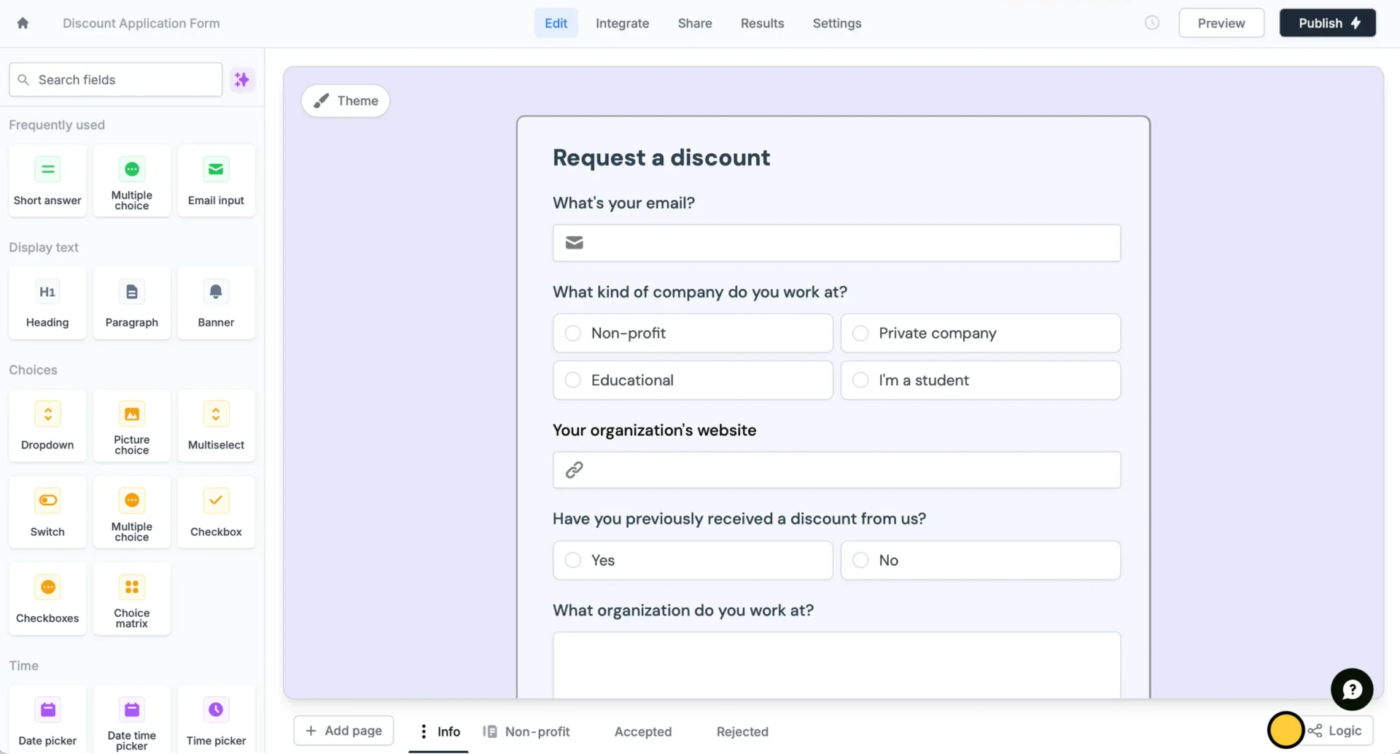
Fillout is an online form builder for teams that keep their records in another system. If your data lives in Airtable, Salesforce, Google Sheets, or Notion, Fillout writes each submission straight into it, so nothing sits in a second place waiting to be synced. It’s a good choice for teams already running on a database.
Fillout reads from your database and writes to it. Point a question at an Airtable base or a Salesforce object, and it pulls in the matching row. The person sees what you already have on file, and their edits save onto that same record. So a client can check their address and correct one line, or a sales rep can update an existing opportunity instead of creating a second one.
Scheduling and payments are built in, too, so a booking page or checkout step can sit inside the same form. Fillout also keeps its own copy of every response, which helps when someone needs an answer before the sync runs.
A G2 user mentioned:
Fillout’s integrations with Airtable and Notion are top-notch. I use it to create complex workflows and forms for my clients and am consistently impressed with the functionality.
Where it taps out: Fillout makes the most sense when there is already a database behind the form. Teams that only need a basic survey may find the integration depth unnecessary.
Best for: Client intake, CRM updates, application workflows, and forms that must read from or write to an existing database.
Skip it if: You want a self-contained survey tool and have no external system where the responses need to live.
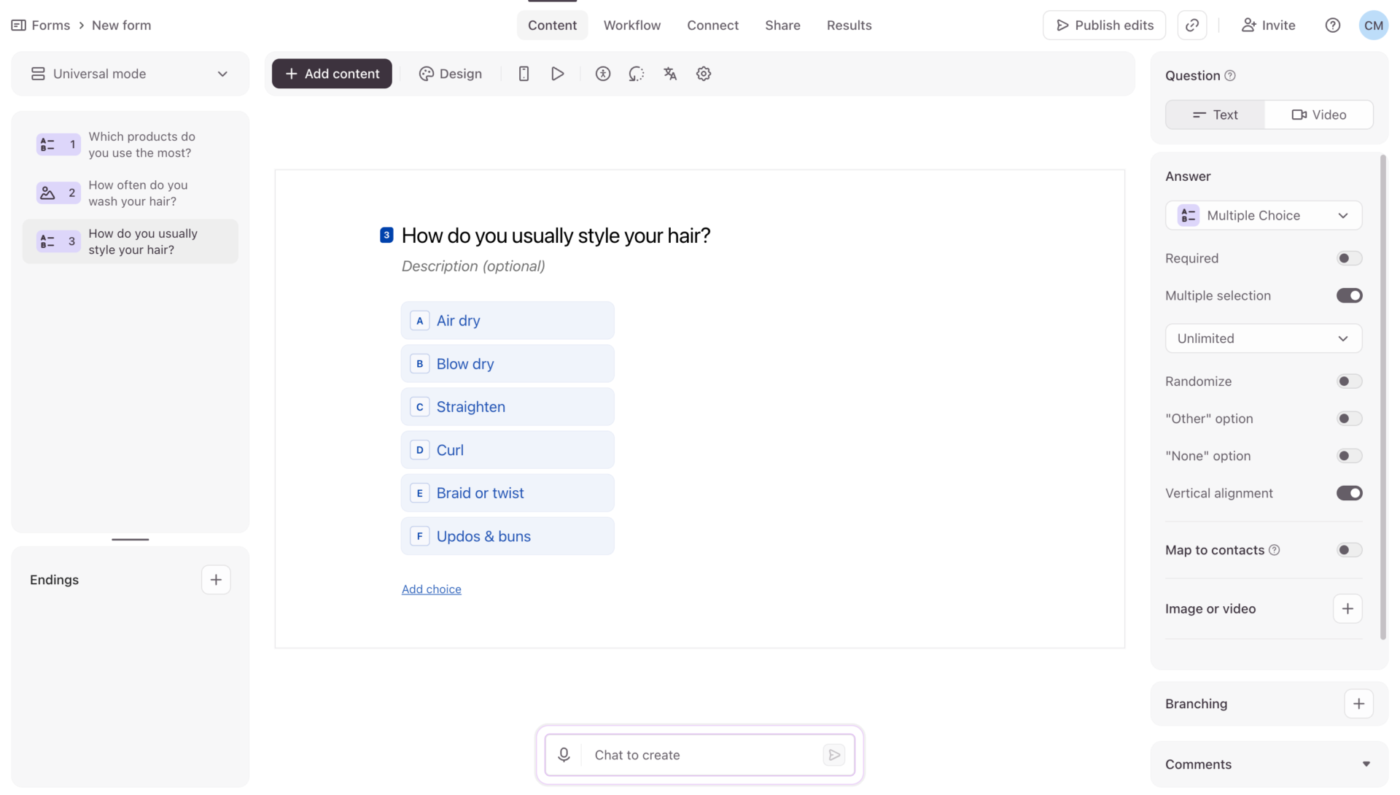
Typeform is an online form builder that shows one question per screen. While traditional builders stack every field on a single page, this one moves through them like a conversation. This format lowers the dread and improves completion rates on public forms. Marketing, recruiting, and CX teams use it for lead capture, product quizzes, customer surveys, and applications, where the audience has no obligation to finish.
That care shows up in what the form can do mid-flow. Recall pulls someone’s earlier answer into a later question by name, while variables and scoring tally responses as they go. Video questions and Stripe payments sit in the same builder as well.
A higher tier adds question-by-question insights, which pinpoint the exact prompt where people bail. Conversion tracking then ties form performance back to the campaign that drove the traffic.
Note: Typeform’s AI works at both ends of a form. Clarify with AI can ask up to two follow-ups when an open-text answer is too thin, and Smart Insights reads results for themes, sentiment, and correlations. Neither is standard on the core self-serve plans: Clarify and Smart Insights sit on Growth Flow.
A G2 user said:
What stands out to me is how professional the forms look without spending much time on design. As someone who works on graphic design, websites, and interior design projects, I often need to collect project details before starting work. The conversational layout feels less overwhelming than traditional forms, so clients are more likely to complete every question. I also like the flexibility to add logic, customize branding, and embed forms directly into websites, which keeps the whole process organized.
Where it taps out: Typeform’s polished flow comes with more friction behind the scenes. Complex forms can take time to build, and the one-question-at-a-time format is not always the fastest choice for long applications or data-heavy forms.
Best for: Public-facing forms aimed at people with no obligation to finish, where a few hundred good responses beat thousands of abandoned ones.
Skip it if: You need high response volume, dense multi-field forms, or advanced workflows at a lower cost.
Also Read: Typeform Alternatives
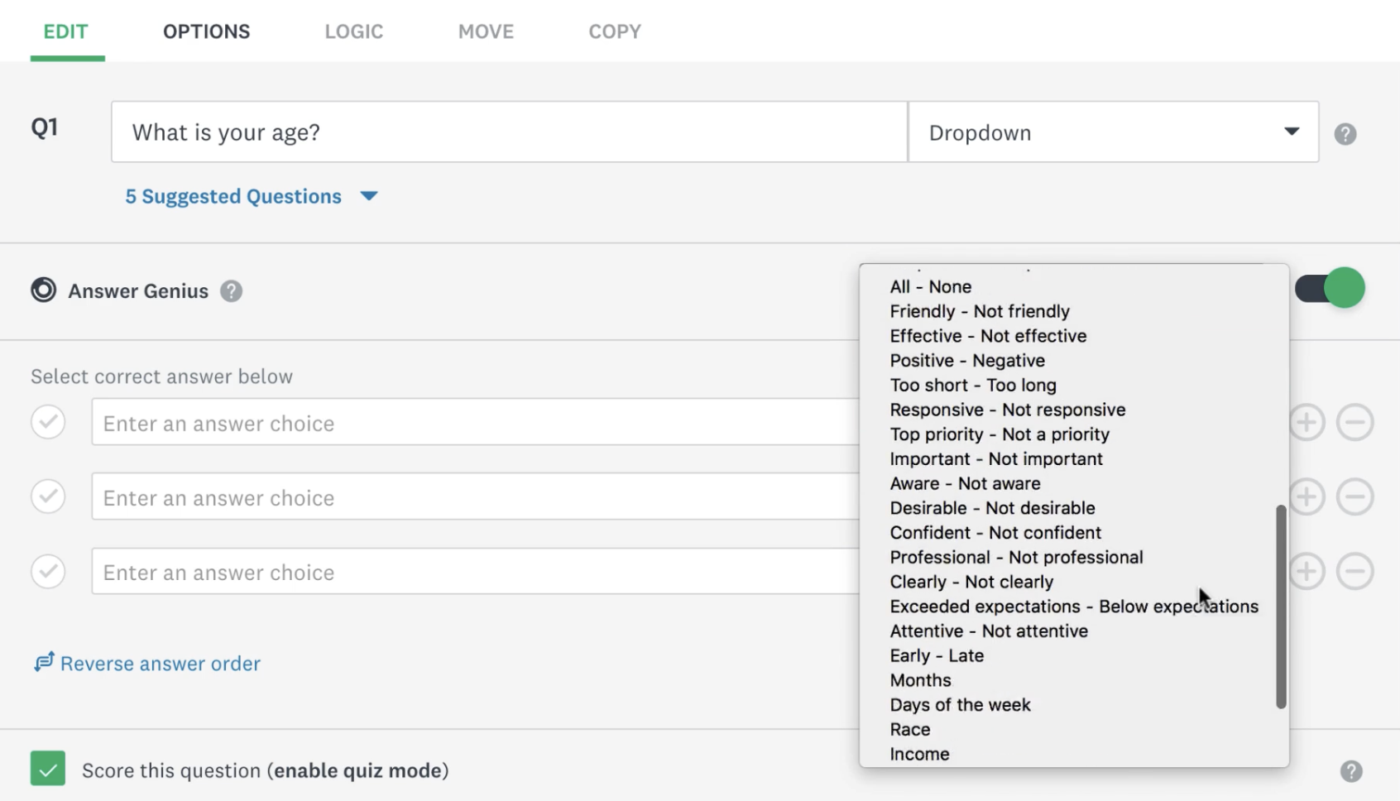
SurveyMonkey is primarily a survey platform built around research methods more than form design. Its Question Bank holds hundreds of questions written and certified by in-house survey methodologists, which keeps wording bias out of a study before it ships.
Plus, the template library covers the studies teams run time and time again: customer happiness, staff engagement, product testing, and market research. Insights, CX, and HR teams pick it when a result has to hold up in front of a stakeholder who will question the wording.
Reach is the bigger draw. SurveyMonkey Audience sells access to a panel of more than 335 million people across 130+ countries, with 200+ targeting options. You can screen by age, region, job function, or gender, then hear from people who have never seen your mailing list.
A G2 user mentioned:
What I like best about SurveyMonkey is how simple and user-friendly it is. It makes it easy to create professional-looking surveys, customize questions, and share them with others without needing any technical knowledge. The results are also presented clearly, which makes it convenient to understand responses and gather useful feedback quickly.
Where it taps out: SurveyMonkey carries more research depth than most teams need for a simple registration or internal poll. Its free plan is restrictive (the individual plan is capped at ten questions per survey), and paid plans can feel expensive when only one person needs advanced analysis.
Best for: Market research, employee studies, customer experience tracking, and recurring surveys that need segmentation or external respondents.
Skip it if: You only need a basic form, expect high response volume on a small budget, or want advanced features without an annual plan.
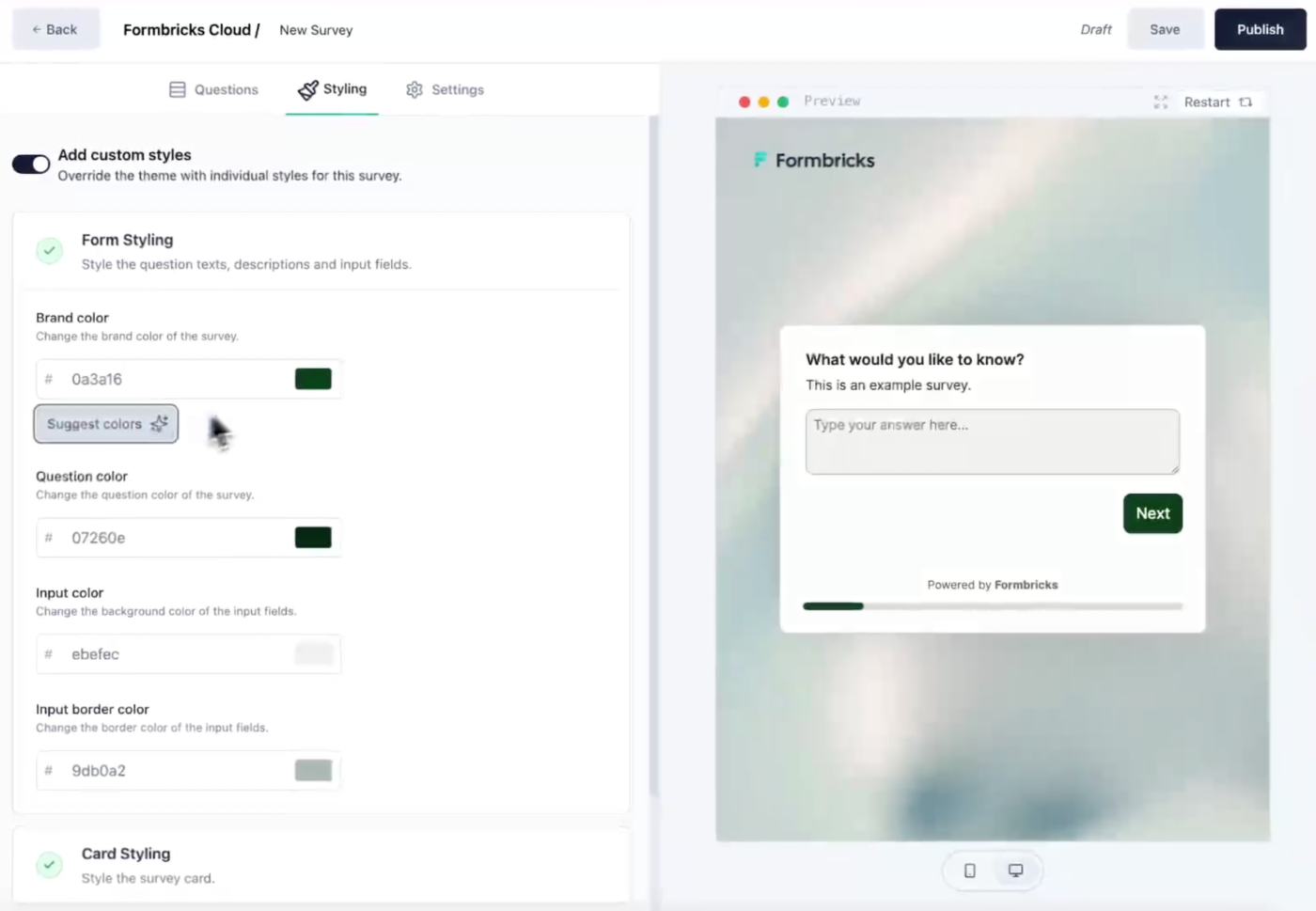
Formbricks is an open-source survey platform you can run on your own servers. The core code is AGPLv3 on GitHub. Responses, user attributes, and uploaded files stay inside the infrastructure your team owns. And teams that would rather not run servers can use Formbricks Cloud, hosted in Frankfurt. Regulated teams choose it when survey data can’t sit with a third-party vendor.
The other draw is where the survey shows up. Formbricks runs link surveys, website pop-ups, and in-app surveys. Each one targets people by user attributes, device data, and recent behavior. A product team can ask about a feature right after someone uses it, or survey only the group that hit a milestone last week.
Reusable segments keep those groups steady, which matters when you track the same cohort quarter after quarter.
A G2 user described:
What I really like about Formbricks is how easy it is to integrate. Whether you’re using a no-code option or an SDK like React, the setup is quick and smooth. Plus, the platform is totally privacy-focused, fully compliant with GDPR and CCPA, and if you prefer, you can self-host it, which is awesome. I also love how customizable everything is—you can really tweak the design and branding of your surveys. Another big plus is that it’s open-source, so most features are free, and there’s a strong community backing it.
Where it taps out: Self-hosting moves costs from the software bill to the engineering team. Your organization owns uptime, upgrades, security patches, storage, and recovery. The managed cloud plans also become expensive quickly once you need larger response allowances, governance, or advanced feedback analysis.
Best for: Self-hosted surveys, controlled data residency, in-product feedback, and regulated research workflows.
Skip it if: No one on the team wants to maintain infrastructure, or you only need a quick internal form with no product integration.
The Microsoft Forms alternative you choose boils down to what happens after someone hits submit. Every tool here builds a form and collects a response. The differences only show up downstream, in whether the answer becomes a payment, a task, a record, or a finding.
The costliest mistake when replacing Microsoft Forms is budgeting against an average month. The other four: assuming a cap only warns you, treating “free” as one standard, forgetting seat minimums, and testing on a form you’d never actually send.
Did You Know? Where an answer appears can matter almost as much as what it says. In one survey analysis, 57% of respondents selected the response shown first, compared with 42% for the response shown last. Randomizing answer choices can prevent the top option from winning simply because it was seen first.
Tally has the best free plan of any Microsoft Forms alternative. It’s the only tool here with no cap on forms or responses, and it includes conditional logic, calculations, payments, e-signatures, and file uploads at no cost. Fillout is the runner-up (1,000 responses a month, unlimited seats). Typeform’s is the weakest, capped at roughly ten responses a month across the entire account.
Here’s how the free plans compare across all nine Microsoft Forms alternatives covered in this guide.
| Tool | What you get for free | Limit caps |
|---|---|---|
| Google Forms | Forms, quizzes, branching, response validation, file uploads, response charts, and Google Sheets exports | Google doesn’t publish a plan-level response cap for Forms. In practice, the ceiling is Google Sheets’ 10-million-cell limit on the linked response sheet, plus your Drive storage |
| Jotform | Five forms, 100 monthly submissions, ten payment submissions, ten signed documents, 100 MB of storage, 10,000 monthly form views, and 500 stored submissions | Limits apply across the whole account. Hitting the form, submission, storage, payment, or signature allowance can disable all forms until the next reset or an upgrade |
| ClickUp | One Form, unlimited submissions, task creation from responses, and custom field mapping | Free Forever covers one Form with unlimited submissions and task creation. Sharing, embedding, conditional logic, hidden fields, and authenticated Forms start on Unlimited at $7/user/month.” |
| Cognito Forms | Unlimited forms, payment collection, calculations, conditional logic, 100 entries per month, and one user, | The account is limited to one user and 100 monthly entries. Electronic signatures, Save and Resume, branding removal, and additional users require a paid plan |
| Tally | Unlimited forms and submissions, conditional logic, calculations, payments, signatures, uploads, answer piping, password protection, integrations, and webhooks | Usage remains subject to Tally’s fair-use rules (e.g., 50,000 submissions/month or 100 GB of uploads/month trigger outreach). Removing Tally branding, using custom domains, saving partial submissions, and accessing advanced team controls require a paid plan |
| Fillout | Unlimited forms and seats, 1,000 responses per month, conditional logic, calculations, scheduling, payments, file uploads, and PDF tools | Redirects, branding removal, CAPTCHA, custom domains, advanced analytics, and some administrative controls require an upgrade |
| Typeform | Unlimited forms, ten questions per form, basic branching, custom endings, embeds, notifications, and spreadsheet exports | Typeform’s free plan is capped at roughly ten responses per month across all forms, with ten questions per form. Advanced logic, hidden fields, and branding removal require a paid plan |
| SurveyMonkey | Unlimited surveys, common question types, templates, AI-assisted creation, and thematic analysis | Each survey can contain only ten questions, and no file uploads |
| Formbricks | One workspace, 250 monthly responses, link and in-product surveys, conditional logic, hidden fields, partial responses, uploads, single-use links, and full API access | Respondent identification, segmentation, integrations, and team collaboration require higher tiers |
Two plans can have similar response caps and fail in completely different ways.
Typeform counts responses across every form in your account. Hit the monthly allowance, and all your forms become private until the counter resets or you upgrade. Jotform’s free plan can keep accepting entries after its 500-submission storage fills. But it removes the oldest stored response to make room for each new one.
So don’t only ask how many responses a plan includes. Ask what happens to the next respondent, whether older data remains accessible, whether the cap applies per form or per account, and whether deleting entries restores capacity.
Microsoft Forms doesn’t offer a way to export a form’s structure that another builder can import directly. You can export responses to Excel, but the form itself, its questions, branching rules, and settings, need to be rebuilt in the new tool.
List the parts that affect how it works:
This is also a good time to remove questions you no longer need.
Open the form, go to Responses, and select either Open results in Excel (live sync to Excel for the web) or download a copy (a static .xlsx file).
For a migration archive, download a copy so it stays independent of the original form. Save a dated version before changing anything.
Keep in mind that uploaded files are stored separately in OneDrive (for personal forms) or SharePoint (for group forms) and don’t move with the spreadsheet. Download or relocate anything you still need before decommissioning the form.
Recreate the questions first, then add logic, calculations, scoring, branding, and integrations.
Choose the replacement based on the job:
Submit several test responses and check every branch, notification, redirect, calculation, and automation.
Also, confirm where the data lands. A form can look correct while still creating incomplete records or sending responses to the wrong place.
Update website embeds, emails, QR codes, documents, help pages, and automations that still point to Microsoft Forms.
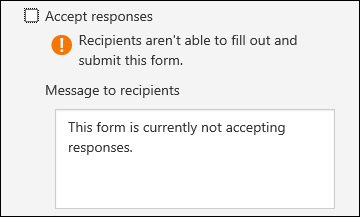
Keep the old form open during the transition. Once the new one is working, go to Settings (⋯ menu) and uncheck Accept responses. Add a custom message directing people to the replacement.
Don’t delete the Microsoft form immediately. Keep it and the Excel export as an archive until you’re sure the migration is complete.
If you’re inside Microsoft 365 and your forms are simple internal surveys, staying put is a legitimate answer. Nothing on this list changes that.
The switch makes sense when a form has become the front door to a process, and the limits of Microsoft Forms are showing. At that point, the question changes to where the response goes and who’s accountable for it.
Most form builders stop at collection. The response lands, and then someone has to move it somewhere else, assign it, and chase it. If that hand-off is where your process breaks, you want a tool where the form and the workflow live in the same place.
Get started with ClickUp for free and connect your forms to ongoing work.
Yes. A free personal Microsoft account supports basic forms and forward-only branching, but caps each form at 200 responses and lacks the organizational permissions and identity controls available to work and school accounts.
Microsoft 365 work/school accounts allow up to 5,000,000 responses per form (variable by license type). Free personal Microsoft accounts stop at 200 responses per form. If you keep hitting the personal-account ceiling, Tally’s free plan doesn’t cap submissions within its fair-use guidelines, and Google Forms publishes no plan-level response cap. Neither is truly infinite, so check the fair-use terms and your storage before a large campaign.
Usually, yes, if routing depends on the answers. Microsoft Forms handles collection and basic notifications, but conditional assignment and approvals generally require Power Automate.
That may not mean an extra subscription. Basic flows can be included with Microsoft 365, while premium connectors may cost more. Some alternatives keep this inside the product. ClickUp can turn submissions into assigned tasks, Jotform supports approval workflows, and Cognito Forms handles roles, statuses, and approval stages.
Microsoft Forms inherits Microsoft 365 tenant security, including encryption and admin controls, which covers most internal use. It doesn’t offer self-hosting, regional data residency choices, or a business associate agreement on personal accounts. Regulated teams typically move to Formbricks self-hosted, Tally’s EU-hosted infrastructure, or a HIPAA-enabled Jotform plan depending on the requirement.
Branching in Microsoft Forms is single-condition only: “If answer to Q3 equals X, go to section Y.” You can’t combine conditions (e.g., “if Q3 = X AND Q5 > 10”). Cognito Forms, Jotform, and Typeform all support multi-condition logic with AND/OR operators.
Mostly yes, but through integrations rather than natively. Google Forms, Jotform, Tally, and Fillout all export to Excel or sync via Zapier and Make, and several offer direct Teams notifications. What you give up is the automatic OneDrive and SharePoint file handling that Microsoft Forms does silently. If your workflows depend on Power Automate flows already wired to SharePoint lists, budget rebuild time for those, not just the form.
Formbricks offers a self-hosted Community Edition under AGPLv3, so responses never leave your infrastructure. Cognito Forms also offers entry encryption, though it’s still cloud-hosted.
No. Microsoft Forms is an active part of Microsoft 365 and continues to receive updates, including Copilot-assisted form building. Microsoft has retired individual features over time, but the product itself remains supported. Teams usually leave for capability reasons (payments, deep logic, workflow) rather than any end-of-life risk.
Google Forms, for most classrooms. Quiz mode with answer keys and point values; grades on submit. It’s free with any Google account, and it plugs into Classroom without a license conversation. Microsoft Forms is competitive if the school already runs Office 365 Education, since education accounts get higher response ceilings than personal ones. Tally works for schools that need unlimited responses without any ecosystem tie.

Manasi Nair
Max 30min read
Manasi Nair
Max 28min read
Manasi Nair
Max 26min read

© 2026 ClickUp





