

As employees seek more value and growth opportunities in workplaces, their primary focus is on accountability and ownership. So, many organizations are also adopting the laissez-faire leadership style to promote autonomy at work and increase job satisfaction.
The Laissez-faire leadership style is derived from the French term ‘Laissez-faire,’ which means ‘let do’ or ‘let it be.’ It follows a non-interference approach where leaders take a step back, allowing their teams to navigate their work independently.
You provide minimal guidance and little direction, allowing your team members to make decisions and solve problems independently. This leadership philosophy is all about delegating tasks, trusting your team, and enabling ownership.
But is it as simple as sitting back and relying on your team to get things done? How does it help? In this blog, we’ll cover the potential benefits, drawbacks, and best practices of the laissez-faire leadership style.
10 Benefits of a Laissez Faire Leadership Style
- Key Characteristics of Laissez-Faire Leadership
- Benefits of Using a Laissez-Faire Leadership Style
- 1. Fuels innovation and creativity
- 2. Boosts job satisfaction and employee engagement
- 3. Promotes leadership development
- 4. Enhances problem-solving skills
- 5. Strengthens team cohesion and collaboration
- 6. Increases flexibility and agility
- 7. Reduces micromanagement and improves efficiency
- 8. Attracts and retains top talent
- 9. Promotes a culture of accountability
- 10. Optimizes resource allocation
- Laissez-Faire Leadership Examples
- Limitations of Laissez-Faire Leadership
- When to Use or Avoid Laissez-Faire Leadership
- Laissez-Faire Leadership Best Practices

 Summarize this article for me please
Key Characteristics of Laissez-Faire Leadership
Compared to other leadership styles, Laissez-faire leadership may come across as leaders shrugging their responsibilities off or being disengaged. However, it can lead to exceptional outcomes when applied in the right context. Here are the key traits that define a laissez-faire leader:
1. Autonomy and freedom
Successful laissez-faire leaders give freedom to their team members to make their own decisions, set their own deadlines, and find their unique paths to success without a rigid approval process. They promote a sense of ownership and responsibility. This level of autonomy increases job satisfaction and enhances productivity.
According to a Harvard Business Review study, employees with autonomy over their work are more likely to be innovative and creative.
3M’s 15% Culture is an excellent example of how laissez-faire leadership works. The company encourages its employees to set aside 15% of their time at work for innovation. Employees can experiment with new technology, create interest groups, and work on creative ideas to build innovative solutions and challenge the status quo
2. Trust
Laissez-faire leaders follow a delegative leadership style. They’re not afraid to hand over the reins and let their team steer the ship, building a culture of immense trust and high employee engagement.
A study by Gallup found that employees who feel trusted by their managers are more likely to be engaged and productive.
3. Minimal supervision
Laissez-faire leaders avoid frequent check-ins with their team. They offer support only when necessary. This minimal supervision helps team members develop problem-solving skills and reduces the stifling effects of micromanagement.
4. Open communication
Effective laissez-faire leadership requires open and honest communication. Leaders set clear expectations, provide necessary resources, share constructive criticism, and create a space where group members feel comfortable seeking guidance when needed.
In essence, laissez-faire leaders are more like mentors than micromanagers. They believe in the potential of their team and provide team members with the environment to thrive.
Also Read: The best communication plan templates to use today
Summarize this article for me pleaseBenefits of Using a Laissez-Faire Leadership Style
Laissez-faire leadership is more than just stepping back and letting your team handle things—it’s about promoting an environment where creativity, innovation, and personal growth can flourish. Let’s explore some of the advantages of this hands-off leadership style.
1. Fuels innovation and creativity
A laissez-faire leadership style creates an innovation culture. It fuels creativity as employees can explore new ideas without constant oversight. It is particularly helpful in industries like tech and design, where innovation is key to staying competitive.
Pixar is a prime example of how laissez-faire leadership enables building successful enterprises. The company focuses on empowering creatives—giving project control to creative people instead of corporate executives.
2. Boosts job satisfaction and employee engagement
Job satisfaction often soars under a laissez-faire leader because employees are trusted to take ownership of their work.
According to research by PwC, employees who have work autonomy have stronger job performance, higher job satisfaction, and greater commitment to the organization. In fact, almost 50% of employees are also willing to sacrifice a 20% raise to have better autonomy over work.
3. Promotes leadership development
When employees have the liberty to make decisions and resolve problems, they inevitably learn how to navigate challenges and become more confident. In a laissez-faire environment, employees often step up to take on informal leadership roles within their areas of expertise. This natural development of leadership skills is invaluable for organizations that thrive on innovation.
4. Enhances problem-solving skills
Without a manager constantly directing every move, employees in laissez-faire settings think critically and develop problem-solving skills. This leads to more innovative solutions and prepares teams to handle challenges more effectively.
5. Strengthens team cohesion and collaboration
Laissez-faire leadership often results in stronger team cohesion, as members rely on each other for support and collaboration rather than on a central authority figure. This peer-driven approach promotes community and mutual respect, leading to more cohesive teams.
6. Increases flexibility and agility
A laissez-faire leadership strategy allows teams to pivot quickly and adapt to new challenges without waiting for managerial approval at every turn. This agility can be a significant competitive advantage, particularly in dynamic industries.
7. Reduces micromanagement and improves efficiency
Micromanagement is often cited as a major source of frustration for employees, leading to lower productivity and morale.
According to a survey, 71% of surveyed workers feel that micromanagement interferes with their job performance, and 85% feel that it negatively impacts their morale. Laissez-faire leadership, by its very nature, eliminates the need for micromanagement and encourages personal growth.
8. Attracts and retains top talent
Top performers crave autonomy and trust. Laissez-faire team leadership is a magnet for talented individuals who want to make a real impact. It offers a challenging environment and helps you build a high-performing team that sticks around.
9. Promotes a culture of accountability
Accountability naturally increases in a laissez-faire setting as team members take full responsibility for their work. This ownership encourages employees to deliver high-quality results, knowing their contributions directly impact the team’s success.
10. Optimizes resource allocation
When teams manage themselves, they can allocate resources more efficiently, as they have a clear understanding of what is needed to achieve their goals. This optimization reduces waste and ensures that resources are directed where they are most needed.
By embracing laissez-faire leadership, you’re not just managing a team; you’re cultivating a culture of high performance where everyone wins.
Summarize this article for me pleaseLaissez-Faire Leadership Examples
This style isn’t a one-size-fits-all solution. Here are some scenarios where it can be effective:
- Creative agencies: In advertising or design agencies, where creativity is key, laissez-faire leadership allows teams to explore bold ideas without the constraints of constant approval from higher-ups
- Research and development (R&D) departments: R&D teams often require the freedom to experiment with new concepts. Laissez-faire leadership provides the autonomy needed to innovate without the fear of immediate failure
- Tech startups: In a fast-paced tech environment, a hands-off approach can empower teams to develop new products or features quickly, responding to market demands more effectively
- Remote teams: With the rise of remote work, laissez-faire leadership can be highly effective. Teams working across different time zones can manage their schedules, focusing on outcomes rather than being micromanaged
Summarize this article for me pleaseLimitations of Laissez-Faire Leadership
While laissez-faire leadership offers numerous benefits, the lack of managerial direction may lead to poor performance and project failures.
- Lack of direction: Without clear guidance, some teams may struggle to stay on track, becoming confused and inefficient
- Potential for poor performance: In the absence of regular oversight, underperforming employees may go unnoticed, which can negatively impact the team’s overall productivity
- Inefficiency in low-skilled teams: This leadership style is less effective in teams that lack experience or motivation, as they may require more direction and support
- Communication breakdowns: With a decentralized approach, there is a risk of communication breakdown between teams, which leads to misunderstandings and misaligned goals
- Inconsistent decision-making: The lack of centralized decision-making can result in inconsistent strategies and actions across different parts of the organization
- Maintaining consistent standards: Without a strong guiding hand, it can be challenging to maintain consistent quality and standards across the team. This is particularly problematic in industries where precision and consistency are critical. Employees may prioritize different standards based on their judgment, leading to chaos
- Challenges in crisis: Laissez-faire leadership is often not feasible in crisis situations that require quick decision-making and strong direction. In such cases, the lack of active leadership can deepen the crisis, leading to delays in response and potentially worsening outcomes
Let’s understand this better with Spotify’s example. A few years ago, the company introduced the Spotify Squads framework. It created independent engineering teams of up to eight members to manage ideation, testing, and deployment. This framework focused on high autonomy but failed due to a lack of collaboration among teams. Working independently led to communication silos and a lack of knowledge sharing. Eventually, Spotify stopped using the framework.
Summarize this article for me pleaseWhen to Use or Avoid Laissez-Faire Leadership
So, are you ready to give laissez-faire leadership a shot? It is vital to know when to use this leadership style and when to avoid it. Let’s explore the scenarios where laissez-faire leadership shines and where it might fall short.
When to use laissez-faire leadership
- Your team is composed of seasoned pros: If your team is filled with experienced, self-motivated individuals who have role clarity, laissez-faire leadership can be highly effective because they can use their knowledge and experience to make strategic decisions
- In creative and innovative industries: When innovation is your top priority, loosen the reins. Laissez-faire leadership gives your team the freedom to experiment and think outside the box
- Speed is of the essence: Laissez-faire leadership can streamline decision-making and accelerate project timelines in fast-paced industries that require quick decision-making
- In stable, non-crisis situations: This leadership style is well-suited for stable environments where the team is performing routine tasks or when you have to follow a flexible, exploratory approach for managing projects. In these situations, the absence of constant oversight can lead to greater job satisfaction and a more relaxed, productive atmosphere
- When promoting a culture of accountability: Laissez-faire leadership can be particularly effective when the goal is to develop a strong sense of accountability within the team. By stepping back, leaders encourage team members to take full ownership of their work, which can lead to better personal responsibility and commitment
When to avoid laissez-faire leadership
- When leading inexperienced or low-skilled teams: Laissez-faire leadership is not effective when dealing with teams that lack experience or necessary skills. Without sufficient guidance, these teams may struggle to stay on track, leading to confusion, mistakes, and inefficiency
- In high-stakes or crisis: During crises or high-pressure situations where quick, decisive action is needed, laissez-faire leadership can be dangerous. The lack of active leadership and clear direction slows the response times and worsens the crisis
- When consistency and quality are critical: In industries where consistency and quality control are paramount—such as manufacturing, healthcare, or finance—a laissez-faire approach can lead to discrepancies and a decline in standards. Without a leader’s close oversight, maintaining consistent quality across the board becomes challenging
- When team dynamics are poor: If a team struggles with internal conflicts or low accountability and lacks strong interpersonal relationships, laissez-faire leadership can worsen these issues. The absence of a guiding leader to mediate and direct the team can lead to further fragmentation and reduced collaboration
Apply this management style in the right situations to promote an environment of innovation, accountability, and high job satisfaction.
Here’s a quick overview of when to apply the laissez-faire leadership style:
| Parameter | Apply Laissez-Faire Leadership | Avoid Laissez-Faire Leadership |
| Team experience | Seasoned professionals with high expertise and self-motivation | Inexperienced team members who require significant guidance |
| Task complexity | Simple tasks that do not require high-level skills | Complex tasks that require ongoing input and adjustments |
| Project urgency | Projects are not time-sensitive and have room for flexibility | High-stakes or time-sensitive projects |
| Performance monitoring | Performance can be effectively monitored through results and outcomes | Performance needs regular monitoring and feedback |
| Crisis | There’s no immediate crisis that requires expert inputs | A pressing issue has arisen that requires decisive and direct leadership |
Summarize this article for me pleaseLaissez-Faire Leadership Best Practices
Laissez-faire leadership isn’t about throwing your team into the deep end and hoping they can swim. It’s about creating an environment where they feel empowered, supported, and ultimately responsible for their success. But how do you achieve this delicate balance without micromanaging?
Here’s how the team at STANLEY Security tackled it with ClickUp as their partner.
Task management software like ClickUp can help you follow a hands-off approach, ensuring you stay updated with team progress without breathing down your employees’ necks.
Let’s see how you can leverage task management software to promote ownership and accountability within your team.
1. Set clear goals and expectations
While minimum intervention is great, your team should be aligned to achieve business objectives and facilitate growth. That’s why clear goal setting is crucial. Setting SMART goals promotes accountability and ensures your team stays in sync.
Try ClickUp Goals to set team objectives, define timelines, and automate progress tracking. Setting individual and team goals helps employees make strategic decisions and allocate resources. You can add unique descriptions and tags to goals to provide better context to employees.

2. Promote open communication
In a laissez-faire environment, transparent communication is vital to prevent misunderstandings and keep everyone on the same page. Regular updates, even if brief, help maintain momentum and provide opportunities for course correction without micromanagement.
ClickUp excels in this area with ClickUp Comments and ClickUp Chat features, allowing team members to communicate seamlessly within tasks. You can easily assign comments to create an action item for yourself or others. With ClickUp Chat, you can embed webpages, spreadsheets, and videos so your team has all the information for completing tasks or brainstorming ideas.

3. Use task management tools
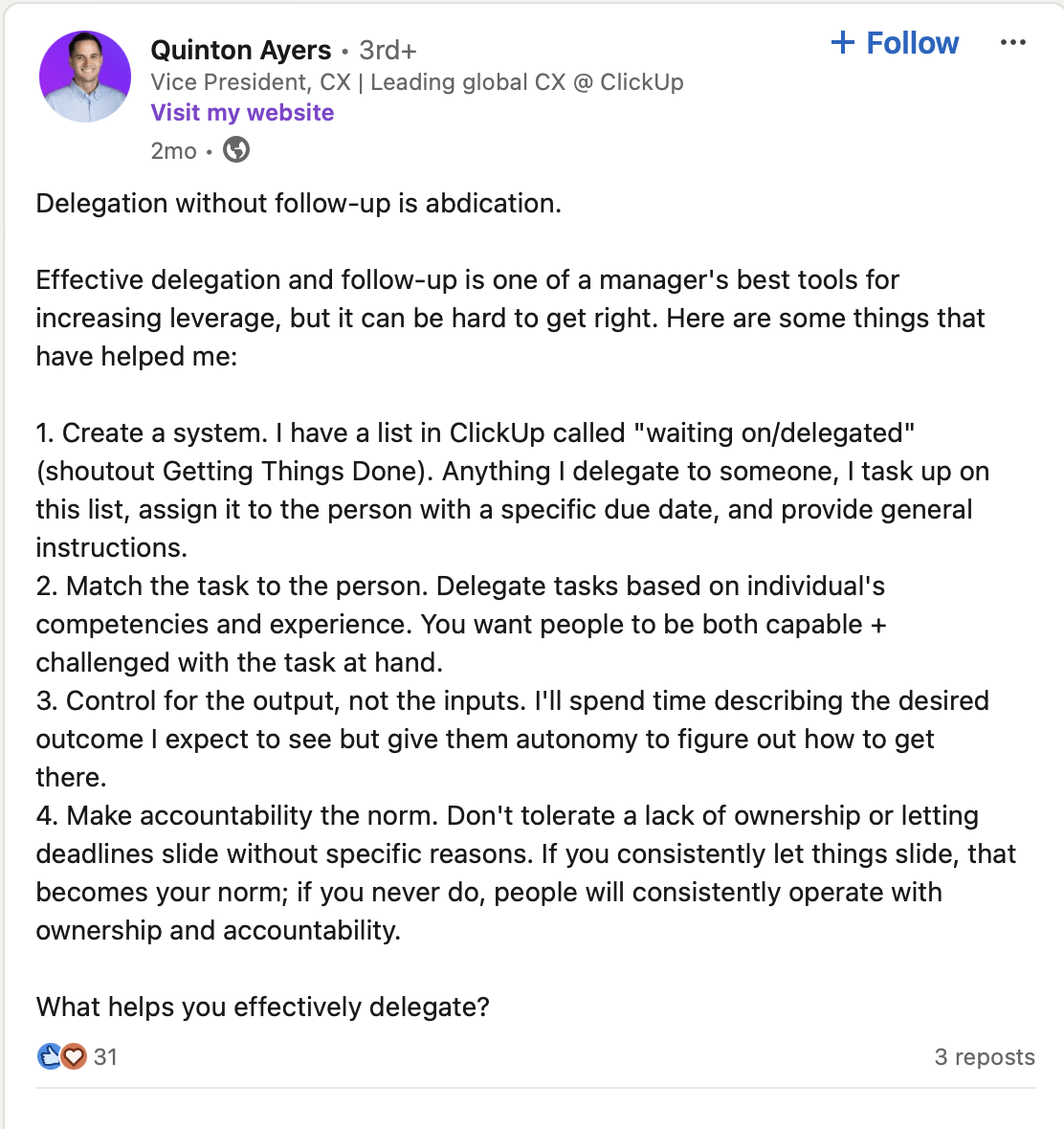
Effective task management and task delegation are crucial to promote a laissez-faire leadership style. By setting up tasks with clear deadlines and deliverables, leaders can step back with confidence, knowing that everything is organized and nothing falls through the cracks.
It also helps employees manage, organize, and prioritize their tasks, thus enabling ownership and accountability at work.
With ClickUp Tasks, team members can manage their workloads independently while providing leaders with the visibility they need to monitor progress. They can plan and organize tasks, set timelines, customize task status, set priority levels, link related tasks, and automate tasks for better efficiency.

Here’s how Quinton Ayers, Vice President, CX at ClickUp, recommends leaders use ClickUp Tasks for effective delegation.
4. Visualize progress
Using software to visualize progress is an excellent way to stay updated on projects without frequent check-ins with your team.
ClickUp Dashboards help you visualize project progress and track employee performance. You can also monitor time spent on different tasks so you can guide your team whenever necessary.

Additionally, the ClickUp Workload View offers a bird’s-eye view of team members’ capacities, ensuring that tasks are balanced and deadlines are met without overwhelming anyone.
5. Manage workload
Laissez-faire leadership is all about empowering employees and providing a healthy environment where creativity and innovation can flourish. This requires efficient resource management to avoid the risk of burnout.

ClickUp’s Employee Workload Template helps you manage team workload better and plan for upcoming projects by assessing the capacity of each employee. You can use the template to delegate tasks to employees and ensure they get a clear view of their tasks and deadlines. This template lets you:
- Get visibility into employee capacity
- Plan projects and make informed decisions
- Set employee expectations
Summarize this article for me pleaseEmpower Your Team With ClickUp and Laissez-Faire Leadership
The laissez-faire leadership style is about trusting your team to do their best without constant follow-ups. But it’s also important to set goals, delegate tasks, and visualize progress to ensure accountability in your team.
Project management software like ClickUp can help you with this. ClickUp is a task management and collaboration platform that helps you plan and complete tasks according to employees’ capacities. Sign up for free on ClickUp and start building an autonomous workplace culture!


Everything you need to stay organized and get work done.

Recent Articles
Managing Creative Teams: How to Lead Your Team to Success 
Managing Creative Teams: How to Lead Your Team to Success
20 SMART HR Goals & Examples for Real Results in 2026
20 SMART HR Goals & Examples for Real Results in 2026
25 Employee Satisfaction Survey Questions to Pulse Check Your Team
25 Employee Satisfaction Survey Questions to Pulse Check Your Team
