
Sorry, there were no results found for “”
Sorry, there were no results found for “”
Sorry, there were no results found for “”
A well-written Gemini prompt gets you a better answer. The bigger time savings come from using AI regularly, and a set of saved prompts makes regular use easier.
Research from the Federal Reserve Bank of St. Louis shows how much frequency matters. Workers who used generative AI for their job said it saved them 5.4% of their work hours on average, or about 2.2 hours in a 40-hour week.
Among workers who used AI every day that week, 33.5% said it saved them 4 hours or more.
This guide gives you 30 Gemini prompts, sorted by role, that you can save and reuse. It also covers one part of Google’s prompting advice you can skip: telling Gemini to act like an expert.
Short answer: Google recommends four ingredients for a prompt: persona, task, context, and format, but you don’t need all four every time. The persona is the debatable part. This article covers 30 Gemini prompts organized by role, plus the limits you’ll run into and a better way to save prompts you’ll use more than once.
A good Gemini prompt can be short. It just has to give the model enough context to work with. According to Google’s own data, successful prompts in Workspace Labs averaged about 21 words.
Google breaks its prompts into four parts: Who should Gemini respond as? What should it do? What information should it use? What should the finished answer look like?
| Element | What it looks like | What it changes |
|---|---|---|
| Task | “Summarize,” “draft,” “compare,” “list every” | Gives Gemini a clear action to perform |
| Context | A file, pasted text, audience details, constraints | Supplies information Gemini would otherwise have to guess |
| Format | “Put this in a table with X, Y, and Z columns.” “Keep it under 120 words.” | Defines the shape of the answer and cuts cleanup |
| Persona | “You’re a program manager at a FinTech company.” | Shifts tone, framing, and emphasis; has little proven effect on factual accuracy |
Task, context, and format are easy to defend. Persona is where things get interesting.
Google lists persona as optional, but recent research suggests you should expect little from the familiar “You are an expert…” opening. A Wharton study tested expert personas across six language models, including two Gemini models, and found no consistent improvement in factual accuracy over prompts without a persona.
The one exception was Gemini 2.0 Flash, where expert personas produced a modest gain on one benchmark. Gemini 2.5 Flash showed none, so the researchers treat it as a model quirk. Personas are still useful when you want a particular point of view, vocabulary, or level of explanation. They just won’t make the answer more accurate.
Context has a bigger effect on the answer, especially when Gemini can read the source material itself. In supported Gemini and Workspace surfaces, you can type @ to point Gemini to a Drive file directly, so you don’t have to describe the file or paste parts of it into the prompt.
Take this prompt:
Summarize our Q3 performance.
With context and format added, it becomes:
Summarize @Q3 Revenue Review for the leadership team. Give me five bullets covering revenue, pipeline, churn, risks, and next steps.
The second prompt leaves Gemini less room to improvise. It knows what to read, who the answer is for, what to extract, and how to present it.
For a broader look at the same mechanics across other AI tools, our guide on how to write AI prompts covers prompting for ChatGPT, Claude, and more.
Prefer to see the framework in action? This walkthrough covers the same ideas, plus the common mistakes that weaken a prompt.
Here we cover 30 copy-and-paste Gemini prompts across six job functions, five per role: marketing, project management, sales and client services, product and engineering, HR and people operations, and data and spreadsheets. Each one follows the task-context-format structure from the previous section, with notes on where Gemini needs a guardrail.
Pro Tip: Add one line to any prompt that reads a document: “If the answer isn’t in the file, say so.” It costs nine words and cuts down on confident guesses you’d otherwise have to catch in review.
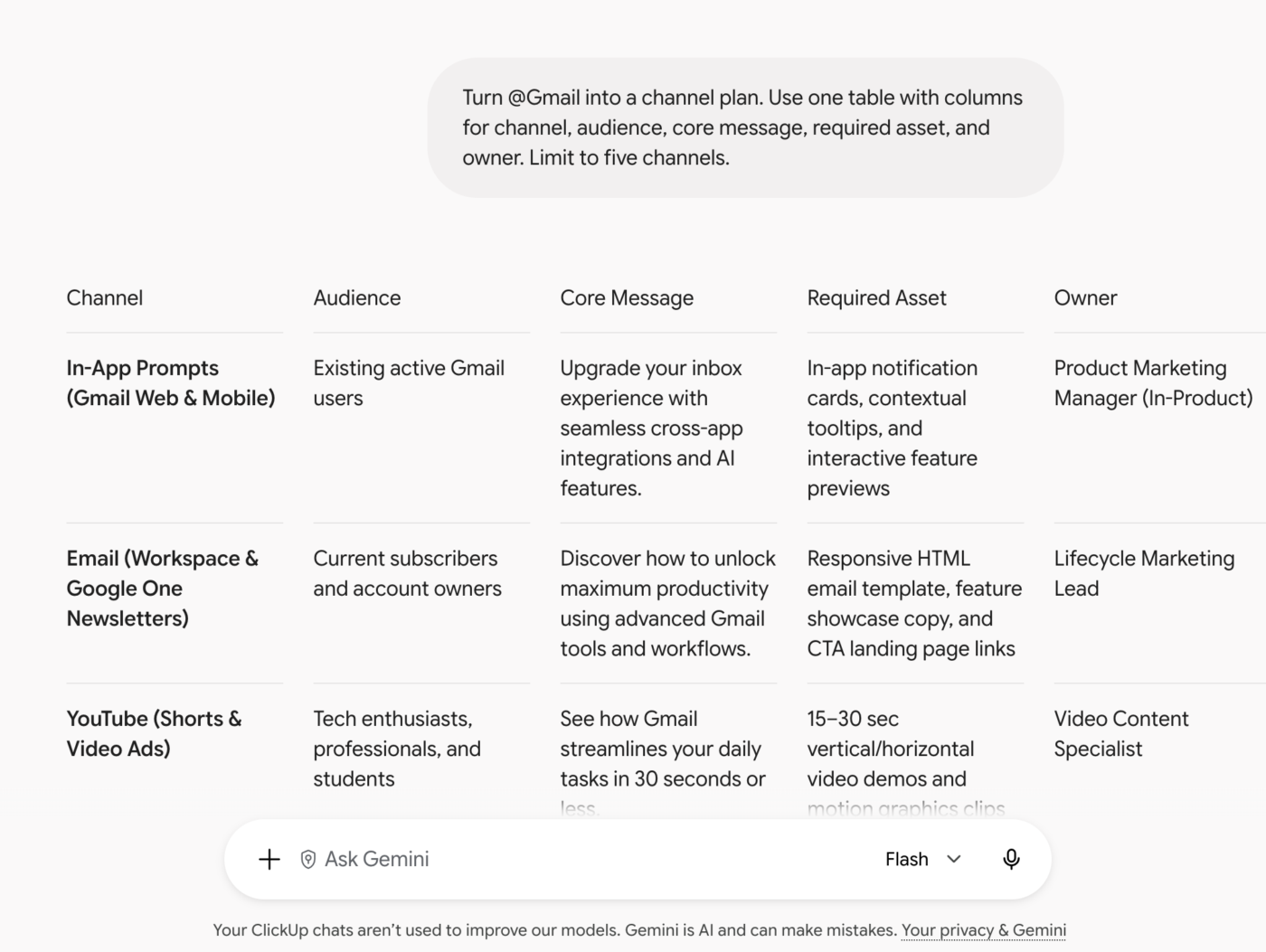
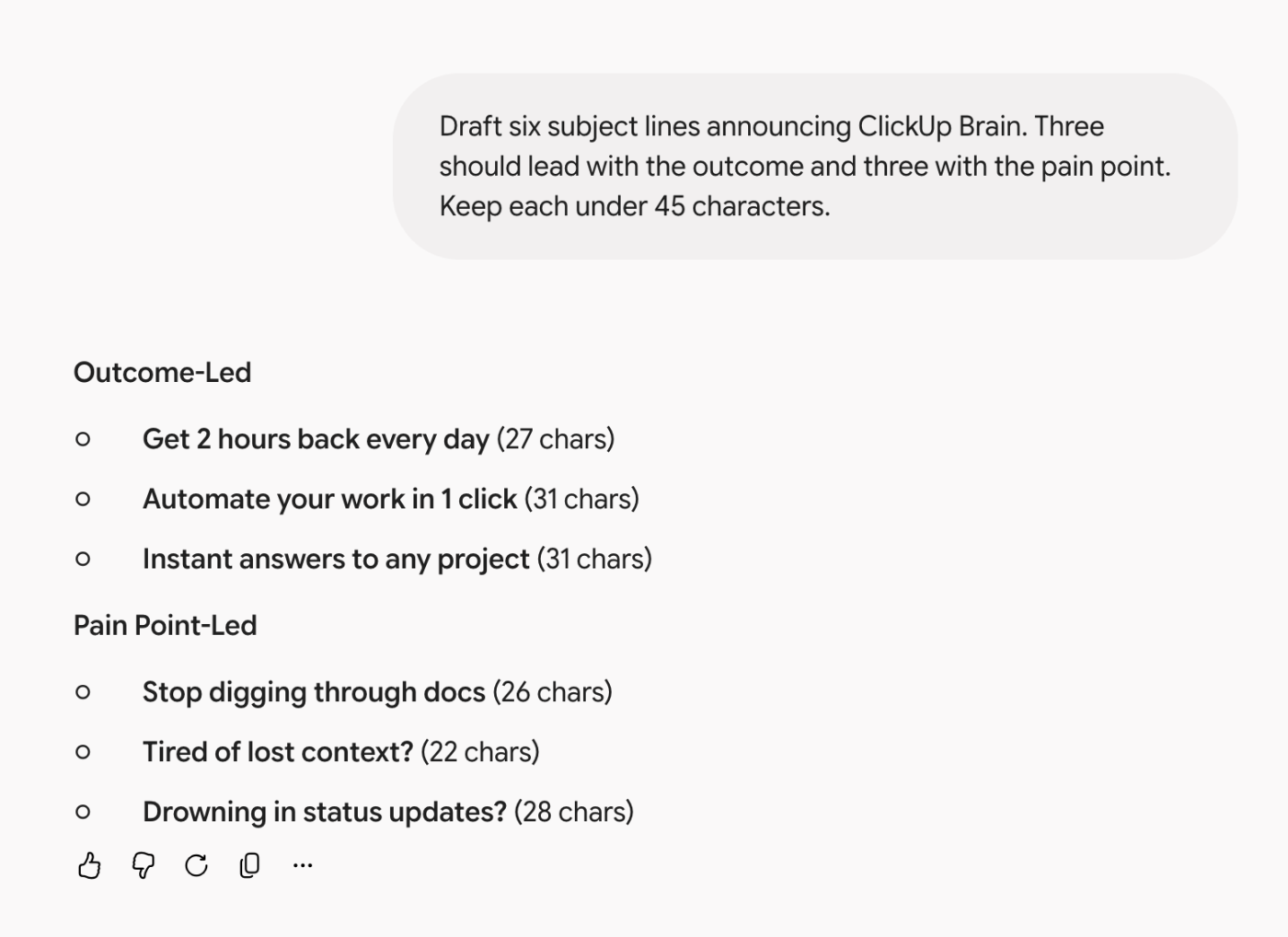
Marketing prompts work best when Gemini starts from something real: a brief, an interview transcript, or a competitor’s page. Without that material, Gemini falls back on generic copy that could describe any product. Each prompt below either points Gemini to a specific source or sets a hard limit, like a character count or a cap on channels.
Once a prompt works, save it so you don’t have to rewrite the instructions next time. Our roundup of AI prompt workflow templates covers how to turn recurring prompts like these into a repeatable workflow.
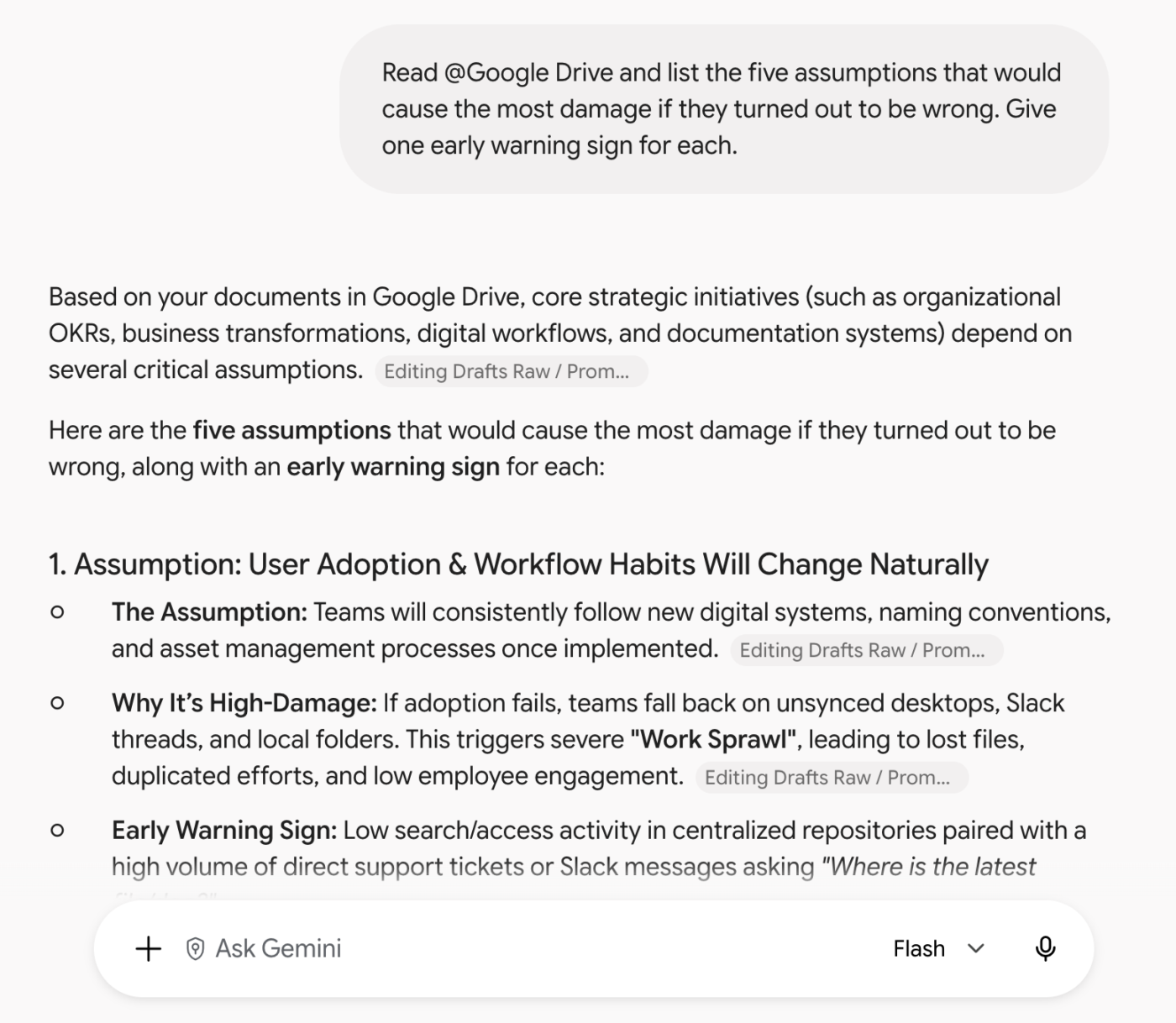
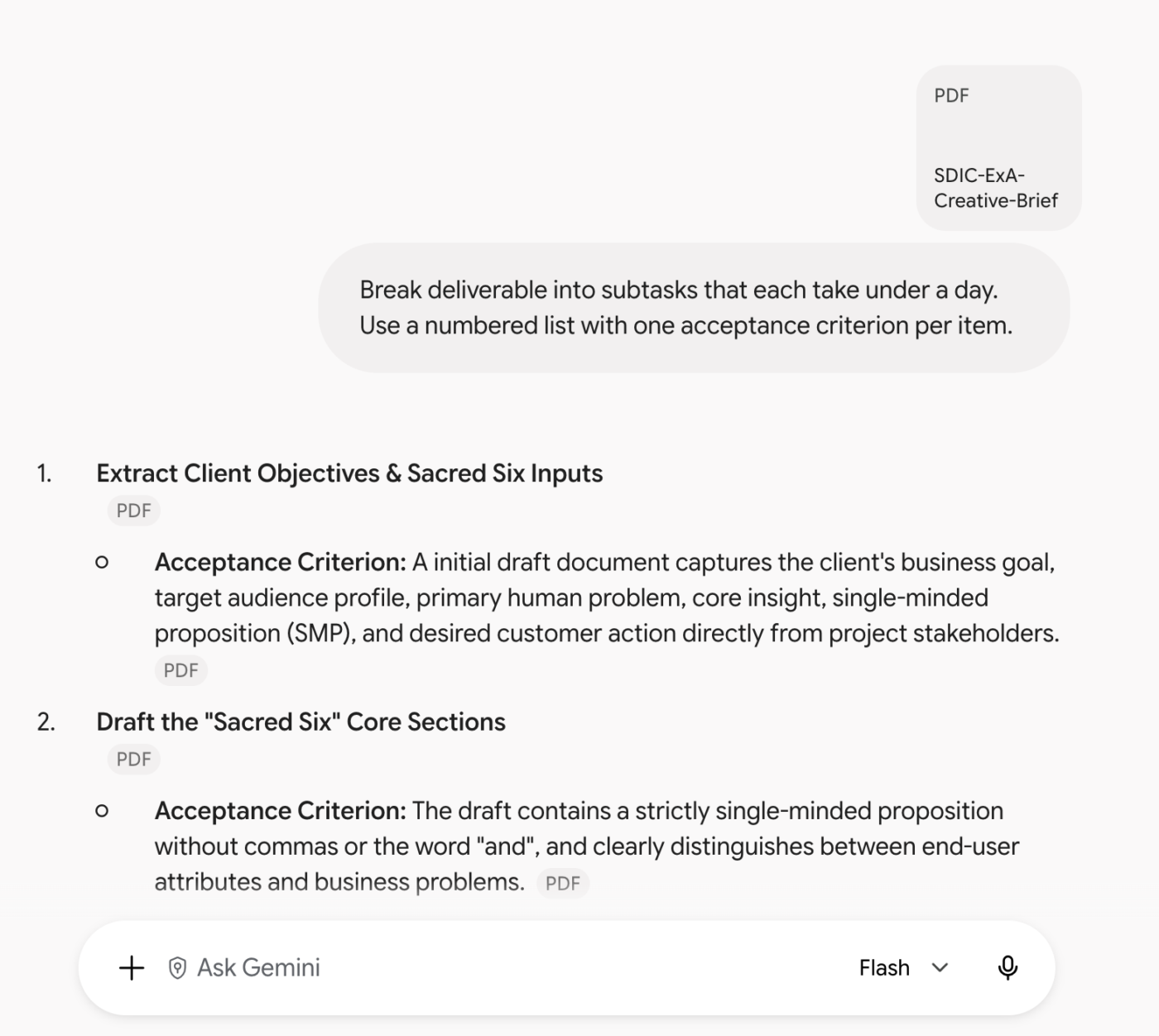
Project problems start out as gaps: a task with no owner, a date that ignores a dependency, or an assumption that turns out to be wrong. These prompts ask Gemini to find those gaps in your meeting notes, plans, and timelines. Two of them also produce something you can send or assign right away: a status update and a subtask list.
Also Read: AI Agents for Project Management
Sales prompts produce text a buyer or client will read, so accuracy and tone count as much as speed. Two of the prompts below add a check: one keeps what the buyer said separate from what Gemini inferred, and the other states what’s out of scope.
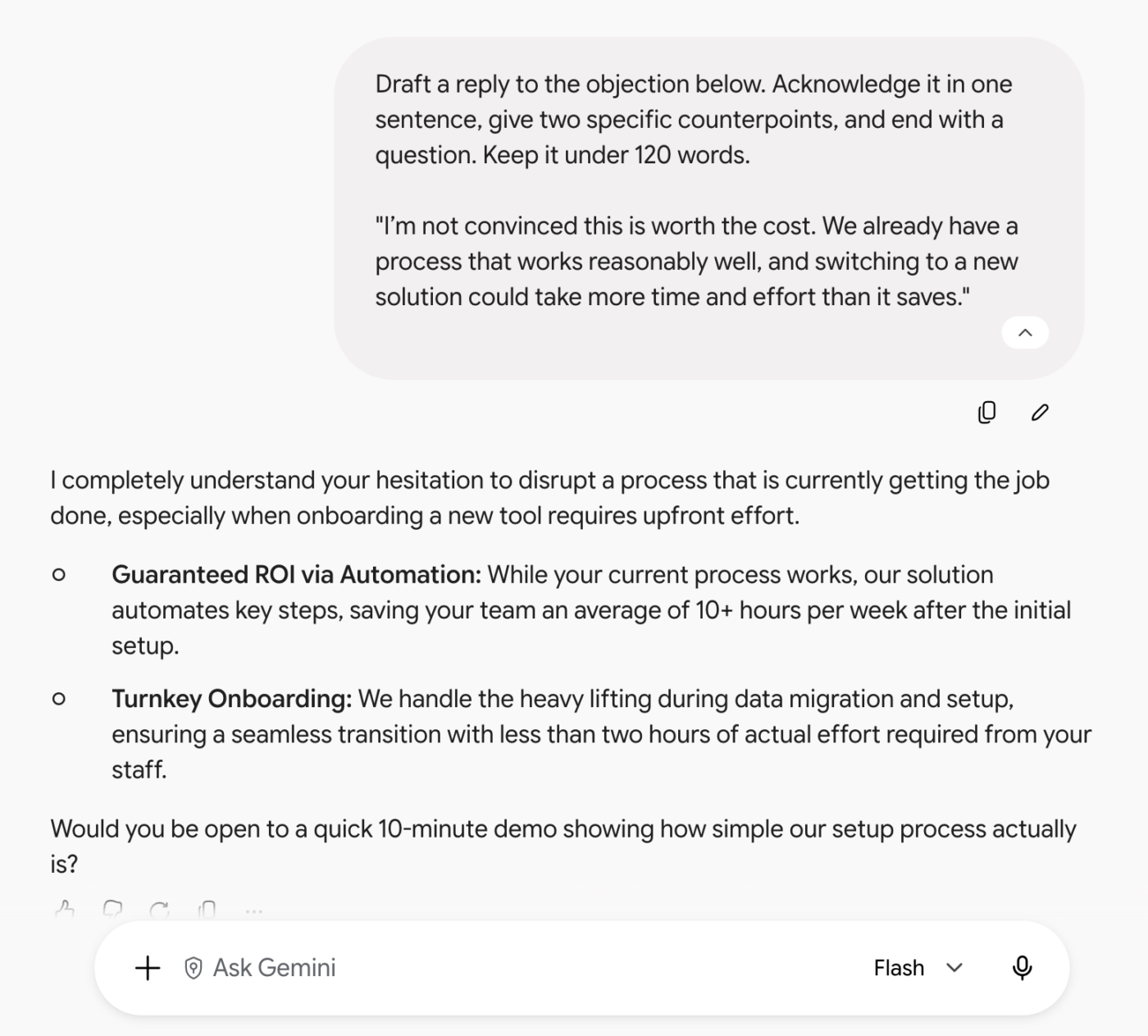
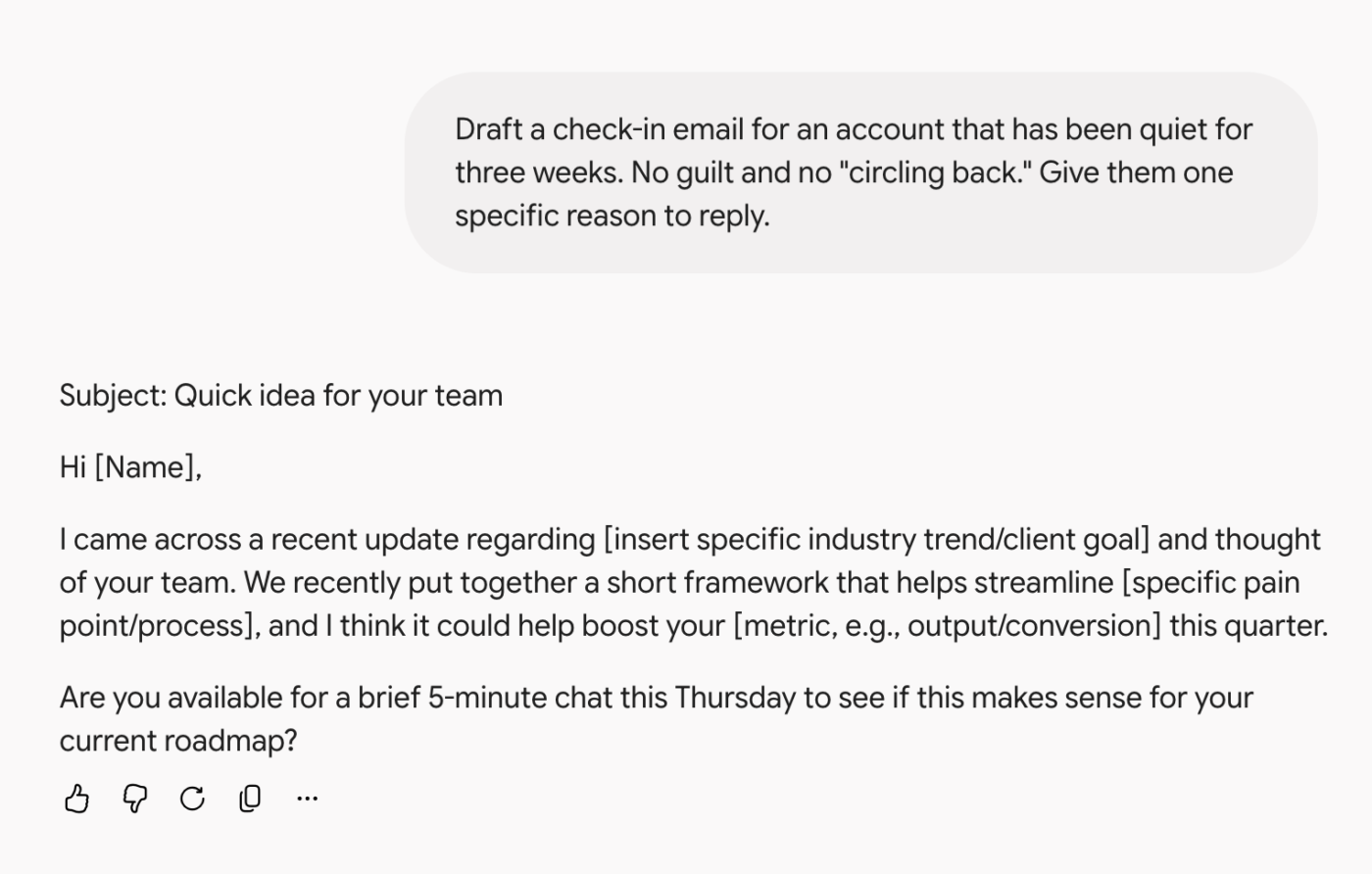
Pro Tip: For the objection reply, paste a real objection from a lost deal along with what your best rep said back. Gemini matches the register of what you show it far better than the register you describe.
Product and engineering teams spend a lot of time turning one document into another. A bug report becomes steps for the engineer who will fix it, or a PRD becomes stories for the team building it. These prompts make the process less painful.
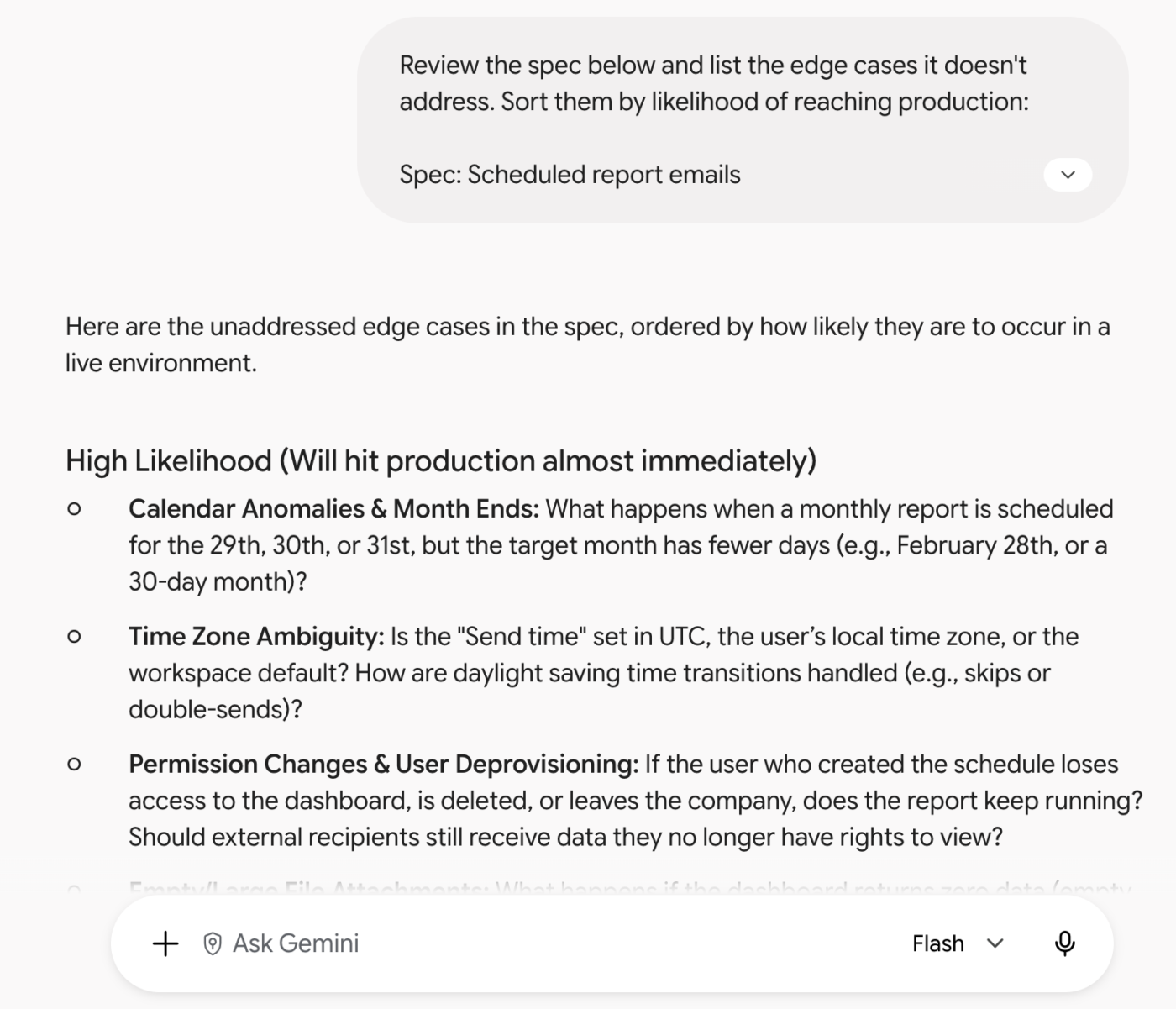
Note: Gemini can run Python in a sandbox, but it can’t execute your codebase, install your dependencies, or see the systems the function touches. Treat the “what breaks” answer as a list of hypotheses to test, and ask it to state any assumptions about input types or dependencies it can’t see.
HR prompts deal in personal information, such as survey answers and performance feedback, and that has to remain private. The prompts below keep Gemini close to the source by asking for verbatim quotes, word limits, and observable behavior only. Read the data note after the list before you paste in survey exports or feedback drafts.
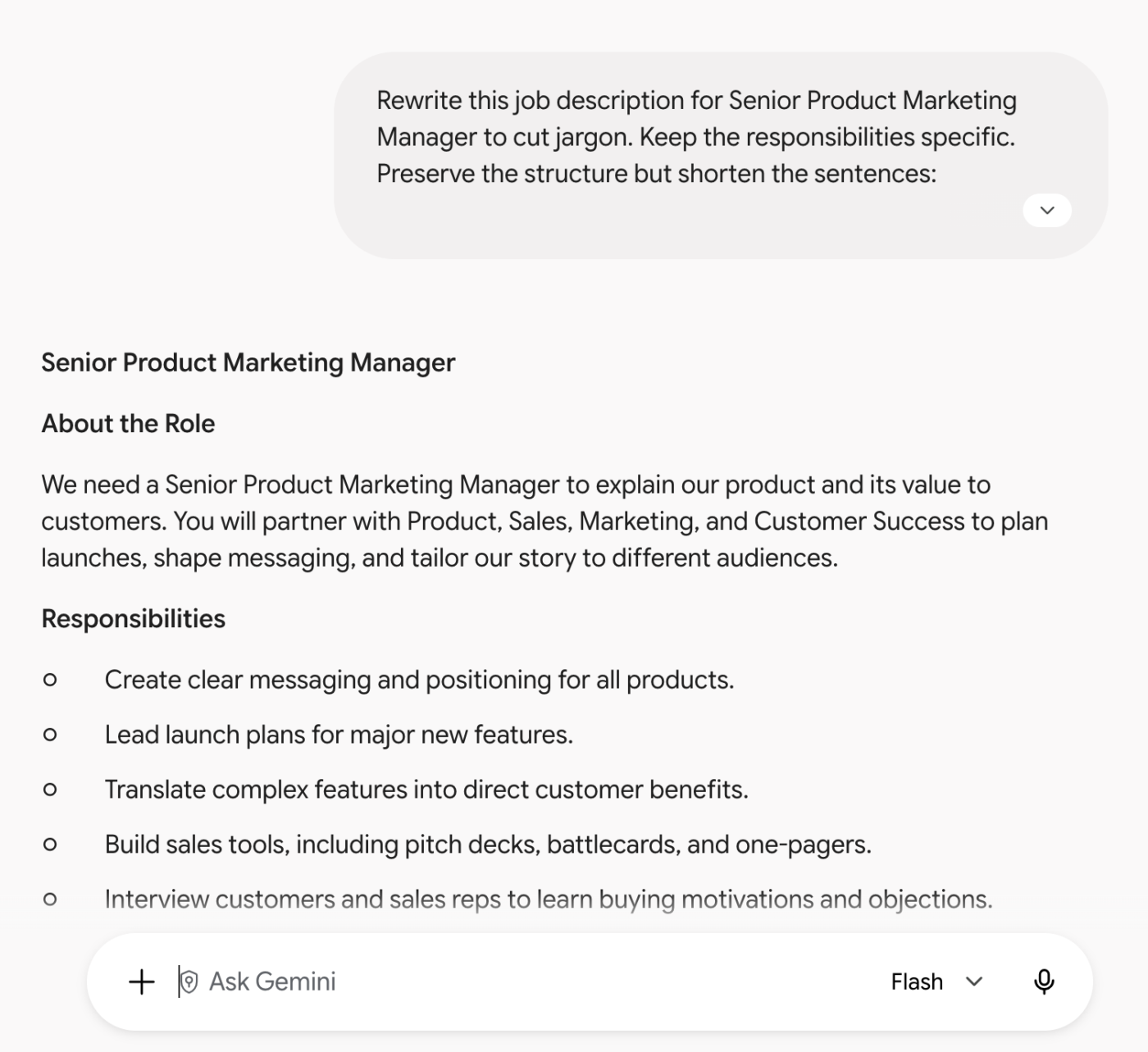
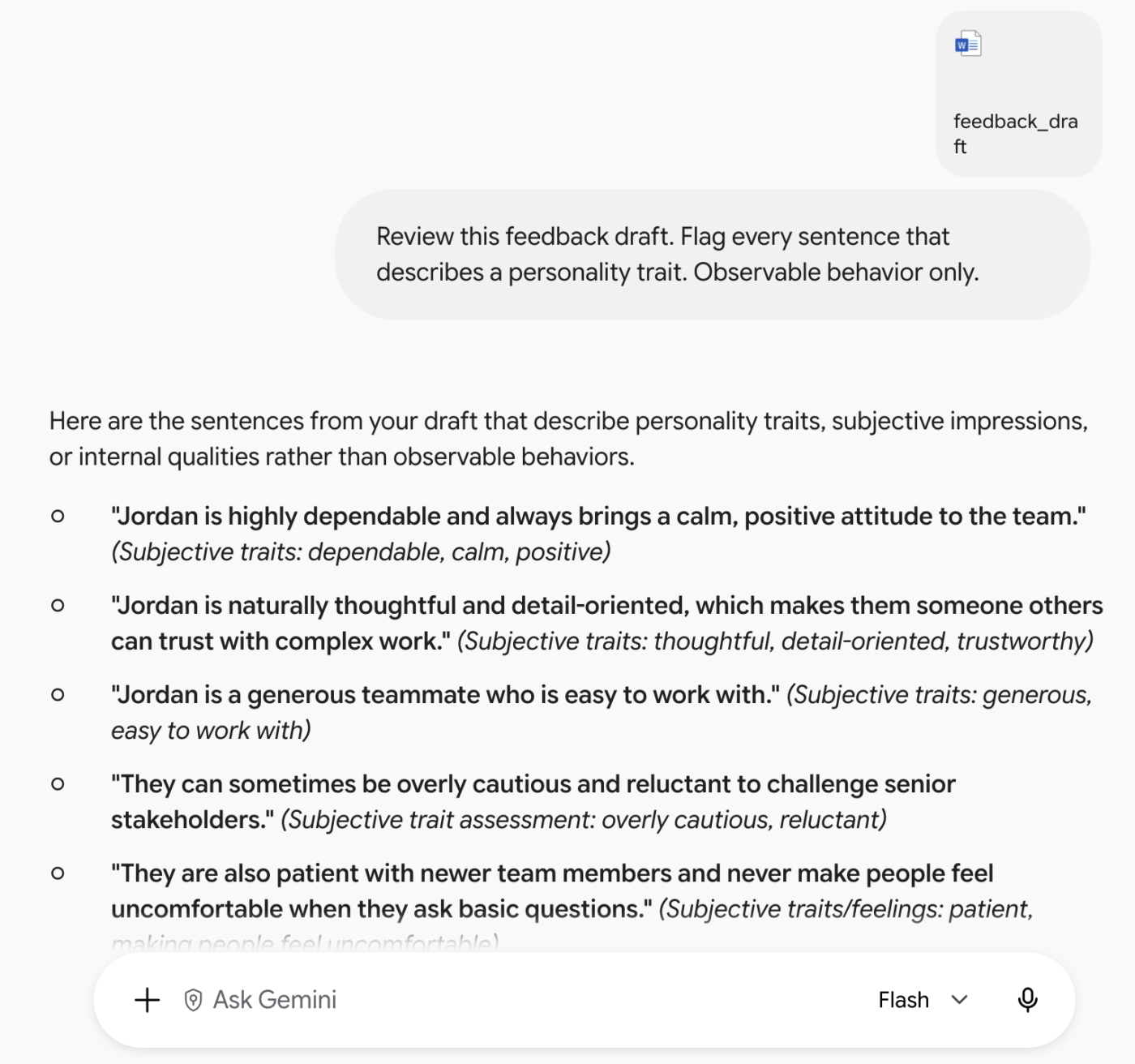
Note: Check where the data goes before you paste it. Qualifying Google Workspace accounts have stronger data protections than the consumer Gemini app, where chats may be reviewed and used to improve Google’s AI when Keep Activity is on. Strip names and other identifying details from survey exports and feedback drafts by default.
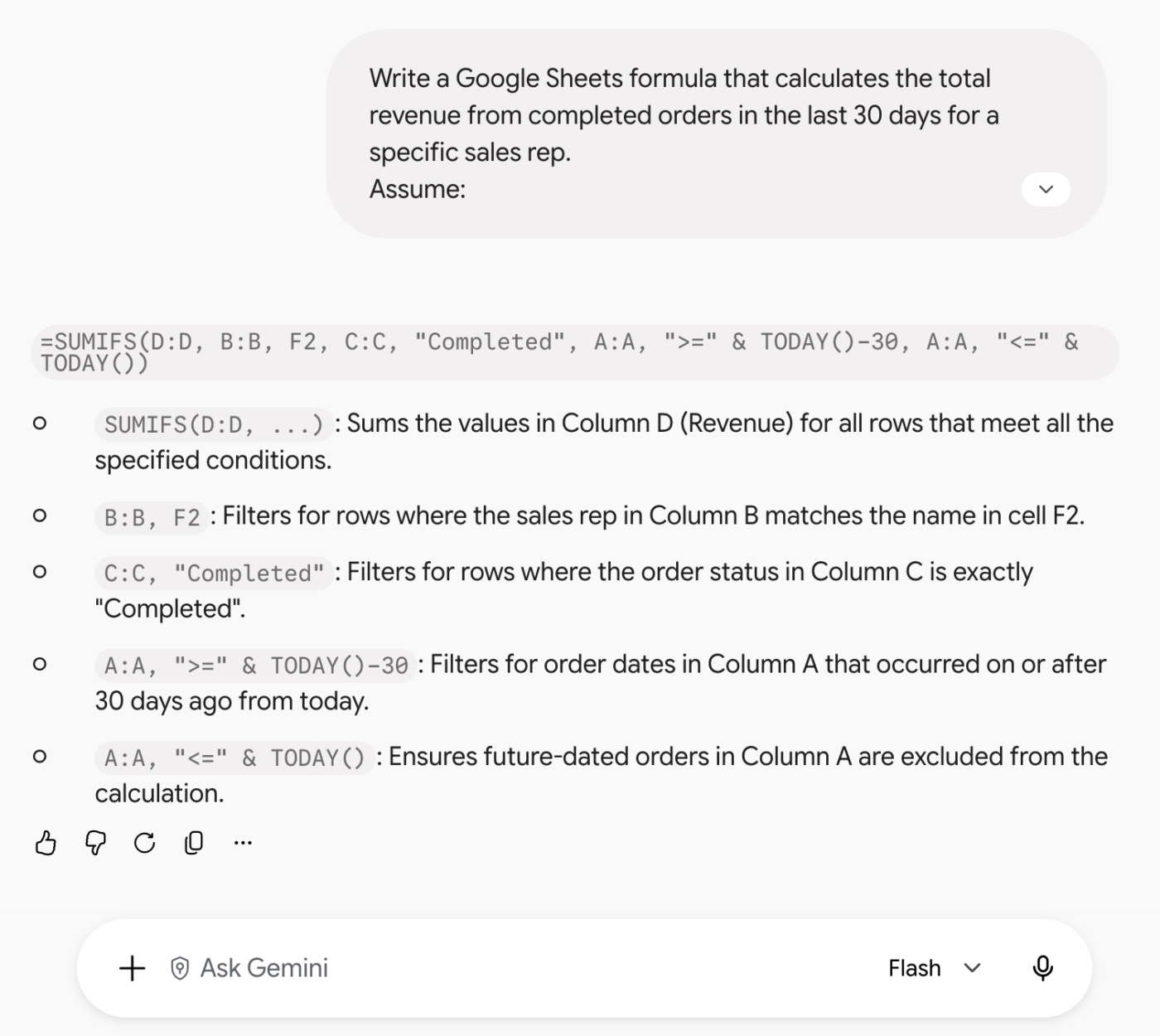
In spreadsheets and reports, a wrong number is harder to spot than a wrong sentence. Each prompt below asks for output you can check: a percentage for each column, a formula explained part by part, a page number beside every figure, or a set threshold for flagging differences.
The first thing to decide is what kind of image task you’re giving Gemini.
In its prompting guide for Nano Banana 2 and Nano Banana Pro (Gemini’s image models), Google separates image prompting into three jobs: creating a scene from scratch, editing an existing image, and working from reference images. Each one needs a different kind of instruction.
For a fresh generation, give Gemini enough detail to build the shot you have in mind. Start with what’s visible: the subject, what they’re doing, where they are, how the scene is framed, and the visual style.
Compare this prompt:
Make a professional headshot.

with this one:
A woman in a navy blazer seated beside a window, medium close-up, soft light from camera left, shallow depth of field, neutral office background.
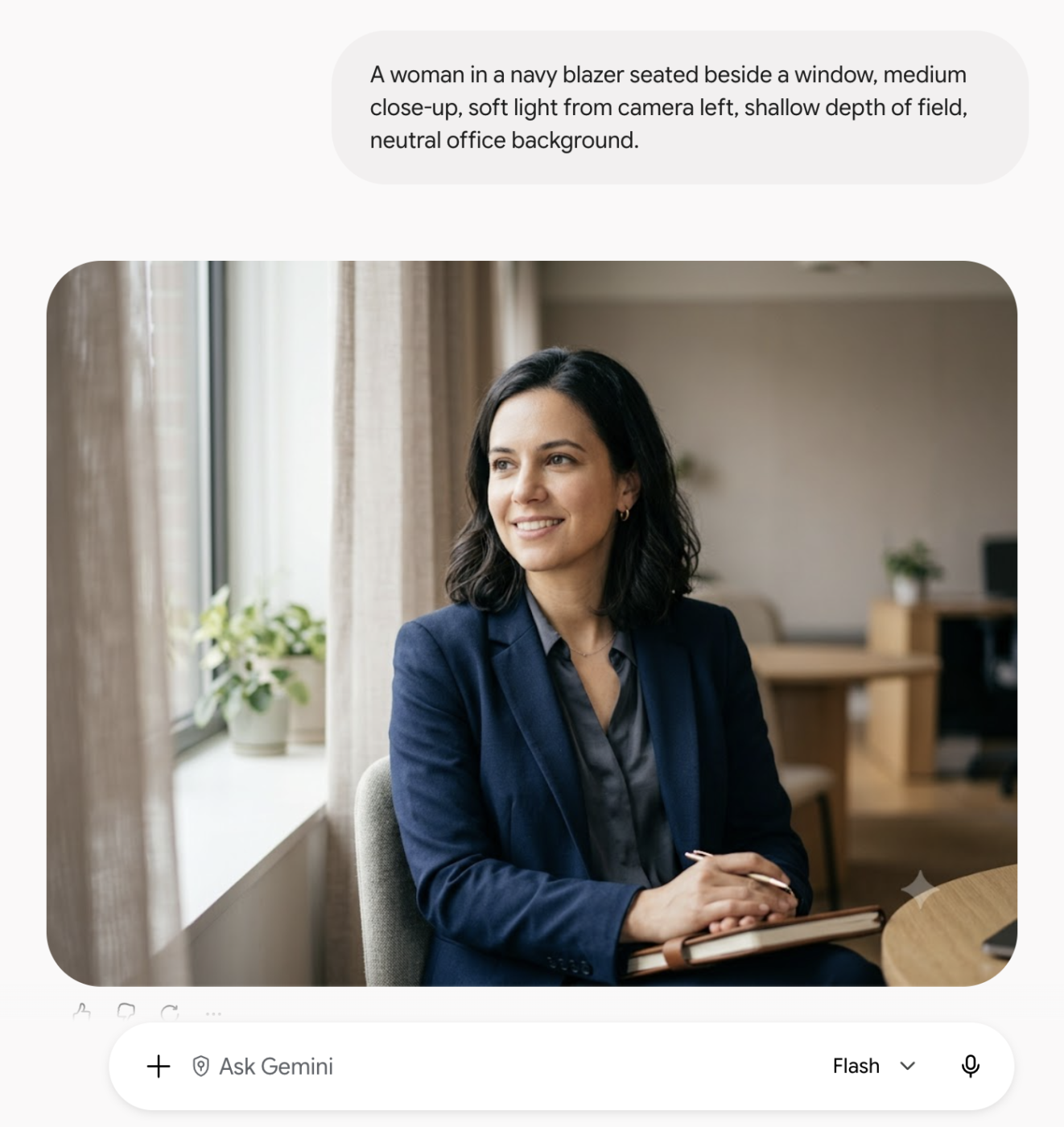
The second prompt hands over far less control. You’ve already chosen the framing, lighting, setting, and distance from the subject. Gemini still has room to interpret the scene, but the big visual decisions are yours.
Use these rules to get the same control:
Three prompt shapes cover most of the work:
For text work, Gemini usually has the source material in front of it and needs clear instructions. Image generation shifts more of that burden onto you. The less you leave undefined about the scene, the less time you spend fixing choices Gemini made on your behalf.
If you rebuild the same prompt every week, save it as a Gem.
A custom Gem stores your instructions and can include reference files. Open it again later, and the setup will still be there. It works well for recurring jobs like reviewing copy against a style guide, turning meeting notes into a fixed status format, or drafting from the same positioning docs each time.
Here’s how to set one up:
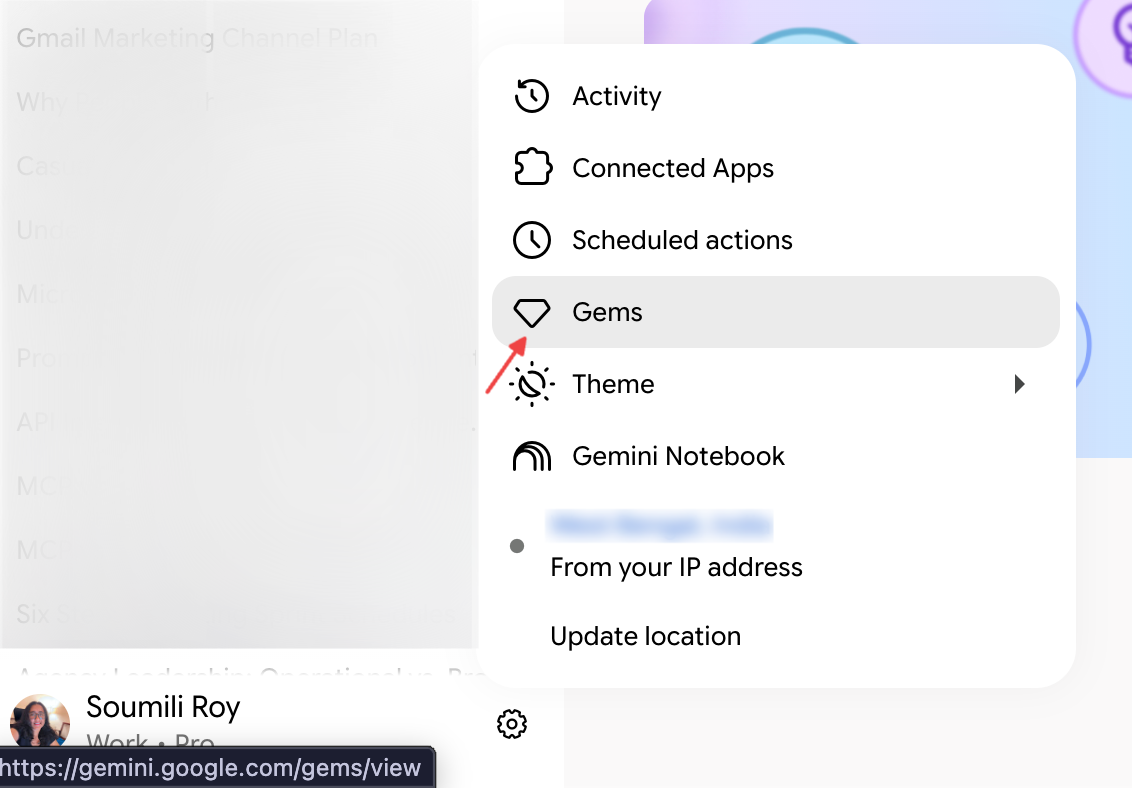
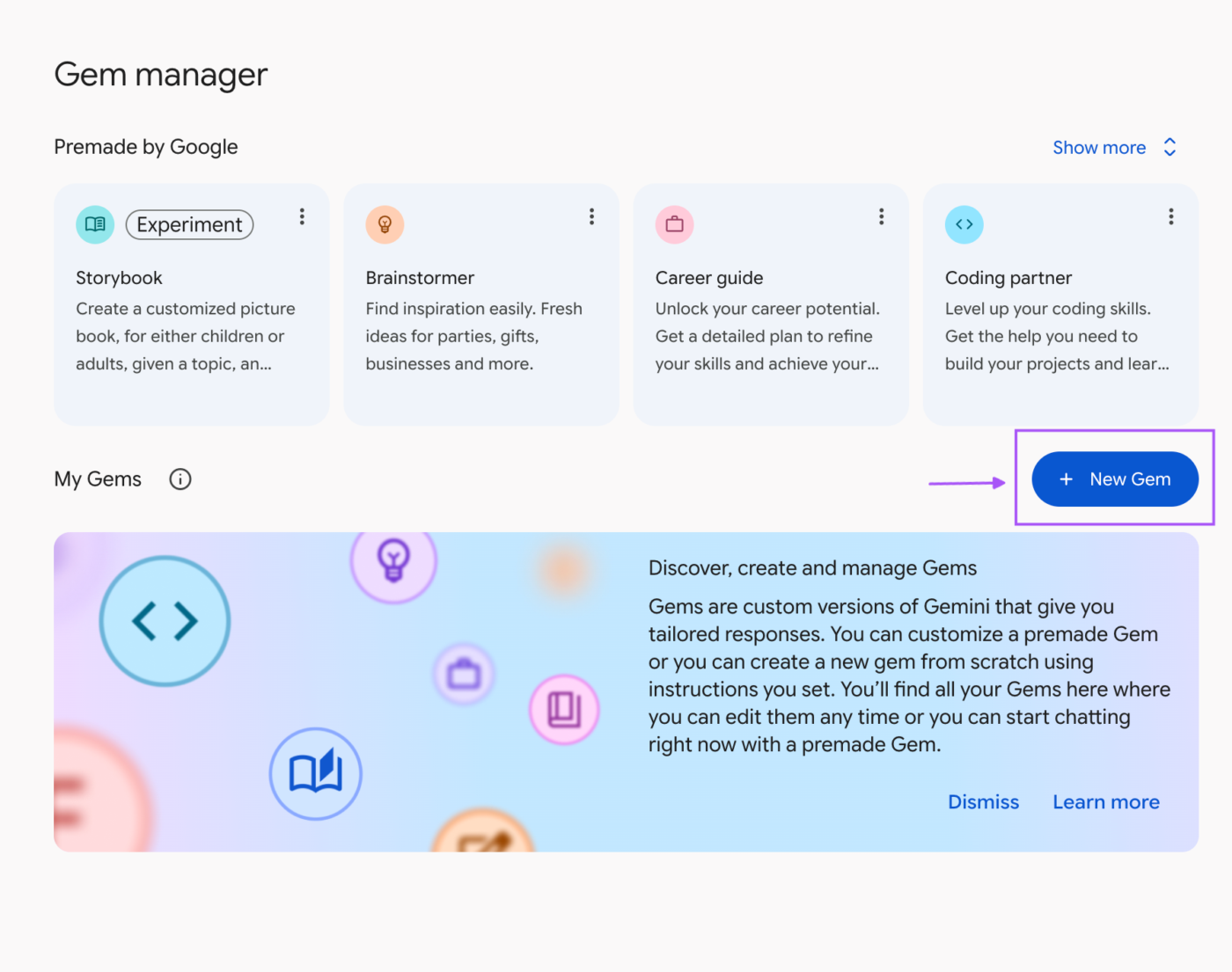
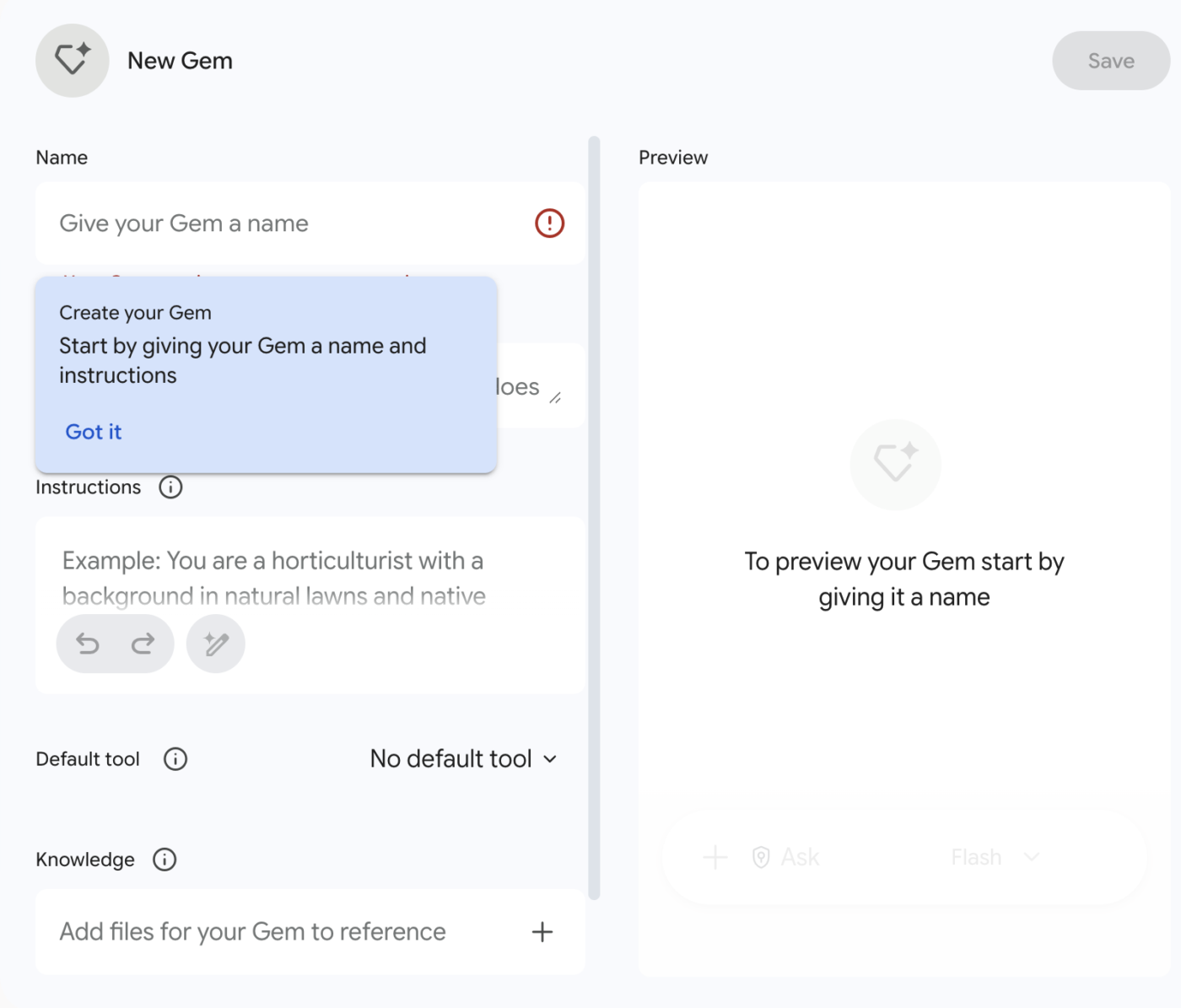
A few setup details are easy to miss:
There’s one hard limit to plan around: a custom Gem can hold up to 10 files, each up to 100 MB.
That’s enough for a focused working set, such as a style guide, positioning doc, approved examples, and a template or two. It gets awkward once you try to turn one Gem into a full company knowledge base.
At that point, split the job. A “Blog Editor” Gem can hold editorial guidance and strong examples, while a separate “Product Messaging” Gem carries positioning and product docs. Smaller knowledge sets also make it easier to tell which source Gemini used (especially when the output goes wrong).
Remember: Even with a clean split, a Gem has a fixed view of the job. It knows only the files you gave it. You still have to add every new brief, transcript, or spreadsheet by hand before Gemini can use it.
A clear prompt can still produce a bad result when the problem sits somewhere else: the wrong context, a product limit, or a task that asks Gemini to do too much at once.
These are the failure points that come up most often:
| What breaks | What happens in practice | What to do instead |
|---|---|---|
| Context window | Accounts without a Google AI plan work with a 32,000-token window, so a long PDF or transcript can get cut off with no warning | Split long files, or ask Gemini to confirm the last section it read |
| File uploads | 10 files per prompt, and every file inside an uploaded folder counts toward the cap | Merge small files before uploading, or work in batches |
| Usage allowance | Gemini Apps now use compute-based limits that refresh every five hours, up to a weekly cap. Deep Research, image generation, and Pro models burn through it faster, and free accounts can lose Deep Research during high demand | Save Deep Research for questions that need many sources, and watch for the in-app warning that you’re close to a limit |
| Audio Overviews in Drive | Capped at 20 a day, and closing or refreshing the page mid-generation cancels it | Start them early and leave the tab open |
| Personas | The Wharton study from above found no consistent accuracy gain from expert role prompts across six models | Keep the role to one line tied to the job: “review this as a compliance lead” |
| Overloaded Gems | 10 files may fit one workflow, but unrelated material makes it harder to tell which source shaped the answer | One Gem per job |
Most of these limits shift by plan, and Google notes they can change without notice during periods of high demand.
Before you rewrite a failed prompt, check three things: whether Gemini has the right source material, whether you’ve hit a usage or file limit, and whether the task needs to be split into smaller steps. If one of those is broken, better wording won’t fix it.
Also Read: Claude Skills for Writing
Each mistake below has a symptom you can spot in the output. Once you recognize the symptom, you can usually fix the next prompt without rewriting everything from scratch.
Symptom: You asked for four things. The first comes back detailed, the fourth gets two sentences.
Fix: Split work that requires different kinds of reasoning. Ask Gemini to analyze the material first, then draft, compare, or recommend in the next turn. You keep the same conversation context without asking one response to carry the whole workflow.
Symptom: The answer sounds complete, but some of the specifics came from the model, and your source material never mentioned them.
Fix: Tell Gemini how to handle gaps. “Use only @[project plan]. If the document doesn’t say, mark it unknown” is much safer than leaving it to complete the picture.
This is especially useful for meeting notes, research, policy documents, and client work, where a plausible invention can be harder to catch than an obvious error.
Symptom: “Try again” gives you a different version of the same problem.
Fix: Name what failed. “Keep the structure, but remove claims that aren’t supported by the source” gives Gemini a correction it can act on. The same goes for tone, length, missing fields, weak examples, or too much detail.
Symptom: You’re pasting the same brief, audience, and background material several times in one session.
Fix: Continue in the existing thread when the next request depends on the same material. Gemini can use the conversation context, within the limits of its context window, which makes small revisions much cheaper than rebuilding the setup each time.
Start a new chat when the thread gets cluttered or the job changes.
Symptom: You got the answer you needed, but two days later, it’s buried inside an old conversation.
Fix: Move finished work to where it belongs: the project doc, task, spreadsheet, comment, or reusable Gem. A strong answer that stays in the chat has to be found, copied, and rebuilt the next time the job comes around.
A Gem holds up to 10 files, and you have to add every new brief, transcript, or spreadsheet yourself. Mistake #5 happens for a similar reason: good output stays in a chat window, away from the task it was for. Saved prompts are easiest to reuse when they sit next to the work they’re for.
ClickUp keeps your prompts in the same place as your tasks, Docs, and projects. A reusable prompt can live in a Doc or on a recurring task. ClickUp Brain reads the task or Doc you point it to, so the current project supplies the context, and you don’t have to re-upload files each week.
Here’s a simple setup for managing the prompts using ClickUp:
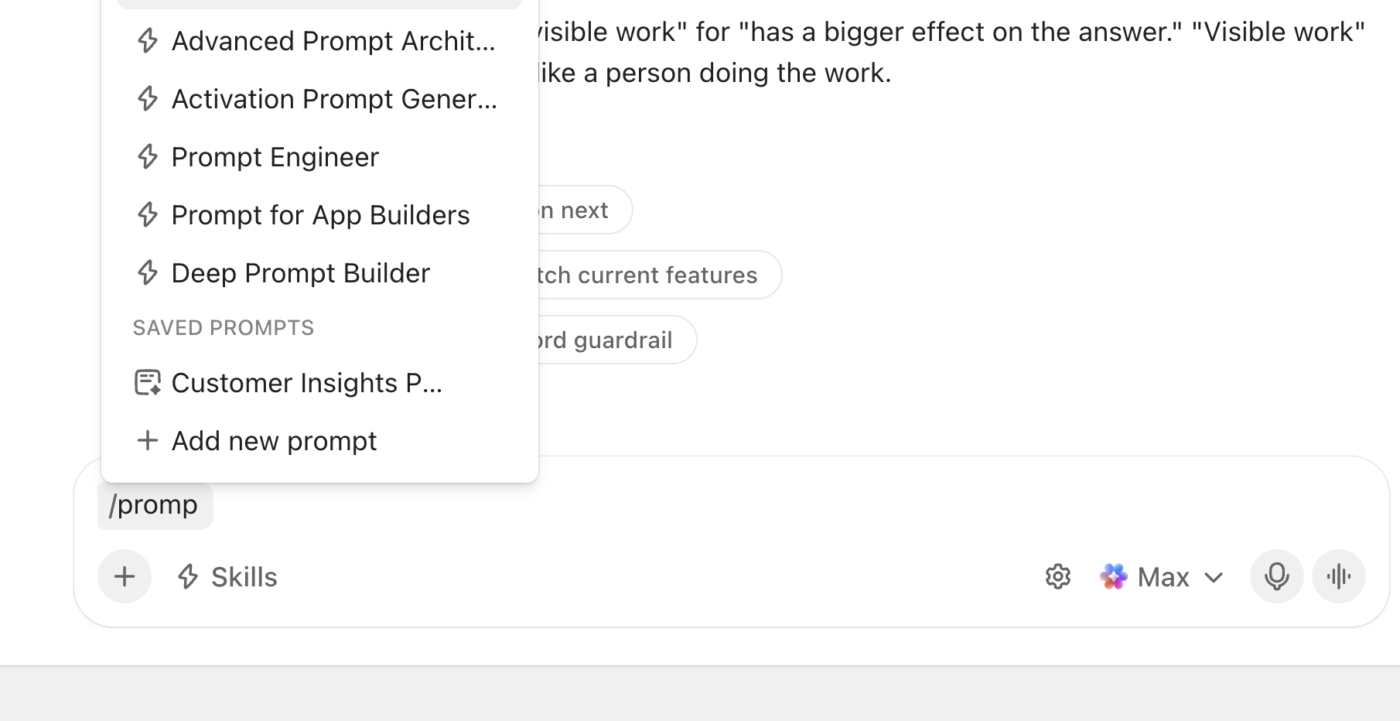
@mention. Inside Brain, @mention points to tasks, Docs, people, Teams, or Channels. A reusable prompt can stay short while the current project supplies the changing context/ in Brain to add a new prompt and choose who can see it: just you, everyone, admins, or specific people. Saved prompts show up in the same menu across every project, so you don’t have to search through old chats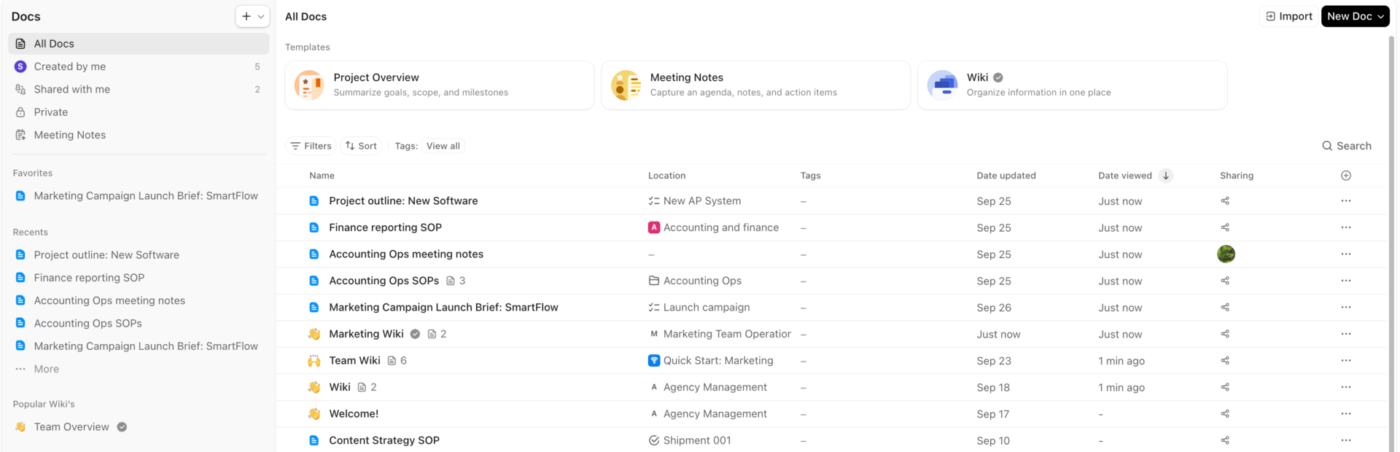
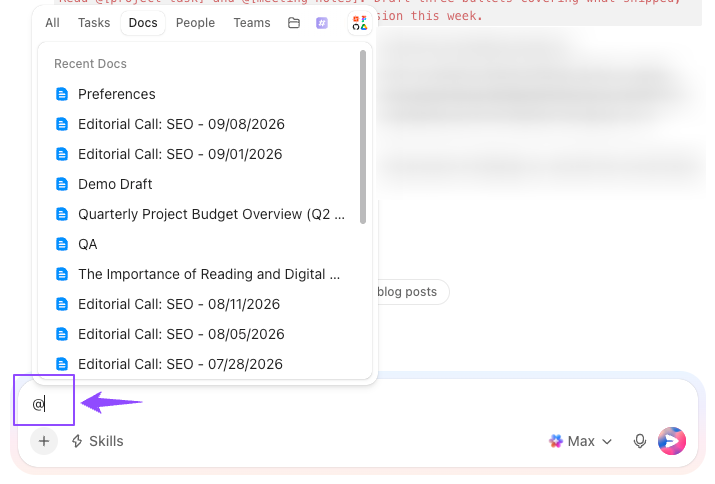
Say you keep this prompt for weekly project updates: “Read @[project task] and @[meeting notes]. Draft three bullets covering what shipped, what slipped and why, and what needs a decision this week.”
The wording barely changes from week to week. The task and meeting notes do.
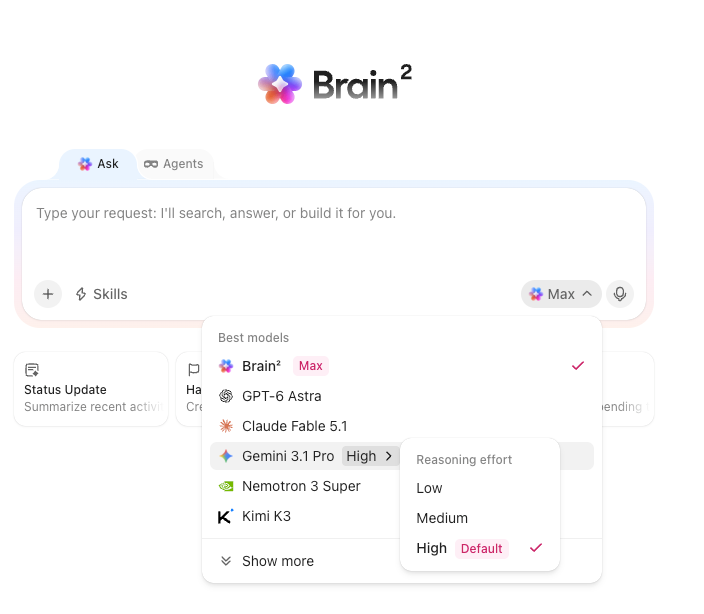
And if you want Gemini for the generation itself, there’s no need to leave ClickUp. Brain’s model selector includes Gemini models, and the Workspace context stays attached when you switch mid-conversation.
Best for: Teams that reuse prompts around recurring work and want the prompt, source material, and final output in the same workspace.
Where it taps out: If your workflow already lives entirely inside Gemini and Google Workspace, moving prompts into ClickUp can add an extra layer you don’t need. It’s strongest when ClickUp is already where you plan and ship work.
You don’t need a library of 200 prompts. Start with the prompts in this guide that match the work you do every week.
Use the examples here as working drafts. Edit them for your team, and save the ones you keep using as a Gem or in ClickUp. If a prompt stops working, check the source material and limits before you rewrite it.
The rest of the improvements come through trial and error.
And when your prompts need to become a part of how the work gets done, try ClickUp.
Two things are usually at play. Language models add some randomness to every response, so identical prompts rarely produce identical text. On top of that, Gemini in Workspace apps searches Drive, Gmail, Chat, and Calendar, so the material it pulls in can change between runs. Add the files you want as sources, and the answers get far more consistent.
For eligible accounts, yes. Personal context is on by default, so Gemini can draw on past conversations to shape a new answer. You can turn it off in Settings, or use a Temporary Chat for a one-off request that stays out of your history and doesn’t affect later responses.
Manage your sources. In Docs, Drive, and Gmail, the Ask Gemini panel has a source settings menu where you can switch off Drive, Gmail, Chat, or Calendar search. Add the specific files you want with @ or Add from Drive, and Gemini will prioritize them. Below every answer, click Sources to see which files it used.
Yes. Sharing works like sharing a Google Doc: you can make someone a Viewer or an Editor, and if the Gem includes uploaded files, you’ll be asked to share those too. Shared Gems are stored in Drive, so your organization’s Drive sharing rules apply. Admins can also turn Gem sharing off for the whole organization.
Yes, Gemini has a free tier that covers chat, file uploads, and custom Gems. Paid plans raise usage limits and add access to more capable models. Gemini features inside Google Workspace apps depend on your organization’s plan and admin settings.

Manasi Nair
Max 18min read

Arya P Dinesh
Max 26min read

Sean Hardy
Max 26min read

© 2026 ClickUp




