

You’re at your desk, preparing a presentation, when you notice a group from your team huddled together—quietly discussing something among themselves.
Curiosity kicks in. What are they talking about? Is it something important?
You feel a twinge of frustration because you’d love to contribute, but you’re not in the loop. This isn’t happening for the first time, either. Even in the past, you’ve felt like you were left playing catch-up at work.
Feeling left out at work can be frustrating and affects the employee and the organization. And it’s more common than you might assume.
In this blog, we will explore what causes workplace exclusion, ways to deal with feeling isolated at work, and more. Let’s get started!🚦
Friendly reassurance: You are not alone in feeling excluded at the workplace, even though it might seem like it. 75% of global employees report that they have felt excluded at work, according to EY’s report ‘Belonging Barometer‘. This is to say, it’s usually a deep-rooted issue and affects many of us.
How Feeling Left Out at Work Can Affect Your Job

 Summarize this article for me please
Feeling Left Out at Work: What’s Really Going On?
Feeling excluded at work occurs when you are excluded from team activities, discussions, or social interactions. This isolation can make you feel alienated and demotivated, affecting your well-being and connection to the team.
When you feel left out, it’s easy to blame yourself. Over the long-term, this can easily spiral and have a strong negative impact on how you feel about work. However, the real reason you weren’t in on that inside joke or didn’t feel like part of the team might be beyond your control.
It could be due to deeper issues like communication silos, unspoken hierarchies, office cliques, or even a workplace culture that leaves everyone feeling disconnected.
Identifying the root cause is crucial to addressing the problem effectively. Before taking further steps to improve the situation, consider whether your experience aligns with these issues.
🚩 Is it just you or the culture?
Many wonder, “Am I at fault, or is there something wrong with my team?”
The best way to determine whether you’re a victim of workplace exclusion is to ask yourself if you’re doing what’s expected of you.
Are you on time with your own projects? Are you polite, collaborative, and doing everything to be a good employee?
If you answer yes to the above questions but still feel excluded, your team culture is probably the culprit.
Some signs that indicate you’re in an unsupportive work environment could be:
- You frequently feel excluded from important meetings or discussions
- Team communication is often unclear or disjointed
- Lack of support and mentorship forces you figure things out on your own
- The culture makes you feel like you should be grateful just to have the job
- You often feel undervalued or unappreciated for your contributions
- The use of phrases like ‘we are a family’ to blur boundaries
- Excessive workload or little to no work-life boundaries
- Office cliques or unspoken hierarchies are evident
🚩 Office cliques: Yay or nay
You might have thought that cliques were something you left behind in high school. Unfortunately, that’s not always true. Cliques often show up in a different form or shape in every workplace.
Many workplaces have cliques—some good, some not so much. These tight-knit groups often form around shared interests, job functions, or personality types.
At first, they might seem harmless, but they can create real barriers for those who aren’t part of them.
Nevertheless, not all cliques are bad; some provide a solid support network.
But more often than not, when these groups start forming in the office, they lead to gatekeeping and exclusivity, making it tough for others to connect and collaborate.
🚩 The subtle reality of exclusion
Exclusion isn’t always obvious. It’s not just about missing out on after-work events or not getting a chance to speak up in meetings.
Sometimes, it’s the subtler things, like not being asked for input on a project or being overlooked for key assignments. These small instances can accumulate over time, making you feel undervalued and disconnected from your team.
Here are some often-unseen signs of exclusion:
- Important emails, chats, or documents are circulated among your peers, but you’re not always included in the distribution list
- Team outings or after-work gatherings are planned, but you’re either not informed or invited at the last minute
- You notice that coworkers frequently have casual chats, such as during coffee breaks, but rarely invite you to join
- Other team members regularly receive guidance or mentorship, but you’re left to navigate challenges on your own
- When your contributions are acknowledged, they are downplayed or not highlighted as much as others’
- During meetings, you might be frequently interrupted, or your ideas are dismissed without much discussion
- You’re consistently given tasks that are important but low-profile
Summarize this article for me pleaseHow to Navigate Feeling Left Out at Work?
To turn this feeling of exclusion around, it’s essential to address it head-on and take proactive steps.
Here’s how. 🗂️
✅ Focus on what you can control
When you’re feeling excluded at work, it’s easy to start blaming yourself or others.
However, the first step in dealing with this situation is to look at what you can control—your performance and attitude.
According to consolidated research from Indeed and Michael Page, you should be focusing on the controllables like:
- Improving your work quality
- Setting personal goals
- Talking to your colleagues before reaching any conclusions
- Maintaining a more positive outlook (as far as possible)
- Finding hobbies outside of your workplace
- Ensuring and inculcating that your self-worth isn’t defined by the actions of others or your work
- Meditation and self-help
- Seeking therapy
Focusing on your performance and attitude can help you feel confident that you’re doing your best and that any issues may not be on your end.
If you do think there’s room for improvement, look for ways to enhance your performance. Talk to your co-workers, especially those in senior roles, have a one-on-one with your manager, and seek feedback. If needed, don’t hesitate to involve HR.
✅ Find your support network
To combat workplace isolation, think outside the box. While it’s natural to connect with those you work closely with, sometimes the best support comes from expanding your network.
Look beyond your immediate team to find people in other departments or professional groups who share your values and interests.
Apart from this, you can consider joining professional groups within and outside your company.
Engaging with communities on platforms like LinkedIn, Fishbowl, Toastmasters International, and Meetup can help you connect with like-minded individuals and expand your network. These interactions can offer fresh perspectives, valuable insights, and a sense of belonging that can help alleviate feelings of isolation.
✅ Build resilience and self-awareness
Resilience is fundamental when dealing with workplace ostracism. It involves staying motivated (as much as is healthy and possible) despite the stress and burnout that often come with feeling left out.
But remember, resilience doesn’t mean suppressing or ignoring your emotions; it’s about acknowledging them and finding healthy ways to cope.
To build resilience, try these:
- Practice self-reflection to strengthen self-esteem
- Process your emotions before you respond
- Compartmentalize work tasks to manage stress and burnout
- Regularly assess yourself to respond thoughtfully rather than react impulsively
Being aware of your surroundings also helps manage feelings of exclusion.
Ask yourself if you often feel left out in group settings or only with certain individuals. Understanding the dynamics of your workplace can help you manage expectations and reduce unnecessary stress by aligning your approach with the environment you’re in.
✅ Handle cliques with professionalism
To navigate office cliques effectively, you need a mix of tact and professionalism. Stay professional by remaining neutral, avoiding gossip, and treating everyone with respect.
Office politics, as noted by the Harvard Business Review, isn’t something you can just opt out of; you are a part of workplace politics simply by being an employee at the organization. Unfortunately, it’s inevitable. That said, engaging with the political dynamics of your workplace doesn’t make you a bad person.
Instead, focus on understanding the political landscape of your workplace. Determine whether your company is minimally, moderately, highly, or pathologically politicized and see how this aligns with your personal style and career goals.
Approach conflicts with calm. Try to understand different perspectives while upholding your professional values. This approach will preserve your reputation and demonstrate your leadership qualities.
If exclusion continues, focus on building one-on-one working relationships within the group. Connecting individually can lead to more genuine and lasting bonds than aligning with a whole clique.
Summarize this article for me pleaseThe Role of Organizations in Managing Workplace Exclusion
The tips and strategies we shared until now were mostly geared toward how you, as an individual, can better handle exclusion.
But here’s the thing: exclusion isn’t just a personal issue; it’s an organizational one.
When a team member or employee consistently feels left out, it negatively impacts the overall work environment.
A culture of exclusion can lead to decreased morale, lower productivity, and higher turnover. It creates a divide between those who feel included and those who don’t, which can undermine team cohesion and effectiveness.
Let’s explore how these dynamics play out and what can be done to address them on an organizational level. 🏢
Effects of feeling left out
Feeling excluded at work can significantly affect one’s well-being and productivity. Emotionally, it often leads to loneliness, anger, and even shame.
Research highlights how toxic workplace behaviors and a lack of inclusivity significantly increase burnout symptoms. Employees who feel marginalized often experience a decline in their well-being, which can spiral into chronic stress and disengagement. They are also more likely to leave their jobs.
💡 Pro Tip: Be assertive at work when addressing toxic behavior. Use ‘I’ statements to explain how their actions impact you, focusing on your feelings rather than placing blame.
That’s not all. Productivity can also take a massive hit.
When employees feel left out, their motivation drops significantly.
BCG’s research emphasizes that joy at work is a central factor in retention and productivity. Employees who enjoy their work are 49% less likely to consider leaving.
Workplace exclusion strains relationships within the team, reducing collaboration and innovation—both vital for success.
Moreover, exclusion means missing out on valuable ideas and talents. Overlooking a set of employees can also lead to missed opportunities for innovation and higher turnover rates, particularly among young, diverse staff.
What can organizations do about it?
Fostering an inclusive workplace goes beyond individual well-being—it’s essential for building a productive and innovative environment.
To support these efforts, ClickUp’s Solution for HR Teams is tailored to help organizations cultivate an inclusive culture.
With features like employee feedback tools, goal setting, and progress tracking, ClickUp provides a centralized platform to monitor and enhance team dynamics.
Let’s explore some practical steps you can take using ClickUp to reinforce these efforts:
Step 1: Inclusive goals and recognition
Create goals that unite your team and ensure everyone feels included.
For example, you could aim for:
- At least 80% of employees to participate in cross-departmental projects or initiatives within the next quarter
- Ensure every team decision-making process includes input from at least three different roles or departments
- Review and improve internal communication tools and processes within six months to make them accessible to all employees
- Establish a formal mentorship program where at least 50% of employees across all levels and departments participate as either mentors or mentees within the next year
You can also promote team-building by mandating activities like brainstorming sessions, rotating leadership roles, implementing open-door policies, and enhancing communication channels.
Set clear goals and processes for welcoming new employees as well. This will help them integrate smoothly and feel like part of the team from the start.
Managing all these goals and events on your own can be challenging, but ClickUp Milestones can simplify it.

With this feature, you can:
- Define inclusion objectives as ClickUp Milestones, marking key points in your diversity initiatives. This makes it easy to keep everyone on the same page, knowing exactly what needs to be achieved
- Use Timeline View along with ClickUp Task Dependencies to monitor ongoing efforts and ensure everything stays aligned with your goals
- As your team completes Milestones, you can highlight and celebrate these achievements, recognizing progress in your inclusion journey
- You can track completed Milestones in the Dashboard, giving you a summarized view of your current project status. This helps you quickly assess where you stand and what’s left to be done
Step 2: Plan inclusive events
Do you know what truly brings people together at work? Informal celebrations and social gatherings, of course.
They’re fantastic for encouraging connections and building camaraderie among your team.
Think about organizing activities that bring everyone together, like cross-departmental lunches and company retreats where colleagues can mingle and get to know each other outside their usual roles.
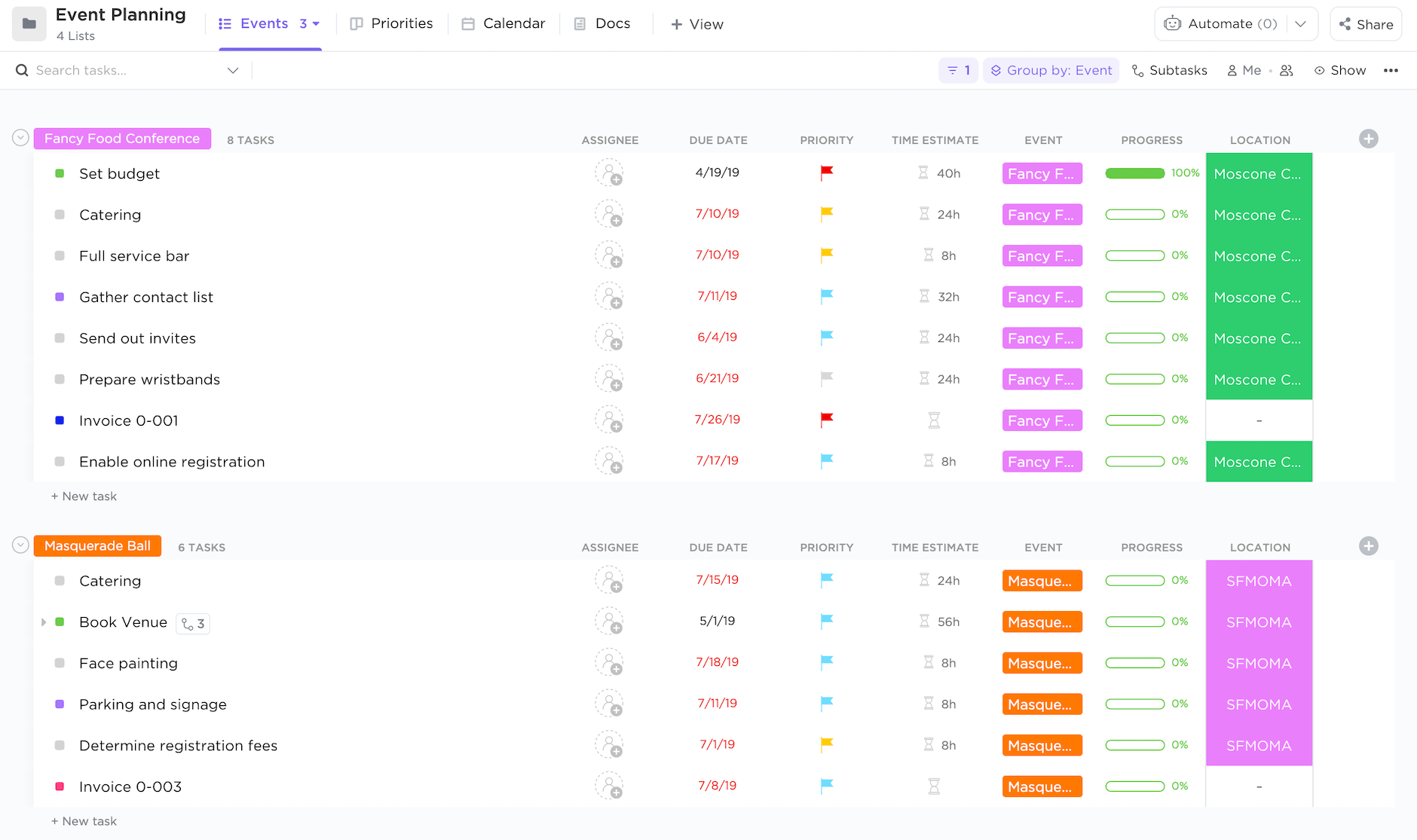
You can employ ClickUp’s Event Planning Template to plan all of these. It streamlines planning and execution with features designed to keep everything organized.
You can create customizable task lists to break down each event into clear, manageable steps. Real-time collaboration ensures everyone is updated, while automated reminders keep deadlines in sight. The user-friendly interface helps you track tasks, deadlines, and resources efficiently, ensuring your events go without a hitch.
Step 3: Collect feedback anonymously
Simply implementing better processes isn’t enough. You need to check if these changes are making a difference and make sure employees feel comfortable sharing their honest feedback.
That’s why it’s important to collect anonymous feedback.
In your anonymous survey, include a mix of closed-ended and open-ended questions like:
- What do you feel about workplace inclusion when it comes to team activities? Do you feel included in these?
- Do you think any groups in the office don’t allow others to enter their professional space?
- Are you working in a positive work environment? Why or why not?
You can use the feedback from these surveys to plan your next steps and make more informed decisions. To solve this issue, rely on ClickUp Forms.

It enables precise feedback collection by using conditional logic that adapts based on user responses. This way, you can easily turn feedback into actionable tasks, making it simpler to address any concerns or areas for improvement in your inclusion efforts.

You can also employ ClickUp’s Employee Feedback Template for similar use cases. It can:
- Manage communication gaps and gather feedback in a structured manner
- Encourage employees working remotely to participate in the feedback process with guaranteed changes on the horizon
- Provide a platform for anonymous and open conversations between employees and management
Another nifty feedback medium is ClickUp’s Employee Engagement Template, which lets you keep track of all your teammates’ needs, wants, goals, and shared personal info. You can also use it to run engagement surveys that provide clear, actionable insights into how your employees feel about their workplace.
Also Read: Performance Review Template
Step 4: Distribute opportunities equitably
It’s not uncommon to see certain team members always landing high-priority tasks while others get sidelined. You might also notice that some team members aren’t fully engaged in group projects, or their contributions go unnoticed.
To combat this, ClickUp’s Team View is an excellent tool for promoting inclusion and balancing workloads effectively.

With Team View, you can view your projects, tasks, and responsibilities in one place, making it easier to distribute work. You can assign tasks to individuals to ensure everyone has an equal opportunity to contribute.
You can even customize views to categorize tasks by tags that reflect team members’ skills and interests. For instance, if you tag tasks with specific skill sets or project types, team members can easily be matched with tasks that align with their preferences and career goals.
Step 5: Improve overall communication
You want information to flow freely, without the barriers of hierarchy or cliques causing miscommunication in the workplace.
ClickUp’s Chat View can help you engage your entire team and keep everyone in the loop.
Clear and open communication plays an essential role in any team’s success, so it’s important to establish transparent channels where everyone feels comfortable sharing their ideas and feedback.
Regular check-ins and updates ensure that everyone stays aligned with the project goals. Fostering a culture of active listening and responsiveness can build trust and keep your team connected.

With Chat View, you can:
- Share updates, link resources, and have a proper conversation with teammates
- Create non-work-related channels to foster a personal connection with peers
- Assign action items with @mentions to keep teams posted on the latest updates
Summarize this article for me pleaseDrive Inclusion and Belonging at Your Workplace with ClickUp
Addressing workplace exclusion is indispensable for boosting team morale and productivity while building a collaborative culture.
You can use ClickUp to help you transform your work environment into a more inclusive and supportive place. From setting goals to organizing team-building events, ClickUp makes it easy to keep everyone engaged and connected.
Sign up for ClickUp today!


Everything you need to stay organized and get work done.

Recent Articles
8 Communication Strategies That Actually Fix Team Chaos 
8 Communication Strategies That Actually Fix Team Chaos
ADHD Task Management: How to Build a System You’ll Still Use in a Month 
ADHD Task Management: How to Build a System You’ll Still Use in a Month

