







Still downloading templates?
There’s an easier way. Try a free AI Agent in ClickUp that actually does the work for you—set up in minutes, save hours every week.
Sorry, there were no results found for “”
Sorry, there were no results found for “”
Sorry, there were no results found for “”
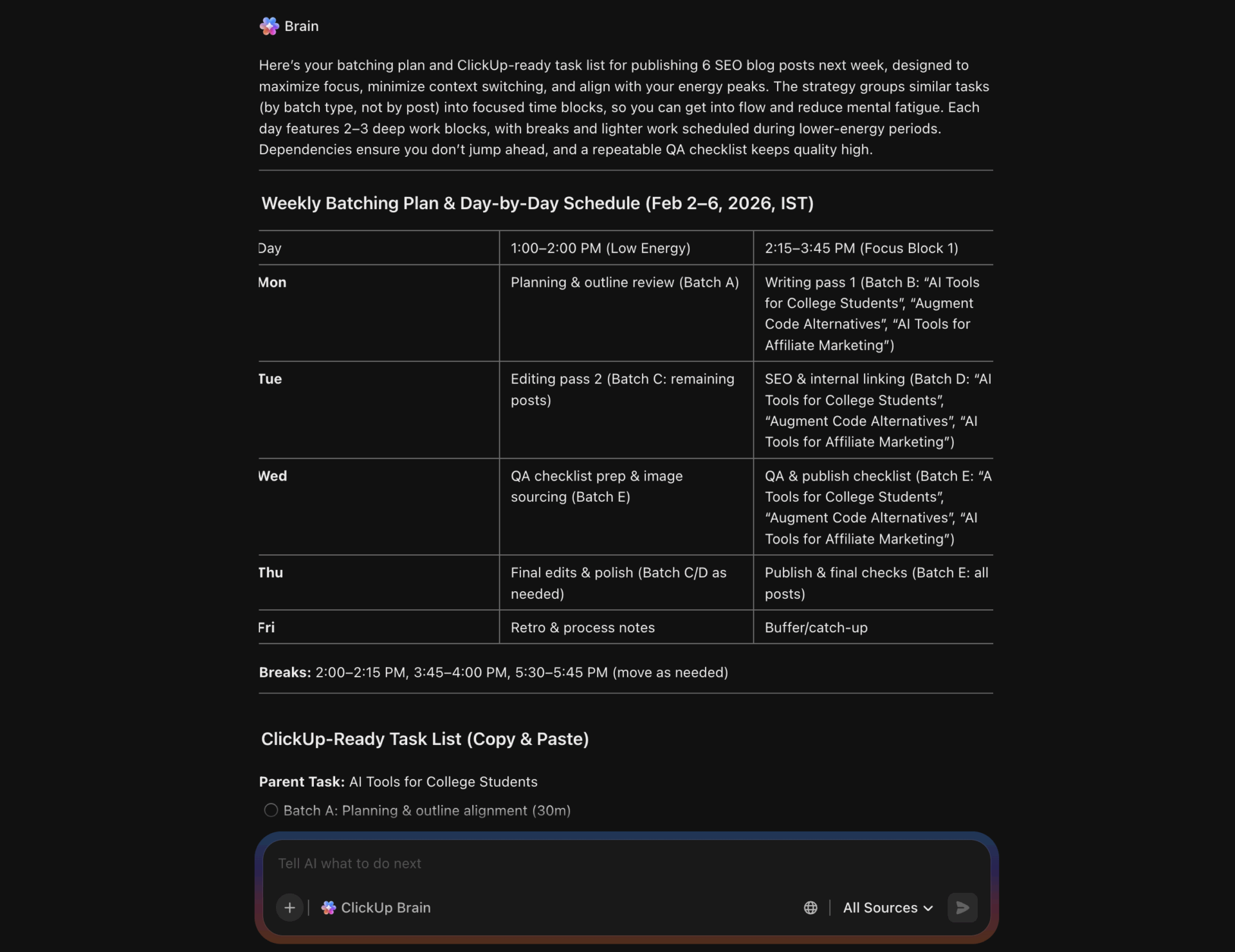
If you’re tired of scrambling to create content every single day, content batching is about to change your life. This guide walks you through everything you need to know about batching your content creation—from setting up your content pillars and planning your calendar to using ClickUp’s converged workspace to streamline your entire workflow in one place.
Most content creators know the daily grind: wake up, scramble to figure out what to post, create something rushed, and repeat tomorrow. This reactive approach drains creative energy and produces inconsistent results. Content batching offers a fundamentally different way to work.
Content batching is a productivity technique where you create multiple pieces of content in one focused session. Instead of writing a single social media post each day, you’d write all of your posts for the week in one go. This approach is built on the idea of grouping similar tasks together to get more done in less time.
Think of it like meal prepping for your content. You wouldn’t cook a brand new meal from scratch three times a day, right? You’d probably prep your ingredients or even full meals on a Sunday to save time during the week. Content batching applies that same logic to your creative work, helping you build a steady content pipeline without the daily scramble.
This method works by minimizing context switching—the productivity drain that happens when you jump between disconnected tools and tasks—like moving from writing to designing to filming. By dedicating focused blocks of time to a single activity, you stay in a state of flow and work more efficiently.
📮 ClickUp Insight: Context-switching is silently eating away at your team’s productivity. Our research shows that 42% of disruptions at work come from juggling platforms, managing emails, and jumping between meetings. ClickUp unites your workflows (and chat) under a single, streamlined platform—launch and manage your tasks from across chat, docs, whiteboards, and more while AI-powered features keep the context connected, searchable, and manageable.
The benefits of batching are a game-changer for any creator—especially when 40% of marketing executives plan to create 3-to-5 times more content in 2024. Understanding the psychology behind batching helps you commit to the approach even when it feels unfamiliar at first.
You reduce the mental drain from constantly shifting gears between different creative tasks. When you batch similar activities together, your brain doesn’t have to reload context with every new piece of content. The startup time for each individual post essentially disappears.
A well-stocked content pipeline means you never miss a posting day, keeping your audience engaged. When you’re not scrambling to create content at the last minute, you can maintain a regular publishing schedule that builds trust with your followers and algorithms alike.
The daily pressure of “what should I post?” disappears when your content is ready to go. Instead of waking up anxious about today’s content, you can focus on strategic thinking, community engagement, or whatever else moves your business forward.
With the logistics handled, you have more mental space to focus on creativity and strategy. Rushed content created under deadline pressure rarely matches the quality of content created in a focused, low-stress batching session.
You can produce a week’s or even a month’s worth of content in just a few focused batching sessions. This multiplier effect is what makes batching so powerful for scaling content production.
This technique is incredibly versatile and can be used for almost any type of content you can imagine, including social media posts, blog articles, videos, and graphics. For modern content creators and marketers juggling multiple platforms, it’s an essential strategy for staying ahead without burning out.
🔍 Did You Know? Marketers who document their content strategy are 313% more likely to report success than those who don’t. A well-planned content calendar isn’t just a nice-to-have—it’s a game changer.
A successful batch creation process turns chaos into a clear, repeatable system. It generally breaks down into three phases: planning, production, and distribution. By dedicating focused time blocks to each phase of this production workflow, you can create a large volume of high-quality content efficiently.
Before you write a single word, you need to know what you’re going to talk about. Content pillars are the core themes or topics that guide your content strategy. Think of them as three to five main subjects that your brand owns and that your audience cares about.
To identify your pillars, start by understanding your audience personas and what they need from you. Then, align that with your unique brand messaging. This ensures your content is always relevant and valuable.
Your pillars might look something like this:
Educational content includes how-to guides, tutorials, and tips that teach your audience a skill. This positions you as an expert and provides genuine value that keeps people coming back.
Entertaining content covers memes, relatable stories, and behind-the-scenes material that builds a connection. This humanizes your brand and creates the emotional engagement that drives sharing.
Promotional content highlights your products, services, or special offers. This is where you directly drive business results, but it should be balanced with value-first content.
Community-building content involves questions, polls, and user-generated content that encourages interaction. This creates two-way conversations and makes your audience feel like participants rather than passive consumers.
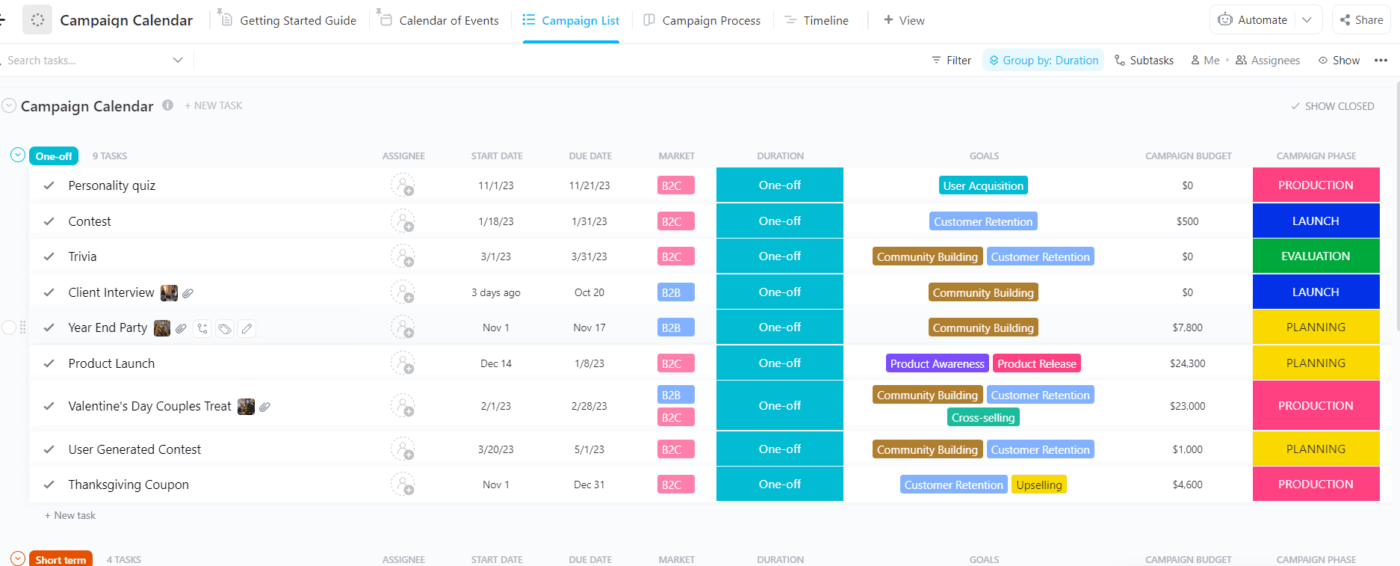
For example, a financial advisor might have pillars like “Investing 101,” “Debt-Free Living,” and “Retirement Planning.” Having these defined content themes makes ideation much easier because you’re no longer staring at a blank page. Instead, you’re simply filling in the blanks for each of your core topics.
Once your pillars are set, it’s time for batch planning. This is where you brainstorm specific ideas for each pillar and organize them into a content calendar. Your goal is to create a content backlog of ideas you can pull from at any time.
Start by brainstorming as many ideas as you can for each pillar. You can use techniques like mind mapping, researching trending topics, or analyzing what your competitors are doing. Don’t filter yourself at this stage—just get all the ideas down.
Next, organize these ideas into an editorial calendar. Decide on your posting cadence (how often you’ll post) and channel mix (which platforms you’ll use). For each idea, add key details to your list including the format (carousel, video, single image, or text post), the call-to-action you want your audience to take, the owner responsible for creating it, and the due date it needs to be ready.
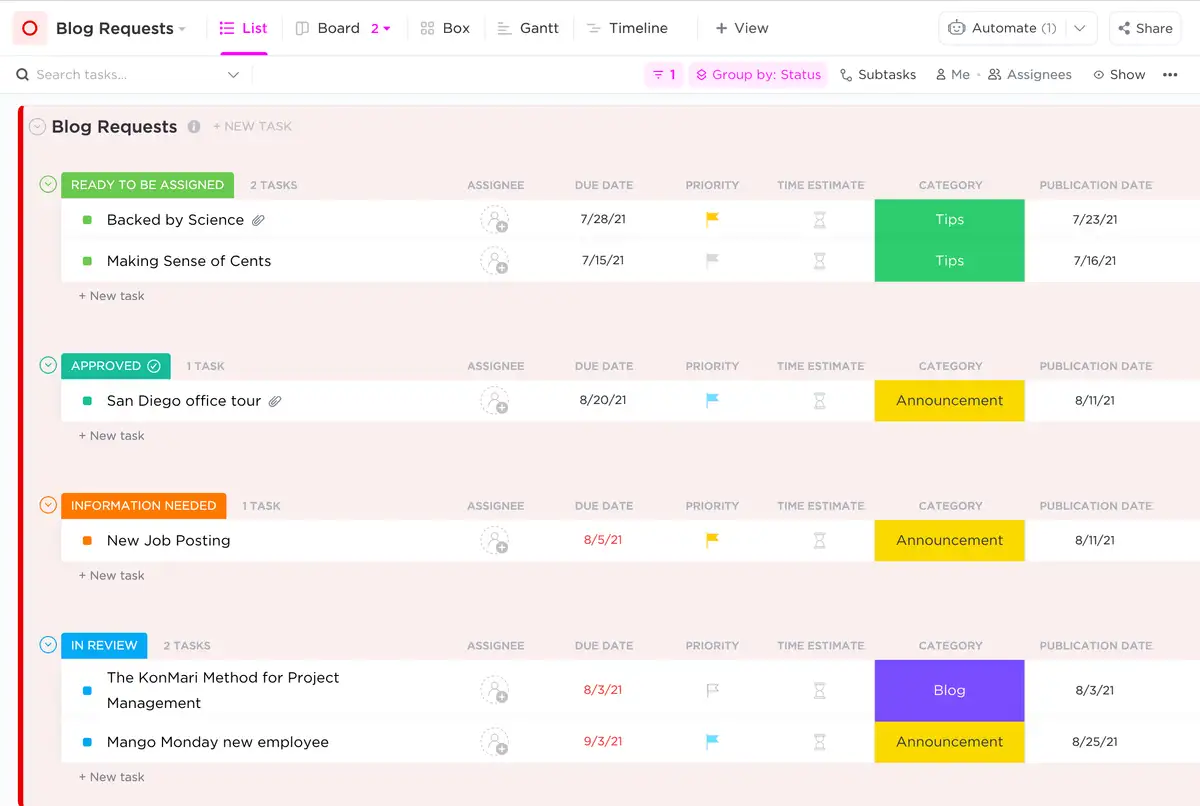
To make your batching even more efficient, think about creating a content series or campaign. This is where multiple posts work together around a single theme, allowing you to create a cohesive set of content all at once.
With your content list ready, block dedicated time for each production activity. Write all your captions in one session, design all your graphics in another, and film all your videos in a third. This keeps you in the same mental mode and makes you dramatically faster.
During each production batch, eliminate distractions completely. Close unnecessary tabs, silence notifications, and commit fully to the task at hand. The magic of batching happens when you can achieve deep focus without interruption.
Once your content is created, schedule everything in advance using your publishing tools. This final step completes the batching process and frees you from daily posting obligations. You can then focus on engagement and community management rather than content creation.\
📖 Also Read: How to Build a Content Creation Workflow
Adopting content batching is a great first step, but optimizing your process is what truly saves you from burnout. These strategies help you get even more from your batching sessions while protecting your creative energy.
Theme days are a classic time blocking technique where you dedicate specific days to specific tasks. For example, Monday could be for writing captions, Tuesday for filming videos, and Wednesday for designing graphics. This helps you avoid context switching and get into a deep state of focus that produces your best work.
Stop reinventing the wheel every time you create a post. Build a library of reusable templates for different formats like quote graphics, carousels, or video intros. This way, you just need to drop in the new content and go. Templates also ensure brand consistency across all your content.
Get more mileage out of every idea. A single blog post can be repurposed into five social media posts, a short video script, and a section for your email newsletter. This multiplies your output without multiplying your effort—and it reinforces your message across channels.
Decide on a timeline that works for you. Macro batching involves creating content for a whole month or quarter at once, which is great for building a buffer and reducing ongoing stress. Micro batching focuses on creating content for the upcoming week, offering more flexibility to react to trends and current events. Most creators find success with a hybrid approach.
Pay attention to your creative energy levels throughout the day and week. Schedule high-focus tasks like writing and strategy during your peak hours when your mind is sharpest. Save lower-energy tasks like scheduling posts or organizing your asset library for times when you’re not feeling as creative.
Instead of writing, designing, and scheduling one post at a time, do all your writing at once. Then, do all your designing. Finally, do all your scheduling. This keeps you in the same mental mode, making you faster and more efficient while reducing the cognitive load of switching between different types of work.
Finally, be realistic. If you’re new to batching, don’t try to create three months of content in one weekend. Start with one week’s worth and build from there. The goal is to reduce stress, not create more of it with unrealistic expectations.
💡 Pro Tip: Block your highest-energy hours for creation and your lowest-energy hours for administrative tasks like scheduling and organizing. Your creative output will be dramatically better when you respect your natural energy rhythms.
The biggest challenge with content batching is often the work sprawl—the fragmentation of work across multiple disconnected tools—where your ideas are in one app, your drafts in another, and your calendar in a third. This tool-switching chaos undermines the efficiency gains you’re trying to achieve with batching.
Eliminate tool-switching chaos and bring your entire production workflow into one place with ClickUp, the world’s first Converged AI Workspace—a single platform where projects, documents, and conversations live together with AI as the intelligence layer that understands your work.
Overcome writer’s block and generate fresh ideas instantly with ClickUp Brain. This powerful AI assistant is built directly into your workspace to help you brainstorm topics, write social media captions, or create detailed content outlines. Because it has the context of your workspace, the suggestions are always relevant to your brand and ongoing projects.
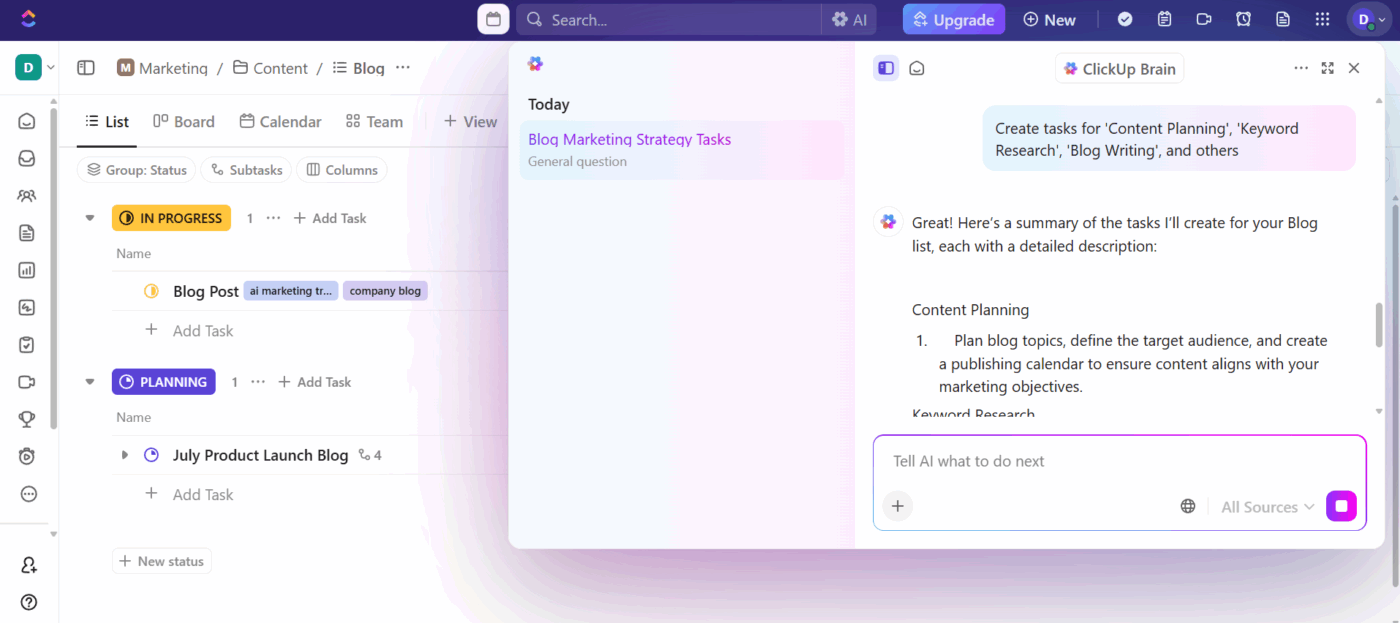
Just type @brain in any task comment or ClickUp Docs to get help brainstorming topics for your content pillars, writing social media captions, or creating detailed content outlines. You’ll join the 81% of marketers already using AI to streamline content creation tasks.
📮 ClickUp Insight: 37% of knowledge workers use AI for content creation, including writing, editing, and emails. However, this process usually involves switching between different tools, such as a content generation tool and your workspace. With ClickUp, you get AI-powered writing assistance across the workspace, including emails, comments, chats, Docs, and more—all while maintaining context from your entire workspace.
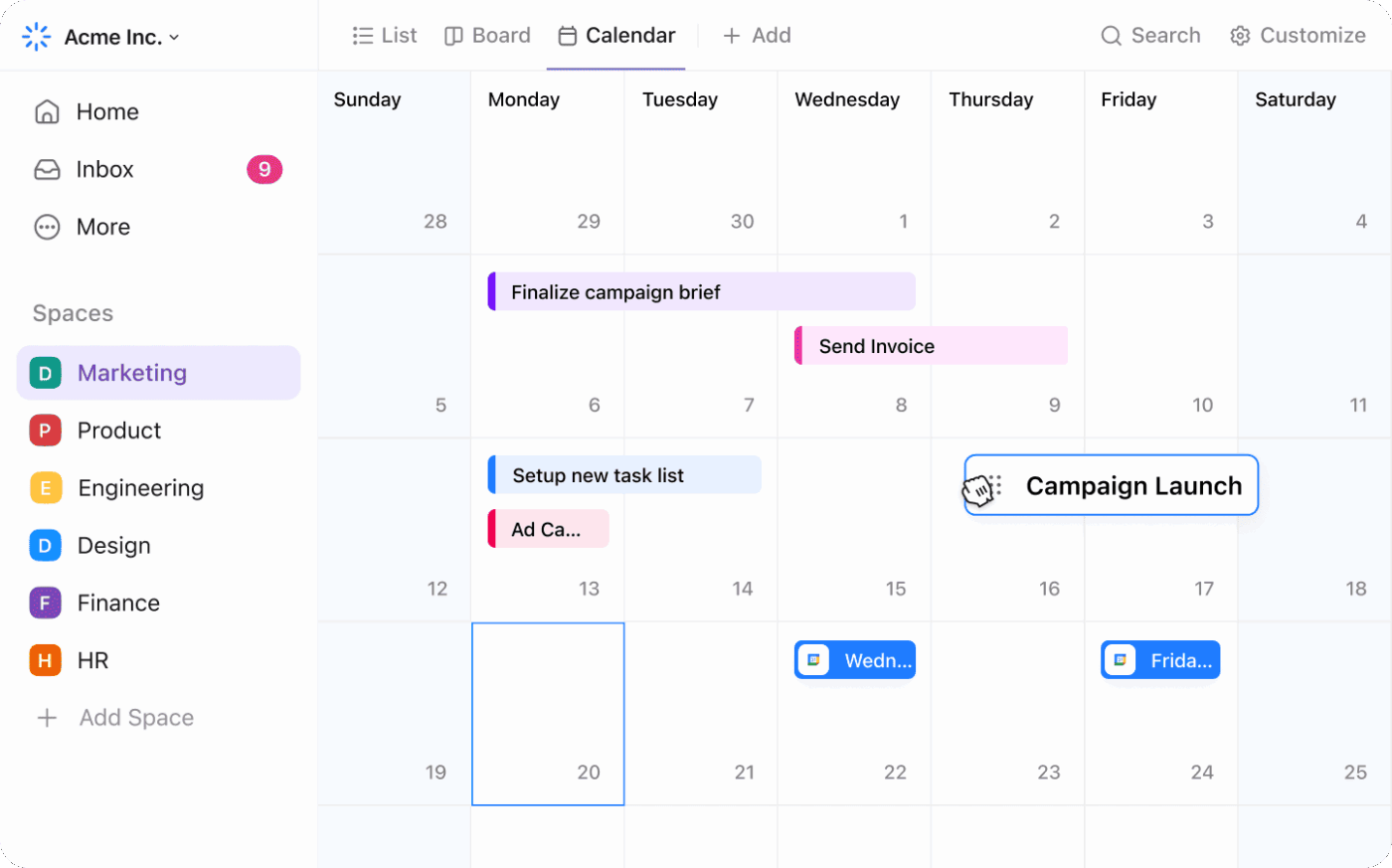
Get a bird’s-eye view of your entire publishing schedule with ClickUp Calendar View. Stop guessing what’s coming next and see your whole month at a glance. Easily drag and drop tasks to reschedule posts, switch between views, and color-code your content to quickly identify gaps in your editorial calendar.
Keep every detail organized and stop letting important information get lost in the shuffle with ClickUp Custom Fields. Add fields to your tasks to track essential data like the target platform, content type, and status. You can create dropdowns for formats, number fields for engagement metrics, or people fields to assign tasks to your team.

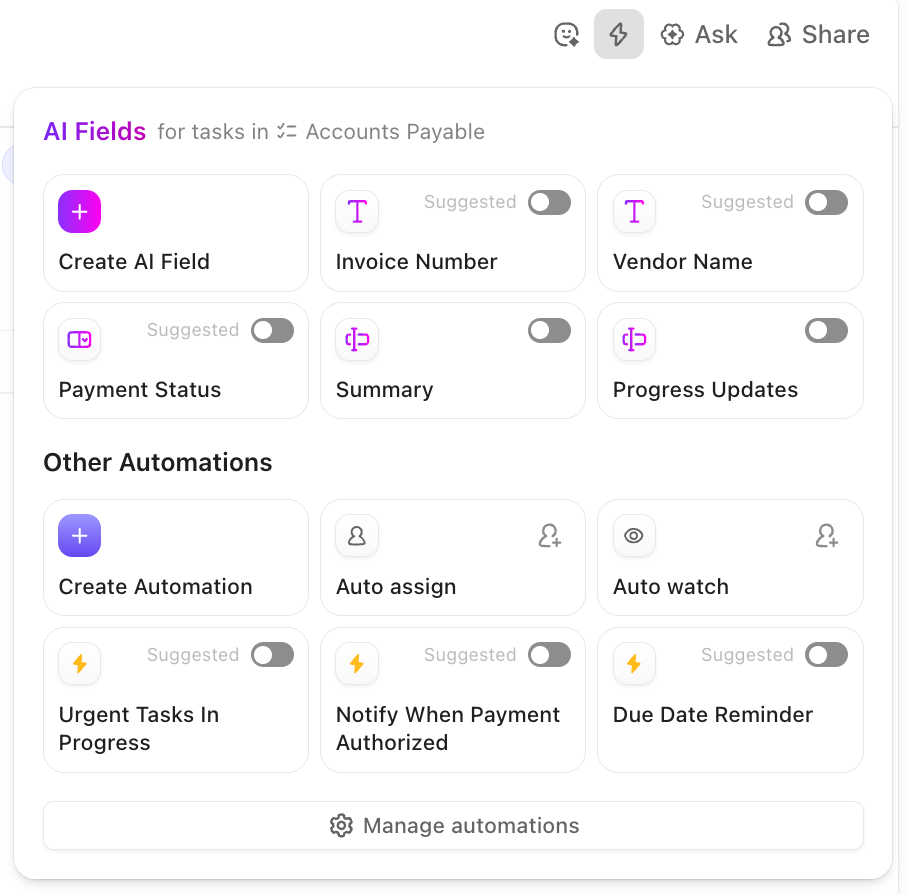
Move content from idea to published post without manual handoffs with ClickUp Automations. Set up rules to automatically update a task’s status, notify a team member when a piece is ready for review, or create recurring tasks for your weekly content series. These automations handle the busywork, so you can focus on creating.
✨ Real Results: Lulu Press saves 1 hour per day, per employee using ClickUp Automations—leading to a 12% increase in work efficiency. Imagine reclaiming that time for actual content creation.
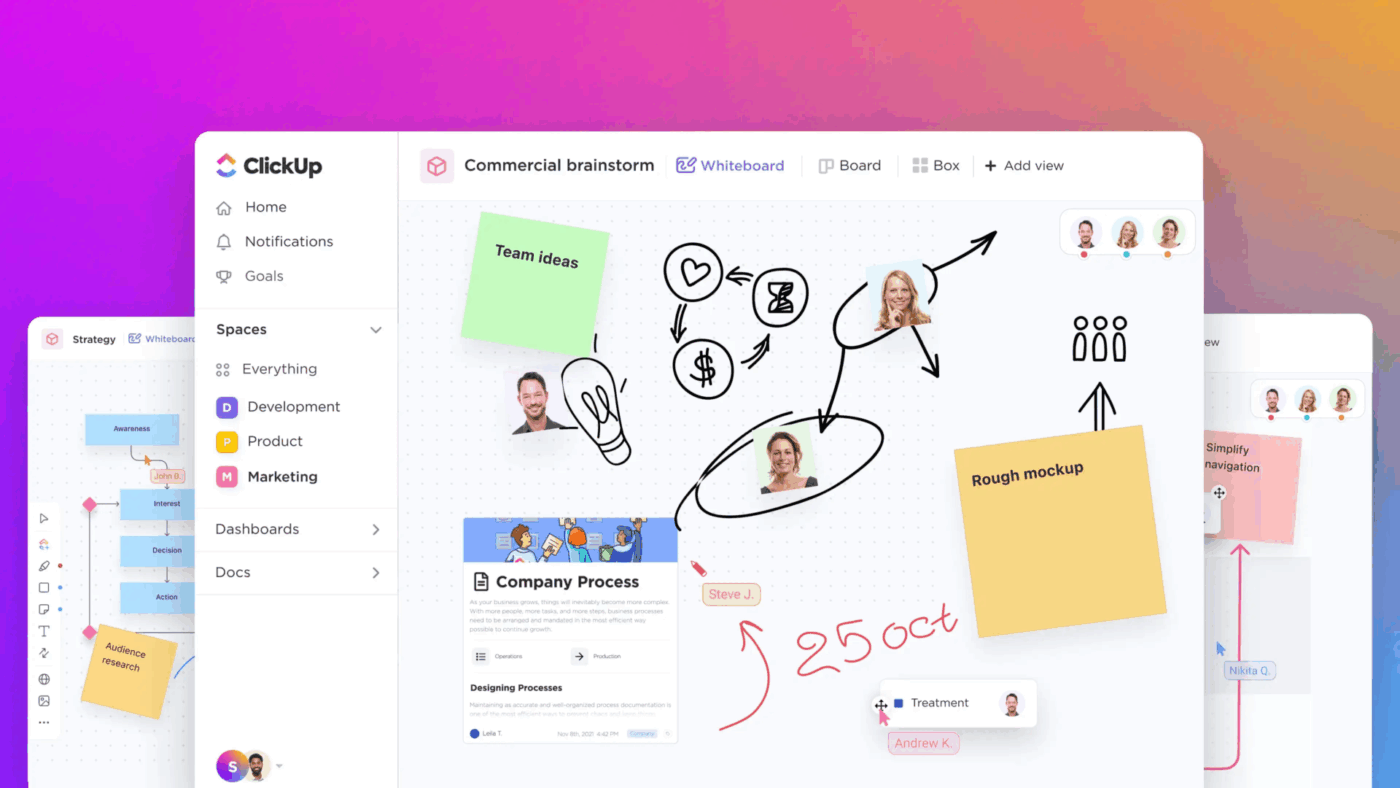
Map out your content strategy visually and brainstorm your next big campaign with ClickUp Whiteboards. This flexible canvas is perfect for creating mind maps of your content pillars, sketching out visual concepts, or building collaborative flowcharts. Your team can add ideas on digital sticky notes and connect concepts in real-time.
Jumpstart your workflow and stop building from scratch with ClickUp Templates. The ClickUp’s Content Calendar Template comes pre-configured with Custom Fields for tracking platforms and statuses, plus a Board View to visualize your pipeline. See every piece of content move through stages with a simple drag-and-drop interface.
Each card in the content calendar template represents a task, such as a blog post, social media update, or video, and displays key information, including the content channel, category, and publish date.
Additional templates like the Social Media Calendar Template and Content Marketing Editorial Calendar Template help you manage specific content types with purpose-built workflows.
Content batching transforms the daily scramble into a systematic, stress-free approach to content creation. By grouping similar tasks together, establishing clear content pillars, and working in focused production sessions, you can create more content in less time while maintaining higher quality.
The key is finding the right tools to support your batching workflow. When your ideas, drafts, calendar, and team communication all live in separate apps, you lose the efficiency gains that batching is supposed to provide.
Get started for free with ClickUp and discover how a converged workspace eliminates tool sprawl while multiplying your content productivity.
How often should I batch my content? Most creators find success with weekly or bi-weekly batching sessions. Start with batching one week of content at a time, then gradually extend to two weeks or a month as you get comfortable with the process. The right cadence depends on your content volume, how quickly your industry changes, and your personal creative rhythm.
What’s the difference between macro and micro batching? Macro batching involves creating content for a month or quarter at once, providing a large buffer against unexpected schedule changes. Micro batching focuses on the upcoming week, offering more flexibility to respond to trends and current events. Many successful creators use a hybrid approach—macro batching evergreen content while micro batching timely pieces.
How do I maintain quality when creating content in batches? Quality actually tends to improve with batching because you’re creating in a focused, low-pressure environment rather than scrambling at the last minute. The key is to build review time into your process—don’t publish immediately after creation. Let content sit for a day, then review with fresh eyes before scheduling.
What tools do I need to start content batching? At minimum, you need a system for organizing ideas, a calendar for scheduling, and storage for your content assets. However, using multiple disconnected tools creates the same context-switching problems batching is meant to solve. A converged platform like ClickUp that combines all these functions in one place maximizes your batching efficiency.
How do I handle trending topics if all my content is pre-planned? Build flexibility into your batching system by leaving 20-30% of your content calendar open for timely, reactive content. This gives you room to respond to trends while maintaining the efficiency of your batched content. You can also keep a backlog of “evergreen” content that can be moved or replaced when something timely comes up.

© 2026 ClickUp

There’s an easier way. Try a free AI Agent in ClickUp that actually does the work for you—set up in minutes, save hours every week.