
Sorry, there were no results found for “”
Sorry, there were no results found for “”
Sorry, there were no results found for “”
Most people comparing Bear and Evernote already know the basics. Bear is for Apple diehards who want a clean Markdown surface. Evernote is for cross-platform users who need a digital filing cabinet with OCR search.
The harder question is why so many heavy note-takers end up running both within six months. Bear for writing, Evernote for storage. Two subscriptions, two systems, nothing that talks to the other.
That’s the capture/retrieval gap. It’s not a missing feature in either app. It’s a structural problem in how most note-taking tools are built. This guide picks between Bear and Evernote on the merits, then names when neither is the right answer.
Short answer: Pick Bear if you live entirely on Apple devices and want the fastest, cleanest Markdown writing surface available. Pick Evernote if you need cross-platform sync, OCR search inside images and PDFs, and a Web Clipper that actually works. If you’re running both because each one solves only half your problem, the issue is not tool choice. It’s the capture/retrieval gap, and we cover how to close it below.
The table below is a direct comparison only. We cover ClickUp separately in its own section.
| Feature | Bear | Evernote |
|---|---|---|
| Editor type | Markdown with inline rendering | Rich text (WYSIWYG) |
| AI features | None | AI writing assistant, AI search (paid tiers) |
| Organization | Nested hashtags | Notebooks, notebook stacks, tags |
| Search | Text search with operators | OCR inside images, PDFs, and handwriting |
| Platform | macOS, iOS, iPadOS only | iOS, Android, Windows, macOS, web |
| Collaboration | None (single-user) | Shared notebooks (paid tiers) |
| Web Clipper | None (third-party only) | Native on Chrome, Safari, Firefox, Edge |
| Table support | No | Yes |
| Templates | None | Native template gallery |
| Free tier | Yes, local-only, single device | Yes, with hard caps on uploads and devices |
| Starting paid price | $2.99/month | $14.99/month |
| G2 rating | 4.5/5 (45+) | 4.3/5 (2,000+ reviews) |
Our editorial team follows a transparent, research-backed, and vendor-neutral process, so you can trust that our recommendations are based on real product value.
Here’s a detailed rundown of how we review software at ClickUp.
Bear is a Markdown-first writing app built by Shiny Frog, designed exclusively for macOS, iOS, and iPadOS. It uses nested hashtags instead of folders and renders Markdown inline as you type.
Solo Apple users: writers, students, researchers, and developers who want a Markdown editor that stays out of the way. If anyone in your workflow uses Android or Windows, Bear is not an option.
Inline Markdown rendering. Bear renders headings, bold, italics, code blocks, and links as formatted text as you type. No split-pane preview. It supports CommonMark and Polar Bear (Bear’s extended syntax).
Nested hashtag organization. Type #work/projects/Q4 inside a note and Bear builds a collapsible tag hierarchy in the sidebar. A single note can live in multiple tag trees. This is more flexible than rigid folders and faster than drag-and-drop filing.
Focus mode. Hides the sidebar and note list, dims everything except the current line. Combined with Bear’s clean three-column layout, it creates one of the most distraction-free writing surfaces in the category.
Encrypted notes. Individual notes can be locked with a password, Face ID, or Touch ID. Useful for journals, credentials, or anything sensitive.
Export portability. Bear exports to PDF, DOCX, HTML, Markdown, JPG, and plain text. Notes are not trapped in Bear’s format.
Free: Local notes on a single Apple device. No iCloud sync
Bear Pro: $2.99/month.
A G2 reviewer said:
The ease of use that bear enables for simple note-taking while giving the ability to stay organized with easy tags and cloud sync is key.
Editorial takeaway: Bear’s design quality is genuinely exceptional. But the Apple-only constraint is not a footnote. For many users, it becomes the reason they eventually migrate.
Bear has no Android, Windows, or web app. It has no built-in AI, no native integrations beyond Apple Shortcuts, no collaboration, and no table support. Search is limited to typed text. Scanned documents and image-based notes are invisible to it.
Apple-only solo writers who want the cleanest Markdown surface available for under $30 a year.
Anyone on your team uses Android or Windows. Or if you need to search inside images and PDFs. Or if you need any form of real-time collaboration.
Evernote launched in 2008 as a digital filing cabinet for capturing everything: web pages, PDFs, images, audio, and typed notes. It makes all of it searchable, including text inside images. Bending Spoons acquired Evernote in 2022 and has since stabilized the platform after years of ownership and performance issues.
Cross-platform individuals and small teams who clip and scan more than they write. Researchers, journalists, consultants, and sales professionals who capture content from dozens of sources and need to find it months later.
Web Clipper. Evernote’s browser extension saves full pages, simplified articles, screenshots, or selected text directly into notebooks. It preserves formatting, adds the source URL, and lets you annotate before saving. No other note-taking app matches it in this category.
OCR search. Evernote indexes text inside images, scanned documents, handwritten notes, and PDFs. Photograph a whiteboard or a business card and search for words in that image six months later. This is Evernote’s single strongest differentiator.
Templates. A native gallery of pre-built templates for meeting notes, project plans, and habit trackers. Reduces setup time for recurring note types.
Audio notes. Record audio inside a note, useful for lectures, interviews, and voice memos alongside typed context.
Cross-platform sync. Evernote runs on iOS, Android, Windows, macOS, and web. Notes sync across all devices.
A G2 reviewer said:
I can have a simple to do list as one note and the next note be a working project budget that I can share and collaborate with additional individuals.
Editorial takeaway: Evernote’s 2026 product is meaningfully better than its 2020 version. But the pricing model punishes anyone who wants to test it before committing. If you need to evaluate Evernote seriously, plan to pay from day one.
The free tier caps at one device and 60MB of monthly uploads. Most users hit that cap within a week. Paid plans are expensive relative to Markdown alternatives. AI features work only inside Evernote’s editor and search, not across external tools. The UI carries 17 years of accumulated features and is heavier than minimalist alternatives.
Cross-platform users who clip, scan, and photograph more than they type, and who need to find that content reliably months later.
You only write text-based notes (Bear or a Markdown editor will be faster and cheaper). Or your team needs notes connected to tasks, projects, and assignees.
| Plan | Bear | Evernote |
|---|---|---|
| Free | Local-only, single Apple device | 1 device, 60MB/month uploads, 25MB note size |
| Entry paid | $2.99/month (Pro) | ~$14.99/month |
| Mid-tier | Not offered | $24.99/user/month |
| Team plan | Not offered | Custom |
| Annual option | $29.99/year | Varies, typically 20-30% off monthly |
Evernote costs roughly five times more than Bear at entry level. Bear’s lower price reflects its narrower scope: it’s a single-user Apple writing app. There is no team plan at any price. Evernote’s higher cost reflects its broader feature set and cross-platform infrastructure.
Pick Bear if:
Pick Evernote if:
Pick neither if:
Note-taking apps have split into two camps. One camp optimizes for capture: how fast you get an idea from your head into the system. Bear, Apple Notes, and Drafts live here. The other camp optimizes for retrieval: how reliably you find that idea months later. Evernote, Obsidian, and Notion live here. Almost no tool does both well.
The cost of that gap is real. According to ClickUp’s 2025 Knowledge Management Survey of over 1,000 professionals, the average knowledge worker spends 30 or more minutes per day searching for work-related information. That’s over 120 hours a year. One in five professionals spends three or more hours daily just looking for files, messages, or context on their tasks. And 74% use two or more tools just to find the information they need.
The “second tool” is not a feature gap. It’s a workflow gap. The note was written. It just never connected back to the work it was supposed to inform.
Most heavy note-takers end up running a two-tool stack: one fast capture app and one heavy storage app. The two apps don’t talk to each other. The workflow cost is invisible until you notice how much time goes toward searching for something you definitely wrote down.
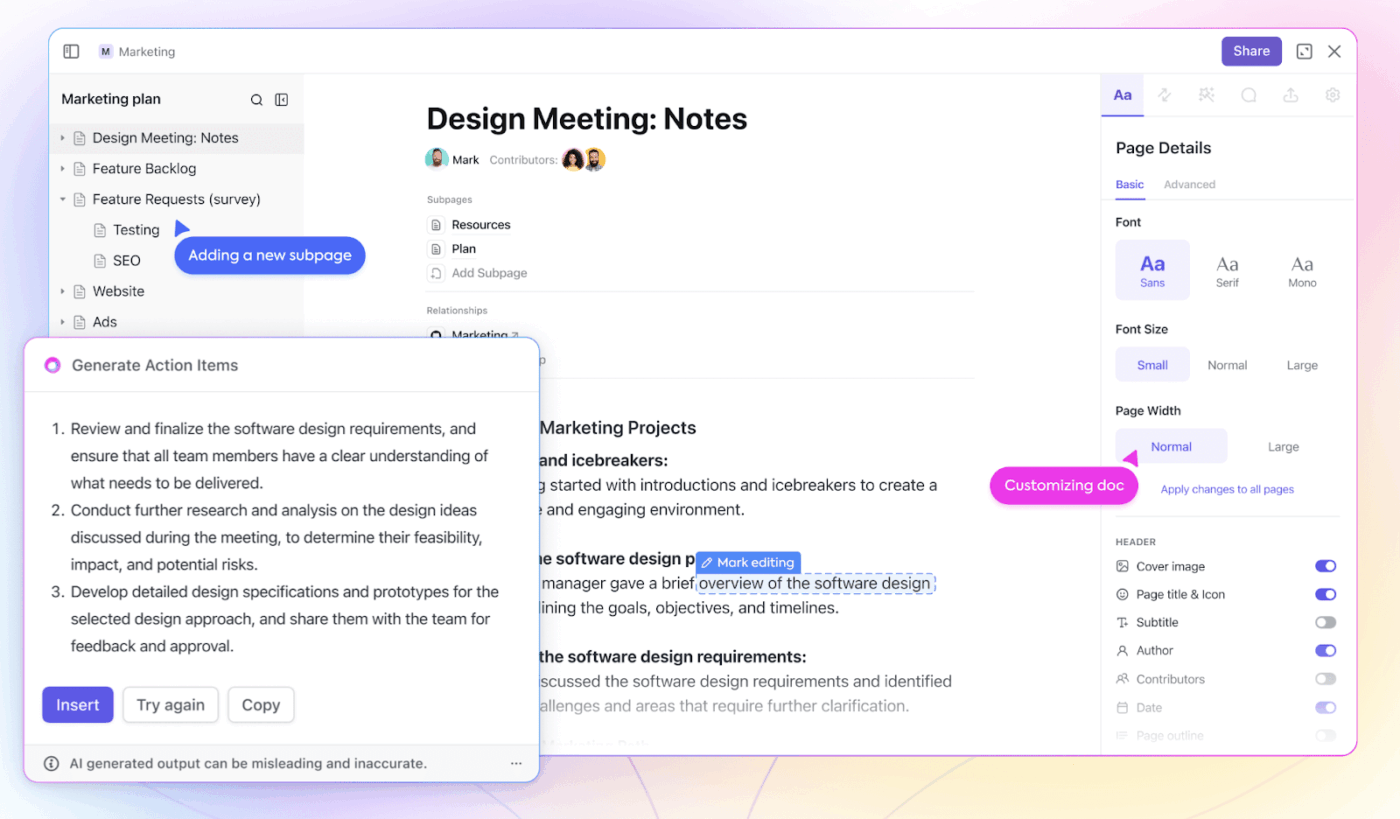
Why this matters: A note’s value is not in being written. It’s in being acted on. Bear and Evernote treat notes as the destination. ClickUp treats notes as the start of a workflow.
ClickUp Notepad is a lightweight scratch pad accessible from anywhere in the workspace. Any line in Notepad becomes a ClickUp Task in one click. It gets an assignee, a due date, and a parent project automatically. The “I’ll deal with this later” problem stops at capture instead of turning into a retrieval problem.
ClickUp Docs handles long-form writing with nested pages, real-time collaborative editing, slash commands, and embedded tasks. Every Doc lives inside your project hierarchy. A meeting note in Docs is already connected to the project, the timeline, and the people it belongs to. For teams moving from Evernote, ClickUp’s native Evernote integration preserves notebooks, tags, and attachments.
ClickUp Brain answers natural-language questions across notes, tasks, comments, and chat. Ask “What did the design team decide about the homepage?” and get an answer pulled from meeting notes, task comments, and docs across your entire workspace. That’s the retrieval half of the gap, and it works because every Doc and Notepad entry sits inside the same workspace as the tasks they relate to.
Honest trade-off: ClickUp is a heavier tool than Bear. For a solo writer who wants a clean Markdown surface with no setup, Bear is faster and lighter. ClickUp’s value grows as workflows scale or as teams consolidate tools. There is a real learning curve coming from a single-purpose notes app.`
A Reddit user said:
I have spent so much time flip-flopping between note apps and to-do apps and concluded that sometimes the easy answer is the best.
Bear is simple, secure and cheap. Done. Dusted.Things works, looks great and links with Bear.
Editorial takeaway: Bear’s appeal is its lack of friction. Reddit users who like it usually praise the same things: simplicity, privacy, low cost, and how well it fits into an Apple-first workflow. The tradeoff is still clear, though. Bear works best when the user is already committed to Apple devices.
A Reddit reviewer said:
Whether Evernote is still worth it for a new user depends on your specific needs and preferences. Evernote is a popular note-taking and organization app that has been around for many years, and it continues to be a valuable tool for many users.
Editorial takeaway: Evernote still has strong brand trust because it has been around for years and serves broad note-taking, clipping, and organization needs. But Reddit discussions rarely treat it as an automatic recommendation anymore. Users usually qualify the praise with “it depends,” especially around price, performance, and whether a new user really needs Evernote’s heavier feature set.
A Reddit user said:
I’ve rocked with Evernote for over ten years, withstanding a lot of frustrations during that time. But I could never find another app that meets my needs. I tried Bear, Ulysses, and others. Now, after this latest update, I think I’m done. Unless Evernote drastically improves immediately, I’m leaving the platform this summer.
Editorial takeaway: Long-time Evernote users often stay because no other app fully matches their workflow, even when they are frustrated. That loyalty is fragile. Reddit comments show that major updates, pricing changes, or workflow disruptions can push even decade-long users to reconsider alternatives like Bear or Ulysses.
Bear is better than Evernote for writing. Its inline Markdown editor renders headings, bold, code blocks, and links as you type, with no toolbar. Evernote’s WYSIWYG editor supports more content types but is slower for pure prose. If your primary use is writing rather than clipping or scanning, Bear is the faster, cleaner tool.
Bear is built by Shiny Frog, a small Italian studio that has focused exclusively on the Apple ecosystem since Bear launched in 2016. There is no Windows app, Android app, or web client, and no public roadmap for one. Users who move away from Apple hardware lose access to their notes unless they export first.
Evernote is worth using in 2026 for cross-platform users who need OCR search and a reliable Web Clipper. Since Bending Spoons acquired Evernote in 2022, the platform has stabilized and shipped meaningful updates including AI writing tools. The free tier caps at one device and 60MB monthly uploads. Plan to pay from day one if you want to evaluate it properly.
Bear and Apple Notes are both Apple-only and free to start. Bear adds inline Markdown rendering, nested hashtag organization, encrypted notes, and export to PDF, DOCX, HTML, and Markdown. Apple Notes is free with no subscription and supports basic tags and formatting. Bear Pro costs $2.99/month. It is worth it if you write in Markdown regularly. Apple Notes is the stronger default if you do not.
Yes. Evernote exports notes as .enex files. Bear imports .enex files directly, preserving note content and tags. Formatting and attachment fidelity vary, and large migrations may require manual cleanup. For teams moving to a shared workspace, ClickUp’s native Evernote import preserves notebooks, tags, and attachments more completely.
Correct. Evernote’s rich-text editor supports tables natively. Bear’s Markdown implementation does not support table syntax. If tables are important to your workflow, Bear is not the right choice.
Bear Pro costs $2.99/month. Evernote Starter costs approximately $14.99/month. That makes Evernote roughly five times the entry price of Bear. Evernote’s higher cost reflects OCR search, cross-platform sync, a template gallery, and AI tools. Bear’s lower cost reflects its scope as a single-user Apple writing app.
For students writing essays, lecture notes, and study guides on Apple devices, Bear is faster and cheaper. For students who scan textbook pages, photograph whiteboards, or use both a phone and a Windows laptop, Evernote’s OCR and cross-platform sync are the deciding factors. Cost favors Bear significantly ($29.99/year versus roughly $180/year for Evernote Personal).

Arya P Dinesh
Max 18min read
Arya P Dinesh
Max 20min read

Praburam Srinivasan
Max 45min read

© 2026 ClickUp




