
Sorry, there were no results found for “”
Sorry, there were no results found for “”
Sorry, there were no results found for “”
The last stretch of a construction project involves more than just finishing the build—it also requires a smooth handover. After months or even years of work, the pressure is on to get everything right.
This makes the construction project handover checklist the backbone of a smooth transition.
Such a checklist ensures that all documentation, warranties, and operational details are properly transferred to the owner. If overlooked, this may lead to costly delays, miscommunication, or even legal disputes.
This blog will discuss the key elements of creating a thorough construction project handover checklist for a seamless turnover. Let’s get started!
🔍Did you know? The global residential construction market size is projected to achieve a market size of USD 8,308 Billion by 2032.
A construction project handover is the official transfer of a completed project from the contractor to the owner. It involves handing over all necessary documents, such as operation manuals, warranties, compliance certificates, and maintenance plans.
This step in your construction project management ensures the owner has everything needed to operate and maintain the building efficiently.
A thorough handover process ensures a smooth transition from construction to operation. It helps in:
Skipping this step or doing it poorly can lead to safety risks and expensive legal consequences. This can affect the contractor’s reputation and the owner’s ability to manage the building efficiently.
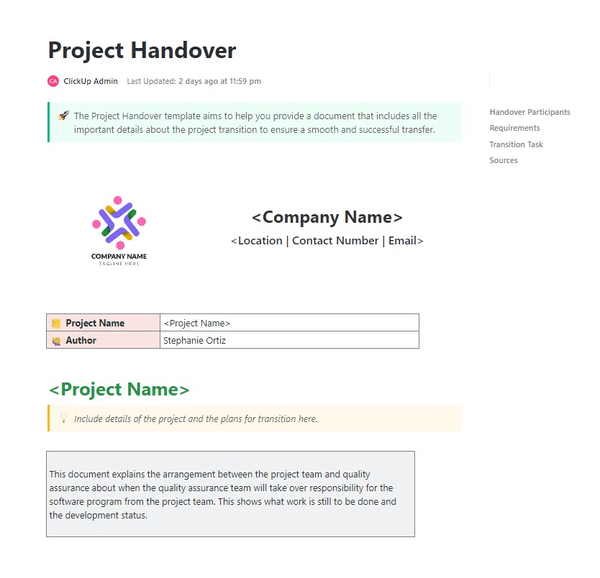
Use ClickUp’s Project Handover Template to streamline final deliverables. It’s perfect for construction teams as it ensures no task, document, or deadline falls through the cracks.
Construction project managers often face obstacles that can derail the process if not properly addressed. Three of the major challenges include:
Project teams often rush to meet deadlines and must pay more attention to critical paperwork, such as maintenance logs, compliance certificates, or system manuals. These are necessary for the owner to operate the building efficiently.
📌Example: A hotel with proper HVAC operation guides could avoid extended downtime when systems fail, as maintenance teams would need to know the specifications for quick repairs.
It often occurs when documentation is done late, and teams are too stretched to ensure all documents are ready.
Handovers can fall apart when there’s poor project coordination between the contractor, project manager, and owner. These gaps usually occur in complex projects with many subcontractors involved, where information doesn’t always flow smoothly between different teams.
Last-minute project pressure often leads to minor defects being overlooked or rushed fixes that don’t hold up long-term.
📌Example: A poorly installed water system might not show issues immediately but could lead to leaks weeks after handover. This leads to expensive repairs and potential property damage.
Such scenarios happen when quality control isn’t well planned due to time limits or final inspections aren’t conducted before the handover.
If not managed correctly, the challenges mentioned above can lead to chaos. This necessitates a thorough checklist to ensure a smooth construction project handover.
Here’s why a checklist is so important:
With so many moving parts, it’s easy to overlook critical paperwork. A checklist guarantees that every project handover document—an operation manual or a maintenance guide—is accounted for and handed over to the owner.
Overall, it helps prevent future operational issues or costly delays.
Construction projects involve multiple teams—from contractors to owners. A checklist ensures everyone is on the same page and no one misses any information. It keeps everyone coordinated during the final stages, reducing the risk of confusion or errors.
It’s easy to miss minor defects when rushing to finish a project. A handover checklist includes detailed checks for snags and defects, ensuring they’re addressed before the project is completed.
This proactive approach minimizes disputes and prevents issues from escalating post-handover.
When you run behind the project schedule, there’s a temptation to rush the handover. A checklist ensures that nothing important is skipped, even when pressed for time.
It allows you to meet your deadline while maintaining the quality and thoroughness expected by the client.
💡 Pro Tip: To ease the handover process and ensure nothing is missed, consider using project handover templates tailored to specific areas, such as documentation, defect tracking, and system handover.
A well-structured construction handover checklist covers everything from construction management terms to detailed system documentation for a smooth transition.
Here are the key components of a construction handover checklist:
These documents show the final construction as completed, including any changes made during the project. Accurate as-built drawings can help the owner avoid confusion or costly mistakes when repairing any part of the building.
O&M manuals provide detailed instructions on maintaining HVAC, electrical, and plumbing systems.
These manuals are crucial for the facility’s long-term performance. Without them, the owner could experience considerable operational downtime.
The handover should include all relevant warranties for materials, equipment, and work completed. These documents protect the owner in case of defects or issues, allowing the owner to avoid unnecessary out-of-pocket repair expenses.
Every construction project must meet certain regulatory standards—from safety codes to environmental regulations. Compliance certificates confirm that the building meets all required standards. Without these approvals, the owner could face legal complications down the road.
A clear snag list details any minor issues or defects that must be addressed before completing the project. It ensures they are resolved promptly, preventing them from becoming larger problems.
Training the facility management team is essential if the project involves complex systems, such as automated building controls or specialized equipment.
This part of the handover checklist confirms that the staff has received proper training to maintain the building successfully.
Read More: Create your snag/punch list seamlessly with these 10 Free Punch List Templates to Streamline Your Construction Projects
A successful handover process requires careful planning and attention to detail. Below are essential steps to ensure you don’t miss the smallest details.
Let’s begin!
Identify key deliverables, stakeholders, and timelines for completion. Develop a comprehensive handover checklist that covers all aspects of the project, including:
Consider using an all-in-one productivity platform like ClickUp to make this construction process efficient.
This platform lets you manage documentation, task tracking, and communication in one place, reducing the stress and confusion often associated with project handovers.
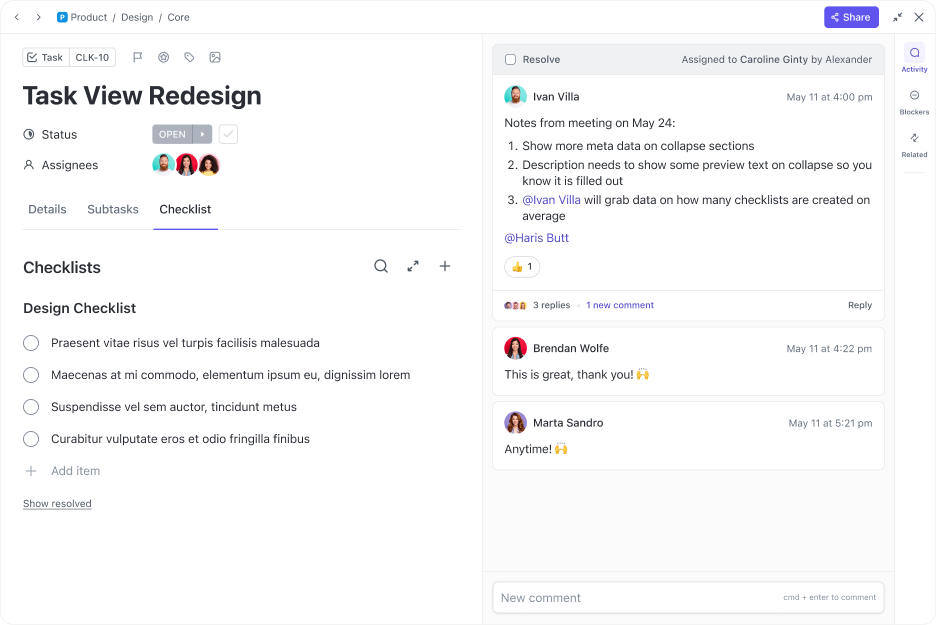
For instance, the ClickUp Task Checklists allows you to break down complex tasks into manageable sub-items, ensuring nothing is overlooked.
It lets you assign specific checklist items to team members, clearly indicating who is responsible for each action. Moreover, the drag-and-drop feature helps you reorganize the checklist as and when you want.
That’s not all!
ClickUp offers multiple construction management templates to simplify your workflow and keep everything organized. Let’s look at one such prominent template:
The ClickUp Project Handover Template provides a clear framework for organizing project data and ensuring smooth team communication. It helps you gather all critical documentation, track outstanding tasks, and ensure every detail is accounted for during the transition.
Its customizable fields and views make it easy to create comprehensive checklists that minimize delays and miscommunication.
Here’s why you’ll love this template:
💡 Pro Tip: Use ClickUp Brain to quickly generate checklists for documentation, compliance certificates, and testing. It also helps you track tasks and get instant answers from your project documents, making your construction handover process even more efficient.
Gather and organize all necessary documentation, such as as-built drawings, warranties, operation manuals, and compliance certificates. Ensure all paperwork is up-to-date and easily accessible to the owner for future reference and building management.
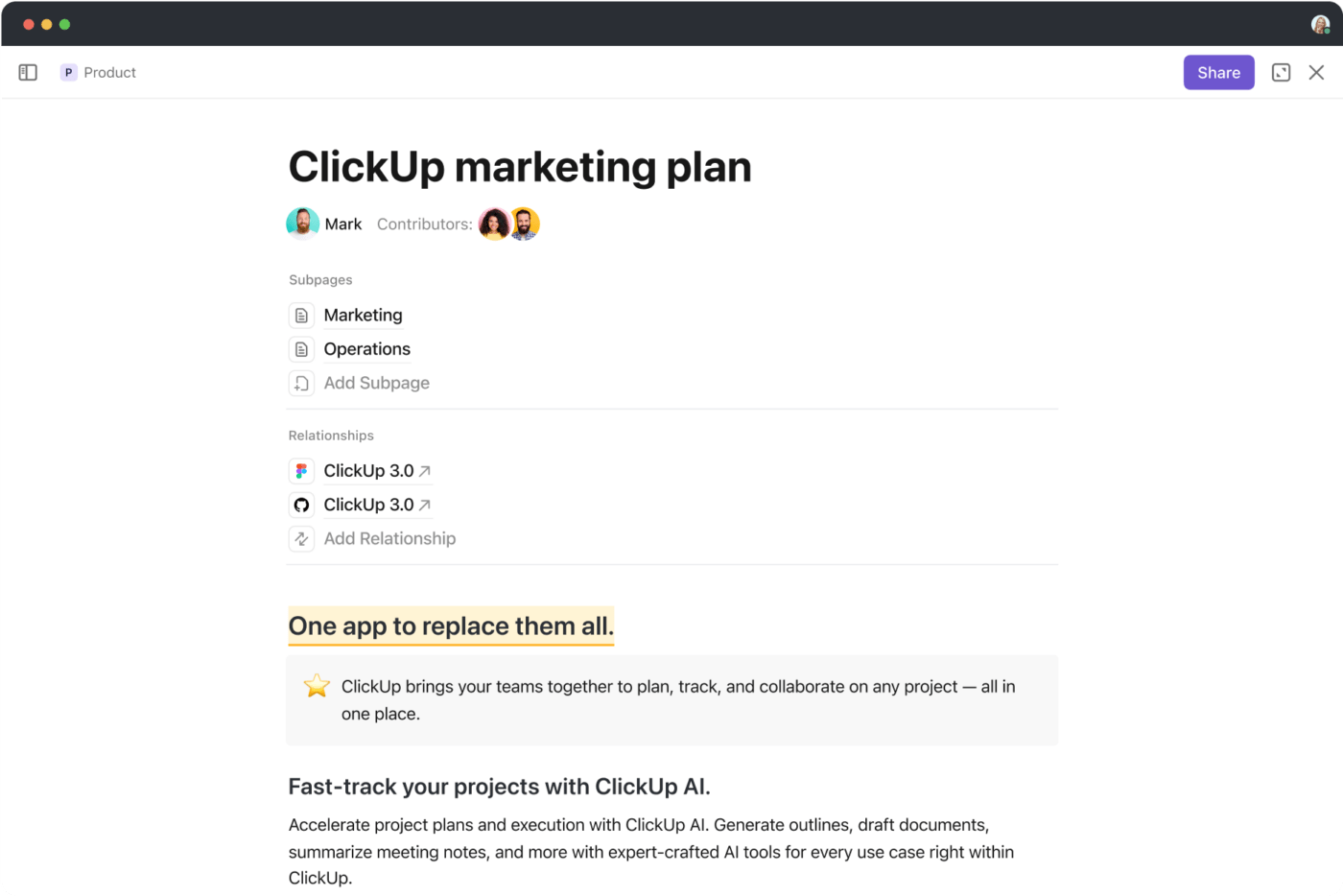
ClickUp Docs is an ideal solution for managing these documents. It allows you to create, store, and share everything—from technical manuals to compliance records—within a centralized platform.
Use this tool to:
📮ClickUp Insight: Nearly 35% of knowledge workers refer to Monday as the least productive day of the week. Accumulated emails, messages, and newer priorities that emerge during Monday standups, could all potentially contribute to this.
But what if you could converge all those Monday updates, tasks, meetings, and emails under a single platform and tackle them all in one go? Try ClickUp, the everything app for work!
Perform a final project site inspection to identify any outstanding issues or defects. Use the snag list (punch list) to document any repairs or touch-ups needed before the handover.
Test all critical systems—such as HVAC, electrical, plumbing, and safety—to ensure they are fully operational and meet the required specifications.

To do so, use ClickUp Tasks to optimize this inspection process by organizing tasks with custom statuses, priority levels, and dependencies. Assign specific inspection items to team members, set priorities based on urgency, and track the real-time status of each task.
Custom fields should also be used to provide additional context and ensure that every aspect of the inspection is managed perfectly.
Provide hands-on training for the facility management team if the building has complex systems or equipment. Ensure they understand how to operate, maintain, and troubleshoot key systems to avoid future operational challenges.
Conduct a walkthrough of the building with the owner to review all completed work, address any final concerns, and confirm that everything meets their expectations. This step helps align expectations and finalizes the transition process.
Once all documentation is complete, defects are resolved, and systems are tested, obtain the owner’s formal sign-off.
💡 Pro Tip: If you use ClickUp for your construction project management, schedule the final meeting with the owner through the ClickUp portal. Plus, grant the owner access to your workspace, ensuring they have everything in one place and don’t miss a single detail.
ClickUp’s checklist functionality, task assignment, and nesting items for detailed subtasks ensure that every step of your construction handover is covered efficiently and that nothing is overlooked.
Here’s how you can go about it:

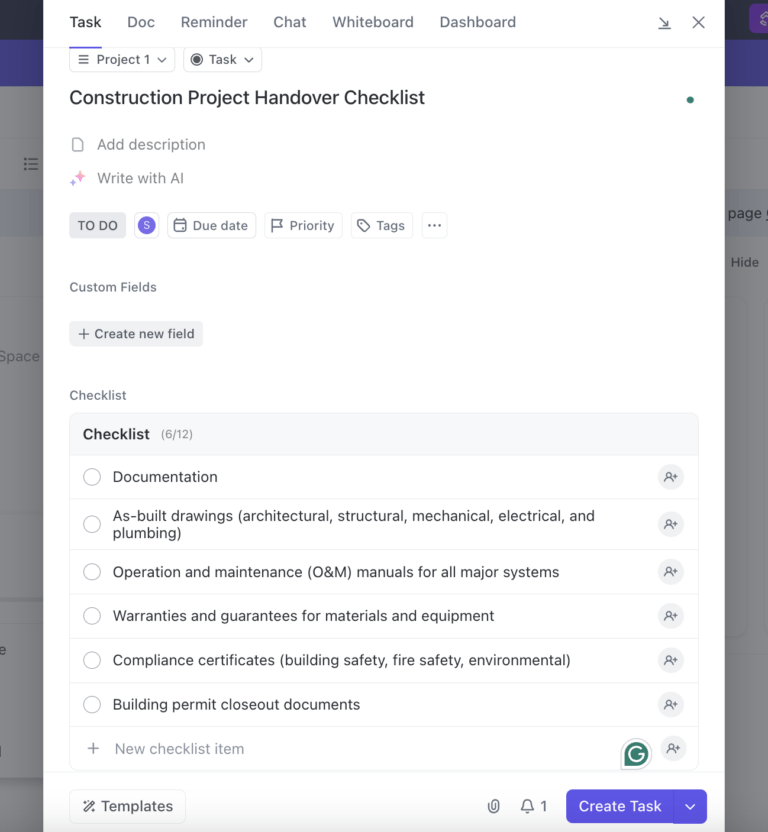
In ClickUp, start by creating a new task for your construction handover. Navigate to the task’s view and add a checklist under the ‘Action item, tab to organize the key components of your handover checklist.

Use task checklists to list all required documents, such as as-built drawings, O&M manuals, warranties, and compliance certificates. Either paste a list of items or create them individually, ensuring each document is tracked.

Assign individual checklist items, such as documentation collection, system testing, etc., to specific team members. ClickUp allows you to assign each checklist item to only one person at a time, ensuring accountability for every task.

If tasks are more complex, such as HVAC system checks or snag list management, nest sub-items under larger checklist categories. This allows you to break down tasks into detailed steps, adding up to five levels of subtasks for more granular tracking.
Below is an example of a detailed construction site handover checklist for a commercial building project. It’s divided into key categories to ensure every aspect of the handover is covered thoroughly.
1. Documentation
2. Systems testing
3. Snag list (Punch list)
4. Compliance & safety
5. Handover of keys and access
6. Training and manuals for facility management
7. Final walkthrough and sign-off
An effective handover process requires more than just ticking boxes—it demands strategic planning and attention to detail.
Therefore, implementing the following best practices ensures a seamless transition, reduces the risk of post-handover issues, and maintains client satisfaction.
Handover isn’t something to think about, only at the end.
Collect relevant documents, track changes, and organize systems from the start of the project. This approach reduces chaos during the final stages and ensures everything is in order well before the deadline.
Rather than relying on paper-based records, utilize digital platforms to organize and share documentation.
Tools like project management software can centralize all handover-related documents, making tracking progress easier and ensuring nothing is missed, even when multiple teams are involved.
Additionally, many readily available templates, such as construction bid templates and contractor estimate templates, help you strengthen your workflow, save time, and reduce manual effort. These templates help you standardize processes and focus on more critical aspects of project management.
Before the official walkthrough with the client, organize a mock session with your team to catch any overlooked issues. This allows your team to address snags, defects, or missing items in a controlled environment before the client is involved, thoroughly minimizing last-minute surprises.
One person should be solely responsible for overseeing the handover process. This coordinator ensures all tasks—from document collection to final inspections—are completed on time.
Having a single point of contact eliminates confusion and creates accountability across the team. This is a very crucial part of all client-based project management.
Read More: To further optimize your construction project management, check out 10 Free Construction Budget Templates to Use
The final handover of a construction project is a critical moment that determines the long-term success of your work.
A poorly managed handover can result in operational headaches, expensive repairs, and a tarnished reputation. However, a smooth and organized handover strengthens your client relationships and solidifies your credibility.
To optimize the process and ensure everything is noticed, utilize tools like ClickUp.
With its customizable templates, task tracking, and real-time collaboration features, ClickUp simplifies the handover process, saving you time and reducing the chance of errors.
Ready to make your next project handover seamless?

Sudarshan Somanathan
Max 22min read

Praburam Srinivasan
Max 23min read
Praburam Srinivasan
Max 21min read

© 2026 ClickUp