

As your company scales, managing a growing information repository can become challenging.
But that’s where the role of a knowledge base manager comes into play.
Every organization has information-packed assets or ‘knowledge’ that needs to be centralized, organized, and updated, right from internal content used by employees to external knowledge assets meant for customer support. A knowledge base manager is responsible for this.
In this blog post, we’ll discuss everything you need to know about how to become a knowledge base manager.
Let’s start!
How to Become a Knowledge Base Manager?

 Summarize this article for me please
Who is a Knowledge Base Manager?
A knowledge base manager is a person responsible for knowledge management. Essentially, a knowledge base worker supervises, maintains, and optimizes an organization’s knowledge repository.
Knowledge management includes internal and external informative materials such as product manuals, guides, infographics, customer support FAQs, compliance guides, project documentation, and really any kind of content that is critical to running an organization.
What does a knowledge base manager do?
The role of a knowledge base manager is dynamic, but their primary responsibilities include:
Curating and organizing resources
A knowledge base manager supplements the curation of new knowledge resources and the management of older ones. They also ensure all of these are streamlined and organized.
Ensuring resource consistency and accuracy
These experts ensure that all resources are created error-free and on par with the company’s tone and voice, which helps maximize their efficiency.
Maintaining resource effectiveness
Knowledge base managers constantly update resources to maintain effectiveness and ensure they don’t become obsolete.
Enhancing resource accessibility
Knowledge base managers structure and organize an enterprise’s resource base efficiently. They ensure that internal and external company resources are easy to locate and can be accessed by employees and customers.
Difference between a knowledge manager and a knowledge base manager
The terms ‘knowledge manager’ and ‘knowledge base manager’ are often used interchangeably. But these are two different job roles.
Here’s how:
| Parameters | Knowledge Manager | Knowledge Base Manager |
| Role type | Strategic in nature | Operational in nature |
| Focus | Focus on creating knowledge management strategies aligning with the organization’s goals | Focus on managing many informative repositories of an organization |
| Core Skill Requirements | Must possess strategic planning skills | Should possess project management and organizational skills |
| Responsibilities | Primarily responsible for formulating and implementing a company’s knowledge management strategies | Mainly responsible for optimizing and managing a company’s knowledge base to ensure knowledge sharing |
| Impact | Helps an organization improve its overall effectiveness and efficiency by implementing the right knowledge management strategies | Assists an organization to become more organized, productive, and customer-friendly by efficiently optimizing and managing its knowledge base |
Summarize this article for me pleaseWhy Become a Knowledge Base Manager?
There are many benefits of becoming a knowledge base manager. Here are some of its top advantages:
Growing market demand
Knowledge base managers have never been more in demand!
According to research, approximately 91% of customers prefer using a company’s online knowledge management system to meet their requests for information. Thus, a growing number of organizations are looking for competent knowledge base managers who can efficiently optimize and manage their knowledge bases for their customers.
High job satisfaction
The role of a knowledge base manager can be incredibly satisfying. Let us explain. In this role, you’re constantly aware that your responsibilities are crucial for your organization’s functioning and reputation. Besides, you know your work helps end customers resolve their queries. This awareness helps boost job satisfaction.
Intellectually stimulating
Knowledge management for an organization is a challenging task. To be eligible, you must possess strong organizational skills, a sharp eye for detail, and expertise in multiple tools. This makes it an intellectually stimulating role perfect for anyone who doesn’t want a mundane 9 to 5 job.
Scope for further career advancement
If you excel as a knowledge base manager and have excellent project management skills, you may get promoted to senior positions like Chief Knowledge Officer (CKO) or Director of Knowledge Management (KM). The salary for these job roles is typically high, and as someone who is responsible for managing a knowledge management team, it comes with a degree of seniority and respect.
Opportunity for continuous learning
The role of a knowledge base manager also offers multiple learning opportunities for personal growth. The nature of the job lets you explore new skills, technologies, and tools while staying updated about market trends and customer behavior. This enables you to evolve and advance in your career constantly.
Summarize this article for me pleaseSkills and Responsibilities of a Knowledge Base Manager
Here are the skills and responsibilities of a knowledge base manager:
Skills of a knowledge base manager
A good knowledge base manager must possess various hard and soft skills to justify their role. These include:
Project management skills
The core responsibility of a knowledge base manager is to manage the knowledge base and optimize it for seamless use. To do so efficiently, you must possess strong project management skills.
Organizational skills
Knowledge base managers must organize the resources in the company’s knowledge base. These resources are plentiful. Thus, you must be excellent at organizing to execute this duty.
Problem-solving abilities
As a knowledge base manager, you will encounter situations that require you to troubleshoot and solve problems to ensure the resource is accessible and available to customers. So, the ability to face and resolve issues is essential.
Attention to detail
A considerable part of any knowledge base manager’s role is checking the accuracy of the content in the repository to ensure it’s error-free and up-to-date. To do this, you must have a sharp eye for detail.
Communication skills
A knowledge base manager must communicate with different departments of an organization for seamless curation and optimization of the knowledge base. Therefore, you must be good at communication to excel in your career in this field.
Technical skills
As a knowledge base manager, you must be familiar with knowledge base management software, document management software, and knowledge sharing software, among others. You also need to be proficient with resource management software, content management systems, analytics tools, etc.
Adaptability
Tools and technology keep evolving. Additionally, the organization’s knowledge base needs are susceptible to change. Thus, you must exude flexibility and a thirst for learning to excel as a knowledge base manager.
User-centered thinking
A company’s knowledge base hoards resources to help users with product issues. So, you must be able to think from a customer’s point of view to help create and make materials accessible that serve them with maximum effectiveness.
Collaborative mindset
A knowledge base manager must collaborate with various teams within the organization to execute their day-to-day responsibilities. Therefore, they need a collaborative- and teamwork-oriented spirit in addition to deep knowledge management skills.
Patience
Managing an organization’s knowledge base can have its moments of upheaval. For example, if information is found to have errors or is contested, it’s important to be patient and have empathy.
Responsibilities of a knowledge base manager
These are the five primary responsibilities of a knowledge base manager:
Knowledge base management
A knowledge base manager’s primary responsibility is managing the organization’s knowledge base, including centralizing all informative resources, updating old resources, and optimizing the base for usability and accessibility.
Knowledge base organization
These experts must organize the resources available in the company’s knowledge base, such as segregating the materials based on time, category, use (internal or external), etc.
Quality assurance
An essential part of a knowledge base manager’s day-to-day activity is checking the quality of the resources in the base. They should have accurate, credible, high-quality content addressing the issue.
User training
Knowledge base managers are also expected to train new team members to create and use the organization’s knowledge base. They have to guide the content team in developing user guides according to the established compliance standards, help teams navigate the internal knowledge base effectively, etc.
Scalability planning
Knowledge base managers must plan for the scalability of the organization’s knowledge base. This requires an over-arching knowledge management strategy, creating a blueprint for additional features required for seamless accessibility, assessing the capacity requirement for accommodating new content, etc.
Summarize this article for me pleaseWhich Business Departments Does a Knowledge Base Manager Interact with?
As a knowledge base manager, here are some departments you will have to collaborate with to execute your duties successfully:
Customer support
Interact with your organization’s customer support and service teams to enable them to access the knowledge base effectively and resolve customer queries efficiently when they arise.
Content
Team up with the content teams or content stakeholders and owners across departments to facilitate the creation and timely updating of knowledge-based resources.
IT and technology
Work closely with your organization’s IT and tech teams to ensure the software and overall technical infrastructure supporting the knowledge base are robust, secure, and efficient.
User support
Occasionally, connect with your company’s user support and training teams to create resources for recruits and help them navigate the knowledge management systems.
Marketing and sales
Contact the marketing and sales departments to gather information on products and services and help create accurate and sufficient resources, such as product manuals and guides.
Summarize this article for me pleaseHow to Become a Knowledge Base Manager?
To become a knowledge base manager, you must possess a combination of qualifications, skills, and experience. Here’s how to adopt a systematic approach to this:
Step 1: Gain a degree in knowledge management
To become an organization’s knowledge base manager, it’s helpful to have a formal education in it. If this is your chosen career path, consider pursuing a bachelor’s degree in knowledge management. Alternatively, you can pursue a degree in related fields like technical writing, information technology, business administration, or another related management field.
The coursework of these disciplines typically revolves around data organization, project management, writing, business communication, etc. They’ll give you the necessary knowledge and skills for this job. Once you complete the formal education, consider getting a certification as a Certified Knowledge Manager (CKM).
Step 2: Develop the required skills
A knowledge base manager must have a diverse set of hard and soft skills. This includes project management, problem-solving, analysis, empathy, communication, and of course, organizational skills. Focus on cultivating these skills.
Gaining practical experience is another great way to develop skills.
So, let’s suppose you want to build your project management skills. To do so, try to land a project management internship to gain hands-on, practical experience in this field. Additionally, attending seminars and workshops may also help in skill development.
Step 3: Achieve proficiency in the right tools
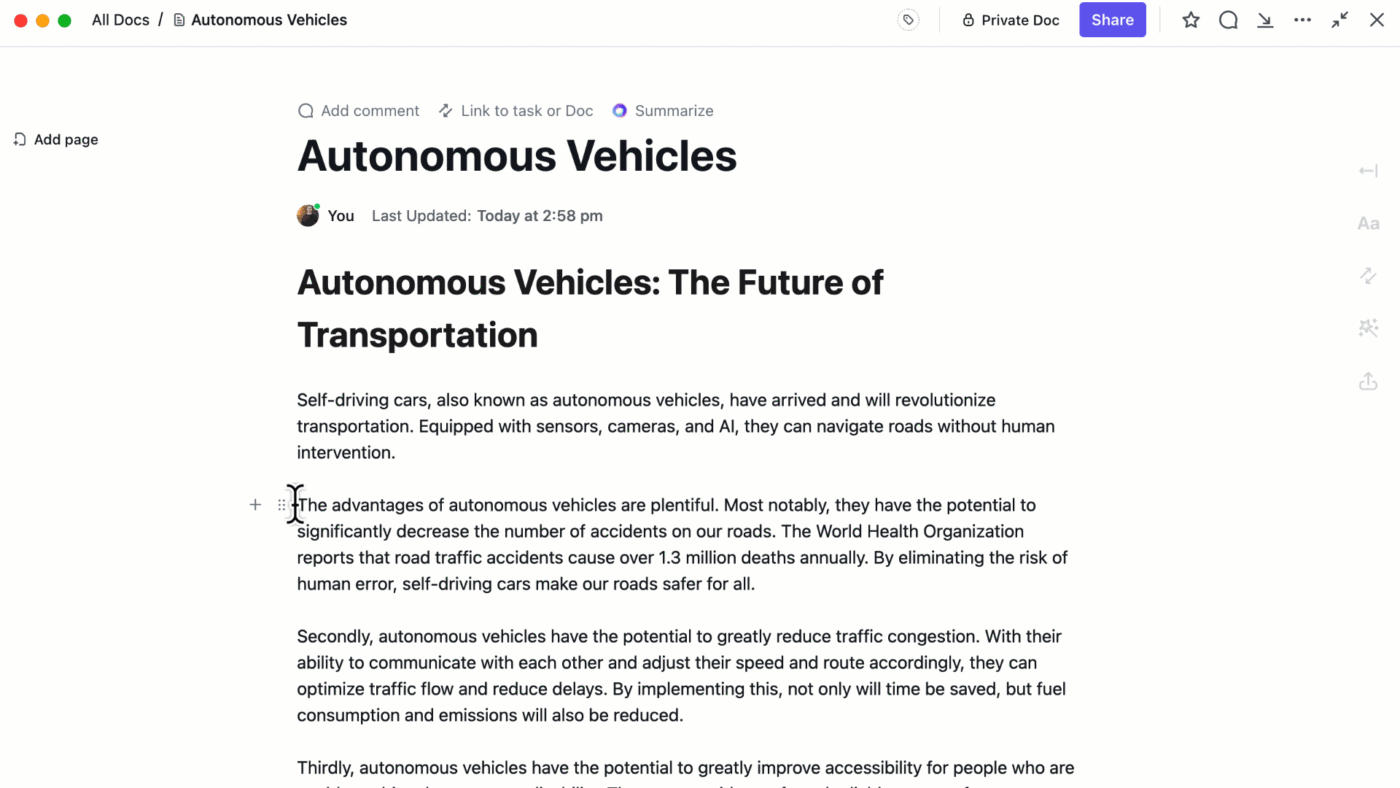
Knowledge base managers must possess strong technical expertise to execute their duties. It’s critical to know how to use a knowledge management tool, such as the ClickUp AI Knowledge Management tool.
ClickUp’s AI Knowledge Management tool hosts a range of features that simplify all aspects of knowledge base management.

Want to streamline the documents in the knowledge base? Use the ClickUp Docs feature as your one-stop solution for knowledge and resource management and sharing.
Build informative resources, customize every piece of content, determine their access and permissions, and collaborate with your team members. ClickUp Docs allows you to create, store, and share files for seamless knowledge base management. You also integrate it with your existing workflows to get a centralized view of every activity as it unfolds.
The Docs Hub feature organizes your knowledge base by allowing you to search, sort, and filter it. It’s easy to use, and you can manage it as you deem fit.
ClickUp Docs also offers other innovative features, like the Focus Mode, integration with third-party platforms like Slack, Google Drive, and Chrome, and a range of knowledge base templates to help you get started!

Easy to use and customizable, the ClickUp Knowledge Base Template acts as a framework for your team to create a centralized, easily accessible digital library of the company’s informative materials. This can help:
- Facilitate team collaboration for updating and creating new materials
- Provide easy access to the company’s internal knowledge repository to new recruits
- Maintain uniformity in creating and storing informative assets
Optimizing the knowledge base is another core duty of a knowledge base manager. Why not implement AI to create a knowledge management system for you?
With ClickUp Brain, optimize your knowledge base by automating resource categorizing, tagging, and organizing with just a click. As ClickUp Brain questions about anything related to your work—tasks, docs, or even people—and it will give you instant, accurate answers.
Another excellent way to centralize a company’s knowledge base is to create a Wiki page. The ClickUp Wiki does that in a snap and provides a range of templates for this purpose!

Efficient knowledge base management involves managing a company’s internal and external knowledge repositories. The ClickUp Wiki Template facilitates the former. Highly customizable and beginner-friendly, this template allows you to create and maintain wiki pages for your internal repository. In doing so, it helps:
- Organize and centralize all crucial information
- Optimize accessibility for all team members
- Standardize knowledge repository creation within the organization

Creating a company wiki page is a time-consuming process. But the ClickUp Company Wiki Template is here to simplify it. With this customizable template, you can seamlessly create and manage wiki pages for your company’s internal knowledge repository. Use it to:
- Modify and centralize your internal knowledge repository
- Access the internal informative materials for your team
- Collaborate with team members
Step 4: Get professional experience
Gaining work experience can help you bolster your CV before applying for the position of knowledge base manager in any organization. So, try to spend at least three to four years working in entry-level roles like technical writing, content manager, knowledge base assistant, or something similar.
Step 5: Apply for knowledge base manager positions
Now, you’re all set to apply for the position of knowledge base manager. Create a resume that highlights your achievements and experience. Once done, look for opportunities on online job portals and networking platforms. Additionally, spread the word in your corporate circle to receive inbound leads.
Summarize this article for me pleaseAdvance Your Career in Knowledge Management with ClickUp
The role of a knowledge base manager can be incredibly exciting in a knowledge economy like ours. They’re in-demand professionals who play an important role in maximizing an organization’s internal efficiency and external reputation.
If you aspire to help a business achieve these milestones, earn the qualifications and develop the skills to become a knowledge base manager.
As for the technical requirements of the role, trust ClickUp to help you every step of the way.
With a set of tools and features that are tailor-made for the role, we’re the steady companion every knowledge base manager needs.
So hurry up—get ClickUp today for free. Sign up here!


Everything you need to stay organized and get work done.

Recent Articles
8 Communication Strategies That Actually Fix Team Chaos 
8 Communication Strategies That Actually Fix Team Chaos
What Is Tacit Knowledge? Definition, Benefits and Examples
What Is Tacit Knowledge? Definition, Benefits and Examples

