

Efficient managers are the backbone of a thriving organization. But what sets a great manager apart from a good one?
The answer lies in having a clear set of goals, not just for the team but also for yourself.
Manager goals act as a roadmap that guides you to continuous personal and professional development and building a successful, motivated team. They serve more than one critical purpose:
- Focused direction: Goals provide a clear direction, ensuring your efforts are aligned with the company’s objectives
- Enhanced development: Managerial goals encourage continuous learning and skill development, enabling you to become more effective leaders
- Improved team performance: When you actively work towards your goals, you set a positive example that translates into a more productive and motivated team environment
- Increased employee engagement: Goal-oriented managers inspire and engage their team members, encouraging a sense of purpose and ownership at work
- Stronger organizational culture: By striving to achieve your goals as managers, you contribute to building a positive and results-driven organizational culture
How to Set SMART Goals for Managers

 Summarize this article for me please
Understanding Manager Goals
Management books often stress the importance of continuous self-improvement for managers and how they should treat goal setting and tracking as essential skills. For a manager, there are three important goal types:
- Career goals: Focus on long-term career aspirations, such as securing a promotion or transitioning into different managerial roles
- Leadership goals: Concentrate on enhancing leadership skills for improved team management, communication, and motivation
- Personal goals: Address personal development goals that can indirectly benefit managerial effectiveness, such as improving time management or public speaking skills
Recommended reading: High Output Management by Andrew Grove. A management primer and a must-read for middle managers.
Importance of professional skills goals for managers
There are several categories of professional skills that a manager must have to become excellent at their job:
- Technical skills: Mastering software programs or industry-specific tools relevant to the business or your team’s work
- Communication skills: Developing strong verbal and written communication abilities for effective information exchange
- Project management skills: Building expertise in project planning, delegation, and execution
- Conflict resolution skills: Learning to self-regulate (through practices like mindfulness and meditation, etc.), assess situations objectively, and resolve disagreements within the team effectively
Professional development goals aimed at leadership skills enhance your ability to:
- Empower and delegate: You learn to develop trust and assign tasks to team members in accordance with their skills and capabilities, facilitating ownership and growth within the team
- Provide constructive feedback: Share constructive criticism and guidance for employee performance improvement
- Become a coach and mentor: Providing ongoing support and guidance will help you nurture talent and career development within the team
- Navigate challenging conversations: Approaching difficult conversations with empathy and professionalism is an underrated trait of excellent managers
Summarize this article for me pleaseSetting SMART Goals for Managers
When setting goals, whether personal or professional, it’s crucial to utilize the SMART framework:
- Specific: Goals should be clearly defined and leave no room for ambiguity
- Measurable: You should have a clear way to track progress and assess success
- Attainable: Goals should be challenging but achievable within a realistic timeframe
- Relevant: Goals should be aligned with the overall team and company objectives
- Time-bound: There should be a clearly defined deadline for achieving the goal
Here is a step-by-step breakdown to help you set SMART goals:
Step 1: Align with organizational goals
Start by understanding the company’s overall strategic goals and objectives. Identify how your managerial goals will help you achieve these business goals faster.
Step 2: Identify areas for improvement
Reflect on your strengths and weaknesses as a manager. Use performance reviews, feedback from co-workers, or self-assessment tools to identify areas for growth.
For example, if you struggle with delegating tasks, but the organizational aim is to improve productivity, your goal could be:
Enhance delegation skills to empower team members and increase productivity.
The SMART objective here would be:
In the next 30 days, develop a delegation framework outlining clear task ownership and communication so that individual and team productivity increases by at least 10%.
Step 3: Define specific goals
Setting vague goals can be a deterrent to success. Clearly articulate what you want to achieve.
For example, instead of ‘Improve team communication,’ consider ‘Implement a weekly team communication meeting to discuss project updates and address roadblocks.’
Step 4: Set measurable benchmarks
Define how you’ll track progress towards your goals. Use metrics, data points, or surveys to quantify success. For example: ‘Increase employee engagement scores by 10% within the next quarter.’
Step 5: Ensure achievability
Set challenging but attainable goals within your resources and capabilities. Consider your team’s workload and skill sets. Discuss goals openly with your team and consider their concerns to prevent inefficiency, demotivation, and burnout.
Break down large goals into smaller, manageable steps.
Step 6: Set realistic timelines
Be ambitious but realistic when setting deadlines. This creates a sense of urgency and helps with action planning.
Give yourself enough time to achieve the desired outcome.
By following these steps, managers can set SMART goals that drive team success, personal growth, and overall business achievement.
Summarize this article for me pleaseExamples of Goals for Managers
Here are various manager goal categories with examples of SMART goals for each one:
1. Increasing team building and employee retention
Strong teams foster collaboration, innovation, and higher morale. Retaining valuable employees reduces turnover costs and ensures continuity of knowledge.
- Goal 1: Foster a more collaborative and supportive team environment
| SMART objective: Implement a monthly team-building activity, with participation exceeding 80%, to promote collaboration and strengthen relationships within the next quarter. |
- Goal 2: Reduce employee turnover by 5% year-over-year
| SMART objective: Conduct exit interviews with departing employees to identify areas for improvement and implement a retention strategy (e.g., career development programs, mentorship opportunities, etc.) to reduce turnover by 5% within the next fiscal year. |
Sidebar: The SMART framework applies both at the individual and team levels, and it is also effective for functional goals, such as human resource development or project management goals.
2. Enhancing training and development programs
Investing in employee development equips them with the necessary skills to excel and stay competitive.
- Goal 1: Identify and address skill gaps within the team
| SMART objective: Conduct a skills assessment survey of team members to identify skill gaps. Develop a training program encompassing relevant online courses and workshops, with at least 70% of team members completing the program within the next six months. |
- Goal 2: Implement a mentorship program to help with knowledge-sharing and career development
| SMART objective: Establish a formal mentorship program, matching senior team members with junior colleagues. Set a target of at least 80% of mentees reporting improved skill development and career clarity within one year. |
3. Improving empathy, creativity, and flexibility
Effective communication, empathy, and adaptability are crucial for building trust, managing conflict, and fostering innovation within the team.
- Goal 1: Become a more empathetic leader who actively listens to team concerns
| SMART objective: Participate in a two-day empathy and active listening skills workshop, followed by implementing a practice of summarizing key points and asking clarifying questions during all team meetings within the next month. |
- Goal 2: Encourage a more innovative team environment that embraces creative problem-solving
| SMART objective: Implement a dedicated ‘brainstorming session’ during each team meeting, focusing on identified challenges, with a target of generating at least three innovative solutions for each challenge within the next quarter. |
- Goal 3: Develop greater flexibility to adapt to changing priorities and unforeseen circumstances
| SMART objective: Review and update project plans weekly to reflect evolving priorities and unexpected challenges, ensuring on-time project completion within the next six months. |
4. Fostering onboarding and marketing skills
A smooth onboarding experience sets new hires up for success, and basic marketing skills can help managers promote their team’s achievements within the organization.
- Goal 1: Streamline the onboarding process for new team members
| SMART objective: Develop a comprehensive onboarding program with clear documentation, training sessions, and team introductions, aiming for all new hires to feel comfortable and productive within their first week. |
- Goal 2: Equip team members with basic marketing skills to promote their work and achievements
| SMART objective: Organize a workshop on basic marketing principles and content creation, with team members producing at least one marketing collateral piece (e.g., blog post, social media content) showcasing their work within the next month. |
5. Improving self-care and health in management roles
Maintaining a healthy work-life balance and prioritizing self-care allows you to show up for your teams with energy, focus, and resilience.
- Goal 1: Maintain a healthy work-life balance to prevent burnout
| SMART objective: Schedule dedicated time for personal activities outside of work (e.g., exercise, hobbies) for at least 30 minutes three times a week and delegate tasks to avoid exceeding a maximum of 50 working hours per week. |
- Goal 2: Prioritize mindfulness and stress management techniques
| SMART objective: Implement a daily 10-minute mindfulness practice (e.g., meditation, deep breathing exercises) and track progress through a journaling habit, aiming for a noticeable decrease in stress levels within the next month. |
Summarize this article for me pleaseHow to Track Manager Goals
Setting clear goals and using efficient tracking methods is vital for a manager. Use a comprehensive project management solution like ClickUp to set SMART goals, monitor progress, and boost productivity.
1. SMART goal setting and tracking with ClickUp Goals
ClickUp Goals allow you to define clear, specific managerial objectives, refining your goal-setting strategy. These goals should be quantifiable with measurable targets.
For example, ‘Increase customer satisfaction by 10% within the next quarter’ is a measurable and specific goal.
- ClickUp offers ‘Targets’ where you can set specific metrics for success, like numbers, percentages, or currency

- Create folders to track sprint cycles, OKRs, weekly employee scorecards, and several team goals in one place

- Assign due dates to both goals and sub-tasks or smaller objectives
- Control who can access the goals, set multiple owners, and manage permissions easily
2. Unveiling performance with ClickUp indicators
ClickUp’s Performance Indicators take goal tracking a step further. The ClickUp KPI Template lets you define specific metrics relevant to your managerial goals.
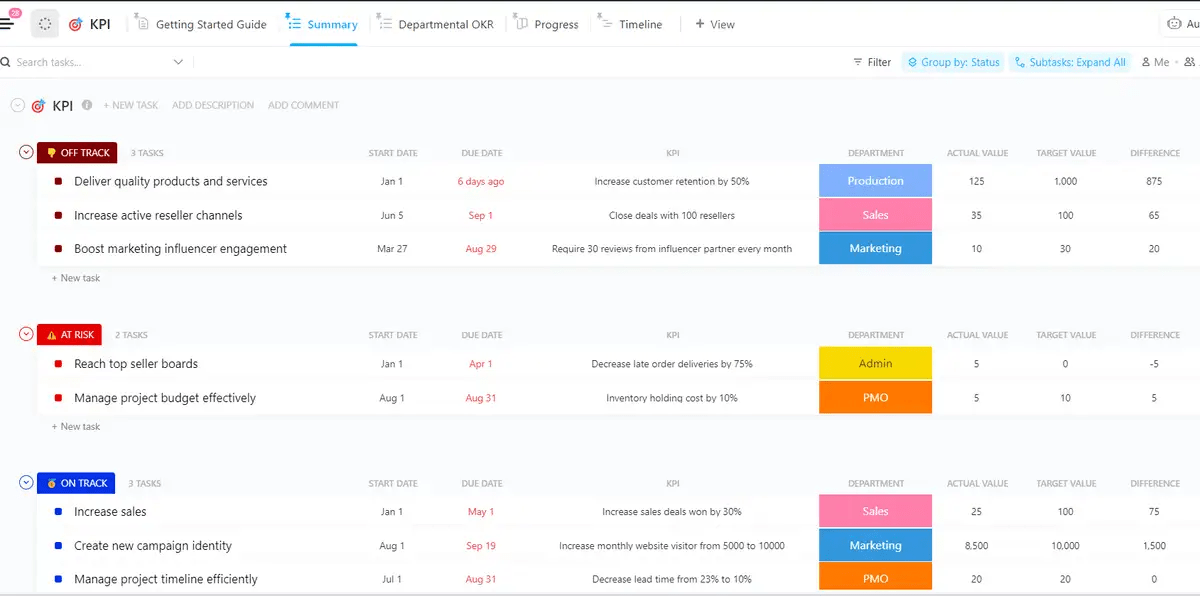
For example, if the goal is to improve team communication, a performance indicator could track the number of team meetings or employee engagement surveys held.
This goal-setting template includes custom fields and pre-defined custom statuses to monitor KPI progress. Each KPI can have details like a target value, actual value, and progress percentage.
Visualize your KPI data as you want: the Summary View offers a quick overview of all KPIs and their current status; other views, like the Progress View and the Timeline View, provide more granular details on individual KPIs.
You can also invite any team member to track KPIs together.
With ClickUp’s project management features, such as time-tracking, automation, emails, and more built-in, this template offers a user-friendly and comprehensive solution for tracking and managing your KPIs in one place.

ClickUp’s Dashboards provide a centralized view of all your goals and their associated performance indicators. This real-time data allows managers to:
- See which goals are lagging and identify areas where additional resources or adjustments might be needed
- Track progress and motivate teams by visualizing achievements as goals move closer to completion
- Foster a culture of accountability, keeping managers focused on achieving results with transparent goal-tracking
3. Boosting manager productivity and time management skills
ClickUp Goals simplifies the goal-tracking process for managers, leading to increased productivity and improved time management.
- The one-stop platform eliminates the need for scattered spreadsheets or documents, saving you valuable time
- You can easily share goals and updates with team members and supervisors within ClickUp, fostering better communication and collaboration
- The visual progress tracking keeps you motivated and focused on achieving your objectives
You can also use the ClickUp SMART Goals Template to help you define and structure your goals effectively. This template streamlines goal creation by prompting you to define specific elements such as goal title, description, targets, and deadlines.

This template ensures goals are clear, measurable, and achievable from the beginning. It also makes it easier to identify and address potential roadblocks.
Summarize this article for me pleaseBenefits of Achieving Manager Goals
Investing in goal achievement yields significant benefits for the manager and the organization.
1. The manager’s role in team motivation
When you set and achieve goals as a manager, you create a positive and motivating environment for your team. Seeing their leader actively work towards a vision instills a sense of purpose and inspires team members to strive for excellence.
2. Effects of manager goals on overall team performance and growth
By focusing on developing their skills and fostering a positive team culture, you contribute directly to improved team performance and overall organizational growth.
Well-defined goals for managers lead to a more engaged workforce, resulting in higher productivity, better decision-making, and increased innovation.
3. Long-term benefits of solid manager goals
Setting and achieving solid managerial goals sets the foundation for long-term success. These goals contribute to a more effective leadership style, a stronger talent pool, and a resilient organization that can thrive in a competitive environment.
Summarize this article for me pleaseManager Goals Are the Cornerstone of Effective Leadership
By setting SMART objectives and using tools like ClickUp, you can focus your managerial efforts, develop necessary skills, and cultivate a thriving team environment.
Investing in managerial goals leads to individual growth and a more engaged, productive, and innovative team.
Effective managers are goal-oriented leaders who inspire, motivate, and empower their teams to achieve their full potential.
Improve your goal-setting process with the right tools.
Try ClickUp today!
Summarize this article for me pleaseFrequently Asked Questions (FAQ)
1. What are examples of goals for managers?
Here are a few examples of goals for managers:
- Increase employee engagement by 15% within the next quarter
- Implement a new training program on project management software and ensure 80% of the team passes the proficiency test
- Organize monthly team-building activities and conduct surveys to measure a 10% improvement in team communication
- Develop a standardized onboarding program and achieve a 90% satisfaction rating from new hires on their onboarding experience
- Participate in a leadership development program to improve public speaking skills and present a quarterly team update to senior management
2. What is a smart goal for a manager?
A SMART goal is Specific, Measurable, Achievable, Relevant, and Time-bound. A SMART goal for managers, for example, is to ‘Increase team collaboration by 20% within the next six months, as measured by a team communication survey, by implementing a weekly team brainstorming session focused on project challenges and solutions.’
3. What are the goals of management?
The goals of management can be broadly categorized as:
- Leading and motivating teams: Inspiring employees to perform at their best and achieve organizational objectives
- Improving team performance and efficiency: Developing strategies and processes that optimize team output while fostering a positive work environment
- Developing and empowering employees: Providing opportunities for skill development and career growth, leading to a more engaged and talented workforce
Achieving organizational objectives: Aligning team efforts with the overall strategic direction of the organization


Everything you need to stay organized and get work done.

Recent Articles
How to Set Product OKRs That Survive the Quarter (With Examples) 
How to Set Product OKRs That Survive the Quarter (With Examples)
Stretch Goals: What They Are, When They Work, and How to Set Them
Stretch Goals: What They Are, When They Work, and How to Set Them
What Are Project Goals? Definition, Examples & How To Write Them 
What Are Project Goals? Definition, Examples & How To Write Them
