
Sorry, there were no results found for “”
Sorry, there were no results found for “”
Sorry, there were no results found for “”
A single interruption costs a worker 23 minutes of focus, according to research by Gloria Mark from the University of Irvine. On a creative team, the person causing most of those interruptions is usually the manager, and they can’t see it happening. They ping the team for updates that the tools should already show, and each ping pulls someone out of the work.
That is the real job of managing a creative team: protect focus, then give direction. It breaks down when a manager spends the day chasing status and passing feedback across tools that don’t talk to each other.
This guide is your solution to managing creative teams without losing productivity: a clear framework and the steps to implement it with examples.
TL;DR: Managing a creative team comes down to six moves: write a real brief, make status visible so nobody has to ask for it, protect the team’s focus, run one feedback and approval loop attached to the asset, balance the load to prevent burnout, and report output in business terms. Ed Catmull’s candor-collaboration-focus model from Pixar is the frame. The six steps are how you actually run it.
Creative team management involves directing people who produce creative output so the work is good, on time, and on brief without sacrificing creativity. Part of the job is ordinary people management: hiring, giving feedback, and managing workloads. The other part is what generic management leaves out entirely. Creative work is messy and non-linear, and your job is to protect that, not to flatten it.
It isn’t the same as managing a team that ships predictable, repeatable units. Creative work moves in bursts, dies in revisions rather than first drafts, and depends on feedback that is partly subjective.
For example, a manager who applies textbook project management to a design team, treating it like a ticket queue, will hit every deadline on the calendar but may still lose the work worth shipping.
A creative team typically includes a creative director, art director, designers, copywriters, video/motion specialists, and a project or traffic manager. The exact team structure shifts between an in-house team and an agency, but the creative team roles and responsibilities are consistent.
In-house teams tend to fold coordination into the creative lead’s job. Agencies split it out into dedicated traffic and account roles because they are juggling multiple clients at once. This is also why agency structures look so different from in-house ones. The smaller the team, the more the hats one person wears, and the greater the possibility of disconnected workflows.
The most effective framework for managing creative teams is Ed Catmull’s model from Creativity, Inc. It’s built on three conditions: candor, collaboration, and focus. Catmull used it to run Pixar for over 30 years. It works because it forces the manager to stay out of the way while maintaining full visibility of the work.
Candor is honest feedback aimed at the work, not the person. Catmull draws a hard line between candor and blunt honesty. The goal is to make it safe to say a draft is broken early, before the team has sunk weeks into a direction that was never going to work.
Pixar built a standing group called the Braintrust to do this: a handful of its sharpest storytellers who tear a film apart in a room with no authority over the director, so the notes stay about the movie and never curdle into a power play. It saved Toy Story 2 four months before release, when the first cut was flat, and the story had to be rebuilt from the ground up.
Collaboration means the best idea can come from anyone on the team, and the manager’s job is to build the room for it to surface. The moment a team learns that only the boss’s ideas survive, they stop offering their own, and you lose the reason you hired them.
Focus means shielding the team from the churn: the pile-up of notes, the scope that shifts every Thursday, the status meetings that eat the morning. This is the condition that managers protect the worst, because the churn usually comes from them.
The framework is easy to nod along to and brutal to run. Candor, collaboration, and focus all demand the same thing from a manager: staying out of the way while still knowing what’s going on. That’s the hard part.
You need to see deadlines, who’s overloaded, and what’s stuck. But the second you reach for that visibility by asking, you break the focus you were trying to defend. The rest of this guide is about getting the visibility without paying that price.
Better creative management protects deep focus time, catches contradictory feedback before execution, surfaces slipping dependencies early, retains senior talent, and eliminates dead time between handoff stages.
Why do managers interrupt without realizing the cost?
Managers and creatives run on vastly different clocks. In Paul Graham’s classic essay, Maker’s Schedule, Manager’s Schedule, he breaks down this exact clash.
A manager’s day runs on one-hour slots. Communication is the job, so dropping a 30-second ping with a question costs almost nothing. On the other hand, a maker’s day runs on half-day blocks of deep work. An interruption splits a focus block into two pieces, both too small to do anything meaningful in.
Even worse? When creators expect interruptions, they stop attempting deep, ambitious work altogether that day.
The manager isn’t being careless or inconsiderate; they’re just operating on a clock they can’t see. That’s why “try to interrupt less” never works. Good intentions fail.
And you can’t fix a blind spot by asking someone to try harder. Graham’s own solution wasn’t discipline; it was structure. He batched every meeting into office hours at the end of the day so they never split a maker’s morning. The lesson for a creative manager is the same. Stop relying on your own good intentions to protect the team’s focus. Instead, start relying on a setup that protects it whether you remember to or not.
Managing a creative team well requires six things: write a proper brief, make work visible, protect focus time, consolidate feedback into one loop, balance the workload, and tie output to business outcomes.
Every project should begin with a written brief. The most reliable cause of a blown creative timeline isn’t a weak first draft. It’s the extra revision cycles that a vague brief guarantees. When the target is uncertain, rounds two and three are where the deadline and the budget suffer.
A good brief names five things:
The manager’s job is to ensure that each asset only contains one message, because saying everything is the same as saying nothing. To make sure everybody has this information, keep the brief where the work will live, not in a separate document nobody reopens.
Pro Tip: If you’re starting from a blank page every time, explore our creative brief templates guide. It gives you a repeatable structure so nothing important gets left out.
Put every active project, its owner, and its deadline somewhere the whole team can see without asking. Most status meetings exist only because status is invisible; make it visible, and they get shorter or disappear.
Visibility also protects capacity. You can’t spot that your best designer is booked at 140% until the work is laid out in one view. This is the core of creative resource management: the difference between planning the load and discovering overlaps too late.
Getting ahead of it is a matter of capacity planning, matching the work coming in to the people who have room for it.
Creative work happens in bursts, and the manager’s job is to defend the conditions for them. For example, to an inexperienced manager, a writer staring out the window reads as idle. But that’s often the work. To protect focus concretely:
Every interruption you remove is creative time you hand back.
Consolidate feedback and approvals into a single path tied to the deliverable itself. When notes are scattered across email, Slack, comments, and hallway conversations, version control collapses, and someone works on the wrong file. One loop, attached to the asset, is how you prevent that.
Feedback quality matters as much as its location. ‘I don’t like it’ is useless and, on creative work, corrosive. Useful feedback separates a personal preference from a problem against the brief. That’s also what candor looks like in practice.
Note: One loop doesn’t mean one reviewer. It means one place. You can still gather notes from five stakeholders, as long as they all land in the same thread and someone owns the final call.
Assign work to the person whose strengths fit it, and watch the distribution so the same few people aren’t always carrying the campaign. Creative burnout is the output of sustained overload, and it shows up first in your most reliable people, because they’re the ones who absorb the overflow.
Superside’s research found that 7 in 10 creative leaders are burned out, and a majority say their teams are stretched past capacity. Rotate the high-visibility work and the grind work, and treat a spike in turnover as a signal about workload, not about talent.
Spreading work this way keeps one person from becoming the silent bottleneck.
Want to know how agencies can stay productive without burning their teams out? Watch this video.
Tie the team’s creative output to the results the business cares about, and report it in those terms. Track a small set of signals rather than raw volume:
This is also how a non-creative manager earns the right to lead creatives. They translate business strategy into a direction for the team. And defend the team upward when progress is solid but not yet visible.
You don’t have to be a designer to manage designers. But you do have to protect their work and explain its value to people who only see the deadline.
The most consistent advice from experienced creative leaders at r/advertising comes down to six behaviors: pair every critique with a direction forward, fight for the work even when it dies, extend trust before it’s earned, gate every project behind a brief, listen more than you talk, and treat a factory-feeling team as an inspiration problem, not a process problem.
Creative work typically lives in one of four places: spreadsheets, design/proofing tools, general project management software, or creative-built work management platforms. The right choice depends on team size and how much of the workflow (briefs, timelines, feedback, capacity) needs to live in a single system.
| Where the work lives | Best for | Skip it if |
|---|---|---|
| Spreadsheets and shared docs | The smallest teams tracking a handful of projects; near-zero cost and learning curve | You’re running more than one project at once. Manual dependency tracking gets brittle once two timelines overlap |
| Design and proofing tools (e.g., Figma, dedicated proofing apps) | The craft itself and asset-level feedback; strong review and markup where the work is made | You need to run the whole workflow. Briefs, timelines, and capacity all live somewhere else, so it can’t be the backbone |
| General project management software | Teams already standardized on one org-wide PM tool that want creative work in the same system | Creative intake and proofing are dealbreakers. It often skips those while piling on functionality creatives don’t need: too much and not enough at once |
| Creative-built work management | Running the full workflow (brief, tasks, deadlines, feedback, approvals) in one connected place | You’re a solo freelancer or a two-person team. It’s more than you need, and it carries a learning curve to match |
The bottom line: Point tools are excellent at their one job and blind to the other three. The question isn’t which tool is best in the abstract. It’s how many seams you’re willing to manage by hand.
Note: The six-step model assumes a team with handoffs and the capacity to distribute. Solo freelancers and two-person teams won’t need it. Agencies with 50+ clients will need intake automation before any of the above matters.
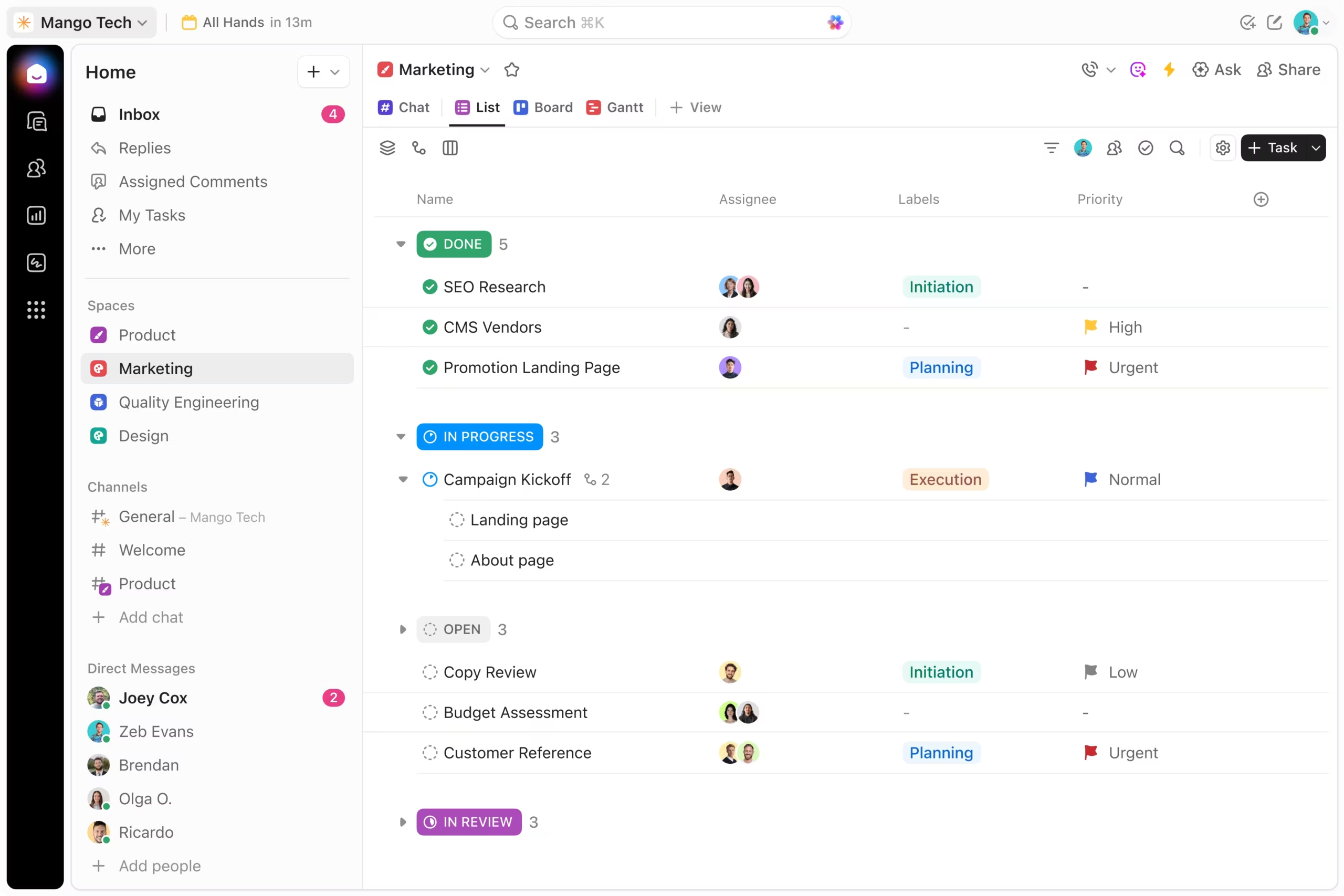
ClickUp sits in the creative-built work management row of that table: it runs the full workflow (brief, tasks, deadlines, feedback, approvals) in one connected place. With this ecosystem, the manager no longer needs to be the connective tissue between disconnected tools.
What works well for creative team management specifically:
Honest limitations: ClickUp carries a learning curve. Teams coming from a simple Kanban board or a spreadsheet will need a week or two to find their setup. If your entire workflow fits on a single whiteboard, a lighter tool will get you moving faster.
Who it’s for: ClickUp fits best when your creative team runs multiple projects at once, involves more than one handoff stage, and needs briefs, feedback, and capacity visible in a single place.
Here’s a walkthrough of how you can review the design and creative workflow in ClickUp:
The six most damaging mistakes in creative leadership are: exposing the team directly to client pressure, refusing to kill work that isn’t landing, delivering feedback at the wrong stage, lowering the hiring bar to fill a seat, managing juniors and seniors identically, and misjudging when to put your own hands on the work.
Here’s the fix for each:
The framework here comes down to one shift: move from chasing status to protecting focus. Every step you implement, from a proper brief to a single feedback loop to visible capacity, removes one more reason for the manager to interrupt the team.
Start with the biggest leak. If your designers lose hours to scattered feedback, fix the feedback loop first. If your lead spends every Monday rebuilding a status picture, make the board do it. You don’t need to overhaul everything at once. Pick the step where the most time disappears, close that gap, and move to the next.
The managers who hold onto talented creatives are the ones who build a system that answers questions before anyone has to ask them. That is the job: protect the people by protecting the conditions, and let the work speak loud enough that nobody needs to ping for proof it’s happening.
Get started with ClickUp for free
The three hardest challenges are protecting deep-focus time from interruptions, giving honest feedback without stifling ownership, and balancing workload before burnout sets in. This is largely driven by overload and understaffing. Unlike predictable workflows, creative output is non-linear, which means standard project management cadences often create more friction than structure.
Five to eight direct reports is the practical ceiling for a manager who is also reviewing work. Past that, review quality drops before anyone notices, because feedback becomes the first thing to get rushed. Agencies solve this by splitting the role: a creative director handles craft and a traffic or project manager handles capacity and scheduling. If you’re at ten reports and still doing both, the review is where the damage is showing up.
Remote creative management depends on making work visible asynchronously, so status never requires a meeting. Keep briefs, deadlines, owners, and feedback in one shared system rather than across chat and email. Batch synchronous time into a fixed window, following Paul Graham’s office-hours approach, so it never fragments a maker’s morning. Distributed teams fail at this more often than co-located ones because a quick desk-side question becomes a notification that arrives whenever it arrives.
Creative work is non-linear, subjective in review, and produces value in bursts rather than steady increments. A technical team ships predictable, testable units where ‘done’ is binary (the feature works or it doesn’t). Creative work dies in revision cycles, not first drafts, and feedback is partly taste-based. This means creative managers must protect ambiguity longer and design feedback loops that separate personal preference from brief alignment.

Sudarshan Somanathan
Max 17min read
Sudarshan Somanathan
Max 20min read
Sudarshan Somanathan
Max 12min read

© 2026 ClickUp




