
Sorry, there were no results found for “”
Sorry, there were no results found for “”
Sorry, there were no results found for “”
Surveys are great for understanding customer sentiments, doing market research, or checking in on your team’s job satisfaction.
But running the survey is just the beginning. The real challenge is diving into the unstructured data and pulling out actionable insights.
As the customer base and team size grew at ClickUp, we realized we needed powerful software to make sense of all the survey data. Doing it manually wasn’t cutting it—especially with large volumes of data.
So, we set out to find the perfect tool.
After testing dozens of survey data analysis platforms, we’ve narrowed down our top 11 favorites. These tools have been incredibly useful for our team, and I hope they’ll be just as helpful for you!
These are the key features I prioritize in a survey data analysis platform:
📮 ClickUp Insight: While 78% of our survey respondents are big on setting goals, only 34% take time to reflect when those goals don’t pan out. 🤔 That’s where growth often gets lost.
With ClickUp Docs and ClickUp Brain, a built-in AI assistant, reflection becomes part of the process, not an afterthought. Automatically generate weekly reviews, track wins and lessons, and make smarter, faster decisions moving forward.
💫 Real Results: ClickUp users report a 2x increase in productivity because building a feedback loop is easy when you have an AI assistant to brainstorm with.
| Tool | Best Feature | Primary Use Case | Pricing |
|---|---|---|---|
| ClickUp | Centralized workspace for survey responses, Customizable dashboards, AI-powered insights with ClickUp Brain | Teams needing customizable surveys, real-time data analysis, and AI-powered survey insights | Free; Custom pricing for enterprise |
| SurveySparrow | Fully branded surveys with customizable CSS, Multi-channel distribution (email, SMS, QR code) | Marketing and CX teams looking to collect branded feedback through various channels | Free; Paid plans start at $19/month |
| Survicate | In-product surveys for feature feedback, Continuous bug reports integration with collaboration tools | Product teams collecting feedback on feature adoption, user experience, or satisfaction post-interaction | Free; Business: $99/month; Scale: $299/month |
| Thematic | Uses AI to analyze unstructured data like chat interactions, Real-time trend identification | CX teams and support managers monitoring satisfaction and churn through voice-of-customer insights | Starter: $2000/month; Enterprise: Custom pricing |
| Tableau | AI-assisted real-time data insights with personalized dashboards | Data or analytics teams visualizing survey data along with other performance metrics | Viewer: $15/month; Creator: $42/month; Explorer: $70/month |
| SurveyMonkey | Extensive template library for various survey types, Advanced survey logic (branching, quotas) | Marketing, HR, and event teams creating detailed surveys and tracking results | Team Advantage: $25/month; Enterprise: Custom pricing |
| Qualtrics | Predictive analytics and churn detection, Multi-source survey data integration | Large-scale enterprises needing deep survey analysis and AI-powered insights on customer behavior | Custom pricing (typically starts at enterprise-level budgets) |
| Google Forms + Looker Studio | Free, quick survey creation, Real-time reporting through customizable dashboards | Solo creators, educators, and small teams looking for a no-cost solution to survey creation and reporting | Free for all users with a Google account |
| Typeform | Conversational, engaging survey design, Multi-path surveys with conditional logic | Teams focusing on interactive surveys and lead generation for external feedback | Free plan available; Paid plans start at $29/month |
| Alchemer | Advanced branching and workflow integrations, Role-based data access | B2B and mid-market teams needing customizable survey logic and data flow integration with CRM systems | Custom pricing; Plans typically start around $49/month |
Our editorial team follows a transparent, research-backed, and vendor-neutral process, so you can trust that our recommendations are based on real product value.
Here’s a detailed rundown of how we review software at ClickUp.
Keeping the above criteria in mind, here are our top picks:
ClickUp has two powerful tools to optimize the survey analysis process: the ClickUp Form View for creating customizable surveys and the ClickUp Dashboards for visualizing the survey data more clearly.
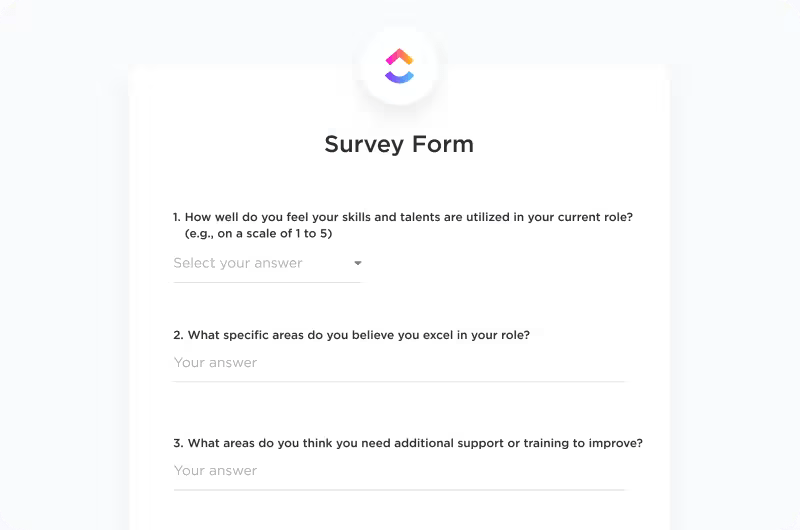
The Form View helps me create custom forms to collect feedback from multiple sources—employees, customers, prospects, and other stakeholders. I can turn this feedback into trackable tasks in ClickUp and add it directly to my workflow. For instance, if a customer complains of a bug, I’ll create a task for our dev team to look into it on priority.
What stands out about the Form View is its flexibility. It’s not a static, cookie-cutter survey form—it supports conditional logic that dynamically updates the questions based on previous responses. This allows me to personalize surveys and capture more relevant data.
💡 Use Custom Fields to automatically tag responses based on sentiment, topic, or department—so they’re easier to filter and assign.
ClickUp Automations further streamline this process. Based on a response, I can automatically assign a task, update a status, or notify the right person—making sure no insight slips through the cracks.

Now, moving on to the next step, I use ClickUp Dashboards to extract insights from the survey data. Custom cards, such as Pie Chart cards, Bar Chart cards, and Calculation chart cards (available in the Business plan and above), help me visualize task data the way I want.

Here’s a quick glimpse of which cards help me track which metrics:
| Card Type | Metric Type |
| Pie Chart card | Open support tickets by status Sprint tasks by status |
| Bar Chart card | Sales pipeline Trends over time |
| Calculation Chart card | Number of new support tickets Average resolution time |
These are just a few examples from the SaaS industry, which heavily revolves around marketing, sales, and customer support. There are plenty of other cards to help professionals from other industries, such as finance, quality assurance, healthcare, construction, and the list goes on.
If I need specific information or insight related to the surveys, I use ClickUp Brain, ClickUp’s built-in, trusted AI co-pilot. It scans all the dashboards in my Workspace and gives me an answer instantly.

⏩ AI Capability: Use ClickUp Brain to supercharge your survey analysis with AI-powered insights. Built on Claude, GPT, and Gemini models, ClickUp Brain helps you instantly summarize large volumes of feedback, identify common themes, and surface sentiment patterns across responses. You can ask questions like “What are the top 3 pain points from our last product survey?” and get accurate, contextual answers in seconds. Combined with Autopilot Agents, you can automate response tagging, create follow-up tasks, and keep dashboards updated—so your team can focus on acting on insights, not digging for them.
Team size: All team sizes—from solo users to large-scale enterprises
Who it’s best for:
Pros:
As a CEO managing multiple media initiatives and a training academy, ClickUp has become my go-to platform for keeping everything aligned. I use it to manage editorial workflows, automate routine tasks, run CRM pipelines for client outreach, and even track progress on educational courses. The versatility is unmatched.
What I love most is the level of customization — from nested subtasks and dashboards to automations and forms. It allows me to build systems that fit the unique needs of both nonprofit projects and commercial services.
Cons:
It can slow down when you’re dealing with large projects that have a lot of nested tasks or custom fields. There’s also a bit of a learning curve for new team members. It takes a little time to get used to all the features, but once you’re familiar with it, it’s great.
Absolutely. If you’re tired of juggling separate tools for surveys, tasks, dashboards, and insights, ClickUp is the one platform that connects it all. It’s not just a survey analysis tool—it’s a full-fledged productivity hub where every piece of feedback leads to action.
Unlike tools that stop at charts or exports, ClickUp lets you assign responses, automate workflows, visualize data live, and use AI to surface patterns instantly. If you’re serious about making survey data part of your team’s everyday decision-making—not just a quarterly report—ClickUp is one of the smartest choices on this list.
I love to add a branded touch to marketing materials, so I was instantly drawn in by SurveySparrow’s CSS customizations. In addition to creating detailed surveys, I could personalize them using contact parameters and custom variables.
I also liked the ease of sharing surveys—the tool gave me the option to create a direct web link for email or SMS, generate a scannable QR code, or embed the link as a widget on our website to collect customer feedback directly.
Team size: Small to mid-sized businesses and agencies
Who it’s best for:
Pros:
The most I like about SurveySparrow are its features like video surveys,conversational forms, share surveys and a lot more.
Its easy to ues, seamless implementation and integration, also the best customer support are the main keys to like this platform
Cons:
I would appreciate some more advanced analytical features, for example the tool could calculate and indicate which differences are statistically significant.
Pricing details sourced from G2
Yes—if brand consistency and aesthetics matter to you, SurveySparrow is a great choice. Its design customization and multichannel reach make it ideal for customer-facing teams. Just be aware that its best features come at a higher price tier, and mobile usability may not be perfect for all use cases.
💡 Pro Tip: Wish your survey tool could highlight statistically significant results automatically? With ClickUp AI, you can summarize survey responses, auto-tag key themes, and even detect outliers—so you instantly know what insights stand out without crunching numbers manually. Pair that with ClickUp Dashboards to visualize trends and KPIs in real time, and you’ve got decision-ready data at your fingertips.
Survicate supports survey creation for multiple channels (email, website, in-app, etc.), but what stood out for me was the ability to create in-product surveys.
Our team tried to collect feedback on specific features with event-triggered surveys (such as asking about the download experience after a user downloads a free template or enquiring about the import experience after they try importing raw data from a third-party tool).
It worked well, I must say. Since the survey was specific and contextual, it also allowed us to understand the unique pain points of our customers (for instance, issues with importing/exporting for specific tools).
Team size: Mid-sized SaaS or product-led teams
Who it’s best for:
Pros:
The interface is very user friendly, and I love the varios customizations options , such as creating custom audiences , the smart question logic (which recently updated) , and the ease of survey creation, along with integrations with other tools. The survey report is easy to understand and visually appeling.
Cons:
While analytics are clear for individual surveys, there is no way to aggregate results across all surveys to see what the average conversion rate is for example. The data presentation is a little limited and I would like to see more stats in the dashboards.
Yes—Survicate is a strong choice for teams that want to understand user behavior as it happens. Its contextual targeting, in-app surveys, and collaboration integrations make it especially powerful for SaaS and digital product teams. If your priority is capturing feedback at the right moment—not just collecting it later—this tool fits the bill.
💡 Pro Tip: Tired of siloed survey data and limited stats? With ClickUp Dashboards, you can pull data from multiple survey projects, track average response rates over time, and monitor trends across campaigns—all in one place. And with ClickUp AI, you can auto-generate insights across surveys to spot patterns, key drivers, and performance gaps—no spreadsheet gymnastics required
While email surveys are useful to understand customer pain points, they usually have a low response rate. Thematic’s survey analysis software addresses this problem.
It uses large language models (LLMs) to analyze chat interactions and predict customer satisfaction levels. I liked this thoughtful feature—it allowed me to accurately measure customer satisfaction (CSAT) scores for customers who had previously contacted our support team, even if they didn’t participate in our customer survey.
Team size: Medium to large organizations with high customer interaction volume
Who it’s best for:
Pros:
……The bottom line, the time saved, the productivity gains and the insights derived are worth their weight in gold. We started small but continue to add more and more of our survey verbatims into our Thematic instance. Call me a Promoter.
Cons:
I think some members find it difficult to get over the erroneous themes or sub themes that are put out. I would like to see more improvements on the NPS/Sentiment scoring as the general themes sentiment do not always go hand in hand with the actual tone of the consumer.
Yes—if you’re looking to go beyond traditional survey analysis and tap into real, conversational data, Thematic delivers exceptional value. It’s best for teams with high volumes of support interactions and a need for real-time, AI-powered insights. For companies where feedback lives outside survey forms, this tool fills the gap beautifully.
🧐 Did You Know? Poor survey analysis—not poor customer experience—is one of the top reasons feedback doesn’t lead to change. A disorganized survey folder = missed growth moments.
I loved Tableau Pulse, which offers personalized AI-assisted insights on your desired metrics. We ‘followed’ some metrics from our customer surveys, such as customer satisfaction (CSAT), net promoter score (NPS), churn rate, and customer lifetime value.
With Pulse, we could get a summary of the key changes in those metrics. With just a single click, it even helped me dig deeper. I could conduct advanced statistical analysis and identify the exact change in numbers and spot outliers or anomalies. It also generated an FAQ-like section for each metric to help me understand the insights better.
Ideal for:
Team size: Mid-to-enterprise teams with dedicated data or analytics resources
Who it’s best for:
Pros:
There are many features which l have liked most:
1. Connect to almost any database which is best feature of it.
2. It support and create many types of charts including Sankey, Donut, map, pie etc. Which helps to easily visualize different types of data in different forms.
3. It has data integration and data extraction functions.
4. Control panels can be viewed on a variety of devices, including tablets, mobile phones and laptops.
5. It makes reviewing and filtering any dashboard very fast.
Cons:
The setup and learning curve is very difficult. the tool is not easy to use, creating dashboards and ratio ads feels time consuming and difficult, don’t use it particularly well and I think I benefited greatly from its ability.
The tool is a bit expensive compared to other data visualization tools but it is worth buying it.
Pricing details sourced from G2
Yes—if your team already works in a data-first environment and wants to integrate survey feedback into broader analytics dashboards, Tableau is a strong contender. It’s not built for creating surveys, but for analyzing them in depth. With Pulse and real-time dashboards, it’s great for surfacing patterns and driving decisions at scale.
Also read: Best Customer Feedback Tools
As our business collects feedback from multiple touchpoints, the customer success team must create different types of forms tailored for each channel. While exploring SurveyMonkey, I came across its template library and was mighty impressed!
From collecting website user experience feedback, contact information, and event registration details to feedback on events and meetings, SurveyMonkey has a template for every purpose. We could also customize the survey themes for a more branded feel.
It’s helpful for companies just getting started with surveys or large teams that want to streamline their multi-channel feedback collection.
Ideal for:
Team size: All team sizes, especially growing companies
Who it’s best for:
Pros:
it just has this seamless like feeling to it, and as a beginner it is super user friendly which makes it more reliable to use at any level of using this survey based application. it comes with customizable templates and other features where you can flexibly create survey. i use it often when i need to collect data on certain projects or need some feedback from people, very cool!
Cons:
My only complaint is that the reporting isn’t super robust unless you upgrade your plan, and it’s not great for team collaboration unless you’re set up with shared access. It also doesn’t play that nicely with other tools, so we usually end up exporting data manually.
Pricing details sourced from Capterra
Yes—especially if you’re just starting with survey analysis or need a platform with strong out-of-the-box templates. It’s one of the most versatile and beginner-friendly tools available, with powerful logic options and excellent reporting. For teams who value speed and consistency in survey creation, SurveyMonkey delivers a solid experience.
💡 Pro Tip: ClickUp lets you create customizable Dashboards, collaborate on survey data in real time, leave comments, assign follow-ups, and connect with 1,000+ tools via native integrations or Zapier—even on the Free plan. While some advanced reporting and sharing features require a paid plan, you can still access core collaboration and integration tools to ensure your survey insights drive action.
Qualtrics is a powerhouse in experience management, offering robust survey design tools, real-time analytics, and predictive insights. It goes beyond collecting data—its powerful AI and machine learning models help forecast customer behavior, detect churn risks, and recommend next steps.
With flexible distribution options and advanced segmentation, it’s a top pick for large-scale, enterprise use cases.
Ideal for:
Team size: Mid-sized to enterprise organizations
Who it’s best for:
Pros:
The survey platform is dynamic and intuitive, but still functional for even a novice to use. I love the creative flexibility dashboard customisation offers. I use it every day to keep track of multiple customer experience programs across the business. I love that we can integrate it with software like Q and our CRM systems. Our licence makes implementing it into our organisation seamless.
I love this platform and I’d recommend it to anyone in the Business Intelligence, Insights or Market Research space.
Cons:
I want to be able to visualize the same data set for different time frames side by side on the same dashboard. Hoping for the ability to filter at the group level rather than just top of page filters.
Yes—if you’re running high-volume or mission-critical research programs. Qualtrics is built for enterprise users who need end-to-end control over data, analysis, and action. If you’re scaling feedback programs across teams or regions, it’s worth the investment. But if your needs are simple or budget is tight, a lighter tool may serve you better.
💡 Pro Tip: Turn every feedback form into a trigger. In ClickUp, you can set automations so that negative feedback creates a task, tags the right team, and even routes it into your next sprint.
Google Forms and Looker Studio together offer a powerful, cost-effective way to collect and analyze survey data—no coding or paid plans required. With Google Forms, you can build and distribute surveys in minutes, using multiple question types, branching logic, and automated response tracking. Once responses are in, Looker Studio lets you turn raw data into interactive dashboards and custom reports, complete with charts, filters, and real-time updates.
💡 Since these tools are frequently paired for end-to-end survey workflows—especially by marketers, educators, and small teams—we’re covering them as a combined solution.
This combo is perfect for anyone looking to launch surveys quickly, monitor trends visually, and share insights with collaborators—all without expensive software or technical expertise.
Ideal for:
Team size: Individuals to mid-sized teams
Who it’s best for:
Pros:
My favorite aspect of Google Workspace is the deep integration between all the Google tools. In particular, the integration between Google Sheets and Looker Studio makes it super easy to create useful, professional-looking reports and share real-time insights. I also appreciate the convenience of having Google Tasks inside of my Gmail and Calendar; It makes organizing my time a cinch, so I use it every day.
Cons:
While I like the integration between Google Forms and Google Sheets, Google Forms is somewhat limited for my use case. I would like to see conditional logic, calculated fields, additional field types, and more design personalization options added. There are also some formatting issues when exporting and opening .docx files in Google Docs.
Google Forms
G2: Not available as a standalone product (part of Google Workspace, which has ~4.6/5 from 40,000+ reviews)
Capterra: 4.7/5 (1,000+ reviews)
Looker Studio
G2: 4.4/5 (445+ reviews)
Capterra: Not listed as a standalone product
Absolutely—if you’re looking for a lightweight, budget-friendly solution. This combo punches above its weight for solo creators, educators, and small teams. While it doesn’t offer advanced automation or predictive analytics, the ability to go from form to live dashboard in minutes makes it one of the most efficient free tools on this list.
💡 Pro Tip: If a stakeholder asks “What are customers most frustrated by this week?”—you can ask ClickUp Brain. It will scan your latest survey responses and give you a human-sounding summary with supporting trends.
Typeform transforms surveys into engaging conversations. Its sleek, one-question-at-a-time interface reduces friction and makes it feel like a chat—not a chore. Whether collecting feedback, generating leads, or building interactive quizzes, Typeform’s intuitive experience boosts response rates and creates a more delightful user journey.
Team size: Solo users to mid-sized teams
Who it’s best for:
I’ve used Typeform for over two years as a startup founder, and it remains one of the most dependable tools in our stack. We rely on it for everything from marketing surveys and NPS tracking to product usability studies. The setup is intuitive, the data outputs are easy to work with, and the integrations with tools like Slack, HubSpot, and Google Sheets streamline our workflows. Highly recommend for teams that value clean UX and actionable insights.
The user interface could be improved for applying design settings. Some of the options are buried in the brand and theme screens. It would be nice to have more control over where the questions and the answers appear on the screen, the layouts are pretty limited. On the data analysis side, it would be nice to have the ability to check questions that are tests so they are eliminated from the results. Right now I have to create a draft survey to test and once it is approved I have to copy the survey and give people a new link to the live version so I can utilize the reports.
Free plan available; paid plans start at $29/month
G2: 4.5/5 (500+ reviews)
Capterra: 4.7/5 (800+ reviews)
Yes—Typeform is a strong choice for teams that prioritize design, interactivity, and a polished end-user experience. It’s ideal for lead generation, customer feedback, and onboarding surveys where brand perception matters. However, teams requiring in-depth analytics or enterprise-level capabilities may need a more robust tool or supporting platform.
⏩ AI Capability: Typeform includes AI-powered suggestions for structuring surveys, choosing relevant questions, and optimizing layout. Users can also integrate third-party AI models through Zapier to automate follow-ups, summarize responses, or personalize user journeys. While its AI capabilities are more lightweight compared to tools like ClickUp or Qualtrics, they provide a helpful boost to survey setup and automation.
Also read: SurveyMonkey Alternatives and Competitors
Alchemer is a flexible survey platform designed for teams that need more control over how surveys are created, distributed, and analyzed—without stepping into full-blown enterprise complexity. Formerly known as SurveyGizmo, Alchemer provides robust features like advanced branching, quotas, workflow integrations, and role-based data access, making it especially effective for B2B feedback and customer research programs.
Team size: Mid-sized teams and growing organizations
Who it’s best for:
The abundance of tools available enables you to conduct almost any kind of survey and build any kind of form for any purpose, from the most simple to the most technical features, connected by robust logic and piping capabilities.
While Alchemer is improving in terms of technology and functionality, it feels like there’s still a way to go to catch up to expectations (e.g., reporting customizations).
Custom pricing; plans typically start around $49/month
G2: 4.4/5 (400+ reviews)
Capterra: 4.5/5 (300+ reviews)
Yes—for mid-sized teams that want more control than free tools offer but don’t need the scale (or price tag) of Qualtrics. Alchemer is great for operational surveys, recurring B2B feedback, and integrated workflows. However, if you want strong AI analysis or modern UI polish, it may feel a bit behind newer platforms.
✨ Your next best product feature, support policy, or team ritual could be hiding in your survey results. ClickUp brings it to the surface—so no good idea slips by.
Zoho Survey is a versatile tool tailored for businesses that want professional-grade survey features without a steep price tag. As part of the larger Zoho suite, it connects natively with tools like Zoho CRM, Zoho Campaigns, and Zoho Analytics, making it a strong option for integrated workflows.
With features like multilingual surveys, customizable reports, and offline data collection, it serves both internal teams and customer-facing operations well.
Team size: Small to mid-sized businesses
Who it’s best for:
Free plan available; paid plans start at $20/month
G2: 4.4/5 (300+ reviews)
Capterra: 4.6/5 (500+ reviews)
Yes—especially if your team already works with Zoho products. It offers great value for the price, making it a smart choice for growing teams that need serious survey capabilities without breaking the budget. However, if you’re seeking highly advanced analytics or AI-powered features, you’ll likely need to supplement it with another platform.
⏩ AI Capability: Zoho Survey itself has minimal native AI features. However, teams can enhance automation and insights by connecting Zoho Survey with Zoho Analytics, which offers AI-powered forecasting and trend detection. Additionally, integrations with Zoho’s AI assistant, Zia, can support smarter reporting and recommendations—though this requires configuration across the Zoho ecosystem.
The main idea behind survey analysis software is to know your stakeholders better and make improvements based on feedback loops. The survey tools I’ve included in this list are great at what they do—analyzing survey data—but not all can balance survey creation and analysis equally or cater to multiple industries.
This is where ClickUp has a clear advantage over the others. The platform empowers you to ask open-ended and intentional questions for gathering qualitative data, visualize your data in a flexible canvas for effective sentiment analysis, make data-driven decisions, and generate valuable insights from survey data to hit your business goals and objectives consistently.
Get started with ClickUp today!
Survey analysis software helps you collect, organize, and interpret responses from surveys. It often includes tools for visualizing data, spotting trends, and generating reports to support decision-making across customer experience, employee feedback, or market research.
Look for features like customizable survey creation, real-time data visualization, automated workflows, dashboard reporting, and AI insights. Integration with your CRM or marketing tools is also a big plus.
AI can help by summarizing responses, analyzing sentiment, detecting patterns, and even suggesting follow-up questions. Platforms like ClickUp use AI (ClickUp Brain) to extract insights from dashboards and automate follow-up tasks based on survey data.
Google Forms combined with Looker Studio offers a powerful free solution. For more workflow automation and AI features, ClickUp’s Free Forever plan also provides solid capabilities at no cost.
Yes. Most leading tools—like ClickUp, Zoho Survey, and Typeform—offer integrations with CRMs, spreadsheets, email tools, and automation platforms like Zapier, so you can act on survey results instantly.

Arya P Dinesh
Max 15min read

Manasi Nair
Max 15min read
Manasi Nair
Max 19min read

© 2026 ClickUp