Teams often struggle to integrate new AI agents into existing systems. Your expensive new tool now sits unused because no one knows how to make it work with your systems.
According to a global survey of business leaders, nearly 23% of organizations are already scaling agentic AI systems beyond experimentation, with another 39% actively testing them in one or more business functions.
Yet, fewer than 1 in 10 companies has successfully moved these tools into widespread operational use across teams and workflows.
This gap between intention and impact shows up.
Instead of treating AI as a plug-and-play product, forward-deployed engineers (FDEs) bridge the divide between pilot and production by deeply embedding in your environment, adapting AI agents to your data, systems, and workflows, and making them genuinely useful to your teams.
Let’s find out how FDEs do it and how to equip them with the right workspace tools to succeed.
How Forward Deployed Engineers Drive AI Agent Adoption
Summarize this article with AI
ClickUp Brain not only saves you precious time by instantly summarizing articles, it also leverages AI to connect your tasks, docs, people, and more, streamlining your workflow like never before.
Summarize this article for me please
What Is a Forward Deployed Engineer?
A forward deployed engineer is a technical expert who works directly with your team, embedded in your environment, to deploy, customize, and maintain software solutions.
Unlike traditional engineers who build products from a distance, an FDE operates at the edge where the product meets the customer. They are tasked with translating an AI agent’s technical capabilities into tangible business value.
The role first gained prominence at companies like Palantir, where complex enterprise software demanded hands-on implementation. FDEs blend deep engineering skills with sharp business context and customer empathy.
Instead of shipping code, they ensure that the AI agent fits perfectly within your unique workflows, data structures, and organizational constraints. And you get an expert who brings the AI’s potential to life for your team. ✨
Summarize this article with AI
ClickUp Brain not only saves you precious time by instantly summarizing articles, it also leverages AI to connect your tasks, docs, people, and more, streamlining your workflow like never before.
Summarize this article for me please
Why Forward Deployed Engineers Are Critical for AI Agent Adoption
AI agents often give generic, unhelpful answers when they don’t understand a company’s unique jargon, workflows, or data. This is a common failure point in enterprise AI adoption. When an AI tool lacks context, it can’t perform its job effectively, leading to low user trust and eventual abandonment.
Over time, this creates a cycle of frustration where teams feel the AI agent is creating more work than it saves. The result is AI sprawl: more tools, more confusion, and less actual impact.
In practice, AI agent adoption breaks down in a few predictable ways:
Lack of domain context: The AI doesn’t understand internal terminology, metrics, or processes, so answers feel generic or wrong
Shallow integrations: Agents aren’t deeply connected to core systems like CRMs, data warehouses, or internal tools, limiting what they can actually do
Edge cases piling up: Real-world workflows expose exceptions and constraints that demos never account for
Slow feedback loops: Issues take weeks to surface and fix, causing teams to lose confidence and stop using the tool
Ownership gaps: No one is responsible for making the AI work end-to-end once the initial setup is “complete”
Without a way to bridge this context gap, AI investments fail to deliver on their promise, and teams fall back to manual processes they already trust.
This is where a forward-deployed AI engineer makes the difference. By embedding directly in your environment, they handle custom integrations, resolve edge cases, and create tight feedback loops that continuously adapt the AI agent to your business.
Over time, the agent stops sounding generic and starts behaving like a system that actually understands how your company works.
📮 ClickUp Insight: 88% of our survey respondents use AI for their personal tasks, yet over 50% shy away from using it at work. The three main barriers? Lack of seamless integration, knowledge gaps, or security concerns.
But what if AI is built into your workspace and is already secure?
ClickUp Brain, ClickUp’s built-in AI assistant, makes this a reality. It understands prompts in plain language, solving all three AI adoption concerns while connecting your chat, tasks, docs, and knowledge across the workspace. Find answers and insights with a single click!
Summarize this article with AI
ClickUp Brain not only saves you precious time by instantly summarizing articles, it also leverages AI to connect your tasks, docs, people, and more, streamlining your workflow like never before.
Summarize this article for me please
The Rise of Forward Deployed Engineers in Enterprise AI
Competitors are launching AI features deeply integrated into customer workflows, creating pressure to keep pace. Your own AI deployments are slow, clunky, and often fail to gain traction, putting you in a reactive position instead of leading the market.
This can lead to lost market share and a reputation for software that doesn’t deliver.
This pressure is why the forward deployed engineer role is surging in popularity. What started as a niche position in high-stakes government and defense contracting is now a major competitive advantage in commercial AI. As AI agents shift from experimental toys to mission-critical tools, companies can no longer afford failed deployments.
And the job market reflects it. Analysis by Indeed’s Hiring Lab and the Financial Times found that job postings for forward-deployed engineer roles more than tripled—specifically rising over 800% between January and September 2025, reflecting explosive demand for this hybrid engineering role in AI deployments.
This surge makes the role one of the fastest-growing in tech hiring this year.
And the level of growth hasn’t gone unnoticed by the industry. Venture capital firm Andreessen Horowitz (a16z) has highlighted the forward-deployed engineer as one of the “hottest jobs in tech,” a role that blends deep technical fluency with customer-centric problem-solving.
A few employers are already moving quickly:
OpenAI has established dedicated FDE teams and planned a significant expansion to support enterprise customers
Salesforcepublicly committed to building a large forward deployed engineering organization to scale AI deployment outcomes
Companies like Anthropic, Cohere, Databricks, and ElevenLabs are actively advertising FDE openings as part of broader AI adoption efforts
This rapid rise underscores that the challenge isn’t just building agentic AI. It comes down to deploying, integrating, and operationalizing it across real workflows. Forward deployed engineers provide that bridge by marrying engineering skills with business context, so AI agents don’t just exist, but deliver sustained value.
🚀 The ClickUp Advantage:Built for forward deployed engineers
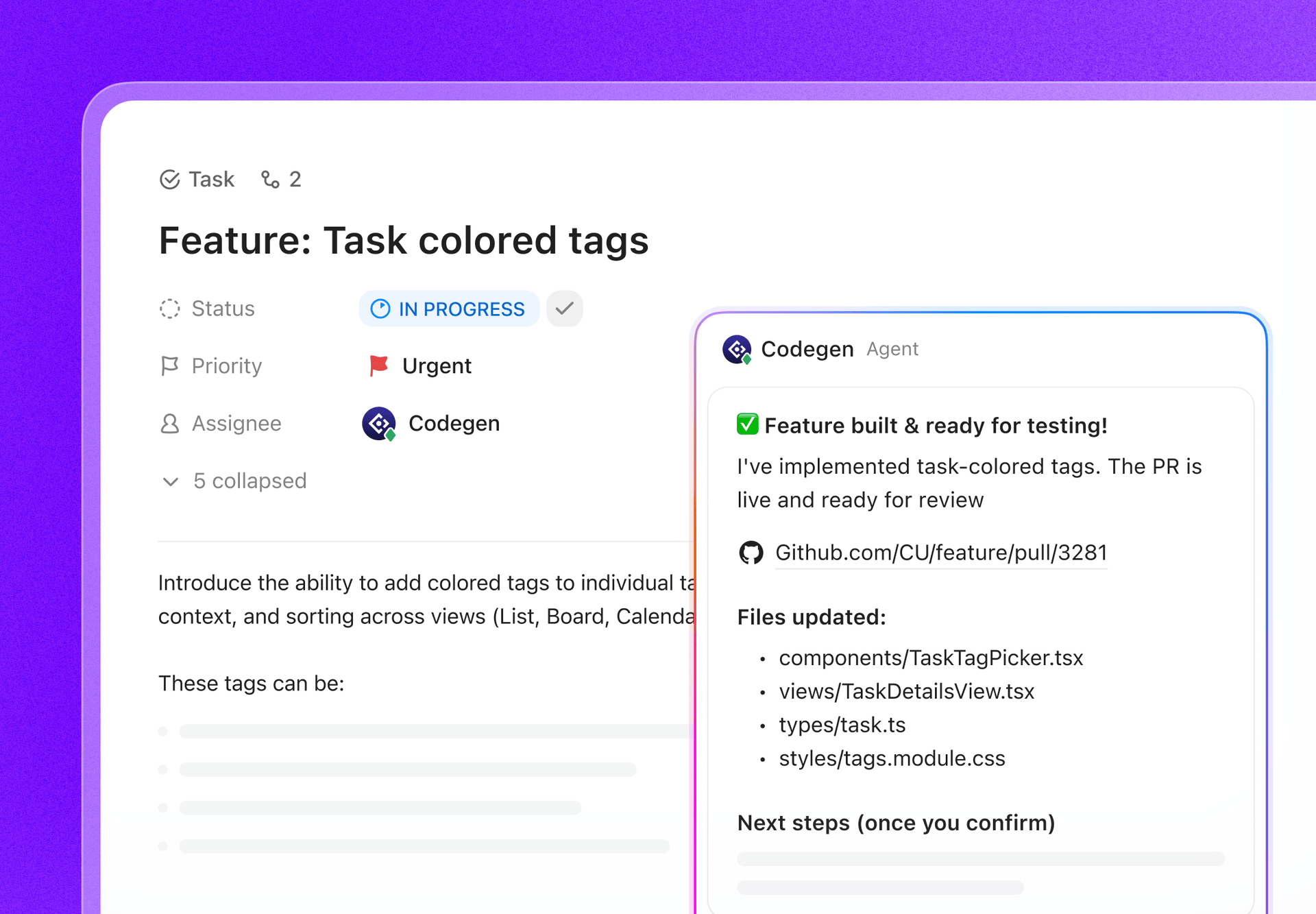
With ClickUp for Engineering and the Codegen Agent, forward deployed engineers get a workspace designed for real production work, not just planning.
Engineering tasks, deployment milestones, bugs, and customer-specific changes live alongside the exact context that explains why the work matters. The Codegen Agent helps FDEs move faster by generating, updating, or validating code directly from real requirements, tickets, and discussions, reducing manual glue work between systems. Instead of rewriting context for every handoff, engineers can turn decisions and feedback into executable changes immediately.
This tight loop is critical for FDEs, who operate under constant pressure to adapt AI agents to messy, real-world environments. The result is faster iteration, fewer dropped details, and deployments that actually stick.
Summarize this article with AI
ClickUp Brain not only saves you precious time by instantly summarizing articles, it also leverages AI to connect your tasks, docs, people, and more, streamlining your workflow like never before.
Summarize this article for me please
How Forward Deployed Engineers Accelerate AI Agent Deployment
Many AI projects get stuck in the ‘implementation gap.’ That’s the painful limbo between signing the contract and getting any real value, where momentum dies in a flurry of emails and missed deadlines. Stakeholders start questioning the investment, and the initial excitement fades into disappointment.
This is the black hole where many AI initiatives fail. The project stalls because the vendor doesn’t truly understand your internal systems, and your internal team doesn’t have the deep product knowledge to execute the integration. This disconnect creates friction, delays, and ultimately, a failed deployment.
Forward deployed engineers are built to close this gap and accelerate adoption. They bring a hands-on, problem-solving approach that turns a multi-month slog into a focused sprint. Here’s how they do it:
Custom integration architecture: An FDE’s first job is to map the AI agent to your existing tech stack. They connect it to your CRM, ERP, and internal databases without disrupting daily operations, ensuring data flows correctly from day one
Workflow embedding: They don’t force you to change how you work. Instead, they configure the AI agent to fit into your team’s established processes, making adoption feel natural and intuitive
Rapid iteration: When something breaks in production, an FDE is there to fix it immediately. This on-site presence compresses feedback cycles from weeks to days, allowing for quick adjustments and continuous improvement
Change management support: A new tool is only successful if people use it. FDEs train end-users, listen to their concerns, address resistance, and champion the tool to ensure adoption sticks long after the initial rollout
Edge case resolution: Demos are clean, but real-world deployments are messy. FDEs thrive on solving the unexpected problems that inevitably surface, handling unique challenges in real time so the project stays on track
Summarize this article with AI
ClickUp Brain not only saves you precious time by instantly summarizing articles, it also leverages AI to connect your tasks, docs, people, and more, streamlining your workflow like never before.
Summarize this article for me please
Key Skills Forward Deployed Engineers Need
Hiring an FDE is challenging because candidates often lack key skills.
The deeply technical ones lack communication skills, while the great communicators can’t write a line of code.
This struggle to find the right person is common because the role demands a rare, hybrid skillset. And hiring the wrong profile can be disastrous.
A pure engineer might build something technically perfect but may struggle to close communication gaps effectively, while a non-technical person won’t be able to solve the deep integration challenges. In either case, the crucial bridge between your business needs and the AI’s technical capabilities remains broken, and the deployment is at risk.
An effective forward deployed engineer combines multiple rare talents. 🦄
Developing them internally from your best engineers is often more successful than hiring a software engineer externally. Here are the core competencies to look for:
Deep technical execution
An FDE must be capable of writing, debugging, and shipping production-grade code in customer environments. This includes working with AI and ML systems, APIs, authentication layers, data pipelines, and deployment infrastructure. They need to understand how the AI agent behaves in real conditions, not just in controlled demos, and be able to diagnose failures that span models, data, and integrations.
Business and workflow empathy
Forward deployed engineers don’t just implement requirements. They take the time to understand how teams actually work, where friction appears, and why certain workflows exist in the first place. This allows them to configure AI agents in a way that feels natural to users, rather than forcing teams to adapt to the tool.
Clear, decisive communication
FDEs spend as much time explaining tradeoffs as they do writing code. They must translate complex technical decisions into clear language for product leaders, operators, and executives. This includes setting expectations, explaining constraints, and helping stakeholders understand what is feasible now versus what requires deeper product changes.
Adaptability in unfamiliar environments
No two customer environments look the same. Forward deployed engineers need to ramp quickly in new codebases, data models, and organizational structures. They must be comfortable operating with incomplete information and adjusting their approach as new constraints surface during deployment.
Problem-solving under real-world pressure
Production issues rarely arrive neatly packaged. FDEs are often pulled in when something breaks, adoption stalls, or trust erodes. They need the ability to stay calm, isolate the real problem, and implement fixes quickly without introducing new risks or regressions.
Product-level judgment
A critical part of the role is knowing what not to build. Forward deployed engineers must distinguish between one-off customer requests and patterns that should influence the core product roadmap. Their judgment helps prevent excessive customization while ensuring valuable real-world feedback makes its way back into the product.
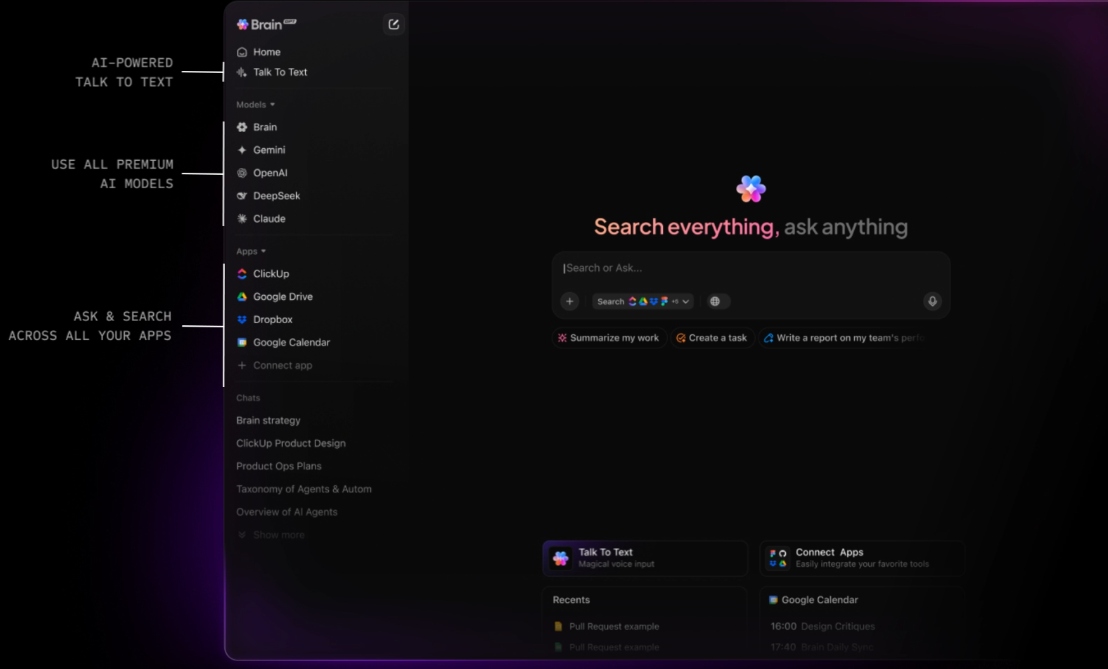
💡Pro Tip: With ClickUp BrainGPT, engineers don’t have to juggle multiple AI tools to test ideas, debug, or refine instructions. BrainGPT acts as a single interface for working across multiple AI models, making it easier to compare outputs, validate approaches, and choose the best response for a given engineering task.
This is especially useful for forward deployed engineers who need to experiment quickly in unfamiliar environments without committing to one model’s limitations. Talk-to-Text speeds things up even further by letting engineers speak requirements, edge cases, or fixes instead of typing long instructions.
The result is less friction, faster iteration, and clearer instructions when every deployment detail matters.
Integrate all your work for faster results with ClickUp BrainGPT
Summarize this article with AI
ClickUp Brain not only saves you precious time by instantly summarizing articles, it also leverages AI to connect your tasks, docs, people, and more, streamlining your workflow like never before.
Summarize this article for me please
Forward Deployed Engineers vs. Solutions Engineers and Consultants
Solutions engineers run great demos and consultants deliver strategic plans, but AI agents often still don’t work in production.
You’re left wondering who is actually supposed to do the work and get the tool across the finish line. The confusion between roles leads to dropped handoffs, finger-pointing, and a project with no clear owner.
The solutions engineer disappears after the deal is signed, and the consultant moves on after delivering their recommendations. Meanwhile, your team struggles with the messy reality of implementation.
A forward deployed engineer is the one who stays for the entire journey. Here’s the breakdown:
Aspect
Forward Deployed Engineer
Solutions Engineer
Consultant
Primary focus
Making the product work in a real production environment and improving it over time
Proving the product can work during evaluation and sales
Advising on strategy, process, or architecture
When they engage
Post-sale and throughout adoption
Pre-sale and during procurement
During defined project windows
Relationship with the customer
Embedded partner who operates alongside customer teams
Trusted technical advisor during the buying process
External advisor with limited operational exposure
Depth of technical work
Writes, debugs, and deploys production code inside customer systems
Configures demos, prototypes, and reference architectures
Rarely writes code; may review or recommend architectures
Exposure to real workflows
Deep, day-to-day exposure to how teams actually work
Limited to representative use cases and demo scenarios
Indirect, based on interviews and documentation
Handling edge cases
Owns and resolves unexpected production issues in real time
Escalates issues back to engineering
Documents risks and recommends mitigation strategies
Feedback loop speed
Tight, continuous feedback from users to product teams
Feedback flows through sales and product marketing
Feedback delivered at milestones or project close
Product influence
Direct influence on roadmap based on recurring customer patterns
Indirect influence via sales insights
Minimal influence; not tied to product evolution
Success metrics
User adoption, time-to-value, long-term customer outcomes
Deal velocity, win rate, and technical validation
Completion of scoped deliverables
Accountability for outcomes
Owns whether the AI agent actually delivers value
Owns whether the product is understood and approved
Owns whether recommendations are delivered
Typical risk if overused
Can become a bottleneck if not supported by good tooling
Hands off too early, leaving gaps post-sale
Produces strategy without execution follow-through
In short, solutions engineers prove the product can work, and consultants advise on what should happen. A forward deployed AI engineer is the one who makes it happen and ensures it keeps working. They own the outcome, not just the output.
Summarize this article with AI
ClickUp Brain not only saves you precious time by instantly summarizing articles, it also leverages AI to connect your tasks, docs, people, and more, streamlining your workflow like never before.
Summarize this article for me please
How to Support Forward Deployed Engineers With the Right Tools
Even high-performing FDEs can drown in chaos without the right tools. They juggle five customer deployments using a messy combination of spreadsheets, Slack DMs, and scattered notes.
This Work Sprawl, or the fragmentation of work activities across multiple disconnected tools that don’t talk to each other, means they spend more time hunting for information than solving customer problems, turning them into a bottleneck instead of an accelerator. It is a recipe for burnout, plus inconsistent customer experiences. 🛠️
This is where you need a Converged AI Workspace: a single, secure platform where projects, documents, conversations, and analytics live together with AI embedded as the intelligence layer.
It gives your FDEs a single place to manage deployments, document configurations, and collaborate with product teams. Let’s look at how:
1. Track every deployment as a living system of work
An FDE starts by breaking each customer deployment into clear implementation milestones using ClickUp Tasks. Each task becomes a single source of truth for that piece of work, holding ownership, timelines, and dependencies in one place.
With Custom Fields for details like customer tier, integration type, or technical complexity, FDEs can instantly see where every deployment stands and which ones need attention, without juggling spreadsheets or status pings.
2. Capture decisions and edge cases as they happen
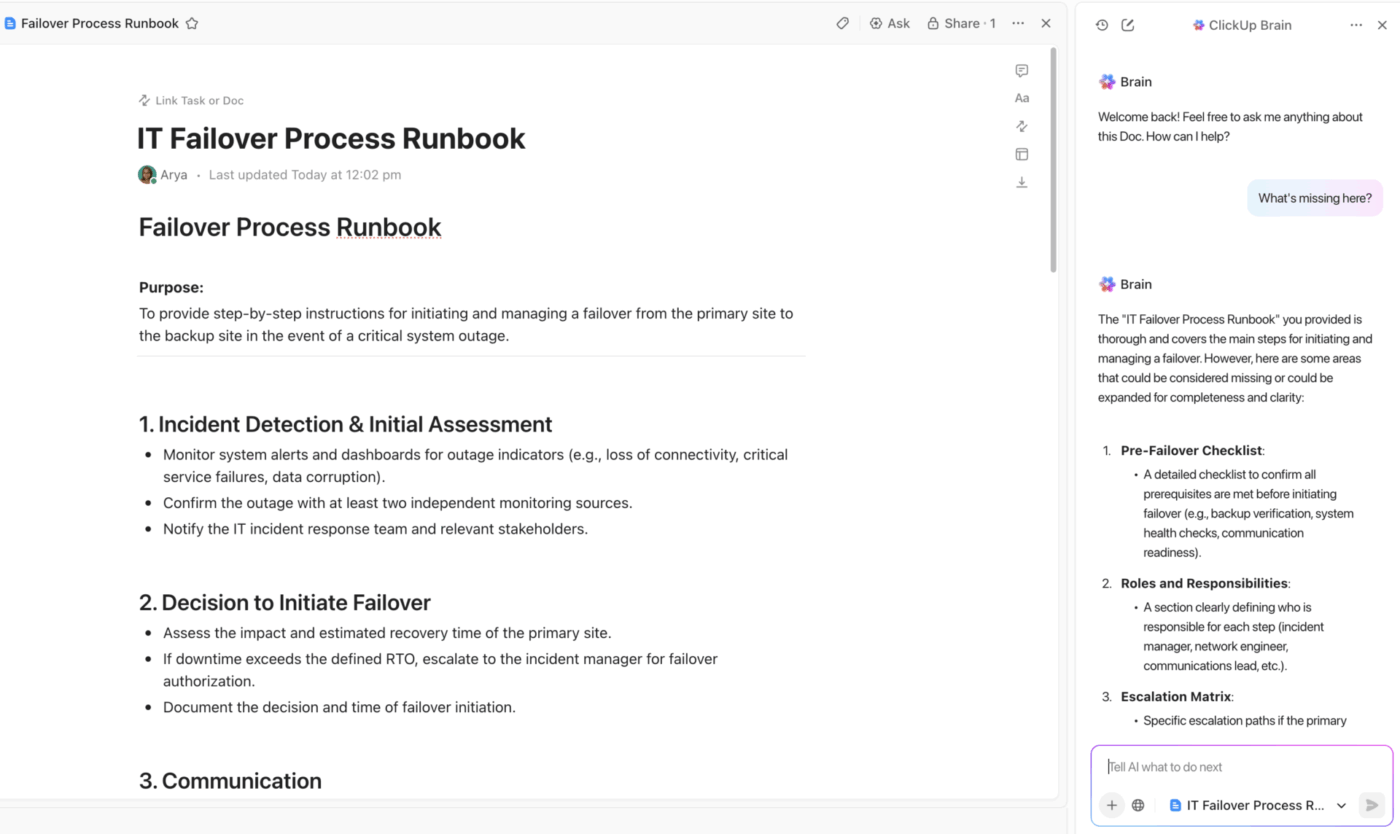
AI-powered Docs in ClickUp speeds up knowledge management processes for FDEs
As integrations progress, context accumulates fast.
Instead of letting critical knowledge disappear into chat threads, FDEs document customer-specific configurations, edge cases, and workarounds in ClickUp Docs.
Because Docs are directly linked to the tasks they support, knowledge stays anchored to real deployments. When one FDE solves a tricky issue, that insight becomes immediately reusable across the team instead of being rediscovered later.
3. Surface patterns across customers, not just anecdotes
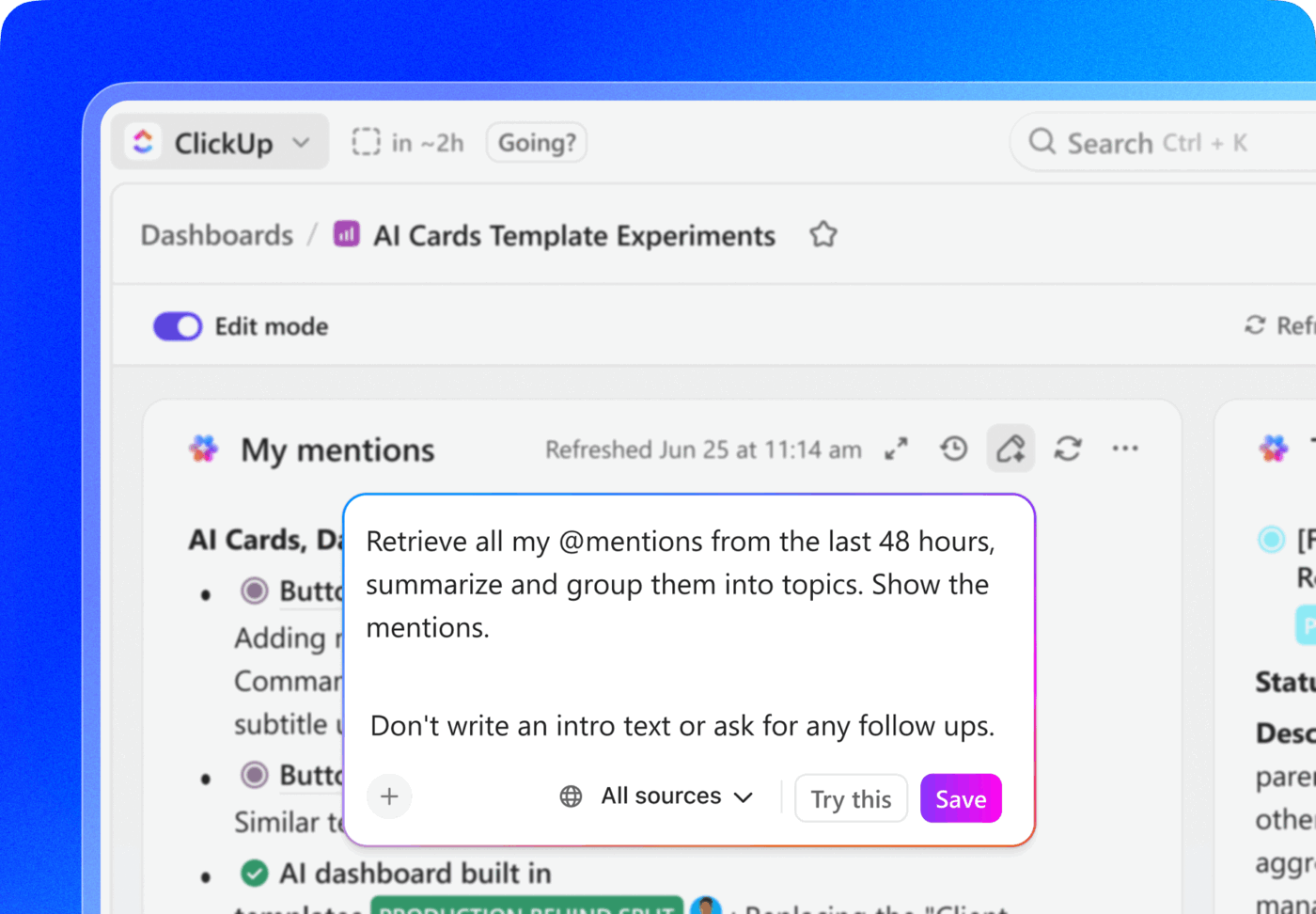
Get those summaries faster with AI in ClickUp Dashboards
Once deployments are underway, FDEs need to spot trends early. ClickUp Dashboards turn task activity into real-time visibility.
If multiple customers are hitting the same integration blocker or configuration gap, it shows up clearly in the data. This shifts feedback from “a few customers mentioned this” to concrete evidence the product team can act on, accelerating fixes and roadmap decisions.
4. Resolve questions without breaking focus
During execution, FDEs constantly need answers: past decisions, similar deployments, and known limitations. ClickUp Brain keeps that friction low.
When they are able to ask AI questions directly inside a task or comment, FDEs get answers grounded in the context of the work they’re doing. There’s no more tab-switching or rebuilding context from scratch.
5. Let agents and automations keep deployments moving
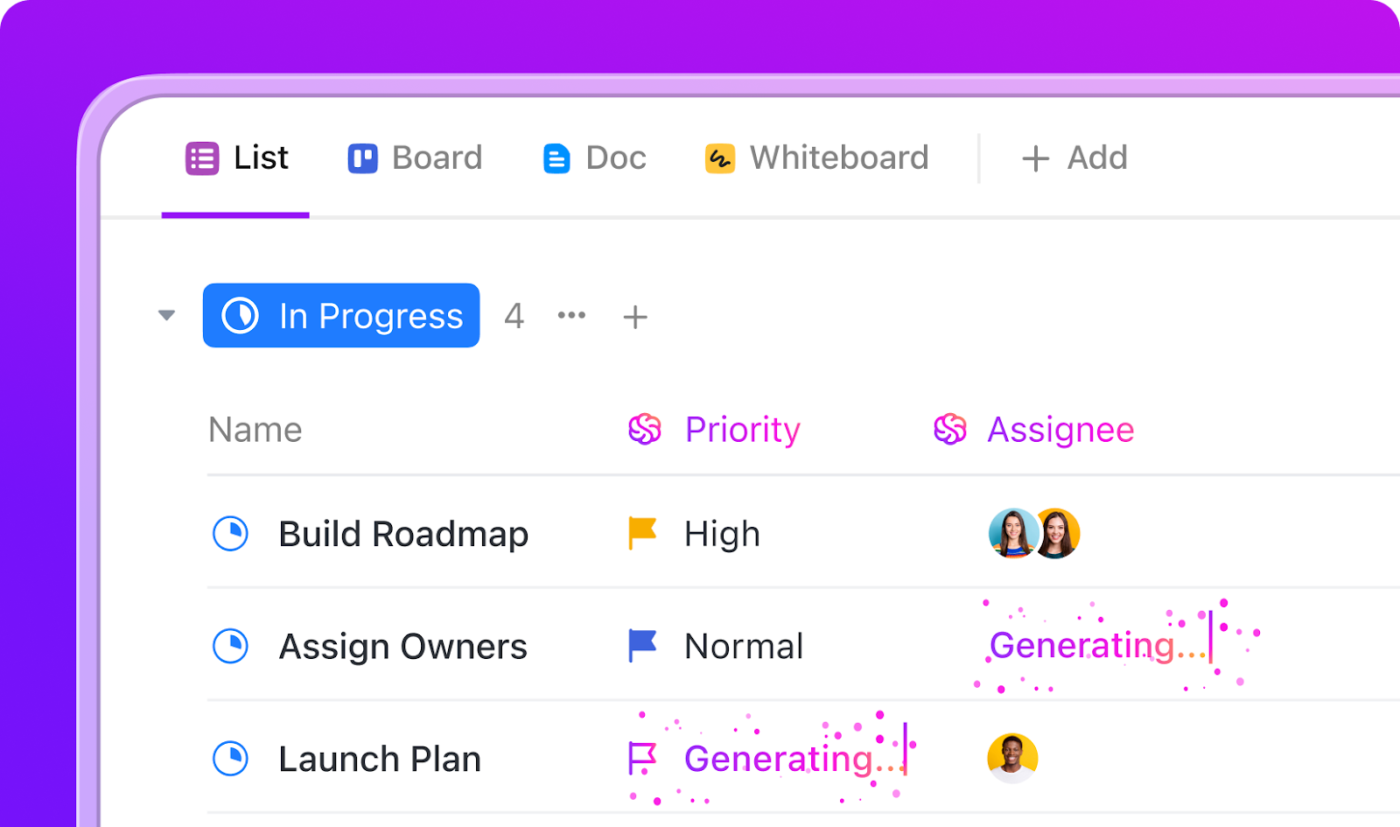
Use ClickUp’s AI Assign, AI Prioritize, and AI Cards to automate task management and surface real-time insights instantly
This is where FDEs stop being human routers. With ClickUp Automations, routine steps like status changes, task handoffs, escalations, and follow-ups happen automatically, so nothing stalls silently.
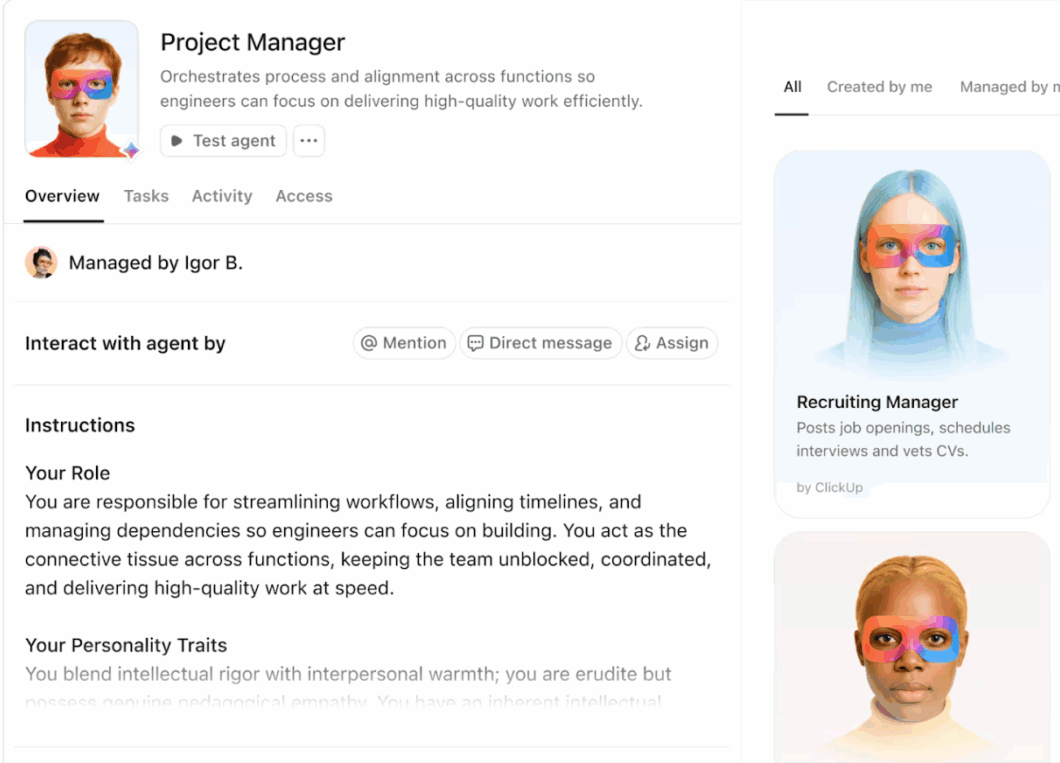
Super Agents take this further by monitoring deployment work in the background, interpreting context from tasks and comments, and acting when predefined conditions are met. An agent can flag stuck implementations, route issues to the right owner, summarize deployment status for leadership, or prompt next steps when feedback is missing, without the FDE having to manually orchestrate every move.
Create custom AI Agents with preconfigured instructions and personalities via ClickUp Super Agents
Together, this creates a tight loop: tasks drive execution, docs preserve learning, dashboards reveal patterns, AI answers questions, and agents keep momentum intact.
Instead of deployment chaos, forward deployed engineers get a system that compounds their impact with every customer they support, freeing them to focus on the hardest problems rather than the administrative glue work.
Summarize this article with AI
ClickUp Brain not only saves you precious time by instantly summarizing articles, it also leverages AI to connect your tasks, docs, people, and more, streamlining your workflow like never before.
Summarize this article for me please
Best Practices for Forward Deployed Engineers
Forward deployed engineers operate at the crossroads of technology, business context, and customer experience. To maximize their impact and ensure AI agent deployments don’t just land but scale, it helps to build routines and practices that reinforce clarity, alignment, and learning across teams.
1. Anchor deployment success in product adoption metrics
An AI agent isn’t truly “deployed” until people use it regularly and meaningfully. FDEs should align deployments with measurable product adoption goals and monitor whether the AI solution is actually moving the needle. Internal adoption signals, such as frequency of use, task completion rates, and reduced cycle times, provide early indicators of real value rather than superficial acceptance.
2. Map the full value chain
Understanding where AI agents can have the greatest impact requires looking beyond the immediate deployment work to the broader organizational value chain. FDEs should collaborate with stakeholders to map the value chain for the work the AI agent touches, from upstream data flows to downstream decision outcomes, and ensure the integration fuels improvements across the whole system.
3. Prioritize use cases based on impact and feasibility
Not all AI agent features are equally valuable or urgent. Work with product and business teams to perform a rigorous evaluation of AI use cases: weighing impact, integration complexity, and user value. This helps prevent wasted effort on low ROI work and aligns focus with strategic priorities.
4. Conduct gap analyses before integration
A common reason AI projects stall is unclear expectations and mismatched assumptions about readiness. FDEs should lead or participate in gap analyses to identify where existing systems, data, or processes fall short of deployment requirements. Documenting these gaps upfront prevents mid-deployment surprises and can inform prioritization.
5. Extend integrations with API-first thinking
Where possible, treat the underlying system APIs as a first-class citizen in deployment planning. Using API-centric integrations makes the AI agent more resilient, maintainable, and easier to iterate on. FDEs should familiarize themselves with the available interfaces and architect robust, secure connections.
6. Embed change management into deployment plans
Technical integration is only half the battle; people have to adopt the agent, too. Pair every deployment with a change management plan that includes training, support materials, feedback channels, and communication cadence. FDEs are often on the front lines of adoption, so equipping teams with the right behavioral frameworks accelerates adoption.
7. Build shared understanding through empathy mapping
When customizing AI behavior or workflows, it isn’t enough to know what users need—you must know why. Empathy maps help surface user motivations, pain points, and expectations that can shape more intuitive agent behavior and smoother workflows. FDEs can facilitate empathy mapping sessions with stakeholders to align teams on end-user realities.
Summarize this article with AI
ClickUp Brain not only saves you precious time by instantly summarizing articles, it also leverages AI to connect your tasks, docs, people, and more, streamlining your workflow like never before.
Summarize this article for me please
Bringing It All Together: FDEs Need Systems, Not Just Skills
Even the best FDEs can’t scale their impact with ad hoc tools and fragmented workflows. When deployment work, customer context, decisions, and feedback live in different places, progress slows and learning gets lost.
The result is the same failure pattern teams are trying to escape: stalled rollouts, low adoption, and AI initiatives that never make it past pilot.
As a converged AI workspace, ClickUp gives forward deployed engineers a single system to manage deployments end to end. Tasks anchor execution, Docs preserve hard-won knowledge, Dashboards surface patterns across customers, Brain accelerates answers in context, closing the loops instantly.
When FDEs are supported by a system built for execution, learning compounds instead of resetting. Deployments move faster, and AI agents evolve based on reality rather than assumptions.
If your teams are serious about turning AI agents into real business outcomes, equipping your forward deployed engineers with the right workspace isn’t optional. Give ClickUp a shot today!
Summarize this article with AI
ClickUp Brain not only saves you precious time by instantly summarizing articles, it also leverages AI to connect your tasks, docs, people, and more, streamlining your workflow like never before.
Summarize this article for me please
FAQ
What does a forward deployed engineer do?
A forward deployed engineer embeds with customers to handle the hands-on technical work of deploying, customizing, and optimizing software, ensuring it works in a real-world production environment.
How is a forward deployed engineer different from a solutions engineer?
A solutions engineer focuses on pre-sales activities, such as demos to demonstrate a product’s viability. In contrast, a forward deployed engineer handles post-sale implementation and long-term adoption by writing code and iterating on the solution.
Why are forward deployed engineers important for AI adoption?
AI agents need deep customization to fit a company’s unique workflows and data, and FDEs provide the on-site engineering expertise to bridge the gap between a generic AI tool and a specific business requirement.
Everything you need to stay organized and get work done.