







Still downloading templates?
There’s an easier way. Try a free AI Agent in ClickUp that actually does the work for you—set up in minutes, save hours every week.
Sorry, there were no results found for “”
Sorry, there were no results found for “”
Sorry, there were no results found for “”
Gone are the days when building enterprise software would be a five-year project. In today’s fast-paced digital world, sticking to traditional development methods is akin to riding a bicycle in a Formula 1 race.
Enter Rapid Application Development. Some of the most successful tech giants, like Spotify and Netflix, have used RAD and low code to stay ahead of the curve.
However, RAD isn’t just about doing the same things faster. It’s also about new approaches to software development that emphasize rapid prototyping, user feedback, and iterative delivery for engineering excellence. Let’s see how.
Rapid Application Development is an adaptive software development approach that prioritizes shorter deployment cycles over lengthy traditional processes.
Gaining popularity in the 1980s when Barry Boehm, James Martin, and others proposed it as an alternative to the then-dominant Waterfall model, which they criticized for its rigidity and inefficiency.
The defining characteristics of RAD are as follows.
RAD encourages teams to build small parts of a large product, creating interconnected units with shorter lead time. This makes it easier to debug/improve these parts independently.
RAD methodology focuses on adaptability and risk mitigation. It enables development teams to identify risks early, evolve with the market, and build products that meet customer needs.
RAD prioritizes user needs and feedback over plans. Prototyping to gauge customer reaction is a key process in RAD.
Rapid application development software stack is a critical aspect in ensuring development outcomes. RAD teams use tools such as low-code, component-based design, code reusability, etc. to ensure that manual work is minimized and developers can focus on high-value activities.
The rapid application development methodology has since integrated with contemporary agile workflows and practices. Here’s how.
Rapid Application Development consists of four phases designed to get the best possible output.

This is the first step of RAD, where the project team performs the requirement management planning of the application.
The planning phase sets the stage for the design and development process.
Next, you focus on visualizing and designing the user experience (UX) through workshops, prototypes, and iterations based on user feedback.
Once designed, it’s time to develop. In this model, engineering teams use a number of rapid application development tools, low-code platforms, component-based approaches, and code reuse for programming, unit integration and some testing.
The cutover phase is akin to the implementation phase in traditional software development. It covers final agile testing, user training, and system support to ensure a smooth transition to the live environment.
Within the RAD model, these four phases are commonly followed. They set up the foundational structure for the process software development teams follow.
Yet, this is just the foundation. Depending on various factors, the development team interprets this process in different ways. They can add phases/steps to suit their specific needs.
For instance, a team developing a banking app might have an additional step within requirement planning for security needs. A SaaS company might add a software excellence phase within construction to minimize tech debt.
Some of the most common threads that evolved from the RAD philosophy are below.
The Rapid Application Development model is diverse, facilitating faster development and higher quality outputs. Let’s explore the key RAD methodology below.
Agile software development is one of the most popular RAD methodologies. Agile is a flexible and iterative approach focusing on small, rapid iterations based on customer feedback.
Agile development follows RAD practices, such as:
For example, a startup building an online shopping app would use agile methodologies to prioritize features, accelerate launches, and adapt to market trends. Scrum, Kanban, and DevOps are popular examples of Agile methodologies.
Read more about DevOps vs agile to see how they all fit together.
Spiral is a risk-based approach to software development. It prioritizes identifying risk patterns and factors early in the product development process and building applications to mitigate that risk.
In addition to the regular RAD practices, spiral also focuses on:
The spiral model is best suited for high-risk industries and projects. A banking app or a health records app are natural examples. However, applications that collect data or payments across industries would benefit from using the spiral model.
Iterative and incremental development refers to building a system through systematically repeated cycles (iterative) and smaller portions at a time (incremental). A new product version is built at the end of each iteration/increment.
Whether built using RAD or traditional methods, iterative/incremental development is a long-used approach. Even the MS Office and SAPs of the 90s pushed upgrades every few years. What has changed with RAD is the speed and accuracy at which organizations can build new features, fix bugs, and improve performance.

Software prototyping is a RAD approach that relies on creating prototypes or incomplete versions of the program before actually developing it to shorten iteration cycles and save costs.
This allows developers to create a version of the application that captures the essential features, enabling them to test functionality and make adjustments before finalizing the design.
For instance, designers can draw innumerable sketches for the app interface and test them with the audience before creating the final UI. Developers can build usable prototypes to test the user journey before integrating the designed UI or making brand-specific visuals.
Disruptive apps also use prototypes to test product-market fit. For instance, a radically new virtual reality game might build a prototype and launch to beta users for feedback before investing in serious development.
Joint application design (JAD) is a RAD approach aimed at minimizing product failures by involving various stakeholders right from the start. An area of the dynamic system development method (DSDM), JAD prioritizes collaboration between customers, users, systems analysts and development teams throughout the product lifecycle.
For example, if you’re using JAD to develop a custom CRM, you would include the following stakeholders in your application design process.
Depending on the product you’re building, your users, market, value proposition, etc., any of the above models might suit you. For instance, if you’re launching an entirely new product in a blue ocean market, prototyping reduces the risks of failure. On the other hand, if you’re building a product in a crowded space with high risk, the spiral model helps prevent mistakes.
Yet, whichever model you choose, RAD offers extraordinary benefits over traditional approaches.
There are several software development models used by organizations today, with minor yet significant differences between each. Fundamentally, many of these models will fall under one of two categories: Sequential or evolutionary.

Sequential model of software development is where a subsequent phase only begins when the previous phase is completed. This is the traditional approach, long followed by engineering organizations.
Waterfall and the V-model are examples of sequential software development approaches.
Evolutionary model is the modern, user-centric, adaptive approach to software development. Agile, Scrum, Kanban, extreme programming, and all other RAD approaches fall in this category.
The fundamental differences—and benefits—of RAD over traditional/sequential models are as follows.
Traditional approaches focused on discipline, putting one step after another. This made it difficult to take a step back and recalibrate when needed.
RAD is agile and iterative. It is more adaptable to market evolution and more forgiving of mistakes (which we all know are inevitable).
Traditional models are linear, one step after another. There is very little room for detours in this approach. If some event forces a detour—like the pandemic forcing work-from-home situations—the cost of doing so would be extremely high.
RAD minimizes the cost of change. By identifying risks and errors early on, it prevents losses and preserves market position.
While sequential models also incorporated user research, they made concrete plans and built applications based on them. Longer development cycle meant that customer feedback is too late or too much to incorporate.
RAD’s planning is for short cycles, typically 1-2 sprints at a time. This allows teams to tap into the pulse of the user and build products they would happily use and pay for.
Traditional models made big-bang launches of products or upgrades that may or may not be embraced by users.
RAD introduces changes in small increments based on customer feedback. It helps users adapt to the change gradually.
In traditional models, there were specialist designers, UI developers, front-end developers, back-end developers, operations specialists, business analysts, etc. Each of them understood their part of the process. Any common knowledge relied heavily on their ability to transfer information effectively.
RAD encourages cross-functional teams to work together. Business teams and full-stack developers work in tandem. Everyone is expected to empathize with the end-user, minimizing information/context falling through the cracks. This helps companies be more user-centric instead of process-centric.
Leveraging these benefits in your organization requires a robust implementation of RAD. Here are some tips to kickstart that journey.
To successfully implement and follow rapid application development practices in your organization, you need:
Let’s examine step-by-step how you can implement RAD in your organization and leverage ClickUp for software development to simplify the process.
Software development leaders typically consider products as large, complex things that take years to build. Their vision tends to be the fort at the end of the kingdom.
RAD needs you to think in bricks. Every big project needs to be broken down to its smallest meaningful parts to be developed.
ClickUp tasks enables you to organize your projects into tasks, sub-tasks, and include checklists for them. Each of these can be worked on independently, even if they have dependencies on other tasks or are part of an agile workflow.

Plan short sprints of one or two weeks each to build product features. In each sprint, combine interrelated features so the contextual knowledge remains intact.
Use ClickUp Sprints to manage development tasks, prioritize work based on feedback, and ensure continuous progress.
Automate repetitive project management tasks and workflows with ClickUp Automations. Use any of the 100+ pre-designed automations to update task statuses, assign tasks based on triggers, and notify team members of changes.

Create formal and informal channels for users to give you feedback on the application.
The effectiveness of RAD depends on the cross-functional team’s ability to ideate, collaborate, and build together.
Use ClickUp Docs to create a central repository of project documentation, guidelines, and user feedback. Edit documents collaboratively, tag users, leave comments, and derive action items directly.
Foster real-time communication in the context of each task with nested comments and mentions. Discuss, ideate, debate, and create differentiated features with ClickUp tasks.
Bring the virtual team together for brainstorming sessions with ClickUp Whiteboards. Review designs, prioritize tasks, clean up backlog etc. Visually organize prototypes at various stages to see what needs attention and take action.
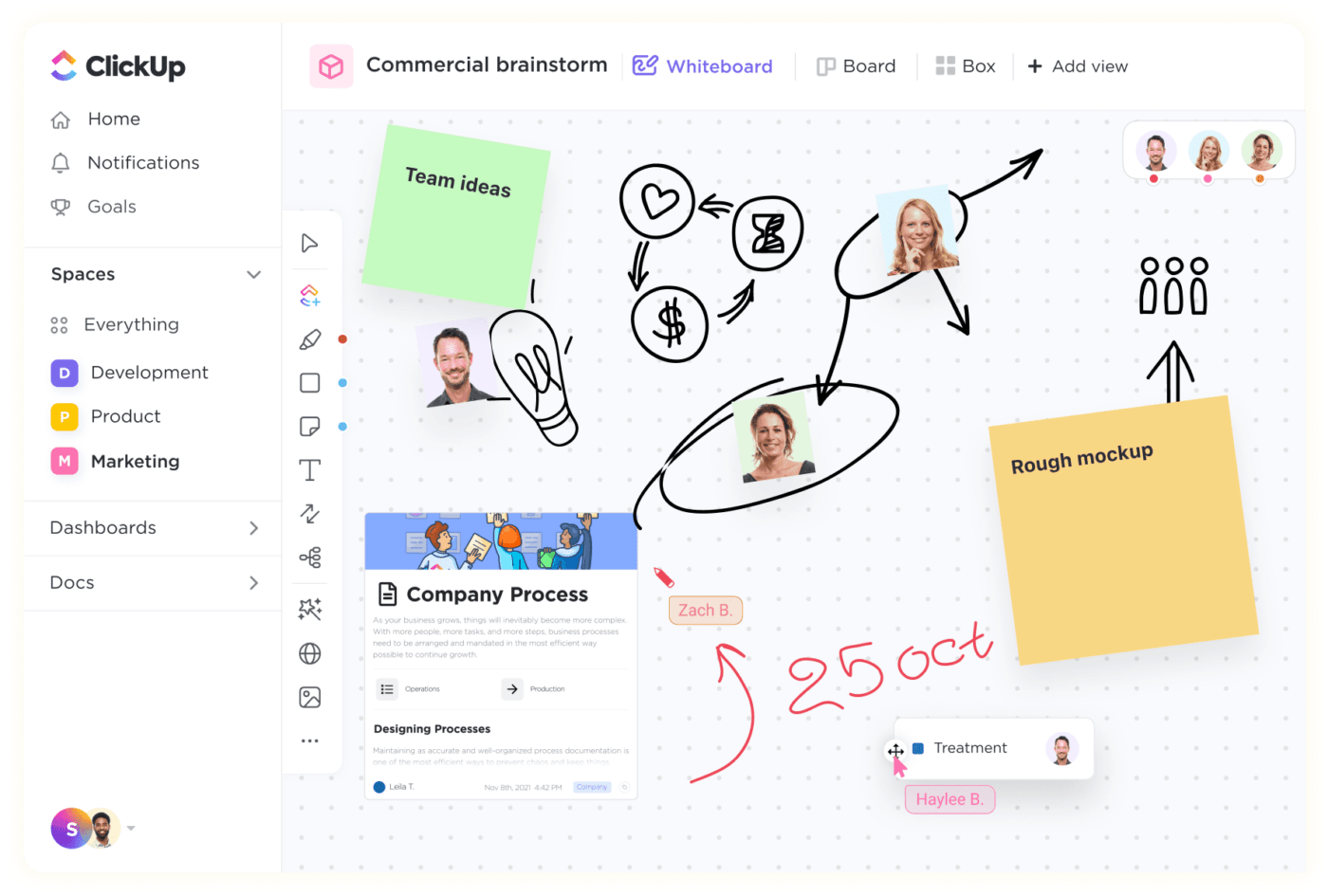
Within RAD, there are several methods and practices, each needing a unique project management approach. Customize ClickUp to manage your app development your way.
Use ClickUp’s custom statuses to track the progress of prototypes from ideation through to feedback and refinement.
Expedite processes with ClickUp templates. Create your own custom checklist templates and apply them to multiple tasks quickly.
Get real-time insights into your project with ClickUp Dashboards and reporting tools. Measure progress, resource utilization, and performance metrics to adapt your project management techniques to your agile transformation.

RAD needs the involvement of multiple business stakeholders in addition to the engineering team.
ClickUp’s collaborative features, such as shared views, guest access, and feedback forms, are designed to improve stakeholder engagement. Use ClickUp to:
Software must evolve at the pace of market demand, customer needs, and competition products. Rapid Application Development enables precisely this. Yet, implementing RAD methods correctly can be a challenge.
With ClickUp’s product development software, you’ve nothing to worry about.
ClickUp is designed to enable the development of collaborative, iterative, and user-centric software. It enables the speed, accuracy, quality, and efficiency that RAD needs. It helps cross-functional teams collaborate, iterate, and create better products.
Whether you’re using RAD to build a disruptive new product or strengthen an existing one, ClickUp can rapidly bring your vision to life.
Whether you’re developing a groundbreaking app, a customer-centric software solution, or an internal tool to boost productivity, ClickUp provides the structure, flexibility, and tools required to bring your vision to life swiftly and successfully.
Begin your journey to rapid app development today. Try ClickUp for free.

© 2026 ClickUp

There’s an easier way. Try a free AI Agent in ClickUp that actually does the work for you—set up in minutes, save hours every week.