Sorry, there were no results found for “”
Sorry, there were no results found for “”
Sorry, there were no results found for “”
A client asks for a same-day answer to a budget question. The project lead is in her flight seat, phone in hand, laptop already stowed away in the overhead cabin, ready to power off. She quickly opens her team’s project management app to find the answer, and it loads a stripped-down version of the dashboard that hides half the fields she needs.
That scenario plays out constantly for anyone managing work from a phone. Most project management tools get built for a desktop screen first and an iPhone screen second, if at all. Full editing gets locked, offline mode barely holds up, and the features that make the desktop version worth using disappear the moment you step away from your laptop.
The best iOS project management apps let you view, edit, and approve from wherever you are.
We tested the leading options for iOS devices in 2026, ranging from full-featured platforms like ClickUp to lightweight personal planners like Things 3. Here’s the rundown.
Note: Unless stated otherwise, paid prices below reflect annual billing. Jira’s price is based on per-seat pricing in a 300-seat deal. We’ve shared both the monthly and annual pricing for Basecamp, because its pricing page lists Pro monthly and Pro Unlimited annually.
| Tool | Best for | Standout feature | Starting price* | Where it taps out |
|---|---|---|---|---|
| ClickUp | One app that runs tasks, docs, and reporting | My Tasks, full mobile task editing, Clips, widgets, Apple Watch, Brain, and Super Agents | Free; Custom plans available for enterprises | More surface area than a simple iOS checklist app |
| Trello | Visual, board-first task tracking | Inbox, Planner, widgets, automations, Power-Ups, and touch-friendly Kanban boards | Free; paid from $5/user/mo | Gets thin on dependencies, workload planning, and native reporting |
| Asana | Cross-functional workflows that keep stalling at handoffs | Inbox, My Tasks, Weekly Focus, offline access, Portfolios, and voice-to-task capture | Free; paid from $10.99/user/mo | Better for mobile triage than deep planning or portfolio reshaping |
| Things 3 | Apple-native individual planning | Magic Plus, Today, Upcoming, This Evening, Quick Find, Siri, widgets, and Shortcuts | Paid from $9.99 one-time | Stops where teamwork starts |
| TickTick | Solo planning where work, habits, and errands share one calendar | Natural-language capture, calendar, habits, Pomodoro, widgets, Smart Lists, and location reminders | Free; paid from $35.99/year | No dependencies, workload views, dashboards, or approvals |
| Jira | Engineering teams that live in sprints and tickets | Mobile issue creation, approvals, screenshots, roadmaps, reports, and notification controls | Free; paid from $7.91/user/mo (for 300 users) | Heavy for non-software teams and needs admin care |
| Notion | Docs-first teams tracking projects inside databases | Pages, databases, relations, rollups, mobile AI, widgets, and quick keyboard actions | Free; paid from $10/user/mo | Offline access is limited, and delivery reporting is softer than PM-first tools |
| monday.com | A visual work OS for ops teams | Color-coded boards, mobile time tracking, dashboards, quick actions, automations, and integrations | Free; paid from $9/seat/mo | Dashboards and deeper workspace setup still need desktop |
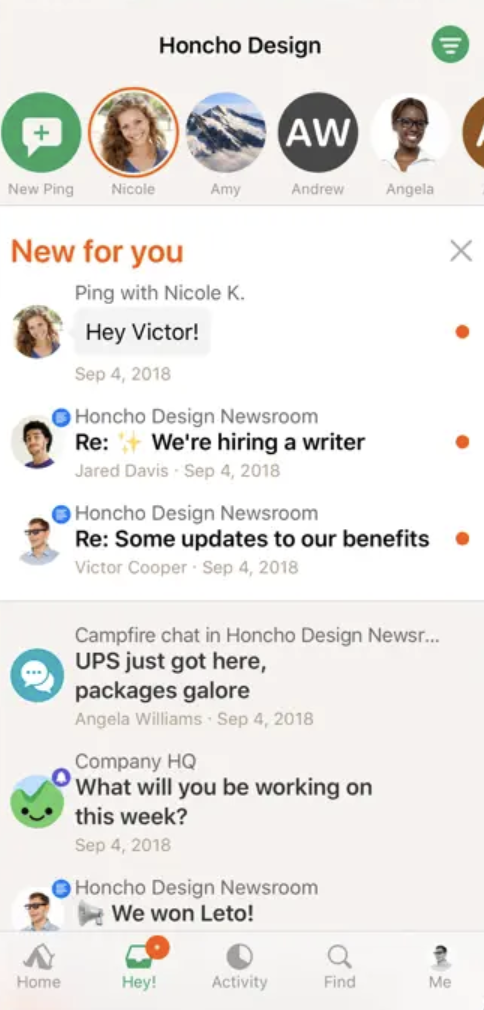
| Basecamp | Simple team and client communication | One-page projects, Message Boards, Campfire, Automatic Check-ins, Card Tables, and Mission Control | Free; Pro $15/user/mo monthly; Pro Unlimited $299/mo annually | No dependencies, workload planning, sprint tooling, or real automation |
| Smartsheet | Field crews feeding data into a live project sheet | Offline forms, Mobile Grid Editing, photo capture, location pins, approvals, and dashboards | Free trial; paid from $9/member/mo | Dense on iPhone for formulas, restructuring, and large sheet work |
Our editorial team follows a transparent, research-backed, and vendor-neutral process, so you can trust that our recommendations are based on real product value.
Here’s a detailed rundown of how we review software at ClickUp.
The features that matter on a phone are not the same ones that sell desktop software. A mobile app can have every integration under the sun and still be useless if capturing a task takes seven taps. Here’s what separates a good iOS project management app from a shrunken desktop dashboard.
The notification point is where most people quietly lose their day. As Cal Newport, computer science professor at Georgetown and author of Deep Work, puts it:
Network tools are distracting us from work that requires unbroken concentration, while simultaneously degrading our capacity to remain focused.
The best mobile PM apps take that seriously and give you real control over what interrupts you.
The 10 best iOS project management apps are ClickUp, Trello, Asana, Things 3, TickTick, Jira, Notion, monday.com, Basecamp, and Smartsheet. Each one is judged on how it works on an iOS device. That means capture speed, what works with no signal, which features stay stuck on desktop, and where the price really lands.
Every entry covers standout features, pricing, user ratings, where the app runs out of room, and who should skip it.
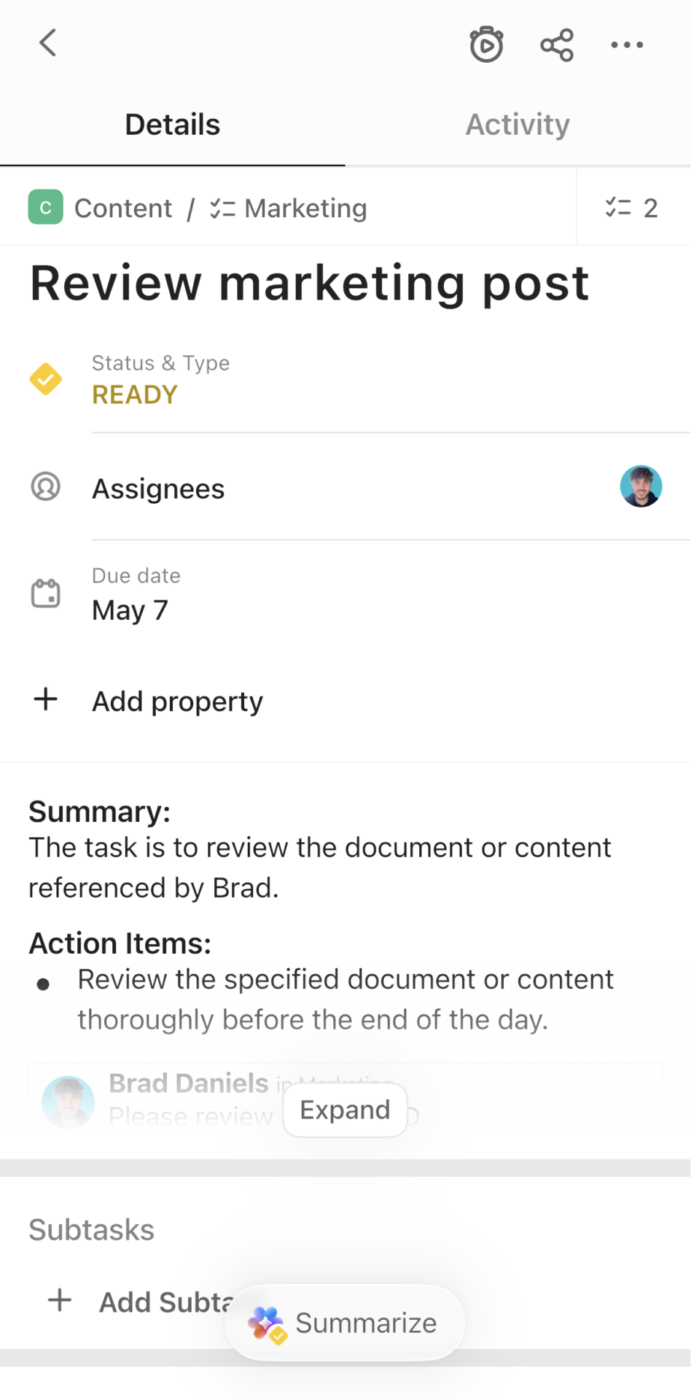
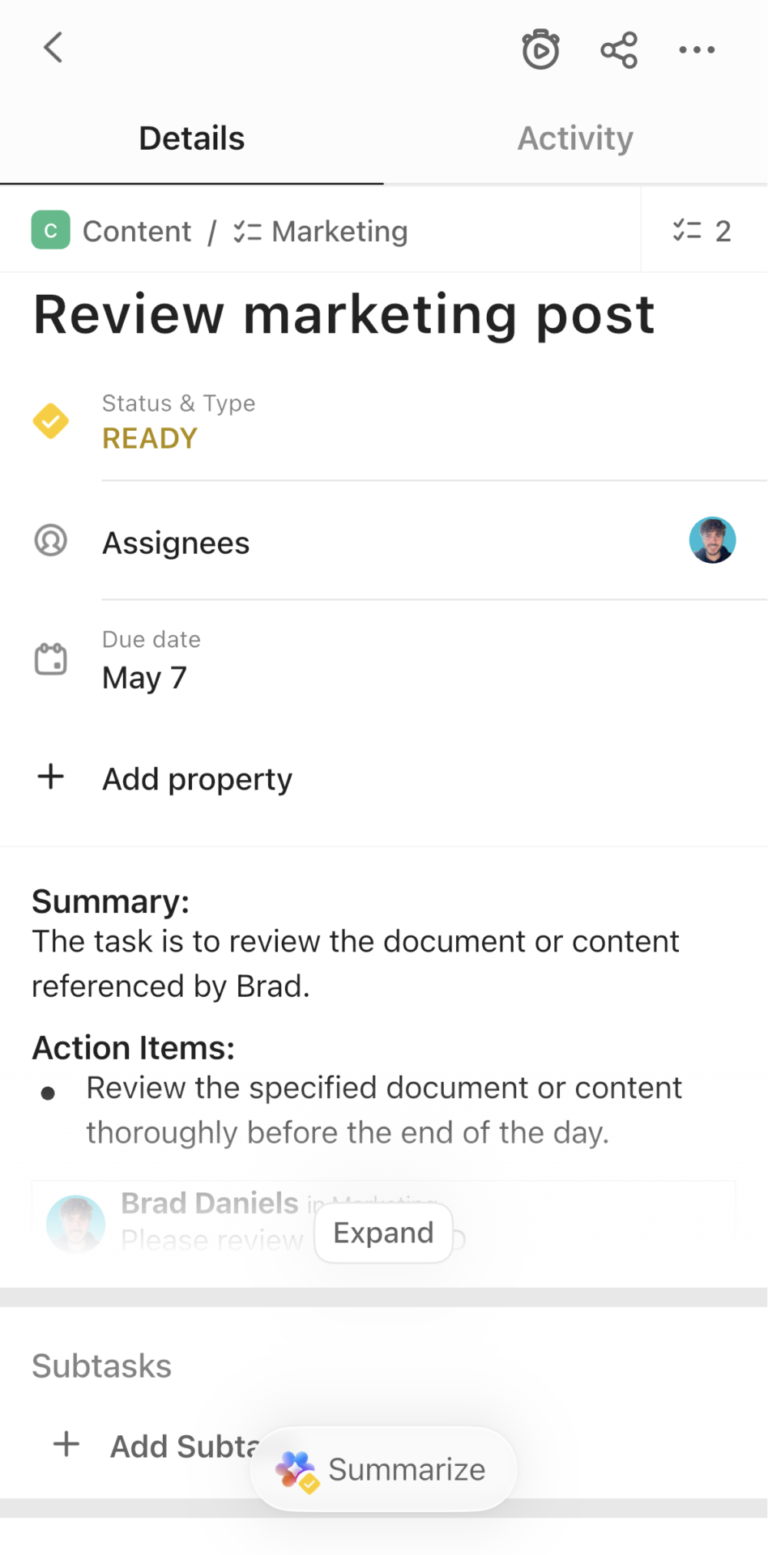
ClickUp is a converged work and project management platform where tasks, docs, views, calendars, reporting, and AI all live in one workspace. The iOS app carries most of that onto your phone.
For example, swipe right, and you’re in your Hierarchy, moving through Spaces, Folders, and Lists exactly as you would on a laptop. Home pulls tasks, reminders, Chat, and comments into one screen, with fully functional offline support for times you lose signal. Plus, you can open a Doc, read a Dashboard, hop on a SyncUp, and ask ClickUp Brain (its native AI layer) what changed since Friday, all from the same app.
That depth suits people who run layered work: a content lead scanning campaign tasks and briefs, an ops manager clearing approvals on a process board, a team lead turning a Chat message into an assigned task on the go.
A G2 user shares:
I like the ease of using ClickUp across my different devices like my Android phone, Apple laptop, and iPad. It’s definitely convenient to use each of these devices interchangeably. I’m also really appreciating the new stand-up feature with AI, or the brain feature, which is improving day by day. I’m liking the improvements because it’s helping me reduce the manual task of running reports for each client.
Where it taps out: ClickUp carries more surface area than a single-purpose iOS task app, and you feel that in week one. Spaces, Folders, Lists, and views take a beat to learn on a small screen. Teams that build the structure on desktop first, then use the phone for capture and review, clear that hump fast.
Best for: Cross-functional teams whose managers live in back-to-back meetings and need approvals, comments, and status changes to happen from a phone.
Skip it if: You only want a checklist app for personal tasks. A lighter tool will feel faster.
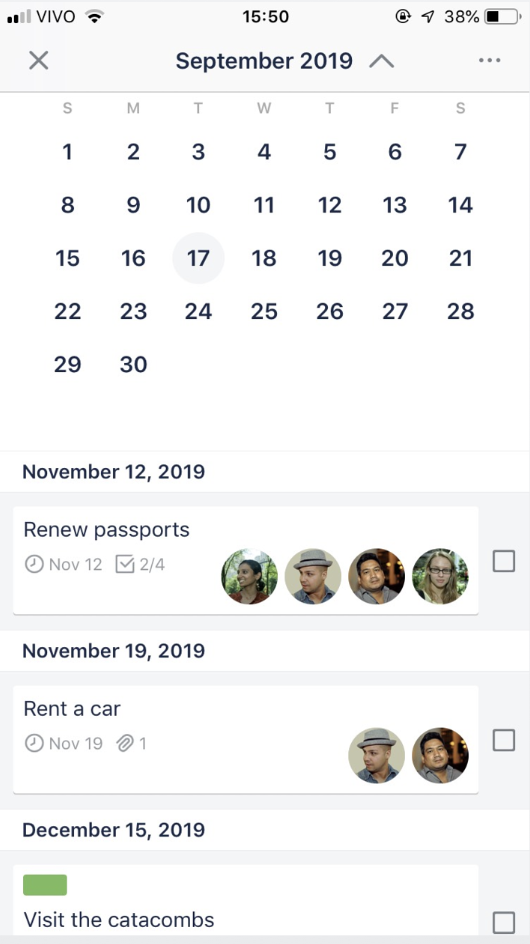
Trello is a Kanban board tool from Atlassian, built on cards you drag between lists. That model was made for touch long before it was made for a phone. You open a board, thumb a card from Doing to Done, and read the state of the project in one glance.
The iOS app leans into that with Inbox and Planner. Anything you capture—a Slack message, an email, a half-formed idea—lands in Inbox first. Then you open Planner, which sits in the bottom nav bar, and schedule it against your connected Google or Outlook calendar. The phone becomes the capture device, and the board becomes the follow-through.
It works well for a freelancer juggling three clients, a two-person marketing team running an editorial board, or a startup tracking bugs and hiring in a handful of columns.
A G2 user mentions:
Trello has a very smooth user interface that is appealing. It connects to various applications, and they have well-developed apps for both Android and iOS. Teams are able to create, assign, collaborate, track, and be organized on various projects. The management is also able to do analysis of each project and see the time taken and resources used.
Where it taps out: Trello gets thin once a project needs dependencies, workload planning, or native reporting. Power-Ups and Premium views cover some of that, though the board stays the center of gravity.
Best for: Freelancers and small teams who want a board they can run entirely from a phone, with almost no setup.
Skip it if: Your projects hang on timelines, dependencies, and resource views. You’ll end up tracking those somewhere else within a month.
Also Read: ClickUp vs. Trello
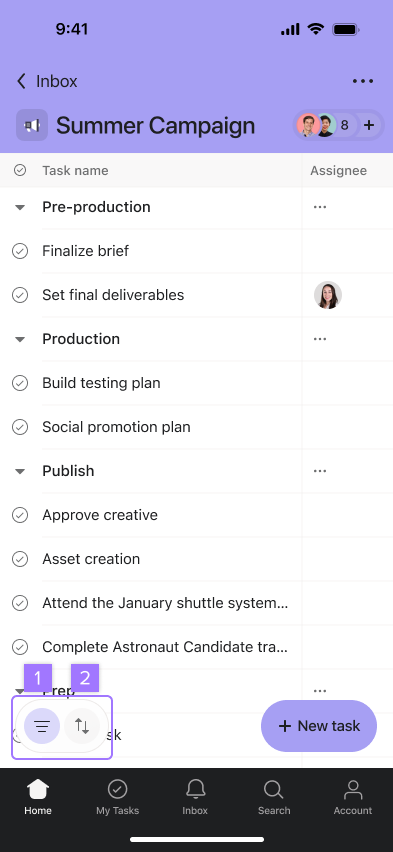
Asana is a work management platform for teams whose projects pass through several sets of hands before they ship. It’s built on one rule: a task can have only one assignee. Nobody hides inside a group of owners, and every handoff has a name on it. That makes it suitable for ops and launch teams that need accountability more than they need extra tooling.
Plus, Asana keeps other people unblocked instead of trying to move your whole workspace onto iOS. The Inbox consolidates updates from every project you’re part of and every task you’re following. Filter by “Assigned to me” or “@Mentioned,” save it as a tab, and clear it before your first meeting. Tap any notification to reassign, comment, or move a due date without leaving the feed.
My Tasks covers your own queue, and Weekly Focus trims it to what has to land before Friday.
Heads-up: Portfolios sits behind a paid tier. If your team is on the free plan, the “read on several projects at once from a phone” experience you’re testing isn’t the one you’ll get.
A G2 user describes:
Asana lets you assign a project to a specific team member and allows you to add a due date. You can easily organize your tasks by project and department. The whole team is notified when a project is completed. They also have an iOS app that is integrated with the Apple Watch and allows you to get notifications each time someone edits or adds a project to Asana.
Where it taps out: Asana’s mobile app is better for triage than deep planning. It works well for approvals, comments, quick tasks, and ownership checks. Larger planning jobs, like reshaping timelines or reviewing portfolios, still feel better on desktop.
Best for: Coordinating team handoffs, approvals, deadlines, and project updates from iPhone or iPad.
Skip it if: You need a fast personal capture app. Things 3 will feel lighter.
Also Read: Why Choose ClickUp Over Asana
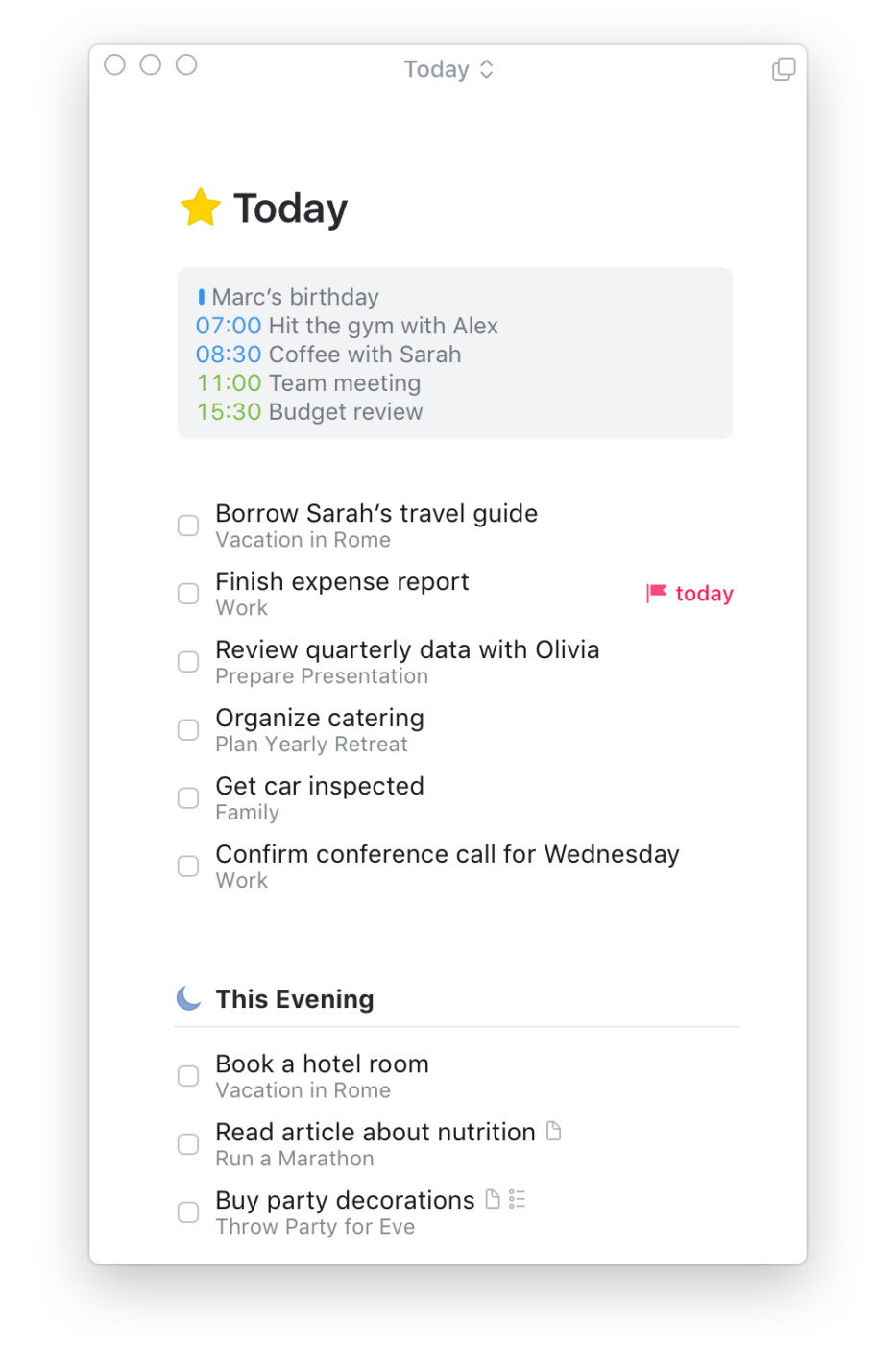
Things 3 is a personal task manager for one person on Apple hardware, made by a German studio called Cultured Code. There are no assignees, comments, or shared boards. It’s a solid choice for consultants, founders, and anyone who runs their own workload and wants a planner that opens instantly and never nags.
On iPhone, the whole app bends toward deciding what to do next. Today shows the short list you committed to, with your calendar events grouped above it. Upcoming lays out the rest of the week: scheduled to-dos, repeating ones, deadlines, and events. Projects hold multi-step work and Areas hold ongoing responsibilities like Finance or Client Work.
Capture is what makes it stick on a phone. Grab the Magic Plus button, drag it anywhere, and the to-do lands exactly where you dropped it.
Note: Things 3 has no AI features. For teams shopping for AI capabilities, that’s a hard stop. For someone who wants a planner that does exactly what they typed, it’s the whole appeal.
A G2 user mentions:
Things is for sure a powerful To Do list. It is aesthetically pleasing, has a clean and intuitive interface, and synchronizes seamlessly with your devices in the Apple ecosystem.
Note: The G2 profile of Things 3 is unclaimed at the time of writing this blog post.
Where it taps out: Things 3 stops where teamwork starts. No real-time collaboration, assignees, shared project space, or support for Android or Windows teammates.
Best for: Solo Apple users who want the fastest possible path from thought to organized list.
Skip it if: Anyone else needs to see, own, or comment on your work and projects.
Note: The one-time purchase of Things 3 is per platform, not per person or per bundle. iPhone, iPad, and Mac are each sold separately. If you want it everywhere, the real cost is closer to $80 total, not $9.99.
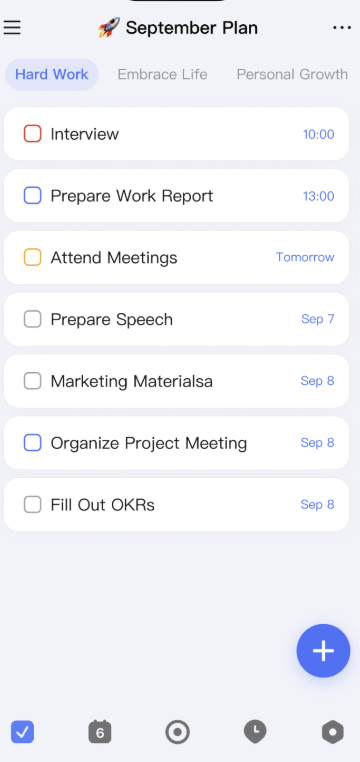
TickTick is a to-do app that combines a calendar, habit tracker, and Pomodoro timer while staying lightweight. It sits between Apple Reminders and a real project tool. It works well for freelancers, students, and one-person operations whose projects blend client deadlines, study blocks, errands, and routines.
On iPhone, the point is that everything shares one timeline. A client deadline, a gym habit, and a focus session all land in the same calendar view, so you see the real shape of a day. Type “buy paint Saturday 4pm,” and the app reads the date and time from the sentence. Ask Siri, and the task appears without unlocking anything.
Widgets put your agenda on the home screen, and the Apple Watch app lets you tick items off without pulling your phone out.
Note: TickTick’s current iOS listing makes no AI claims. No AI capture, transcription, or summaries. If AI-assisted entry matters to you, this isn’t the app.
A G2 user shares:
TickTick sets up the date and time as soon as we write words/phrases like “tomorrow”, “Monday 8am”, etc. Apart from that, we can add frequent habits to improve our days.
Note: The G2 profile of TickTick is unclaimed at the time of writing this blog post.
Where it taps out: TickTick is a personal planner wearing project clothes. No dependencies, workload views, dashboards, or approvals.
Best for: Solo planners who want deadlines, habits, and focus time on a single calendar.
Skip it if: More than two people need to see the plan, or you’re tracking anything with dependencies.
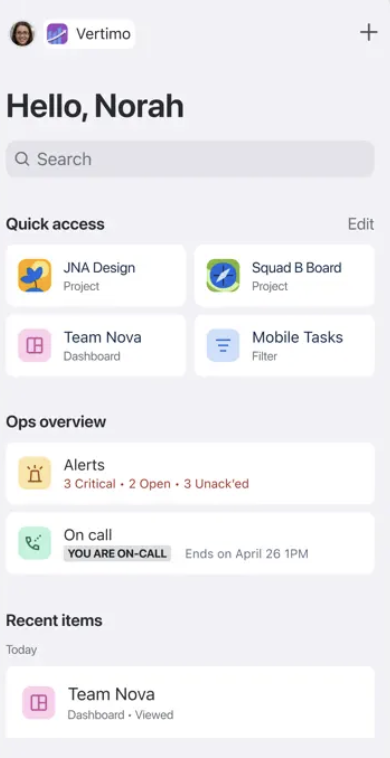
Jira is Atlassian’s issue tracker, and it’s the default for engineering teams running Scrum or Kanban. Work in this tool moves as issues through a workflow instead of tasks down a list. It’s a strong, time-tested option for dev, QA, product, and IT teams already inside the Atlassian stack.
The iOS app keeps the ticket system honest between standups. Here, you can grab the bug a customer just described, add a screenshot, and file it before you forget the details. Create or edit any work item, leave comments, and check roadmaps when someone asks where a release stands.
Project summaries show the key metrics at a glance, so you can tell if a sprint is drifting without opening your laptop.
Note: Jira’s prices vary based on the total number of seats you purchase.
A G2 user says:
The convenience that comes from Jira Cloud Mobile has been my favorite so far because it allows me to track work done and assigned tasks. More so, I can remotely update my team on any changes that need much attention. Push notifications are another feature that helps keep me updated, and I like that even when I am offline, I am always updated, which has been very helpful so far.
Where it taps out: Jira is powerful because it’s specific, and that specificity costs you. Teams that aren’t shipping software often find the workflows, field schemes, and permissions heavier than their work needs.
Best for: Engineering and IT teams who need the backlog to stay accurate between standups.
Skip it if: Nobody on the team writes code, or you want a tool that doesn’t need an admin.
Looking for an overall POV on the top project management tools? Watch this video to choose the right one for your team:
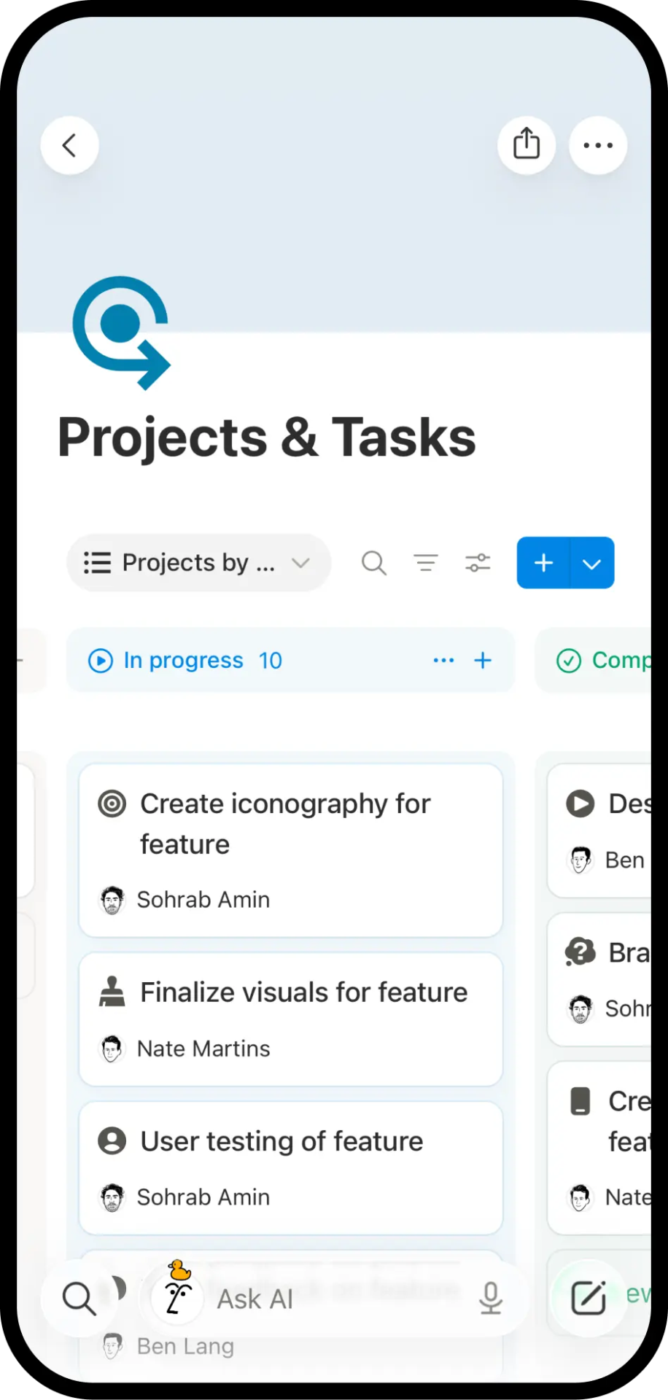
Notion is a docs-and-database workspace for teams that want their plans, notes, and trackers to live in the same place. It’s popular among content, marketing, research, and startup teams that think in pages first and workflows second.
The app is strongest on your iPhone when the structure already exists. You open a wiki, search for a decision, drop a comment on a task, or add a row to a content calendar from the hallway. Home Screen widgets can open a specific page or database, while the AI widget jumps straight into chat, camera, or voice.
Notion AI is wired into the mobile experience too. Ask for a summary of a long page, a quick answer from workspace context, or help drafting the next update without waiting to get back to your desk.
A G2 user shares:
The best part is the mobile app, especially on iOS, which makes accessing Notion on the go super handy. Plus, there’s a really good bot that quickly answers my questions, making it easy to tackle problems directly from the app.
Where it taps out: If your team needs dependencies, capacity planning, or structured delivery reporting on the iOS app, Notion will feel inadequate.
Best for: Docs-first project tracking, team wikis, content calendars, and research hubs that need to travel well to iPhone and iPad.
Skip it if: You want a purpose-built project manager with dependencies and reporting out of the box.
Also Read: Best Productivity Apps for iOS
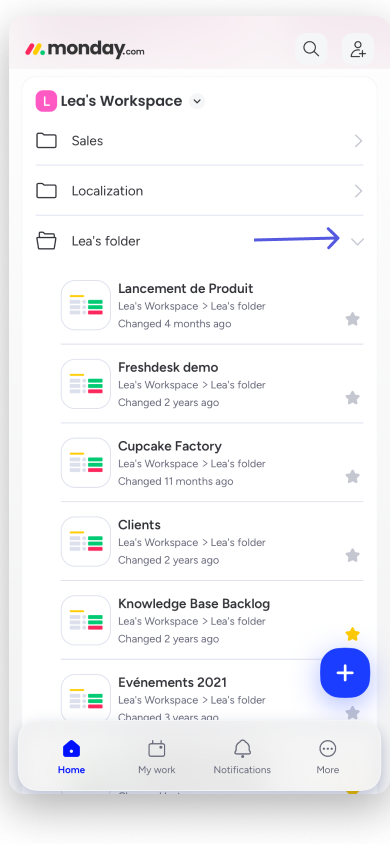
monday.com is built for ops managers, marketing leads, and client services teams. It’s a visual work platform where every process lives on a color-coded board. Columns hold the data, and status buttons hold the state. You read a project’s health from the colors before you read a single word. It’s a good pick for teams running shared processes with several moving parts.
Those colors are what survive the trip to a small screen. A board that would be an unreadable spreadsheet on a phone turns into a scrollable stack of cards with tappable status buttons. Drop an update, attach a photo from a site visit, then switch between views to read the same work four different ways.
New boards you create in the app land in your main workspace by default, so capture stays fast, and you can organize things properly later.
A G2 user describes:
Monday has helped us keep information current with our field crews so they have immediate access to the project information. The guys in the field are able to access the information on their iPads.
Where it taps out: Dashboards can only be created at a desk, and board-level dashboard views are read-only on a phone.
Best for: Ops and marketing teams who configure a workflow once on desktop and then run it from their phones.
Skip it if: You want to build dashboards, configure complex workflows, and manage every layer of your system from your phone.
Basecamp is built for teams that lose time to scattered messages. This tool from 37signals gives every project one page. The to-do lists, message board, chat room, schedule, docs, and files all sit together. It’s widely used among agencies, client services teams, nonprofits, and small businesses that want fewer places to check work.
That single-page setup is what makes it appealing for iOS project managers. Open a project, and the whole thing is right there, so catching up means reading one screen instead of four. Reply to a message board post, tick off a checklist, or jump into a Campfire chat. You can snooze notifications when you need the project to leave you alone.
Automatic Check-ins are one of its highlights. Basecamp asks your team a set question on a schedule you pick. Everyone answers from their phone, which replaces a standup.
A G2 user mentions:
One of the most useful features is the “needle” in the Mission Control, which gives us a quick overview of the status of each project, allowing us to understand in seconds how everything is going without having to enter each one. Additionally, its applications on iOS and iPadOS allow us to manage tasks and track progress from anywhere, which brings a lot of agility to daily work.
Where it taps out: Basecamp keeps things simple on purpose, and that costs you if you need dependencies, workload planning, sprint tooling, or real automation. The app is built for catching up, commenting, and chatting. Running a structured project system from a phone isn’t the goal here.
Best for: Client-facing project communication, simple task tracking, shared files, and calmer team updates on iOS.
Skip it if: Your projects hinge on dependencies, capacity math, or automated workflows.
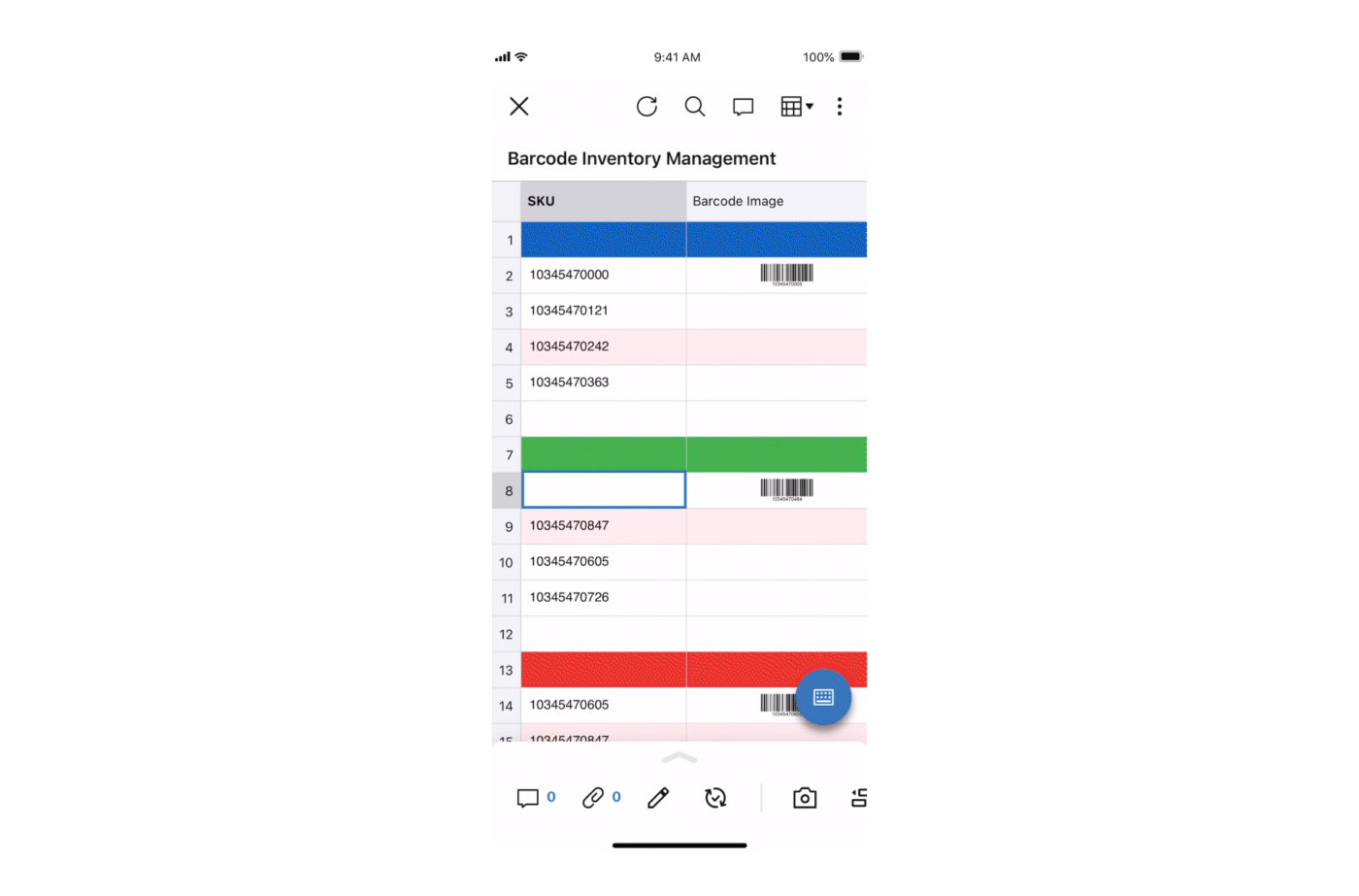
Smartsheet is a project management platform built on a grid. If your team already runs on spreadsheets, the layout needs no explanation. The difference is that rows here carry attachments, approvals, automations, and reports. It’s suitable for construction, facilities, logistics, and operations teams whose data comes from people standing on a site.
The mobile app exists to close the gap between the field and the sheet. A technician scans a barcode on a piece of equipment, snaps a photo, drops a location pin, and submits an inspection form.
It also features touch-optimized Mobile Grid Editing, allowing you to update cell values, review attached PDFs, and process multi-step approval requests in seconds. Offline forms are its main appeal. Signal is often patchy on a job site, so the form still opens and saves, then uploads when the cell reconnects.
Note: The old free plan was discontinued for new signups on August 28, 2024. Existing free accounts keep working, but new teams get a trial instead.
A G2 user captures:
Some of the key features of Smartsheet include the ability to create and share customizable sheets and templates, set up automated alerts and notifications, and use Gantt charts to visualize project timelines. Smartsheet also offers mobile apps for iOS and Android, making it easy to access and update information on the go.
Where it taps out: Smartsheet gets dense on an iPhone, because the grid it came from was built for a wide screen. Forms, approvals, quick row edits, and status checks work well. Writing formulas or restructuring a big sheet is a desktop job.
Best for: Capturing field data and keeping spreadsheet-based operations current from an iPhone or iPad.
Skip it if: You want a visual, low-setup experience rather than a spreadsheet model.
Pro Tip: Photo capture from the field adds up fast against storage limits, and it’s the kind of thing nobody checks until a crew’s uploads start failing mid-shift. If your team is submitting inspection photos daily, check your plan’s attachment storage before rollout.
The right pick comes down to one question: who else needs to see the work? Solo planners want capture speed. Teams want accountability. Field crews want the app to keep working with no signal. Find your situation in the table below.
| If you want… | Choose | Because |
|---|---|---|
| Tasks, Docs, Chat, offline support, AI, and reporting in one mobile app | ClickUp | The Hierarchy, Docs, Dashboards, and Brain all travel to the phone, not just a task list |
| A board you can run entirely with your thumb | Trello | Cards drag between lists on touch, and Inbox plus Planner turn the phone into the capture device |
| One named owner on every handoff | Asana | A task can only ever have one assignee, so nothing stalls in a group of owners |
| The fastest path from thought to organized list, solo | Things 3 | Magic Plus, Jump Start dates, and Quick Find, with no subscription and no teammates |
| Deadlines, habits, and focus time on one calendar | TickTick | Work and personal routines share a single timeline, plus location reminders and Estimated Pomo |
| The backlog accurate between standups | Jira | Built for issues moving through a workflow, with camera-roll bug reports and snooze controls |
| Project docs and trackers in the same place | Notion | Pages hold the brief, notes, and database together, with AI wired into mobile |
| To read project health off colors, not text | monday.com | Status buttons and color-coded boards survive a small screen better than a grid |
| Clients in the project without paying for seats | Basecamp | Pro bills employees only, and every project lives on one readable page |
| Site data in the sheet before the crew leaves | Smartsheet | Offline forms, barcode scanning, and photo plus location capture feed rows directly |
Pro Tip: You don’t have to force one tool to do everything. A lot of the smoothest setups pair a personal planner with a team tool: Things 3 or TickTick for your own list, ClickUp or Asana for anything that needs an owner other than you.
Two things worth checking before you commit. First, run a trial with your phone in airplane mode. Offline claims vary more than most pricing pages suggest. Second, look at where AI sits on the price list.
Usually, but security depends on both the app and the iPhone it runs on. Client names, budgets, files, and task details can still appear in notifications, widgets, search results, or downloaded files.
Before approving an app, check whether it offers:
For freelancers and small teams, Face ID, hidden notification previews, and two-factor authentication may be enough. Teams handling financial, legal, healthcare, or unreleased client data should also confirm the app’s compliance and device management controls.
If you’re switching your project management app, a messy migration hurts more on a phone than on a laptop.
On a desktop, you can see the whole workspace at once and work around whatever didn’t get transferred. On an iPhone, you’re relying on the app to surface the right task in two taps. If your structure arrived broken (missing custom fields, orphaned subtasks, automations that didn’t transfer), the mobile app has no way to hide that from you. You’ll open it at the airport gate, find nothing where you expect it, and go back to the old tool.
Tasks, due dates, and assignees migrate cleanly almost everywhere. ClickUp, Asana, monday.com, and Notion all offer importers for the common sources. What doesn’t survive: automations, custom field logic, comment threads with original timestamps, and attachments over a size cap. Budget a day of rebuild for every workflow you’d genuinely miss.
So move one project first, finish the structure on your desktop, and only then judge the mobile experience. Testing an iOS app against a half-migrated workspace tells you nothing about the app.
Whatever you shortlist, install two or three and run a real week on your phone before deciding. The App Store screenshots will not tell you how an app feels at 7 am on a crowded train, but a few days of actual use will.
If you want a single app that handles tasks, docs, reminders, and reporting without switching between five icons, ClickUp is the most complete option on iOS. Get started with ClickUp for free and test it on your own phone this week.
No. Apple has apps for Reminders and Notes. Both handle personal to-dos, subtasks, and attachments. Neither have assignees across projects, dependencies, workload views, or reporting. Reminders can share a list through iCloud and assign items to other Apple Account users, so it works for a household or a pair. Teams tracking handoffs need to use a third-party iOS app.
ClickUp. Its Free Forever plan is the only one that gives teams unlimited tasks and unlimited members. Trello’s free tier is simpler to start but caps you at 10 boards and 10 collaborators per Workspace. Jira is free up to 10 users, which fits small dev teams. TickTick’s free plan is the better pick for solo planning.
No. Microsoft has never shipped a native iOS version of Project. Planner has an iPhone and iPad app, but it needs a Microsoft 365 work or school subscription. Plans built in Planner Premium, the replacement for Project for the web, don’t surface reliably on mobile. iOS-first teams pick a third-party tool.
Things 3. Each platform has a one-time purchase. Things Cloud sync is included at no extra charge. Every other app on this list moves to a subscription above its free tier. The free plans from ClickUp, Trello, and Jira are the only other way to pay nothing.
A to-do app tracks your tasks. A project management app tracks a team’s work. The dividing line is three features: assignees, dependencies, and reporting. Things 3 and TickTick have none of them and are faster because of it. ClickUp, Asana, and Jira have all three, which is why they need setup before they earn their keep.
ClickUp, Notion, and monday.com. Their desktop layouts survive the extra width instead of stretching a phone view. The real iPad advantage is Split View and Stage Manager: a task list beside a doc or a call. ClickUp puts multiple views and dashboards side by side. Notion wins when the brief and the tracker need to sit on one page.
Yes, but coverage varies by app. Things 3, TickTick, and Apple Reminders all take Siri dictation and ship Apple Watch apps. ClickUp and Asana offer Watch apps plus Home Screen widgets for glanceable counts. Asana turns an iPhone voice memo into a structured task with a title, assignee, and due date. Jira, Basecamp, and Smartsheet rely on notifications instead.
All of them except Things 3, which is Apple-only across Mac, iPad, iPhone, Watch, and Vision Pro. ClickUp, Trello, Asana, Jira, Notion, monday.com, Basecamp, Smartsheet, and TickTick all ship Android apps alongside iOS. Check this before you standardize. An Apple-only tool becomes a migration the first time you hire someone with a Pixel.

Manasi Nair
Max 14min read
Manasi Nair
Max 9min read

Arya P Dinesh
Max 17min read

© 2026 ClickUp