







Still downloading templates?
There’s an easier way. Try a free AI Agent in ClickUp that actually does the work for you—set up in minutes, save hours every week.
Sorry, there were no results found for “”
Sorry, there were no results found for “”
Sorry, there were no results found for “”
Your people are your company’s greatest strength. And it’s a business leader’s job to create a workplace where employee productivity flourishes.
But how can you tell if your people feel empowered to bring their best selves to work?
What if you knew how to calculate productivity per employee as easily as checking your bank account? You’d have a clear picture of how much value each employee generates, where inefficiencies slow things down, and how to optimize for better results.
But most businesses get it wrong. They track time spent working instead of actual impact, creating a gap between effort and outcomes.
So, what’s the right way to measure productivity and drive business growth? Let’s break it down.
Struggling to measure and improve workforce efficiency? Here’s how to calculate productivity per employee and optimize performance:
Supercharge your team’s productivity today and streamline your workflows with the best tools for tracking and automation.
Employee productivity is how efficiently an employee’s work turns into measurable results. It’s not about hours clocked in but the value created in that time.
Picture two project managers:
Same role, same hours, but vastly different productivity levels.
True productivity is about:
So, how do you determine productivity per employee? Start by tracking the right productivity metrics. Use those numbers to spot real performance drivers and workflow bottlenecks and eliminate the guesswork.
Without measurement, productivity is just an assumption. A team may seem busy or even feel, but is their work driving results? Are high performers recognized? Are inefficiencies being overlooked?
Tracking employee productivity calculation isn’t about micromanaging; it’s about making informed decisions that improve both business performance and employee well-being.
Here’s why it matters:
By integrating productivity formula calculations, businesses can compare productivity across teams, track progress over time, and make smarter operational decisions. This ensures that every hour worked contributes to business success.
A team’s output isn’t just determined by skills or experience. It’s a combination of workplace conditions, engagement levels, and operational efficiency. Even the most talented employees can struggle if the right systems aren’t in place.
Some of the biggest productivity roadblocks include:
The key to sustained productivity is identifying and eliminating these barriers. So employees spend more time on meaningful, high-value work that drives business success.
📖 Read More: How To Measure Productivity in the Workplace?
Measuring productivity is understanding how much output a business gets for the effort invested. A clear productivity formula helps leaders assess performance, optimize workflows, and make data-driven decisions.
The simplest way to measure productivity is by calculating how much output is generated for every unit of input:
Productivity = Total Output ÷ Total Input
This method is widely used because it provides a quick snapshot of efficiency. However, it doesn’t reveal the full picture, it overlooks factors like quality, complexity, and effort.
Consider a content marketing team:
At first glance, this seems productive. But does this formula tell you if the content is engaging, well-researched, or driving conversions?
No. One writer may churn out 15 rushed, low-quality pieces, while another produces 5 high-performing, SEO-optimized articles that bring in traffic and leads.
This formula is useful for quick comparisons but should be paired with other productivity measurements to assess the true impact of work done.
📖 Also Read: How To Reduce Burnout with Organizational Strategies
Ideally, labor productivity measures how effectively employee hours translate into output:
Labor Productivity = Output Value ÷ Hours Worked
This method is crucial in industries where time efficiency directly affects profitability, such as manufacturing, retail, or customer service.
Example:
A higher productivity ratio means employees are working efficiently, while a lower number signals inefficiencies like wasted time, poor workflow, or skill gaps.
However, raw numbers don’t tell the full story. Two workers assembling products at the same rate may have vastly different approaches. One might work faster but create defects, while the other ensures high-quality output with minimal errors.
That’s why tracking productive hours alongside employee performance and quality is essential for a complete picture of workforce efficiency.
👀 Did You Know? Henry Ford revolutionized labor productivity in 1913 by introducing the first moving assembly line.
This innovation cut the time to build a Model T from 12 hours to just 93 minutes, skyrocketing output and redefining efficiency in manufacturing.
It’s a perfect example of how labor productivity isn’t just about hours worked but about optimizing processes to get more done with the same effort.
These formulas are useful, but productivity is about efficiency, quality, and impact. Businesses that rely solely on output data without considering real performance drivers risk making flawed decisions.
The goal is to track productivity metrics that align with business success rather than just measuring work completed.
📖 Read More: Top Factors Affecting Productivity at Work
Productivity can’t always be visualized with a single variable. Some industries require a holistic approach to efficiency. The multifactor productivity formula evaluates multiple inputs to measure overall business performance:
Multifactor Productivity = Total Output ÷ (Labor Input + Capital Input + Material Input)
This method is particularly useful in logistics, manufacturing, and service industries, where multiple resources influence output.
For example, a logistics company wants to improve shipment efficiency. Instead of only tracking employee output, they analyze:
By using multifactor productivity measurements, the company realizes that delivery delays aren’t due to worker inefficiency, but outdated routing technology. Instead of hiring more drivers, they invest in AI-powered route optimization, reducing costs while increasing shipments per day.
This formula helps businesses pinpoint which factor has the most impact on productivity, allowing them to make smarter, cost-effective decisions rather than assuming more labor equals higher output.
Unlike multifactor productivity, which considers multiple inputs, the partial factor productivity formula isolates one specific input. Such as labor, capital, or materials, which offers a more focused way to assess efficiency:
Partial Productivity = Output ÷ Specific Input (e.g., Labor or Capital)
This is especially useful for departmental comparisons or role-based evaluations.
Think of a software development firm that wants to assess developer efficiency.
Instead of measuring the entire company’s output, they track:
At first glance, one developer might seem more productive by writing twice as many lines of code. But a deeper look reveals that half of their work needed major revisions, while another developer wrote fewer but higher-quality, error-free lines of code.
By using partial factor productivity, leaders can compare productivity within roles or across teams, identifying where efficiencies can be improved without misinterpreting raw output numbers.
📖 Also Read: Tips to Improve Time Management Skills at Work
No single productivity formula tells the whole story. Businesses that rely only on output numbers may overlook inefficiencies, misallocate resources, or invest in the wrong solutions.
Using multifactor and partial factor productivity measurements helps leaders:
Productivity isn’t about working more—it’s about working smarter. The right calculations ensure that every input contributes to meaningful business growth.
Understanding how to calculate productivity per employee is only half the equation. What truly matters is using that data to drive efficiency and increase employee productivity.
Many businesses struggle with measuring employee efficiency because traditional tracking methods focus on time spent working rather than actual impact. The key is to combine data-driven insights with AI-driven optimizations to eliminate inefficiencies and enhance performance.
To accurately calculate employee productivity, businesses should track:
Want to take productivity tracking to the next level?
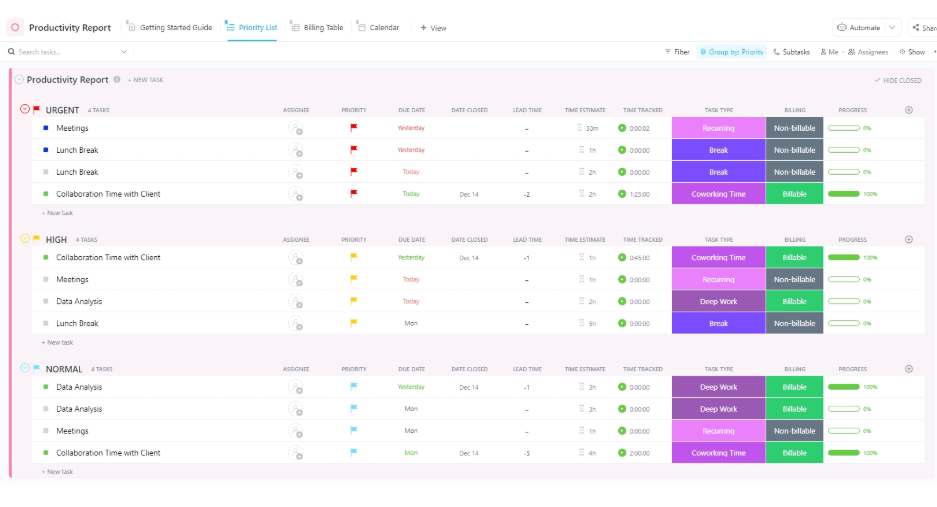
The ClickUp Personal Productivity Report Template provides a structured measure of individual performance.
With this template, you can:
Manual tracking and process bottlenecks waste valuable time. Companies looking to boost productivity need to embrace AI-powered automation.
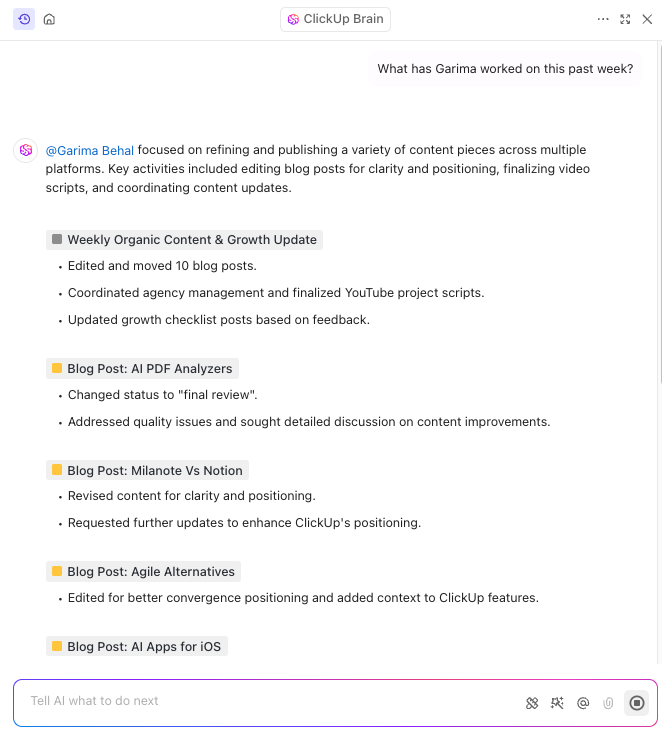
For instance, you can ask ClickUp Brain for an instant standup or summary of a team member’s output.
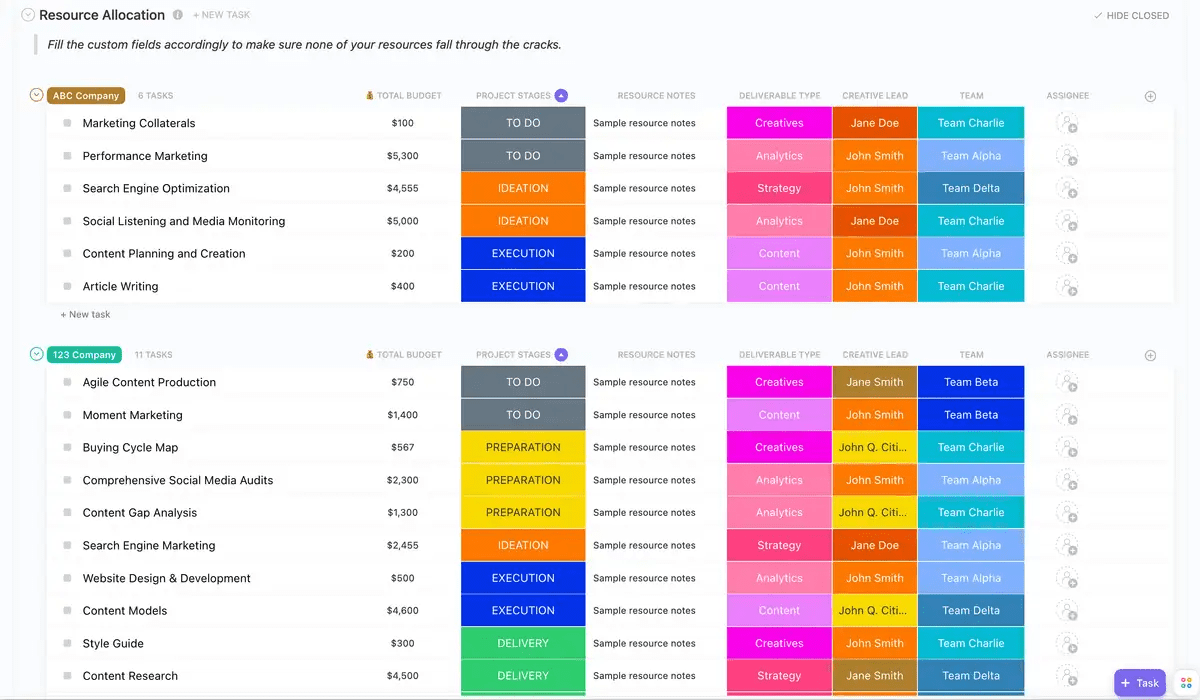
Businesses can use the ClickUp Resource Allocation Template to track productivity more effectively.
This template helps:
📖 Also Read: How to Use AI for Productivity?
Beyond tracking and automation, companies can improve employee performance by fostering a more positive work environment.
Strategies include:
With the right productivity measurements, AI-powered tools, and streamlined workflows, businesses can increase employee productivity, track progress efficiently, and scale operations without unnecessary hiring.
Productivity improvements don’t come from working longer hours. They come from working better. The difference between a high-performing team and a struggling one often boils down to how well employees are supported, how frictionless their workflows are, and whether they have the right conditions to succeed.
If you’re looking to increase employee productivity, focus on these five impactful changes:
It’s easy to blame poor productivity on lack of effort, but more often, the real culprit is workplace inefficiency.
Some of the biggest hidden drains on productivity include:
Fixing productivity starts with cutting out inefficiencies, not just demanding more output.
📮ClickUp Insight: Monday blues? Turns out Monday stands out as a weak link in weekly productivity (pun unintended), with 35% of workers identifying it as their least productive day
This slump can be attributed to the time and energy spent hunting for updates and weekly priorities on Monday mornings. An everything app for work, like ClickUp, can help you here.
For instance, ClickUp Brain, the built-in AI assistant, can ‘catch you up’ on all critical updates and priorities in seconds. 💁
Employees spend far too much time on repetitive tasks, administrative busywork, and low-value activities.
To boost efficiency:
When employees spend most of their time on high-value work, productivity naturally increases.
📖 Also Read: Best Employee Productivity Tracking Software Tools
High-performing teams don’t just produce more, they sustain performance without burnout. That requires:
Sustainable productivity means delivering consistent results without sacrificing employee well-being.
Productivity drops when employees feel like they’re being monitored instead of trusted.
Instead of constant check-ins and rigid oversight:
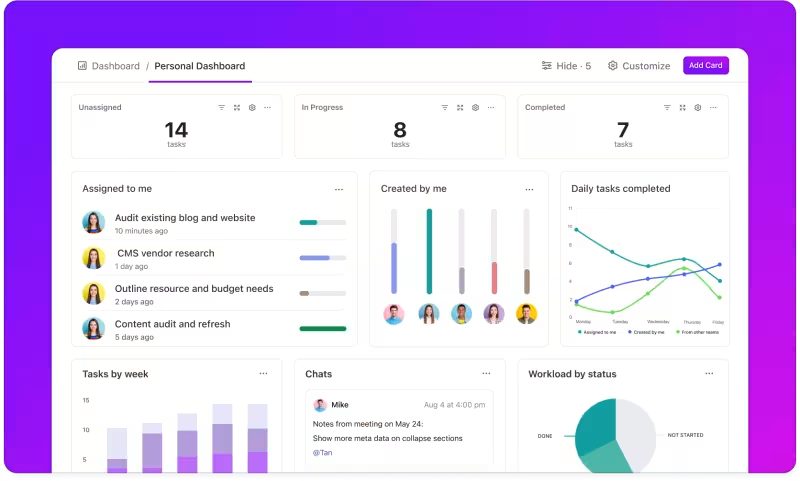
Employees are most productive when they feel autonomy over their tasks rather than feeling like they’re just completing someone else’s checklist.
📖 Read More: How to Improve Your Team Productivity?
Productivity shouldn’t be reactive where teams only focus on efficiency when deadlines are tight.
Instead, businesses should:
The most productive teams refine their approach consistently to ensure efficiency is the norm.
Improving productivity means removing the obstacles that stop them from doing their best work. When businesses optimize workflows, cut distractions, and create a sustainable work rhythm, productivity becomes effortless, not exhausting.
To improve employee productivity, you need optimize workflows, measure impact, and eliminate what’s holding your team back. The right approach, whether through multifactor productivity formulas, the standard productivity formula, or strategies to improve productivity, ensures that every effort contributes to business growth.
When businesses accurately calculate employee productivity, they uncover hidden inefficiencies, boost performance, and drive measurable success. All while enhancing employee satisfaction by creating a more efficient and rewarding work environment.
🚀 Ready to take productivity to the next level? Sign up for ClickUp today and equip your team with the best tools for tracking, automating, and optimizing work.

© 2026 ClickUp

There’s an easier way. Try a free AI Agent in ClickUp that actually does the work for you—set up in minutes, save hours every week.