
Sorry, there were no results found for “”
Sorry, there were no results found for “”
Sorry, there were no results found for “”
As a project manager or a business leader, you’re expected to be quick and critical. But when the organization is undergoing massive change, you have various opinions pushing and pulling you in a million directions.
It’s truly maddening, and no matter how hard you try, the list of priorities is endless. Fortunately, there’s a workaround for this.
You can employ the force field analysis technique—a powerful framework for visualizing the driving and restraining forces that influence organizational and business goals.
In this article, we’ll examine the history, benefits, and drawbacks of force field analysis using practical examples from various industries. More importantly, we’ll learn how to control and manage forces influencing smart and strategic decision-making. Ready? Let’s go.
Force field analysis is a technique for identifying and analyzing the driving and restraining forces that influence a change initiative.
Developed in the 1940s, force field analysis is the brainchild of Kurt Lewin, a German-American pioneer in social, organizational, and applied psychology.
In the modern age, the framework is used to help project managers, business leaders, and decision-makers understand what’s pushing the change they want and what’s holding it back. The insights from this technique aid decision-making and reduce resistance to the strategic changes the management wants to introduce.
Did You Know? The technique is a part of Kurt Lewin’s Field Theory, which suggests that people are the sum of all of their influences. Behavior involves the complex effects of many influences and our interactions within our environments.
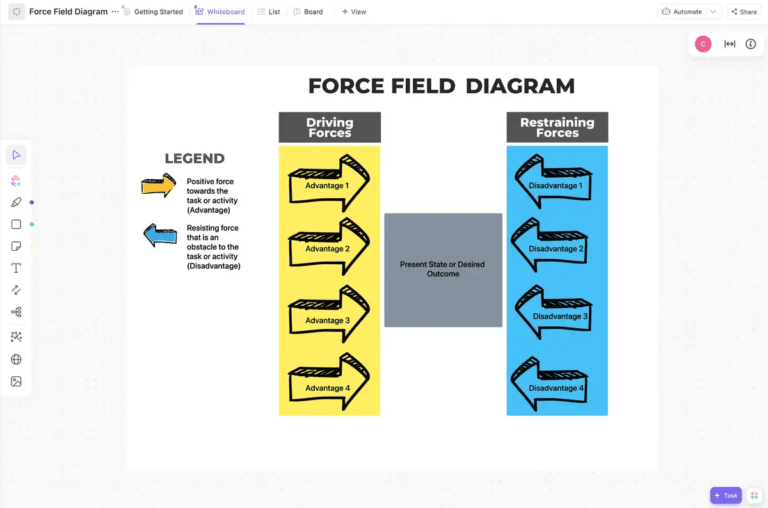
Use ClickUp’s Force Field Diagram Template to lay out driving and resisting forces in one visual space—perfect for making balanced decisions, analyzing change impact, and getting stakeholder buy-in.
Force field analysis (FFA) and SWOT analysis in project management are equally powerful frameworks in decision-making and strategic planning. That said, each has its unique uses and quirks.
FFA is designed for business professionals to help identify the forces that drive or impede change.
SWOT analysis, on the other hand, can help you make high-level assessments of internal strengths (S), weaknesses (W), external opportunities (O), and threats (T) to an organization or a market opportunity.
Here’s a quick comparison of the two:
| Aspect | Force field analysis (FFA) | SWOT analysis |
| Purpose | Identifies forces for and against a specific change | Identifies strengths, weaknesses, opportunities, and threats in an organization |
| Focus | Targets change management, focusing on particular forces | Offers a broader view of internal and external factors |
| Output | Provides actionable steps to increase driving forces and reduce restraining forces | Primarily offers insights without direct action plans |
| Application | Best for managing transitions or organizational changes | Used for general strategic planning and risk assessment |
| Analysis type | Force-based analysis: Weighs the strength and impact of forces pushing for and against change | Comparative analysis: Compares internal capabilities with external factors |
| Decision-making focus | Helps decision-makers strategize to create a proposed change by altering the balance of forces | Helps identify the current strategic position and explore future opportunities |
| Process complexity | Focused on the intensity of specific forces, more detailed for change initiatives | Is simpler, more overview-focused, and valuable for broad evaluations |
Although FFA and SWOT are for making decisions, they have different focuses. FFA looks at specific changes, while SWOT evaluates an organization’s overall situation in its environment.
Lewin’s force field analysis identifies and evaluates the forces that drive and limit proposed change. It’s still widely used to guide successful transitions in organizations.
Kurt Lewin, born in 1890, was a visionary psychologist whose work reshaped how businesses approach change management. Lewin, often called the father of social psychology, pioneered influential research on group dynamics, leadership, and change management.
His force field analysis concept relies on the following:
Let’s understand the concept with a simple example.
Suppose you’re planning a dinner with your friends. You want to go to a lively bistro, but one of your friends prefers a quiet café. In this scenario, your desire for a lively night out is your driving force, while your friend’s preference is the restraining force.
To reach a decision, you could increase your driving force by persuading your friend to give the restaurant a try. Or, you could decrease the restraining force by finding a restaurant with a quieter section where your friends can enjoy themselves, too.
Lewin’s Field Theory states that human behavior is shaped by multiple forces competing at any given time in a specific environment. When people want to maintain the status quo, these forces either drive change or resist it to balance the opposing forces.
The key to making the change is shifting this balance by strengthening (increasing) the driving forces and weakening (decreasing) the resisting forces.
With enough practice, project managers can use FFA to map out both forces and take strategic actions to ensure smooth transitions for the team or organization.
Analyzing a force field requires specific steps to recognize and assess the factors that support and impede a specific change or project. Here’s a detailed guide on how to conduct a force field analysis.
To define your change (problem) statement, you can start with ClickUp Docs. It can help you with:
Engagement, collaboration, organization, and awareness—this integrated approach via ClickUp Docs simplifies change management for your organization.
After identifying the changes, label the forces that drive or resist the change. These include:
To effectively analyze the driving and restraining forces in your change management process, leverage ClickUp Table View.
Here’s how ClickUp Table View features can enhance your force field analysis:

The next step in process mapping for FFA is to quantify each force’s impact by assigning scores. Without these scores, it’s easy to overestimate or underestimate the influence of specific forces.
For example, you might score ‘increased productivity’ as a driving force an 8, while ‘steep learning curve,’ a resisting force, could receive a 6.

The problem: someone else, or yourself, might second-guess the scores.
ClickUp Custom Fields can help you assign and share numerical values and weights with others. It’s a great way to get stakeholders involved and know if they agree with your views.
Here’s how Custom Fields enhances analysis:
In short, the process is purely objective; every team member can identify the factors that are crucial priorities for your project.
📮ClickUp Insight: 83% of knowledge workers rely primarily on email and chat for team communication. However, nearly 60% of their workday is lost switching between these tools and searching for information. With an everything app for work like ClickUp, your project management, messaging, emails, and chats all converge in one place! It’s time to centralize and energize!
Now, total and compare the scores for driving and restraining forces.
If the total of the driving forces significantly outweighs the restraining forces, it suggests that implementing the change is feasible. Otherwise, you may need to investigate the opposing forces further to develop more viable options to reduce the resistance.
Keep in mind that you can change the rating for each force.
For instance, if you feel that the ‘learning curve,’ an opposing force initially, isn’t a hurdle—lower its rating. Similarly, you can rate the ease of use as a higher driving force if it’s a key motivator for your organization.

To visually analyze the results of your research, consider ClickUp Mind Maps. Besides improving your process through force field analysis, ClickUp Mind Maps can:
As for balancing the forces, we recommend the ClickUp Force Field Diagram Template. It’s one of many change management templates used by project management professionals and business leaders for error-free decision-making.
The ClickUp Force Field Diagram Template is a comprehensive root cause analysis tool.
It visualizes and evaluates the forces that drive or resist the changes you want to make across your organization. With this force field analysis template, you can:
What’s more, this template integrates:
Based on your analysis, involve stakeholders in devising an action plan on how to implement changes with minimal resistance. This is where clarity becomes your ally.
Assign tasks to your team, envision transitional challenges, and think of ways to address the challenges in the plan.
This could involve:
However, handling change management can be difficult and confusing. ClickUp Dependencies can help here by linking related tasks and structuring your action plan.
Here’s what it can do:

With clear steps defined, your team only needs to follow them to mitigate challenges. In doing so, restraining forces are curbed while forces that drive change are given a much-needed push.
Take productivity, which is considered a driving force, for instance. Within ClickUp, you can create a task dependency on your internal L&D team to track and improve employee training initiatives. In essence, with ClickUp Dependencies, you’re not just managing change; you’re orchestrating it with finesse.
Post successful implementation, track the progress of your change initiative by measuring the performance of goals and objectives.

ClickUp Goals lets you:
What’s more, with ClickUp Goals, you can:
To demonstrate the power of FFA, let’s explore top examples from several organizational scenarios.
The force field analysis is most effective when you can clearly define the forces, measure them, and tie them to your objectives. Here are some practical scenarios on how to successfully implement FFA.
Let’s say your organization is considering adopting a full or partial remote work model.
The first step in bringing about this change is to discuss it with the stakeholders and clearly define the problem based on their decision-making style.
⚡ Identifying the driving and restraining forces:
What follows is identifying the driving and restraining forces. And don’t forget: you need to measure the forces and rate them based on their importance and impact.
🎯 Critical focus areas:
Key Takeaway: By assigning scores to each of the forces and analyzing their weights, you can determine if remote work is the right decision. If it is, additional collaboration tools or security measures may be needed.
The decision relates to investing in new learning technology, such as a Learning Management System (LMS).
⚡Identifying the driving and restraining forces:
The analysis should help you identify the driving forces, such as improved learning outcomes. And the restraining forces, like the high cost of implementation and resistance from trainers.
🎯 Critical focus areas:
Key Takeaway: Evaluate the long-term benefits of personalized learning against short-term resistance. A head-to-head comparison will help you decide whether the technology will contribute significantly to process improvement, employee productivity, and mood as part of learning outcomes.
FFA can help you evaluate various potential risk mitigation techniques and strategies used for a project.
⚡ Identifying the driving and restraining forces:
Join forces with the risk team to find out the positive expected outcome of implementing the strategies (driving forces), as well as the obstacles or downsides (restraining forces).
🎯 Critical focus areas:
Key Takeaway: With FFA, you can decide whether to implement the full range of risk mitigation strategies or evaluate more balanced approaches.
Force field analysis in M&As can reveal whether the benefits of the merger outweigh the costs and challenges. The driving forces, such as increased market share, should be weighed against restraining forces like cultural differences or integration complexities.
⚡Identifying the driving and restraining forces:
🎯 Critical focus areas:
Key Takeaway: Evaluating M&As through the FFA lens can help you predict if the deal will be a success and result in sustainable growth for the organization and its employees.
There are both advantages and drawbacks to force field analysis. Here are some things for you to keep in mind.
Some of the key advantages include:
While highly beneficial, force field analysis does have its limitations.
Force field analysis is a valuable tool for managing transitions and organizational changes. By identifying driving and restraining forces, businesses can strategically plan and mitigate resistance to change.
As a manager or decision-maker, you may want to try out conducting a force field analysis for yourself. Why not go for a tool that comes with pre-built templates and features to assist you? As a user-friendly platform that can help you streamline your business processes, ClickUp can help you with force field analysis—and much, much more.
Sign up on ClickUp today and take your change management strategies to the next level.

Praburam Srinivasan
Max 21min read
Praburam Srinivasan
Max 22min read

Sudarshan Somanathan
Max 22min read

© 2026 ClickUp