

Sorry, there were no results found for “”
Sorry, there were no results found for “”
Sorry, there were no results found for “”
Setting the right CRM goals is the difference between a scattered customer strategy and a streamlined path to growth.
Without clear objectives, sales teams chase the wrong leads, marketing efforts miss the mark, and customer relationships weaken.
A well-defined CRM strategy ensures every interaction moves your business forward, improving retention, efficiency, and long-term success.
Struggling to retain customers, optimize sales, or keep teams aligned?
Here’s how to set and achieve CRM goals that drive real growth:
Ready to scale smarter and take control of your CRM strategy?
CRM goals align your sales and marketing teams with customer service, ensuring every interaction pushes your business forward.
Without them, customer relationship management becomes disorganized, opportunities slip through the cracks, and long-term growth stalls. Think about a business struggling to keep track of customer inquiries.
Sales teams miss follow-ups, marketing campaigns feel disconnected, and customer retention takes a hit. A well-defined CRM strategy sets clear objectives, like improving response times or boosting repeat purchases, so teams know exactly what to prioritize.
A company aiming to shorten its sales cycle might aim to respond to leads within an hour, reducing the chances of losing prospects to competitors. Another business focusing on customer retention could introduce a loyalty program, rewarding existing customers for repeat purchases.
At its core, CRM isn’t just about storing customer data—it’s about turning that data into actionable insights that drive business growth. With the right goals in place, every interaction becomes a step toward a stronger, more profitable customer relationship.
A CRM strategy is the game plan that determines whether your business builds lasting customer relationships or loses them to competitors.
Every sales call, marketing campaign, and customer support ticket feeds into a bigger picture: How well do you manage customer relationships?
Without a solid CRM strategy, businesses run into the same problems:
Now, compare that to a business with a well-defined CRM strategy. Their sales reps know exactly when to reach out, their marketing campaigns speak directly to the right audience, and their customer service team anticipates issues before they become problems. Everything clicks into place.
Say a company struggles with low email response rates. Instead of blindly sending more emails, they use CRM data to track customer behavior. Like who opens emails, who clicks, and who ignores them. Based on that, they refine their approach, automate follow-ups, and see engagement skyrocket.
Or take a business worried about customer loyalty. They analyze repeat purchase data, identify top customers, and roll out exclusive offers that make them feel valued—before they ever consider switching to a competitor.
That’s what a CRM strategy does. It makes every customer interaction count. When done right, it turns casual buyers into loyal customers and keeps your business ahead of the competition.
📖 Read More: What is a CRM campaign?
If your CRM goals aren’t specific, measurable, and tied to real business challenges, they won’t drive results. The key is breaking down the process so that your goals are clear, actionable, and trackable. Here’s how to do it step by step:
Every CRM goal should solve a real problem that’s slowing down sales, marketing, or customer service. Start by looking at where customers drop off, disengage, or stop buying.
Ask yourself:
📌 Example: If your business struggles with customer retention, your CRM goal might be:
“Increase customer retention by 15% in six months through better post-purchase engagement.”
Vague CRM goals won’t get you anywhere. Instead of “Improve customer experience”, define something you can track:
📌 Increase customer satisfaction (CSAT) from 80% to 85% in the next quarter
📌 Reduce response time on support tickets from 3 hours to 1 hour using automation within 1 year
📌 Grow repeat purchases by 25% through targeted email campaigns and loyalty rewards programs
Every goal should include a metric and a deadline so that progress is clear.
💡Pro Tip: SMART (Specific, Measurable, Attainable, Relevant, and Time-bound) goals can change the way you set and achieve goals. Read more about it and use this preset but customizable SMART Goals template to get started with CRM success!
Not all customers need the same approach. Segment your audience and set goals that match their behavior.
📌 New customers: Increase onboarding email open rates by 20% within 3 months
📌 Loyal customers: Boost referral program participation by 30% next quarter
📌 Churn-risk customers: Reduce subscription cancellations by 15% using re-engagement campaigns
This ensures your CRM strategy isn’t one-size-fits-all but instead targets customers where they are in their journey.
Manually tracking CRM goals? Inefficient and unsustainable. The best CRM systems automate performance tracking so nothing gets overlooked.
A CRM system shouldn’t just store data—it should help you act on it before problems arise.
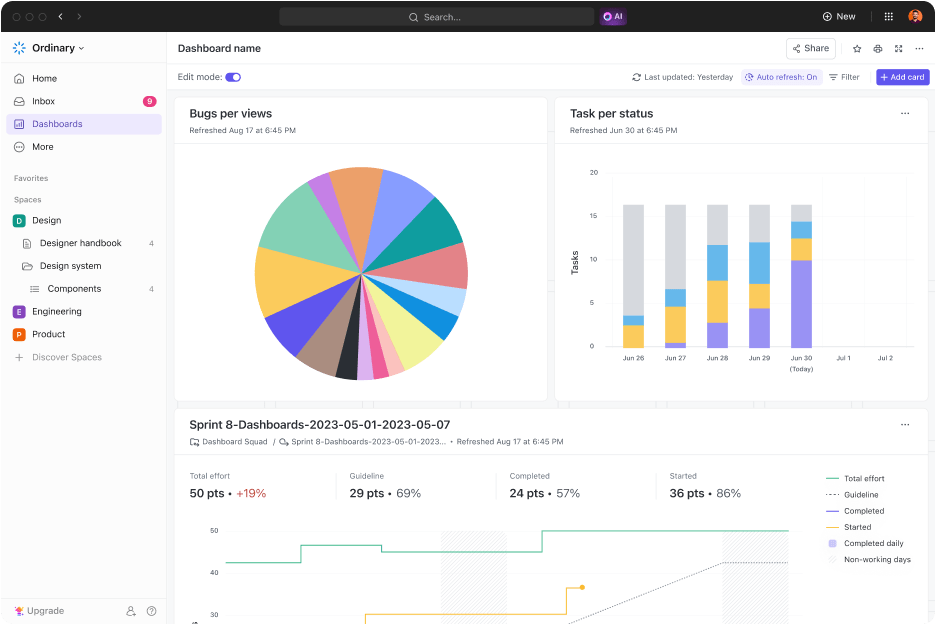
💡Pro Tip: If a customer support team is struggling with slow response times, they can use dashboard tools like the ClickUp Dashboards to track live ticket resolutions. They spot a bottleneck in the escalation process, tweak workflows, and cut response time in half within weeks.
Set up ClickUp automations to trigger actions so your CRM runs like a well-oiled machine and your team can focus on what’s really important: the customer!
A CRM goal without clear ownership won’t be executed effectively. Every goal should have a responsible team or individual to ensure accountability.
In ClickUp, a simple “@” within a Task, Chat, Doc or anywhere in ClickUp, assigns ownership to the right person, so nothing slips through the cracks.
Regular team check-ins keep everyone aligned and adaptable so you can refine goals as needed.
What separates businesses that thrive from those that struggle with customer relationships? Clear, well-defined CRM goals. The right objectives ensure that every interaction boosts engagement, strengthens loyalty, and drives revenue.
Here are the essential CRM goals that will help your business create meaningful customer experiences:
New customers may keep your business moving, but loyal customers keep it thriving. They spend more, refer others, and stick around longer. Yet many businesses focus more on attracting new buyers than nurturing the ones they already have.
Imagine two customers:
Which one drives more revenue over time? Customer B. The real value isn’t in the first purchase rather it’s in the relationship you build afterward.
When customers leave, it’s rarely about price or product. More often, it’s because they feel overlooked, unappreciated, or disconnected from the brand. Your CRM should help you change that narrative by making each customer feel like a VIP.
📌 Example: A subscription-based business struggles with customers canceling after three months. Instead of offering last-minute discounts, they use CRM data to track disengagement signs early. They set a goal to increase retention by 20% in six months by launching a tiered rewards program, offering exclusive benefits for customers who stay subscribed longer
Time kills deals. The longer a lead sits in your pipeline, the less likely they are to convert. Prospects lose interest, competitors swoop in, and what seemed like a sure sale turns into a lost opportunity.
Now, picture two sales teams:
Who closes deals faster? Team B—every single time. The difference isn’t luck; it’s having a CRM strategy that keeps leads engaged and moving through the pipeline without friction.
📖 Also Read: Effective CRM Tips to Manage Customers
📌 Example: A software company struggles with leads taking months to make a purchase decision. Instead of letting them stall, they set a goal to reduce the sales cycle by 25% in Q2 by automating follow-ups, personalizing outreach based on prospect behavior, and integrating real-time deal tracking into their CRM
Within weeks, response rates increase, deal velocity improves, and the sales team spends less time chasing dead leads.
A customer reaches out for support. Minutes turn into hours. Hours turn into radio silence. By the time they finally get a response, they’ve already switched to a competitor.
That’s how businesses lose customers; not because of a bad product, but because of a bad experience. Once frustration sets in, even a one-time issue can permanently damage trust.
The difference between a frustrated customer and a loyal one often comes down to how quickly and effectively their concerns are handled. Your CRM should help you solve problems before they become deal breakers.
📌 Example: A SaaS company notices that customers cancel subscriptions after poor support interactions. They set a goal to increase CSAT from 80% to 90% in six months by implementing AI-driven ticket prioritization, reducing response times, and following up with dissatisfied customers before they churn
The result? Faster resolutions, happier customers, and a lower churn rate.
📖 Also Read: How to Successfully Implement a CRM System?
A customer signs up for your newsletter. Weeks pass, and they never hear from you until a generic sales email lands in their inbox. By then, they don’t remember your brand, they don’t care, and they definitely don’t click.
That’s how businesses lose engagement before they even have a chance to build it. Customers are bombarded with marketing messages daily. If yours doesn’t feel timely, relevant, and personal, it’s just noise.
Engagement isn’t about blasting promotions—it’s about consistent, valuable interactions that make customers feel like they matter.
✅ Fact Check: Studies show that 81% of consumers are more likely to buy from a brand that offers personalized experiences. Yet many businesses still send generic, one-size-fits-all messages
The key to engagement? Right message, right time, right audience.
📌 Example: A fashion brand struggles with low email open rates and declining social engagement. Instead of blasting generic promotions, they set a goal to increase engagement by 30% in Q3 by segmenting audiences and sending hyper-personalized content like product recommendations, abandoned cart reminders, and VIP early access emails
The result? More clicks, higher conversions, and deeper customer relationships.
If you’re spending $100 to acquire a customer who only generates $50 in revenue, something is broken. Customer acquisition costs (CAC) can eat into profits fast—especially when businesses throw money at ads and campaigns without a strategic CRM-driven approach.
But cutting costs recklessly isn’t the solution. If you slash budgets without optimizing targeting, you’ll end up with fewer leads, lower conversions, and wasted efforts. The goal? Lower CAC while maintaining (or even increasing) lead quality.
📌 Example: A fast-growing e-commerce brand notices that their ad spend is increasing, but conversions are stagnating. Instead of scaling budgets blindly, they set a goal to reduce CAC by 15% in six months
All this could’ve been achieved by refining ad targeting, using lookalike audiences, and launching a customer referral program. Within weeks, they see higher-quality leads at a lower cost.
Picture this: A sales rep manually updates lead details, a marketer spends hours sorting customer lists, and a support agent wastes time copying and pasting responses. Every minute lost to manual work is a minute NOT spent on customers.
CRM workflows should be automated, seamless, and smart without being a maze of spreadsheets and repetitive tasks. When automation is done right, teams can focus on what matters: closing deals, personalizing interactions, and solving customer problems.
📌 Example: A B2B company’s sales team is drowning in manual data entry, leading to slow response times and missed follow-ups. They set a goal to increase productivity by 30% in Q4 by automating lead follow-ups, AI-driven prioritization, and real-time reporting
Within weeks, they see faster deal closures and a more focused sales team.
📖 Also Read: How to Manage and Optimize Your CRM
Ever had a customer call support about an issue, only for the rep to have zero context because sales never logged the deal details? Or worse—marketing sends a promo to an already frustrated customer, completely unaware of an unresolved complaint? That’s what happens when teams don’t communicate.
A CRM isn’t just a database of contacts—it’s the central nervous system of your business. When sales, marketing, and customer support work in silos, customers get mixed messages, inconsistent service, and a frustrating experience.
The solution? A shared, real-time CRM strategy that connects every team.
📌 Example: A SaaS company notices that customer complaints about onboarding miscommunication are increasing. Instead of blaming different departments, they set a goal to increase internal collaboration scores by 40% by integrating CRM tools across all teams
With a shared customer dashboard and cross-department workflows, handoffs become seamless, reducing customer confusion and boosting satisfaction.
Here, ClickUp Chat becomes the perfect communication tool. You can use it to triage customer concerns, schedule messages and follow-ups, assign comments (yes, right from Chat!), and lots more.
Setting CRM goals is only the first step. How you track and optimize them determines their success. Without proper tracking, teams end up guessing progress, missing follow-ups, and failing to adapt to customer needs.
A good CRM tool centralizes customer interactions, automates workflows, and ensures teams stay aligned with real-time data.
Here’s how to use CRM tools to set, track, and optimize CRM goals effectively.
CRM goals only work when teams can see progress in real time and adjust accordingly. Without visibility, objectives become static numbers instead of dynamic targets.
🔹 Steps to use goal tracking effectively:
Suppose a sales team wants to shorten the sales cycle by 25% in Q3. Instead of tracking deals manually, they can use ClickUp Goals to monitor pipeline movement, automate status updates, and ensure each rep knows their conversion targets.

Teams can’t improve what they can’t measure. ClickUp Dashboards provide a visual breakdown of CRM performance, making it easier to spot trends and adjust strategies before issues escalate.
🔹 Steps to use Dashboards effectively:
Manual CRM processes slow down teams. Missed follow-ups, inconsistent customer interactions, and slow deal closures cost businesses valuable time and revenue. Automation ensures customers receive timely, relevant engagement without manual effort.
🔹 Steps to use task management effectively:
Think of a marketing team that is handling thousands of leads. They struggle to keep track of follow-ups. Such a team can use ClickUp Tasks and ClickUp Automations to automate lead assignments, trigger follow-up reminders, and ensure no prospect is left unattended.

Scattered customer data leads to miscommunication, lost context, and inconsistent experiences. Keeping everything in one place ensures that every department has access to the same insights.
🔹 Steps to use collaboration tools effectively:

Think of a fast-growing startup that sees inconsistencies in how sales reps communicate product offerings. By maintaining a shared knowledge base in ClickUp Docs and using ClickUp Chat for real-time discussions, they standardize messaging and improve customer experience.
📮ClickUp Insight: A typical knowledge worker has to connect with 6 people on average to get work done. This means reaching out to 6 core connections on a daily basis to gather essential context, align on priorities, and move projects forward.
The struggle is real—constant follow-ups, version confusion, and visibility black holes erode team productivity. A centralized platform like ClickUp, with Connected Search and AI Knowledge Manager, tackles this by making context instantly available at your fingertips.
Manually creating CRM tracking systems wastes time and leads to inconsistencies. ClickUp’s pre-built templates provide structure and ensure teams follow best practices.
🔹 Steps to use CRM & KPI Templates effectively:
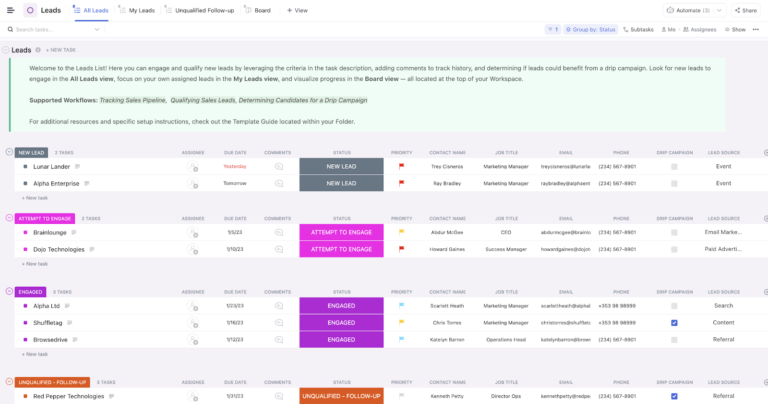
For instance, an e-commerce brand is planning to expand to new markets. They need a structured CRM system to manage customer interactions. Instead of building one from scratch, they can use ClickUp’s CRM Template to automate outreach, track engagement, and monitor retention trends—all in one place.
⚡ Template Archive: Free CRM Templates In Excel, Google Sheets, & ClickUp
You can have the most advanced CRM in the world and still struggle with customer retention, slow sales cycles, and misaligned teams.
CRM isn’t about having more data—it’s about using that data to take the right actions at the right time.
If your CRM goals aren’t driving business growth, here’s what’s missing.
Question: When was the last time your team used CRM insights to change their strategy?
Most teams input data into their CRM but never use it to guide decisions. It becomes a record-keeping system rather than a growth-driving engine.
🚨 Break the cycle:
💬 Shift the mindset: If your sales team is relying on gut instinct instead of CRM insights, they might as well be working off spreadsheets. The most successful teams let data guide their decisions in real time.
Imagine two companies selling the same product.
Who wins? Company A. Every time.
So, what should your plan of action be?
🚀 Make data-driven decisions before competitors do:
🔎 Business lesson: A sales team that waits for perfect data before acting is already losing. Speed beats perfection.
🚨 The #1 excuse for CRM underperformance: “Our CRM is too complex.”
Translation? “We’re not using it effectively.”
📌 The fix? Simplify CRM usage, not CRM data.
💬 Mindset shift: The best CRM isn’t the simplest—it’s the one that helps teams take action effortlessly.
Businesses obsess over acquisition, but the easiest revenue comes from customers you already have.
If retention is a “quarterly KPI” instead of a daily initiative, you might be doing it wrong.
🔥 How to bake customer retention into your CRM strategy?
🔎 Why it works: Businesses that proactively track disengagement signals like declining email opens or inactive accounts can often boost renewals significantly by re-engaging customers before they decide to leave.
Every manual CRM task is time stolen from customer relationships. If your team spends more time updating CRM records than engaging customers, you’re losing.
🤖 What should be automated?
🔥 CRM best practice: Automate everything that doesn’t require human connection so teams can spend their time on high-impact interactions.
The way people buy, interact, and engage with businesses is constantly changing. If your CRM strategy looks the same as it did last year, you’re already outdated.
🛠 How to evolve your CRM approach?
💬 Final thought: The businesses that dominate CRM success don’t set and forget their strategies—they evolve faster than customer expectations.
CRM goals shape how your business builds relationships, retains customers, and drives revenue. Without them, sales slow down, customer engagement weakens, and opportunities slip away.
With the right customer relationship management (CRM) strategy, tools, and automation, every customer interaction becomes a step toward stronger loyalty, faster sales cycles, and smarter decision-making.
Whether you’re refining retention efforts, optimizing sales processes, or enhancing collaboration, a goal-driven CRM approach ensures your marketing and sales teams stay aligned and proactive.
Ready to turn CRM insights into action? Sign up for ClickUp to streamline workflows, track CRM goals in real time, and keep your entire team on the same page.

Melissa Shymko
Max 13min read

Praburam Srinivasan
Max 12min read

Sudarshan Somanathan
Max 18min read

© 2026 ClickUp




