Sorry, there were no results found for “”
Sorry, there were no results found for “”
Sorry, there were no results found for “”
Back in 1950, psychologist J.P. Guilford introduced the concept of convergent thinking—a structured, logical way to tackle problems. Think of it as the opposite of divergent thinking. Instead of generating a bunch of creative ideas, it’s all about narrowing things down to find the best solution quickly and efficiently.
Over time, convergent thinking has grown from just a thinking method into a go-to decision-making strategy for students, educators, and professionals like you. It helps break down complex challenges into clear, actionable choices—perfect for boosting efficiency and accuracy.
In this article, we’ll walk you through how to sharpen your convergent thinking skills and level up your creative problem-solving game, no matter your field.
Convergent thinking is a structured, logical reasoning process that narrows multiple possibilities to find the best solution. It follows the idea that the simplest answer is often the most effective, using logic and analytical reasoning to cut through complexity and reach a clear decision.
You can use it to solve math problems, complete a crossword, or find the best route to your destination. It can also help allocate resources, design campaigns, or determine the most viable location for a new market.
Convergent thinking is as much a boon in day-to-day life as in business and professional fields. Any activity that requires you to narrow down options and pick the right one calls for convergent thinking, or at least a mix of it, along with other problem-solving approaches.
What is the difference between divergent and convergent thinking? Divergent thinking is a free-flowing, creative technique that complements convergent thinking. It encourages you to generate a wide range of ideas and explore different possibilities for a single problem.
Encouraging divergent thinking sparks creativity and innovation, while convergent thinking embraces structure. It brings focus and decision-making into play. One expands the options; the other narrows them down to find the best solution.
Divergent thinking is about exploring multiple possibilities, while convergent thinking zeroes in on the most effective answer.
But here’s the thing—convergent or divergent thinking aren’t opposites; they’re partners. The best problem solvers know how to use both, balancing creativity with structure to tackle challenges from all angles.
Here’s a comparison between divergent and convergent thinking:
| Aspect | Convergent thinking | Divergent thinking |
| Thinking style | Focused, logical, and step-by-step | Creative, open-ended, and expansive |
| Thought process | Narrowing down options to find the correct answer | Generating a variety of multiple possible solutions |
| Best for | Problems with a clear, defined solution | Complex issues needing a creative process and solutions |
| Skills needed | Analytical thinking, reasoning, and logic | Creativity, innovation, and outside-the-box thinking |
| Time sensitivity | Fast and efficient | Requires more time to explore and process ideas |
| Outcome | A single, optimal solution | A range of ideas requiring further consideration with convergent thinking |
| Risk | Low risk, based on proven methods | Higher risk, as it involves untested concepts |
Convergent thinking often appears in intelligence tests, where only specific answers are acceptable. It values clarity, efficiency, and speed. While this process may narrow down potential solutions, critical thinking ensures that decisions are logical, well-reasoned, and practical.
Critical thinking plays a vital role in convergent thinking by ensuring that ideas, data, and solutions are evaluated logically, objectively, and well-reasoned.
For instance, if you’re designing a product for users who frequently run errands, one possible solution could be an app. This app would allow users to control their cars remotely to send and collect goods.
To critically evaluate this idea, you would analyze it through three key lenses:
Critical thinking steps in to help you assess how practical the solution you came up with through convergent thinking really is. It helps you decide whether to refine, put aside, or toss your idea, ensuring that your decisions are solid and well-thought-out.
🧠Fun Fact: Distractions can spark creativity! At off-peak times, when we’re less focused, our brains explore a wider range of information. This helps us think more creatively and find innovative solutions.
Let’s look at this with a hypothetical problem: A coffee shop is experiencing a decline in customer visits.
Follow this step-by-step process to effectively use convergent thinking to generate ideas, make decisions, and solve problems.
Begin the problem-solving process by clearly defining the issue at hand. Understanding the problem sets the stage for a clearer understanding of everything that follows. It ensures you address the right challenge and avoid making assumptions.
📌 Example: The owner notices a drop in foot traffic and suspects it’s due to increased competition from a new café nearby.
Collect relevant data, facts, and insights. This could involve research, talking to experts, or conducting surveys. A solid knowledge foundation allows you to approach the problem from a well-informed standpoint.
📌 Example: They analyze sales data, conduct customer surveys, and check online reviews to understand why regular customers aren’t returning.
During a brainstorming session, develop as many logical solutions as possible. The goal here is to analyze all possibilities.
📌 Example: Potential fixes include launching a customer loyalty program, updating the menu, extending business hours, or improving the shop’s ambiance.
Examine each idea, considering its advantages and drawbacks. This helps you identify which options are practical, which could work best, and which might introduce new challenges. It’s a critical step in making the most informed decision.
📌 Example: The owner assesses costs, feasibility, and potential impact—realizing that a loyalty program is affordable and directly encourages repeat visits.
Select the solution that best solves the problem. This doesn’t mean picking the quickest fix but the one most likely to deliver lasting results. Use critical thinking here. The focus is on effectiveness and well-defined solutions that work in the long term.
📌 Example: They decide to implement a points-based rewards system, offering free drinks after a certain number of purchases.
Put the chosen solution into action. This includes planning, gathering necessary resources, and executing your strategy.
📌 Example: The coffee shop rolls out the loyalty program, promotes it on social media, and tracks sales to measure its success.
Stay flexible by monitoring the results and making adjustments if needed. Continuous evaluation helps ensure the solution stays on track.
But wait, did you think convergent thinking was only useful in business? Not even close! It’s a powerful tool for refining ideas into practical solutions, no matter the field. Let’s explore some more examples to see just how impactful it can be.
Every digital product starts with broad possibilities. A content brainstorming session may produce countless ideas for a website layout, app design, or user flow. But not every idea makes sense. Convergent thinking helps filter through concepts, selecting those that fit user needs and technical constraints.
For example, a design team creating a mobile app for elderly users might generate various solutions to improve accessibility.
After brainstorming (using divergent thinking), they use convergent thinking to narrow down options.
The team evaluates feasibility, user needs, and project goals, then implements a larger font and simpler navigation for a more effective and practical solution.
A good user experience feels natural, but that doesn’t happen by chance. UX designers rely on structured thinking to remove confusion and improve usability.
For example, a UX designer working on an e-commerce site might explore ideas like voice-assisted navigation or one-click purchases. Using a convergent thinking process, the team evaluates each option based on ease of use, customer feedback, and feasibility.
They choose the one-click purchase option, as it’s faster and more convenient, ultimately improving the user experience by focusing on practicality and efficiency.
👀Did You Know? Cornell research revealed that 70% of online shoppers will abandon their cart if faced with a complicated checkout process.
Personalization depends on balancing user preferences with business goals. Convergent thinking helps make those decisions effective.
For instance, a streaming service wants to refine its recommendation system. A design thinking approach might generate multiple ideas—genre-based recommendations, watch history analysis, AI-generated playlists, or user surveys.
The team narrows it down based on feasibility, user engagement, and technical capabilities.
The best approach is a mix of AI-driven suggestions and manual user preferences. This results in a system that feels personal but remains practical to implement.
Convergent thinking offers several advantages, making it the go-to method when precise solutions are needed, especially in technical, legal, and financial areas:
📮ClickUp Insight: Context-switching is silently eating away at your team’s productivity. Our research shows that 42% of disruptions at work come from juggling platforms, managing emails, and jumping between meetings. What if you could eliminate these costly interruptions?
ClickUp unites your workflows (and chat) under a single, streamlined platform. Launch and manage your tasks from across chat, docs, whiteboards, and more—while AI-powered features keep the context connected, searchable, and manageable!
Though efficient, convergent thinking isn’t always the best approach. Here are some drawbacks to consider for convergent thinkers:
Also Read: The Best Problem-Solving Software to Use
Convergent thinking thrives on using what you already know to find the most effective solutions. To make it work even better, you can apply specific techniques that help sharpen your ability to focus, analyze, and make decisions.
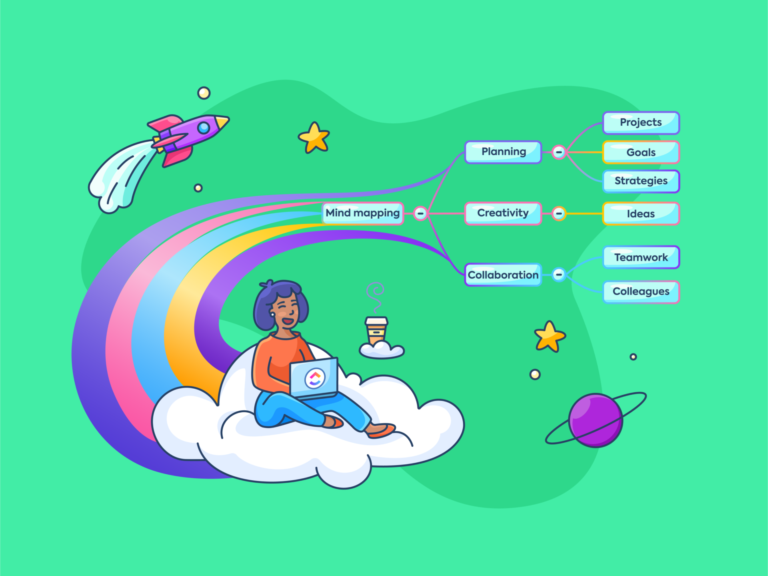
Brainstorming: One effective way to boost convergent thinking is to use brainstorming and structured thinking. Brainstorming isn’t just about throwing out random ideas—it’s about challenging existing knowledge and assumptions and pushing boundaries to discover what really works.
Vertical thinking: Looking at a problem from a single, focused angle is another excellent way to hone in on the best single solution. But to make the most of this approach, you need the right tools to organize and refine your ideas efficiently.
As an everything app for work, ClickUp gives you access to many features that support brainstorming and help structure ideas in a way that makes decision-making easier.

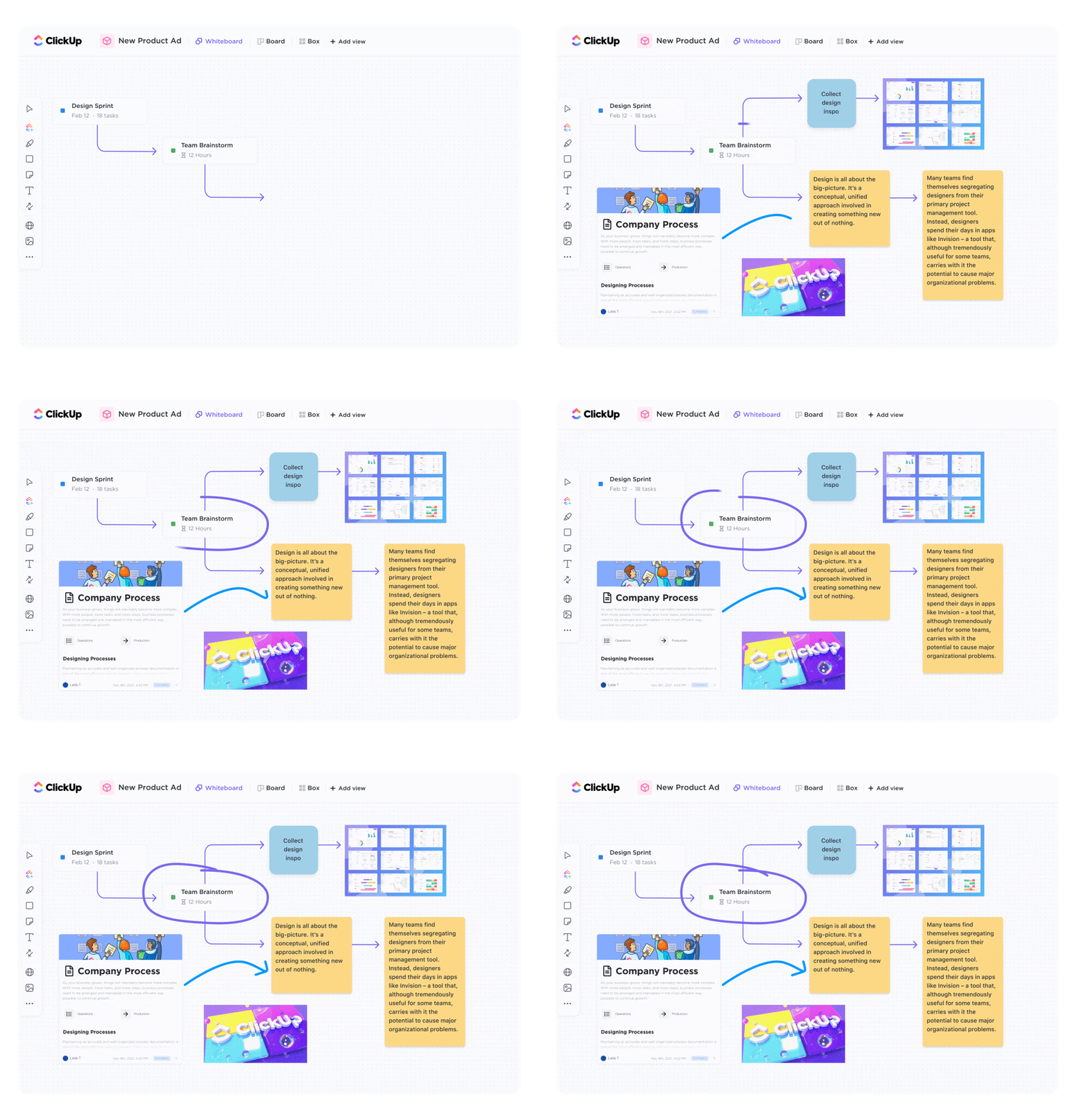
ClickUp Whiteboards turn your brainstorming sessions into dynamic, collaborative environments. Rather than just writing down ideas, you can quickly add images, sketches, and notes, giving each idea a chance to evolve and be fully explored.
Whiteboards also make evaluating and refining multiple options in real time easy.
If you’re working remotely, share your virtual whiteboard with teammates, allowing them to add their input even after the brainstorming session ends.
With the ClickUp Zoom integration, seamlessly introduce the whiteboard into virtual meetings, ensuring everyone is on board with the idea—even if they’re miles apart.

Use ClickUp Comments, Proofing, and @mentions to follow up on ideas asynchronously for further collaboration. This way, you can keep the momentum going long after the brainstorming session ends.
And once you’re done, turn your ideas into tasks in ClickUp from within the same Whiteboard!

ClickUp Tasks helps simplify complex problems by breaking them into smaller, manageable tasks. You can split a large project into individual steps, creating tasks and sub-tasks. This approach helps you estimate the time and effort needed for each step and ensures that everything is addressed.
Collaborate on specific tasks by assigning. tasks to team members or including them in discussions by adding comments. This keeps everyone involved and on track.
Another useful tool in the platform’s arsenal is ClickUp Brain, the AI assistant that helps with critical and analytical thinking. You can use AI for brainstorming to quickly generate solutions and ideas based on your project’s context.
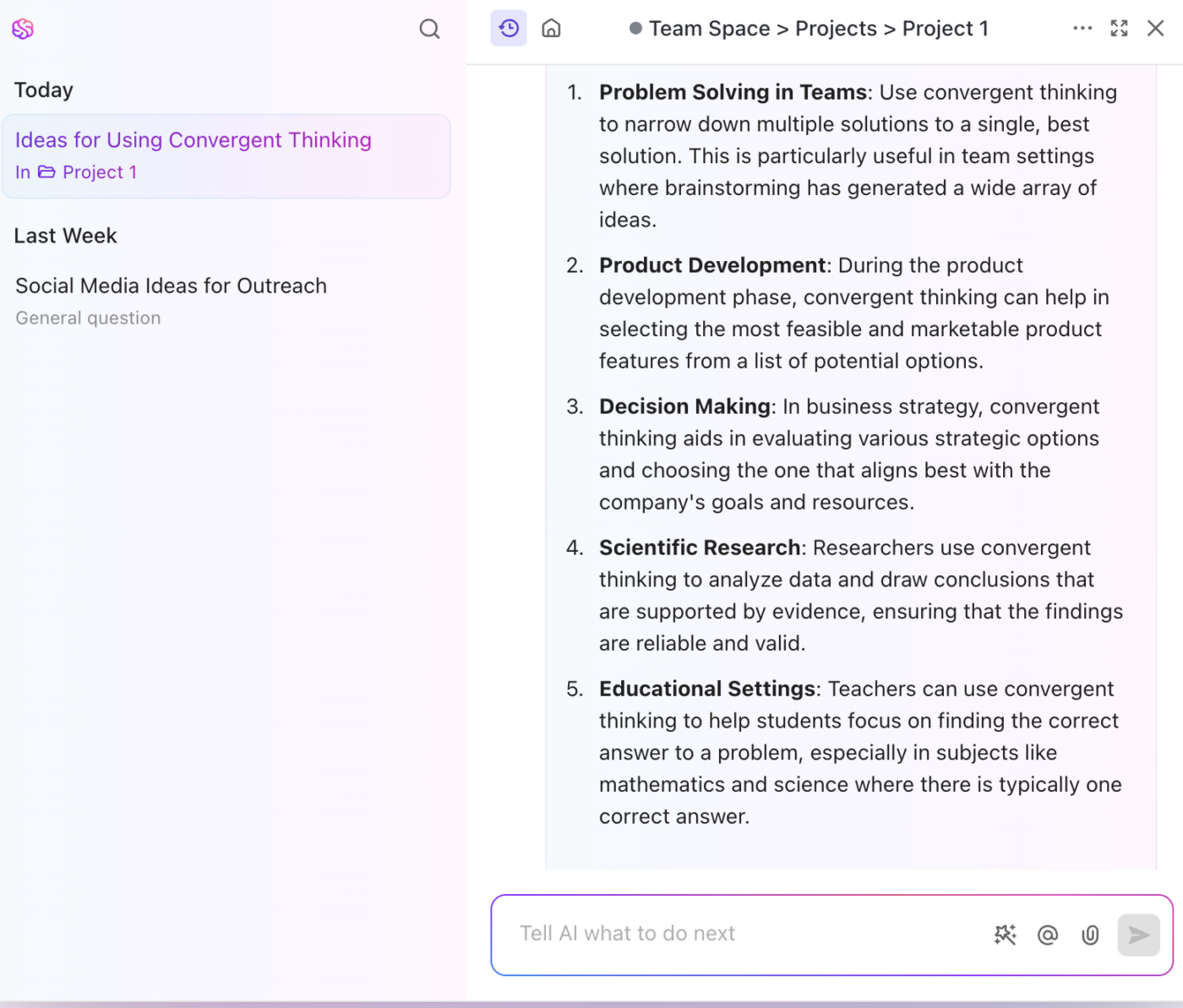
The assistant can also automate tasks like assigning action items, planning projects, and filling in data. This boosts productivity and helps you stay focused on what matters most.
How much time does your team lose to repetitive tasks that add little value? Automation saves time, boosts team morale, reduces errors, and maintains consistency. And with ClickUp Automations, you can achieve all of these!
💡Pro Tip: AI-enabled automation is expected to reduce costs by over 30%. This is the perfect time to invest in AI-powered project management tools!
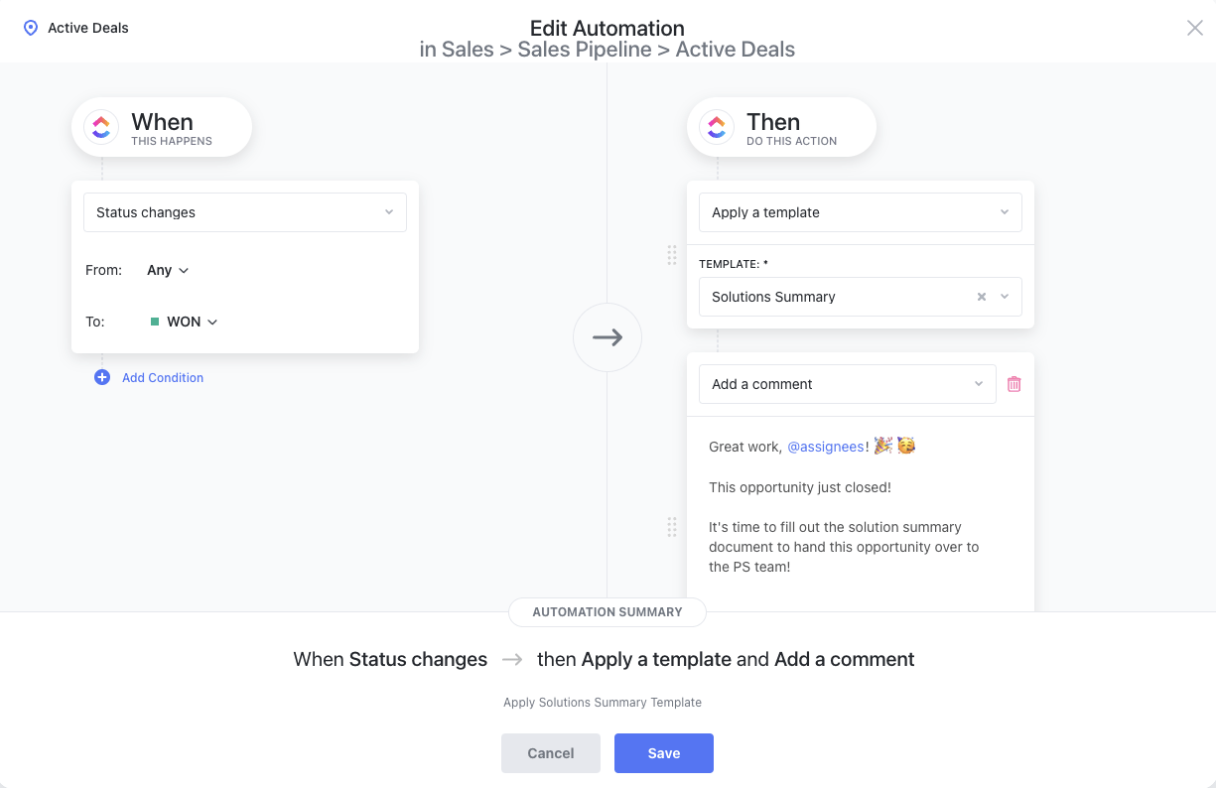
ClickUp offers over 100 premade automations that save you time. Automate tasks like assigning responsibilities, setting priorities, posting comments, and updating status in real time.
Can’t find the right automation in the library? No problem! Build custom automation to suit your goals and speed up your progress.
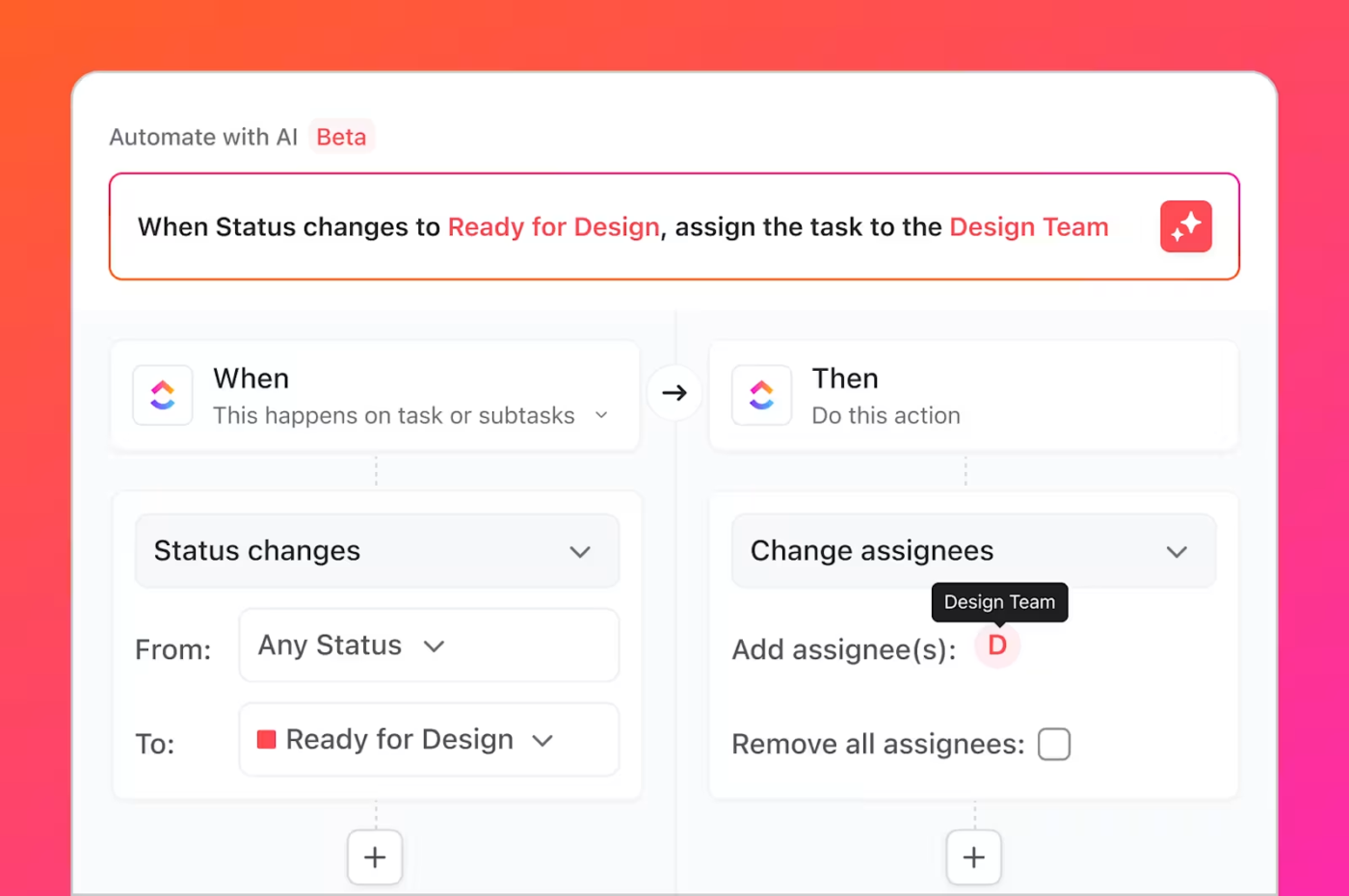
Want even more? ClickUp’s integrations let you connect with other apps and automate workflows without missing a beat.
ClickUp also offers a rich library of decision-making templates for structured problem-solving!
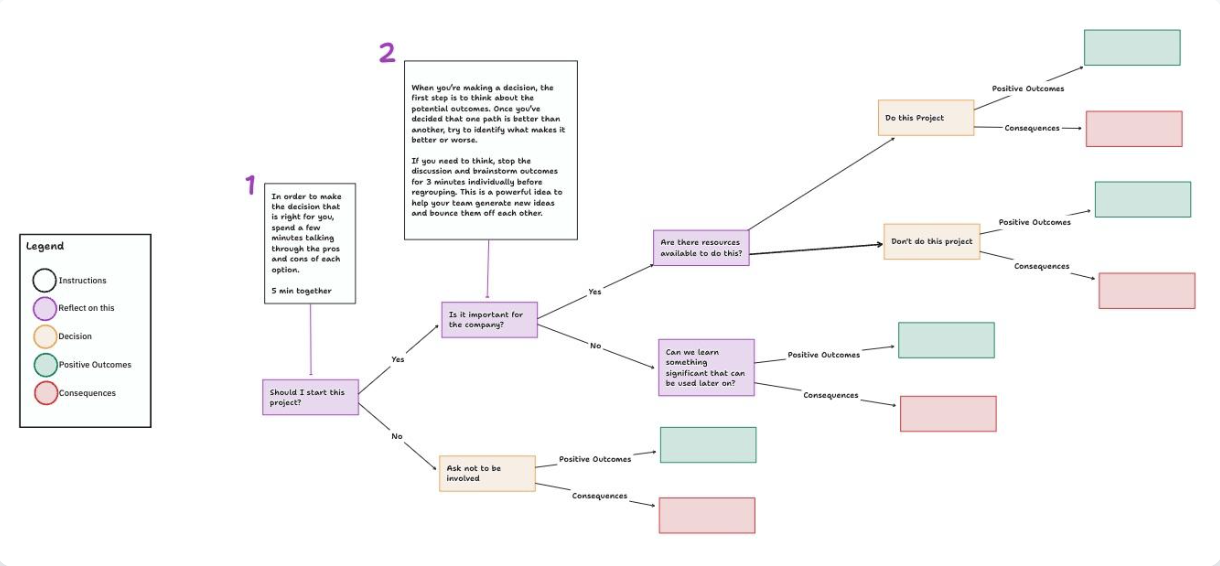
For example, the ClickUp Decision Tree Template is a powerful tool designed to help visualize outcomes, analyze options, and identify key decision points. It turns the decision-making process into a clear, graphical representation, allowing you to break down complex choices and potential outcomes step by step.
You can use various shapes and colors to highlight positive outcomes, decisions, and other key factors.
ClickUp is life-changing! I constantly think about ways I can build out a ClickUp space for projects in my life and my workflow. ClickUp has made me more productive and I have never felt so successful in all I do as when using it.
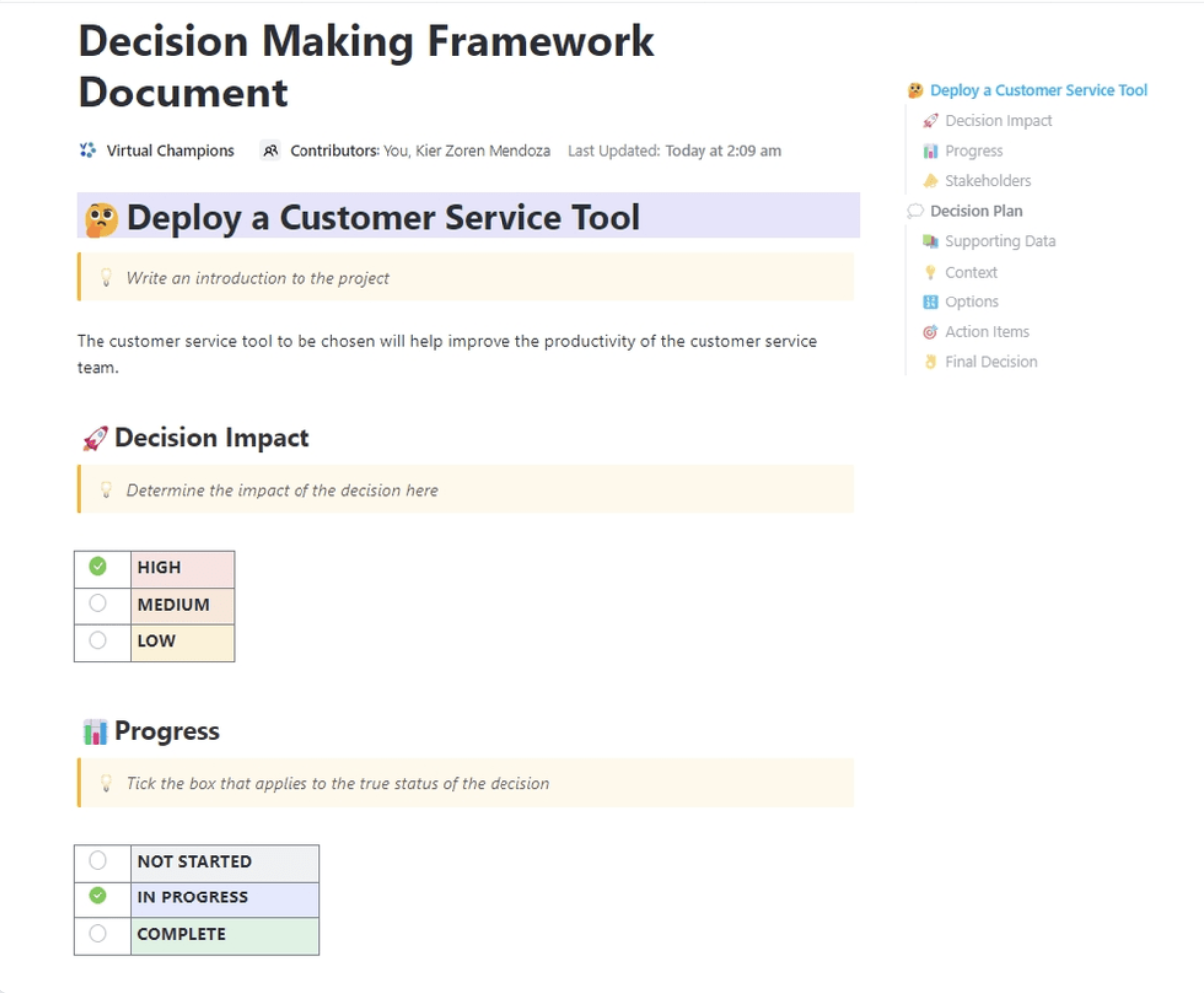
Similarly, the ClickUp Decision-Making Framework Document Template helps you manage multi-criteria decision analysis. It provides a clear structure for tracking all details related to a decision. You can record supporting data, so all stakeholders stay informed throughout the process.
Also Read: Best Digital Whiteboard Software Programs
Convergent thinking goes beyond finding the most simple, best answer. It saves time, builds confidence, and sharpens professional skills. Adopting a convergent thinking approach doesn’t have to mean sacrificing creativity but directing it where it has the most impact.
With tools like ClickUp, applying convergent and divergent thinking becomes easier. Its unified features help you organize and categorize tasks, keeping you focused and clear on every step.
Don’t let decision fatigue hold you back. Sign up for ClickUp today to improve your workflow!

Sudarshan Somanathan
Max 22min read
Sudarshan Somanathan
Max 23min read

Praburam Srinivasan
Max 22min read

© 2026 ClickUp