






Still downloading templates?
There’s an easier way. Try a free AI Agent in ClickUp that actually does the work for you—set up in minutes, save hours every week.
Sorry, there were no results found for “”
Sorry, there were no results found for “”
Sorry, there were no results found for “”
AssemblyAI is a developer-first Speech AI platform that lets you add high-accuracy speech-to-text transcription and audio intelligence to your product via a simple API.
It supports features like speaker detection, sentiment analysis, and more—all with a clean developer experience. But as your use case becomes more complex, you may start to hit limitations.
Maybe you’re working with noisy, real-world audio and need better diarization. Or you’re building a multilingual app and find some dialects aren’t fully supported. Or perhaps you’re in a regulated industry that demands on-premise deployment or deeper model customization—features AssemblyAI doesn’t currently offer.
If you’re looking for a reliable way to explore and compare some affordable applications instead, you’ve come to the right place!
From better language coverage to tighter model control or collaborative transcript editing, our round-up of tools offers more flexibility for your needs. 🌈
Designed with developers, product teams, and researchers in mind, AssemblyAI helps you move fast from testing in a no-code playground to deploying production-ready models that handle real-time or recorded audio with high accuracy.
But here are some limitations that might push you to consider Assembly AI alternatives:
👀 Did You Know? In 2016, millions of viewers tuned into the Olympics—and for the first time, AI was quietly working behind the scenes. IBM Watson powered real-time closed captioning for live broadcasts, marking one of the earliest large-scale uses of AI transcription tools.
Let’s take a quick look at the top Assembly AI Alternatives:
| Tool name | Key features | Best for | Pricing |
| ClickUp | Everything app for work, which offers transcription across voice notes, video clips, meetings, and more | Enterprises, mid-sized companies, small Businesses | Free plan available, Paid plans start at $7/user/month |
| Otter.ai | Real-time transcription, speaker separation, live summary, tagging, export formats | Small businesses, mid-sized companies | Free plan available, Paid plans start at $16.99/user/month |
| Rev | Human and AI transcription, legal formatting, timestamps, and certified transcripts | Enterprises, legal teams, small businesses | No free plan, AI: $0.25/min, Human: $1.99/min |
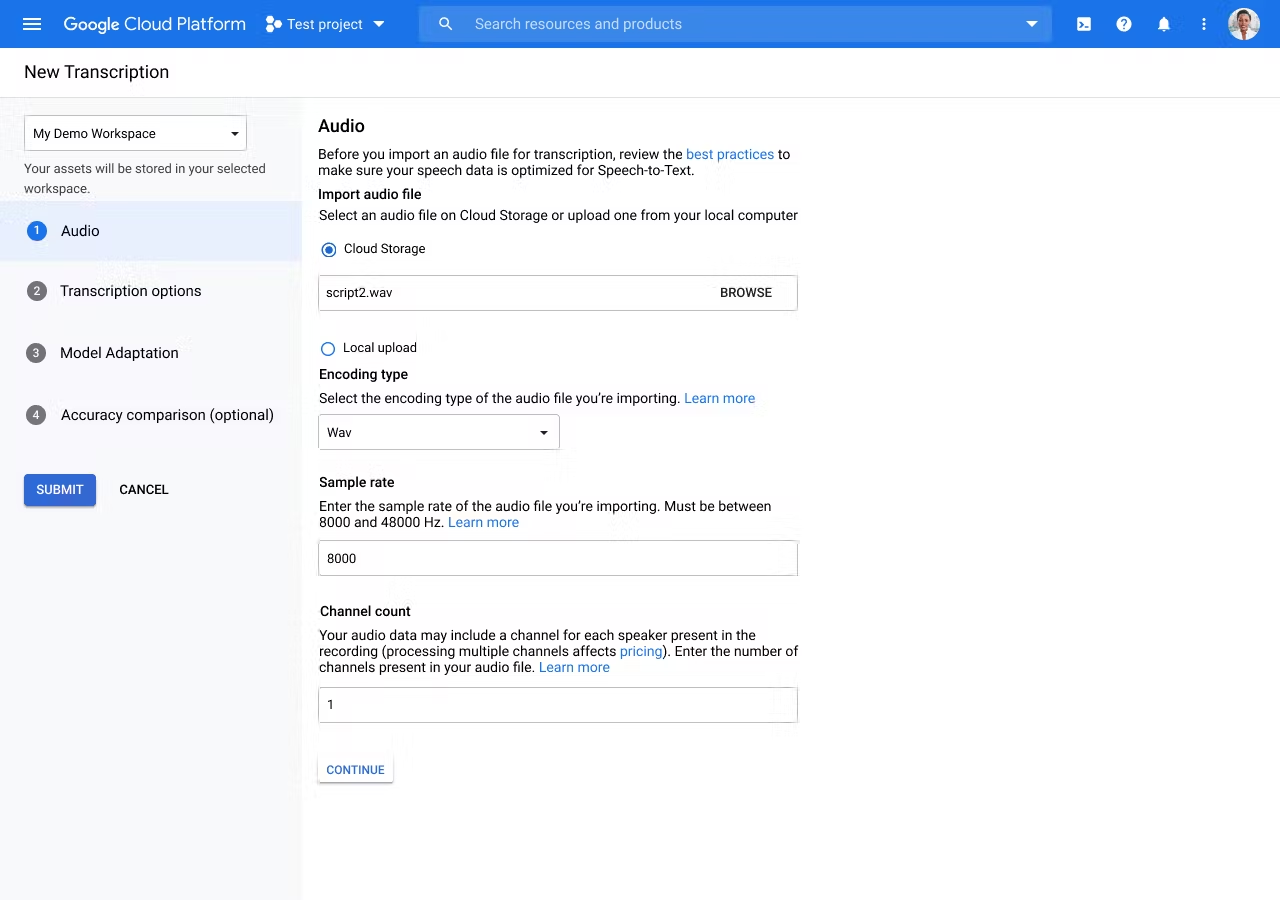
| Google Cloud Speech-to-Text | Real-time streaming, 125+ languages, pre-trained/custom models, strong ecosystem integration | Enterprises, mid-sized companies | Custom pricing |
| Deepgram | Real-time & batch transcription, sentiment analysis, redaction, speaker diarization, on-prem deploy | Enterprises, mid-sized companies | Free trial ($200 credit), Paid plans start at $4,000/year |
| AWS Transcribe | Live transcription, channel identification, custom vocab, contact lens analytics | Enterprises, mid-sized companies | No free plan, Custom pricing |
| Descript | Transcription-based video editing, Overdub, multitrack audio editor, screen recording | Developers, researchers, and small businesses | Free plan available, Paid plans start at $24/month |
| Whisper | Multilingual transcription, translation, punctuation, open-source, confidence scoring | Everything app for work offers transcription across voice notes, video clips, meetings, and more | Free plan available, API: $0.006/minute |
| Speechmatics | Sentiment analysis, topic detection, profanity filtering, audio segmentation | Enterprises, mid-sized companies | Free plan available, Paid plans start at $0.24/hour |
| SpeechBrain | Open-source, modular architecture, pretrained models, Hugging Face integration, speech tasks | Researchers, developers, and academic institutions | Free Forever |
It’s time to get into it! Let’s look at each tool’s capabilities in detail and find the perfect fit for you:
Imagine a workspace where every meeting, voice note, and screen recording is automatically transcribed, searchable, and ready to turn into actionable insights. That’s the magic of ClickUp as a transcription software.
With ClickUp’s AI-powered tools, you can capture every word from your Zoom, Teams, or Google Meet calls using the AI Notetaker. Instantly, you’ll have a full transcript, a concise summary, and a checklist of action items—no more scrambling for notes or missing key details. The AI notetaking tool identifies speakers, captures important moments, and highlights key decisions and action items—all while the meeting is in progress.
Once the meeting is transcribed, the content lives in ClickUp Docs, a powerful real-time document editor built for teams. Docs lets you edit collaboratively, leave inline comments, mention teammates, and embed media or tasks—all in one place. It provides a dynamic workspace where you can turn ideas and documentation into action.
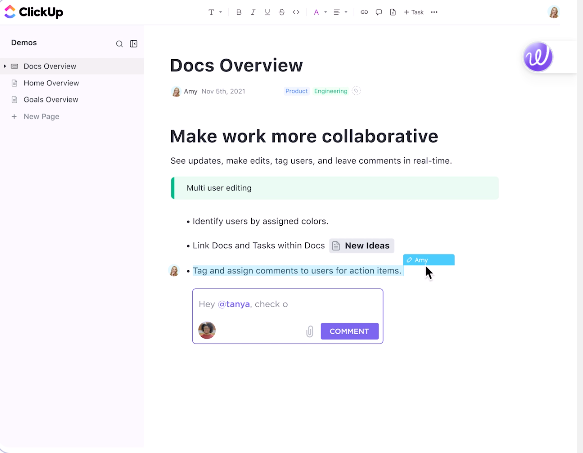
You can also track version history, share permissions, and embed ClickUp elements like task lists or project views directly inside the transcript. You can track updates, link related initiatives, or manage sign-offs without leaving the doc.
With ClickUp Brain, you can extract knowledge from any meeting note instantly. Ask natural language questions like “What deadlines were discussed?” or “What’s the next step for the design team?” and get precise, context-aware answers based on your meeting content. This AI for meeting notes can also help you generate summaries tailored to specific use cases like client follow-ups, executive briefs, or stakeholder updates.
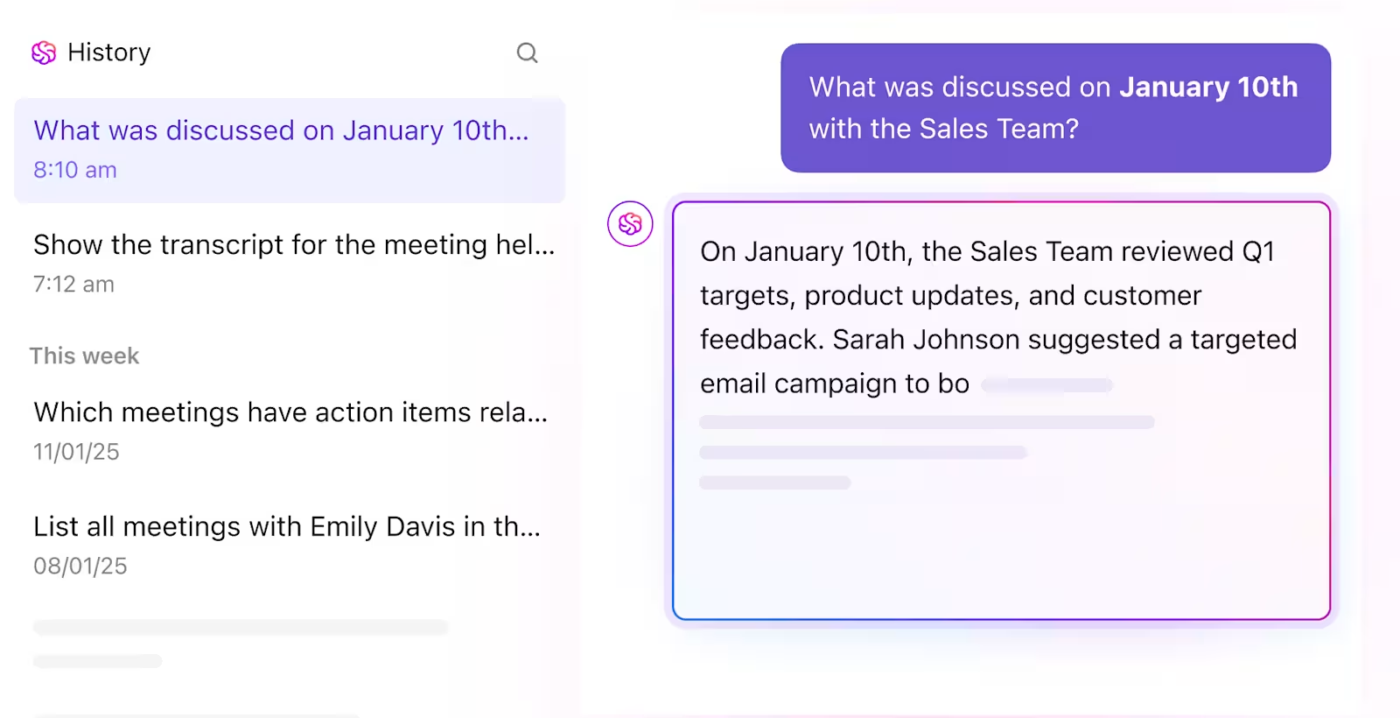
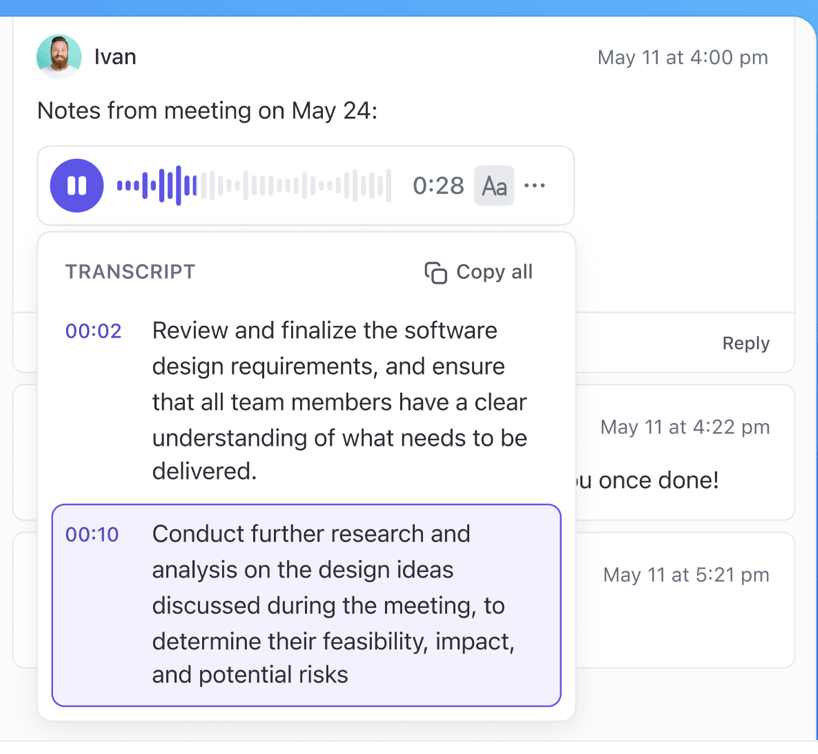
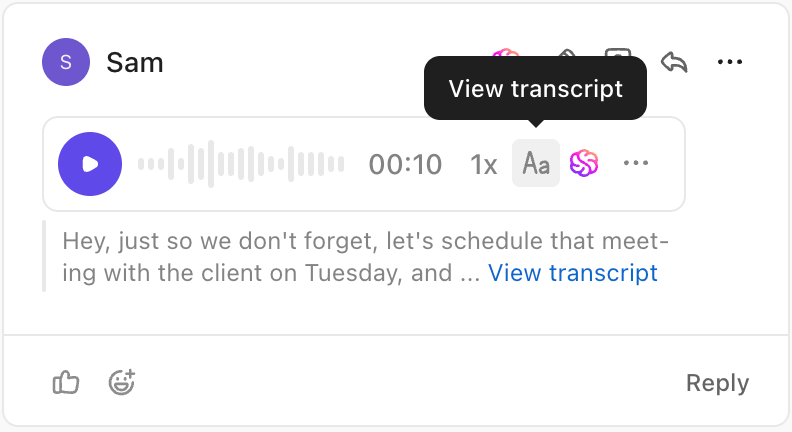
But ClickUp doesn’t stop at meetings. Record screen demos via ClickUp Clips or quick voice clips, and ClickUp AI will transcribe them automatically. Need to revisit a specific moment? Just search the transcript or click a timestamp to jump right in. You can even ask ClickUp Brain questions about your recordings, and it’ll pull answers straight from your transcripts.

Whether you’re collaborating across languages, documenting client calls, or keeping track of project updates, ClickUp transforms spoken words into organized, actionable knowledge. It’s more than just transcription—it’s productivity, clarity, and collaboration, all in one place.
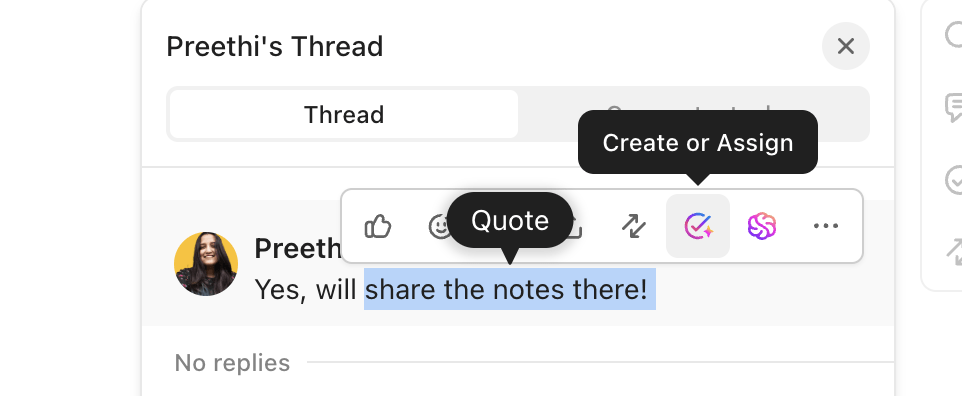
Finally, when you feed all these notes and information into ClickUp Tasks, it turns discussion into deliverables. You can highlight a sentence in the transcript and instantly convert it into a task, assign it, and set a due date. That task stays linked to the source conversation for full context, and workflows would keep going without interruptions.
A Capterra review says:
I really like ClickUp’s versatility. It has a wide range of features and could potentially replace many other software solutions. For small and growing teams, it provides a great way to organize and visualize work. Lastly, ClickUp’s AI is a great tool to help my team search for items.
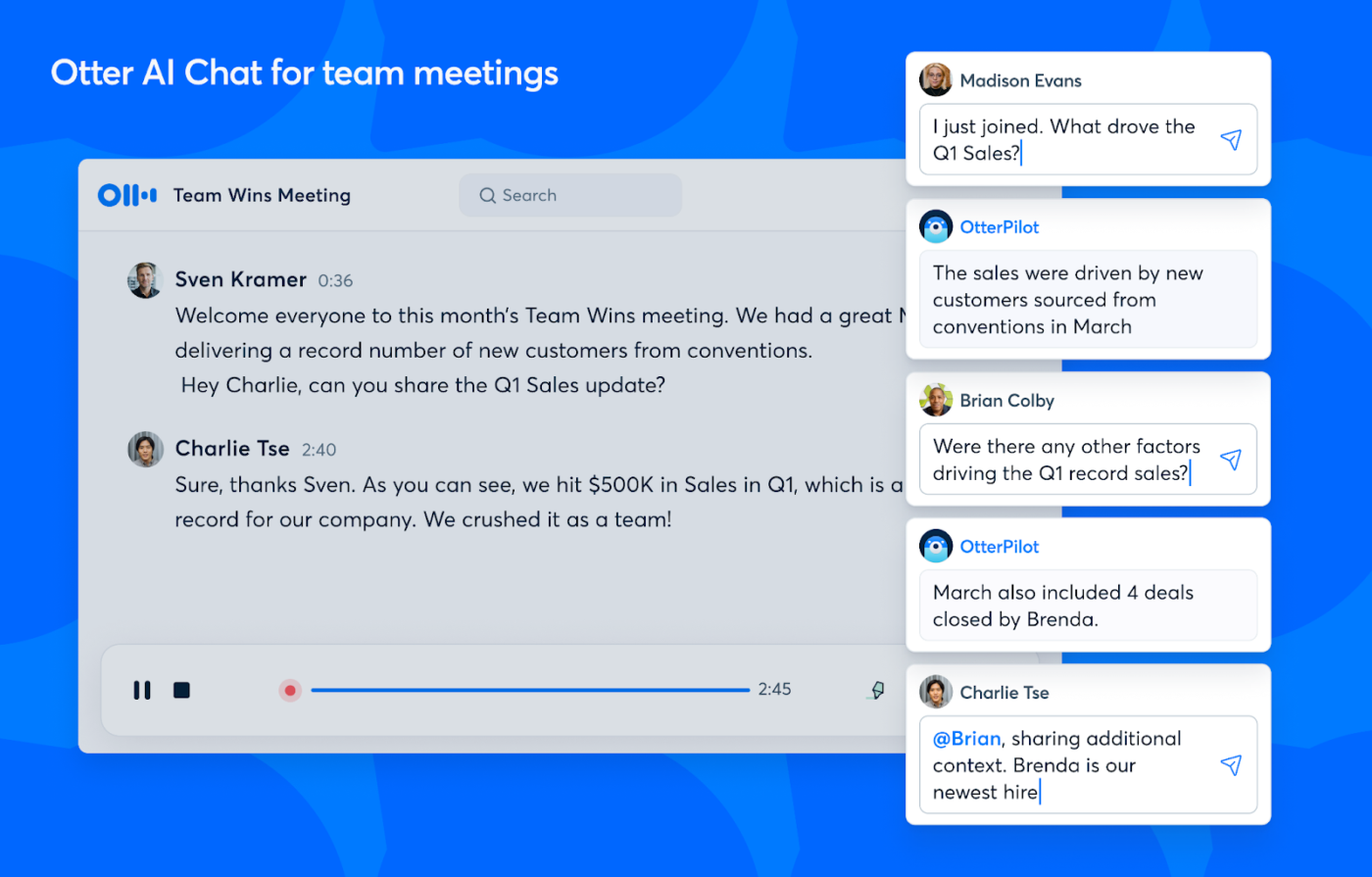
If you’re part of a remote team or managing multiple projects, Otter helps you capture everything discussed in your meetings without needing to type notes. It works with Zoom, Google Meet, and Microsoft Teams to automatically record and transcribe conversations in real time.
You also get a live summary that updates as people speak—useful when you need a quick snapshot of what’s been covered so far. Otter also separates speakers so you can track decisions, action items, or follow-ups tied to specific teammates.
You can add highlights or comments and tag teammates in the transcript to flag important parts or clarify next steps. Need to revisit a conversation? Otter’s search feature helps you jump straight to the moment you’re looking for
A G2 review says:
If I missed something in a live meeting I can always have the live transcription up on another screen and I don’t have to ask someone to repeat themselves due to the amazing accuracy of the live transcription.
📚 Also Read: Best Otter.ai Alternatives & Competitors
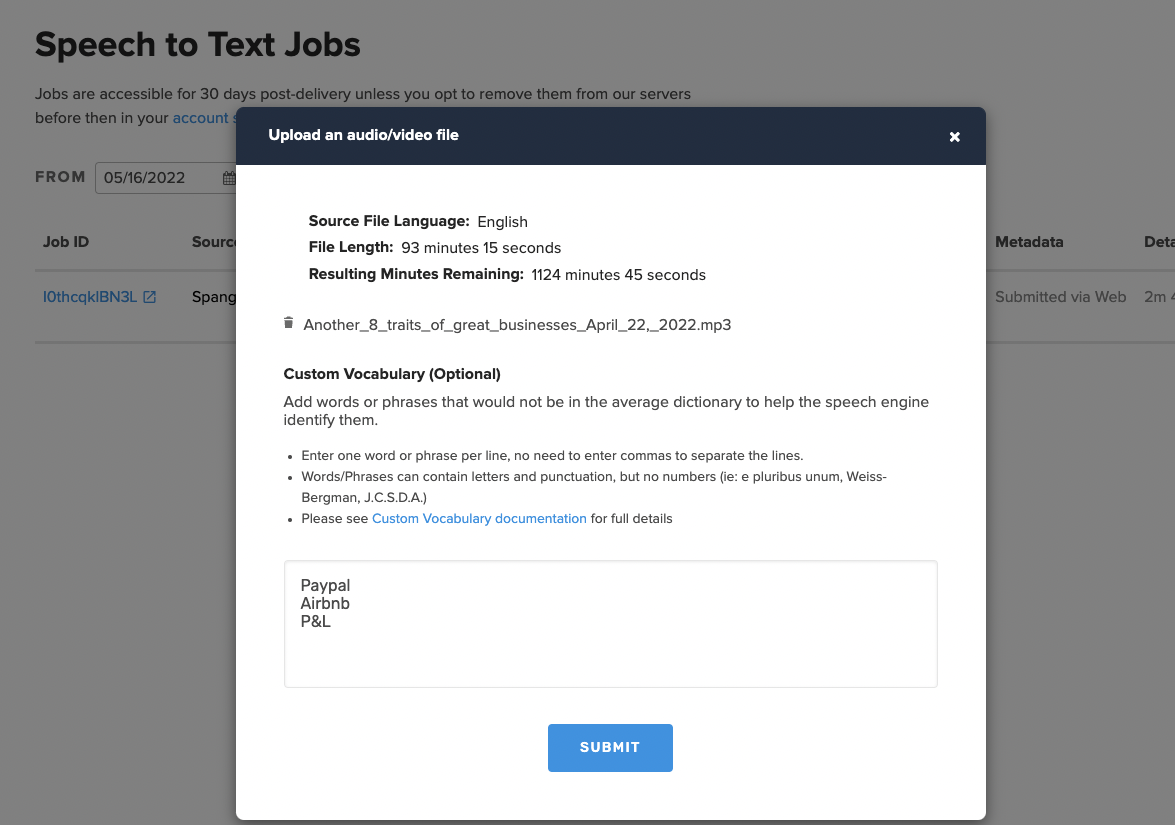
Rev is a high-accuracy speech-to-text software for legal work, such as depositions, hearings, and client interviews. The platform offers the option to choose between verbatim transcripts that capture every word or clean-read versions that skip filler.
Each transcript includes speaker labels and timestamps, and certified copies if you need them for official filings. You can also request custom formatting like numbered lines or layouts tailored to your court’s requirements.
Your files are encrypted, and every transcriptionist handling legal content signs an NDA to ensure security. If you’re working on a tight timeline, rush delivery is available in as little as 12 hours. To simply cross-departmental collaboration, Rev allows you to add, share, and collaborate on notes with other teams.
A G2 review says:
Rev makes it incredibly easy to turn my audio files into clear, accurate transcripts with minimal effort on my part. I love how simple the interface is—uploading files is quick, turnaround times are fast, and the formatting is clean and professional.
🎧 Quick Hack: When adding a voice-over to a video, you can record your voice-over as you screen record using ClickUp Clips. There is no need for separate audio syncing later. Just trim and share.
📮 ClickUp Insight: Nearly 88% of our survey respondents now rely on AI tools to simplify and accelerate personal tasks.
Looking to generate those same benefits at work? ClickUp is here to help! ClickUp Brain, ClickUp’s built-in AI assistant, can help you improve productivity by 30% with fewer meetings, quick AI-generated summaries, and automated tasks.
If you’re building a voice-enabled app, chatbot, or virtual assistant, Google Cloud Speech to Text gives you the tools to add fast, accurate transcription. It supports real-time streaming, so users can speak naturally and get instant responses—even in low-latency environments.
The Chirp model, trained on millions of hours of audio, handles accents, noisy backgrounds, and fast, conversational speech. With support for over 125 languages, you can build for a global audience without needing separate models.
You can integrate the API using REST or gRPC. This AssemblyAI alternative works well with other tools in the Google Cloud ecosystem, including Dialogflow and Vertex AI. You can manage all parts of the transcription service centrally, from speech input to intent recognition and response generation.
A Capterra review says:
I remember back 5 years earlier when I transcribed almost 10k minutes of recorded speech for weeks. Google cloud services made it much easier now and it made it possible to transcribe in hundreds of languages and accents.
📚 Template Archive: Free Task List Templates in Excel & ClickUp
🧠 Fun Fact: Today’s audio transcription tools don’t just capture words—they identify speakers, detect emotions, and follow the exact sequence of conversation. With ongoing development and smarter algorithms (often built using languages like R), the future promises even sharper accuracy, where machines won’t just hear us, they’ll truly understand us.
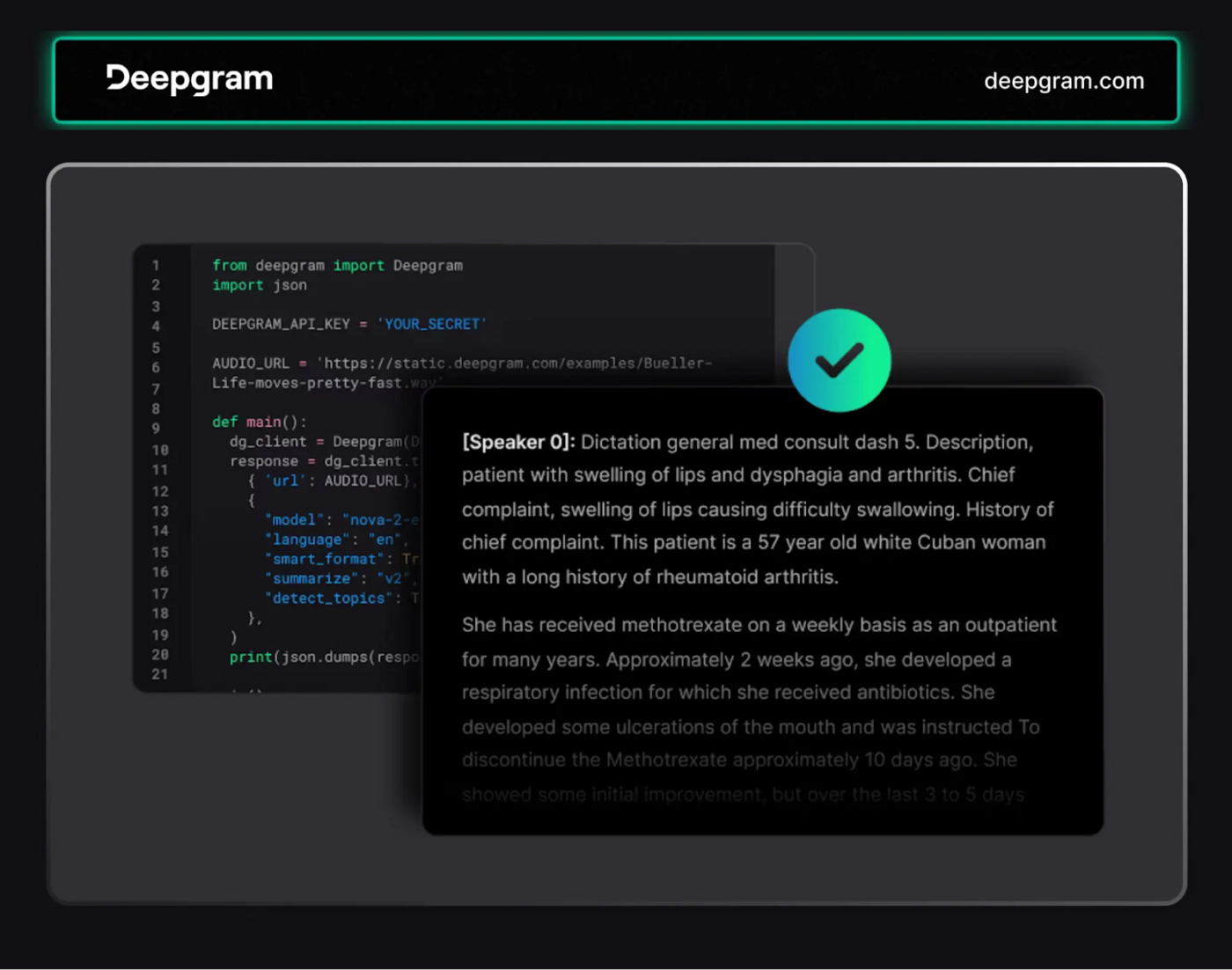
Deepgram is an API-based tool that converts audio into text, speech, or synthetic voice using deep learning.
Unlike traditional speech recognition systems, it’s trained end-to-end on real-world audio across 30+ languages. You can use it to stream audio live with sub-second latency or transcribe recordings in bulk.
Developers can also leverage it to fine-tune results by boosting keywords, adding domain-specific terms, or labeling speakers. Deepgram also detects sentiment and topics, making it useful not just for transcription but for analyzing what’s being said—and how.
A G2 review says:
The product works consistently and the team is very approachable. The product can handle high concurrency, and comes with the main transcription features we need, specifically grammar and speaker labelling.
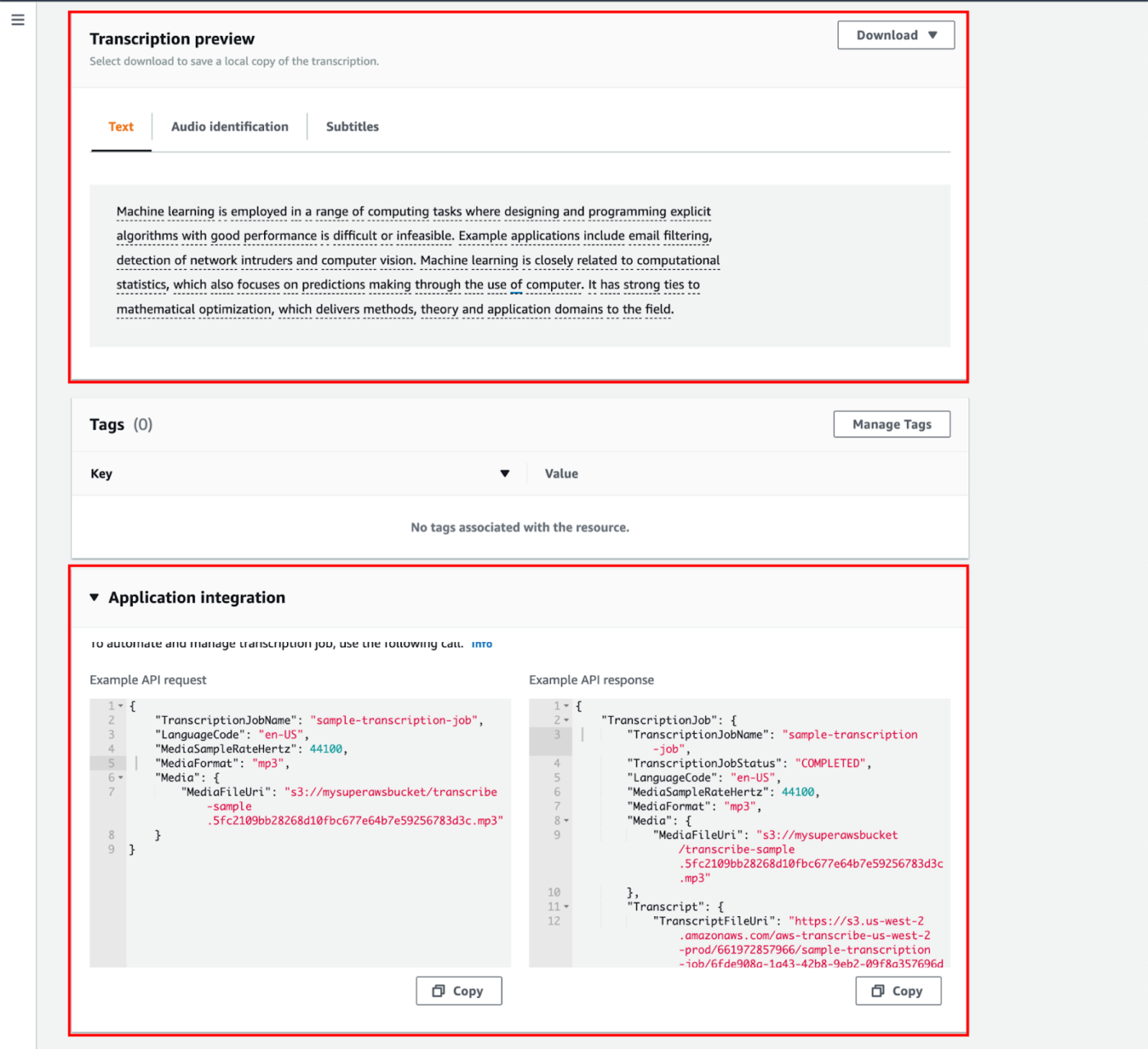
Amazon Transcribe can be used on its own or integrated directly into your support tools. It brings speech-to-text into your workflow without disrupting it.
Handling a high volume of calls? Features like speaker diarization and channel identification make it easy to tell agents and customers apart. You can track performance, review conversations, or troubleshoot faster.
Need more accuracy? Train custom language models to pick up on brand terms, product names, or local accents. For live interactions, streaming transcription gives you instant visibility. Partial results appear in real time, making it suitable for live coaching, escalation, or triggering automated actions.
And with support for over 100 languages, your team stays responsive no matter where your customers are.
A Capterra review says:
By using Amazon transcribe, I am easily able to transcribe my words and language into coherent and understandable text. It allows for efficiency with time, instead of having to type. It is clear and concise
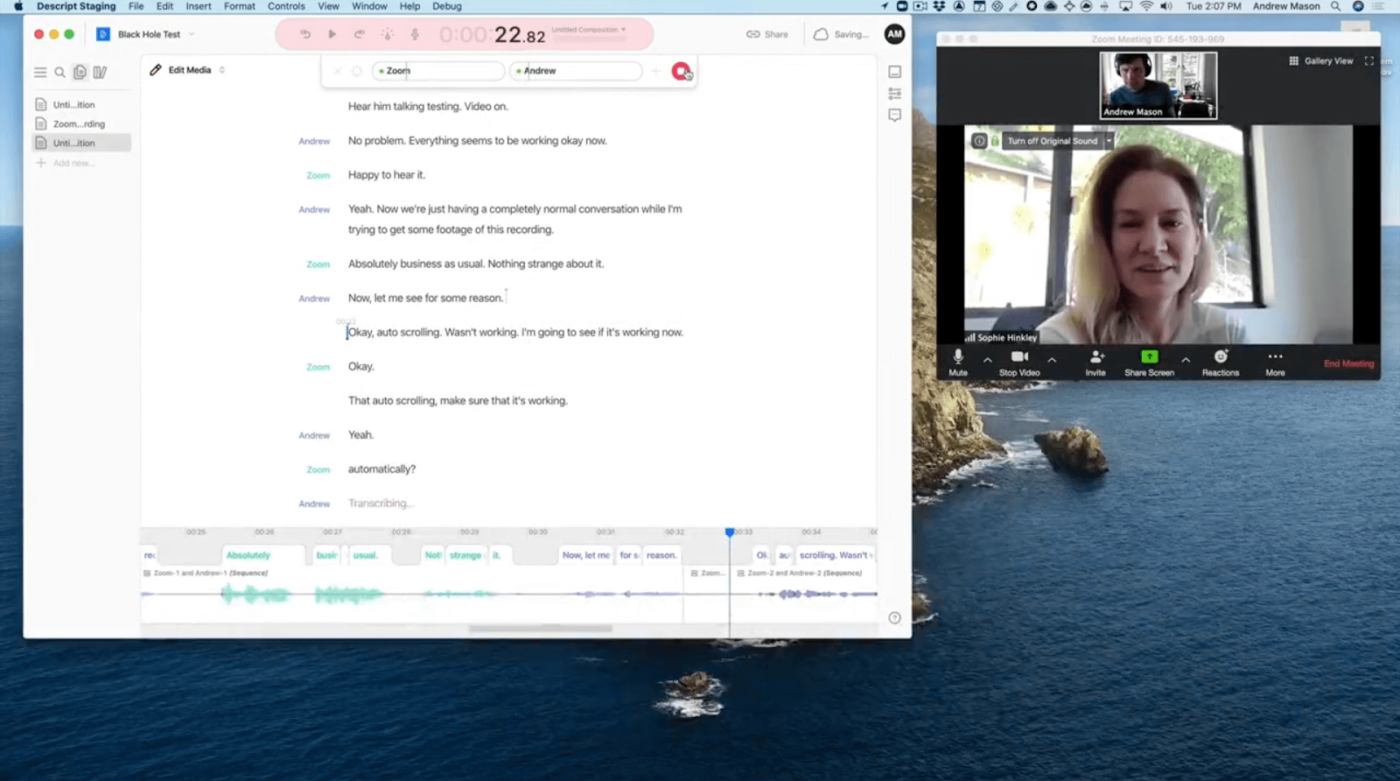
Descript is an all-in-one audio and video editing tool that transcribes spoken content into text. It allows you to edit media as easily as a document.
You can highlight insights on the spot, making tracking feature requests or pain points easier. The transcript appears like a document, so copying key moments into your roadmap or backlog is simple.
However, if you want to build transcription into your product, note that Descript doesn’t currently offer a public speech-to-text API. Its transcription features are limited to the desktop and web apps. While there’s an Overdub API for synthetic voice generation, it’s only available to enterprise users and doesn’t support general transcription use cases.
A G2 review says:
I was looking for a platform to help me edit podcast videos with captions and transcripts and came across Descript. I was very impressed with the quality of the platform and everything it does. It’s super easy to use and has many powerful, helpful, timesaving features.
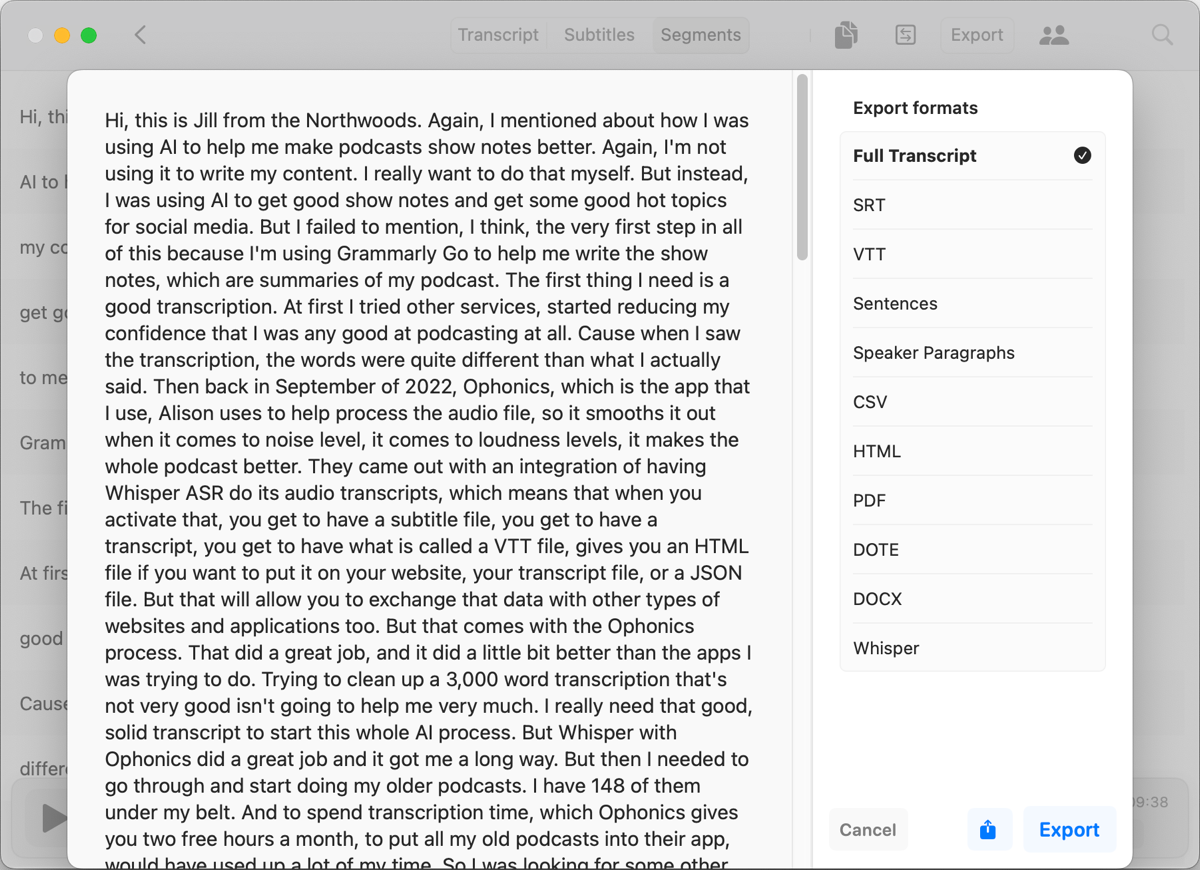
If you’re a researcher or developer working with multilingual audio, Whisper AI gives you a flexible and accurate way to transcribe, translate, and analyze speech. Trained on 680,000 hours of diverse audio, it handles real-world conditions like background noise, code-switching, and varied accents without needing you to clean the data first.
You can use it to detect spoken language, generate phrase-level timestamps, or convert speech to English from nearly 100 languages. With five model sizes from 39 million to 1.55 billion parameters, you can choose what best fits your compute budget.
Because it’s open-source under the MIT license, you can modify, fine-tune, or integrate it into your own tools and research workflows.
A G2 review says:
Whisper stands out for its user-friendly interface, making it remarkably easy to navigate. Implementing it seamlessly into existing systems is a breeze. Its frequency of use is a testament to its reliability. While boasting a rich set of features, the ease of integration enhances its overall appeal.
📚 Template Archive: Free Meeting Notes Templates to Take Better Meeting Minutes
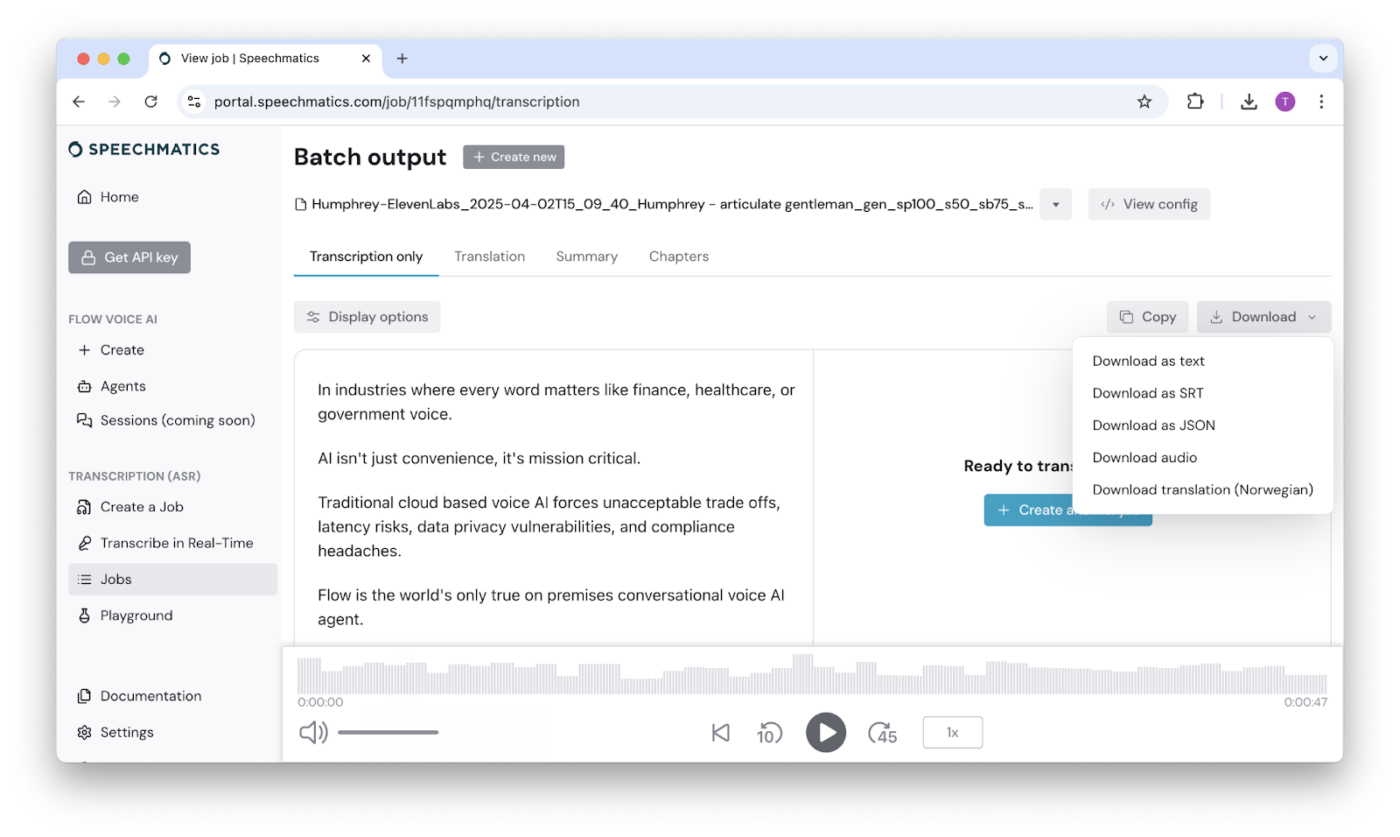
Speechmatics gives you enterprise-grade APIs for Speech-to-Text and voice AI agents. It is built to handle a wide range of languages, accents, and audio conditions. It supports all major audio and video file formats with automatic sample rate detection, allowing you to work with raw media without extra prep.
With numeral formatting, Speechmatics automatically turns spoken numbers, dates, and currencies into clean, structured text, saving you the effort of manual corrections later.
Profanity and disfluency detection helps you flag or remove filler words and offensive language, which is useful for customer calls, media content, or legal transcripts.
A G2 review says:
I was amazed by the accuracy of the voice recognition and the authenticity of the generated speech. It was as if actually talking to a real person. Also the response time was fast and I immediately recommended it to people around me to try. I can imagine it being well used in many areas.
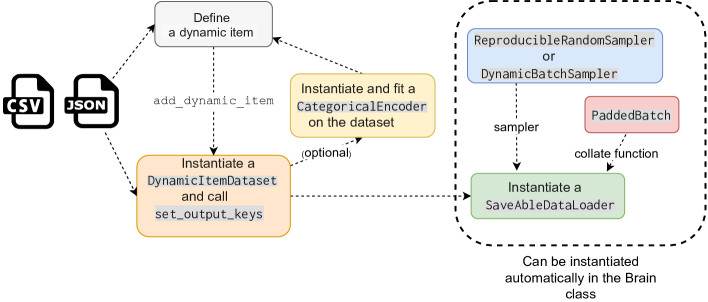
SpeechBrain is an open-source, all-in-one conversational AI toolkit designed to support research and learning in speech and language processing. Built on PyTorch, it is a resource for academic teams and students who want hands-on access to the building blocks of modern speech technologies.
The toolkit includes over 100 pretrained models and 200+ training recipes. You can train your models, fine-tune existing ones, or use reproducible baselines for coursework and research papers. All without needing to build everything from scratch.
It supports self-supervised learning, works with multiple microphones, and has detailed documentation. This makes it easier to handle real-world challenges like low-resource ASR, speaker diarization in noisy settings, and emotion detection across multi-speaker audio.
AssemblyAI and its best alternatives stop at transcription. You still have to dig through raw text, extract key takeaways, and assign action items. It’s a disjointed workflow that slows momentum and leaves insights stranded.
That’s where ClickUp stands apart. Rather than just transcripts, it offers a complete transcription service. With it, you get to instantly record and transcribe meetings, voice notes, and screen clips with ClickUp AI. Summaries and transcripts are auto-organized in Docs, linked to tasks, and searchable with ClickUp Brain. Capture, share, and act on every conversation—all in one place.
✅ Try ClickUp for free today!

© 2026 ClickUp

There’s an easier way. Try a free AI Agent in ClickUp that actually does the work for you—set up in minutes, save hours every week.