






Still downloading templates?
There’s an easier way. Try a free AI Agent in ClickUp that actually does the work for you—set up in minutes, save hours every week.
Sorry, there were no results found for “”
Sorry, there were no results found for “”
Sorry, there were no results found for “”
Here’s something you might not realize: your telecom network generates more data in a single day than most industries produce in a month.
Globally, that adds up to 188 exabytes every month. It’s massive, and AI is changing how you make sense of all that information.
But plugging AI into your network isn’t enough. You still need your people working together to unlock its full value—your network engineers, data scientists, and operations teams. If you don’t have one unified system to track progress, share context, and stay aligned, things can stall fast. And when that happens, even the best AI tools won’t deliver the results you’re expecting.
In this guide, you’ll explore how AI is transforming telecommunications—and how you can plan, manage, and organize your AI initiatives more effectively using tools like ClickUp.
Ready? Let’s dive in. ⚒️
Let’s start by looking at the core AI technologies making this transformation possible. They include:
Machine learning (ML) is essentially pattern recognition at scale. Algorithms learn from your historical network data to predict future behavior, such as forecasting traffic spikes or identifying unusual activity that signals a problem.
Deep learning, on the other hand, is a more advanced subset of ML; it’s what you use to make sense of unstructured data like voice recordings and video streams.
In your world, these AI technologies power churn prediction, anomaly detection, and even traffic forecasting. The good thing about these models is that they get smarter over time as they process more data, so if you have clean, centralized data pipelines, you’d be at a huge advantage.
While machine learning is great at predicting things, generative AI is all about creating new content. You’ve probably heard of large language models (LLMs); these are the engines that can draft customer communications, generate network configuration scripts, or summarize complex incident reports in seconds.
Tasks that used to take your engineers’ hours, such as writing a detailed root cause analysis or creating a new knowledge base article, can now be completed in minutes.
While you still need a human to review the outputs, especially for anything that’s customer-facing or touches on compliance, they still significantly reduce the time your team spends on documentation.
🧠 Fun Fact: Generative AI tools improved worker productivity by about 15% in real-world studies, mainly by helping them write documentation, summarize information, and communicate faster.
A digital twin is a virtual replica or simulation of your physical telecom network. It’s like your digital sandbox. You can use them to simulate changes, like testing new 5G antenna placements, modeling capacity upgrades, or running disaster recovery scenarios, before ever touching your live infrastructure.
Everything behaves as it does in real life, but here, nothing you do can break the actual system, so it lets you catch problems that would otherwise cause service outages or angry customer calls, while avoiding the risk of testing in a live environment.
Just remember, a digital twin is only as good as the data it’s fed; a stale twin is more likely to mislead you.
With intelligent automation, your entire network can run on autopilot. How? Instead of humans manually fixing problems or adjusting settings, the system can make decisions, take action, and handle complex scenarios on its own, using both preset workflow rules and AI-powered insights.
For your team, this looks like:
Basically, this human-in-the-loop model frees up your engineers to focus on the truly complex problems that require their expertise, while automation handles all the repetitive, boring tasks.
📮ClickUp Insight: 88% of our survey respondents use AI for their personal tasks, yet over 50% shy away from using it at work.
The three main barriers? Lack of seamless integration, knowledge gaps, or security concerns.
But what if AI is built into your workspace and is already secure?
ClickUp Brain, ClickUp’s built-in AI assistant, makes this a reality.
It understands prompts in plain language, solving all three AI adoption concerns while connecting your chat, tasks, docs, and knowledge across the workspace. Find answers and insights with a single click!
Now that we’ve covered the tech, let’s look at where it actually shows up in your day-to-day operations. These are the high-impact applications delivering real value to telecom teams right now.
Network traffic is sometimes unpredictable, and trying to manage it manually is like setting yourself up for a losing battle. With 5G, things get way more complicated. You have more cells, more handoffs, and way more moving parts than any human team can track.
AI can analyze real-time and historical data to balance loads, reduce latency, and prevent congestion before it affects your customers. When they do happen, AI-driven traffic management enables you to maintain consistent quality of service (QoS) without wasting money on extra capacity ‘just in case.’
We can all agree that unplanned outages are a nightmare. They cost you revenue, customers lose trust in you, and send your support teams into a frenzy. Sticking to a calendar-based approach as a preventive measure, by replacing parts on a fixed schedule, doesn’t cut it either. You never truly know what you need to change or what you don’t.
AI takes a different approach. By looking at sensor data, the environment, and past failure patterns, it can predict when equipment might fail. That way, your team can fix problems before they happen, moving your entire maintenance schedule from reactive firefighting to proactive, planned work.
Remember the days of frustrating IVR phone menus? They’re being replaced by conversational AI that actually understands what customers want. These AI-powered chatbots and virtual assistants can pull account data, process plan changes, and provide outage updates without ever needing to hand off to a human agent.
It frees up your human agents to handle only the most complex and sensitive customer issues. Plus, with sentiment analysis, the AI can flag frustrated customers in real time and route them to a specialized team for priority handling. The result is faster resolutions, lower support costs, and improved customer satisfaction.
Telecom fraud is a constant battle. You’re dealing with everything from SIM swaps and subscription fraud to complex international revenue share fraud (IRSF) and account takeovers. Rule-based systems are too slow to keep up with fraudsters who are constantly changing their tactics.
AI excels at detecting these threats. It can detect anomalies in real time, like unusual call patterns, sudden location changes, or atypical data usage, and flag or block suspicious activity before you face major losses. Deep learning models are really powerful here because they can learn new fraud signatures as they emerge, helping you stay one step ahead.
If these use cases haven’t already made it clear how transformative AI can be to telecommunication teams, these are measurable improvements that can happen across your business once it’s implemented:
Adopting AI isn’t as simple as flipping a switch. You’re going to run into some very real friction, and it’s better to know what’s coming.
These challenges are significant, but they’re manageable with a clear strategy and tools that reduce complexity rather than add to it.
The pace of innovation isn’t slowing down, and a few key trends are shaping the future of AI in the telecom industry.
Agentic AI represents a significant shift. These are autonomous AI systems that can take action on their own, not just make recommendations. Think of an AI that not only detects a network fault but also diagnoses the root cause and applies the fix independently.
Agentic AI delivers real value when it moves beyond analysis and begins taking controlled action inside operational workflows. With Super Agents in ClickUp, telecom teams can build supervised AI agents that monitor projects, analyze operational data, and trigger actions when issues arise.
For example, a Super Agent can summarize network incident reports, generate follow-up tasks for engineering teams, track infrastructure rollout milestones, or surface risks in large-scale deployment projects. Instead of waiting for manual prompts, these agents continuously monitor activity across tasks, Docs, and updates.
For telecom operators managing complex infrastructure, this turns AI from a reporting tool into an operational layer that helps coordinate teams, maintain visibility, and keep critical projects moving forward. See how. 👇🏼
We’re also moving toward AI-native 6G networks, where intelligence is built into the infrastructure from the ground up, rather than being bolted on as an afterthought. At the same time, edge AI will enable a new class of ultra-low-latency applications by processing data closer to the user, which is critical for applications such as autonomous vehicles and augmented reality.
The carriers that win in this new era will be those who successfully operationalize AI across their entire value chain, treating it as a core operational backbone, not just a series of isolated pilot projects—already, 50% of telecom executives report capturing measurable impact from generative AI implementations.
AI projects in telecom are a cross-functional beast. You’ve got network engineers, data scientists, product managers, and customer ops all trying to work together.
Each team owns a different piece of the puzzle and often uses different tools to manage their work. The result? There’s no single source of truth.
This is called Work Sprawl—the fragmentation of work activities across multiple, disconnected tools and platforms. Conversations are lost in Slack threads, plans live in spreadsheets, tasks are tracked in Jira, and critical decisions are buried in email chains. It’s a recipe for misalignment and stalled progress.
You can end the chaos of scattered work by bringing your tasks, docs, dashboards, and communication into one place with ClickUp, a Converged AI Workspace—a single, secure platform where projects, documents, conversations, analytics, and more live together with AI embedded as the intelligence layer.
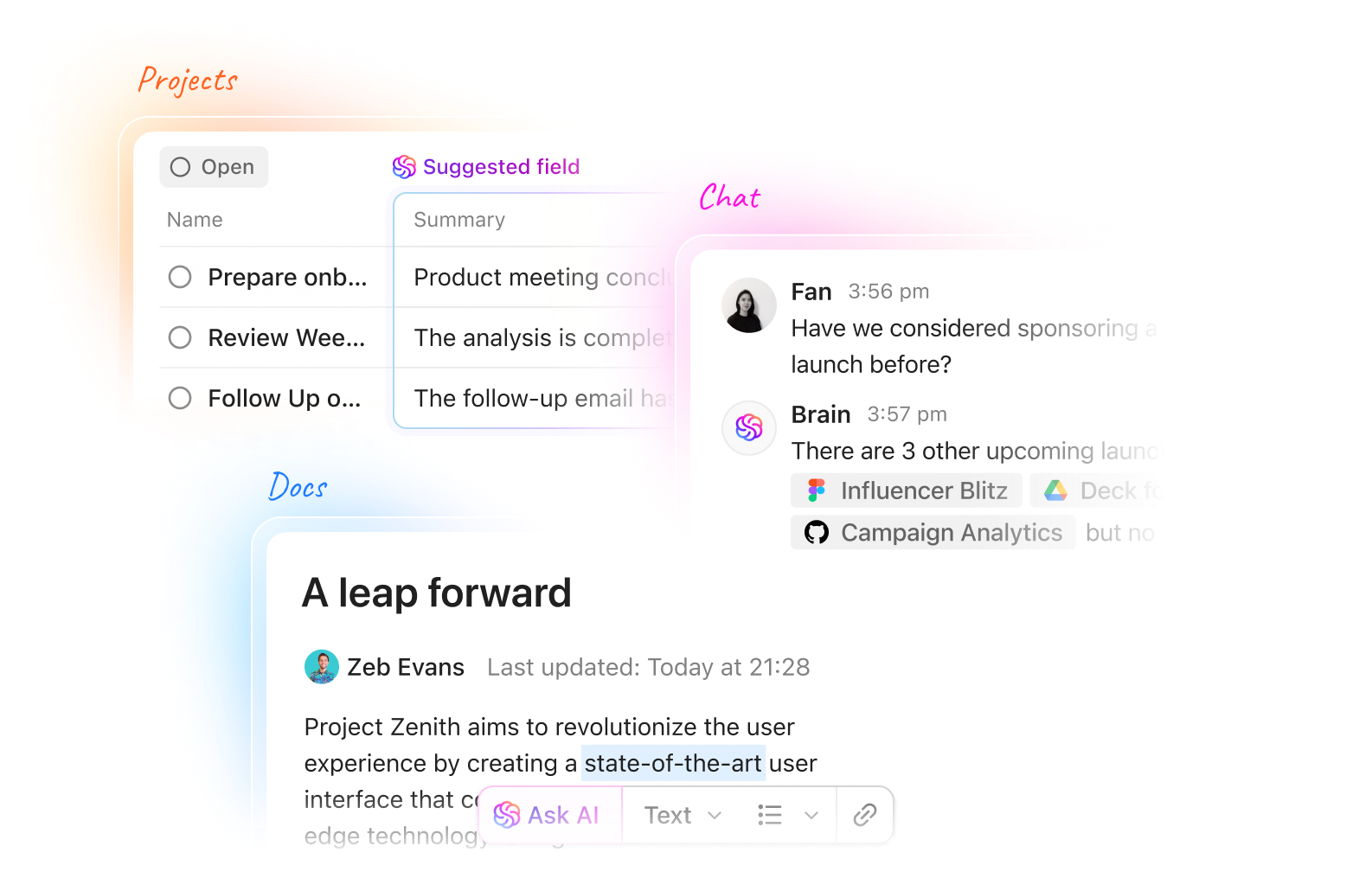
Here’s how you can stop the sprawl and manage your AI initiatives effectively:
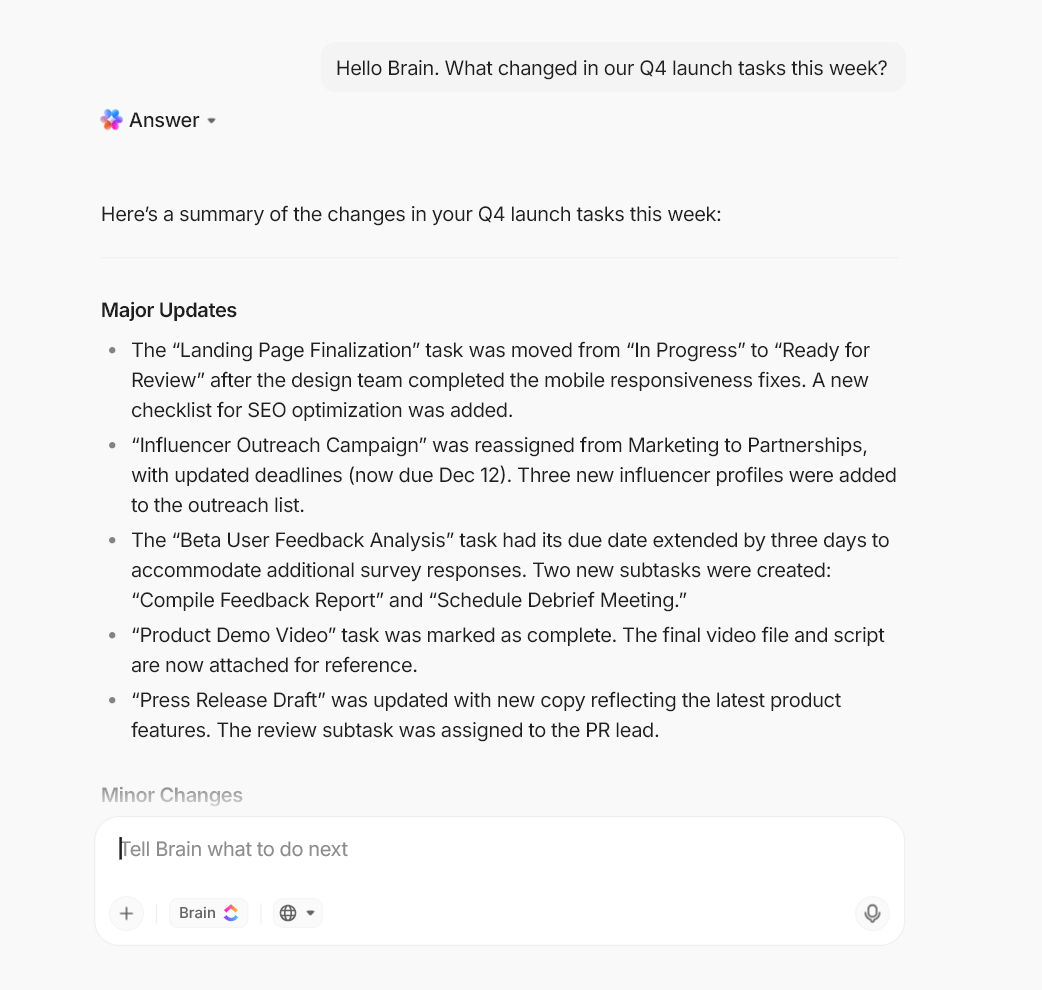
Because ClickUp Brain understands your projects, team conversations, tasks, and documents, it can surface insights from across your workspace, draft project updates, summarize long comment threads, and answer questions using your team’s actual data.
For you, that means you can ask, ‘What’s blocking the predictive maintenance rollout?’ and get an instant answer pulled from tasks, comments, and project docs.
You can even type @brain in any task comment to get a contextual reply right where you’re working.
You can easily give every initiative a home using ClickUp’s Hierarchy.
Create Spaces for departments like Network Ops or Customer Experience, use Folders for major projects, such as ‘Fraud Detection AI,’ and lists for specific workstreams.
This gives you a single source of truth, while every team still uses their preferred view—whether it’s a ClickUp Kanban board for daily tasks, a ClickUp Gantt chart for long-term planning, or a simple ClickUp List view.
In those same spaces, you can keep documentation such as technical specs, runbooks, and meeting notes, all connected to the exact tasks they support, using ClickUp Docs.
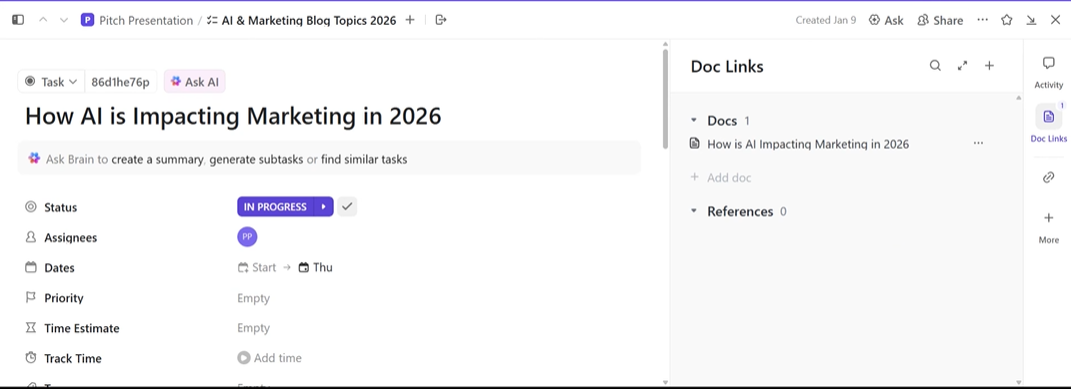
And with real-time editing features like ClickUp Comments and ClickUp @mentions, your team gets to collaborate seamlessly. Conversations stay anchored to those tasks and documents, so you never have to hunt for context.
For example, if a developer needs clarification on a data pipeline requirement, they can @mention the data engineer directly in the spec. The engineer replies in the same Doc, the decision is recorded instantly, and everyone stays aligned.
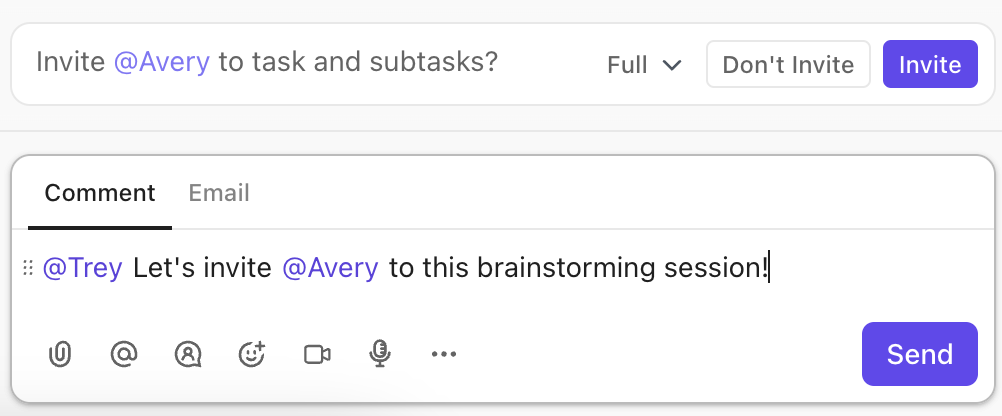
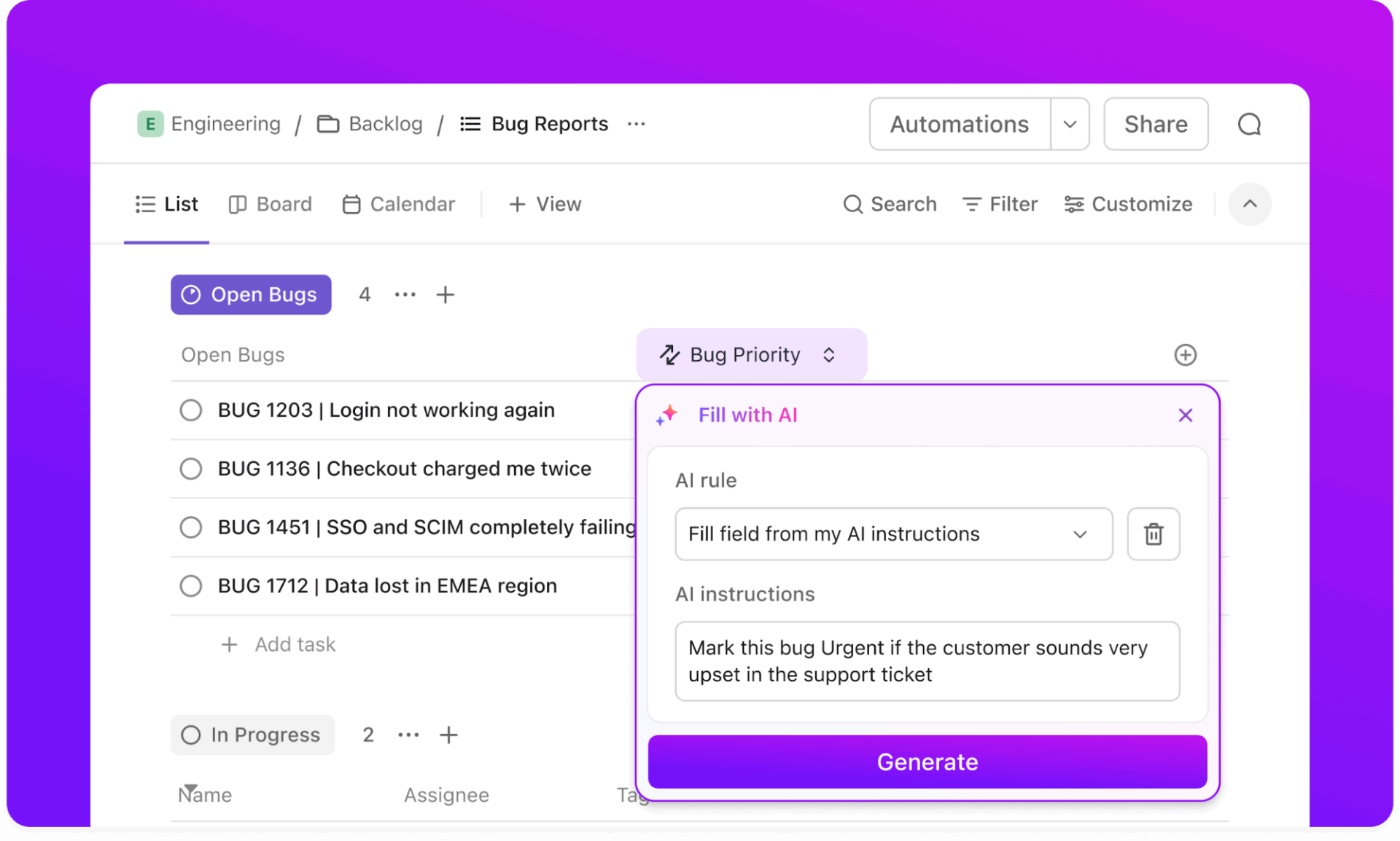
Say goodbye to the soul-crushing manual work of chasing status updates. You can simply set up rules to handle the busywork with ClickUp Automations.
For example, when a ‘Data Pipeline’ task is marked complete, it can automatically trigger the start of the ‘Model Training’ task and notify the data science team, so your entire team is constantly focused on high-impact tasks.
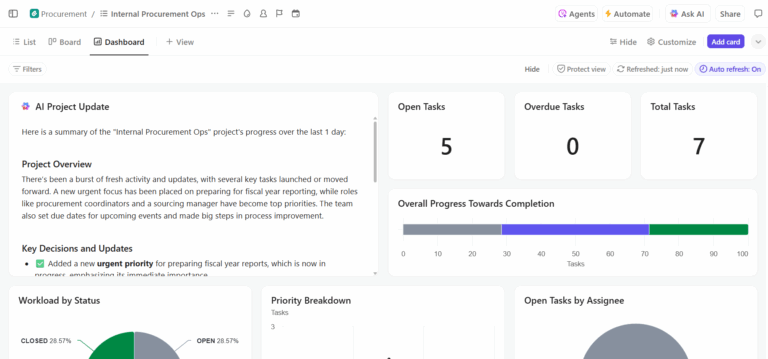
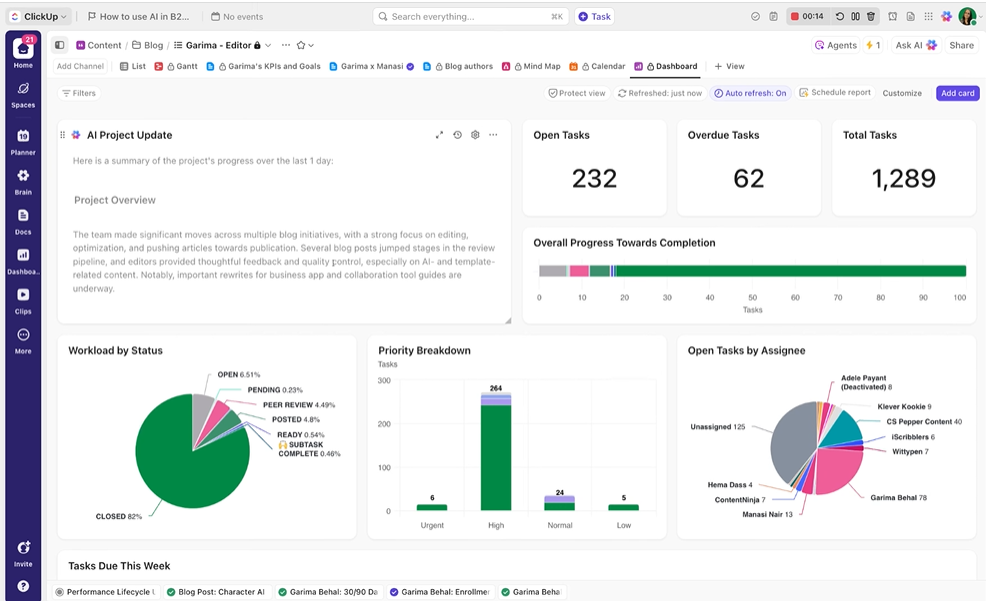
Ditch the static slide decks and get a live, high-level view of your AI initiatives with ClickUp Dashboards.
You can pull data directly from your ClickUp Tasks, ClickUp Time Tracking, and ClickUp Custom Fields to build a single dashboard that shows project health, team velocity, and upcoming milestones. Now, leadership can see progress in real time without having to request a report every time.
Managing AI in telecom is complex, but your workflow doesn’t have to be chaotic. Help your team move faster, together, with the structure and intelligence ClickUp provides.
📮 ClickUp Insight: 1 in 4 employees uses four or more tools just to build context at work. A key detail might be buried in an email, expanded in a Slack thread, and documented in a separate tool, forcing teams to waste time hunting for information instead of getting work done.
ClickUp converges your entire workflow into one unified platform. With features like ClickUp Email Project Management, ClickUp Chat, ClickUp Docs, and ClickUp Brain, everything stays connected, synced, and instantly accessible.
💫 Real Results: Teams are able to reclaim 5+ hours every week using ClickUp—that’s over 250 hours annually per person—by eliminating outdated knowledge management processes. Imagine what your team could create with an extra week of productivity every quarter!
AI in telecommunications is now essential. It’s the core engine for keeping your networks reliable, your customers happy, and your operations efficient.
The real challenge isn’t deciding whether to adopt AI, but figuring out how to coordinate the people, data, and workflows required to make it successful.
That coordination problem is where most initiatives fail. But it’s solvable when you stop scattering work across disconnected tools and start operating from a single, intelligent workspace.
The telecom companies that will thrive are the ones that treat AI as an operational backbone—and they’ll need a work platform that’s built for that ambition.
Ready to bring your AI initiatives together? Get started for free with ClickUp.✨
You need a blend of technical skills like data engineering and machine learning, deep domain knowledge of telecom operations, and strong change management skills to help your frontline staff trust and adopt AI-driven recommendations.
Machine learning analyzes existing data to make predictions, like forecasting network traffic, while generative AI creates entirely new content, like drafting a customer service response.
The most successful teams use a centralized workspace where engineering, operations, and data science can share tasks, documents, and dashboards to avoid the context sprawl that slows down cross-functional projects.
Traditional automation relies on rigid, pre-programmed scripts and menus, whereas conversational AI uses natural language to understand a customer’s intent and can pull real-time data to resolve issues without forcing them through a frustrating phone tree.

© 2026 ClickUp

There’s an easier way. Try a free AI Agent in ClickUp that actually does the work for you—set up in minutes, save hours every week.