


Ever started a project thinking everyone was on the same page, only to realize halfway through that there was a complete misalignment between your expectations and what your client wanted? Sounds like a nightmare?
That’s typically what happens when a client brief is unclear or worse, nonexistent.
A client brief is the difference between a smooth project launch and a chaotic mess of revisions, missed deadlines, and blown budgets. When done right, it eliminates guesswork, aligns stakeholders, and sets the project up for success before a single task begins. In other words, it keeps your client happy, your boss happy, and perhaps, most importantly, your team happy.
If you also want to write a client brief (or guide your clients towards creating one!) that keeps teams focused, deliverables crystal clear, and projects moving forward without the usual roadblocks, stay tuned to this blog.
Client Brief: What is it and How to Write One?

 Summarize this article for me please
⏰ 60-Second Summary
A client brief is the backbone of any project, ensuring clear expectations, structured workflows, and seamless execution.
Here’s how to create one that eliminates confusion and drives results:
- Define goals, objectives, and project scope upfront to prevent misalignment and scope creep
- Structure the brief with specific requirements, target audience insights, and deliverables to streamline execution
- Enhance clarity with brand guidelines, success metrics, and approval processes so every stakeholder knows their role
- Use templates and real-world examples to build actionable, well-written briefs that keep teams on the same page
- Manage and track client briefs effortlessly with ClickUp’s collaborative tools, task management, and document organization to improve efficiency from start to finish
Summarize this article for me pleaseUnderstanding Client Briefs
A client brief is a foundational document that aligns expectations between businesses and service providers before a project begins.
It outlines key details such as goals, objectives, project scope, target audience, and deliverables, ensuring that everyone involved stays on the same page from the start.
The role of client briefs in successful projects
A well-written brief acts as a strategic blueprint, reducing misunderstandings, minimizing scope creep, and streamlining execution.
It helps teams define project priorities, allocate resources efficiently, and track progress against predefined objectives. All of these contribute to project success and improved ROI.
Note that a client brief is distinct from a creative brief. Here’s how they differ:
Client brief vs. creative brief
| Aspect | Client brief | Creative brief |
| Purpose | Defines business problems, goals, and logistics | Guides a creative team on execution |
| Focus | Outlines project scope, objectives, and expectations | Details tone, messaging, and brand guidelines |
| Intended audience | Internal stakeholders, agencies, or project managers | Designers, marketers, and content creators |
| End goal | Ensures alignment on project requirements | Provides direction for content creation |
Both types of briefs play a crucial role in projects, but a comprehensive client brief ensures that all necessary information is available before the creative process begins.
Summarize this article for me pleaseImportance of Writing a Client Brief
Imagine kicking off a project with a vague email thread and a half-formed idea. Your team starts working, but expectations shift, revisions pile up, and the budget stretches beyond control.
What happens without a clear client brief?
🚨 Unclear expectations: Teams work with assumptions instead of facts
📉 Scope creep: Priorities shift, deadlines stretch, and budgets spiral
🔄 Endless revisions: Deliverables miss the mark, leading to frustration
Why does a client brief matter?
✅ For project managers: Keeps timelines, deliverables, and stakeholders aligned
✅ For marketers: Translates business problems into a clear roadmap for the creative team
✅ For teams: Ensures everyone stays on the same page and minimizes miscommunication
A well-structured client brief is the foundation of a successful project that runs smoothly from start to finish. Let’s explore what goes into one.
Summarize this article for me pleaseComponents of a Client Brief
A client brief is more than just a checklist. It sets the foundation for a successful project by outlining the necessary information teams need to execute with confidence. Without it, projects risk scope creep, misaligned expectations, and wasted resources.
1. Project overview
This section should provide a quick understanding of what the project is about. If a new stakeholder joins midway, they should grasp the objectives and key deliverables within minutes. This is an answer to the ‘why’ behind a project.
🔹 Example: Instead of saying “Website redesign,” specify “Revamping an e-commerce site to cover x new offerings, improve mobile experience, and increase conversions by 20%.”
Read More: How to Write a Project Proposal?
2. Goals and objectives
Clearly define what success looks like. Short-term goals keep teams focused, while long-term objectives align with broader business strategies.
🔹 Example: Launching a rebranding campaign to establish a stronger digital presence and attract a younger audience
3. Target audience
A project’s success depends on reaching the right people. Understanding the ideal customer ensures that messaging, design, and positioning resonate.
🔹 Example: A fitness app for corporate professionals requires a different tone and UX than one targeting Gen Z gym-goers
4. Brand guidelines and messaging
A project without brand guidelines risks producing designs, ads, or content that feel off-brand or disconnected. A well-written brief should specify logo usage, typography, color palettes, and tone of voice, among others.
🔹 Example: A traditional haute couture fashion brand may not want bold, playful fonts or informal language in its marketing campaigns. Clear brand guidelines ensure that the creative team maintains a premium, sophisticated tone across all platforms
👀 Did You Know? Tiffany & Co. trademarked its signature “Tiffany Blue“, making it one of the first colors legally protected in branding
This shows that brand consistency is more than simple aesthetics. Rather, it is about owning a distinct identity that makes a lasting impression.
5. Deliverables and timeline
Every successful project depends on clear expectations for deliverables and deadlines. Without them, teams waste time guessing what’s required or revising work endlessly.
📌 Deliverables: What needs to be created or submitted
⏳ Timeline: Key milestones, feedback rounds, and launch dates
🔹 Example: A marketing agency handling a product launch might set phased deliverables—week one for branding assets, week two for ad copy, and week three for landing page design. A structured timeline keeps the project on track and ensures nothing is rushed last minute
6. Budget and constraints
Even the best ideas can fall apart if they exceed financial limits. Defining the budget early helps teams prioritize what’s feasible without wasting effort on unrealistic concepts.
🔹 Example: A startup looking for a new website may want an interactive, custom-built platform but only has the budget for a simple, conversion-focused landing page. Setting these expectations early prevents misalignment and wasted time
A comprehensive client brief eliminates guesswork, improves collaboration, and ensures that every stakeholder is aligned before execution begins.
Summarize this article for me pleaseHow to Write a Client Brief: Step-by-Step Guide
A well-structured client brief removes ambiguity and ensures that every stakeholder understands the project’s scope, objectives, and constraints. Without it, expectations shift, priorities become unclear, and teams waste time on revisions that could have been avoided.
To create a comprehensive client brief, follow these structured steps to define goals, align teams, and streamline execution.
Step 1: Define the project’s purpose and goals 📋
Every project begins with a problem that needs solving. A client brief should clearly state what the project aims to achieve and how success will be measured.
A tech startup launching a website to simplify customer onboarding should define its purpose as improving user experience and reducing drop-off rates. Goals should be quantifiable, such as increasing sign-ups by 20% within the first three months. If these objectives are not stated from the start, teams will have different interpretations of what the project should accomplish.
Start with:
- Success metrics that will determine if the project meets expectations
- A clear purpose outlining why the project exists
- Specific goals tied to measurable outcomes
Step 2: Identify the target audience 🎯
A project is only effective if it resonates with the right people. Understanding the ideal customer ensures that messaging, design, and functionality are tailored to their needs.
A fintech company developing a budgeting app must decide whether it is catering to college students managing their first paychecks or high-income professionals tracking investments. The tone, features, and marketing approach will differ significantly for each audience.
To define the target audience:
- Identify behavioral insights that influence purchasing or engagement decisions
- Outline demographics such as age, location, and profession
- Understand pain points and how the project will address them
Step 3: Outline the project scope and deliverables 🔎
A project can quickly expand beyond its original intent if the scope is not clearly defined. The client brief should establish exactly what is included and what is not.
A company requesting a brand refresh might assume that it covers website updates, while an agency may only be working on logo redesign. Misalignment like this leads to delays, budget overruns, and scope creep.
Ensure clarity by specifying:
- Out-of-scope items to prevent unnecessary work and budget extensions
- Project scope to outline what is expected
- Deliverables such as logos, website designs, or ad campaigns
Step 4: Establish brand guidelines and key messaging 👩🏫
Without brand consistency, projects risk delivering mixed messages. A client brief should define visual and tonal guidelines to ensure all teams create assets that align with the brand’s identity.
A luxury real estate brand focusing on high-end clientele must maintain a refined and sophisticated tone. If a creative team starts using playful fonts and casual language, the messaging will feel disconnected. Including brand voice, typography, and color palettes in the brief prevents these inconsistencies.
Define:
- Visual guidelines including colors, fonts, and imagery styles
- Tone of voice to match the company’s personality
- Key messages to ensure consistency in communication
Step 5: Set clear timelines and milestones ⏱
A project without structured deadlines risks dragging on indefinitely. A client brief should break down each phase with key dates for feedback, approvals, and execution.
A retail brand launching a Black Friday campaign cannot afford delays. If feedback rounds are not scheduled in advance, assets might be approved too late to be effective. Structuring the timeline in the brief keeps everyone accountable and ensures that the project moves forward smoothly.
To manage timelines effectively:
- Set a final deadline to align stakeholders and ensure timely delivery
- Create a timeline breakdown including research, production, and launch phases
- Define approval checkpoints to prevent last-minute changes
Step 6: Define the budget and constraints 💰
A project cannot succeed if financial limitations are unclear. A client brief should state the budget upfront so that expectations align with resources.
A startup planning a video ad campaign may envision cinematic production with professional actors. If the budget only allows for stock footage and in-house editing, teams need to adjust their approach early rather than revising plans later.
To manage budget constraints:
- Consider scalability options if additional funding becomes available
- Provide a clear budget range to guide decision-making
- Outline resource limitations to prevent unrealistic requests
Step 7: Clarify approval processes and next steps 🙌
One of the biggest causes of project delays is confusion around who needs to approve what. A client brief should outline a structured process for sign-offs and revisions to prevent bottlenecks.
A website redesign can stall for weeks if multiple department heads provide conflicting feedback with no designated decision-maker. Assigning clear approval responsibilities ensures that feedback is consolidated and that revisions happen efficiently.
Include in the brief:
- Next steps after approval to transition smoothly into execution
- Who is responsible for approvals at each stage
- How feedback should be submitted to streamline revisions
A client brief is a strategic tool that keeps projects aligned, prevents unnecessary delays, and ensures that every stakeholder works toward the same goal. Defining clear objectives, setting expectations, and structuring deliverables from the start reduces inefficiencies and sets up projects for long-term success.
Read More: How to Create a Winning Client Presentation?
Summarize this article for me pleaseTools and Resources for Creating Client Briefs
A client brief is only useful when it stays dynamic, accessible, and actionable. The right tools keep project details centralized, enable seamless collaboration, and ensure smooth execution.
Centralizing client briefs with collaborative documentation
A client brief should be more than a static document. It needs to evolve with project updates, stakeholder feedback, and shifting priorities.
📌 Use case: A marketing agency working on a rebranding project needs a shared space where designers, strategists, and copywriters can align on brand guidelines, messaging, and visual identity without confusion

📍 ClickUp Docs helps you draft client briefs and keeps all client brief details in one place, allowing teams to collaborate in real time, track changes, and maintain a single source of truth.
Also Read: How to Use AI for Documentation?
Assigning tasks and tracking progress seamlessly
A well-structured client brief should translate into clear action items. Assigning responsibilities ensures that every deliverable is executed on time.
📌 Use case: A software development team building a new app from a client brief needs to divide work into front-end, back-end, and UX design while tracking progress on each phase

📍 ClickUp Tasks helps teams assign responsibilities, set deadlines, and link relevant sections of the brief to ensure that no detail is missed.
📍 ClickUp Chat keeps discussions connected to tasks, eliminating miscommunication and scattered approvals.
Collaborating visually with brainstorming tools
Some projects require a brainstorming phase before finalizing key details in the client brief. Teams need a visual space to map out ideas, refine workflows, and align on creative direction.
📌 Use case: A creative agency working on a product launch needs to sketch campaign ideas, map content strategies, and explore branding concepts before finalizing the client brief

📍 ClickUp Whiteboards allow teams to organize creative concepts visually, making it easier to structure campaign messaging, design elements, and content themes.
Tracking project status and stakeholder updates
A client brief defines deliverables, but tracking how those deliverables are progressing is just as important. Stakeholders need a real-time view of task completion, approvals, and upcoming deadlines.
📌 Use case: A project manager handling a product development brief needs to ensure that each stage—prototyping, testing, and final production—is progressing as planned

📍 ClickUp Dashboards provide real-time insights, helping teams monitor workloads, track milestones, and keep stakeholders informed without needing constant check-ins.
Writing and refining the client brief with AI
Drafting a comprehensive client brief requires structuring complex information into a clear, actionable format. AI-powered tools help streamline content creation, refine details, and ensure completeness.
📌 Use case: A marketing team preparing a client brief example for an ad campaign needs to draft structured sections covering objectives, audience insights, creative direction, and deliverables without missing critical details
📍 ClickUp Brain assists in drafting and summarizing client briefs, ensuring that every project requirement, goal, and constraint is clearly documented. It also helps teams refine language, fill in missing sections, and optimize clarity before finalizing the brief.

Using collaborative documentation, task management, visual planning, and AI-driven insights keeps briefs actionable, organized, and aligned with project goals.
Summarize this article for me pleaseClient Brief Examples and Templates
Even with a structured approach, crafting a client brief from scratch can feel overwhelming. Using templates and real-world examples simplifies the process, ensuring that your brief remains clear, comprehensive, and actionable.
1. Project review client brief example
📌 Scenario: A software development company is launching a new feature and needs to document insights from the project lifecycle to refine future releases
Project Review Client Brief
| Section | Details |
| Project name | AI Chatbot Feature Enhancement |
| Business problem | Users struggle with chatbot accuracy, leading to frustration and high support ticket volume |
| Objectives | Improve chatbot response accuracy by 40% and reduce customer support queries by 25% |
| Target audience | Existing SaaS customers who frequently use live chat support |
| Project Scope | UX/UI improvements, backend AI model updates, beta testing with select customers |
| Deliverables | Chatbot update, user testing report, post-launch analytics |
| Budget | $50,000 allocated for development and testing |
| Timeline | Research: 2 weeks, Development: 8 weeks, Testing: 4 weeks, Launch: 1 week |
| Stakeholders | Product Manager, Development Lead, UX Researcher, Marketing Team |
| Approval process | Final sign-off by CTO before deployment |
Using a structured template ensures that every project phase is documented efficiently.
The ClickUp Project Review Template helps teams capture project insights, document challenges, and improve future workflows.
2. Marketing campaign brief example
📌 Scenario: A digital marketing agency is managing a new brand awareness campaign for an eco-friendly fashion brand and needs a structured brief to align all teams
Campaign Brief
| Section | Details |
| Campaign name | “Sustainable Style” Social Media Awareness Campaign |
| Business problem | Lack of brand recognition in the sustainable fashion industry |
| Objectives | Increase brand awareness by 30% and drive 15,000 new website visits within 3 months |
| Target audience | Millennials and Gen Z shoppers interested in sustainable fashion |
| Project Scope | Social media campaign, influencer partnerships, video content creation |
| Deliverables | 15 Instagram posts, 5 influencer collaborations, 3 promotional videos |
| Budget | $75,000 for influencer partnerships and ad spend |
| Timeline | Creative development: 3 weeks, Campaign rollout: 8 weeks, Post-campaign analysis: 2 weeks |
| Stakeholders | Marketing Director, Social Media Manager, Content Creators, Influencers |
| Approval process | Initial concept approval by the Brand Manager, final review by the CEO |
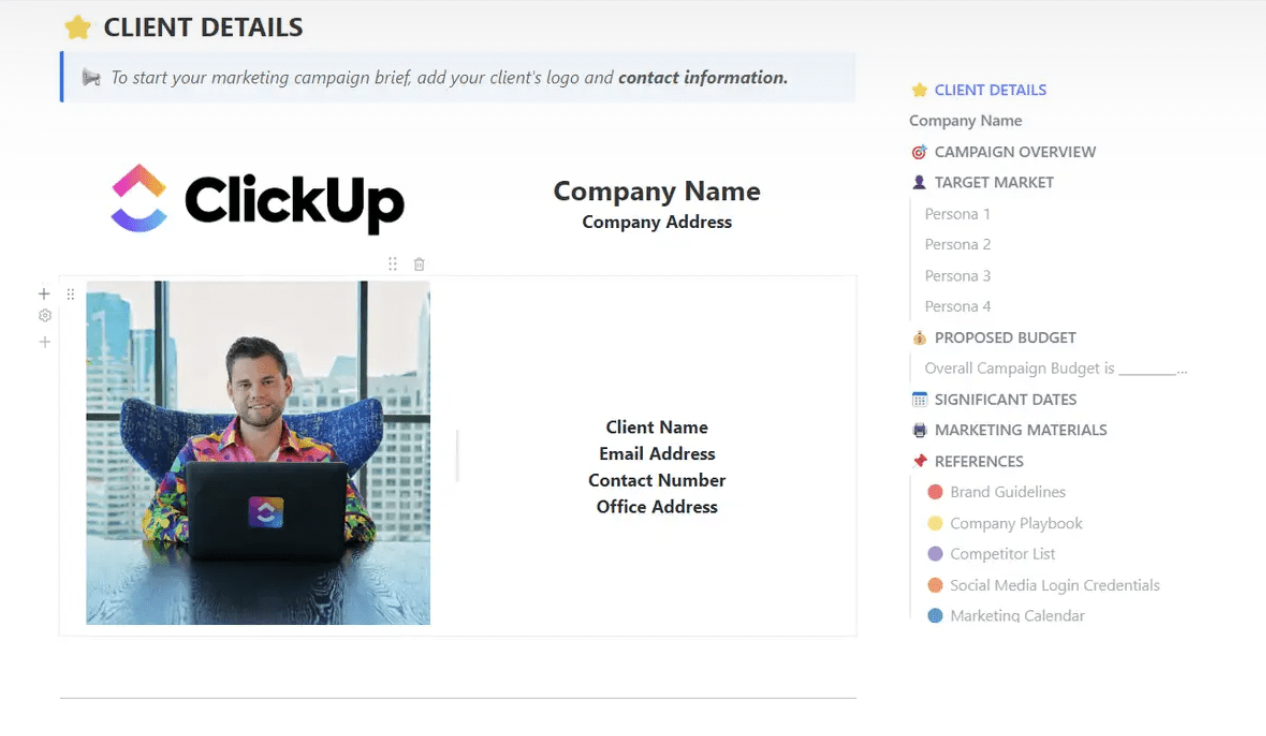
A campaign brief ensures smooth execution by defining creative direction and deliverables upfront. You can leverage the ClickUp Campaign Brief Template. It simplifies the process by outlining goals, audience insights, and asset requirements in a structured format.
While you are gathering all the essential tools to craft the perfect client brief, here’s a really cool video on how AI might help you market yourself better. 👇
3. Website development client brief example
📌 Scenario: A startup wants to build a conversion-focused website for its new SaaS product and needs a structured brief to align its design and development teams
Website Development Brief
| Section | Details |
| Project Name | SaaS Website Launch |
| Business problem | Current landing page has a high bounce rate and does not effectively convert visitors into sign-ups |
| Objectives | Increase sign-up conversion rate by 25% and improve user engagement |
| Target Audience | Startups, small businesses, and tech professionals looking for workflow automation tools |
| Project scope | UX/UI design, content strategy, front-end and back-end development |
| Deliverables | Homepage, product pages, sign-up flow, blog section, integrations page |
| Budget | $100,000 for design, development, and testing |
| Timeline | Wireframing: 3 weeks, Development: 6 weeks, Testing & QA: 2 weeks, Launch: 1 week |
| Stakeholders | UX Designer, Content Strategist, Front-End Developer, Back-End Developer, Marketing Lead |
| Approval process | UI/UX approval by CEO, functionality approval by Tech Lead |
A structured website brief ensures all teams are aligned on design, content, and technical execution.
Without a clear framework, creative direction can become scattered, leading to misaligned expectations and multiple revisions.
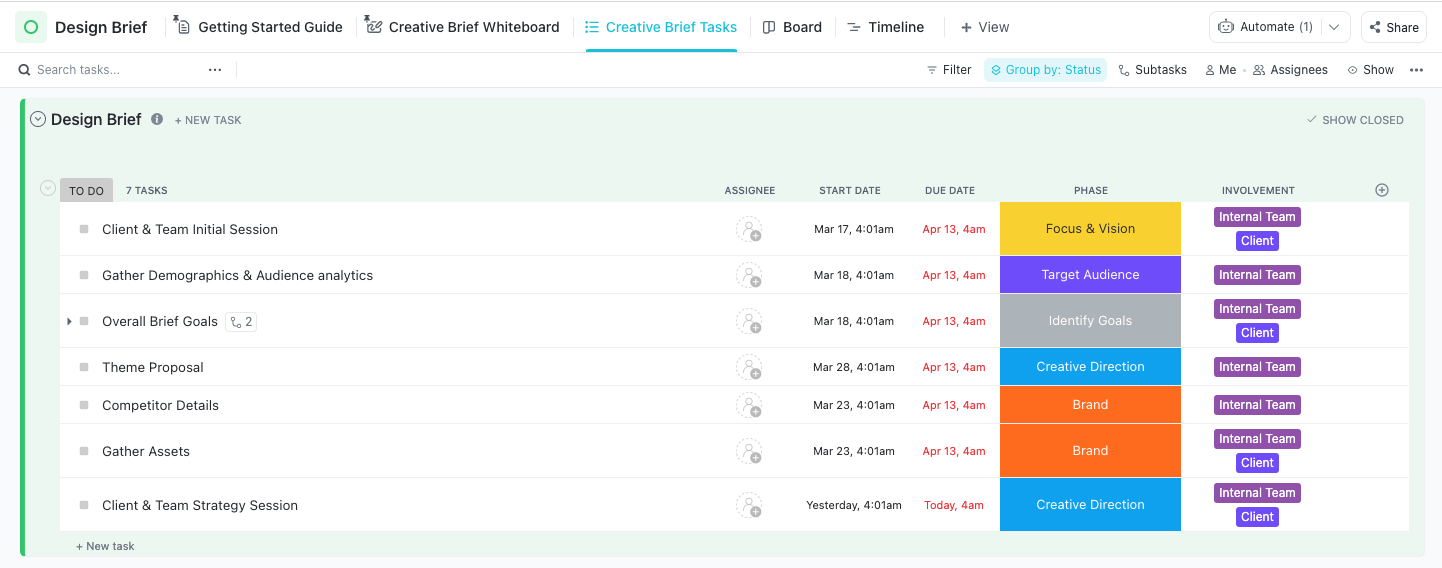
The ClickUp Design Brief Template streamlines the process by outlining design specifications, content requirements, and development guidelines, ensuring every phase of the project stays on track.
4. Product packaging design client brief example
📌 Scenario: A beverage company is launching a new line of organic energy drinks and requires a well-defined brief for the packaging design team
Product Packaging Brief
| Section | Details |
| Project name | Organic Energy Drink Packaging |
| Business problem | Competitors dominate shelf space, and the brand needs to stand out in the health-conscious market |
| Objectives | Create eye-catching packaging that communicates the organic, natural ingredients of the product |
| Target Audience | Health-conscious consumers, athletes, and eco-friendly shoppers |
| Project scope | Label design, bottle packaging, brand messaging, sustainability elements |
| Deliverables | 3 packaging concepts, finalized design for production, print-ready files |
| Budget | $30,000 for design and production setup |
| Timeline | Research: 2 weeks, Design phase: 4 weeks, Approval & production setup: 3 weeks |
| Stakeholders | Brand Manager, Graphic Designer, Marketing Team, Sustainability Consultant |
| Approval process | Final approval from CEO before mass production |
A detailed packaging brief ensures that the design aligns with brand identity and regulatory guidelines.
With the ClickUp Project Deliverables Template, your teams can track key deliverables, revisions, and approval processes throughout the project.
A client brief is only effective when it is structured, clear, and actionable. These real-world examples show how different industries use client briefs to align teams, define expectations, and ensure smooth project execution.
Summarize this article for me pleaseTips for Enhancing Client Briefs
Even well-structured briefs can fall flat if they lack clarity, engagement, or strategic depth. Beyond listing objectives and timelines, a powerful client brief should influence action, eliminate friction, and inspire better results. Here’s how to take your client briefs to the next level.
Start with a one-line project vision
People don’t remember pages of details—they remember a single, clear takeaway. Open your brief with a one-sentence summary that sets the direction instantly.
🔹 Instead of: “Develop a new app with improved usability and better navigation.”
✅ Say: “Build a frictionless mobile experience that makes checkout 50% faster.”
A well-crafted opening anchors the entire brief, ensuring every stakeholder aligns with the core goal before diving into specifics.
Address what could go wrong before it happens
Most briefs focus on what needs to be done but few anticipate potential roadblocks. Proactively calling out risks saves time, budget, and frustration later.
Include a ‘What to Watch For’ section covering:
- Possible bottlenecks (e.g., delayed approvals, unclear branding guidelines)
- Technical limitations (e.g., platform constraints, integration issues)
- External dependencies (e.g., waiting on third-party assets)
A brief that plans for challenges creates a smoother execution from day one.
Make sure every deliverable is actionable
Vague briefs lead to scope creep, misinterpretations, and excessive revisions. Every deliverable should have a clear format, purpose, and owner.
❌ “Design a landing page for the campaign.”
✅ “Deliver a high-converting landing page (mobile-first) with a lead capture form, three unique CTA placements, and SEO-friendly copy.”
If a deliverable can’t be instantly visualized, it needs more clarity.
Cut the fluff and keep only what’s essential
A brief isn’t an essay. It should be scannable, high-impact, and free of unnecessary details.
- Use tables, bullet points, and section headers to make information easy to digest
- Remove anything that doesn’t directly affect execution
- Keep it to the minimum length needed for full clarity—not a word more
If stakeholders need a separate meeting just to understand the brief, it’s too long.
Speak the stakeholder’s language
A designer, developer, and marketing strategist all process information differently. A great brief adapts to its audience instead of forcing every stakeholder to read through generic instructions.
How to adjust your wording based on who’s reading:
- For creatives: Describe tone, mood, and brand identity instead of just “make it modern”
- For developers: List platform requirements, integrations, and functionality expectations
- For executives: Focus on high-level goals, ROI, and strategic alignment
A brief that meets each team’s needs upfront prevents endless follow-up questions.
👀 Did You Know? The term “stakeholder” originally comes from 16th-century gambling, where a “stakeholder” was the neutral party holding the bets
Today, stakeholders hold something just as valuable—project direction, approvals, and expectations—making clear communication essential to keep everything on track.
End with a strong call to action
A brief should inform and drive action. Conclude with a clear directive so stakeholders know exactly what happens next.
❌ “Let us know if you have questions.”
✅ “Review and confirm by Friday so production can begin on Monday.”
Every great client brief is a blueprint for action, alignment, and success. By making it unmistakably clear, measurable, and easy to digest, you ensure that everyone is aligned before the real work begins.
Summarize this article for me pleaseTurn Client Briefs Into a Competitive Advantage
A client brief is the foundation of a smooth working relationship, ensuring that every stakeholder is aligned from the start. A well-structured brief eliminates confusion, defines expectations, and sets the stage for achieving desired outcomes without unnecessary revisions.
From client onboarding to managing the entire project, a strong brief keeps execution on track. When paired with the right project management software, it becomes a dynamic tool for tracking progress, streamlining approvals, and ensuring seamless collaboration.
Want to streamline your brief management and make every project more efficient? Sign up for ClickUp today!

Everything you need to stay organized and get work done.
