

Sorry, there were no results found for “”
Sorry, there were no results found for “”
Sorry, there were no results found for “”
Every day, you’re focused on building something real—structures that will stand the test of time, projects that transform communities. Your expertise shows in every foundation poured and every beam placed.
But when it comes to marketing your construction business? That’s a challenge that can’t be solved with a blueprint or a level.
While you can see a building take shape before your eyes, marketing often feels like working in the dark. But that’s not the case. Just like you wouldn’t start a project without proper planning, there’s a clear path to getting your business in front of the right clients.
Ready to build a construction marketing plan strategy that works as hard as you do? Let’s explore some strategies, tools, and techniques that can help your construction business thrive in today’s market. 🏗️
Follow these steps to create an effective construction marketing plan:
A construction marketing plan is a strategic roadmap designed to attract clients, boost project visibility, and drive business growth in the construction industry.
It outlines specific marketing goals, target audiences, and promotional tactics tailored to the needs of a construction business. This plan ensures all marketing efforts align with business goals, focusing on areas like brand positioning, lead generation, and customer retention.
A marketing project plan is crucial for construction companies for several reasons:
🔍 Did You Know? The total value of construction in the U.S., covering residential, non-residential, and non-building sectors, is expected to surpass 2.2 trillion dollars by 2027.
Ready to make your mark in the construction industry? Let’s take a look at the key pieces of a marketing plan that’ll help you get noticed. 🧩
The foundation of any successful marketing plan lies in its executive summary. Your company’s annual goals, budget allocations, and growth sectors must shine through this crucial section.
A thorough market position analysis supports your strategic direction, while revenue projections demonstrate growth potential across service lines.
Additionally, the current economic climate brings unique challenges and opportunities, requiring careful consideration here.
Marketing objectives stand as guideposts for your construction business success.
Each service line, such as residential renovations, commercial developments, and infrastructure projects, needs its own revenue targets.
Setting quarterly benchmarks helps you stay on track with client acquisition goals while keeping growth rates aligned with the market and what your team can handle.
🧠 Fun Fact: Around 63% of construction companies are turning to social media and digital ads to reach younger job seekers.
Market research helps you create a focused construction marketing plan.
Keep an eye on local and regional trends to see what’s driving demand in your area. Competitor strategies, such as pricing and market focus, offer insights you can use to position yourself effectively.
Further, analyze past projects to identify patterns and build detailed customer profiles. Look into opportunities like sustainable construction or new technologies to stand out.
You’ll need to actively track economic shifts and demographic changes to stay prepared for what’s next.
Setting the right construction budget ensures you’re investing in the areas that will give you the most return. Focus on tactics that generate the highest quality leads and most engagement.
Regularly assess where your money is going and make adjustments to maximize results. This ensures that each dollar spent contributes to growing your brand and reaching your business goals.
📈 What’s Trending: Construction companies love using time-lapse videos to showcase the transformation of a project. One example is the One World Trade Center project in New York, which used time-lapse footage to show its progress over several years.
Turning your marketing strategy into action involves carrying out the specific tactics you’ve planned, whether it’s running targeted ads, posting content, or attending events.
The key is to stay consistent, monitor progress, and make sure your actions align with your overall goals. Effective execution requires adapting to what’s working, tweaking approaches when needed, and ensuring your team stays on track.
Your USP is what sets you apart from competitors. It’s the reason a client should choose your construction services over others. This could be anything from a specific skill set, unbeatable customer service, or innovative solutions others can’t offer.
Defining and highlighting your USP in your marketing materials ensures you capture attention and build trust.
If your construction company specializes in eco-friendly, sustainable building practices, your USP could be something like ‘The green construction experts who build smarter, energy-efficient homes.’ This shows clients you offer a unique, environmentally conscious approach that other companies might not.
Other compelling differentiators that resonate with target clients may include:
📖 Also Read: How to Start a Construction Company
You need a solid team to get your plan rolling. Assigning clear roles ensures everyone knows exactly what they’re responsible for—whether it’s content creation, lead generation, or social media management.
Make sure your team has the right mix of skills to cover all the bases, from digital marketing to design and data analysis.
A well-coordinated crew will help keep things on track and make sure your marketing efforts actually hit the mark.
📮ClickUp Insight: 92% of workers use inconsistent methods to track action items, which results in missed decisions and delayed execution.
Whether you’re sending follow-up notes or using spreadsheets, the process is often scattered and inefficient. ClickUp’s Task Management Solution ensures seamless conversion of conversations into tasks—so your team can act fast and stay aligned.
You can’t improve what you don’t measure. A measurement framework helps track the success of your marketing efforts so you can see what’s working and what needs tweaking.
Comprehensive tracking of marketing effectiveness may include:
For a construction company, measuring the number of qualified leads generated from a targeted Google Ads campaign can help you determine if your ad spend is paying off.
If the leads aren’t converting, you can adjust your targeting or messaging to improve results.
An action calendar is your blueprint for getting things done on time. It lays out everything you need to do, when you need to do it, and who’s handling what.
Having an action calendar also makes sure you’re staying on top of seasonal or time-sensitive opportunities.
For example, if you’re running a spring promotion for home renovations, your action calendar might have specific dates for email blasts, social media posts, and follow-up calls, ensuring you stay consistent and timely with your messaging.
📈 What’s Trending: Construction companies are using platforms like Instagram to share behind-the-scenes shots and project updates. For instance, Balfour Beatty regularly posts sneak peeks of their major projects on Instagram, showing everything from initial groundwork to finished skyscrapers.
Crafting a solid marketing strategy for a construction company isn’t as simple as posting ads online and hoping for the best. It requires careful planning, smart decisions, and organization.
Here’s how you can create a winning marketing strategy (with a marketing planning software).👇
Before diving into any marketing efforts, you need a clear, measurable objective.
A marketing objective sets the stage for everything you do: it defines your purpose, directs your efforts, and helps you gauge success. Whether your goal is to generate more leads, increase brand awareness, or expand into a new market, having a well-defined objective is essential for success.
To set measurable objectives, break them down into smaller, actionable key results.
For example, if your marketing objective is to boost lead generation, your key results could include metrics such as gaining 100 new leads per month, increasing website traffic by 30%, or converting 20% of leads into customers.
Align your team’s efforts with these measurable outcomes to ensure everyone works toward the same target.
📌 Example: Let’s say your construction company’s goal is to increase lead generation. You can apply the ClickUp SMART Goals Template, add targets like ‘gain 50 new leads per month’ and ‘convert 15% of leads into clients,’ and track them.
A SWOT analysis is a strategic planning tool that helps you evaluate your construction company’s Strengths, Weaknesses, Opportunities, and Threats.
Understanding these four elements is critical to crafting a marketing strategy that highlights your strengths while addressing potential weaknesses.
The next step is to identify market opportunities, like emerging trends, changes in regulations, or new technologies. Similarly, consider external threats, such as increasing competition or shifts in consumer behavior.
To make this process easier, try the ClickUp Work SWOT Analysis Template.
It starts with identifying your strengths, such as a strong reputation, skilled workforce, or specialized services that set the company apart. Weaknesses like limited brand awareness or gaps in digital marketing can then be addressed.
The next step involves exploring opportunities, such as industry trends, regulatory changes, or new construction technologies that create a competitive edge. Finally, evaluating external threats—like an increase in competitors, shifting client expectations, or economic downturns—helps prepare for challenges.
Researching industry trends, customer behaviors, and competitor strategies clarifies your business’s stand in the market. It also helps craft a competitive marketing plan.
You’ll want to identify your target audience’s needs, pain points, and preferences, as well as research your competitors’ strengths and weaknesses. Tools like customer surveys, focus groups, and market reports can provide valuable insights into current trends.
Assign specific team members to research different market aspects, such as customer demographics or competitor performance. This ensures your team stays organized and on schedule for gathering insights, and you can easily track each task’s progress in real time.
📌 Example: If your team is conducting market research into customer preferences for home renovation styles, you can assign a task to one team member to collect survey data, while another task gathers information on competitor offerings.
Identify how much money you’re willing to invest in each aspect of your marketing strategy—advertising, content creation, market research, and more—and make sure you stay within your budget limits.
Doing so ensures that you allocate resources effectively and spend money where it counts.
A good marketing budget should also account for both short-term and long-term expenses. Consider ongoing costs like monthly ad spend, one-time investments, website redesign, or a marketing campaign launch.
Create Custom Fields in your spreadsheets to track budget details and keep your team on the same page. You can use these to record estimated costs, actual expenses, and whether the budget has been approved.
Ideally, each task or project should have its own budget tracking, making it easy to see where you stand financially at any given moment.
📌 Example: Suppose you’re running an online advertising campaign. You can create these custom fields to track how much you’ve spent versus how much you budgeted:
Now that you’ve gathered your insights and set your objectives, it’s time to create a strategic marketing plan.
This plan will define how you’ll reach your target audience, what channels you’ll use (social media, email, etc.), and the type of content that will resonate most with potential clients.
Don’t forget to outline your messaging and identify the most effective marketing tactics to achieve your objectives. This step is where the magic happens; it’s the blueprint for all your marketing activities.

Use ClickUp Docs to create and share strategic documents with your team. This gives everyone access to a centralized knowledge base, ensuring the strategy is clear and easily accessible.
You can also create detailed marketing plans, develop content calendars, and track project-specific insights—all linked directly to relevant tasks. Each Doc is a living document; it functions as an interactive hub where your team can collaborate in real time.
Let’s say you’re managing a quarterly SEO campaign. Create a central Doc with subpages to house keyword research, content briefs, and progress reports. Link this Doc to related tasks, like drafting blog posts or analyzing rankings.

Add ClickUp Assign Comments and @mention team members for quick approvals or additional input, ensuring the entire process flows smoothly.
📌 Example: For a digital marketing campaign focused on lead generation, you can create a detailed marketing strategy in Docs, outlining the target audience, key messaging, and content plan. The document can be shared with the entire team for feedback and to ensure everyone is aligned.
Tracking performance is crucial to understanding the impact of your marketing efforts.
Focus on specific KPIs, like the number of qualified leads generated through your website’s contact forms, increases in site traffic from your targeted marketing channels, or higher conversion rates from your ad campaigns.
Real-time monitoring helps you spot trends, such as which types of content or ads are driving the most engagement. You can also identify which campaigns are underperforming, giving you the insight needed to tweak messaging, optimize landing pages, or adjust your ad targeting.

With ClickUp Dashboards, you can easily track KPIs using customizable cards that display real-time data. Add time-based cards to monitor metrics over specific periods and adjust campaigns as needed based on performance insights.
📌 Example: Let’s say you want to monitor the success of your Facebook ad campaigns. You can set up a Dashboard that shows metrics like impressions, clicks, and conversion rates, allowing you to adjust and fine-tune your campaigns to increase performance.
🌻 Case study: In 2015, The Korte Company, a prominent U.S. design-builder, noticed that while its website attracted substantial traffic, it wasn’t effectively converting visitors into leads. To tackle this, it revamped its digital strategy, focusing on restructuring the site to enhance user experience and strategically placing valuable content to encourage visitor engagement.
Over two years, these efforts led to a 650% increase in monthly website contacts, jumping from an average of 27 to 202 per month. Reflecting on this success, Todd Imming, CMO of The Korte Company, remarked, “We’ve seen steady growth in traffic and leads since launching the new site back in 2015.”
📖 Also Read: 10 Free Construction Management Templates
Digital marketing might not be the first thing that comes to mind when you think of construction, but let’s be real—it’s how you get noticed in today’s world.
You can’t just rely on word-of-mouth or a few flyers anymore.
Let’s explore some techniques to help your business shine online. ✨
Your website is often the first impression clients have of your construction business.
Create a modern, mobile-friendly site that showcases your expertise, highlights completed projects and includes easy ways for clients to contact you. Be sure to include an FAQ section to address common queries and establish trust.
Search engine optimization (SEO) plays a critical role in increasing your online visibility. Start by identifying relevant keywords like ‘construction services near me’ or ‘commercial construction experts.’ Optimize your website’s content, meta descriptions, and headings for these terms.
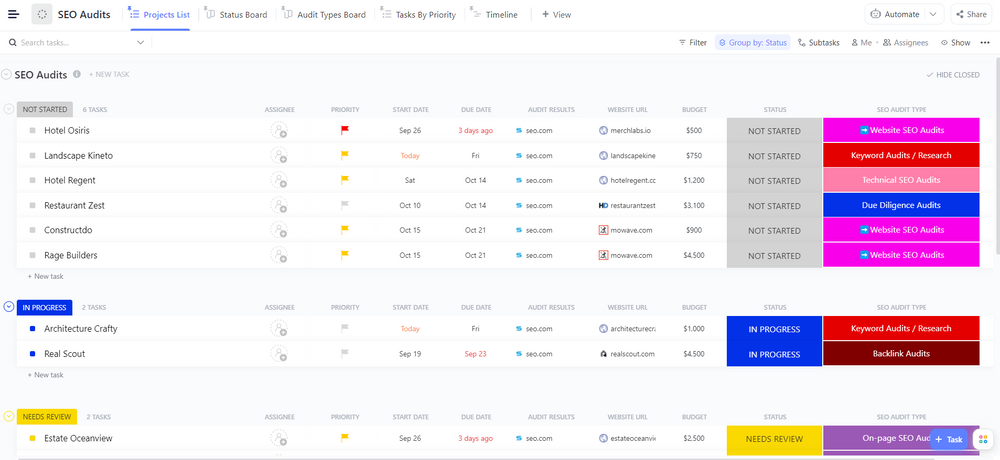
To make this process efficient, use ClickUp’s SEO Project Management Template.
It takes the chaos of keyword research, content optimization, and link-building and turns it into an organized, easy-to-follow system. Everything you need—tasks, timelines, and strategies—live in one spot, so you’re not jumping between tools or chasing spreadsheets.
What’s even better? You can track KPIs like organic traffic and keyword rankings as you work. No need to scramble for data—it’s all baked into your workflow.
ClickUp Integrations, such as Semrush or Google Analytics, help you dive deeper into data-driven insights. Connect them to track keyword rankings, website traffic, and conversion rates directly within ClickUp.
Pay-per-click advertising puts your business in front of people actively searching for construction services. Create targeted campaigns focused on location-specific keywords to attract local clients.
Monitor ad performance regularly to optimize cost-per-click and increase ROI.
Content marketing helps position your brand as an industry leader. Write blog posts on construction tips, produce videos showing your work in progress, or create case studies highlighting client success stories.
Regularly posting quality content builds trust and draws in potential clients.
🧠 Fun Fact: Drones are becoming a go-to tool for construction companies to capture aerial photos and videos of their projects. These stunning shots help show off massive projects and give clients a whole new perspective.
Building an effective construction marketing plan takes effort, but the right tools can make the process much smoother.
Think about tools that handle different aspects of your strategy—design, analytics, and most importantly, project management.
Canva can make your designs stand out, helping you create professional visuals for social media and marketing materials without needing a designer. Google Analytics adds precision to your strategy, offering insights into campaign performance, audience behavior, and conversion rates.
But when it comes to planning, managing, and executing your marketing initiatives seamlessly, nothing matches the powerful combo of the ClickUp Construction Project Management Software and the ClickUp Marketing Solution. Here’s why. 💁

ClickUp Whiteboards give your team a shared visual space to brainstorm, plan, and organize ideas.
You can map out campaigns, assign tasks, and connect different elements of your strategy. Everything is interactive, so you can move ideas around, attach Tasks directly to sticky notes, and outline timelines visually.
Suppose you’re planning a paid advertising campaign. You can start by sketching out a timeline, then attach specific tasks like ‘Draft ad copy’ or ‘Design ad creatives’ to sticky notes. Assign these Tasks to team members directly on the board and connect them to deadlines.
When priorities shift, simply drag and rearrange elements without disrupting the overall structure.
📈 What’s Trending: Some construction companies focus on storytelling to differentiate themselves. For example, Skanska often shares stories about the people behind the projects, which adds a personal touch and highlights their values in the industry.

ClickUp Brain uses AI to supercharge your creativity and research processes. It’s perfect for generating content ideas, drafting outlines, and providing instant feedback.
It’s built into your ClickUp workspace, helping you build campaigns faster without sacrificing quality.
Working on content for a lead generation campaign? Use AI in construction marketing to draft engaging email templates, refine ad copy, or structure a report summarizing campaign results.

You can also use ClickUp Brain in Whiteboards to generate images based on your prompts, which is great for visualizing construction project concepts or marketing materials.
If you’re brainstorming ideas for a new campaign or putting together design concepts for a client presentation, generating images on the spot helps bring your vision to life. It saves time and ensures that your visuals are on point.
🔍 Did You Know? More than half of construction CEOs (55%) say the toughest part of using AI to boost business is figuring out where it’ll actually make a difference.
Let’s explore how ClickUp’s templates simplify your marketing planning process.
The ClickUp Marketing Action Plan Template provides a structured approach to executing your marketing campaigns. It lets you map out everything from high-level goals to the nitty-gritty details, keeping all your strategies in one place.
Plus, it tracks your budget and performance metrics, so you’re always in the loop on how your campaigns are doing and where your money’s going.
Additionally, the ClickUp Construction Project Management Template bridges the gap between marketing and operational teams. It’s a must-try!
🧠 Fun Fact: Some construction firms host ‘topping out’ events when a building reaches its final height. These celebrations often include signing the last beam and snapping a group photo, adding a little fun and tradition to the hard work.
Marketing your construction business doesn’t have to be complicated. Here are a few best practices that can help your business succeed. ↪️
Encourage prospects to reach out for consultations or quotes. Effective CTAs turn website visitors into leads. Instead of generic phrases like ‘Contact us,’ guide potential clients toward specific next steps.
✅ Weak: ‘Learn more about our services’
✅ Strong: ‘Schedule a free 15-minute site consultation today’
Here’s where you can place CTAs:
A well-structured email marketing strategy keeps past, current, and potential clients engaged with your business. Sending promotional emails alone may not be effective, so it’s important to provide valuable content that resonates with your audience.
Example of an effective email sequence for a construction business:
Networking and showing your work in person can help establish credibility and generate new leads. However, not all events provide the same value. Choose the right ones based on your target audience and business goals.
These are the types of industry events worth attending:
Collaborate with real estate agents, architects, or suppliers to create mutually beneficial partnerships. This can open doors to new projects and expand your client base.
Examples of effective partnerships include:
📈 What’s Trending: Many construction companies turn to client testimonial videos to build trust and show their expertise. A great example is Turner Construction, which showcases satisfied clients talking about their successful projects on their website and social media platforms.
Building a great construction marketing plan doesn’t have to feel like laying bricks one by one.
It’s all about having the right tools, a clear strategy, and a team that’s ready to crush it. With a little effort and some creative thinking, your business can go from ‘just another construction company’ to the construction company everyone’s talking about.
Want to make the whole process easier (and way more fun)? ClickUp’s got your back! It’s the all-in-one app that helps you plan, track, and crush your marketing goals without breaking a sweat.
Let’s get your marketing rolling. Sign up for ClickUp today!
© 2025 ClickUp