

Sorry, there were no results found for “”
Sorry, there were no results found for “”
Sorry, there were no results found for “”
Curious about what makes your favorite software powerful? The magic lies in open-source projects, where collaboration drives innovation.
Whether you’re a developer or just interested in tech, navigating the vast open-source landscape can be overwhelming. Some projects may go unnoticed, and you don’t want to invest your skills in those that might fade away.
My team and I explored open-source tools from machine learning to web development, and our research yielded valuable insights. In this blog, I’m going to list down some cool open-source projects, ensuring you have the best tools at your disposal.
| Tool | Best for | Best features | Pricing* |
| ClickUp | All-in-one project management for open-source teams and contributors Team size: Ideal for individuals, mid-market teams, and enterprises | Views & Dashboards, Docs, Whiteboards, Automations, GitHub integrations, ClickUp Brain | Free forever; Paid plans from $7/user/month |
| Mattermost | Secure developer communication and collaboration Team size: Ideal for small to large dev teams | Self-hosted deployment, plugins, bots, secure channels | Free; Paid plans from $10/user/month |
| TensorFlow | Building and deploying ML models Team size: Ideal for research teams and AI engineers | Keras APIs, multi-device support, production ML pipelines | Free (open source) |
| PyTorch | Deep learning research and production ML Team size: Ideal for ML engineers and data scientists | Dynamic computation graphs, TorchScript, GPU acceleration | Free (open source) |
| Scikit-learn | Classical machine learning in Python Team size: Ideal for individual developers and data teams | Classification & regression tools, Python stack integration | Free (open source) |
| Django | Rapid, secure web application development Team size: Ideal for startups and dev teams | Built-in security, ORM, fast development cycle | Free (open source) |
| Flask | Lightweight and flexible web apps Team size: Ideal for solo devs and small teams | Minimal core, extensible architecture, simple routing | Free (open source) |
| React | Building interactive user interfaces Team size: Ideal for frontend teams of any size | Component-based architecture, JSX, large ecosystem | Free (open source) |
| Vue.js | Progressive web interface development Team size: Ideal for startups and frontend teams | Reactive rendering, simple API, strong documentation | Free (open source) |
| Jenkins | Continuous integration and delivery automation Team size: Ideal for DevOps and engineering teams | Massive plugin ecosystem, distributed builds | Free (open source) |
| Ansible | Infrastructure automation and configuration management Team size: Ideal for IT ops and DevOps teams | Agentless automation, reusable modules, YAML playbooks | Free (open source) |
| Kubernetes | Managing containerized applications at scale Team size: Ideal for mid-size and enterprise engineering teams | Auto-scaling, service discovery, rolling deployments | Free (open source) |
| Elasticsearch | Real-time search and data analytics Team size: Ideal for data and platform teams | Distributed search, real-time aggregation | Paid plans from $95/month |
| Apache Kafka | High-throughput real-time data streaming Team size: Ideal for data engineering teams | Distributed messaging, low-latency processing | Free (open source) |
| PostgreSQL | Advanced open-source database management Team size: Ideal for startups to enterprises | ACID compliance, powerful indexing, query optimization | Free (open source) |
| Linux Kernel | Core system resource management Team size: Ideal for OS developers and system engineers | Process control, memory management, hardware drivers | Free (open source) |
| SerenityOS | Experimental desktop OS development Team size: Ideal for niche OS developers | Unix-like core, retro GUI, full-stack OS | Free (open source) |
| Flutter | Cross-platform mobile and web apps Team size: Ideal for mobile app teams | Single codebase, native performance, fast UI rendering | Free (open source) |
| React Native | Native mobile apps using JavaScript Team size: Ideal for mobile product teams | One codebase for iOS & Android, large plugin ecosystem | Free (open source) |
| ERPNext | End-to-end business process management Team size: Ideal for SMEs and mid-market companies | Accounting, CRM, manufacturing, ERP modules | Paid plans from $52/month |
| Bagisto | Laravel-based e-commerce development Team size: Ideal for e-commerce dev teams | Marketplace support, mobile commerce, headless setup | Free (open source) |
| Odoo | Modular business operations management Team size: Ideal for growing businesses | CRM, accounting, inventory, POS, customization studio | Free plan; Paid plans from $31.10/user/month |
| freeCodeCamp | Learning web development through projects Team size: Ideal for individual learners and educators | Free certifications, project-based learning, community support | Free (open source) |
| Open edX | Scalable online education delivery Team size: Ideal for universities and enterprises | MOOCs, multimedia learning, real-time engagement | Free (open source) |
Discovering the right open source project management tools to contribute can enhance your coding skills and expand your network within the open-source community
Here are the top 24 top open source projects ideal for new contributors, to help you manage projects seamlessly
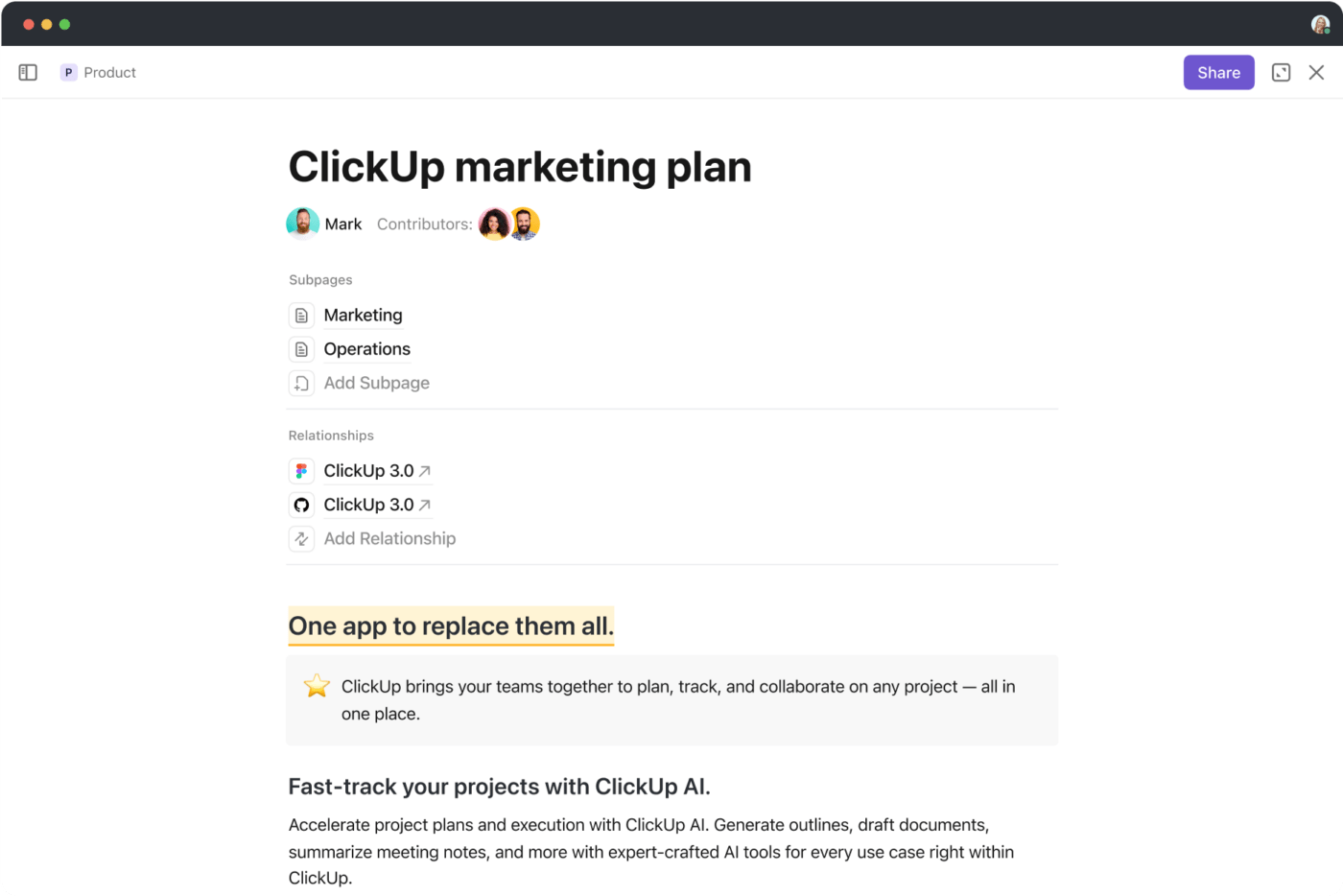
Though ClickUp for Software Teams isn’t an open-source tool in the traditional sense, it mirrors the foundational principles of the open-source philosophy, such as flexibility, sharing, collaboration, and community engagement. Its user-friendly interface, vast customization options, and robust integration capabilities make it a prime tool in project management.
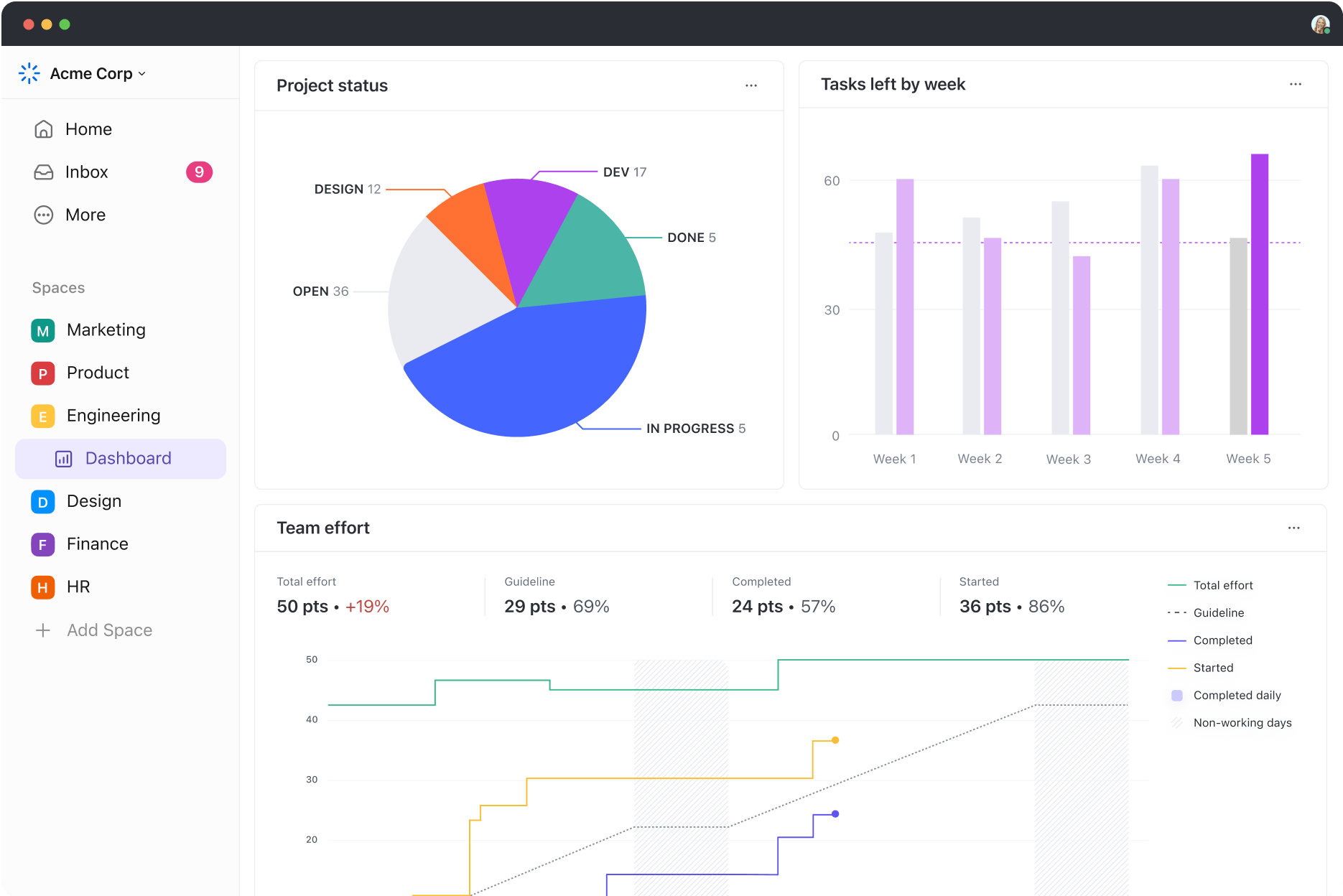
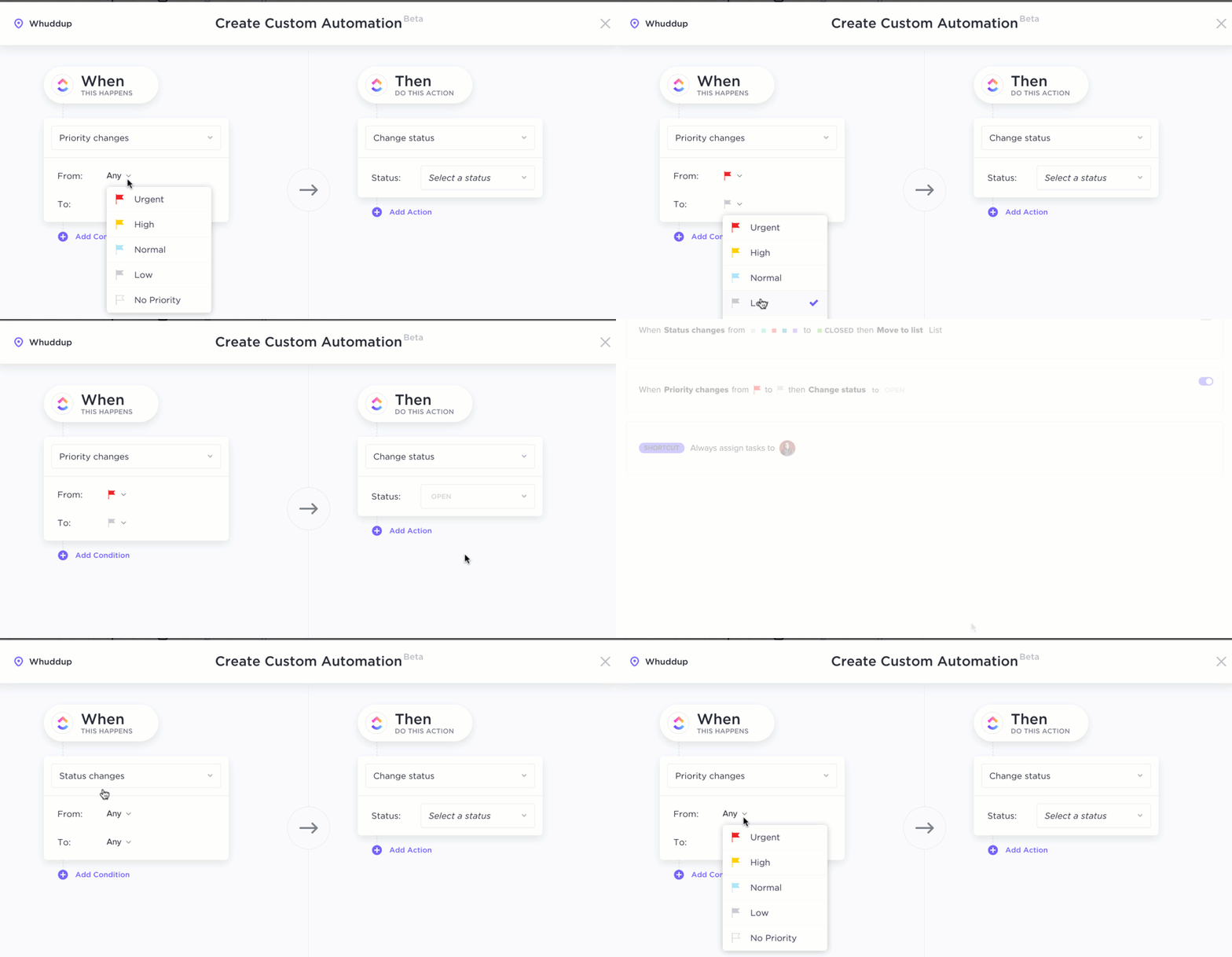
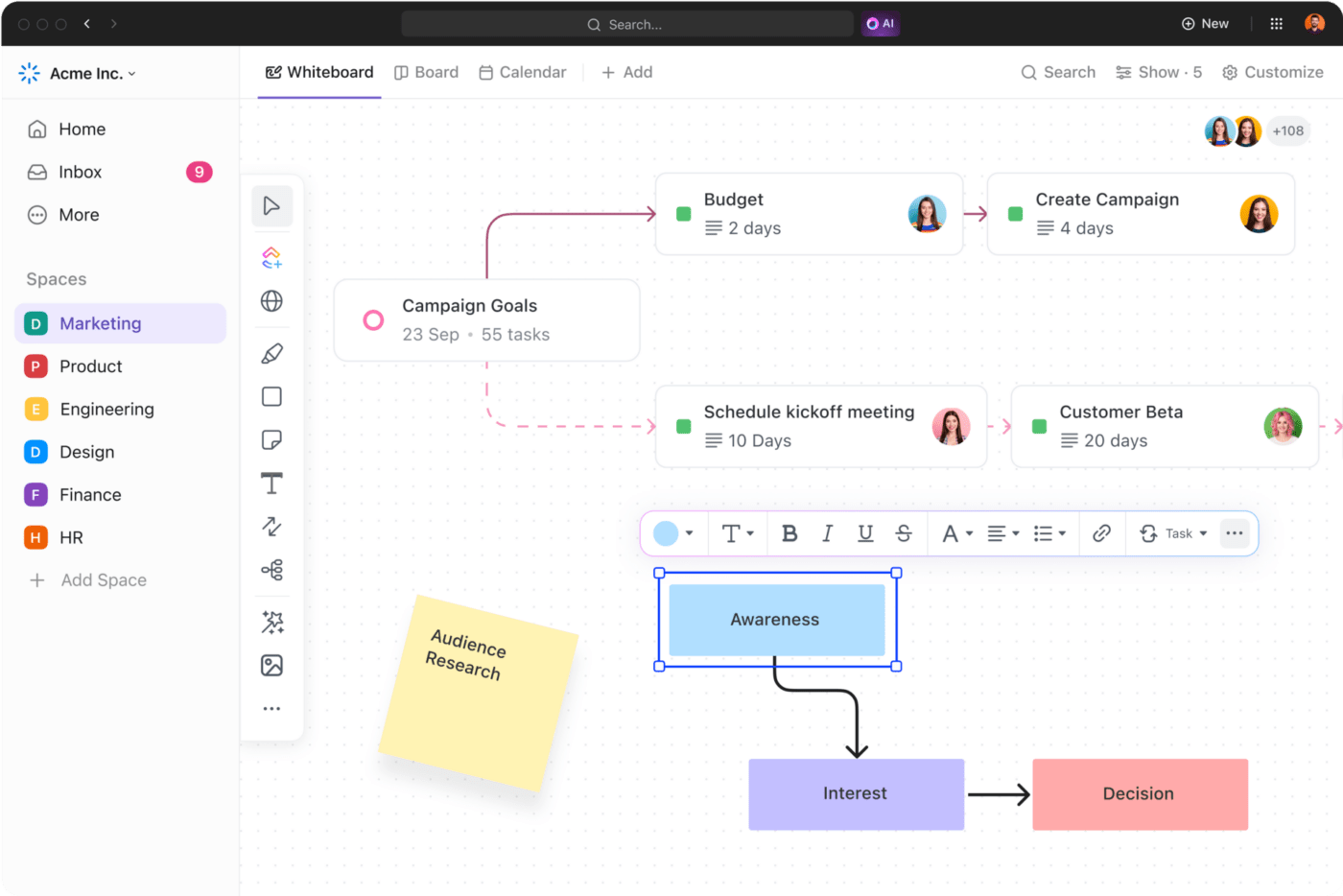
ClickUp Project Management offers top-notch privacy and sharing functionalities, ensuring no compatibility issues across its full range of project management features. Like open-source projects allowing developers to tailor their tools to fit specific needs, ClickUp offers extensive customization options. Users can tailor views and dashboards to their preferences and set up detailed automation with various apps.
ClickUp fosters a collaborative environment where users can share insights, tips, and best practices through a community group. This community aspect mirrors the open-source culture, where users contribute to the tool’s growth and enhance its usability through shared knowledge.
ClickUp users benefit from a rich repository of resources, tutorials, and user-generated content that helps them maximize the platform’s potential.
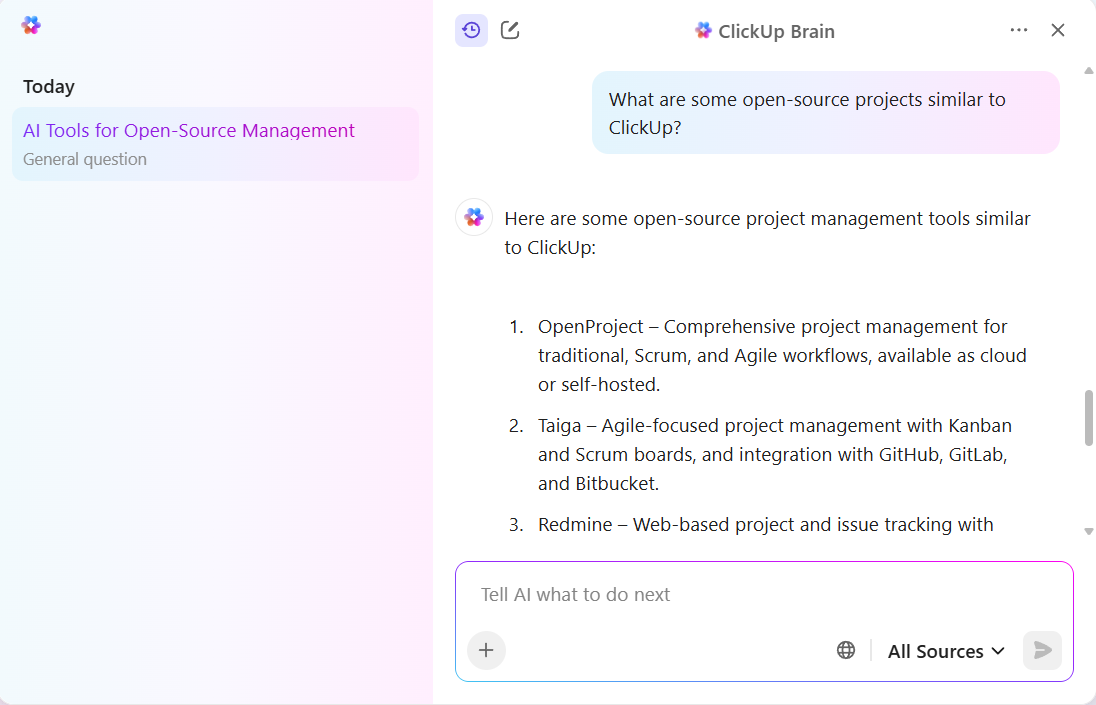
In today’s open-source environment, it’s not just about finding the right project, it’s also about how you manage your contributions, workflows and tools. Many teams fall victim to work sprawl, juggling multiple disconnected apps and channels or AI Sprawl, bouncing between dozens of generative-AI tools without unified context. ClickUp addresses both by unifying tasks, docs, chat, and AI into one workspace. With ClickUp you reduce friction, stay focused on the code and collaboration, and not waste time switching tools.
Moreover, developers can enhance their work by integrating with GitHub or creating applications using the ClickUp API. This adds to even greater developer flexibility and control over project management workflows.
ClickUp offers the tools needed for remote teams need to complete and deliver projects. The features and functionality it offers is powerful with its ease of use. Also it is more customizable to meet the needs of our developers, project managers and remote team.
Read More: How can open APIs customize your workflows?
ClickUp limitations
ClickUp pricing
ClickUp ratings and reviews

Mattermost is an open-source messaging and collaboration platform designed for developers and companies seeking a secure and configurable team communication tool. It enables teams to organize conversations, share files, and manage projects through integrated channels and workflows.
Mattermost best features
Mattermost limitations
Mattermost pricing
Mattermost reviews and ratings

TensorFlow is an open-source projects library designed for high-performance numerical computation. It offers a flexible ecosystem that allows developers to easily build and deploy machine learning models.
TensorFlow supports diverse applications with its Open API, which is backed by extensive API documentation tools. This ensures developers can easily customize and extend their machine learning projects.
TensorFlow best features
TensorFlow limitations
TensorFlow pricing
TensorFlow ratings and reviews

PyTorch is an open source machine learning library favored for applications like computer vision and natural language processing. It excels in deep learning model development and research. It offers a comprehensive suite of tools, such as tensor computing with strong GPU acceleration and dynamic computation graphs for flexible model building.
PyTorch best features
PyTorch limitations
PyTorch pricing
PyTorch reviews and ratings

Scikit-learn is a Python library that provides simple and efficient data mining and analysis tools. It is built on NumPy, SciPy, and Matplotlib, is accessible to everyone, and is reusable across various contexts. Scikit-learn is open source under the BSD license and is suitable for commercial use.
Scikit-learn best features
Scikit-learn limitations
Scikit-learn pricing
Scikit-learn reviews and ratings

Django is a high-level Python web framework that supports rapid development with clean, pragmatic design. Favored by perfectionists under deadlines, Django streamlines web app development by handling much of the routine work, allowing developers to focus on unique app features.
Django best features
Django limitations
Django pricing
Django reviews and ratings

Flask, a micro web framework for Python, is perfect for beginners. It is lightweight yet powerful and allows users to create web applications quickly. Flask is built on the Werkzeug WSGI toolkit and Jinja template engine and relies on the Click CLI toolkit for its command-line capabilities.
Flask best features
Flask limitations
Flask pricing
Flask reviews and ratings

React is the definitive library for building web and native user interfaces, offering unmatched flexibility in the development process. This tool enhances developer productivity by utilizing JavaScript, a versatile programming language. Its GitHub integration capabilities streamline development workflows and promote collaboration.
React best features
React limitations
React pricing
React reviews and ratings

Vue.js is recognized as a progressive JavaScript framework designed for building user interfaces. It provides the simplicity of integration like a library and the robust feature set of a full-fledged framework, making it suitable for everything from small-scale applications to large-scale enterprise-level projects.
Vue.js best features
Vue.js limitations
Vue.js pricing
Vue.js reviews and ratings

Jenkins is an open-source automation server that lets you deploy, automate, and build tools and projects of any scale. This tool is known for its extensive community members’ support and ability to handle complex workflows efficiently.
Jenkins best features
Jenkins limitations
Jenkins pricing
Jenkins reviews and ratings

Ansible is an ideal open-source IT automation tool for simplifying provisioning, configuration management, application deployment, and many other IT processes. The Red Hat® Ansible Automation Platform enhances its robust framework by integrating numerous upstream projects into a unified enterprise solution for advanced automation needs.
Ansible best features
Ansible limitations
Ansible pricing
Ansible reviews and ratings

Kubernetes, or K8s, revolutionizes the management of containerized applications through its robust automation capabilities. As a cornerstone of modern DevOps, Kubernetes excels in deploying, scaling, and managing complex applications.
Kubernetes best features
Kubernetes limitations
Kubernetes pricing
Kubernetes reviews and ratings

Elasticsearch is a distributed, RESTful search and analytics engine known for its speed, scalability, and ability to handle various data types. As the core component of the Elastic Stack, Elasticsearch supports a variety of use cases, including log and infrastructure monitoring, application performance monitoring, and more.
Elasticsearch best features
Elasticsearch limitations
Elasticsearch pricing
Elasticsearch reviews and ratings

Apache Kafka is a powerhouse in data streaming. As an open-source distributed event streaming platform, it enables high-performance data pipelines to streamline analytics and data integration. Apache Kafka encourages community involvement, and maintaining its robust architecture often involves a pull request from global contributors.
Apache Kafka best features
Apache Kafka limitations
Apache Kafka pricing
Apache Kafka reviews and ratings

With over 35 years of active development, PostgreSQL has gained a strong reputation for reliability, feature robustness, and performance. It supports a wide range of advanced data types and performance optimization features, which are crucial for efficiently handling large volumes of data.
PostgreSQL best features
PostgreSQL limitations
PostgreSQL pricing
PostgreSQL reviews and ratings

Linux kernel is the central component of Linux operating systems, serving as the critical mediator between hardware and processes. It manages system resources and simplifies complex interactions, ensuring efficient performance. Developed with security in mind, the kernel is a testament to the power and flexibility of open-source tools.
Linux Kernel best features
Linux Kernel limitations
Linux Kernel pricing
Linux Kernel reviews and ratings

SerenityOS is an open-source operating system that combines a nostalgic graphical user interface with modern software design principles. It was built from scratch by a cohesive, tight-knit user and developer community that continually enhances its capabilities and stability.
SerenityOS best features
SerenityOS limitations
SerenityOS pricing
SerenityOS reviews and ratings

Created by Google, Flutter is an open-source UI software development tool for developing native applications for Android, Mac, Google Fuchsia, iOS, Linux, Windows, and the web from a single codebase. This tool is renowned for helping developers build attractive, natively compiled tools and applications.
Flutter best features
Flutter limitations
Flutter pricing
Flutter reviews and ratings

Developed by Facebook, React Native is designed to create native mobile apps using JavaScript and React. It enables developers to write code once and deploy it on Android and iOS platforms, significantly reducing development time and costs while maintaining a high performance and user experience.
React Native best features
React Native limitations
React Native pricing
React Native reviews and ratings

ERPNext is widely regarded as one of the top free and open-source ERP software programs. The tool offers a complete suite of business management tools, from financial accounting to CRM and manufacturing. Its user-friendly interface and extensive customizability make it a preferred choice for over 10,000 companies worldwide.
ERPNext best features
ERPNext limitations
ERPNext pricing
ERPNext reviews and ratings

Bagisto is an open-source e-commerce platform built on Laravel and Vue.js. It helps businesses establish or expand their online stores. With various customizable features and an intuitive interface, Bagisto supports marketplaces, mobile apps, blockchain, and headless commerce applications, all powered by Generative AI.
Bagisto best features
Bagisto limitations
Bagisto pricing
Bagisto reviews and ratings

Odoo is an open-source, all-in-one business software that offers a range of applications to streamline and automate business processes. Its modular architecture, Odoo, enables users to start with basic modules and add more as their business grows. It’s widely used for CRM, e-commerce, accounting, inventory, point of sale, and project management.
Odoo best features
Odoo limitations
Odoo pricing
Odoo reviews and ratings

freeCodeCamp is a non-profit organization that offers free, interactive coding lessons and other projects to help people learn web development and earn certifications in various programming disciplines. With its extensive curriculum, you can master basic HTML and CSS to complex topics and technologies like machine learning and information security.
freeCodeCamp best features
freeCodeCamp limitations
freeCodeCamp pricing
freeCodeCamp reviews and ratings

Open edX is one of several secure, highly scalable open-source projects used by universities, enterprises, and government organizations worldwide. It is designed to deliver diverse learning experiences, including massive open online courses (MOOCs), small private online courses, and corporate training sessions.
Open edX best features
Open edX limitations
Open edX pricing
Open edX reviews and ratings
When managing open-source software development, not all tools are created equal. They can make all the difference in fostering innovation and collaboration. Each of the open-source projects mentioned offers unique advantages, but ClickUp stands out as a game-changer.
It’s more than just a management platform—it’s a flexible, customizable solution designed to enhance team collaboration and streamline project workflows, especially for developers working in open-source environments.
What makes ClickUp particularly powerful is its ability to align with the core values of open-source—transparency, collaboration, and adaptability. It integrates effortlessly into various development workflows, from small teams to large-scale projects, allowing users to manage tasks, automate processes, and track progress easily.
Whether working on a personal project or contributing to a global initiative, ClickUp offers the structure and tools needed to stay efficient and organized.
With open-source development evolving rapidly, a reliable tool like ClickUp is critical to staying competitive and driving innovation forward. Are you ready to optimize your project management strategies?
Sign up with ClickUp today and experience how it transforms your open source projects.
Start by aligning projects with your interests, tech stack, and skill level. Look for active repositories, engaged communities, and clear contribution guidelines to ensure your efforts have long-term impact and visibility.
ClickUp centralizes task tracking, communication, and documentation, helping contributors stay organized across multiple projects. With integrations like GitHub and Slack, it streamlines collaboration, automations, and progress visibility in one unified workspace.
Yes, open-source software is typically free to use and modify. However, some projects may have specific licensing terms that govern commercial use or redistribution; always check the license before contributing or deploying.
Basic coding skills, Git proficiency, and understanding of documentation are essential. You’ll also benefit from strong communication, as open-source projects thrive on collaboration, feedback, and peer code reviews.
© 2025 ClickUp



