

Sorry, there were no results found for “”
Sorry, there were no results found for “”
Sorry, there were no results found for “”
Fantastic new ideas, market research, user feedback—you have everything to create the perfect products. But how do you decide which tasks or ideas to tackle first?
Whatever choice you make, you must justify it to the shareholders and your team. And what’s better than a prioritization score to do that?
In this highly competitive world, where each task and idea competes for attention and resources, mastering the art of prioritization is crucial. Using a framework like RICE (Reach, Impact, Confidence, and Effort) prioritization can help you quantify your ideas and provide a basis for selecting a specific idea over others.
This article will discuss the details of the RICE scoring model and how it can transform your decision-making.
The RICE model is a prioritization framework used in product management and project development to evaluate and prioritize tasks, features, or projects by scoring them based on four criteria.
RICE stands for:
The RICE method helps provide structure and objectivity during decision-making, facilitating better priority management and objective decisions.
The formula for the RICE method is as follows:
RICE Score = (Reach x Impact x Confidence) / Effort
With this score, it becomes easier to decide the order of the project and priority tasks.
💡Pro Tip: AI assistants can significantly reduce decision fatigue when it comes to prioritizing tasks. See how! 👇🏼

Sean McBride, the former product manager at Intercom, co-developed the RICE framework. He and his colleagues struggled to find a prioritization framework that best served their decision-making needs.
One of the common problems product managers face is whether to select projects based on personal outlook or ones with a broader reach. So, McBride developed the RICE score to solve problems related to making objective decisions.
Previously, we discussed the components of the RICE score in short. In this section, let us delve deep into them one by one.
The first component of the RICE framework is Reach. It measures the number of people a project affects within a given period. The higher the reach, the greater the number of people the project will benefit. It is typically measured over a month or quarter.
To calculate reach, you can define which category of users you’re considering. However, it is best to use actual measurements from product metrics.
For example, assume that you’re launching a new collaboration feature on your evaluation platform, with 100,000 active users monthly.
The first step is to identify the potential audience or user base for which this feature will impact over a month (or quarter). Let’s say you estimate this feature is relevant to 40% of your user base. So, your reach is 40,000 users.
Impact evaluates the potential effect of a task, feature, or project on individual users. In reach, you measure the number of people impacted by a feature. In impact, you measure how much the people are affected.
So, in the above example, you can check how much the collaboration feature will increase user engagement and team collaboration.
We typically measure impact with a higher goal. McBride used a multiple-choice scale for this:
You don’t need to use the same scale. You can choose the one that fits your requirements.
A crucial point to remember while measuring this is that you need to define clear goals for each project before using the RICE score. And the best way to do this is to collaborate with your team and stakeholders. You can use a shared whiteboard to brainstorm and communicate in real time.
Confidence measures your certainty about your reach, impact, and effort estimates. This criteria is determined based on the answer to the following question:
How confident are you about this feature and the scores you’ve assigned?
The answer is expressed as a simple percentage. McBride used the following multiple-choice scale:
Anything below 50% is a guess. Again, you can use any scale that works best for you. From 10% intervals to 25% intervals, use what best matches your requirements. However, the key here is to be completely honest.
User context, research, and experimentation should support a high confidence score. You can also use product backlog management tools for advanced analytics and insights.
The confidence score allows you to ensure your decisions are truly data-backed. If you have high reach and impact scores but a low confidence score, you can explore how to improve.
Effort tells you the total amount of work you need to do to complete the project. You must consider your team members’ time, including product, design, and engineering teams. It is estimated as person-months, the amount of work one team member can do in a month.
Unlike other factors, effort is a negative factor. So, the higher the effort, the less viable your project will be. Higher effort means you need more time to finish the project.
For example, designing, testing, debugging, and launching the feature in our example may take three months. Assuming you have a team of 5 people, your effort score would be 15 person-months.
Talking to your team members is best to get an accurate picture.
Using templates and product management software can optimize your RICE prioritizing process.
ClickUp is a project management tool that simplifies product management and makes it faster and easier. You can use ClickUp for Product Management to map your product vision, simplify prioritization, and build roadmaps that connect teamwork.
Also, read about work prioritization tools to help you prioritize your daily work better. Here’s how:

Task views give you a unique way to visualize your tasks. You can select between views, including list, activity, board, table, and team. You can list tasks, write updates, ask contextual questions about different tasks, and generate task summaries.
Ask the members about their specific tasks to estimate your team’s effort (in-person hours/weeks/months).
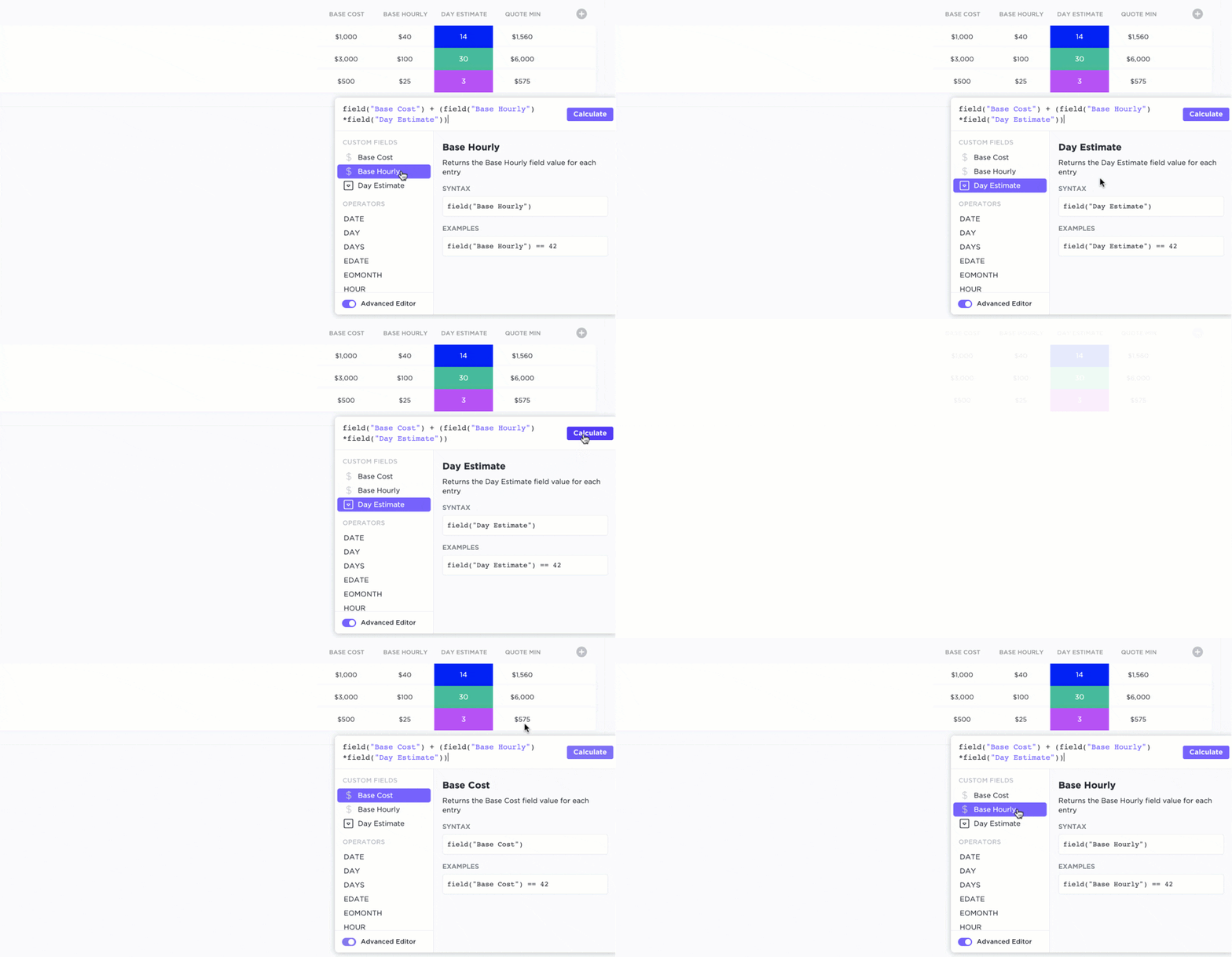
With Custom Fields, you can customize your workspace and add different data types. You can use advanced formulas, mathematical functions, date and time functions, etc. This is perfect for adding scores to your RICE components.
ClickUp also allows you to create fields, edit them, and show and hide them when required.
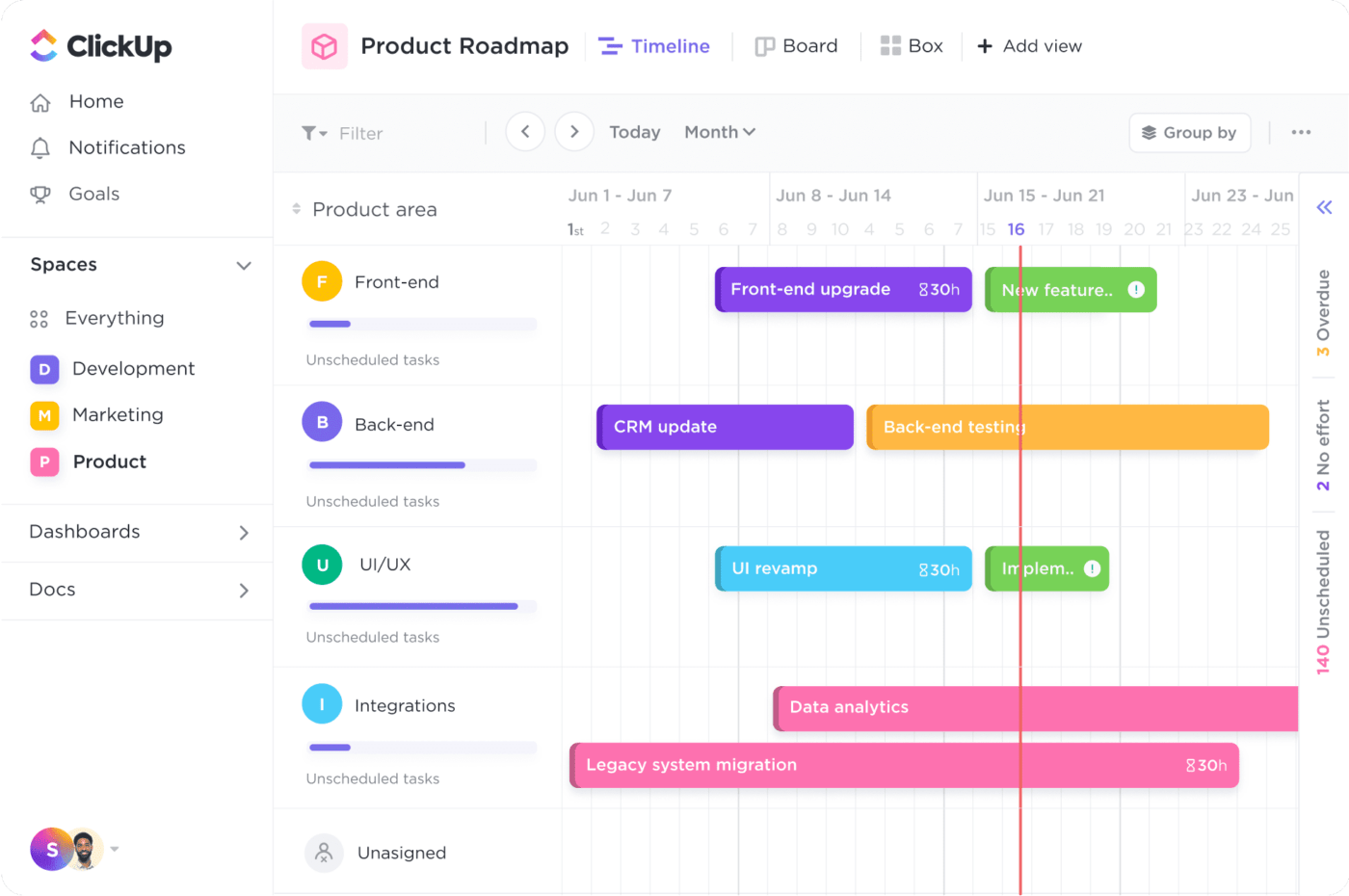
You can use ClickUp Product Planning to build roadmaps, set milestones, add templates, visualize better, and more. The Gantt charts allow you to plan for success and visualize project timelines. You can easily compare and collaborate, manage priorities, and track progress.
📮ClickUp Insight: A typical knowledge worker has to connect with 6 people on average to get work done. This means reaching out to 6 core connections on a daily basis to gather essential context, align on priorities, and move projects forward.
The struggle is real—constant follow-ups, version confusion, and visibility black holes erode team productivity. A centralized platform like ClickUp, with Connected Search and AI Knowledge Manager, tackles this by making context instantly available at your fingertips.
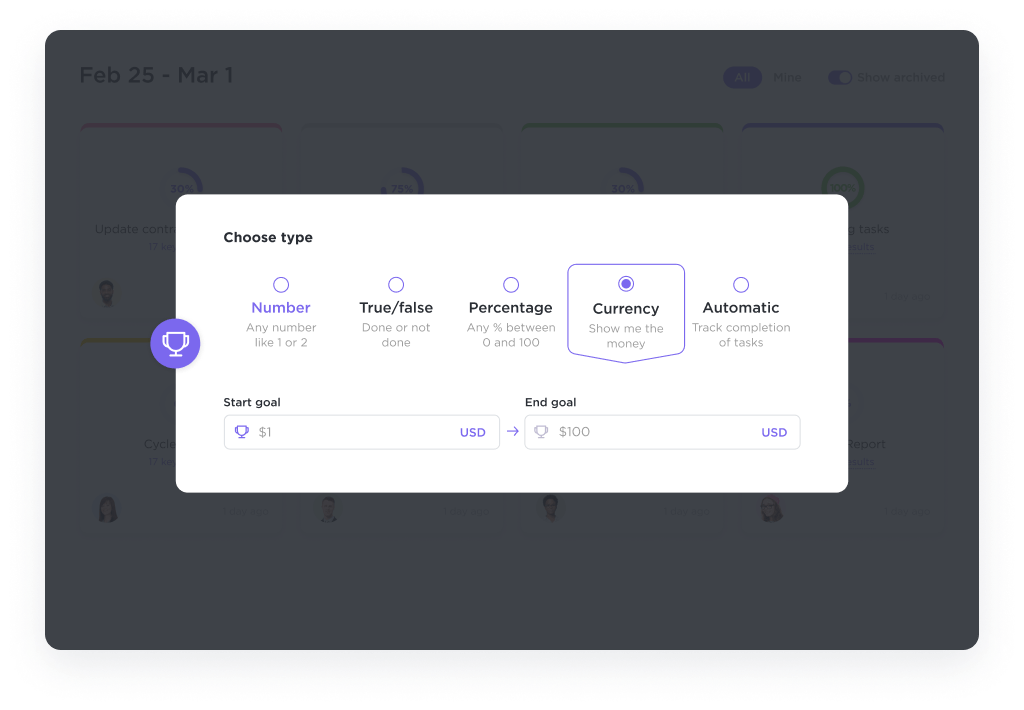
The RICE prioritization framework works best when your team and stakeholders agree on the goals you want to achieve using different ideas. ClickUp Goals helps align team objectives, set clear targets, measure success, and manage all your goals in one place.
Using prioritization and product planning templates enhances efficiency, improves decision-making, and ensures effective resource allocation. Some templates you can use are:
Like other frameworks, the RICE prioritization method has benefits and flaws. While it quantifies your ideas, it can also be inaccurate. Let us understand these pros and cons in detail.
Here are some of the pros of RICE prioritization:
It enables better communication using a standardized scoring system and helps straightforwardly communicate priorities. It helps everyone identify top-priority tasks and manage their priorities better. Further, using product management tools also enhances collaboration and the sharing of updates in real time.
The RICE score gives you a clear and numerical prioritization of tasks or features. So, you can sort the list as per priority, focusing more on high-priority items. This enables you to use your resources, including time and money, efficiently.
RICE uses a simple scoring system based on four factors so people can use it without product management certification or qualification. Team members, stakeholders, and decision-makers can easily use it to understand the reason behind various prioritization-related decisions.
The score prioritizes four key factors: reach, impact, confidence, and effort. These are among the most crucial factors in assessing an idea’s viability and whether an idea is viable.
The RICE framework offers a quantitative approach to prioritization by removing personal biases and subjective opinions. It relies on data-backed and measurable facts that help you make informed decisions.
It offers flexibility by allowing teams to adapt and apply it to different categories of tasks, products, and features. Whether new product features, bug fixes, or process improvements, RICE can be tailored to suit different contexts.
The RICE score helps align team members and stakeholders and ensures everyone works towards the same goals. This also fosters a collaborative and more focused work environment.
Some of its cons include:
One of the major cons of RICE is that it involves a lot of estimation and guessing. We may overestimate the values, which will make the score inaccurate. Moreover, the confidence factor is subjective based on the person’s understanding and confidence in the task.
Therefore, it is crucial to be as accurate as possible. The required metrics can help you do this.
Another issue with this method is that it is not customer-centric. Factors like reach and impact do capture some aspects of customers. However, crucial elements like preferences, feedback, and emotional aspects are not considered.
Even with reach and impact, these figures are defined by what the product manager believes the reach and influence of a particular product over a specified time would be.
Assigning scores in RICE is not entirely free of subjective judgment. Different product managers have different biases that can lead to inconsistent scoring. Some may intentionally inflate or deflate scores, especially in the confidence component. One way of avoiding this is to involve several people in the scoring process.
Looking for alternatives to the RICE prioritization model? We got you!
BRICE Scoring is an excellent alternative to the RICE framework for prioritizing product management. It is similar to RICE, except it measures an additional factor called Business Importance.
So, the five factors measured are Business Importance, Reach, Impact, Confidence, and Effort. Business Importance measures how the product you are considering aligns with the strategic business objectives. It is typically scored between 1 and 3, with 3 being the highest score (representing that the product is critical to business).
To calculate the BRICE score, you can use this formula:
BRICE Score = (Business Importance x Reach x Impact x Confidence) / Effort
Value vs. Effort is a prioritization method that focuses on value and effort and allows you to evaluate different features. The idea is quite simple: you measure the benefit the idea will give you and compare it with the effort it takes to achieve it.
Assign each feature a value score and an effort score to calculate it. The features that have high value and low effort are clear winners. High value, high effort, and low value, low effort come next. It is best to avoid features that have low value and high effort.
While the method gives a clear idea for prioritization, one of its downsides is that it is difficult to estimate value and effort.
The SU-RICE framework has two imperative factors not included in the RICE model: source and User Persona. This is a more comprehensive framework, as it also considers from which source you’re getting your product feature ideas and user persona, in addition to reach, impact, confidence, and effort.
You can consider four sources: prospect, customer, market or competition, and internal, and list them as per priority. This framework gives a more detailed understanding of a task or feature’s context and potential impact.
Story mapping prioritizes the features based on how your customers plan on using the product. It is not a scoring model. Instead, it involves collecting user stories that describe a feature and mapping them.
This gives you an outline of the product and lists sub-tasks and details for each task. This method is highly customer-centric and lets you see the big picture. While ideating, you also create a visual document that reminds everyone of their goals.
The RICE framework is an excellent method for deciding which ideas deserve attention first. It quantifies ideas and makes it easy to prioritize them. Moreover, it takes little time to use and helps in objective decision-making.
Some things to remember while using the model:
An all-in-one product management tool like ClickUp offers better alignment, collaboration, visualization, and templates during prioritization. Sign up for free today!
© 2025 ClickUp