


Developing a product or software is complex. You want a game plan that doesn’t leave your developers plotting escape routes.
Enter the three pillars of Scrum. These essential principles form the backbone of the Scrum project management framework. They ensure stability and success throughout your Scrum journey.
If you’re new to Scrum, you will find these pillars helpful in keeping your work balanced and your team motivated to deliver their best work.
How to Use the Three Scrum Pillars for Product Development
- What Are the Pillars of Scrum?
- Understanding Scrum’s Core Principles
- The Three Pillars of Scrum
- Practical Application of the Three Pillars of Scrum
- Overcoming Hurdles with the Three Pillars of Scrum
- Integrating Scrum pillars with other methodologies
- Collaborative techniques that bolster the effectiveness of Scrum’s pillars
- Stakeholders’ contributions to maintaining the three pillars of Scrum
- How Scrum pillars enhance project management and productivity
- Potential challenges and solutions in effectively implementing Scrum principles
- Using the right Scrum/Agile management tool
- Using Scrum Pillars for Enhanced Project Management
- Common FAQs

 Summarize this article for me please
What Are the Pillars of Scrum?
Scrum is an agile project management framework that helps teams deliver work iteratively and incrementally. It’s designed for projects that involve a high degree of uncertainty or frequent changes in requirements.
Scrum teams work closely, stay flexible, and take small, meaningful steps forward during short bursts of work called sprints. The development process in Scrum is all about keeping the momentum going and adapting as needed.
At the core of Scrum project management, three pillars of empiricism help in handling complex problems:
- Transparency
- Inspection
- Adaptation
Being transparent with project processes helps keep everyone in the loop; regular inspections help monitor project progress, and adapting strategies to changing requirements or scenarios allows you to incorporate feedback and improve continuously. Embracing these three principles makes Scrum a team-friendly and customer-friendly methodology.
Scrum: A Brief History
The term ‘Scrum’ can be traced back to a 1986 Harvard Business Review paper titled ‘The New Product Development Game’ by Hirotaka Takeuchi and Ikujiro Nonaka.
The authors discussed the ‘Rugby approach’ (a sports metaphor for a team that moves together from start to finish) for speedy and more flexible product development. They proposed this as an alternative to the traditional sequential or ‘relay race’ approach, where each runner covers the distance independently and passes the baton to a team member at the end of their turn.
Fast forward to 1993, when Jeff Sutherland, John Scumniotales, and Jeff McKenna implemented Scrum practices for the first time at the Easel Corporation.
The results of this new approach drew in Ken Schwaber (CEO of Advanced Development Methods) and Mike Beedle (who later co-authored ‘Agile Manifesto’).
Throughout this period, they refined the concepts of Scrum behind the scenes, but it was not unveiled to the public until the 1995 OOPSLA Conference. Sutherland and Schwaber then introduced the world to Scrum by presenting a paper titled ‘The SCRUM Development Process’ at the conference.
Nearly three decades later, the essence of SCRUM remains the same, but the framework continues to grow and evolve with regular revisions. What started as a software development framework has been adopted across various industries to simplify complex problems.
Summarize this article for me pleaseUnderstanding Scrum’s Core Principles
The methodology of Scrum is based on empiricism—a concept that emphasizes gaining knowledge from real-life experiences and observations. Scrum relies on gathering evidence and facts through constant experimentation, which leads to faster feedback, continuous improvement, and quicker delivery of projects.
Scrum also shares principles with Holacracy, a management philosophy that distributes decision-making power throughout an organization. Like Scrum, Holacracy promotes agility, collaboration, and effectiveness within companies. It creates a work culture where everyone works together for better outcomes.
To understand these structures better, let’s dive into the six core values of Scrum methodology that are also reflected in Holacracy.
1. Empirical process control: The three Scrum pillars—transparency, inspection, and adaptation—govern empirical process control. The Scrum process relies not on theory but on real-life observations
2. Self-organization: Cross-functional Scrum teams must be self-organized, as this helps them fulfill their specific roles, take accountability, and critically assess their performance without any guidance from the leadership
3. Collaboration: Everyone in a Scrum team knows what the others are working on. Team members communicate clearly with stakeholders to ensure a constant feedback loop
4. Value-based prioritization: This core value focuses on organizing action items based on customer value. The goal is to deliver quality products or services as quickly as possible
5. Time-boxing: In Scrum, work gets done in sprints. Everything, from sprint planning to daily meetings, has clear start and stop times. This time-boxing ensures everyone knows the allocated time for each step and the overall progress of sprints
6. Iterative development: Teams receive feedback after each sprint and work on improving the product. These continuous improvement cycles make it easier for teams to work on changes and ensure the product meets the client’s expectations
Summarize this article for me pleaseThe Three Pillars of Scrum
Let’s dive deep into the three Scrum pillars and discover their importance in managing development projects.
Transparency in Scrum
In Scrum, transparency means everyone involved in the development process knows what’s going on—the good, the bad, and the ugly.
When a team practices transparent workflow management, All team members and external stakeholders get the same information, trust each other, work toward the same goal, and communicate openly. This pillar is what makes Scrum a highly collaborative methodology.
Here are some practical ways to ensure transparency in Scrum:
1. Streamline documentation: When you keep project-related documents organized and accessible, the Scrum team members get clarity on their goals. These documents may include:
- Sprint backlog: A list of tasks the Scrum team has to work on during a sprint
- Product backlog: A prioritized list of action items required to improve the product
- Sprint review: An event where stakeholders check project progress and provide feedback
- Definition of Done (DoD): A set of criteria a product increment must meet to be considered ready for release. This documentation process helps teams stay focused while keeping goals, processes, and progress visible to all stakeholders
2. Be a Scrum Master: Scrum Masters are experts in the Scrum framework and help the agile team understand its principles and practices. They ensure open communication among the product owner, team members, and stakeholders, ensuring everyone is on the same page.
By organizing regular activities such as sprint planning, daily standups, and sprint reviews, they eliminate bottlenecks and help team members gain insight into what everyone else is doing
3. Make progress visible: You can use burnup and burndown charts to keep your team members and customers updated on progress toward sprint goals.
- Burnup charts help you track the total work completed rising over time, highlighting progress made and the total scope of the project.
- Burndown charts depict the remaining work effort decreasing towards zero, visualizing how much work is left to complete the project
4. Bring stakeholders closer: By establishing clear communication channels, you can help teams and stakeholders collaborate better, receive feedback, and implement changes based on that feedback
Transparent processes enable teams to build interpersonal trust because everyone understands what others are working on. This collaboration is key to achieving your shared goals!
Inspection in Scrum
Inspection in Scrum refers to constantly evaluating the product, processes, and practices. Clients and even internal team members can participate in the inspection and suggest ideas to improve the product.
Inspection happens during:
- Sprint planning: At the beginning of a sprint, the Scrum team decides which product backlog items to work on
- Daily Scrum: The Scrum developers meet every day of the sprint to inspect progress toward the sprint goal and adapt the sprint backlog accordingly
- Sprint review: The Scrum team presents their work to the stakeholders and asks for feedback
- Sprint retrospective: After each sprint, the team holds a meeting to brainstorm on the past sprint, analyze what went right and what went wrong, and plan strategies for improvement
This pillar brings incremental improvement in Scrum product development. You don’t wait till the end for feedback; instead, you seek feedback on the go after each sprint and modify the product features to make sure the final results align with the client’s vision.
Adaptation in Scrum
Inspection works together with the third pillar of Scrum, known as adaptation. Once a sprint is over and you have completed the inspection, it’s time to change your processes and make room for improvement.
Adaptation allows team members to freely share their learnings and insights and facilitate problem-solving. Through brainstorming sessions, you can identify opportunities for innovation and adapt your approaches for better outcomes next time.
Scrum development teams can implement adaptation in the following ways:
- Adjusting sprint backlog: Based on the insights derived during the inspection, teams can adapt changes to the items in the sprint backlog
- Adapting daily stand-ups: Teams can alter their day-to-day work plan during daily stand-ups and incorporate new strategies
- Reviewing sprint feedback: Scrum teams can analyze the feedback they received in the previous sprint review and use it as a guide to adapt their approach for the next sprint
This Scrum pillar makes your team agile, improves the quality of work, helps identify problems, adjusts your workflows for more efficiency, and maintains high customer satisfaction levels.
Summarize this article for me pleasePractical Application of the Three Pillars of Scrum
Let’s see how you can apply the three pillars of Scrum in real-life software development.
User stories and their role in Scrum
A user story is an agile Scrum term that refers to the smallest unit of work in the agile framework, expressed as ‘persona + need + purpose’. It’s the general, non-technical description of a software feature written from the user’s point of view.
The Product Owner (a Scrum team member) creates user stories based on the requirements they receive from the customer or stakeholder.
While writing a user story, you don’t have to fret about the details. Simply write a few sentences on how a particular product feature will bring value to the customer.
The format of a user story typically follows a simple and concise sentence structure that outlines the desired functionality from the user’s perspective:
As a [user persona], I want to [action], so that [benefit].
Example: As a frequent user of the ClickUp mobile app, I want to be able to log in with SSO (single sign-on) to access my account quickly and securely, eliminating the need to remember and enter my password every time.
Good user stories offer a lot of benefits for Scrum teams:
- Reinforce the first pillar of Scrum, which is transparency
- Help you estimate project effort and timelines more accurately
- Enable more effective sprint planning
- Maintain focus on the immediate needs of the user
- Promote collaboration among team members
- Encourage critical thinking and innovative solutions to reach the goal
Using value-based pricing in Scrum software development
The Scrum framework aims to deliver maximum value in the least amount of time. But how can this be done in a complex development process? It’s through value-based prioritization.
The idea behind this concept is to determine the order of tasks and decide what to work on right now and what to do later. After creating user stories, the Product Owner speaks to the customer or stakeholder to understand which business requirements deliver the most value.
Based on this discussion, the Product Owner re-arranges the user stories in the ‘Prioritized Product Backlog,’ keeping the high-value action items at the top. The following techniques can be used to prioritize items effectively:
- MoSCoW method: Focuses on four types of features—must have (essential for current release), should have (needed for future release), could have (nice to have for future release), and would have (may or may not be required for future release)
- Kano model: Prioritizes actions based on the customer’s basic needs, performance needs, and excitement needs
- Weighted Shortest Job First (WSJF) score: This prioritization method sequences tasks based on their relative value and urgency. It divides the relative cost of delay by relative job duration to get the WSJF score of a task. Tasks with higher WSJF scores are prioritized because of their higher relative cost of delay and shorter relative job duration
Value-based prioritization is useful for both the development team and the client, as it:
- Makes projects adaptable
- Ensures smart resource allocation
- Maximizes return on investment (ROI) for resources allocated
- Provides value at an early stage
- Enhances customer experience by prioritizing what’s most valuable to them
- Focuses on delivering value continuously
Implementing agile tools to enhance Scrum practices
To make the most of your Scrum framework, you need a powerful, agile tool that brings all stakeholders under one roof.
And what can be a better option than ClickUp? This all-in-one agile software saves time, speeds up sprint cycles, helps team members collaborate better, and ensures you hit your KPIs and keep clients happy.
Here’s how to empower your Scrum team using Sprints in ClickUp:
- Streamline sprint management: Maintain transparency on what to do and when. Set sprint timelines, assign points, mark priorities, and sync your product development process with tools such as GitHub, GitLab, and Bitbucket

- Fastrack development with sprint automation: Don’t waste time on manual tasks. Create new sprints, mark sprints as ‘Done’ or ‘In Progress,’ and move unfinished tasks to the next sprint, all using ClickUp Automation

- Get real-time insights with visual reporting: Check how quickly your team works through user stories and stay on top of project progress with burndown and burnup charts. Check the current status of tasks and identify bottlenecks using Cumulative Flow, and measure the average completion of work per sprint using Velocity

You can leverage ClickUp’s Scrum templates to streamline documentation and maintain transparency.
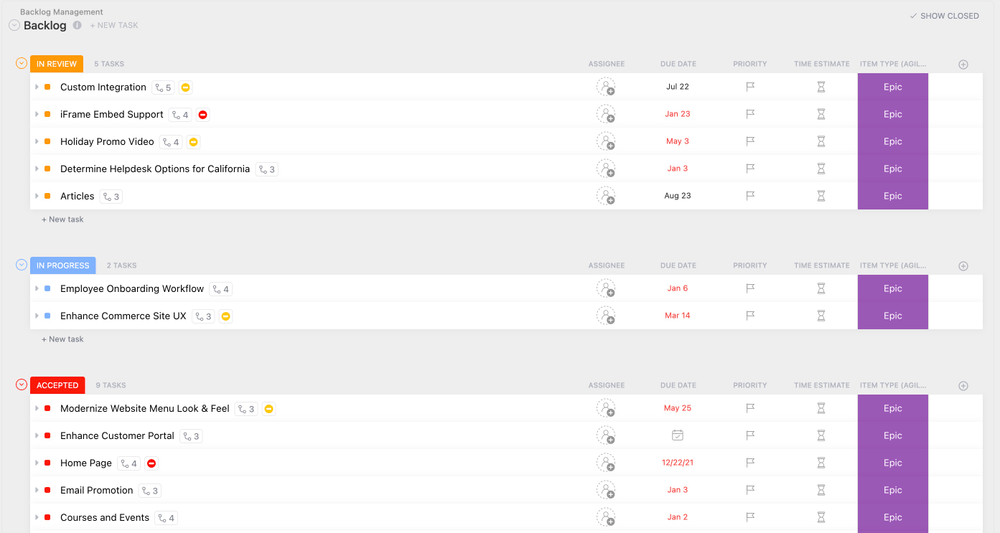
These customizable templates make your life a little easier as a product manager and allow team members to manage their workflow better.
Summarize this article for me pleaseOvercoming Hurdles with the Three Pillars of Scrum
While managing complex development projects, you may encounter issues implementing feedback, maintaining transparency and flexibility, staying efficient, or keeping up quality. The three Scrum pillars can help you overcome these challenges. Let’s see how:
Integrating Scrum pillars with other methodologies
Scrum is powerful, but what if you could make it even better?
You can combine the Scrum framework with agile project management methodologies such as Kanban and Extreme Programming (XP). This approach gives you the best of both worlds, makes your team more efficient, and streamlines how you manage your workload.
For instance, to make processes more flexible, this is what Scrumban (a combination of Scrum and Kanban) achieves by unifying Kanban’s visual workflow with Scrum’s time-boxed sprints:
- It enhances the visibility and transparency of your work
- It improves collaboration among all the teams
- It helps you overcome challenges faster
Collaborative techniques that bolster the effectiveness of Scrum’s pillars
You can strengthen the effectiveness of Scrum pillars by using collaborative techniques that promote transparency, responsiveness, and adaptation. Some of these techniques are:
- Daily stand-up meetings that allow synchronization and discussion of work
- Sprint planning meetings that comprise all Scrum teams for better alignment
- Sprint retrospective meetings that involve the product owner and the development team to review, clarify, and prioritize items in the product backlog
- Pair programming that allows for two developers to work together, continuously exchanging insights, reviewing each other’s work, and providing instant feedback
Stakeholders’ contributions to maintaining the three pillars of Scrum
Stakeholders are involved in the development process from start to finish. They maintain the three pillars of Scrum in the following ways:
- Communicating their wants and requirements to the team (Transparency)
- Keeping an eye on project progress and looking for areas that need improvement (Inspection)
- Providing feedback after each sprint and requesting the Scrum team to make changes accordingly (Adaptation)
These stakeholders can be anyone who has a vested interest in the development team’s output—internal teams, customers, users, or sponsors.
How Scrum pillars enhance project management and productivity
The three pillars of Scrum together create an environment for project delivery. Here’s how:
- Transparency: Clear communication and shared information lead to better accountability, collaboration, and risk management
- Inspection: Regular checks enable early problem detection, continuous improvement, and quality assurance
- Adaptation: Embracing change allows for flexibility, increased customer satisfaction, and faster time to market.
Potential challenges and solutions in effectively implementing Scrum principles
You may come across some challenges while implementing the Agile Scrum methodology. Let’s make things clearer by presenting a few common issues and ways to resolve them:
Problem: Resistance to change
Solution: Work toward communicating the benefits of Scrum and how it empowers teams. You can start with a trial project using the Scrum framework to make team members familiar with it and provide them with the necessary resources to understand the methodology better
Problem: Scope creep and changing priorities
Solution: You must prioritize user stories effectively and stick to the defined sprint goals. Try to keep stakeholders in the loop to get regular feedback, manage expectations, and adjust priorities as needed
Problem: Lack of continuous improvement
Solution: Use regular retrospectives to identify and address issues and implement client feedback to improve your approach. Create a workplace culture where teams feel encouraged to do better than what they did yesterday
Using the right Scrum/Agile management tool
Complex projects call for an agile project management tool to maintain transparency, allow inspection, and enable adaptability.
As the project manager, you must pick the right tool to handle the entire development process, from creating user stories and backlogs to sprint planning and execution.
Clickup’s Agile Project Management Software can be a great solution here.

Let’s look at how you can streamline software development projects with ClickUp:
- Promote collaboration: Allow Scrum team members and stakeholders to collaborate transparently with ClickUp Docs. Use it as a centralized repository for sharing product ideas, prototypes, product specs, and more

- Create agile workflows: Design a flexible workflow tailored to your Scrum team’s unique needs. From ideation to product release, you can manage the entire product lifecycle within one platform

- Save time with AI: Generate product roadmaps, test plans, and technical documentation with ClickUp Brain and speed up the development process

- Visualize your work: Prioritize backlogs and identify bottlenecks with ClickUp’s Board view. Check Sprint Points and your team’s workload capacity with Box View. Brainstorm and collaborate using whiteboards. Structure sprints and manage milestones with Gantt Charts

ClickUp keeps agile teams focused on core development while upholding the three pillars of Scrum.
Summarize this article for me pleaseUsing Scrum Pillars for Enhanced Project Management
Understanding and using the three Scrum pillars—transparency, inspection, and adaptation—makes a visible difference in product development. They’re not just theoretical constructs but practical tools that keep your projects on track.
Besides managing complex workflows, Scrum pillars create an environment where innovation is prioritized, teams work toward continuous improvement, and collaboration becomes second nature.
Together, these pillars turn Scrum into more than just a project management framework—they make it a driving force for cultivating creativity and teamwork in your projects.
You’ll see more benefits when you pair them with ClickUp’s project management features.
Summarize this article for me pleaseCommon FAQs
1. What are the three pillars of Scrum?
The three pillars of Scrum are Transparency, Inspection, and Adaptation.
2. What is the three-pillar theory?
The three pillar theory in Scrum refers to the pillars of empiricism: transparency, inspection, and adaptation. Transparency ensures clear communication, inspection ensures constant monitoring and evaluation of processes and products, and adaptation ensures ongoing development of the product, processes, and practices.
3. What are the three pillars of sustainability?
The three pillars of sustainability are social, economic, and environmental sustainability.


Everything you need to stay organized and get work done.

Recent Articles
How to Use Scrum Project Management for Modern Teams 
How to Use Scrum Project Management for Modern Teams

