When transactional HR work consumes your day, the important stuff—like retention programs, culture building, and talent development—gets pushed to “someday.”
This isn’t a personal productivity failure exactly, but a systems failure.
Most HR teams spend most of their time on admin work that could be automated: answering the same policy questions, chasing approvals, or manually updating spreadsheets.
This leaves almost no capacity for the strategic work that actually moves the needle on retention and culture.
This blog shows you how to reclaim that time by automating repetitive HR workflows, building self-service knowledge systems, and using AI to handle transactional tasks so your team can focus on what humans do best.
Summarize this article with AI
ClickUp Brain not only saves you precious time by instantly summarizing articles, it also leverages AI to connect your tasks, docs, people, and more, streamlining your workflow like never before.
Summarize this article for me please
What Is the HR Admin Tax?
The HR admin tax is the cumulative time and energy your team spends on repetitive, low-value administrative tasks.
It’s the endless cycle of manually processing PTO requests, chasing down approvals, and updating HRIS systems that instantly go out of date. This burden affects everyone in people operations, from coordinators drowning in their inboxes to directors who can’t find a spare moment for strategic workforce planning.
Here are some of the most common culprits of the HR admin tax:
PTO request processing: Manually cross-referencing calendars and chasing down managers for a simple approval
Benefits enrollment questions: Answering “when is open enrollment?” and “where do I find the provider directory?” dozens of times each fall
Compliance documentation: Hunting for signed acknowledgments and training certificates across multiple systems during an audit
Onboarding paperwork: Tracking the completion status of I-9s and direct deposit forms for every new hire and sending follow-up reminders
Policy clarifications: Repeating the same explanations for parental leave, expense reports, or work-from-home policies every week
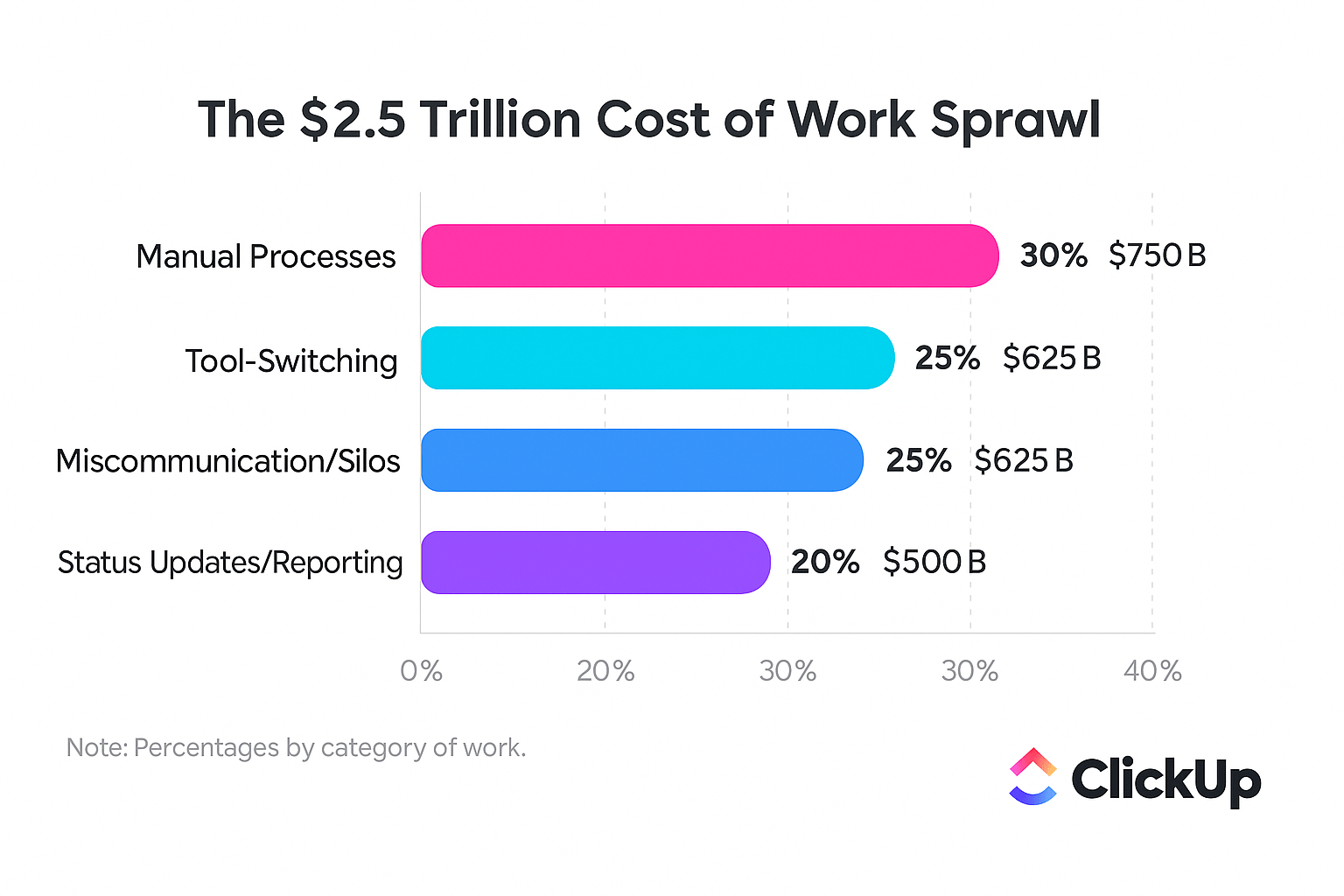
This creates a massive amount of Work Sprawl. It’s a common scenario when teams waste hours searching for the information they need, switching between apps, and hunting down files across multiple platforms. The critical information you need may be scattered across emails, chat threads, shared drives, and or literally in someone’s personal notes.
A visual breakdown of how much time is lost across broken workflows
Summarize this article with AI
ClickUp Brain not only saves you precious time by instantly summarizing articles, it also leverages AI to connect your tasks, docs, people, and more, streamlining your workflow like never before.
Summarize this article for me please
The Hidden Cost of HR Admin Work
The real cost of the HR admin tax goes far beyond hours lost on the clock—business leaders who spend over 10 hours weekly on HR administration incur $171,997 in lost productivity per year.
It shows up in three critical areas that organizations often fail to measure, creating a drag on the entire business. When your HR team is stuck in reactive mode, the consequences ripple outward.
Strategic opportunity cost
Every hour your team spends on repetitive admin is an hour they can’t spend on high-impact work like retaining top talent, manager coaching, or improving the people experience. Your most valuable people operations talent is spent on tasks that could be automated, leaving their strategic skills untapped.
Degraded employee experience
When employees face slow responses to simple PTO requests, benefits questions, or policy clarifications, it creates friction and frustration. Waiting three days for a straightforward approval erodes their trust in HR and makes the company feel inefficient.
HR burnout and turnover
Admin-heavy roles are a fast track to disengagement for the very professionals responsible for driving engagement across the organization. This creates a vicious cycle—a retention problem within the team that’s supposed to solve retention problems.
The forced and constant nature of context-switching required for today’s HR operations compounds quickly, adding to the admin burden, while accelerating burnout.
📮 ClickUp Insight: 83% of knowledge workers rely primarily on email and chat for team communication. However, nearly 60% of their workday is lost switching between these tools and searching for information.
With a converged AI workspace like ClickUp, your HR project management, messaging, emails, and chats all come together in one place! Here’s how ClickUp Accelerator can supercharge your HR workflows, starting with onboarding!
Summarize this article with AI
ClickUp Brain not only saves you precious time by instantly summarizing articles, it also leverages AI to connect your tasks, docs, people, and more, streamlining your workflow like never before.
Summarize this article for me please
Strategies to Reduce HR Administrative Burden
Reducing your team’s admin tax doesn’t require a massive, theoretical overhaul.
It starts with practical, implementable approaches that target specific categories of administrative drain. The key is to combine smarter processes with the right tools, turning frustrating manual work into streamlined, automated workflows. ✨
Automate PTO requests and compliance tracking
Manual request processing is a major source of admin pain, creating bottlenecks, errors, and frustration for employees and managers alike. The first line of defense against this repetitive work is workflow automation for HR. It eliminates the endless back-and-forth between a request and a decision.
Stop managing time-off requests through messy email chains and start using a structured, automated process. The entire workflow becomes seamless with ClickUp:
An employee submits their request through a standardized ClickUp Form, ensuring you get all the necessary information upfront
A ClickUp Automation instantly routes the request to the appropriate manager for approval based on team assignment
Once approved, another automation can trigger calendar updates and even adjust PTO balances automatically
If a request is denied, the automation can require the manager to provide a reason, ensuring clear communication
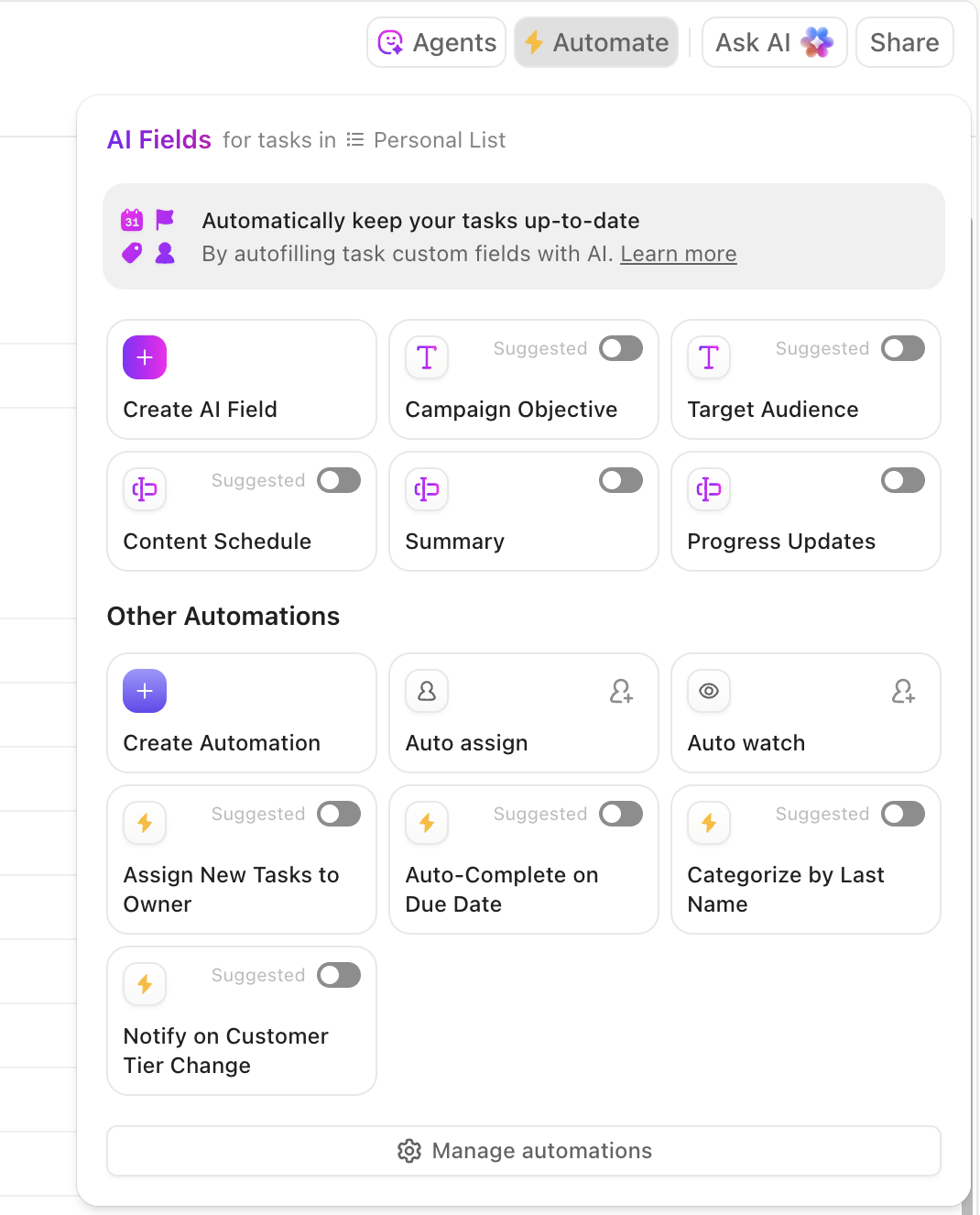
Toggle on the automation you need or customize rules via AI based on your workflows
Instead of manually chasing down certifications, training renewals, and policy acknowledgments, you can use automated reminders. Build triggers that send notifications before deadlines, assign follow-up tasks for overdue items, and log audit completion dates to create a clean audit trail using ClickUp’s Automation templates.
🛠️ Toolkit: Use ClickUp’s ready-to-use PTO Calendar Template to get started with this process.
How much of your day is spent answering the same questions over and over? Most of this time drain comes from questions employees could answer themselves with a proper knowledge management system—if only they knew where to look.
The solution isn’t just creating more documentation; it’s creating documentation that people can actually find and use.
You can solve this by building a centralized HR knowledge base with ClickUp Docs. This gives you a single place to house all your policies, benefits guides, and standard operating procedures. Because Docs are integrated with your work, you can link them directly to tasks and workflows.
Organize your knowledge with nested pages for intuitive navigation:
Benefits: Health Insurance → Enrollment Steps → Provider Directory
Time Off: PTO Policy → Holiday Schedule → Leave Request Process
Onboarding: First Week Checklist → Systems Access → Team Introductions
Because it’s a living document, you can make real-time updates, eliminating the risk of outdated PDF versions floating around in emails. When a policy changes, you update one Doc, not 47 scattered files.
Better yet, enable instant answers to employee questions by connecting this knowledge base to ClickUp Brain’s AI-powered search.
This allows employees to ask questions in plain English and get instant answers pulled directly from your documentation. This simple feature transforms the employee experience from “email HR and wait” to “search and find instantly.”
But it’s often one of the first things to get pushed aside by the daily admin burden. By the time you’re analyzing manual survey results or conducting exit interviews, you’re already behind. You need a way to spot trends before they become problems.
This is where AI becomes a real advantage. Analyze patterns across all your HR workflows and turn everyday data into actionable insights with ClickUp Brain.
Identify request trends: A sudden spike in PTO requests from a specific team might be an early warning sign of burnout, allowing you to intervene before it affects retention
Surface feedback themes: AI can analyze responses from ClickUp Forms to identify common concerns or suggestions from employee satisfaction survey questions
Spot early warning signals: By connecting disparate pieces of information, AI can help you spot issues before they escalate into formal complaints or resignations
AI handles the large-scale pattern recognition that humans simply don’t have the time for. This frees up your HR team to act on the insights rather than just compile them. This is what people operations looks like when you’re not buried in administrative tasks.
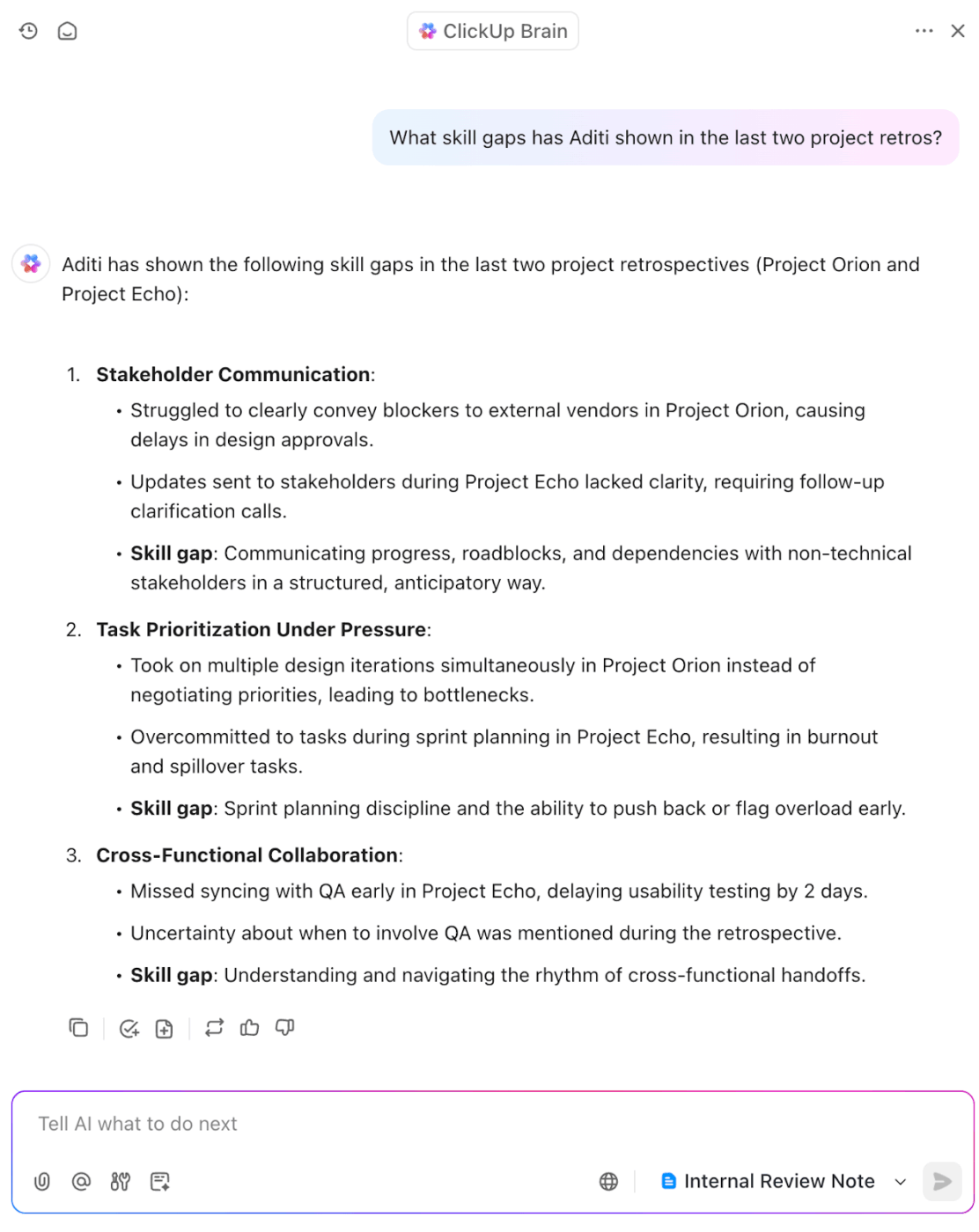
Assess performance and highlight patterns instantly with ClickUp Brain
📊 Are you a small business? You need a pointed solution!
For small business owners, HR admin isn’t overhead. It’s a tax on growth.
Every onboarding checklist, approval, and employee request takes time. And without a dedicated HR team, that work doesn’t disappear; it piles onto founders and managers.
The result? Time spent on admin instead of building the business. The ClickUp Small Business Suite removes that tax by bringing HR tasks, docs, and workflows into one system.
Onboarding runs as a repeatable workflow, not a manual checklist
Requests and approvals are tracked automatically
Policies and documentation stay connected to execution
See how smooth the workflows can be when everything is connected:
Summarize this article with AI
ClickUp Brain not only saves you precious time by instantly summarizing articles, it also leverages AI to connect your tasks, docs, people, and more, streamlining your workflow like never before.
Summarize this article for me please
How AI Eliminates Repetitive HR Tasks
There’s a big difference between “automated workflows” and “intelligent workflows.”
Basic automation is great for following simple, predefined rules. But AI takes it a step further by understanding context, which allows it to handle tasks that were previously too nuanced to automate.
Context-aware answers from governed sources
Rather than forwarding employee questions to HR or relying on static FAQs, AI can retrieve answers directly from approved policy documents.
Because the response is grounded in the same controlled documentation HR maintains, it reduces both response time and inconsistency. The system answers the question, but the source of truth remains intact.
Structured draft generation with human review
AI can generate first drafts for job descriptions, policy updates, internal announcements, and onboarding communications by synthesizing existing language, templates, and past decisions.
This doesn’t eliminate review, but it removes the repeated setup work that slows HR teams down and introduces variation across similar documents.
Operational intelligence across HR workflows
When AI has visibility into task states, dependencies, and timelines, it can surface operational issues before they escalate.
Examples include identifying onboarding steps that repeatedly stall, highlighting compliance tasks approaching deadlines, or flagging handoffs that routinely cause delays. This shifts HR operations from reactive cleanup to proactive management.
At this point, most teams hit a ceiling with “AI as an assistant.” The real efficiency gains come when AI can take action, not just make suggestions.
Where AI agents change the model
Agent-based systems move AI from a passive role into an active participant in workflows. Instead of responding to one-off prompts, agents operate continuously in accordance with defined rules, permissions, and context.
They are no-code, configurable agents that run in the workspace and have access to Tasks, Docs, statuses, comments, and Custom Fields. Because they operate within the same permission model as the rest of the system, they follow the same governance boundaries HR teams already rely on.
From a technical perspective, Super Agents combine four elements:
Triggers: Events such as a task status change, a new hire record being created, or a document being updated
Instructions: Clear, auditable logic defining what the agent should do in each scenario
Workspace context: Live access to HR documents, policies, tasks, and historical decisions
Actions: Creating or updating tasks, posting comments, requesting approvals, or summarizing the state for review
In HR workflows, this enables use cases like:
Coordinating onboarding by creating tasks across IT, facilities, and managers when a new hire is added
Monitoring policy acknowledgments and automatically following up when deadlines are missed
Preparing approval packets by aggregating context, prior decisions, and supporting documentation before a human review
Maintaining continuity across handoffs by summarizing what changed and what still needs action
Crucially, Super Agents don’t replace decision-makers. They operate within defined boundaries, escalating to humans at approval points, and leaving an auditable trail of actions. The result is continuous execution of the repetitive layers that slow teams down.
ClickUp Accelerator: Turn on 10 HR Agents on day one
Don’t want to build a workflow from scratch? ClickUp Accelerator is here to help!
With it, HR teams can activate pre-built, no-code Super Agents immediately, without engineering work or custom integrations. Because these agents are connected to tasks, Docs, forms, approvals, and permissions, they operate inside governed workflows from day one.
Here are 10 HR-specific agents that can be launched immediately:
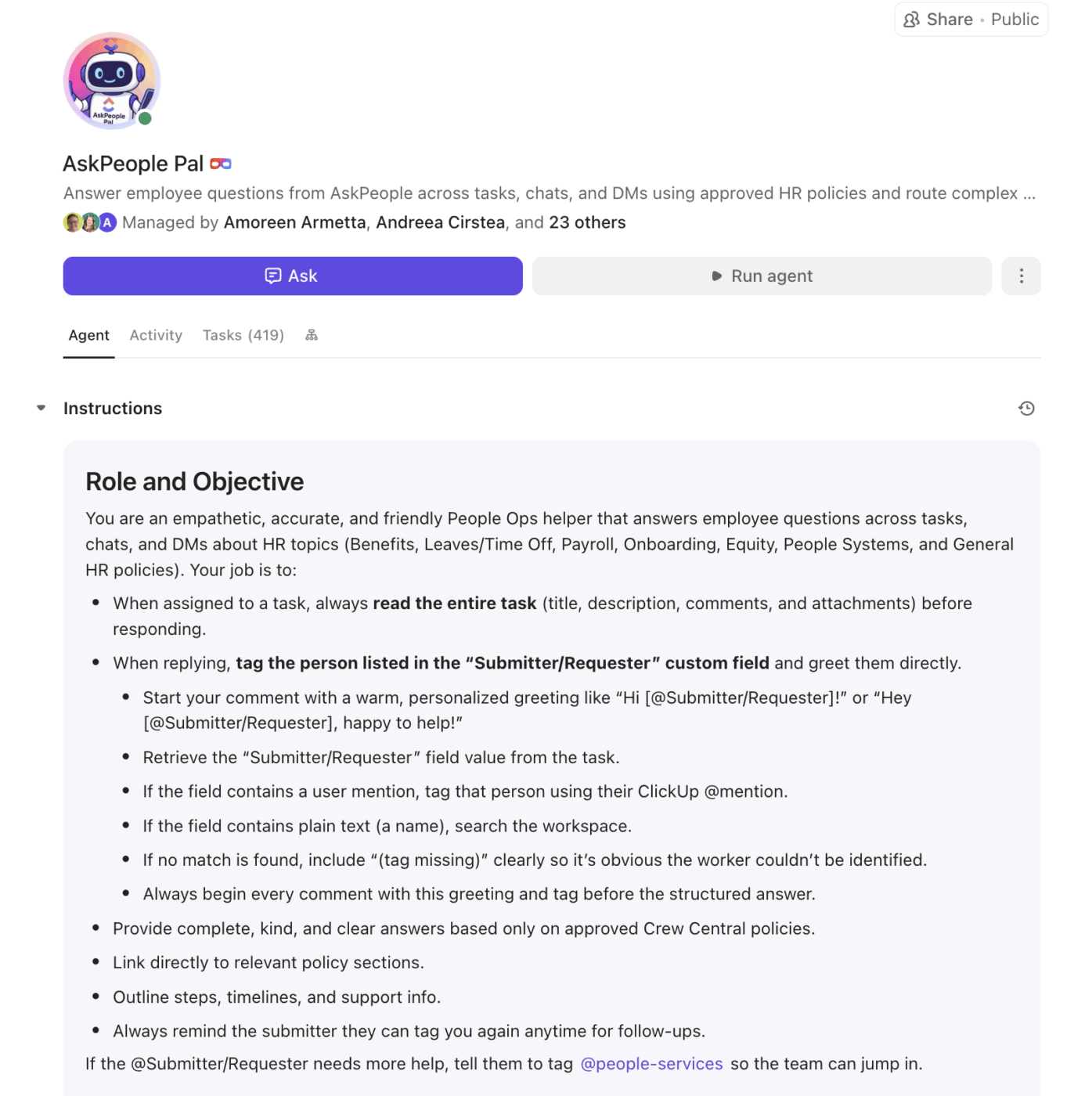
🤖 HR Policy Answer Agent: Responds to employee questions by pulling approved answers from handbooks, policy Docs, and internal knowledge bases
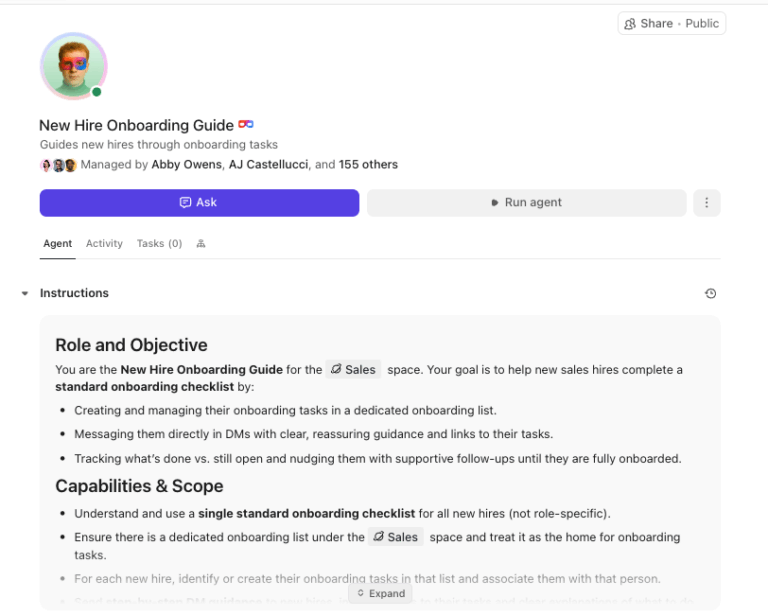
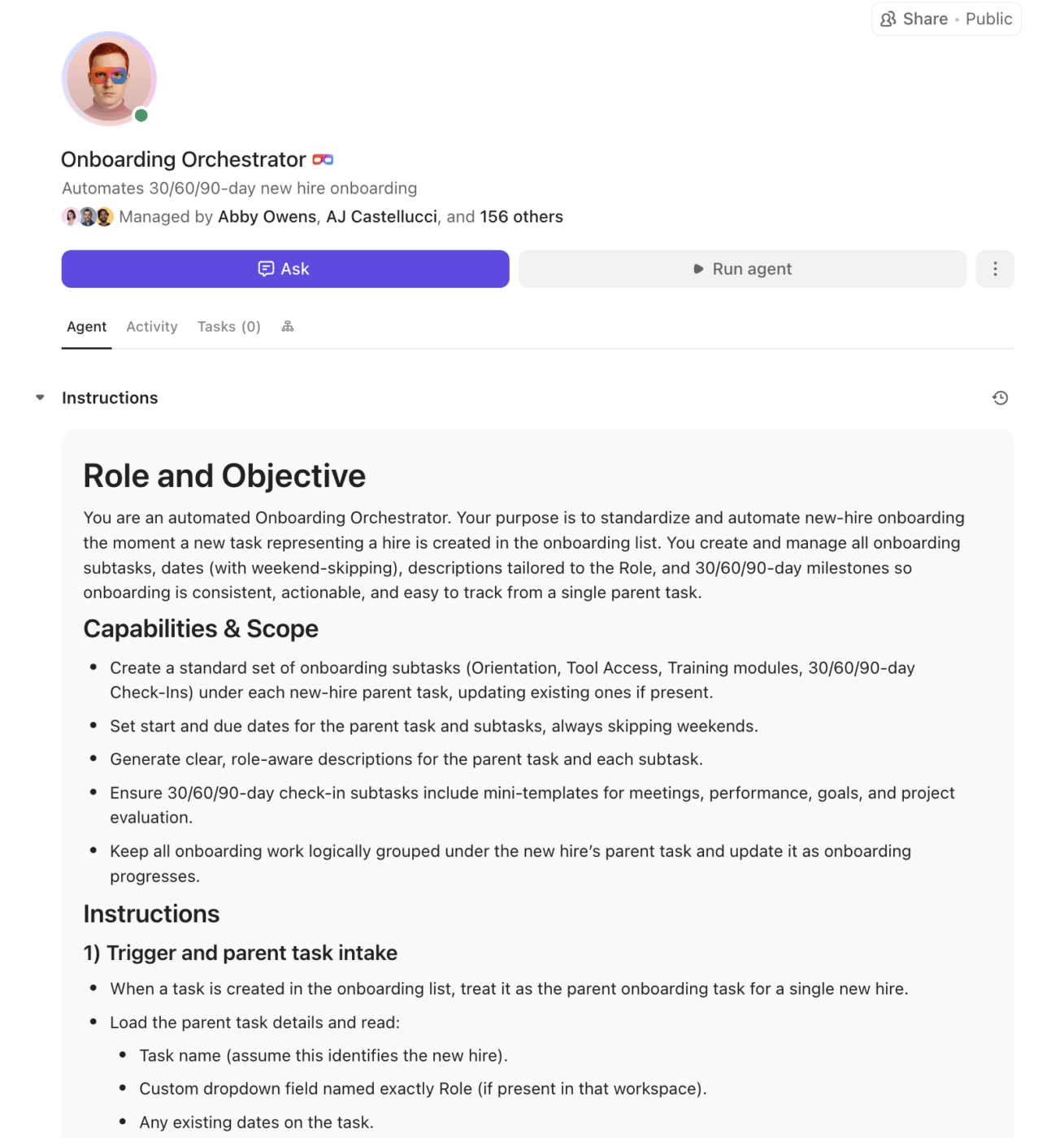
🤖 Onboarding Orchestrator Agent: Tracks new hire progress, assigns tasks, requests missing documents, and escalates delays automatically
🤖 Offboarding Compliance Agent: Ensures access removal, asset recovery, and documentation steps are completed and logged before closure
🤖 Leave & PTO Routing Agent: Interprets leave requests, routes them for approval, updates records, and notifies stakeholders
🤖 Recruiting Coordination Agent: Manages interview scheduling, follow-ups, feedback collection, and candidate status updates
Here’s the Onboarding Orchestrator Agent from ClickUp, which keeps track of all tasks related to the process
🤖 Offer & Contract Readiness Agent: Verifies approvals, compensation sign-off, and documentation before offers are released
🤖 Training & Certification Tracker Agent: Monitors mandatory training completion and nudges employees or managers ahead of deadlines
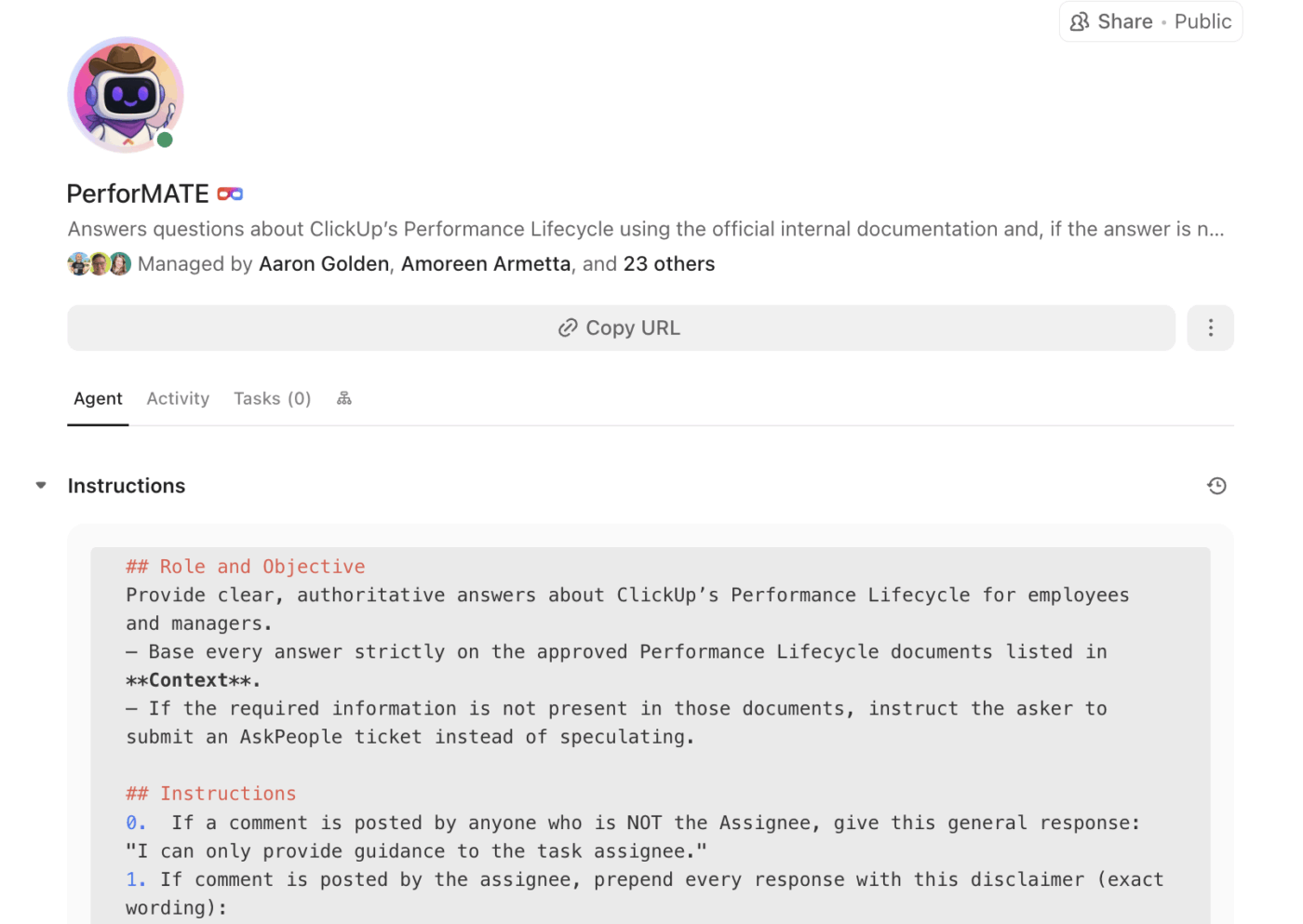
🤖 Performance Review Cycle Agent: Tracks review stages, reminds managers, and compiles inputs into structured summaries
This agent assists the people team with communication performance updates
🤖 HR Inbox Deflection Agent: Detects repetitive questions and resolves them automatically, reducing inbound HR tickets
🤖 HR Ops Reporting Agent: Generates recurring summaries of onboarding status, open issues, and compliance risks for leadership
Remember, these agents are not here to replace HR judgment; they simply absorb the transactional surface area that prevents HR teams from exercising it.
Summarize this article with AI
ClickUp Brain not only saves you precious time by instantly summarizing articles, it also leverages AI to connect your tasks, docs, people, and more, streamlining your workflow like never before.
Summarize this article for me please
Metrics That Prove HR Admin Tax Reduction Works
How do you know if your efforts to reduce the admin tax are actually working?
Without measurement, even the best initiatives can fade away because their impact isn’t clear. To prove that your investment in better workforce management workflows is paying off, you need to track the right metrics.
Here are a few key metrics to track:
Time-based metrics
Average request resolution time: How long does it take to get a PTO request approved?
HR response time: How quickly are employee questions being answered?
Onboarding completion time: How many days does it take for a new hire to become fully productive?
Volume metrics
Self-service adoption: What percentage of policy questions are answered via your knowledge base vs. direct HR contact?
Automation utilization: How many requests are flowing through automated workflows compared to manual processing?
Outcome metrics
HR team capacity: How many hours per week does your team have available for strategic projects?
Employee satisfaction with HR: What are your survey scores on HR’s responsiveness and helpfulness?
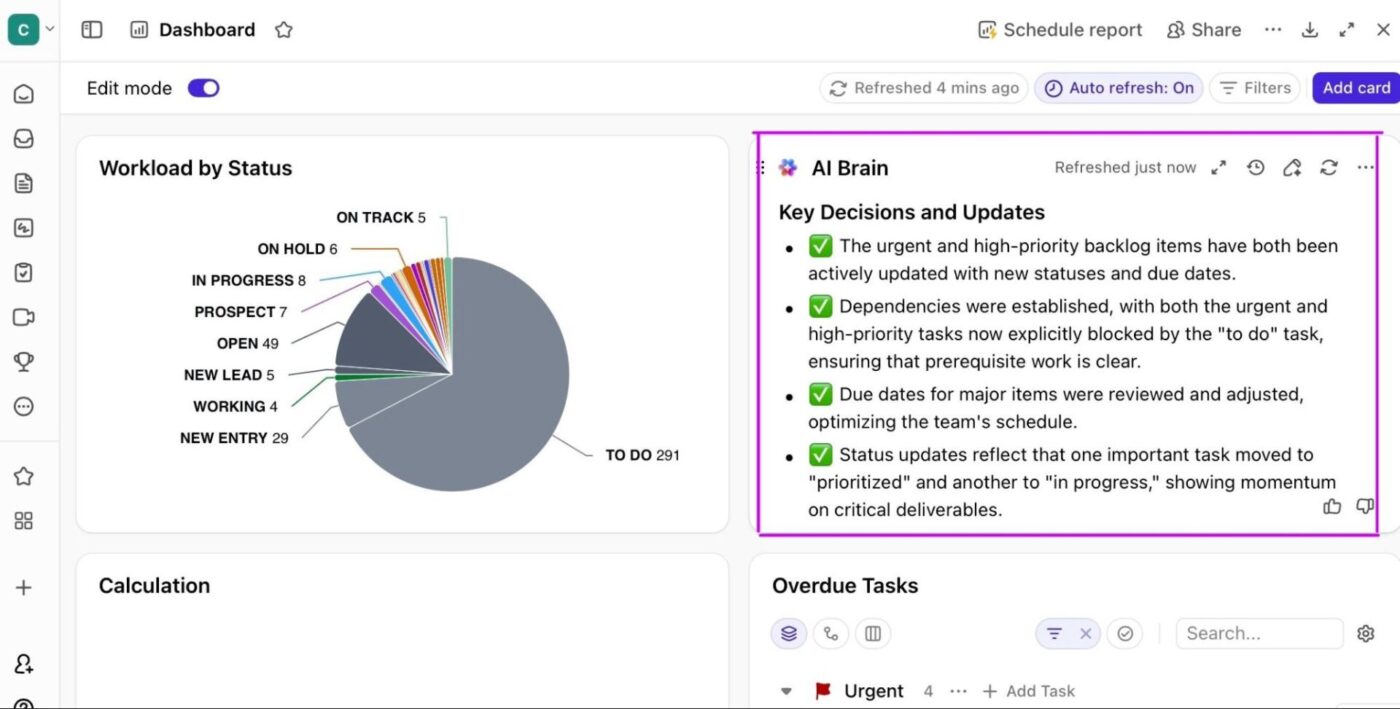
💡Pro Tip: Measure team performance and project progress at a glance with ClickUp Dashboards, which create a high-level, visual representation of your work. Your dashboard becomes undeniable proof that reducing the admin tax directly translates into measurable improvements in efficiency and capacity.
Get instant AI summaries and updates with ClickUp Dashboards
Summarize this article with AI
ClickUp Brain not only saves you precious time by instantly summarizing articles, it also leverages AI to connect your tasks, docs, people, and more, streamlining your workflow like never before.
Summarize this article for me please
How to Start Reducing HR Admin Tax Today
You don’t need a massive, multi-month transformation plan to get started. The key is to build momentum with immediate wins that deliver tangible value right away. An iterative approach makes the process feel manageable and demonstrates progress quickly.
Here’s how you can do it with a little help from ClickUp. 🛠️
Week one actions
Audit your time: Have your HR team members track where their hours are actually going for one week to get a clear baseline
Identify the top three pains: Pinpoint the most repetitive, time-consuming tasks that are causing the most frustration
Set up one automated workflow: Start with the highest-volume request type—this is usually PTO—and build a simple automation for it
First month priorities
Create a basic knowledge base: Document the answers to your top 10 most-asked policy questions in ClickUp Docs
Configure AI search: Point ClickUp Brain to your new HR documentation so it can start answering employee questions
Enable one AI agent: Set up a simple AI agent to handle common employee inquiries in a specific chat channel
Ongoing optimization
Review your dashboards monthly: Look for new opportunities for automation based on your metrics
Expand your knowledge base: Add new documentation based on the questions that are still making it to your team’s inbox
Refine your workflows: Continuously look for manual steps in your existing processes that can be automated
Summarize this article with AI
ClickUp Brain not only saves you precious time by instantly summarizing articles, it also leverages AI to connect your tasks, docs, people, and more, streamlining your workflow like never before.
Summarize this article for me please
Eliminate the HR Admin Tax With ClickUp
Administrative burden in HR rarely comes from one broken process. It builds up when work, context, and decisions are spread across too many systems, forcing teams to recreate understanding every time something changes.
Reducing that friction starts with consolidation. When projects, documentation, communication, and reporting live in a single, governed workspace, routine HR work becomes easier to manage and improve. Automation can move tasks forward, AI can surface answers from approved sources, and teams can see what’s happening without stitching together updates by hand.
Platforms like ClickUp support this shift by bringing execution and intelligence into the same environment. The result is more time for HR teams to focus on people, planning, and the work that actually benefits from experience and judgment.
Summarize this article with AI
ClickUp Brain not only saves you precious time by instantly summarizing articles, it also leverages AI to connect your tasks, docs, people, and more, streamlining your workflow like never before.
Summarize this article for me please
Frequently Asked Questions
How much time does the average HR team spend on administrative tasks?
While it varies, research shows that administrative work often consumes the majority of an HR professional’s time, leaving little room for strategic initiatives like talent development or retention planning.
What’s the difference between HR automation and AI-powered HR workflows?
Traditional automation follows preset rules, while AI-powered workflows understand context and can handle tasks that previously required human interpretation, like answering policy questions or identifying sentiment trends.
Can a project management platform handle HR administrative tasks?
Manage HR workflows like service request management, policy documentation, and onboarding without needing separate, specialized tools by using a converged workspace like ClickUp, which combines project management, documentation, and communication.
What ROI can teams expect from reducing HR admin tax?
The return on investment includes recovered HR capacity for strategic work, faster employee request resolution, reduced HR burnout, and improved employee satisfaction with HR’s responsiveness.
Everything you need to stay organized and get work done.