Sorry, there were no results found for “”
Sorry, there were no results found for “”
Sorry, there were no results found for “”
Most teams don’t pick between Microsoft Teams vs. Slack based on habit, and then spend months wondering why their chat tool and project management tool never quite talk to each other. That fragmentation matters more than ever.
Microsoft’s 2025 Work Trend Index found employees are interrupted 275 times a day during core work hours, making the case for fewer, more connected tools even stronger.
This article breaks down how both the tools compare across messaging, video, AI, integrations, and security.
It also shows you why ClickUp, the world’s first Converged AI Workspace, is worth a serious look if you’re tired of stitching together separate tools just to get work done. 🤩
Slack is a chat-first communication hub built for speed and flexibility across diverse tech stacks. On the other hand, Microsoft Teams is a video-first collaboration suite tied into the Microsoft 365 ecosystem.
Lastly, ClickUp is the only option here that converges communication, project management, docs, and AI into a single workspace, so you don’t need to bolt a PM tool onto your chat app.
The right pick depends on how your team actually works day-to-day. 👀
| Feature | Microsoft Teams | Slack | ClickUp |
| Best for | Microsoft 365-heavy orgs | Diverse, non-Microsoft tech stacks | Teams wanting chat + project management in one place |
| AI | Copilot (paid add-on) | Slack AI (paid add-on) | ClickUp Brain (built-in) + ClickUp Brain MAX, ClickUp Super Agents, and ClickUp Automations |
| Messaging | Channels nested in teams; threads in channels only | Flexible channels; threads everywhere | Chat linked to tasks and docs |
| Video/audio | Up to 300 participants with recording | Huddles (max 50, no recording) | SyncUps, Clips, and AI Notetaker |
| Task management | Requires Planner, Loop, To Do | Canvas and Lists (lightweight) | 15+ native views including Gantt, Board, and Calendar |
| Integrations | 2,500+ (deepest with Microsoft 365) | 2,400+ (ecosystem-agnostic) | 1,000+ (fewer needed due to native features) |
| Security | End-to-end encryption, ATP, DLP, HIPAA | DLP, EKM; HIPAA on Enterprise Grid only | SOC 2 Type II, GDPR, role-based permissions |
📖 Also Read: Google Workspace vs. Microsoft 365 Comparison
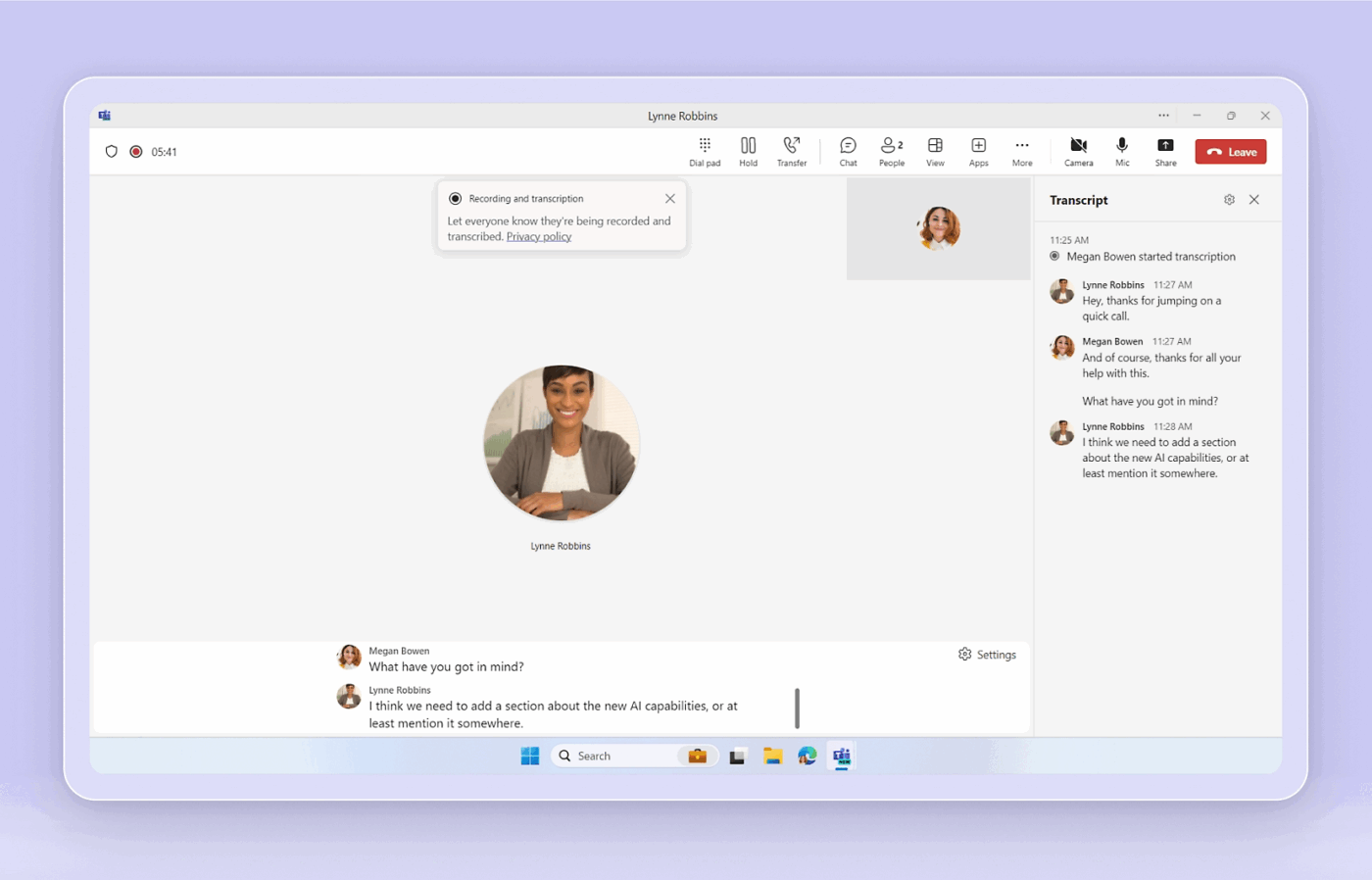
Microsoft Teams is a communications hub that combines persistent chat, video meetings, VoIP calling, and document co-authoring, all within the Microsoft 365 ecosystem. It’s especially popular with enterprises already paying for Microsoft 365 licenses.
An overview of some of the best communication tools:
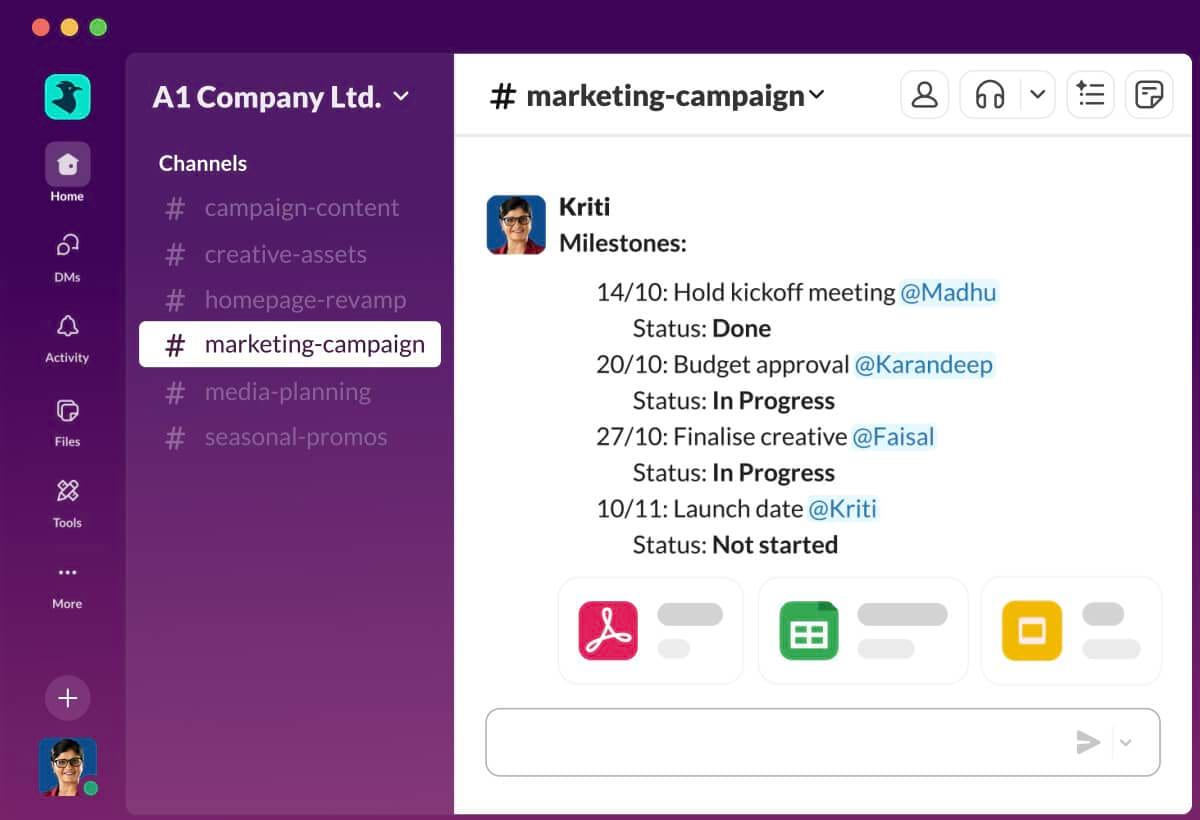
Slack is a channel-based digital workplace communication tool owned by Salesforce. It centralizes conversations, files, and app notifications, and it’s a popular option for real-time team chat among startups and teams using diverse tech stacks.
📮 ClickUp Insight: Only 10% of our survey respondents use voice assistants (4%) or automated agents (6%) for AI applications, while 62% prefer conversational AI tools like ChatGPT and Claude. The lower adoption of assistants and agents could be because these tools are often optimized for specific tasks, like hands-free operation or specific workflows.
ClickUp brings you the best of both worlds. ClickUp Brain serves as a conversational AI assistant that can help you with a wide range of use cases. On the other hand, AI-powered agents within ClickUp Chat channels can answer questions, triage issues, or even handle specific tasks!
Let’s see how Microsoft Teams vs. Slack stack up against each other:
Your team sends hundreds of messages a day, but finding the one that matters shouldn’t feel like digging through a haystack. The way Teams, Slack, and ClickUp handle channels, threads, and notifications is surprisingly different.
Teams nest channels within ‘teams,’ creating a formal hierarchy. Threaded replies work in channels only, not in direct messages. Statuses are predefined (Available, Busy, Do Not Disturb) with limited custom message options.
Slack uses topic-based channels with threads available everywhere. You get custom sidebar sections, keyword notifications that alert you when specific terms appear anywhere, and fully customizable statuses.
🏆 Winner: It’s a tie! Slack offers the most advanced chat customization, and Teams provides more structure for large organizations.
You’ve spent 45 minutes in a meeting, and now you need to figure out what was decided. All of the tools: Teams, Slack, and ClickUp have added AI features to help, but they take very different approaches.
Microsoft Copilot works across the entire Microsoft 365 suite. Within Teams, it handles meeting recaps, real-time transcription, and action item detection. Its strength is meeting intelligence, which is turning long calls into structured summaries with owners and deadlines. The catch is that it requires a Microsoft 365 Business Standard or Enterprise license.
🏆 Winner: Microsoft Teams takes the lead! Copilot is good for meeting AI within Microsoft 365, while Slack AI is a solid way to catch up on chat.
🚀 ClickUp Advantage: Most AI tools still live in silos – you search in one place, write in another, and switch between apps to get work done. ClickUp Brain MAX eliminates that fragmentation by acting as a central AI layer across your entire workflow, both inside and outside ClickUp, eliminating AI Sprawl.
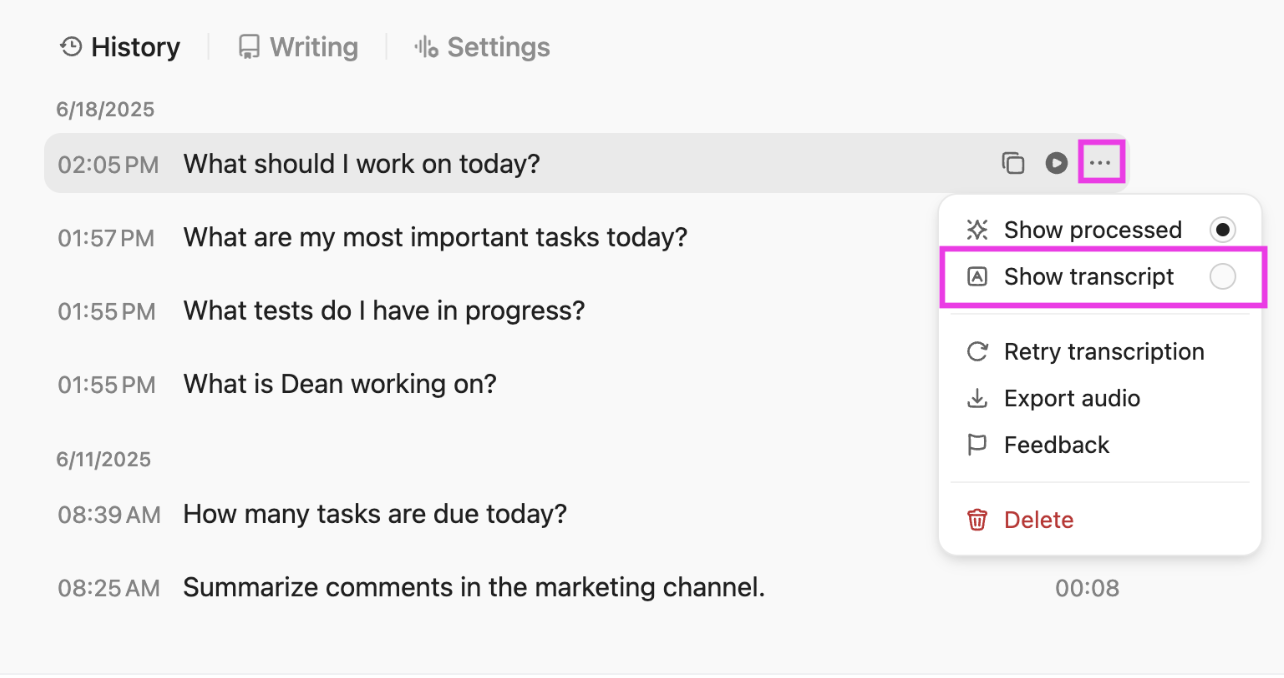
Its stand-out feature is the ClickUp Talk-to-Text. Instead of typing, you can speak naturally and convert your thoughts into structured, AI-enhanced text in any app. For instance, a founder reviewing weekly performance can press a shortcut and say: ‘Pull updates from this week, compare them to last week, and draft a team update highlighting risks and next steps.’
Video is where these two tools diverge most. Teams was built around video as a core pillar, while Slack treats it as a lightweight add-on.
Teams is built for structured, large-scale meetings and events, with features designed for both collaboration and control. You get capabilities such as meeting recordings, live captions, real-time translation (in 40+ languages), screen sharing, breakout rooms, and presentation modes.
It also includes features like Together Mode (placing participants in a shared virtual environment) and tools like hand-raising, reactions, and participant tracking.
Slack Huddles, on the other hand, are designed for quick, informal conversations. You can jump into audio or video calls directly from a channel or DM, share your screen, and collaborate in real time.
🏆 Winner: It’s Microsoft Teams! Teams dominate live video because Slack’s Huddles are too lightweight for formal meetings.
Should it be an email or a message?
Here’s how both tools let you connect with other tools in your tech stack:
Teams offers 2,500+ marketplace apps with the deepest connections to Microsoft 365 products. Third-party tools outside Microsoft often feel less polished.
Slack’s 2,400+ third-party connections are ecosystem-agnostic, connecting with Google Workspace, Salesforce, Atlassian, and virtually any SaaS tool.
🏆 Winner: It’s Slack! Microsoft Teams works best for integrations with the Microsoft 365 suite, but Slack connects with multiple third-party apps.
🚀 ClickUp Advantage: Connect your existing tools with 1,000+ ClickUp Integrations, including Slack, Microsoft Teams, Google Drive, GitHub, Figma, HubSpot, and Zapier. But because project management, docs, chat, whiteboards, and time tracking converge natively in ClickUp, you need fewer integrations in the first place.
When it comes to security and compliance, the stakes are much higher than just feature depth. Both Microsoft Teams and Slack offer strong security foundations:
Teams leads with enterprise security: end-to-end encryption, ATP, DLP, and HIPAA compliance on any paid plan.
Slack offers DLP and Encryption Key Management, but reserves HIPAA compliance for its most expensive Enterprise Grid plan.
🏆 Winner: Microsoft Teams takes the lead! It has more comprehensive and accessible enterprise security features, especially for organizations that need compliance without jumping to premium tiers.
🚀 ClickUp Advantage: Protect your data with SOC 2 Type II and GDPR compliance, two-factor authentication, SSO (SAML), encryption in transit and at rest, and role-based permissions with granular access controls by Space, Folder, and List in ClickUp.
Microsoft Teams is built around meetings, and Slack around messaging. ClickUp takes a fundamentally different approach. It brings communication, collaboration, and execution into a unified work management platform.
This means conversations don’t get lost and meetings don’t sit idle – they turn into actual work. Let’s break down the features that make this possible. 🌟
ClickUp Chat is designed to eliminate the disconnect between conversations and work. It flips that model by embedding chat directly into your workspace, eliminating work sprawl.
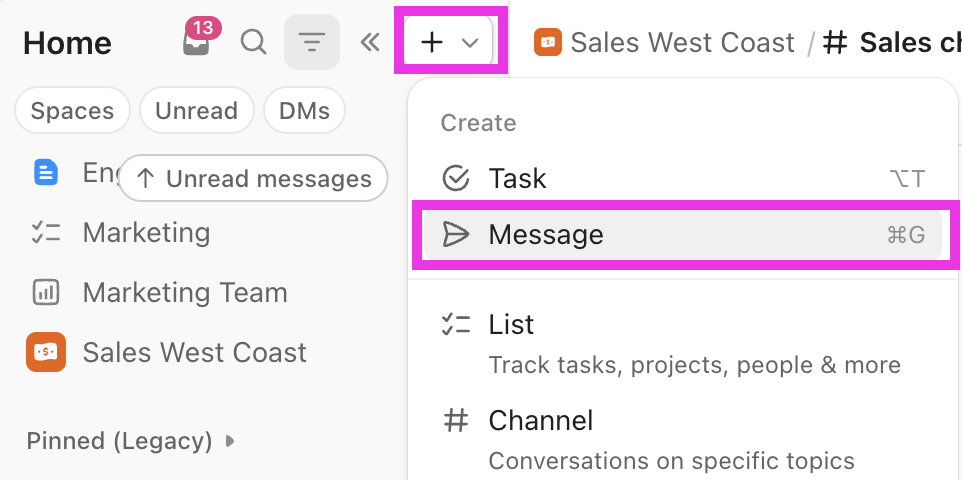
Here are some key capabilities that set it apart:
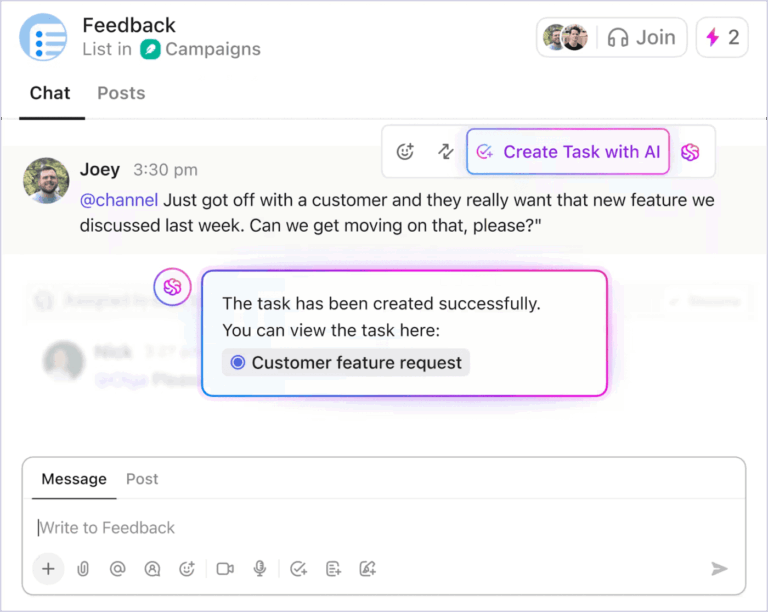
For instance, a product team is discussing a bug in a channel. Instead of switching to a separate project management tool, they convert the message into a task, assign it to an engineer, and attach relevant comments. The conversation, task, and resolution stay linked so that anyone can trace the full context later.
🚀 ClickUp Advantage: ClickUp Brain becomes truly powerful when it’s embedded directly inside ClickUp Chat, transforming conversations into a live, AI-powered command center for work.
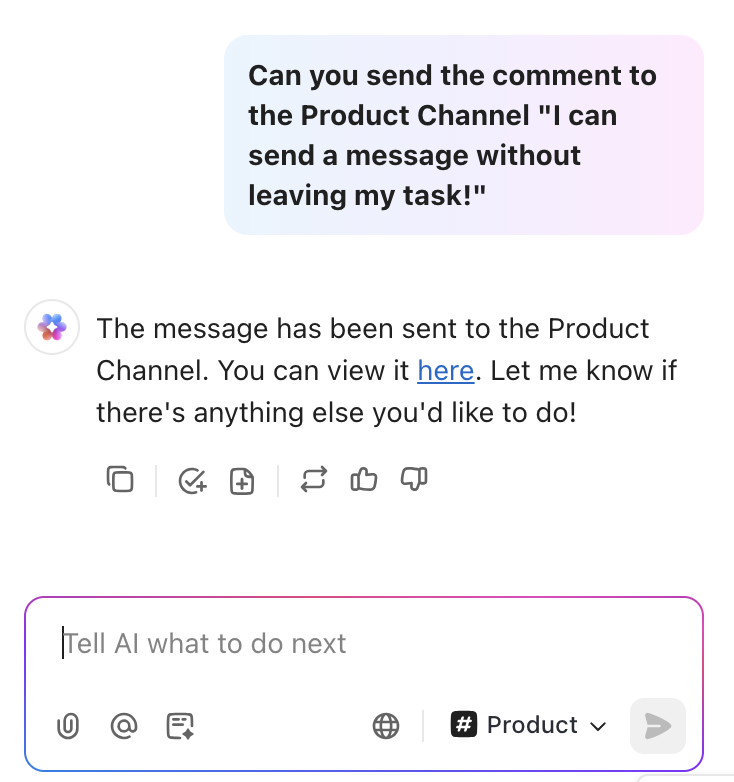
Inside any Chat Channel or direct message, ClickUp Brain can be accessed in multiple ways. Access it through the Ask panel, message drafts, slash commands, or directly from messages.
What this looks like inside Chat:
ClickUp SyncUps bring real-time communication directly into your workspace without needing external tools like Zoom or Teams. They allow teams to jump into instant audio or video calls, share screens, and collaborate in real time.
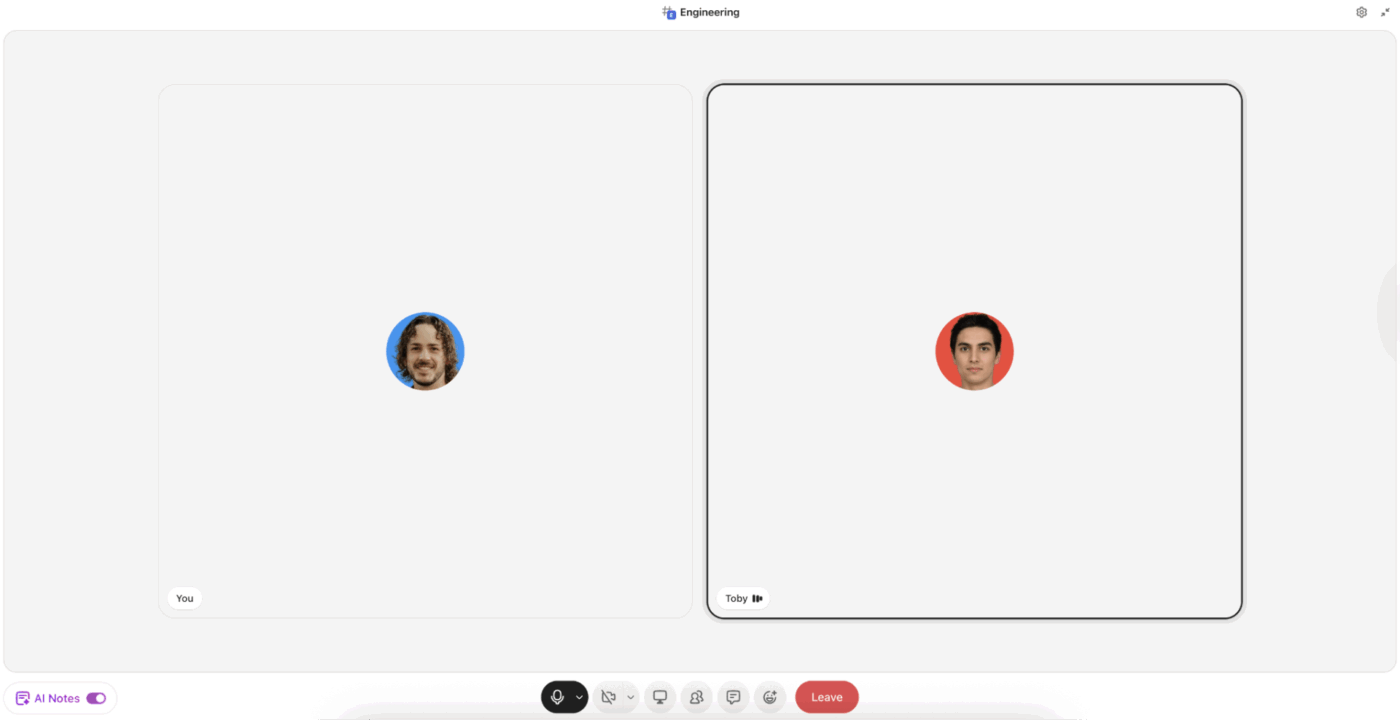
You get access to:
🚀 ClickUp Advantage: Turn every meeting into an organized, actionable output inside your workspace with the ClickUp AI Notetaker.
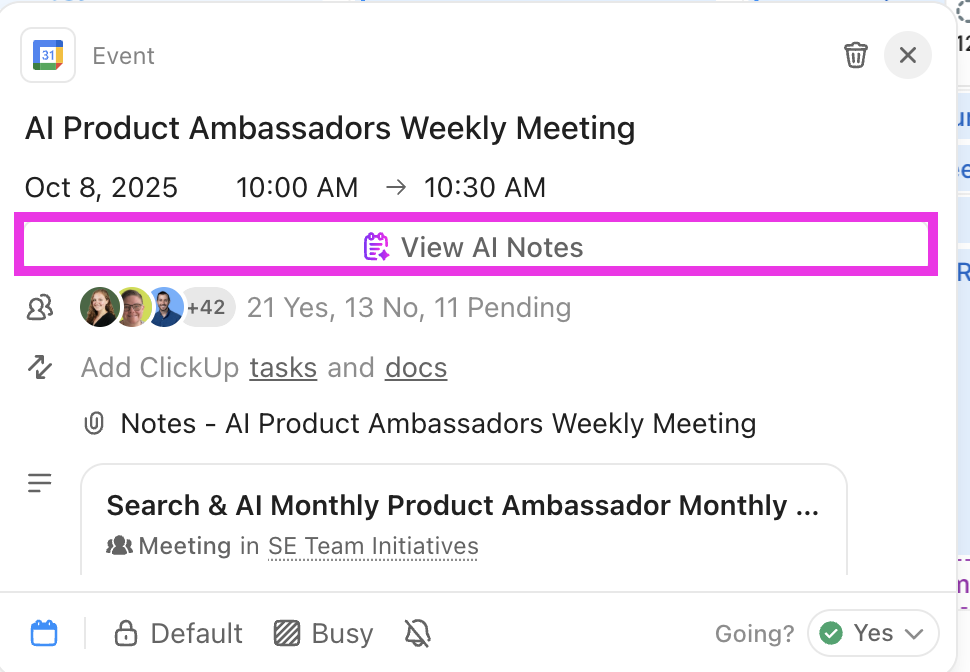
It automatically joins your meetings (Zoom, Google Meet, or Teams), captures everything, and creates a private ClickUp Doc with structured notes. These include a clear overview, key takeaways, action items, attendees, and even a full transcript. For shorter calls, it also includes a video recording, while longer ones come with audio.
ClickUp Clips makes it easy to replace long meetings and unclear messages with quick, visual communication. Teams can record async video messages, their screen, share context, and communicate ideas more clearly, right inside their workspace.
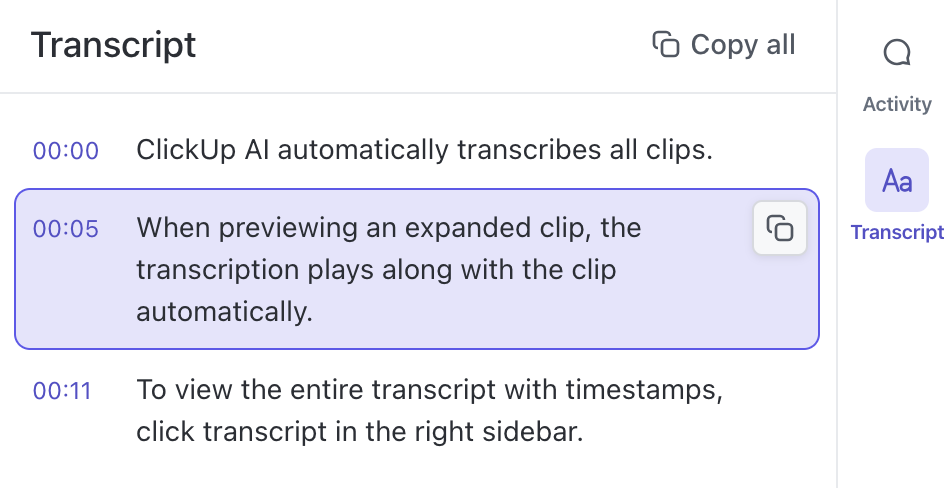
With Clips, you can record your entire screen, a specific window, or just a browser tab, along with audio. You can even create voice-only Clips when visuals aren’t needed. Once recorded, Clips are automatically saved in your workspace and can be instantly shared via link or embedded directly into tasks, comments, or Docs.
You get:
The best collaboration setup is about reducing the number of disconnected tools your team has to manage. 🙌
Here’s what a user had to say about ClickUp:
Before ClickUp, meetings, and back-and-forth email communications led to a black hole where items were left unseen and unattended. Due to this, tasks were not being reviewed on time, and no one knew how the creative development was going.
Now, everyone on the team can clearly see when action items are due, chat and collaborate within the tasks.
Microsoft Teams and Slack both do what they’re built for: communication. Teams leans into structured meetings, while Slack excels at fast, flexible messaging. But both still leave a gap between talking about work and actually getting it done.
That’s where ClickUp changes the conversation entirely.
With ClickUp Chat, discussions are directly tied to tasks and projects. ClickUp SyncUps bring meetings into your workspace with AI-powered notes and action items. ClickUp Clips replace unnecessary calls with clear, async video updates. And with ClickUp Brain and Brain MAX, you can search, summarize, generate, and even use Talk-to-Text to turn ideas into action instantly.
Sign up to ClickUp for free today! ✅
No. Slack is owned by Salesforce, which acquired it after Microsoft built Teams as a direct competitor.
Yes, you can connect them through the Microsoft Teams Calls app in Slack or through Zapier, but managing two chat platforms creates work sprawl.
Slack Huddles support audio and video with up to 50 participants on paid plans, but they don’t include recording, live captions, or breakout rooms.
Microsoft Teams leads in total users, largely driven by bundling with Microsoft 365 subscriptions, while Slack remains widely used among startups and tech companies with diverse tool stacks.

Manasi Nair
Max 23min read
Manasi Nair
Max 29min read
Manasi Nair
Max 14min read

© 2026 ClickUp