

If you’re reading this, we’ll go out on a limb and assume:
- You’re a marketing professional tired of the full-time grind and want to do your own thing and own your time
- You’re a young professional or student and want to try your hand at freelance or a side gig
- You already run a business and want to expand your offerings
Well, the good news is if you’ve ever wondered if becoming a marketing consultant is a good idea, the answer is simple—yes. You just need to find your niche and, more importantly, understand that you will have to tailor your offerings to suit your clients’ needs. Would a protein supplement brand have the same marketing strategy as a fast food company? Probably not.
Here’s a quick look at what we’ll cover:
- Who a marketing consultant is
- What your job as a marketing consultant entails
- How to set up your marketing consultancy
- How to leverage networking tools such as LinkedIn
- How to become an independent marketing consultant
- The finances of it all
- How to grow your marketing consulting business
Let’s break it down.
How to Start a Marketing Consulting Business
- Understanding Consulting & Its Relevance in Marketing
- Roles & Responsibilities of a Marketing Consultant
- Setting Up a Marketing Consultancy
- Leveraging Networking Tools
- The Independent Marketing Consultant
- The Financial Aspect of a Marketing Consultancy
- How to Grow Your Marketing Consulting Business
- From Passion to Profession
- Frequently Asked Questions (FAQ)

 Summarize this article for me please
Understanding Consulting & Its Relevance in Marketing
A consultant is an individual a company hires for their expertise in a particular field. You could be hired to perform any number of consulting services, including audits, strategy, feedback, upskilling, problem-solving, and even to offer your expertise on a project an in-house team is working on.
A marketing consultant is simply a consultant who offers their marketing expertise—branding, digital marketing, market research, product launches, and advertising are some key areas. As a marketing consultant, you can focus on a niche that best utilizes your skills. For example, your focus could be digital marketing, and your niche could be how to grow organically through SEO content.
The size and scope of your own consulting business are totally up to you.
Now you might ask yourself why an organization wouldn’t do this in-house.
- Consultants allow organizations to get an outsider’s perspective. There could be solutions or problem areas that an internal team may have missed
- Given that a consultant is not a full-time employee, organizations can always easily find someone else without the extensive paperwork that comes with full-time hires
- Sometimes, organizations have no choice if they’re keen to work with highly experienced and sought-after marketers who may not want to be tied to any single organization
It may interest you to know that legacy businesses such as McKinsey & Company (specializing in management consulting), Bain & Company (doing similar work), and Deloitte (offering a range of professional services) all fall into different niches in the consulting world.
None of these companies were built overnight, so your goal is to scale one step at a time. To build a profitable consulting business, remember to focus on your skills, don’t be deterred by failure, and always be open to course-correct if something isn’t working for you.
Summarize this article for me pleaseRoles & Responsibilities of a Marketing Consultant
Would soccer legend Lionel Messi have scored as many goals without the right coaching and his teammates playing crucial passes to him? Would legendary Olympian Usain Bolt have won as many gold medals without the right nutrition and care from expert trainers?
As a marketing consultant, your role is similar to that of an elite athlete’s coach. Every organization you work with will have a different focus area that needs strengthening, flaws that need ironing out, and strategies that need implementing.
How they execute a particular project is where you come in. Depending upon the scope of work, you will analyze their digital marketing efforts and brand initiatives, run campaigns, drive engagement, and ultimately contribute to growth. There are some basic skills that will benefit you as a consultant, including problem-solving, analytical thinking, and strategic planning.
Understanding the target audience
You’ll also need to understand different audience personas while working with different organizations. Remember the protein supplement and fast food example? Even organizations in the same industry, say two fast-food companies, likely have different target audiences. Perhaps one caters to 35- to 55-year-old working professionals looking for a healthy meal during their work break, while the other caters to high schoolers looking for a greasy, after-school snack.
Your customer demographic will define the kind of marketing initiatives you undertake. Snackable and shareable content on social media platforms like Instagram might work for those under 18. At the same time, you might have to target the 35- to 55-year-old age group through smart, insightful content on LinkedIn. Some businesses may also benefit from other digital marketing avenues, such as SEO blogs that drive organic growth.
Leveraging CRM
Amid all this, it’s likely you’ll also have to navigate the world of Customer Relationship Management (CRM). Don’t be fooled by the self-explanatory nature of the term; it can get quite complex. Simply put, CRM is crucial to helping your business grow.
Bonus read: 10 best CRMs for consulting in 2024
Your CRM strategy could be as simple as reaching out to potential clients on LinkedIn and as vast as hiring an external agency that handles CRM for you. It will help you gain valuable insights on potential customers, effectively communicate with clients, run targeted outreach campaigns, and even support cross-selling or upselling. For example, your cold message goes unanswered by hundreds of people except one. Why did they respond? Are they your niche? Why did it strike a chord with them?
Sounds like a lot, but don’t worry, there are some great AI tools for consulting to help take some of the load off you.
Summarize this article for me pleaseSetting Up a Marketing Consultancy
Setting up a successful consulting business may sound daunting. But if you follow a few actionable steps and take advantage of free templates like the ClickUp Consulting Project Plan Template, you’ll have a business set up quickly.
After you identify the areas of expertise and services you will offer and research the market and competition to position your services uniquely, this template will help you create a consulting project plan.
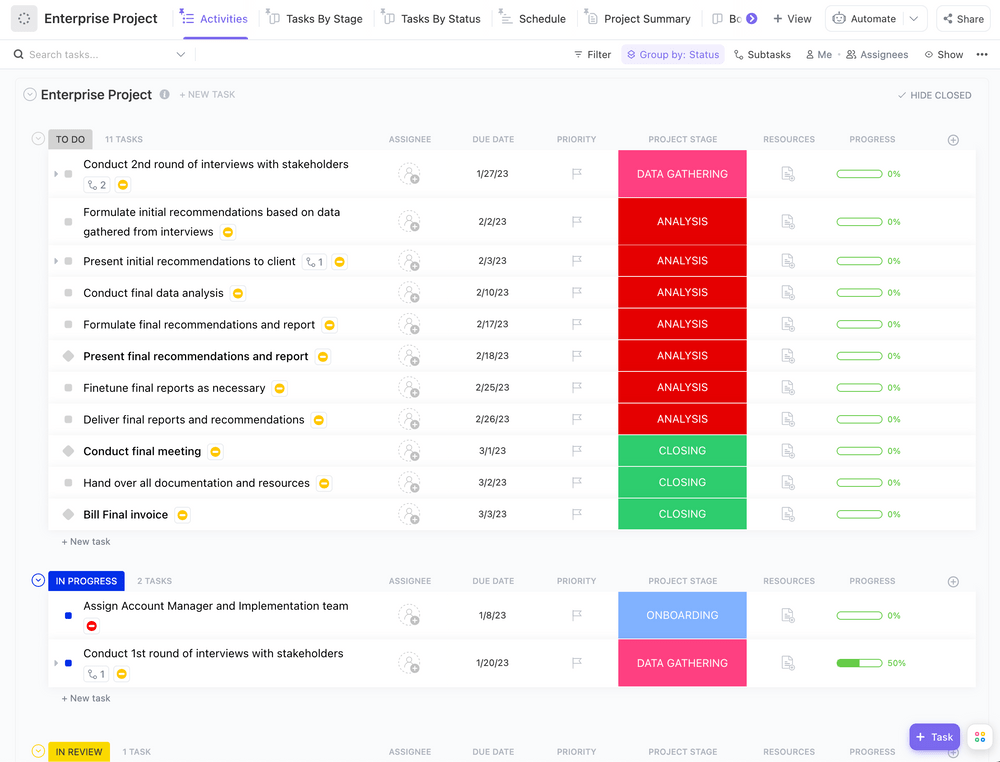
Use the template to:
- Organize larger projects into smaller, more manageable ClickUp Tasks and assign them to team members
- Set deadlines and monitor budgets using Gantt charts
- Monitor progress with 12+ custom task statuses and dashboards to ensure smooth project execution
Follow these steps to get started.
1. Find your niche
If you were to buy a car, you would consider a budget, the type of car, features, fuel economy, etc. And after test-driving a few, you settle on one that meets your requirements. Becoming a marketing consultant is similar to this: you are the only one with the car, and your potential clients are buyers with different preferences and requirements. Like every car isn’t for everyone, you must find what sets you apart from your target audience. There will always be other consultants and businesses offering the same services as you.
- What are your strengths? Is it SEO? Content marketing? Advertising? Brand? Social media marketing?
- Focus on your core skills and work that you enjoy doing. It’s an old cliche, but if you love your job, are you really working?
- Don’t be afraid to go back to the basics. You might have a skill you picked up early in your career but stopped using it as much as you progressed. That very skill, say, quality long-form writing, could be your niche
- Less is more. If you offer too many services, brands may see you as a Jack-of-all-trades (master of none)
2. Make a rate card
Once you settle on your niche and services, the next step is to make a rate card. Your rate card should include the following:
- List of services with a rate card for each. You could charge per hour, per project, or per day depending on the service and what suits you best
- You may choose to charge different clients differently. For instance, a lower base rate for startups compared to larger organizations with bigger marketing budgets
- It is a good idea to add a timeline to your services. For example, if you are helping conduct an audit, mention how long the project will take so the expectation is set from the beginning
3. Build a portfolio/website
You could go all out and make a website that you can direct potential clients to or make a portfolio that you share with them. The choice is yours. Whichever route you choose to take, make sure both highlight your strengths, showcase your skills, and clearly define what you are offering to potential clients.
4. Get professional liability insurance
As with all things in life, sometimes plans don’t pan out the way we hope. Or perhaps you did your best, but your client isn’t happy. This is where professional liability insurance comes in. It protects you from settlement claims and costly legal fees in case of lawsuits arising out of negligence, mistakes, or failure to deliver on promised services.
The cost of professional liability insurance will depend on the size of your business and the field you are working in. Some clients may require professional liability insurance as part of your contract.
5. Decide between a registered company and an individual consultant
As with the portfolio and website, whether or not you register a company or choose to operate as an individual consultant is entirely up to you. Let’s briefly look at the advantages and disadvantages of both.
Advantages of a registered company
- Scaling is easier, with seamless integration of more partners, employees, etc.
- Professional image
- You’ll have the potential for tax benefits
Disadvantages of a registered company
- Higher initial costs
- More paperwork, regulatory requirements, etc.
- Once you scale and have more partners, employees, etc., there will be less flexibility in decision-making
Advantages of being an individual consultant
- Your setup cost can be close to zero
- Easier to manage with less paperwork and regulatory requirements
- Complete control of your time, business decisions, etc.
Disadvantages of being an individual consultant
- Your personal assets are at risk in case of debt or legal claims
- You might have to work harder to build credibility
- More complicated to scale
6. Find a mentor
Finding the right mentor or experienced entrepreneur friend can teach you valuable lessons and prepare you for any potential roadblocks. The right mentor will not only help guide you but also build connections, create accountability, learn from someone you trust, and keep you on the right path.
7. Find clients
Now comes the grind. Finding clients, especially that first client, is the biggest challenge you will face as a marketing consultant. You must work hard to get your first client from cold messaging, referrals, personal branding, etc. However, once you do, it should be much easier to find more gigs, as good work will always lend itself to glowing referrals.
Summarize this article for me pleaseLeveraging Networking Tools
One of the biggest disadvantages of being a consultant is that you aren’t guaranteed a monthly paycheck. This is why it’s important to keep the momentum going once you’re up and running. Relying on a few clients is a recipe for disaster, so keep the outreach going—whether you do it yourself or hire someone to help.
You may create an engaging Instagram page for your business and promote content on other platforms like Meta and X, but the place you want to promote the most on is LinkedIn. It is the best platform for professionals like you to network, engage, and reach out to potential clients, second only to a personal referral.
Pro tips for LinkedIn networking
Assuming you already have a LinkedIn account, here are some of the ways you can use it to your advantage:
- Connections: Stalking your peers is always fun, even on a professional networking platform like LinkedIn, but remember that they may also be your competition. Make sure to send connection requests to leaders at companies you’d like to work with—follow them and regularly engage with their posts
- Personal branding: LinkedIn is a great place to get noticed for your skills and potential work engagements. Post consistently about topics around your area of expertise, or just post about topics that you’re passionate about on your own profile or company page. Your end goal is for a potential client to see your post
- Lead generation: LinkedIn can be the only CRM you and your business need. Use its advanced search feature to find the right individuals to send cold messages to (you might need a LinkedIn Premium account to message some members). It’s the most direct way to contact the companies you would like to work with
- Finding talent: If you plan to expand your business instead of flying solo, LinkedIn is also a great place to find excellent talent. While you can post a job opening, don’t underestimate the power of a powerfully crafted hiring post from your personal profile. Chances are the people you reach are either fans of your work and will be a good culture fit or are already vetted and good at what they do
Summarize this article for me pleaseThe Independent Marketing Consultant
We hope this article has answered all your questions regarding the ins and outs of starting a marketing consulting business. If you’re convinced it’s something you’d like to take on independently, then this part is for you.
Here are some perks—yes, it’s no joke—you’ll enjoy as an independent consultant.
Honing your skills
Because you’ve chosen to fly solo, you can have your cake and eat it too (well, mostly!). You can choose to focus on work you both enjoy doing and are good at or upskill and explore other avenues on the side. You’re also the master of your own offerings, so feel free to tailor your services to fit your needs. And if you’d like to build credibility, consider getting a consulting certification that will reinforce your expertise.
Flexibility
Perhaps the job’s flexibility is the biggest perk of being an independent marketing consultant. As your own boss, you get to pick the people and organizations you want to work with, set your working hours, and answer only to yourself (this one’s bittersweet because the goof-ups are also on you!).
But make sure you don’t slack off and let down your clients or yourself. This is even more important when you are on a retainer with set deliverables and agreed timelines.
We’ve already looked at how to start a marketing consulting business, but here’s where the fun begins for you.
Here are some brief pointers on how to effectively fly solo:
- Focusing on your core skills and doing what you love is the first step to having fun as an independent consultant. However, your offering must meet market demands because that’s what will bring in business
- Create a business plan that includes your services, target audience, and financial projection and needs
- Even if you’re working independently, make time to establish yourself. Be that by building a powerful personal brand on LinkedIn (Medium or even Substack), coming up with a unique brand name, designing a logo, creating a website/portfolio, and even an outreach plan
- Make sure your paperwork is in order. This includes professional liability insurance, any licenses or permits your country or State requires, and the type of business you would like to register (sole proprietorship, LLC, etc.)
- Referrals are the best way to get clients but also focus on networking, cold messaging, and potentially even digital marketing to attract clients
- Finally, it is important to stay up to date on industry trends. This will not only help you tailor your services to meet evolving market demands but also tell you to upskill in anticipation of shifts in trends
Summarize this article for me pleaseThe Financial Aspect of a Marketing Consultancy
So, how much does it cost to start a consulting business? Costs will likely vary based on the type of marketing consultancy you start, whether you choose to go independent or register a business, want to have an office space, etc.
Here are some of the basic expenses you will have to incur to start a marketing consultancy business.
Registration
Obtaining the necessary licenses and registering your business will cost between $500 and $2,000, depending on your operation and business structure.
Technology
An entry-level laptop or computer can cost between $400 and $1,000, depending on the manufacturer and specifications. Fortunately, you can get away with spending nothing on software, with plenty of free options. The best marketing agency software can help get you started.
Office space
This is one cost that you can completely ignore if you work from home or allow any future employees to work from home. If you prefer the buzz of physical office space, it will cost you anywhere from a few hundred dollars to over $1,000 per month, depending on your location and the size of the space you rent. It’s worth mentioning that even if you set up a home office, you could be looking at spending a few thousand dollars depending on how fancy you want it to be.
Marketing
You can spend as little as $3-4 per paid ad on Instagram to $25 and up on platforms like LinkedIn to get your brand the eyeballs it needs. However, you can grow your business organically by coming up with creative ideas that won’t cost you a penny to execute.
Miscellaneous expenses
Costs such as professional insurance, potential legal fees, and unforeseen expenses such as computer repairs or upgrading your software suite can run into hundreds and thousands of dollars.
But that’s not all—you will have to consider two other very crucial financial aspects.
To start with, make a call about your preferred pricing model. A value-based pricing model is beneficial to both the consultant and potential client, as fees are set based on the perceived value of the services provided. This has an advantage over hourly pricing models.
Second, you have to decide whether or not you would like to contract the services of a financial advisor. If you’re an independent consultant working with select clients and have no plans to scale, you may not need a financial advisor. However, if you plan to expand, a financial advisor can help you budget, forecast growth, manage cash flow, and ensure your business is financially stable.
Summarize this article for me pleaseHow to Grow Your Marketing Consulting Business
If you’ve made it this far, congratulations! Hopefully, you now have a decent sense of what it takes to set up and run a marketing consultancy. As they say, though, it’s probably in your best interest to plan for the future. Growing your business will help you keep up with inflation and also afford a better lifestyle for yourself.
Make a start by keeping a handy list of valuable resources, such as helpful blog posts on how to scale your consulting business and growth marketing strategies.
Must-have skills to achieve tangible growth
Communication is key
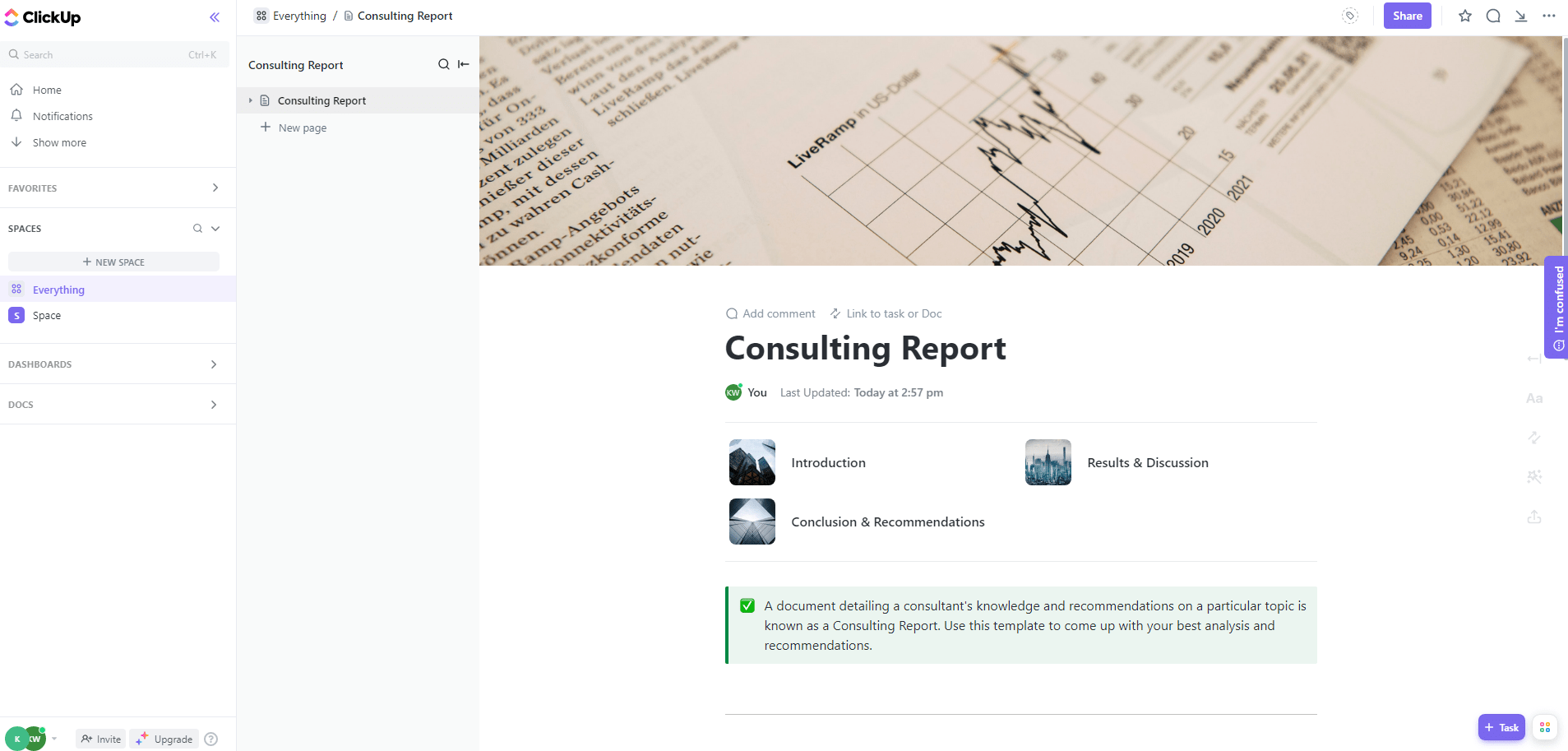
Remember, no matter how good you are at what you do, it will get you nowhere if you aren’t effectively getting your message across to current and potential clients. The ClickUp Consulting Report Template is a great tool to have in your arsenal to stay on top of your communication as a consultant
Be creative
There are hundreds, if not thousands, of marketing consultants out there. What makes you different? Be adaptable and show clients that you can offer them something others cannot
Solve problems
Is there a company you really want to work with? Look at their marketing efforts, figure out how to plug the gaps, and reach out to them. Very often, clients will be open to a fresh perspective that an in-house team might miss
Build relationships
An obvious one, but an important one. Don’t underestimate the power of relationship building in client management. Even clients who can’t afford you but enjoy their conversation with you might become referrals! Even once a contract ends, a client might refer you to someone else if you’ve built a solid relationship with them
Cultivate management skills
You need to be on top of every.single.thing. Be it the projects you’re taking on, understanding basic business principles, or developing decent financial acumen—being organized and disciplined is half the work done
Strategic management
We’re almost at the end now, but before we conclude, let’s talk about something that will take you very far in your consultancy business—strategic management. This will help you achieve your consultancy goals by ensuring you are structured in planning, implementing, and evaluating every step of your business.
- Set clear goals for your consultancy business that align with your personal goals
- Perform a thorough market analysis to identify your niche. Combine this with a SWOT analysis (Strengths, Weaknesses, Opportunities, Threats) to understand factors that could affect business goals
- Set SMART goals (Specific, Measurable, Achievable, Relevant, Time-bound) and develop a strategy that plays to your strengths
- Make sure to stay relevant. But also stay true to your brand and your own identity. Don’t switch from knowledge-based posts to memes based on short-term trends, instead hop on moment marketing trends that align with your business and stay culturally relevant
As you start to shape your marketing consultancy business, don’t forget that ClickUp has many free tools and templates you can leverage to get you going. It’ll help you create and quickly access custom client portfolios all in one place.

ClickUp Whiteboards are a great way to brainstorm independently, with your team as you grow, or with external marketers you contract. ICYMI, ClickUp also serves as your CRM, in addition to managing tasks, planning projects, and even integrating any other software you use.
Summarize this article for me pleaseFrom Passion to Profession
Becoming a marketing consultant can be a lucrative career. You’ll have the freedom to take on projects you are truly passionate about. This can lead to immense professional growth, as it also lets you take on diverse opportunities, unlike the monotony of a typical 9-5 job.
However, it requires a lot of hard work, competition is fierce, and you won’t have the security of a regular income. To top it all, you will have to be your own boss, which involves managing a business and all the operational challenges that come with it.
But don’t let the negatives deter you—the possibilities are endless! Excellent communication skills, coupled with a growth mindset and bias for action, and high-quality work will ensure you grow both personally and professionally. Good luck!
Summarize this article for me pleaseFrequently Asked Questions (FAQ)
1. Is a marketing consultant a good job?
A marketing consultant’s job can be lucrative and quite exciting, as it allows you to choose your own projects and promises superior work-life balance to a traditional full-time job.
2. What do I need to start my own consultancy?
You can start your own marketing consultancy with just a computer and an internet connection. Various free tools, like ClickUp, allow you to build your business from scratch, and platforms such as LinkedIn are great ways to reach potential clients.
3. What do you need to be a marketing consultant?
To be a marketing consultant, you need expertise in market research, strategy development, digital marketing, and branding. Strong analytical skills, creativity, and communication abilities are essential. Experience in the field and a deep understanding of various marketing channels and tools are crucial for providing effective, tailored solutions to clients.
4. Can I be a consultant without a company?
Yes, you can be a freelance consultant without registering a company.


Everything you need to stay organized and get work done.

Recent Articles
Claude Skills for Writing: How to Build One That Actually Fires 
Claude Skills for Writing: How to Build One That Actually Fires
What Is Tacit Knowledge? Definition, Benefits and Examples 
What Is Tacit Knowledge? Definition, Benefits and Examples
How Marketing Agencies Can Use Claude (Without Wasting It) 
How Marketing Agencies Can Use Claude (Without Wasting It)
