

From Colossus to Terminator to Agent Smith, popular culture is rich with examples of artificial intelligence (AI) gone rogue.
Dystopian stories aside, it’s normal to wonder about or even fear an AI takeover. After all, our news feeds are full of stories of AI technology outperforming humans. So if you or those around you are struggling with AI anxiety, know that you’re not alone.
And we’re here to help!
So, take a deep breath as we help you navigate the promising world of AI together—minus the anxieties!
AI Anxiety: Is AI Stealing Your Job (and Your Sanity)?
- Understanding AI Anxiety
- What Are the Leading Causes of AI Anxiety?
- Prevalence of AI Anxiety: Trends and Perceptions
- How to Know if You’re Experiencing AI Anxiety?
- 9 Actionable Tips for Overcoming AI Anxiety
- Managing AI Anxiety with ClickUp
- Embracing AI Minus the Anxiety With ClickUp
- Frequently Asked Questions

 Summarize this article for me please
Understanding AI Anxiety
AI technology has touched nearly every aspect of our professional and personal lives. You may use AI in marketing to generate rich media content or write captivating ad copy.
Your product teams might use AI in software development for code completion, automated testing, and code documentation.
AI for HR comes in very handy when screening large numbers of job applicants, scheduling interviews, and more.
Then, of course, no customer support experience is complete without ubiquitous chatbots and virtual assistants.
And that’s just scratching the surface.
As we interact with a growing number of AI tools, many of us may feel a twinge of unease. Does the AI seem eerily human? Is my data secure? Will AI soon be able to take over my job?
These feelings of worry are what we call AI anxiety.
AI anxiety isn’t necessarily the fear of robots taking over. Instead, it’s a complex emotion that may emanate from the fear of job displacement to uncertainty about the future of the human race, and everything in between!
Consider how content writers felt when generative AI tools like ChatGPT became mainstream or how deep fakes of political leaders confused the world. AI anxiety is partly the whiplash many of us experience when confronted with the rapid rate of technology development.
Interestingly, this isn’t a recent phenomenon. Throughout history, people have often resisted technological advancements.
Take, for example, the Luddite movement, where textile workers opposed the use of mechanized looms or knitting frames. Or how people believed the telegraph would lead to social unrest and panic when it became mainstream in the 19th century. We’ve also had computer anxiety in recent years!

In short, it’s absolutely valid to feel anxious. AI is a complex new technology that’s growing at a breakneck speed. Naturally, navigating the uncertain future it may bring is daunting.
Summarize this article for me pleaseWhat Are the Leading Causes of AI Anxiety?
What makes us fear AI technology in the first place?
Well, the answer is multifaceted. So let’s dissect each element:
- Loss of job security due to automation: Fear of robots taking over specific tasks and causing widespread unemployment across different industries and sectors
- Uncertainty about the future: The rapid pace of advancements in AI builds a sense of uncertainty about the future of work and the skills required to remain employable
- Rise of the gig economy: AI may tilt the economy by focusing on short-term, unstable work arrangements rather than long-term talent retention and nurturing
- Human skill neutralization: With AI automating several tasks requiring human skill or expertise, it will devalue said skill and cull human creativity and job satisfaction. It may even kindle existential crises as humans deal with a sense of doom and obsolescence with AI taking charge
- Automated decision-making: Using AI for decision-making in matters of law, finance, and healthcare without any human oversight
- Algorithmic bias: AI algorithms may perpetuate social, economic, ethnic, and other biases because of the limited training data sets and poor representation
- Lack of transparency: The black-box nature of AI systems raises questions about its fairness, accountability, and potential misuse
- Fear of singularity and sentience: The idea that AI will attain superintelligence and pose a threat to humanity at large is a common theme
- Privacy and security concerns: A lack of consistency in AI governance paired with AI’s ability to access, collect, and analyze large volumes of data stokes privacy and security concerns
- Blurring lines between humans and machines: Being unable to differentiate humans from AI and vice versa as the technology turns increasingly sophisticated
- Fear of weaponization of AI: Like any tool, AI isn’t intrinsically “good” or “bad”. It depends on the intent of the individual or the organization using it. Its use for malicious intents in surveillance or warfare may also seed anxiety

- Constant exposure: The psychological fatigue from non-stop (sometimes sensationalized) news about how AI manipulates decision-making, behavior, and emotion can also cause you to fear it
Whether these fears are unfounded or based on the truth is a whole different debate. The source and intensity of such anxiety varies depending on each individual’s background and experiences. It might even stem from a cause that’s not listed above!
To put it in another way, AI anxiety is very real and it’s a lot more widespread than you may think—as we’re about to explore in the next section.
Summarize this article for me pleasePrevalence of AI Anxiety: Trends and Perceptions
We rounded up some AI statistics surrounding AI anxiety. Here’s what we found:
- Three out of four employees worry AI may render their job obsolete, while two-thirds are afraid of being replaced by AI
- 22% of Americans view AI as a threat to their job, with this fear most prominent in the IT, manufacturing, and retail industries
- 63% of employees are concerned they lack access to or the resources for AI learning opportunities and want more training
- Employees believe AI will hurt them financially by negatively affecting their pay and limiting career progression opportunities
- Americans largely fear the economic implications (71%), lack of regulation (53%), and sentience (42%) of AI
- Employees are anxious about using AI ethically and responsibly, with concerns around morals, legal implications, and cybersecurity
- About 8 in 10 employees believe organizations must self-regulate AI usage, while nearly as many feel that governments should play a regulatory role
- Only 14% of workers have witnessed their job being replaced by a robot, suggesting that fears around AI taking over human jobs may be exaggerated.
- Millennials and Gen X are more open to using AI at work, while Gen Z and Baby Boomers are less likely to trust it
- Employees within the 26 to 34 age bracket are most likely to experience AI anxiety
- AI anxiety is higher among people of color and diverse ethnicities, primarily in Black, Hispanic, and Asian employees
- Nearly half of the employees experiencing AI anxiety saw a decline in their overall mental health
- About half of the employees worrying about AI reported the intent to seek a new job with a different employer
Summarize this article for me pleaseHow to Know if You’re Experiencing AI Anxiety?
Anxiety is a normal human emotion that manifests in different forms. However, AI anxiety stands out in a few ways. For one, regular anxiety focuses on multiple stressors or triggers ranging from uncertainty, financial concerns, health conditions, or social interactions—most of which are hypothetical or even abstract.
On the other hand, AI anxiety stems from a specific concern related to AI’s development and impact on human life. The tangible presence of AI makes these anxieties very real and immediate.
Here are some signs you could be experiencing AI anxiety:
- Do you often think about how AI can automate your job and make your skills obsolete?
- Are you worried about how AI is changing the nature of work?
- Do you stress over the new skills you’ll have to acquire to remain employable?
- Are you concerned about the vast amount of data AI systems collect, store, and analyze?
- Do you struggle with intrusive thoughts about AI surpassing human intelligence?
- Do you feel bombarded by sensationalized or exaggerated content on the negative impacts of AI?
- Are you anxious about the malicious use of AI, especially since it’s virtually indistinguishable from humans?
- Even if you can’t pinpoint a specific reason, do you have a general sense of unease surrounding AI apps, tools, or platforms?
Summarize this article for me please9 Actionable Tips for Overcoming AI Anxiety
Here are some practical tips on how to reduce workplace anxiety:
Demystify AI
It is only natural to fear something you don’t fully understand. So, bust out that AI glossary to tame the monster! Explore online courses, resources, or libraries to dive right in. Once you get a deeper understanding of the basics, such as common terms, types, capabilities, and limitations, you’ll feel more confident in knowing that it (currently) does not hold a candle to emotional intelligence.

Focus on the positives
Explore the various opportunities AI advancements may unlock in different fields. Research about the headways it’s making in climate change, healthcare, and education. Of course, stay wary of the potential dangers, but do not be consumed by it. Focus on the real-world benefits you see around yourself.
Experiment with AI
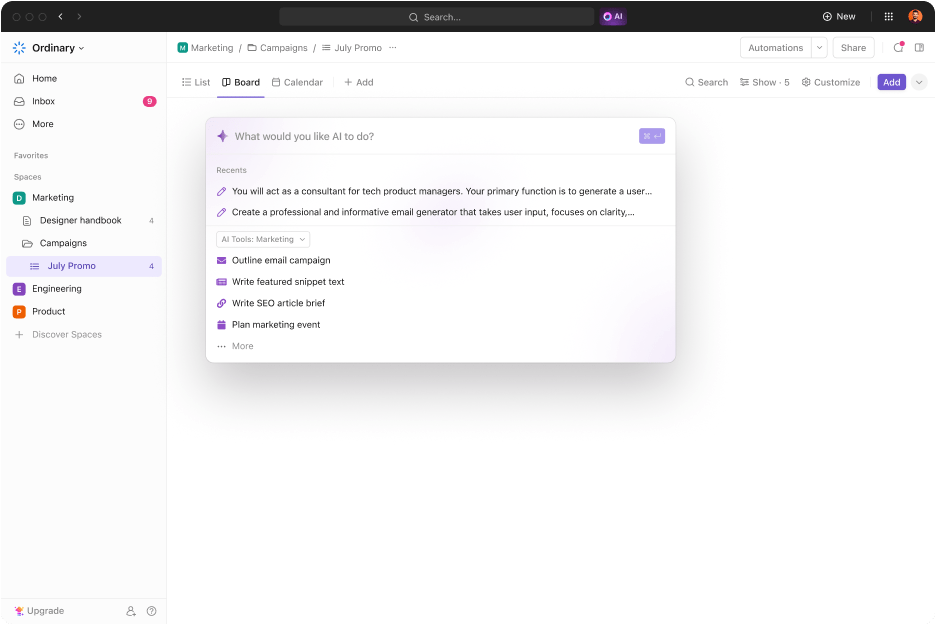
Exposure therapy can a great way to overcome your fears. So, use AI for daily life tasks to become more comfortable around it. Craft emails using generative AI tools or experiment with AI as a personal assistant. Getting first-hand experience of how AI integrations boost productivity can be a masterclass in dispelling misconceptions.
Prepare for the future
Sure, nobody knows which new technology may disrupt the world next. Try to take the upward AI trend as a sign to identify areas where AI complements your skills and natural talents. Explore learning opportunities related to other new technologies like automation, data analysis, and human-computer interaction to pad your resume.
Participate in AI communities
Become an active member of online forums and communities about AI. Use this stage to voice your concerns, ask questions, and gain insights from others in the same boat as you. You can even seek out and engage with experts to gain different perspectives and informed opinions. Such constructive interactions will challenge your inaccurate thoughts, perceptions, and assumptions about AI.
And if you’re still biting your nails, here’s what Pascal Bornet, renowned AI expert and bestselling author of IRREPLACEABLE, says about what makes humans so special:
Read Pascal Bornet’s newsletter on AI to learn more.
Prioritize your health
Advancements in technology have been a part of human civilization from the very beginning. There’s no reason for your physical and mental health to unduly suffer because of it. Practice relaxation techniques such as meditation, deep breathing exercises, or yoga to manage symptoms of anxiety. Also ensure you’re getting sufficient sleep, following a healthy diet, and exercising regularly.
Caring for your mind and body will make you more resilient to stress and anxiety. For instance, a speaking to a qualified therapist may help you accept what you cannot control and work on issues you can. Consider taking breaks from stressors or triggers until you create a healthy coping strategy.
Have SOS techniques
While most of the tips shared above are helpful in the long run, you might also require short-term strategies for when the anxiety builds up. Here are some quick yet effective exercises:
- 3-3-3 Rule: This is a grounding technique that includes naming three things you see, three things you hear, and three things you can touch or move
- 5-4-3-2-1 Method: This mindfulness exercise engages all five senses. Name five things you see, touch four things (ideally with different textures), identify three different sounds, name two things you smell, and taste one thing
Summarize this article for me pleaseManaging AI Anxiety with ClickUp
While AI anxiety is a genuine concern for most of us, it shouldn’t hold you back from living your best life today. Interestingly, the solution could be hiding in the very thing you fear—artificial intelligence.
You may know ClickUp as an all-in-one project management tool. But did you also think that you could use it—specifically ClickUp Brain—to overcome AI anxiety?
Yes! ClickUp Brain is your built-in teammate that lets you become comfortable around AI. As a role-specific AI that offers contextual assistance within your workspace, ClickUp Brain can help you:
Create content faster: Forget struggling with proposals, project plans, and customer emails from scratch. ClickUp Brain offers research-powered prompts, allowing you to create high-quality, relevant content in a flash
Focus on high-value tasks: Wasting time hunting for the right information, tool, or feature? Not with ClickUp Brain. It anticipates your needs based on your role and what you’re working on. Need a task summarized? Update progress? Generate to-dos? You got it!
How can you make the most of these capabilities at work? Let’s look at some popular use cases.
Overcome the overload
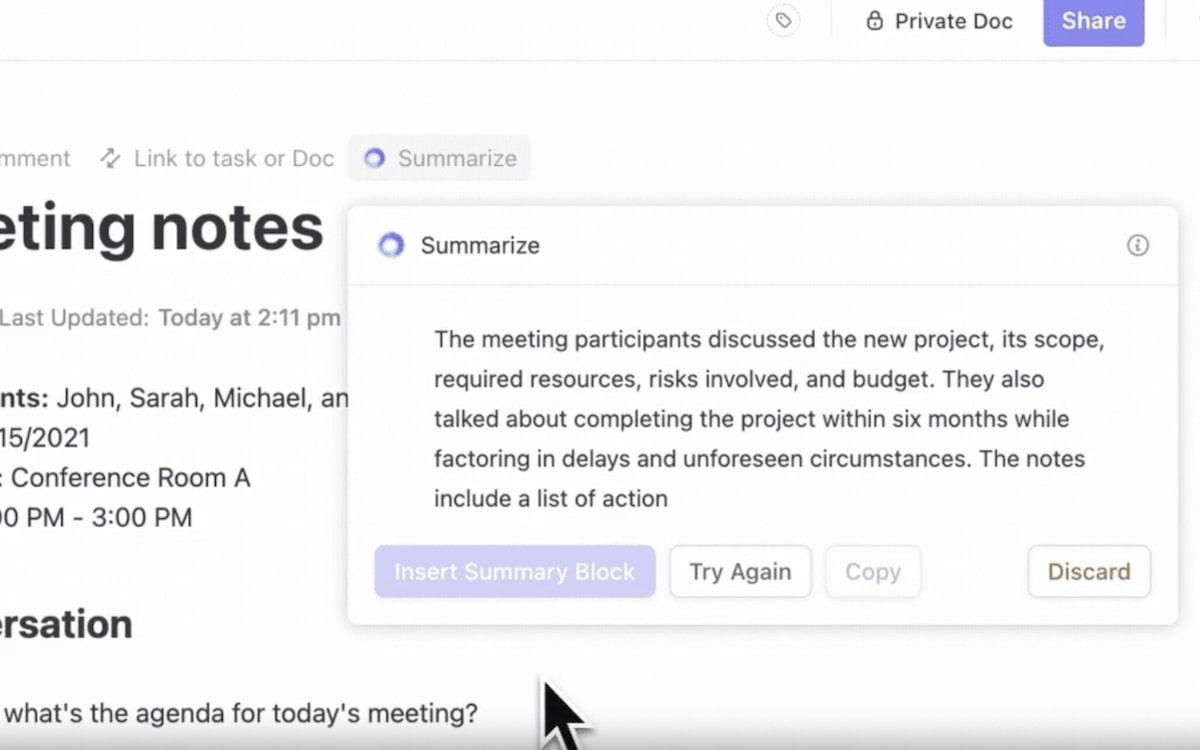
Feeling overwhelmed with all the learning resources or information about AI? ClickUp Brain can help you collect and categorize resources like online surveys, new studies, and innovation. It then organizes and presents this data as lists or mind maps to make the insights more accessible.
Lean on your AI assistant

ClickUp Brain is a dependable project management assistant.
We’ll say it again, working with AI is one of the best ways to get over AI anxiety. Enlist ClickUp Brain’s help to create tasks or sub-tasks within your personal or work projects.
You can use it to summarize your daily tasks, provide an overview of what you need to focus on next, or even write a standup for your current project workflow.
Write like a pro

Whether it is writing a social media post about your experiences with AI or summarizing notes from complex documents, ClickUp Brain makes writing less of a hassle. By delegating these tasks to AI, you gain firsthand experience of how AI can be beneficial so that you view it as a collaborator rather than a competitor.
Summarize this article for me pleaseEmbracing AI Minus the Anxiety With ClickUp
We get it: Change is scary, and it causes anxiety. But don’t let it stop from achieving your goals.
AI is a technology made by humans for humans, and its impact depends on how we use it. Strategies like learning about AI technology, developing digital literacy and fluency, and engaging in conversations about it can transform anxieties into opportunities.
Hopefully, embracing the tips we’ve shared above will help you get out of your head and thrive alongside AI. Consider using ClickUp Brain to springboard into action and get AI to work for you! Sign up for a free ClickUp account now!
Summarize this article for me pleaseFrequently Asked Questions
Why does AI make me anxious?
You may experience some anxiousness around AI because of:
- Fear of job displacement
- Uncertainty about the future of work
- Concerns of autonomous decision-making
- Worries about AI exceeding human intelligence
- Concerns about the malicious use of AI
Which jobs are most threatened by AI?
Repetitive, data-driven jobs are most vulnerable to AI disruption. This includes roles like data analysts, data entry operators, software engineers, paralegals, project coordinators, writers, administrative workers, and more.
How many people fear artificial intelligence?
According to some studies, nearly 70% of employees fear artificial intelligence.


Everything you need to stay organized and get work done.

Recent Articles
How AI Agents Can Elevate Client Service Delivery (Without Losing the Human Touch) 
How AI Agents Can Elevate Client Service Delivery (Without Losing the Human Touch)

