


Collaborating with distributed teams is not the same as collaborating with your team onsite. Organizations need to design and enforce multiple systems and processes to bring distributed teams together for improving collaboration.
While collaboration tools assist in many ways, collaborative leadership builds the foundation of an inclusive environment where diverse voices contribute through shared decision-making and open communication.
Collaborative leadership style can help you leverages the collective intelligence of the entire team, prioritizing shared decision-making, open communication, and teamwork.
However, prioritizing collaboration in the workplace is just one piece of the puzzle. You also needs to create processes and a culture of collaborative work management, where not just the leadership team but the entire organization is empowered to work together and lead with empathy.
In this blog, we will look at collaborative leadership and explore ways to implement it within your organization.
How to Practice Collaborative Leadership (with Examples)
- What Is Collaborative Leadership?
- Characteristics of a Collaborative Leader
- Collaborative Leadership in Remote Work and Virtual Teams
- How to Implement Collaborative Leadership
- Evaluating the Impact of Collaborative Leadership
- Overcoming Challenges and Mitigating Risks in Collaborative Leadership
- Future Trends in Collaborative Leadership
- Create Future Leaders Within Your Organization Using ClickUp

 Summarize this article for me please
What Is Collaborative Leadership?

The collaborative leadership approach is a methodology that involves every team member in a department or organization in taking ownership of their activities. This is a shift from the traditional hierarchical approach, where the leader dictates direction, and the other team members are expected to comply with it.
Instead, collaborative leaders involve their teams in the decision-making process, ensuring that every voice is heard. It creates an environment where everyone feels valued and empowered to contribute ideas and work together toward shared goals.
This has several key advantages for organizations, such as:
- Improved decision-making, as every team member can put forward their views, allowing the teams to get diverse perspectives and make well-rounded decisions
- Encourages team members to think innovatively and share creative ideas, leading to a culture of innovation and out-of-the-box thinking
- Promotes open and collaborative communication, ensuring sharing of ideas, concerns, and opinions
- Helps brainstorm and solve complex problems with the collective intelligence of the team, making it easier and more efficient to tackle these complex issues
But what does collaborative leadership include? Here are a few examples of what collaborative leadership can look like:
- A CEO who encourages open communication and feedback from all employees through regular town hall meetings and surveys
- Marketing managers who hold brainstorming sessions with the entire marketing team to develop a new campaign and take in their creative ideas for a well-rounded campaign
- A project manager who brings together cross-functional teams for quick brainstorming or stand-up sessions and communicates the daily or weekly plans with a clear overview of expectations and responsibilities for each team member
By fostering a culture of collaboration and leveraging remote collaboration tools, leaders can unlock their teams’ full potential and achieve remarkable results.
Summarize this article for me pleaseCharacteristics of a Collaborative Leader

Now we know exactly what collaborative leadership means. But how do you become a collaborative leader?
The answer lies in the common traits of collaborative leaders, which include:
- Excellent communication skills: Collaborative leaders are masters of communication. They are clear, concise, and actively listen to their team members
- Empathy and emotional intelligence: Understanding and considering the emotions and perspectives of others is crucial in a collaborative environment, and that’s why a high EQ is a must
- Trust and delegation: Collaborative leaders trust their team members and delegate tasks effectively, empowering them to take ownership of their work rather than micromanaging or taking over the tasks themselves
- Strong facilitation skills: Guiding discussions, ensuring everyone has a voice, and fostering healthy debate are essential skills for collaborative leaders
- Conflict resolution skills: Collaborative leaders should be able to navigate conflict constructively and find solutions that benefit everyone without creating distrust or disagreements in the teams
- Openness to feedback: Collaborative leaders welcome team input by actively seeking feedback. They don’t hesitate to critique to identify areas for growth and make the team stronger
Pro Tip: Use the ClickUp Employee Feedback Form to gather valuable information from your team in an organized manner, saving both time and effort.
Collaborative leadership can really improve team collaboration. Leaders tap into a hidden treasure of creativity and problem-solving power by valuing diverse perspectives and empowering team members to share ideas. This leads to more innovative solutions, better decision-making, and improved team dynamics.
Summarize this article for me pleaseCollaborative Leadership in Remote Work and Virtual Teams
Cross-funcțional collaboration is often challenging for most organizations. But, in a remote and distributed environment, collaboration requires the extra mile from the leadership to help make everyone feel connected.
This is because teams are now working in remote locations as per their preferences, leading to:
- A feeling of isolation, since physical separation and lack of real-time collaboration makes team members feel disconnected from each other
- Challenges in having group sessions or team meetings, as coordinating schedules and ensuring everyone can participate in meetings in different time zones is challenging
- Misunderstandings due to lack of non-verbal cues and limited face-to-face interaction
Collaborative leadership can bridge these gaps, fostering a thriving organizational structure and culture in remote teams. By embracing collaborative leadership practices, organizations can improve project collaboration and teamwork, enjoying several benefits, such as:
- Ownership mindset: Breaking down siloed conversations and teams fosters a sense of collective ownership through collaboration
- Empowers teamwork: Promotes trust and team building, where team members feel comfortable taking risks, sharing ideas, and admitting mistakes without fear of retribution. This fosters innovation and problem-solving, as diverse perspectives can be openly explored
- Builds trust: Improves transparency in the workplace, as everyone is informed about projects, goals, and challenges. Regular team meetings (virtual or in-person), along with readily accessible information through centralized project management and productivity solutions to help everyone be in sync
- Improves EQ: Collaborative leaders with high Emotional Quotient (EQ) create a supportive environment that addresses these concerns and fosters well-being. This reduces the chances of burnout and feelings of isolation
- Values team feedback: It creates avenues for active listening, as collaborative leaders don’t just listen to their team’s opinions; they also take in their concerns, ideas, and frustrations. This shows each team member that they are valued and creates a safe space for open communication, even virtually
Summarize this article for me pleaseHow to Implement Collaborative Leadership
Want to implement a collaborative leadership approach in your organization? While this approach depends hugely on organizational culture, there are ways to subtly introduce this methodology and help your team members take on more initiatives. Here’s a practical approach:
1. Define your company’s vision
Collaborative leadership means involving every team member in the decision-making process. For this to happen, organizations need to start by building a clear vision of their collective goals.
Start with a brainstorming session to understand your shared purpose. Focus on what your company wants to be known for and how it solves customer problems, and gain different perspectives to understand your ‘Why.’
2. Empower teams
Once you have your goals ready, empower your team members to take ownership of their respective roles and responsibilities. Delegate activities, help them step up in their roles, and create training programs to help each member gain the confidence to make decisions. This helps build future leaders and creates more opportunities for your company to grow.
Watch “Lead, Don’t Follow,” an expert knowledge-sharing session from ClickUp to understand how you can empower your project managers better.
3. Foster open communication
Encourage open and transparent communication; this is the only way every team member will come forward with their unique ideas and share feedback. To gather these thoughts, you can host regular team meetings to share updates on time, discuss potential challenges, brainstorm ideas, and address challenges holding your team back.
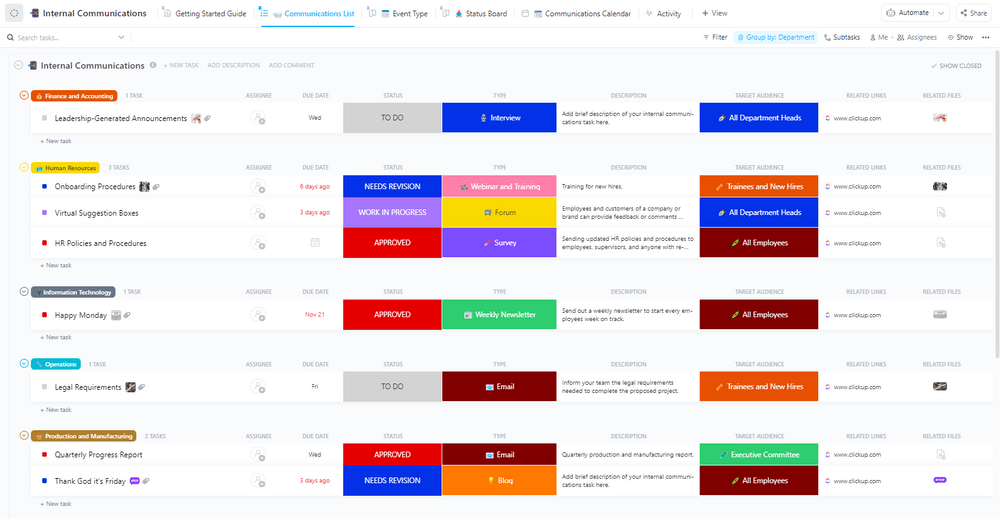
You can use the ClickUp Internal Communications Template for a transparent approach to sharing ideas. This template allows you to share company-wide updates effectively so your employees can access the right information at the right time. This helps you by:
- Organizing conversations, notes, and other documents in one place
- Facilitating a structured approach to delivering key updates to employees
- Providing transparency by enabling visibility into key company initiatives and processes
You can use this template to make your all-hands meetings or group sessions more productive by allowing employees to understand and engage with your larger goals better.
4. Invest in collaboration tools
The best way for multiple stakeholders and departments to collaborate is by using a single source of truth that houses multiple requirements. These tools allow teams to work together seamlessly, regardless of location or departments, and put all their ideas, documents, and knowledge base in a shared platform.
For all your collaborative efforts, you can trust an all-in-one platform like ClickUp, which is designed to bring out the leader within each team member. This is because the platform goes beyond just task management and project tracking—it is a powerful collaboration tool where every team member can share ideas, update information, and work together effectively.

With ClickUp, implementing collaborative leadership is a breeze. Its powerful features are designed with user-friendliness in mind, making it easy for you to take charge. These features include:
- Centralized communication: Bring all your conversations and chats to a centralized platform using ClickUp Chat View. This powerful chat feature allows all your communication within tasks, projects, and even documents to be seen on a centralized platform, ensuring that you can get answers, discuss ideas, and collaborate without any conversation getting missed
- Collaborative work: Use ClickUp Docs, the in-build document app, to help you collaborate on document creation and editing. Teams can add comments, update or edit documents in real time, and ensure everyone is on the same page. With ClickUp Collaboration Detection, you can even get automatic notifications to know when other people are typing, editing documents, or making updates to your documents
- Virtual brainstorming: Get a digital canvas where your team members can brainstorm on projects, add notes, and organize thoughts. With Clickup Whiteboards, you can even create mind maps, flowcharts, and sticky notes to capture ideas and collaborate visually
- Better communication: If your team members are struggling with a particular project or workflow, you can use Clickup Clips to record a video and share your ideas in detail. From mouse movements, comments, and one-click share options, you can easily create detailed clips to capture your thoughts and ensure that all your team members are on the same page

The best part about ClickUp is that you can start instantly using ready-to-use collaboration and communication plan templates. The ClickUp Team Management Plan Template can help you manage your cross-functional teams and empower them to make decisions.
This ready-to-use and fully customizable template is designed to help you stay on top of your activities, ensuring that every team member’s progress, milestones, and deliverables are clearly visible. This will ensure that every team member is on the same page. This helps you implement collaborative leadership by ensuring that every team member:
- Gets clarity on their role and responsibilities
- Communicate and share thoughts with others easily
- Stays accountable for their tasks
Summarize this article for me pleaseEvaluating the Impact of Collaborative Leadership
Implementing a collaborative leadership approach is one thing. To evaluate the effectiveness of collaborative leadership, you can measure specific KPIs for:
- Team performance: Look for metrics like task completion rates, project completion timelines, and innovation rates to gauge performance
- Sense of ownership: Use surveys or take anonymous feedback to understand if your collaborative leadership approach is providing results. Craft questions to gauge employee ownership, purpose, and satisfaction
- Productivity: Track project metrics and timelines to understand how many projects were delivered on time, how productive your teams were, and where the collaborative approach is helping your teams become more productive
- Client satisfaction: Track client feedback and satisfaction scores to assess the impact and understand if your collaborative leadership strategy is giving you the expected outcomes. When teams are working collaboratively and effectively, it often translates to better customer service and improved client satisfaction
Since collaborative leadership considers every input, it can lead to slower progress, especially if too many teams are involved. So, while collaborative behavior is ideal for a thriving work environment, it should be used by keeping the big picture in mind.
For example, when making tough decisions, the management teams or leadership team can work with a small cross-functional group and communicate the decision, much like a traditional approach. This way, you can still implement collaborative leadership without being too dependent.
Let’s quickly examine the differences between traditional and collaborative leadership so that you can decide which style best meets your needs.
| Metric | Collaborative Leadership | Traditional Leadership |
| Decision-Making | More informed, diverse perspectives | Faster decisions, which involve only top leadership or management teams |
| Innovation | Encouraged by open communication and diverse ideas | May be stifled by a top-down approach |
| Employee Engagement | Increased ownership and purpose | Employees may not be happy with management decisions, leading to disengagement and low morale |
| Problem-Solving | More effective due to collective intelligence | More individualistic or authoritative due to limited avenues for every team member to contribute |
Summarize this article for me pleaseOvercoming Challenges and Mitigating Risks in Collaborative Leadership
While collaborative leadership offers numerous advantages, it’s not without its challenges. Some of the common challenges one encounters when having a collaborative approach include:
- Decision-making slowdown: Longer time taken to reach a consensus, as diverse opinions and brainstorming can be time-consuming, especially with larger teams
- Potential for conflict: Diverse perspectives can lead to disagreements and conflict
- Lack of direction: Without a clear leader, teams may struggle with focus and direction
- Free riding: In some cases, team members may dodge responsibility, relying on others to do the work
To stay clear of these issues, we recommend using a mix of traditional and collaborative leadership methodologies. This ensures that you get the best of both strategies and do not create roadblocks by sticking with just one approach. Additionally, you can address these common pitfalls using these tactics:
- Define how your team will reach a consensus on key decisions. For instance, if a decision takes too much time to finalize, the CEO or team leader can have the authority to go with the decision they feel most comfortable with
- Set ground rules or effective communication, ensuring that every voice gets heard
- Recognize both individual contributions and collective successes so that both participative and individual processes thrive
Summarize this article for me pleaseFuture Trends in Collaborative Leadership
The future workforce is bound to be more distributed and collaborative. A collaborative leadership approach can give you a competitive advantage in this new and evolving landscape.
However, we cannot ignore the role of AI and machine learning in reshaping the workplace. By combining advanced technologies with collaborative leadership principles, you can:
- Empower AI-powered decisions: Team members can use AI to help with ideas and recommendations, making more informed decisions
- Automate repetitive tasks: AI can free up team members from mundane tasks, allowing them to focus on more strategic and creative work, which is ideal for a collaborative leadership process
- Improve communication: Some team members have strong ideas but lack the ability to communicate them effectively. With AI-powered content generation and editing, they can provide highly articulate and well-written ideas, helping them collaborate with other team members
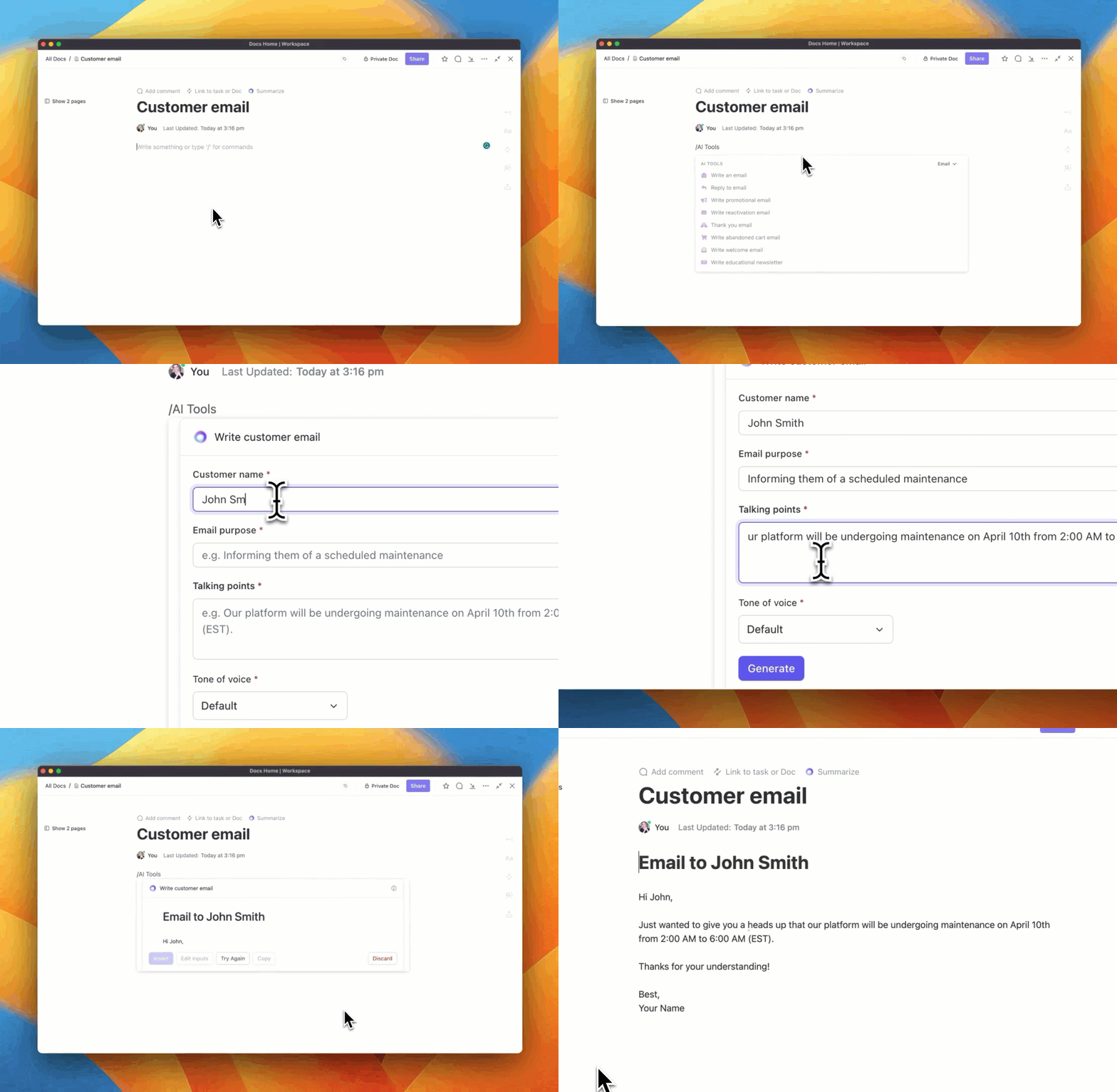
Pro Tip: Use ClickUp Brain to generate content for emails, documents, and much more in seconds
With a collaborative leadership approach, the future workplace will be:
- More agile and adaptable, as every team member has the required skills and knowledge to step up in their role
- Efficient despite global and diverse teams working together, as each team member is empowered to contribute and share ideas
- Improved emotional quotient (EQ) by creating a safe space for open communication, fostering innovation and collaborative growth
Summarize this article for me pleaseCreate Future Leaders Within Your Organization Using ClickUp
Collaborative leadership can seem radical, but it is necessary in today’s dynamic and often remote work environment. It empowers teams, fosters innovation, and leads to better decision-making.
To implement collaborative leadership practices, you must create a company culture that values individual performance and encourages them to work with others.
ClickUp can help you fine-tune the collaboration part of the equation with its host of features. Use it to collaborate in real-time via shared documents, brainstorm on virtual whiteboards, and keep track of important updates. This will help you keep everyone on the same page and allow your employees to innovate and take more initiative.
With tools like ClickUp, you can create a work environment where everyone feels valued, heard, and empowered to contribute their best.
Sign up for a free ClickUp account today and build a collaborative and successful team!

Everything you need to stay organized and get work done.
