

Sorry, there were no results found for “”
Sorry, there were no results found for “”
Sorry, there were no results found for “”
Most decisions seem straightforward at first glance. You pick an option, act on it, and move on. But what happens after that?
Every choice sets off a series of consequences—some predictable, others not so much. Thinking beyond immediate results is the difference between a strategic decision and an unexpected consequence.
This blog post explores second-order thinking, a skill that helps you analyze the bigger picture and anticipate long-term effects. You’ll learn how it works, why it matters, and actionable steps to apply it professionally and personally. 📝
Second-order thinking helps you anticipate the long-term consequences of decisions, reducing risks and improving strategic outcomes. Here’s how to master it:
ClickUp helps streamline second-order thinking with:
Second-order thinking is a mental model that helps individuals look beyond the immediate outcome of their actions and consider long-term effects. Also known as ‘second-level thinking,’ it pushes you to analyze how your choice might influence future scenarios, uncovering possibilities and risks that first-order thinking often overlooks.
Instead of stopping at the most obvious solution, second-order thinking encourages you to explore potential ripple effects, both positive and negative.
📌 Example: At public events, if one person stands to get a better view, others behind them may also stand, leading to a chain reaction where everyone ends up standing. This collective behavior doesn’t improve anyone’s view and results in discomfort for all.
Here’s why it’s important:
🔍 Did You Know? In chaos theory, small changes in initial conditions (the butterfly effect) can lead to vastly different outcomes. This idea is closely tied to second-order thinking, as decisions today can ripple out unexpectedly.
While first-order thinking is more reactionary and focuses on solving a problem quickly, second-order thinking requires taking a step back, questioning assumptions, and planning for potential outcomes.
Let’s look at their differences in more detail. ⚒️
| Criteria | First-order thinking | Second-order thinking |
| Focus | Focuses only on immediate rewards and surface-level outcomes | Considers long-term consequences and deeper impacts |
| Decision approach | Seeks quick and simple solutions | Explores deeper impacts and complexities |
| Assumptions about outcomes | Assumes outcomes are linear | Anticipates ripple effects and chain reactions |
| Time orientation | Often short-sighted and reactive | Proactive and strategic in approach |
| Example scenario | ‘Implementing new technology will improve efficiency’ | ‘Implementing new technology will improve efficiency, but we need to consider training, resistance, and cybersecurity risks’ |
| Risk assessment | Prone to impulsiveness and shortsightedness | Evaluates risks over time, aiming for sustainable solutions |
| Problem-solving style | Safe, superficial, and conventional | Outside-the-box thinking that challenges assumptions |
For example, consider the immediate success of a new strategy alongside potential long-term impacts on resources or team dynamics. This approach builds smarter, more resilient decisions.
💡 Pro Tip: Apply probabilistic thinking to evaluate decisions by assigning likelihoods to outcomes instead of assuming certainty. Pair this with second-order thinking to anticipate the broader ripple effects of your choices.
Second-order thinking encourages you to analyze your decisions and examine broader implications.
Here are some essential elements that form its foundation. 💁
🔍 Did You Know? The planning fallacy causes people to underestimate the time, cost, and effort needed for tasks, often leading to delays and overspending. Second-order thinking counters this bias, anticipating ripple effects like resource shortages or project bottlenecks.
Second-order thinking provides a structured way to approach decisions and anticipate their long-term effects. Here are the key advantages:
💡 Pro Tip: Use mental models when making decisions. Frameworks like inversion (thinking backward from a problem) and second-order effects analysis can help systematically evaluate the consequences of decisions.
Daniel Kahneman’s Thinking, Fast and Slow offers essential insights into the thought processes shaping decisions.
He describes two modes of thinking:
Second-order thinking requires engaging System 2 to overcome System 1’s instinctive reactions. For instance, instead of making a quick decision based on initial impressions, one should take the time to examine alternative scenarios and their potential outcomes.
Here’s a comprehensive guide to building and incorporating second-order thinking into your daily life. 👇
Before making a choice, define the situation or challenge clearly. Break it down into specific questions:
📌 Example: When launching a new product, define success metrics like increased sales, market share, customer satisfaction, or brand recognition. Don’t just base it on gut feel or hearsay.
💡 Pro Tip: Write down the risks and trade-offs. Every decision has them, and early acknowledgment prevents surprises later. You can also use the technique outlined in the Six Thinking Hats book to enhance decision-making and problem-solving.
First-order thinking focuses on immediate and direct consequences. Ask:
📌 Example: A product launch’s first-order effects could include:
Beware of reactive decision-making. If you only consider first-order effects, you risk overlooking unintended consequences.
To uncover second-order effects, think several steps ahead. Play out potential ripple effects by asking:
Try this exercise: Take a recent decision and break it into layers. List immediate outcomes, then explore what could result from those. Keep going until you uncover third-level consequences.
📌 Example: A surge in sales (first-order effect) could lead to:
💡 Pro Tip: Try pre-mortem analysis—instead of evaluating a past decision, imagine your choice has failed. Ask, ‘What went wrong?’ This forces you to think beyond surface-level effects.
Consider how your decision might affect others—your colleagues, customers, or stakeholders. Hearing their perspectives often provides fresh insights into the potential impact of your choices.
Ask yourself:
📌 Example: Customers may love the product, but delays might be problematic. Employees might see new opportunities but experience workload stress.
💡 Pro Tip: Surround yourself with diverse perspectives to gain fresh insights. Engage with individuals from different backgrounds and experiences to uncover blind spots in your thinking and consider new possibilities you might not have seen otherwise.
Encourage creativity and explore different strategies. For each alternative, repeat first and second-order analysis.
Explore multiple strategies:
You can also use these mental models:
📌 Example: Consider phased rollouts or beta testing with select users rather than launching one whole product.
💡 Pro Tip: Explore case studies to learn from examples of second-order thinking. Analyze decisions made in real-life scenarios, focusing on the ripple effects and how those choices shaped outcomes.
A decision is only as good as the reasoning behind it. Keep track of your thought process:
Not all effects happen immediately—some unfold over time. Consider the time horizon of your decision:
📌 Example: A new product might get great initial sales, but will customers return? Poor long-term service could erode brand trust.
💡 Pro Tip: Apply Monte Carlo simulations (used in finance and risk analysis) to predict different future scenarios based on probabilities.
Good decisions thrive on good questions. Challenge assumptions and ask:
Reverse-engineer decisions—instead of thinking forward, start from an ideal future outcome and work backward to see what choices would get you there.
💡 Pro Tip: Use the ladder of inference to analyze how your own biases, including limited data and assumptions, affect your decision-making. This will help you stay objective and select and interpret data based on facts.
Second-order thinking extends beyond theory and proves invaluable in real-world scenarios. Here’s how it applies across business, personal decisions, and problem-solving:
Second-order thinking gives businesses a competitive edge through strategic decision-making:
🧠 Fun Fact: Grandmasters are known for their second-order thinking. Besides reacting to their opponent’s moves, they anticipate multiple future possibilities, considering the chain reactions their actions might trigger.
Second-order thinking improves choices in your personal life by focusing on future implications:
🧠 Fun Fact: In colonial India, a bounty on cobras led to people breeding the snakes to present them to government officials and collect rewards. When the bounty was canceled, breeders released them into the wild, worsening the problem—a classic second-order effect.
This approach enhances problem-solving through deeper analysis:
📖 Also Read: Best Digital Whiteboard Software Programs
Second-order thinking goes beyond surface-level decision-making. It involves considering your choices’ long-term consequences and ripple effects to ensure better outcomes. This process requires structured tools and thoughtful analysis.
ClickUp, the everything app for work, is a project management and team collaboration platform that can help you practice second-order thinking effectively. Its suite of tools centralizes your work to help you focus on more seamless decision-making.
Let’s look at how you can leverage ClickUp for second-order thinking. 👀
Structured decision-making templates help guide your second-order thinking process and offer a clear framework for evaluating options and their potential impacts. They allow you to visualize cause-and-effect relationships while staying organized.
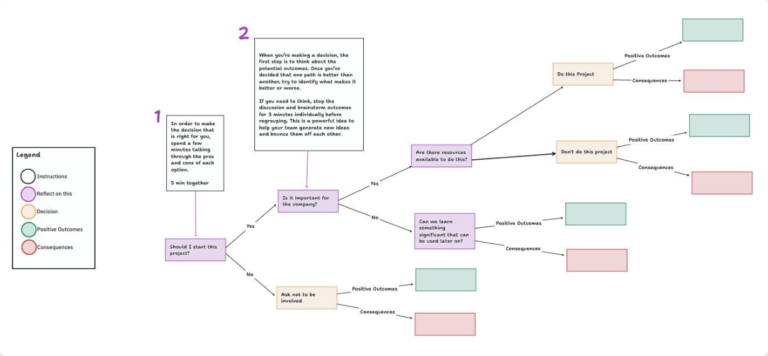
For instance, the ClickUp Decision Tree Template enables you to break down complex decisions into branches, making it easier to map out possible outcomes and long-term impacts.
Similarly, the ClickUp Decision-Making Framework Document Template provides a structured format for systematically evaluating choices, ensuring every aspect of a decision is considered.
ClickUp provides a range of features as problem-solving software to streamline and enhance second-order thinking. Its tools help you break decisions into smaller tasks, map their interdependencies, and visualize potential outcomes.

ClickUp Tasks serve as the foundation for your decision-making process. They allow you to break complex decisions into actionable steps, assign responsibilities, and set deadlines.
You can add ClickUp Custom Fields to track risks and estimate the impact of each task.
For instance, when evaluating the launch of a new marketing campaign, you could create Tasks for audience research, creative development, and resource allocation. These Tasks ensure you don’t miss anything and the decision-making process remains organized and transparent.

ClickUp Task Dependencies lets you establish relationships between tasks, showing how one action influences another. This feature ensures decisions are executed in the correct order, avoiding bottlenecks and delays.
For example, when planning a product launch, dependencies can link tasks like finalizing designs, conducting user testing, and preparing marketing materials. Dependencies highlight how these tasks interact and keep the workflow seamless.
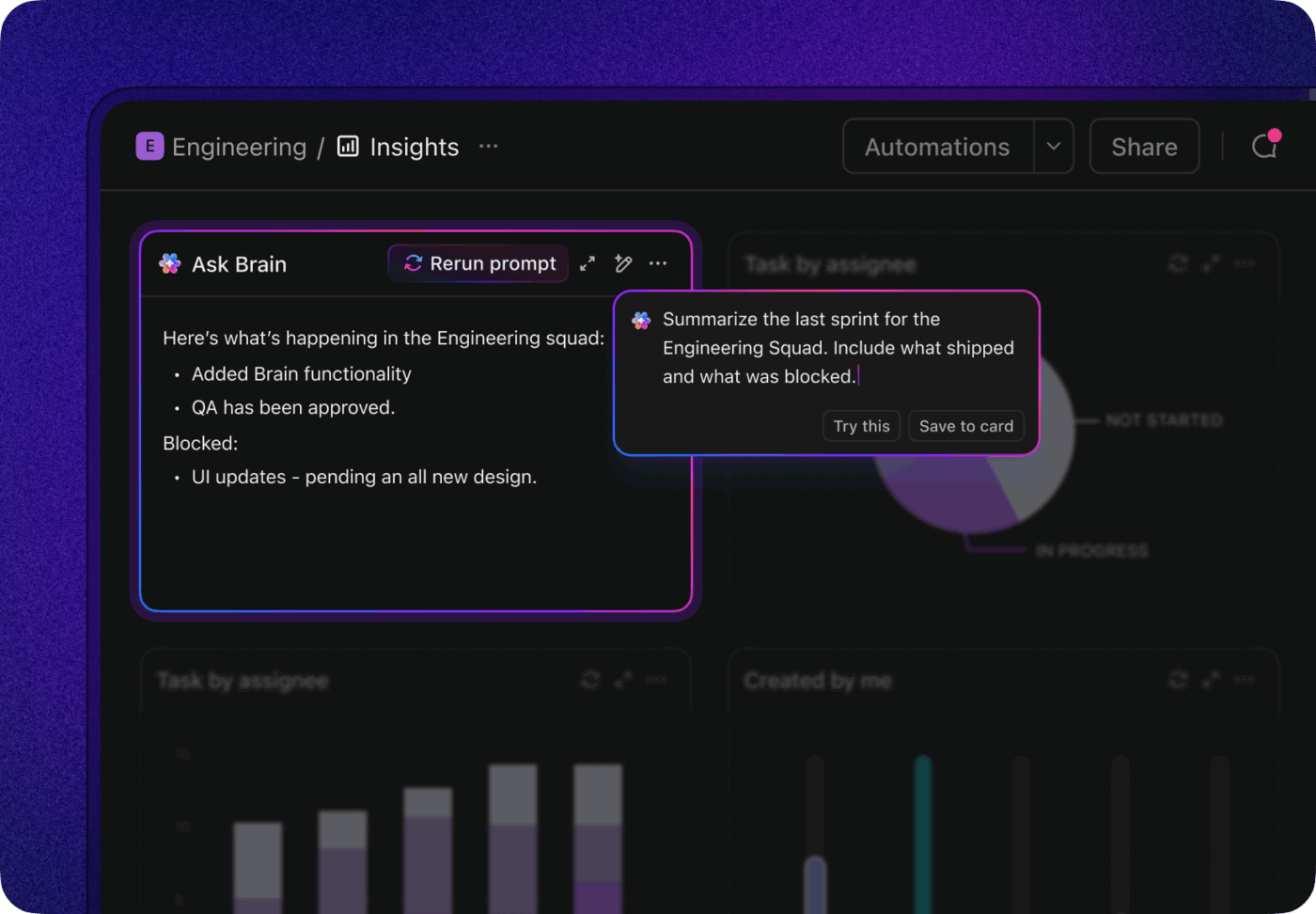

ClickUp Mind Maps allow you to brainstorm ideas and visually represent decision trees. This feature makes it easy to outline potential scenarios and evaluate their long-term impacts.
For example, if your organization is considering an expansion into a new market, you can use Mind Maps to explore immediate costs, long-term revenue potential, and possible risks. Visually connecting these factors helps you better understand the decision’s second-order effects.

You can also visualize your decisions with ClickUp Whiteboards. It allows you to identify dependencies and create diagrams that show how different parts of your template or tool interact. If you change one area, you can predict how it might affect other parts, allowing you to plan for the long term.
Another effective method you can apply using Whiteboard is scenario analysis. For instance, you can map out best-case, most likely, and worst-case scenarios when launching a product. It lets you connect tasks, dependencies, and related documents to maintain context. Its real-time collaboration features allow other stakeholders to contribute as well.
🧠 Fun Fact: Second-order thinking involves looking beyond immediate outcomes to anticipate the longer-term effects of actions. French colonial rulers in Hanoi aimed to control the rat population by paying for each rat tail submitted. This led to people cutting off tails, releasing rats to breed, and even establishing rat farms, ultimately increasing the rat population.

ClickUp Dashboards bring all your data and metrics into a single view, making monitoring the outcomes over time easier. You can customize cards to display relevant KPIs, such as revenue growth, customer satisfaction, or project milestones.
For example, if you’re tracking the impact of a new business strategy, Dashboards let you visualize progress, create detailed reports, and adjust plans based on real-time data.
🔍 Did You Know? Howard Marks, the billionaire investor and co-founder of Oaktree Capital, popularized the concept of second-level thinking in investing. In his book The Most Important Thing, he contrasts first-level thinking (simple, surface-level analysis) with second-level thinking (deep, strategic reasoning that considers multiple layers of impact).
Second-order thinking allows you to look beyond immediate problems and outcomes and consider the bigger picture. It helps you anticipate long-term effects, reduce risks, make thoughtful decisions that align with your goals, and avoid costly mistakes.
ClickUp simplifies second-order thinking with intuitive tools and innovative solutions designed for deeper analysis.
Break decisions into actionable steps using ClickUp Tasks, map out ripple effects through Dependencies, and visualize scenarios using Mind Maps. While Dashboards tie everything together, helping you track results and refine your strategies in real time for extraordinary performance.
Start making smarter, more strategic decisions today. Sign up for ClickUp today! ✅

Sudarshan Somanathan
Max 23min read

Manasi Nair
Max 28min read
Sudarshan Somanathan
Max 26min read

© 2026 ClickUp





