
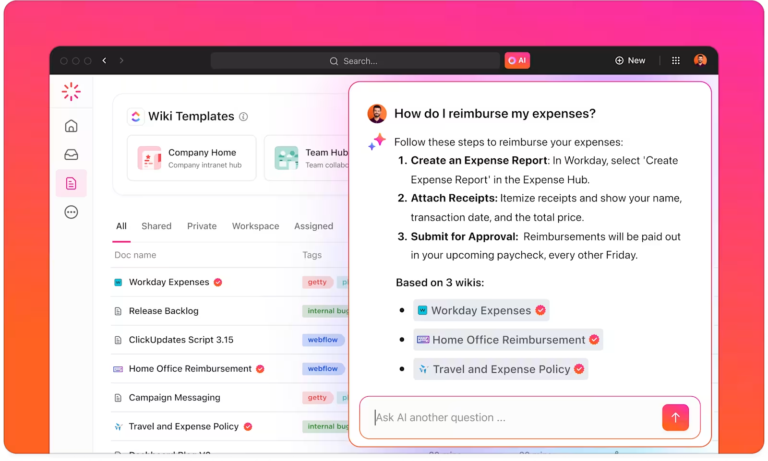
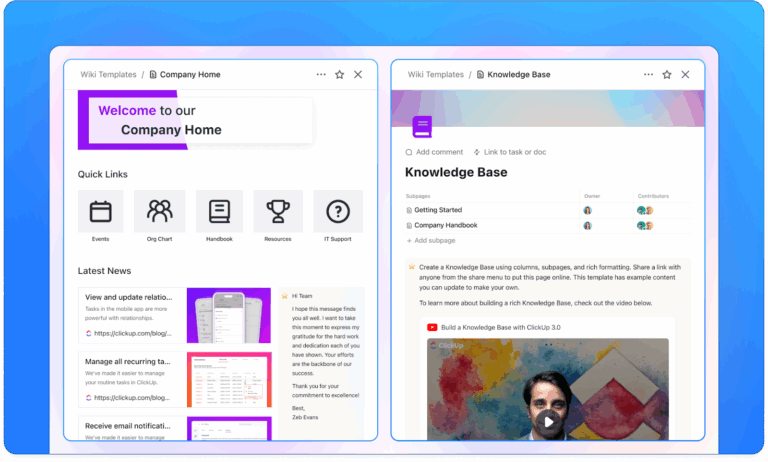
Sorry, there were no results found for “”
Sorry, there were no results found for “”
Sorry, there were no results found for “”
Most teams choosing between Notion and Confluence think they’re picking between flexibility and structure—but the real decision is whether your documentation should live separately from your actual work. Research has already shown that 62% of employees already spend too much time searching for information.
This comparison breaks down how Notion’s block-based databases stack up against Confluence’s Jira-integrated hierarchy, covering AI capabilities, search functionality, enterprise security, and more. We also talk about the hidden costs of keeping your wiki disconnected from execution.
Here’s a quick breakdown of how Notion and Confluence stack up.
| Feature / Category | Notion | Confluence | ClickUp |
|---|---|---|---|
| Best for | Startups, small-to-medium teams, individuals wanting customizable workspaces | Enterprises, software development teams, organizations using Jira | Teams that want docs, tasks, chat, and AI in one platform without managing separate tools |
| Core strength | Block-based flexibility with relational databases and all-in-one workspace | Structured documentation with deep Atlassian ecosystem integration | Converged workspace combining documentation, project management, chat, and AI in one system |
| AI capabilities | Notion AI for writing assistance, Q&A, autofill; included in Business/Enterprise | Atlassian Intelligence for summarization, content generation, natural language search | ClickUp Brain: contextual AI across docs, tasks, comments, and chat; can answer questions, generate content, summarize updates, and automate reporting |
| Database functionality | Advanced relational databases with multiple views (Kanban, Calendar, Gallery, List) | Basic page organization with limited database features; relies on macros | Native task databases with Custom Fields, relationships, formulas, and 15+ views (List, Board, Gantt, Calendar, etc.)—fully tied to execution |
| Search | Basic search; can struggle with large workspaces | Robust full-text search with advanced operators and CQL | AI-powered semantic search across tasks, docs, comments, and chat; prioritizes verified wiki content |
| Integrations | 100+ integrations via API; one-way syncs to Jira/GitHub/Asana | Native Jira/Trello/Bitbucket integration; 3,000+ Marketplace apps | 1,000+ integrations; native task-to-doc linking; reduces need for external PM + wiki + chat stack |
| Security/Compliance | SOC 2, GDPR; Enterprise adds HIPAA eligibility | SOC 2, ISO 27001, HIPAA, FedRAMP; Atlassian Guard for advanced controls | SOC 2, ISO 27001, HIPAA; SSO/SAML, SCIM, granular permissions, audit logs |
| Learning curve | Moderate (blank canvas can overwhelm) | Steep for non-technical users | Moderate; structured hierarchy reduces chaos while maintaining flexibility |
This table highlights the fundamental dilemma: Notion offers a creative sandbox, while Confluence provides a corporate library. Your choice depends on whether you value unstructured flexibility or governed consistency more.
Instead of forcing a choice between two extremes, a truly effective platform should offer both flexibility and structure.
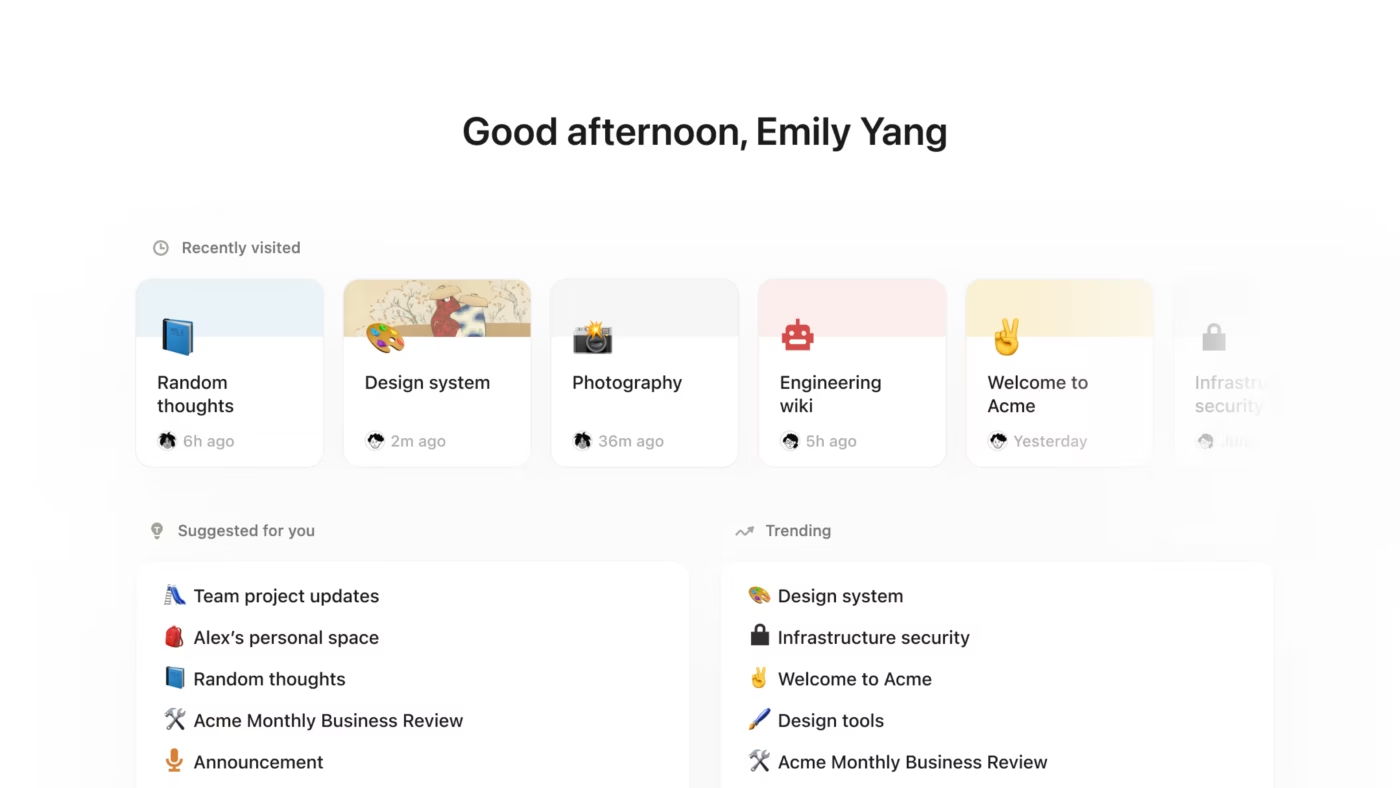
Notion’s a connected workspace that combines documents, wikis, databases, and projects into one highly customizable platform. Its core is a block-based architecture, which means every piece of content—from a line of text to an image or a full database—is a movable block. This allows you to design pages and workflows that fit your exact needs without writing any code.
Pros:
Cons:
Here’s what a G2 reviewer said about Notion:
Huge fan of the templates, they save so much time. Centralizing all our docs is great, but the “publish to web” feature is the real MVP for sharing specific pages externally. Also, the AI is actually useful for cleaning up messy notes or provide a really starting point for any document.
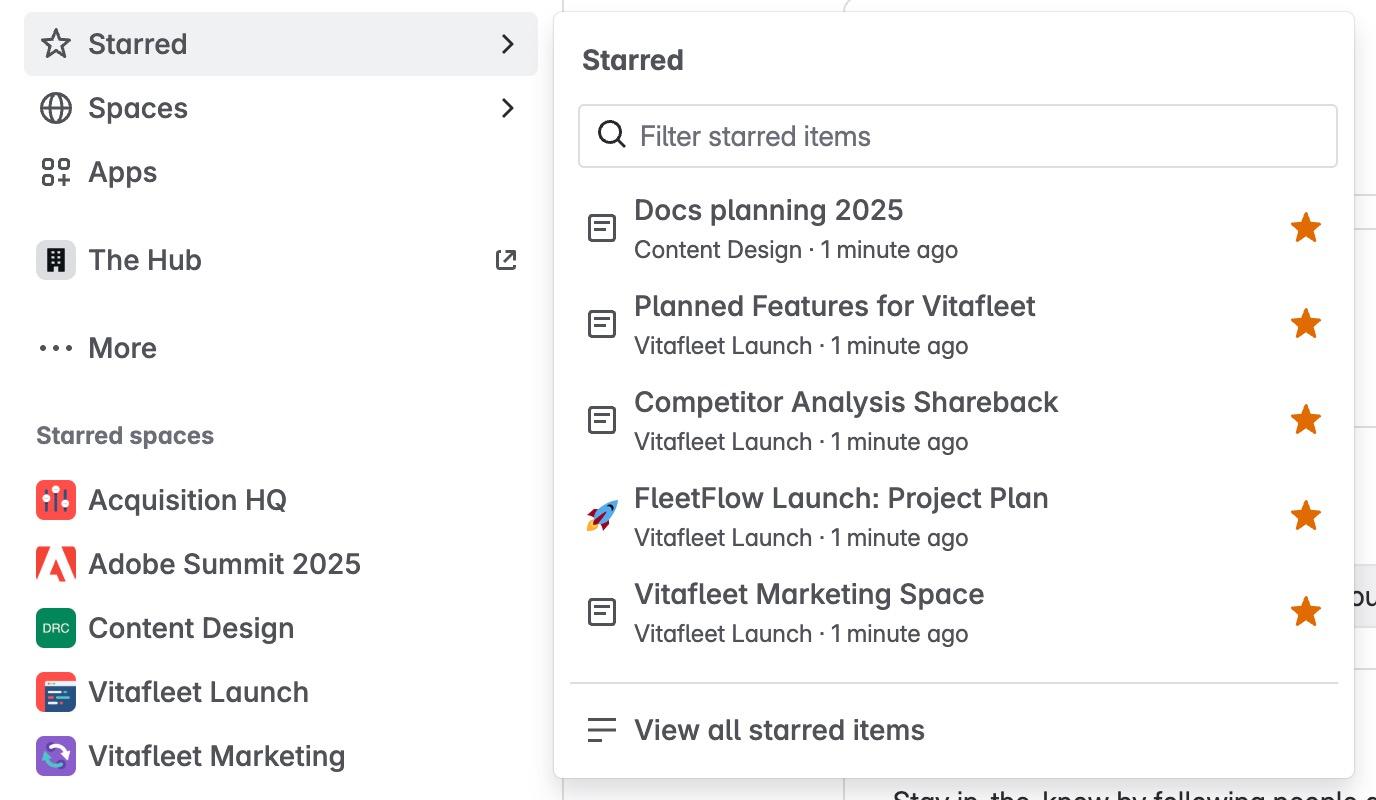
Confluence is Atlassian’s enterprise-focused documentation platform that enables structured knowledge management, especially within software development teams. It organizes information in a strict hierarchy of Spaces (for teams or projects) and nested Pages. Its main advantage is seamless, native integration with other Atlassian products, such as Jira.
Pros:
Cons:
Here’s what a G2 reviewer said about Confluence:
I use Confluence as a single source of truth for all company-related information, product guides, team overviews, project roadmaps, project and team planners, and the company wiki. I appreciate Confluence for providing a central location not only to store shareable information but also to easily create this information using an easy-to-use page builder. I love that Confluence can be accessed by the entire company, so everyone can collaborate and share relevant and sometimes critical information.
If you’re considering Confluence specifically and want to see how ClickUp compares in practice, watch this side-by-side comparison that demonstrates the key differences in workflow and capabilities.
📮ClickUp Insight: Context-switching is silently eating away at your team’s productivity. Our research shows that 42% of disruptions at work come from juggling platforms, managing emails, and jumping between meetings. What if you could eliminate these costly interruptions?
ClickUp unites your workflows (and chat) under a single, streamlined platform. Launch and manage your tasks from across chat, docs, whiteboards, and more—while AI-powered features keep the context connected, searchable, and manageable!
Here’s how the two platforms compare across key features:
You need an AI that understands the context of your work and helps you move it forward, not just one that writes emails. Without this, your team wastes time summarizing meeting notes manually and searching for answers buried in tasks or comments.
Notion AI is integrated directly into the workspace. It can help you write and summarize content, but its real power comes from features like autofilling database properties and answering questions based on your workspace content. You can also instruct the AI Agent to perform actions on your behalf.
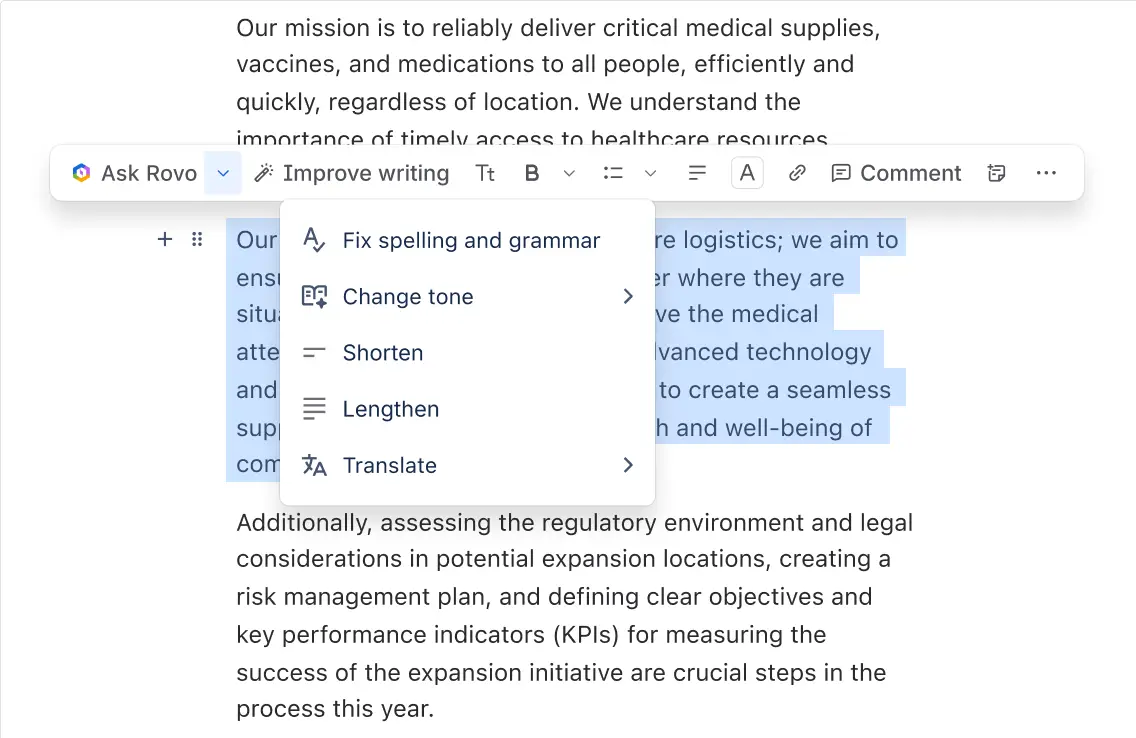
Confluence leverages Atlassian’s AI solution, Rovo, which connects knowledge across the Atlassian ecosystem. It can summarize pages, help you write content, and perform natural language searches. Its key advantage is its ability to pull context from both Confluence pages and Jira issues, providing answers that connect documentation with development work.
🏆 The verdict: Tie
Both platforms offer solid AI writing and summarization tools. Notion AI feels more deeply embedded in the day-to-day workflow with its database capabilities. Atlassian Intelligence is the clear winner for teams heavily reliant on Jira, as it bridges the gap between documentation and development tasks.
The editing experience differs dramatically between these tools—and your team’s workflow preferences should drive this decision.
Notion uses a flexible block-based editor. This means you can drag and drop text, images, databases, and embeds to create custom page layouts. It supports real-time collaboration with presence indicators and inline comments, and you can create nested pages to organize information.
Confluence provides a more traditional page editor with a standard formatting toolbar. It uses “macros” to add dynamic content like tables of contents or Jira issues. Collaboration happens in real-time with co-editing, and you can leave both inline and page-level comments for feedback.
🏆 The verdict: Depends
Notion offers a more modern and flexible editing experience, making it ideal for creative and dynamic documents. Confluence’s structured editor and blueprint system are better suited for teams that need to enforce consistency across formal documentation like product requirements or technical specs.
Teams struggle to make sense of project data scattered across static documents and spreadsheets. You’re trying to track tasks, resources, or content calendars, but your documentation tool can’t filter, sort, or relate information. This forces you to manage critical data outside your primary tool, creating data silos and manual update work.
Here’s where Notion has a significant advantage. It includes full-fledged relational databases that can be viewed as tables, boards, calendars, timelines, or galleries. You can create relationships between different databases, use formulas to calculate data, and create filtered views for specific needs.
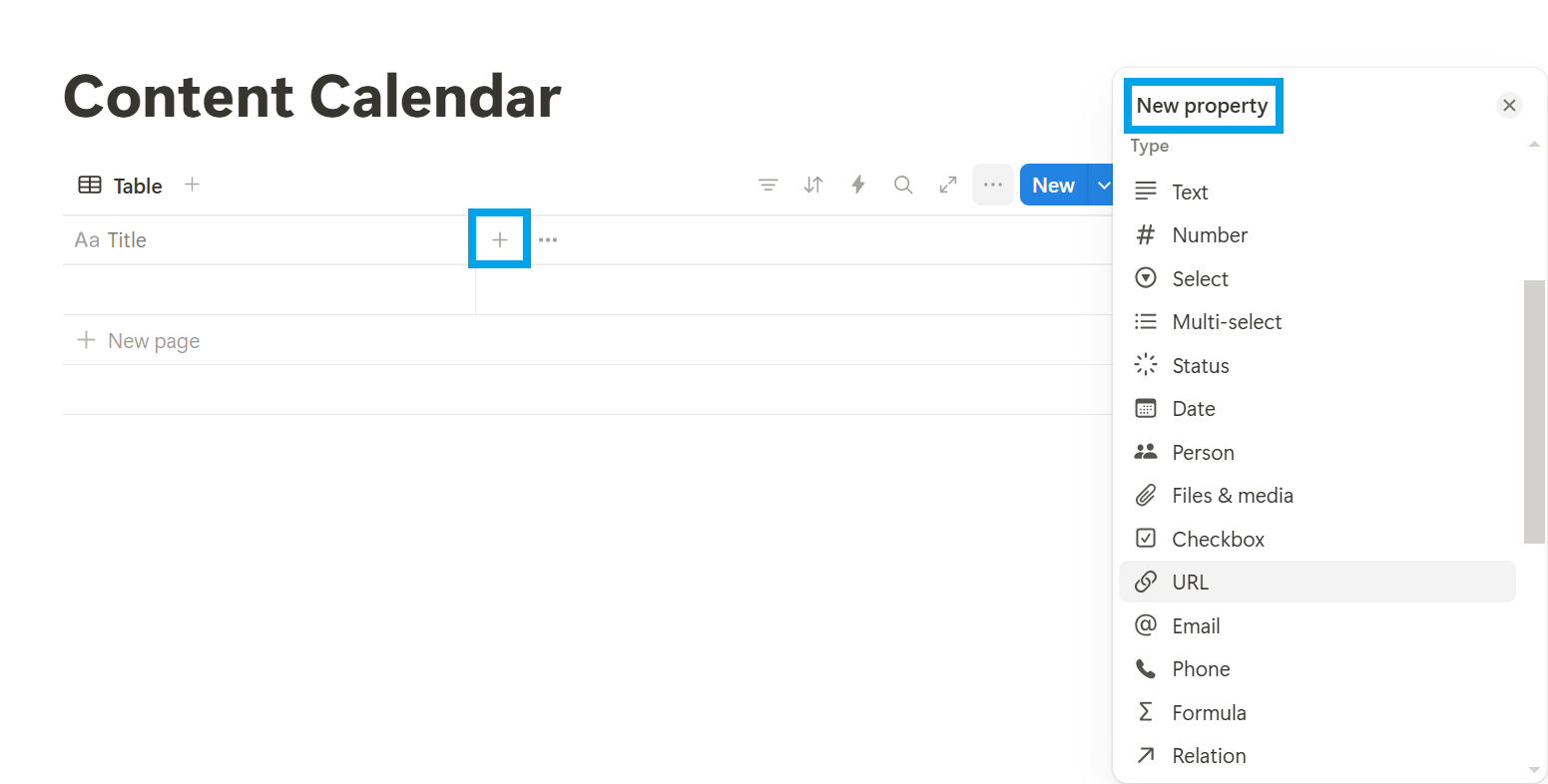
Confluence doesn’t have native database functionality. You can create simple tables, but you can’t filter, sort, or view them in different ways. To get any database-like features, you have to either embed Jira issues or purchase third-party apps from the Atlassian Marketplace.
🏆 The verdict: Notion wins this round.
Notion is the undisputed winner here. If your team needs to track structured data of any kind—whether it’s a project list, a CRM, or a content calendar—Notion’s built-in databases are far superior. Confluence is simply not designed for this purpose.
Notion’s search is fast and simple for smaller workspaces. You can use a keyboard shortcut to quickly search across all your pages and databases. However, as your workspace grows, its search can become slow and struggle to surface the most relevant results, and it lacks advanced search operators.
Confluence can handle massive amounts of documentation, and its search capabilities reflect that. It offers a powerful full-text search with advanced operators and its own Confluence Query Language (CQL). This allows you to run highly specific queries to find exactly what you need, even in a workspace with millions of pages.
🏆 The verdict: Confluence gets this one
For enterprise-scale documentation, Confluence’s search is more robust and reliable. Notion’s search is adequate for personal use or small teams, but it doesn’t hold up as your knowledge base scales.
💡 Pro Tip: Stop digging for answers—let ClickUp Brain MAX surface them instantly.
Instead of relying on keyword search alone, Brain MAX understands context. Ask a natural-language question like “What did we decide about the Q2 pricing update?” and it scans across Docs, tasks, comments, and chat to deliver a synthesized answer—complete with links to the source of truth.
For enterprise teams, this becomes even more powerful. Brain MAX prioritizes verified Wiki content, respects granular permissions, and surfaces the most relevant information based on your role and access. That means faster answers without compromising governance.
Are you constantly copying and pasting links and updates between your wiki and your project management or communication tools? This context switching creates friction and increases the likelihood that your documentation will become outdated.
Notion offers native integrations with popular tools like Slack, Google Drive, and GitHub, plus connections to 100+ third-party apps via its public API.
Confluence’s greatest strength is its native integration with the Atlassian suite, especially Jira. You can embed Jira issues, boards, and roadmaps directly into Confluence pages, creating a tight bond between documentation and development work. The Atlassian Marketplace offers over 4,000 apps and integrations.
🏆 The verdict: Again, depends.
If your team lives in Jira, Confluence is the clear choice. Its native integration is deeper and more seamless than anything Notion offers. However, if your team uses a diverse set of specialized tools, Notion’s broader API and embed capabilities might be more useful.
As your company grows, you’re worried your documentation tool won’t keep up. You need advanced security, granular permissions, and compliance certifications to satisfy legal and IT requirements. A tool built for small teams can become a major liability, lacking the governance and control that enterprise knowledge management requires to operate securely.
Notion has been adding enterprise features like SCIM provisioning, audit logs, and advanced permissions. It has key compliance certifications like SOC 2 and offers HIPAA eligibility on its Enterprise plan. However, its flexible nature can make it difficult to govern at scale, and some enterprises report performance issues with very large workspaces.
Confluence was designed for the enterprise from day one. It offers a wider range of compliance certifications, including FedRAMP, and provides more advanced security features through Atlassian Guard. Its structured permissions and centralized user management can match the complexities of large organizations.
🏆 The verdict: Confluence wins this round.
Confluence is the more mature and robust platform for large enterprises with strict security and compliance needs. Notion is catching up, but it is still more suitable for startups and mid-market companies that don’t require the same level of governance.
You’re about to invest in a new tool, but if it is too complex or unintuitive, adoption will fail. This results in wasted money and a return to the old, chaotic ways of working with scattered documents and emails.
Notion has a modern, clean interface that feels intuitive at first. However, its “blank canvas” approach can be intimidating for new users, and without proper guidance, workspaces can quickly become a mess. Mastering its more powerful features, like databases, requires a significant learning investment.
Confluence’s interface feels more traditional and can be clunky for users accustomed to modern apps. The use of macros and a complex permission system creates a steep learning curve, especially for non-technical team members. While its structure provides guardrails, it comes at the cost of user-friendliness.
🏆 The verdict: Tie
There’s no easy winner here, as both tools present different learning challenges. Notion is easier to start with, but harder to master and govern. Confluence is harder to start with, but it provides a more structured, albeit rigid, environment.
Choosing between these two tools often feels like a frustrating compromise. You’re forced to pick between a flexible tool that might become chaotic or a structured one that might feel too restrictive. This decision is made even harder because neither tool truly solves the bigger problem: the disconnect between where you document work and where you actually do it.
Choose Notion if:
Choose Confluence if:
Even after you choose, you’ll likely find yourself dealing with work sprawl. Your team will still need a separate project management tool, a chat app for communication, and other specialized software. This fragmentation drains productivity.
Here’s how a Redditor summed it up:
Confluence is great because it connects to JIRA so a lot of people (including me) use it because we interact a lot with software developers. I absolutely love it for managing small projects and creating easy to understand wikis as it was designed as a wiki add on for software developers and find sit very simple to use. It isn’t flashy and doesn’t need to be. Confluence does nickle and dime you with little add on subscriptions for nice to have things.
Notion is a great flexible wiki but it is SOOOO customizable that you can spend a lot of time and go down a lot of template rabbit holes and have to create your own structure.
If you are creative and scrappy Notion is great. If you like the structure already there mostly for you Confluence is my pick.
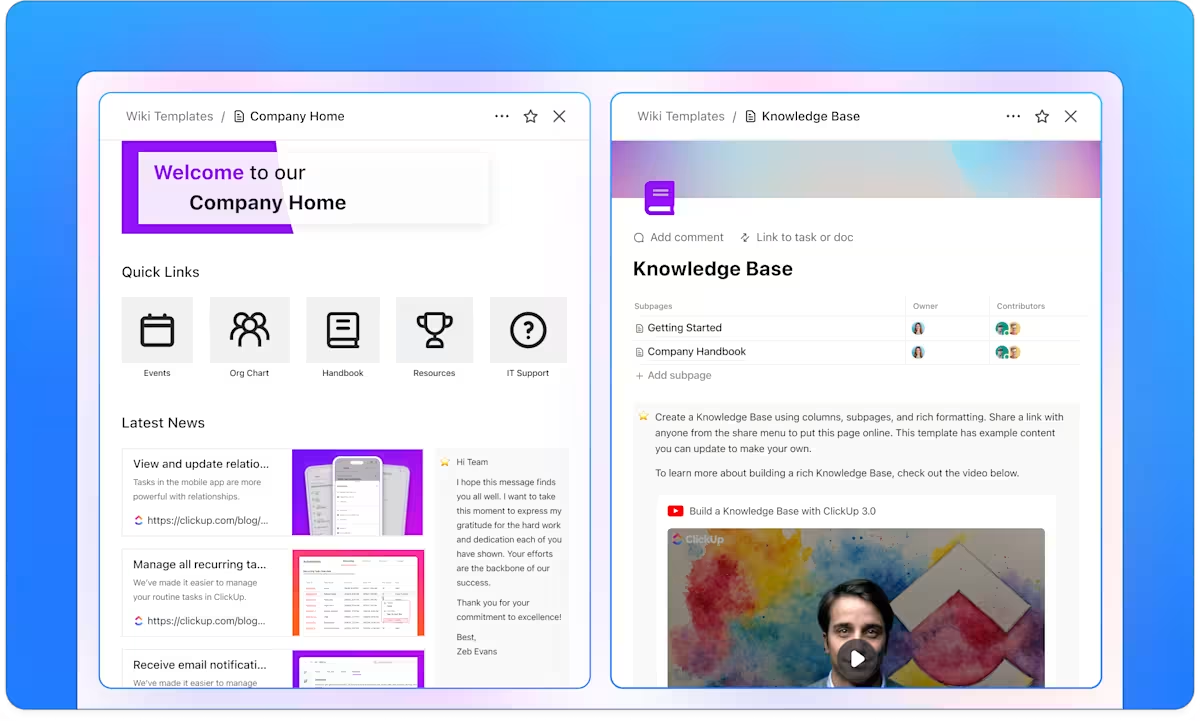
The debate between Notion’s flexibility and Confluence’s structure overlooks a bigger issue. Both are primarily documentation tools, forcing your work to live in a separate system. This creates a constant struggle with context sprawl. Teams waste hours searching for the information they need to do their jobs, switching between apps, hunting down files, and repeating updates across multiple platforms.
Eliminate this fragmentation with the world’s first converged AI workspace. ClickUp brings your documents, tasks, communication, and AI into a single, unified platform.
As a user noted,
What I love most about ClickUp is how seamlessly everything works together. The combination of Chat, Whiteboards, and Spaces allows us to brainstorm, assign, and track work all in one place. It’s flexible, visual, and highly customizable perfect for managing multiple teams and projects across departments. The Wiki feature also helped us replace scattered SOPs and onboarding docs with a single source of truth.
With ClickUp, you get the flexibility of a modern doc editor combined with the structure of a powerful project management system. The platform adapts to your team’s needs, whether you’re a startup that needs to move fast or an enterprise that requires governance.
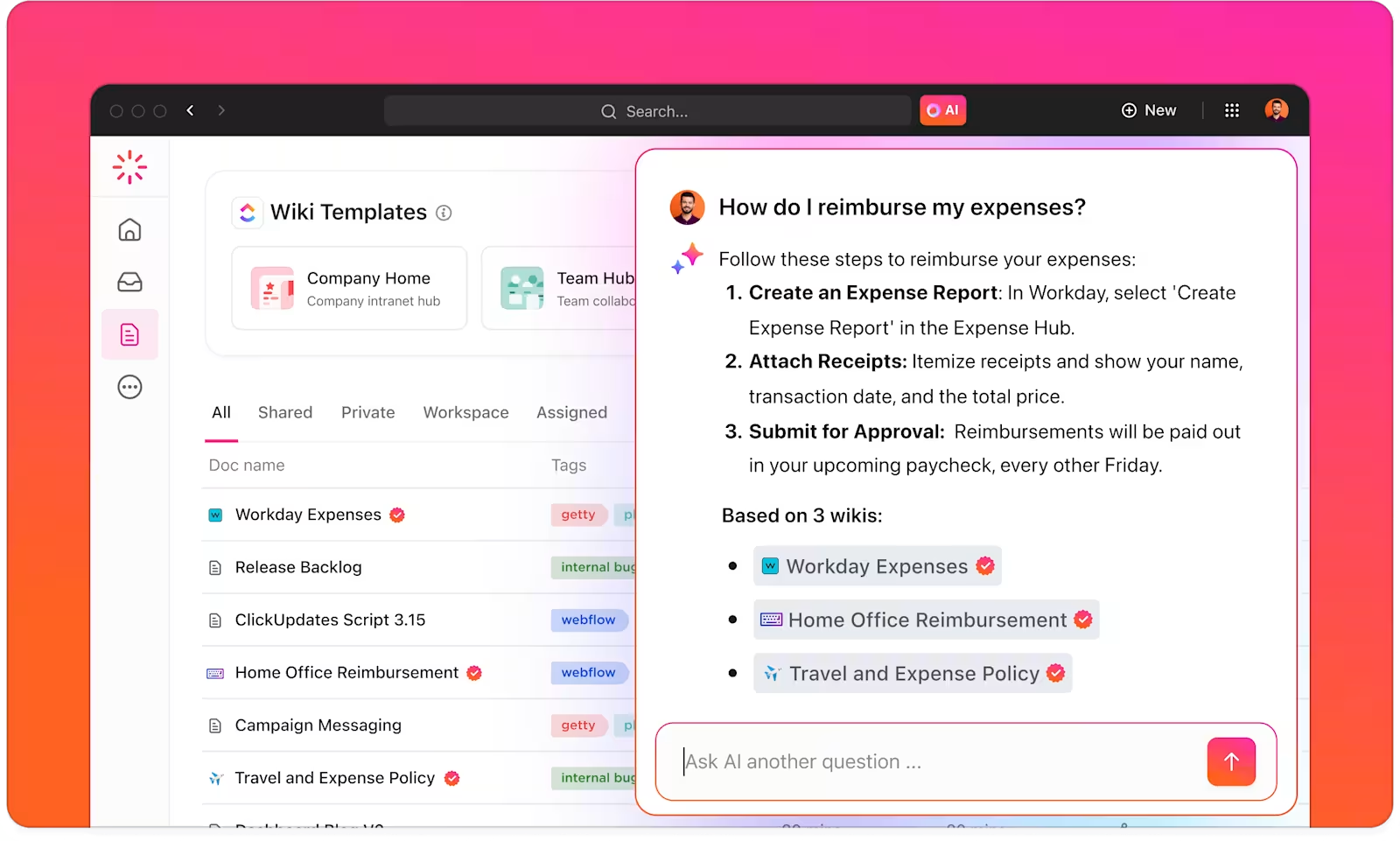
Here’s a quick overview of what you can do with ClickUp:
💡 Pro Tip: Deploy the Wiki Upkeep Super Agent for knowledge management hygiene. It flags outdated Docs so your team can keep your knowledge base current and trustworthy. You can also customize it to create follow-up tasks.
Learn how to create your own Super Agents in ClickUp:
The “winner” in the Notion vs. Confluence debate depends entirely on your team’s priorities. If you’re a startup that needs a flexible, all-in-one tool with strong database capabilities, Notion is a great choice. If you’re a large enterprise, especially one using Jira, that requires structured documentation and robust security, Confluence is the more traditional and safer bet.
However, both tools operate on an outdated premise: that documentation should live separately from execution. This separation is the root cause of work sprawl and lost productivity—exactly what ClickUp’s converged AI workspace eliminates.
ClickUp is a strong choice if:
If Notion represents flexibility and Confluence represents structure, ClickUp represents convergence.
Effective work management isn’t about having a better wiki; it’s about having a single platform where knowledge and action converge.
For teams tired of constant context switching who want documentation connected directly to their workflows, ClickUp offers a unified solution. Get started for free with ClickUp.
Notion offers lightweight project management through its flexible databases, which can be turned into Kanban boards or timelines. It’s great for general task tracking, but Jira is a purpose-built tool for software development with advanced features like sprint planning and deep DevOps integrations that Notion lacks.
Yes, migration is possible, but often requires significant manual cleanup. You can import Confluence content into ClickUp Docs or use Notion’s importer to pull in data, but you’ll likely need to re-establish page structures and integrations.
Confluence, when paired with Jira, is the long-standing industry standard for software development teams due to its native integration for linking issues to documentation. While Notion can be used by smaller dev teams, it doesn’t offer the same depth of IT workflow integration.
For enterprises, Notion’s biggest drawbacks are its potential for performance issues at scale and its less mature governance and compliance features. Confluence’s main drawbacks are its steep learning curve for non-technical users and its rigid structure that can feel dated.

Arya P Dinesh
Max 27min read

Manasi Nair
Max 27min read
Manasi Nair
Max 32min read

© 2026 ClickUp




