Sorry, there were no results found for “”
Sorry, there were no results found for “”
Sorry, there were no results found for “”
If a business’s financial system is the structure that keeps it running, then the general ledger would be its foundation.
You may not always see it that way, but everything else would fall apart without it.
All financial transactions—buying supplies, paying employees, or selling your product—are logged in the general ledger, creating a solid foundation for your financial operations.
It’s not just about knowing the numbers; it’s about ensuring your business can grow without hidden cracks forming underneath the surface.
So, let’s understand what a general ledger is and the types, examples, and benefits of one.
The general ledger is foundational to a business’s financial health, capturing all financial transactions to ensure accuracy and support decision-making.
A general ledger is the primary record book for a company’s financial data. It’s like a central hub where all financial transactions are recorded and summarized.
Think of the general ledger as the heart of your business’s financial system. Every penny that comes in or goes out gets recorded here, keeping your company’s finances healthy and ordered.
It’s not crucial just for accountants—business owners must also understand how the general ledger works. Without it, you’d risk missing key insights that help you make informed decisions.
Its primary role is to ensure that your financial statements, like the balance sheet and income statement, are accurate and up to date. By storing company financial data, the general ledger allows you to track and summarize your financial situation, making it easy to spot trends, manage cash flow, and prepare for audits.
Some of its key functions include:
Let’s make accounting less intimidating and more relatable. The general ledger is your business’s financial diary, keeping track of every important move.
So, how does it work in practice? Here are a few everyday examples:
On Mar 5, 2024, ABC Corporation purchased equipment for $12,000 in cash. Here’s how this transaction is recorded:
Journal entry:
Equipment account:
| Date | Description | Debit | Credit |
| March 5, 2024 | Cash | 12,000 | |
| Total | 12,000 |
Cash account:
| Date | Description | Debit | Credit |
| March 5, 2024 | Equipment | 12,000 | |
| Total | 12,000 |
Service revenue and expenses: On April 10, 2024, the company billed clients $8,000 for services. On April 15, it paid $2,000 for office supplies. On April 20, it also paid $1,500 for utilities.
Journal entries:
Accounts receivable:
| Date | Description | Debit | Credit |
| April 10, 2024 | Service revenue | 8,000 | |
| Total | 8,000 |
Service revenue account:
| Date | Description | Debit | Credit |
| April 10, 2024 | Accounts receivable | 8,000 | |
| Total | 8,000 |
Office supplies account:
| Date | Description | Debit | Credit |
| April 15, 2024 | Cash | 2,000 | |
| Total | 2,000 |
Utility expense account:
| Date | Description | Debit | Credit |
| Apr 20, 2024 | Cash | 1,500 | |
| Total | 1,500 |
Cash account:
| Date | Description | Debit | Credit |
| Apr 15, 2024 | Office supplies | 2,000 | |
| Apr 20, 2024 | Utilities expense | 1,500 | |
| Total | 3,500 |
In the first example, the general ledger records equipment purchases, impacting the equipment and cash accounts.
The second example tracks the billing for services and the subsequent expenses for office supplies and utilities, illustrating how these transactions affect accounts receivable, service revenue, office supplies, utilities expenses, and cash accounts.
These examples demonstrate how the general ledger helps record and track financial activities, ensuring clear and organized financial management.
The general ledger is a versatile tool that adapts to the needs of various businesses. Here’s how it plays a crucial role in diverse business settings:
The general ledger is instrumental in managing sales, inventory, and expenses for retail businesses. It tracks daily sales transactions, reconciles cash registers, and monitors inventory levels. Retailers can maintain accurate profit margins and streamline inventory management by categorizing sales revenue and tracking the cost of goods sold.
Service-based businesses rely on the general ledger to record client billing, track service revenue, and manage operating expenses. The general ledger helps maintain detailed accounts of receivables and payables, ensuring client payments are accurately recorded, and service-related costs are managed efficiently.
The general ledger handles complex transactions involving raw materials, work-in-progress, and finished goods in manufacturing. It tracks production costs, allocates overhead, and monitors inventory levels. This comprehensive tracking helps manufacturers understand their cost structures and manage profitability.
Nonprofits use the general ledger to manage donations, grants, and program expenses. It helps track restricted versus unrestricted funds, ensure compliance with donor requirements, and provide transparency in financial reporting. Accurate ledger entries support effective budget management and financial accountability.
The general ledger manages real estate companies’ property transactions, rental income, and maintenance expenses. It also tracks lease payments, property management fees, and capital expenditures. This detailed financial record helps real estate firms manage cash flow and assess property profitability.
Also Read: How to Use Project Accounting: Must-Know Principles, Processes, and Tips for Project Teams
General ledger management tools are essential for businesses of all sizes to streamline financial processes, improve accuracy, and gain valuable insights. These tools automate tasks, reduce errors, and provide real-time visibility into financial data.
Although ClickUp is a comprehensive project management software, it also has built-in features that can help you easily manage the general ledger and function as accounting software.
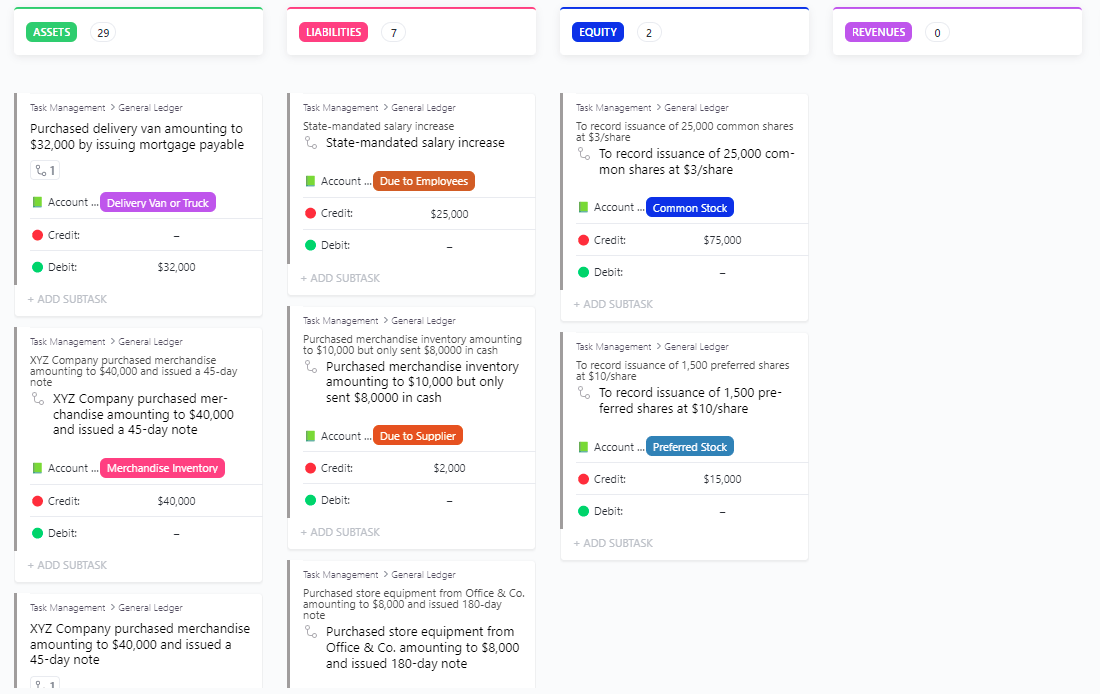
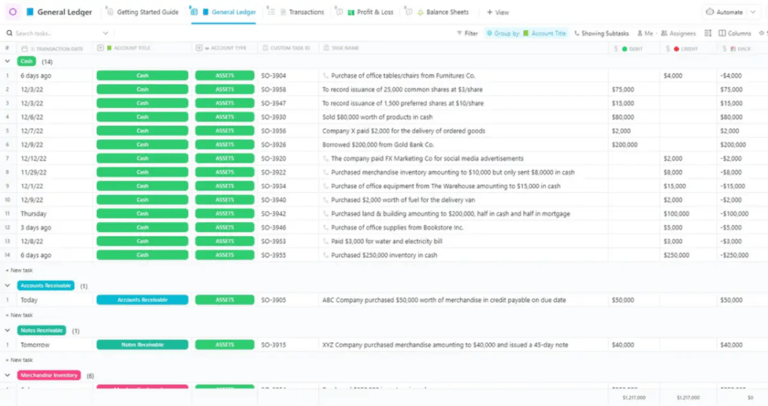
For instance, the ClickUp General Ledger Template can help you track debit and credit transactions, compare assets and liabilities, and gain insight into your company’s financial health.
Here’s how you can leverage the template to enhance your general ledger management:
ClickUp Brain, the AI-powered assistant within the ClickUp project management platform, can significantly enhance your general ledger accounting processes.

Here’s how:
In essence, ClickUp Brain can simplify your general ledger accounting processes, reduce errors, and provide valuable insights to help you make better financial decisions. By leveraging its AI capabilities for accounting, you can improve efficiency, accuracy, and compliance within your accounting department.
📮ClickUp Insight: While 34% of users operate with complete confidence in AI systems, a slightly larger group (38%) maintains a “trust but verify” approach. A standalone tool that is unfamiliar with your work context often carries a higher risk of generating inaccurate or unsatisfactory responses.
This is why we built ClickUp Brain, the AI that connects your project management, knowledge management, and collaboration across your workspace and integrated third-party tools. Get contextual responses without the toggle tax and experience a 2–3x increase in work efficiency, just like our clients at Seequent.
Bonus: Check out other general ledger and bookkeeping templates from ClickUp.
The general ledger and double-entry bookkeeping go hand-in-hand. Double-entry bookkeeping is precisely what it sounds like—every transaction gets recorded twice. This system keeps your financial records balanced.
In a double-entry accounting system, every transaction has two sides—a debit and a credit. Let’s say you sell a product for X. In your general ledger, you’ll record X as revenue (a credit), but you’ll also need to log X into your cash account (a debit).
The idea is to keep everything balanced so your business’s financials reflect reality.
If one side doesn’t match the other, it means that something’s off—and that’s where the general ledger comes in, helping you spot those discrepancies before they become bigger issues.
The general ledger is more than a list of numbers—it’s a categorized record of everything your business owns, owes, earns, and spends. Financial transactions are sorted into specific account types, and they find their home in one of several account types, making it easier to track and understand your financial picture.
Here are the key types:
These are short-term obligations your business owes, like bills or supplier invoices that haven’t been paid yet. Accounts payable ensures you stay on top of due payments without risking the stoppage of services or supplies.
Everything you earn gets recorded in revenue accounts. Sales, service fees, or any income source flows through here, clearly showing how well your business performs.
On the flip side, expenses show where your money goes. Everything from rent and utilities to payroll falls under this account. Managing expenses helps keep profits in check and avoids financial leakage.
These entries represent what the business owns. Whether cash in the bank, inventory, or equipment, assets give your company value. Asset accounts reflect the resources that enable growth and operations.
Liabilities show what your business owes to others. This could be loans, unpaid invoices, or future obligations. Tracking liabilities ensures you know exactly where your debts stand and helps manage cash flow effectively.
Each account is vital in maintaining an organized and accurate general ledger. When properly categorized, they give you the complete picture of your business’s financial health—both the bright spots and the areas that need attention.
For those who live and breathe numbers, the ledger is indispensable. Here’s why:
The general ledger is essential for generating precise financial statements. Consolidating all transactions into a single framework ensures that reports such as the balance sheet and income statement reflect true and accurate figures. This precision is critical for financial analysis, forecasting, and investor relations.
The general ledger tracks all transactions, helping monitor cash inflows and outflows. This visibility supports better cash flow management, ensuring liquidity is available for operations and growth.
The general ledger breaks down your revenue streams, giving you a clear view of what’s driving your sales. This detailed perspective lets you spot trends, evaluate performance, and adjust strategies to boost your income where it matters most.
The general ledger is crucial for calculating net income because it accurately records and categorizes all financial transactions, ensuring comprehensive tracking of revenues and expenses. Regular updates provide real-time accuracy, while detailed records help identify and correct discrepancies. This meticulous organization and reporting capability ensures that net income calculations reflect your business’s financial performance.
For those immersed in the intricacies of business management, the general ledger offers more than just financial oversight—it also delivers significant non-financial benefits.
Staying on top of regulations can be difficult, but the general ledger helps you navigate it effortlessly. Maintaining an organized record of all transactions simplifies compliance and audits with accounting standards and legal requirements, reducing the risk of costly penalties/
Internal controls are all about keeping your financial operations in check. The general ledger supports this by offering a clear audit trail, helping you catch errors and prevent fraud before it becomes a significant concern. It’s your first line of defense in maintaining financial integrity.
This combination of compliance and control safeguards your business and enhances overall operational integrity, making the general ledger an invaluable asset beyond its financial functions.
Now that we know the benefits of a general ledger. Let’s see how it works.
Here’s a clear breakdown of the process:
It all starts with recording transactions. Each financial event—a sale, purchase, or expense—is first logged into a journal with details like date, amount, and involved departments or parties. This initial entry captures the raw data of every transaction.
Next, these journal entries are transferred to the general ledger. Each transaction, whether revenue, expense, asset, or liability, is posted to the relevant account. This step organizes the data, ensuring that every account reflects current information.
You’ll need to balance each account regularly to ensure accuracy. This involves verifying that the total debits equal the total credits. Balancing helps catch discrepancies and ensures that your ledger remains accurate and reliable.
With all transactions accurately recorded and balanced, the general ledger can generate financial reports like the balance sheet and income statement. These reports provide a snapshot of your business’s financial health and performance.
Also Read: 10 Financial KPIs You Need To Track
The general ledger is a crucial part of financial transaction management for businesses of all sizes and sectors. Meticulously recording, categorizing, and summarizing financial transactions ensures that every dollar is accounted for and every financial detail is captured.
Leveraging smart solutions like ClickUp can be transformative for optimizing ledger management and enhancing efficiency. ClickUp’s templates, project management features, and AI tool, ClickUp Brain, can simplify data entry, integrate seamlessly with other financial tools, and provide real-time updates and insightful reports.
Sign up for ClickUp today!

Sudarshan Somanathan
Max 23min read

Sean Hardy
Max 44min read
Sudarshan Somanathan
Max 30min read

© 2026 ClickUp