








Still downloading templates?
There’s an easier way. Try a free AI Agent in ClickUp that actually does the work for you—set up in minutes, save hours every week.
Sorry, there were no results found for “”
Sorry, there were no results found for “”
Sorry, there were no results found for “”
Congratulations on taking the first step toward your dream career! As a first-time job seeker, crafting your initial resume can be daunting. With little formal experience, how do you effectively showcase your potential?
The key is to transform your resume into a compelling story highlighting your transferable skills, academic achievements, and enthusiasm for learning.
Remember, your entry-level resume isn’t merely a list of past jobs; it’s a powerful tool to demonstrate your value as a candidate. By focusing on your strengths and crafting a well-structured document, you can differentiate yourself from the competition.
In this blog post, we will provide the essential tools and guidance to create a standout entry-level resume through practical examples and templates!
An entry-level resume is a document that highlights your skills, education, and experiences to secure your first professional position.
It’s designed to showcase potential and adaptability, as candidates often have limited or no formal work experience in their desired field.
While a strong resume format is essential, the content is what truly matters. Here’s a breakdown of the key sections to include in your entry-level resume:
Pro tip: Keep your resume concise and easy to read, ideally one page for entry-level applicants.
According to ResumeGenius’s survey, career objectives and skills are the most popular sections to include in a resume for 76% of job seekers.
These sections are popular due to their ability to offer recruiters and hiring managers a quick overview of a candidate’s qualifications and potential.
For your entry-level resume, you can choose between an objective statement or a resume summary. Here’s a breakdown to help you decide:
Example:
‘Highly motivated recent graduate with a degree in Marketing seeking an entry-level position at a dynamic marketing agency to leverage strong communication and analytical skills while contributing to successful marketing campaigns.’
Example:
‘Enthusiastic and results-oriented individual with excellent communication and customer service skills gained through volunteer work. Eager to leverage problem-solving abilities and a passion for [Industry] in an entry-level [Job Title] role at [Company Name].’
For entry-level job seekers, a strong educational background can be just as valuable as experience, especially if the position requires a recent degree in your field.
According to NACE’s Job Outlook 2024 report, 87.4% of employers hired new college graduates with online degrees.
Here’s how you can make your education section stand out:
Here are some examples to write your education section in different scenarios:
1. Recent graduate:
Bachelor of Science in Marketing (2024), State University
Relevant Coursework: Marketing Analytics, Consumer Behavior, Social Media Marketing
Dean’s List (2022 & 2023)
2. Candidate with internship experience:
Master of Arts in Graphic Design (2023), School of Design
Thesis: “The Impact of User Interface Design on Brand Perception”
Graphic Design Internship (2022), Design Agency XYZ—Assisted with creating social media graphics and website layouts
3. Candidate with relevant certifications:
Associate’s Degree in Computer Science (2022), Community College
Google IT Professional Certificate (2024)
Relevant Coursework: Programming Fundamentals, Database Management, Cybersecurity Essentials
A hiring manager sifts through hundreds of resumes, spending mere seconds on each. How do you stand out as a recent graduate or someone with limited experience? The answer lies in your value proposition.
Unlike seasoned professionals with years of experience, your value proposition focuses on your potential and unique skills. It’s a concise statement that grabs the recruiter’s attention and convinces them you’re the ideal candidate despite lacking extensive background.
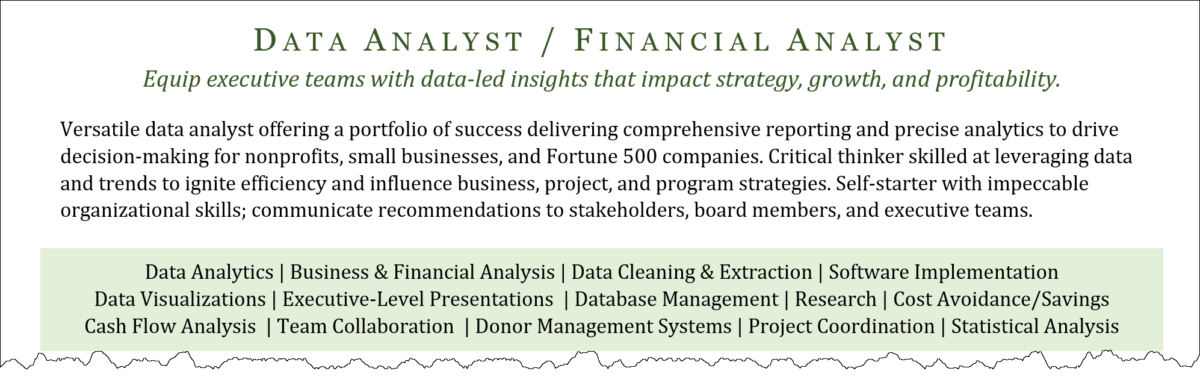
For example, in the above image, the data analyst/financial analyst distinguishes themself as someone who can “equip executive teams with data-led insights that impact strategy, growth, and profitability.”
This is the analyst’s value offering, which is backed by a short paragraph highlighting their specific skills.
Recruiters often come from different backgrounds than entry-level applicants. Value proposition statements bridge this gap.
Similar to career objectives or resume summaries, value propositions translate your skills, experiences, and even personal qualities into clear, outcome-oriented statements that resonate with the employer. By showcasing your potential impact, you become a magnet that attracts their attention.
Here are some tips to showcase your sales and marketing savvy, even as an entry-level candidate:
Analyze the job description and identify specific skills and strategies mentioned. Tailor your resume to showcase how your skills and experiences align with their needs. This demonstrates your understanding of the role and how you can contribute to their sales or marketing strategy.
Instead of:
‘Increased sales at a retail store.’
Try:
‘Applied strong communication skills and product knowledge to consistently exceed sales targets by 10% in a competitive retail environment.’
Instead of:
‘Managed social media for a club.’
Try:
‘Developed and implemented a social media strategy for a student club, resulting in a 20% increase in follower engagement and brand awareness.’
For entry-level jobs, create a resume that showcases your potential, even without extensive work experience.
Here’s how:
The top section of your resume, often a 3-4 sentence blurb, is the first thing a recruiter will see. Here, you’ll grab the employer’s attention with an objective statement or a resume summary. Choosing the right one depends on your background—objective statements are for recent graduates with no experience, and resume summary for those with 1 to 2 years of work experience.
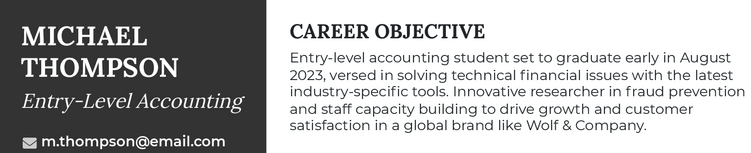
The above is an example of an objective statement for a recent graduate applying for an entry-level accounting job.
While you might lack formal work experience, you possess a wealth of transferable skills gained through various avenues.
Here’s how to identify and emphasize them:
For example:
Job description: Looking for a social media intern with strong communication and content creation skills.
Your resume:
‘Managed social media accounts for a local animal shelter, resulting in a 15% increase in follower engagement through creative content creation and engaging posts.’
Employers want to see your impact. The best way to show this is through volunteer work and internships.
Instead of ‘Helped with administrative tasks,’ say something like: ‘Streamlined volunteer onboarding process by 20%, improving volunteer retention for a local non-profit’. This demonstrates initiative, problem-solving skills, and quantifiable results.
For example:
Volunteer: Community Garden Project (2022-Present)
Treat internships like condensed professional experiences. Highlight the projects you tackled, the skills you honed, and the problems you helped solve.
For example:
Volunteer: Community Garden Project (2022-Present)
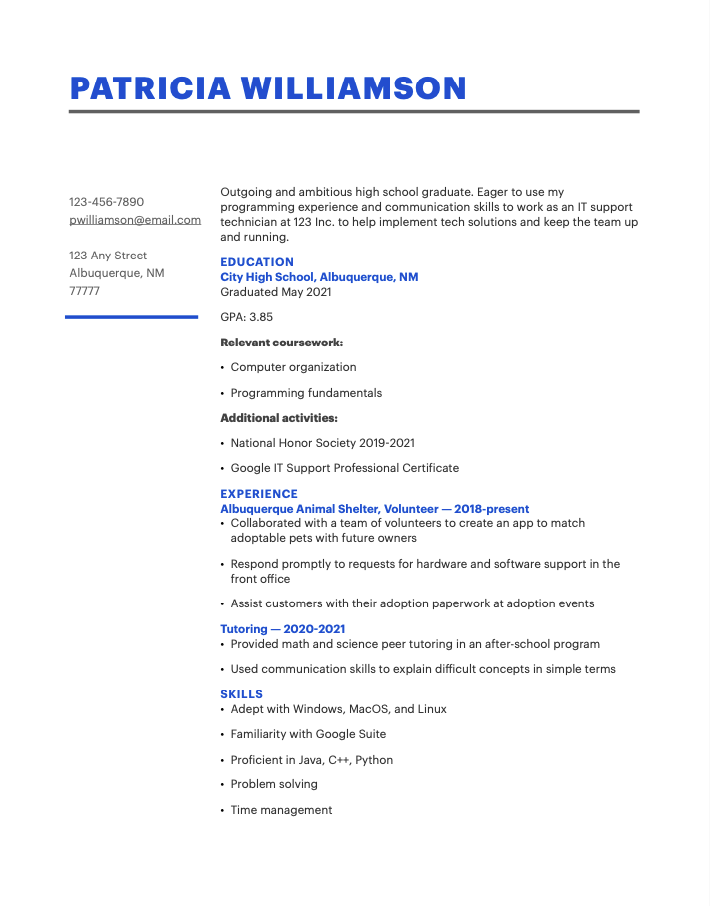
The above resume can be considered a great example of showing potential even though the candidate lacks experience. In the resume format, look at the weightage given to transferable skills one might have picked up during their internship and volunteering projects.
Other ways to demonstrate potential are:
Even with no formal work experience, you can highlight a surprising range of technical skills on your resume!
Here are some categories and examples to consider:
Software proficiency:
Programming and web development:
Data analysis and visualization:
Design and Multimedia:
A combination resume format is the most ideal for entry-level jobs or first-time job seekers. It allows you to showcase both your skills and limited work experience. Here’s why you should use it:
Pro tip: For optimal readability, ensure all text on your resume is left-aligned. Centering is optional for your name, contact information, and headline, but avoid centering any other elements. Avoid light and intricate fonts, as Applicant Tracking Systems (ATS) won’t read it well.
Most HRs use skills management software for hiring and onboarding, which means everyone uses solutions-based software. So why shouldn’t you?
Using supportive tools for creating, managing, and tracking resumes at an early stage, like that of entry-level jobs, can help you get a proactive advantage.
That’s why you need ClickUp, a comprehensive productivity and work management software! For personal use cases, it can work more than a document management platform.
Here’s how you can use ClickUp effectively for creating your resume:

With ClickUp Docs, you can create impressive resumes. Here’s how:
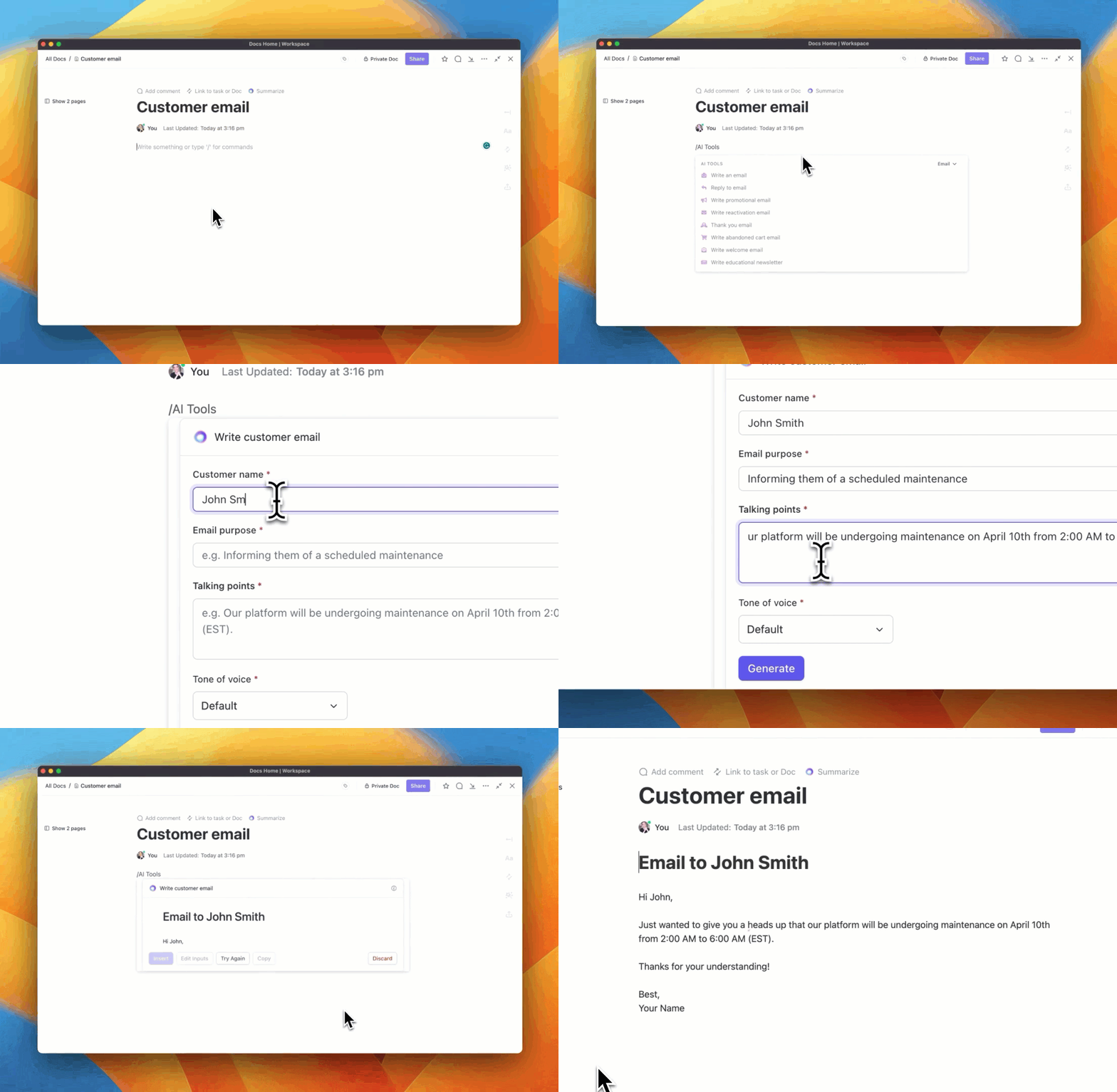
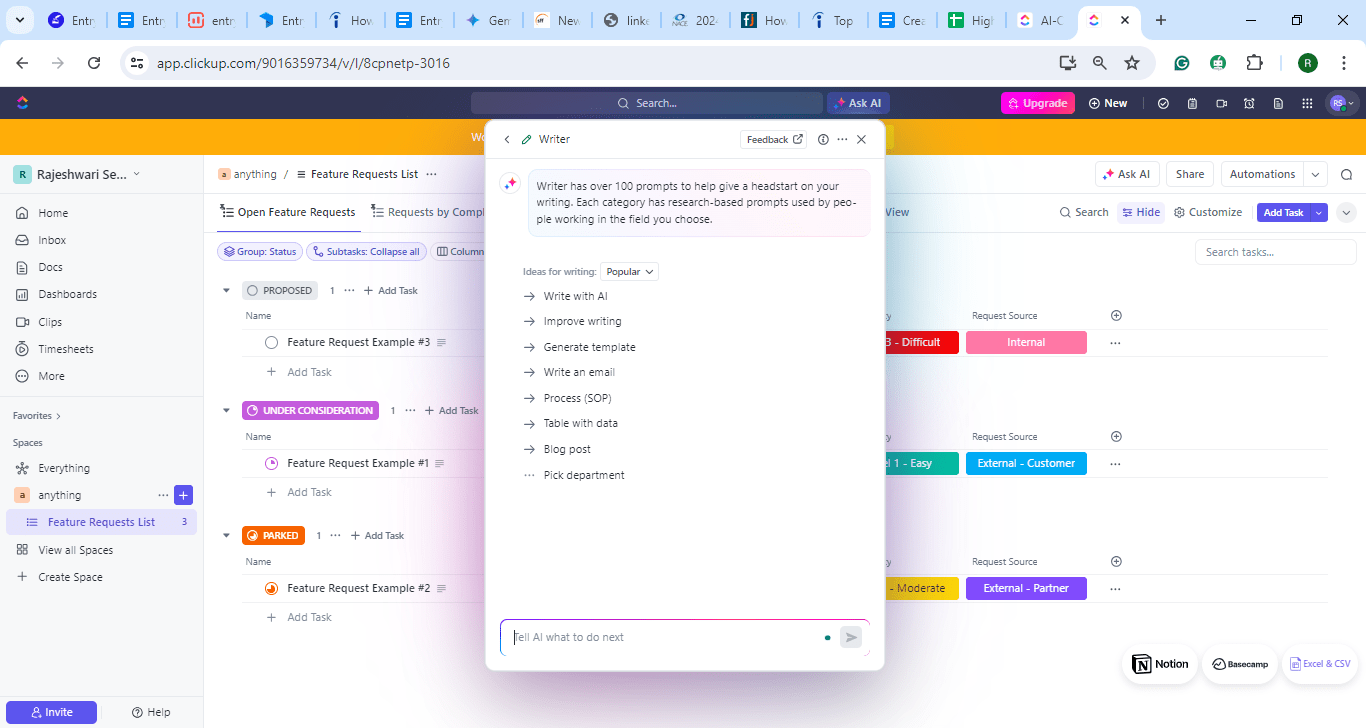
There are so many possibilities when it comes to combining ClickUp Brain’s AI Writer for Work with ClickUp Docs to refine your resume:
ClickUp templates are pre-built documents that eliminate the need to create resumes, cover letters, or job applications from scratch every time, saving you valuable time and effort.
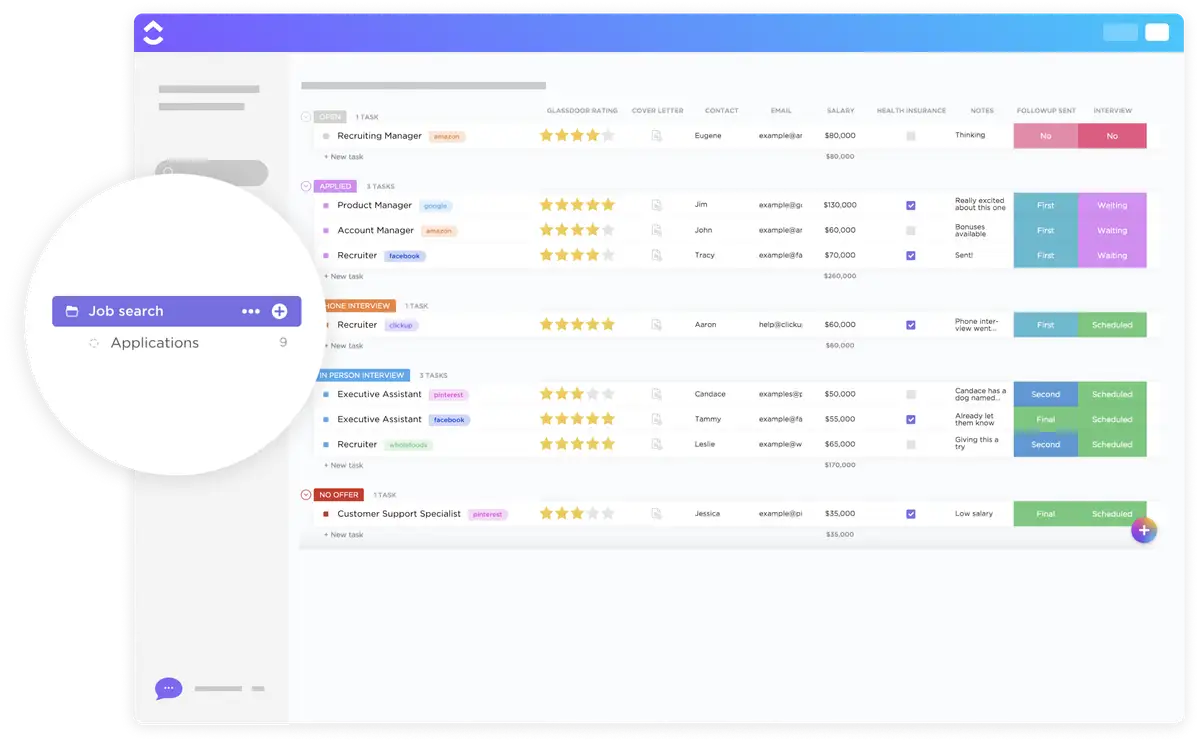
For instance, use the ClickUp Job Search Template to track all resumes, job applications, responses, and follow-ups in one place.
Feeling overwhelmed by the job search process? ClickUp’s Job Search Template facilitates your entire search, keeping you focused and informed every step of the way. Here’s how:
See your progress at a glance:
Craft stellar applications:
Customize your search:
Say you’re now at a mid-career stage. It is now time to level things up. Use the ClickUp Career Path Template to visualize your progress journey.
ClickUp’s Career Path Template helps you to take control and visualize your professional goals within your organization. Here’s how it can help:
Craft a personalized roadmap:
Maximize ClickUp’s power:
Your resume is often your first impression with potential employers, so it needs to be informative, well-organized, and visually appealing.
Here are some essential tips and best practices to elevate your resume and grab the attention of hiring managers:
Formatting and design:
Content and wording:
Additional best practices:
Now that you know how to draft your entry-level resumes, let’s check out some resume templates to help you get started:
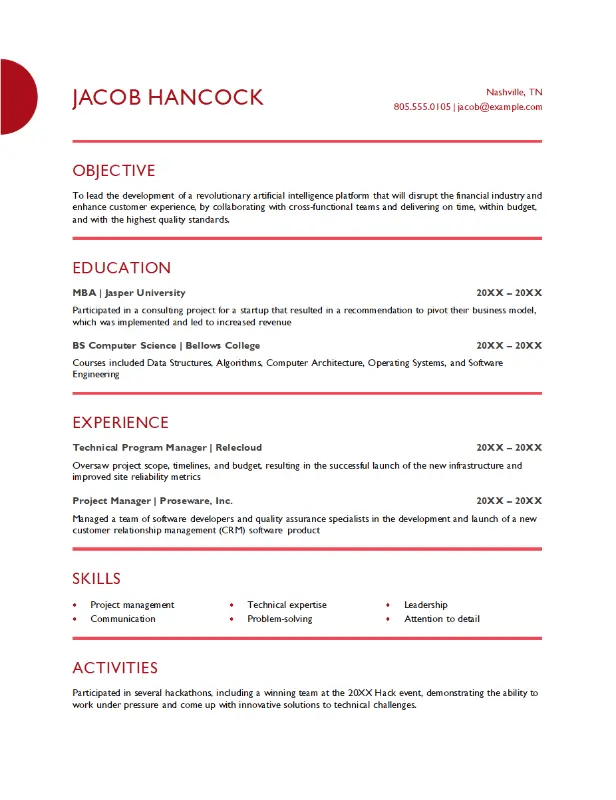
Looking for a project management role and need a resume that screams organization and efficiency? Look no further than the Project Management Resume Template by Microsoft.
This template offers a clear and straightforward structure ideal for showcasing your skills and experience, even if you’re just starting your career journey.
Focus on what matters most:
This template prioritizes a clean and readable layout, perfect for making a strong first impression. The best part? You can customize it with different monochrome solid colors to add a personal touch and maintain a cohesive design.
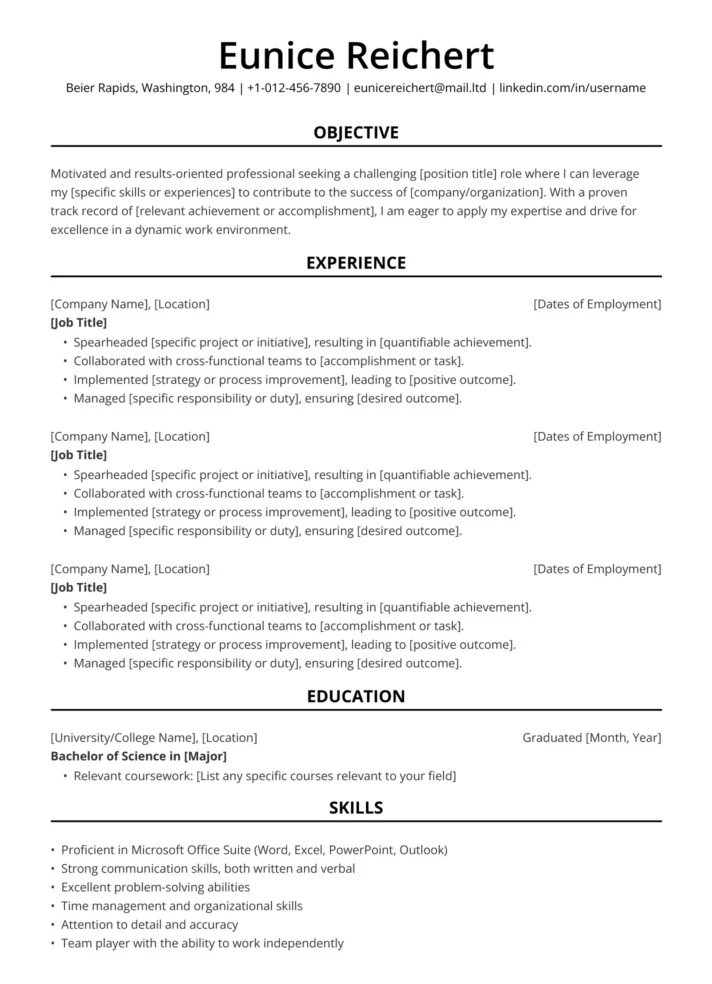
The Entry-Level Resume Template by GDoc is designed for Google Docs and Microsoft Word. It is especially suitable for fresh graduates or those seeking internship opportunities.
This template prioritizes a clean and organized layout, making it easy for hiring managers to navigate your qualifications. Here’s what it offers:
Clearly defined sections: Each section has a distinct heading and dedicated space to showcase your skills and experiences.
Don’t worry if you’re starting from scratch! Each section comes with pre-written filler content to guide you on what information to include and how to structure your text. Simply replace the filler text with your details and tailor it to each job application.
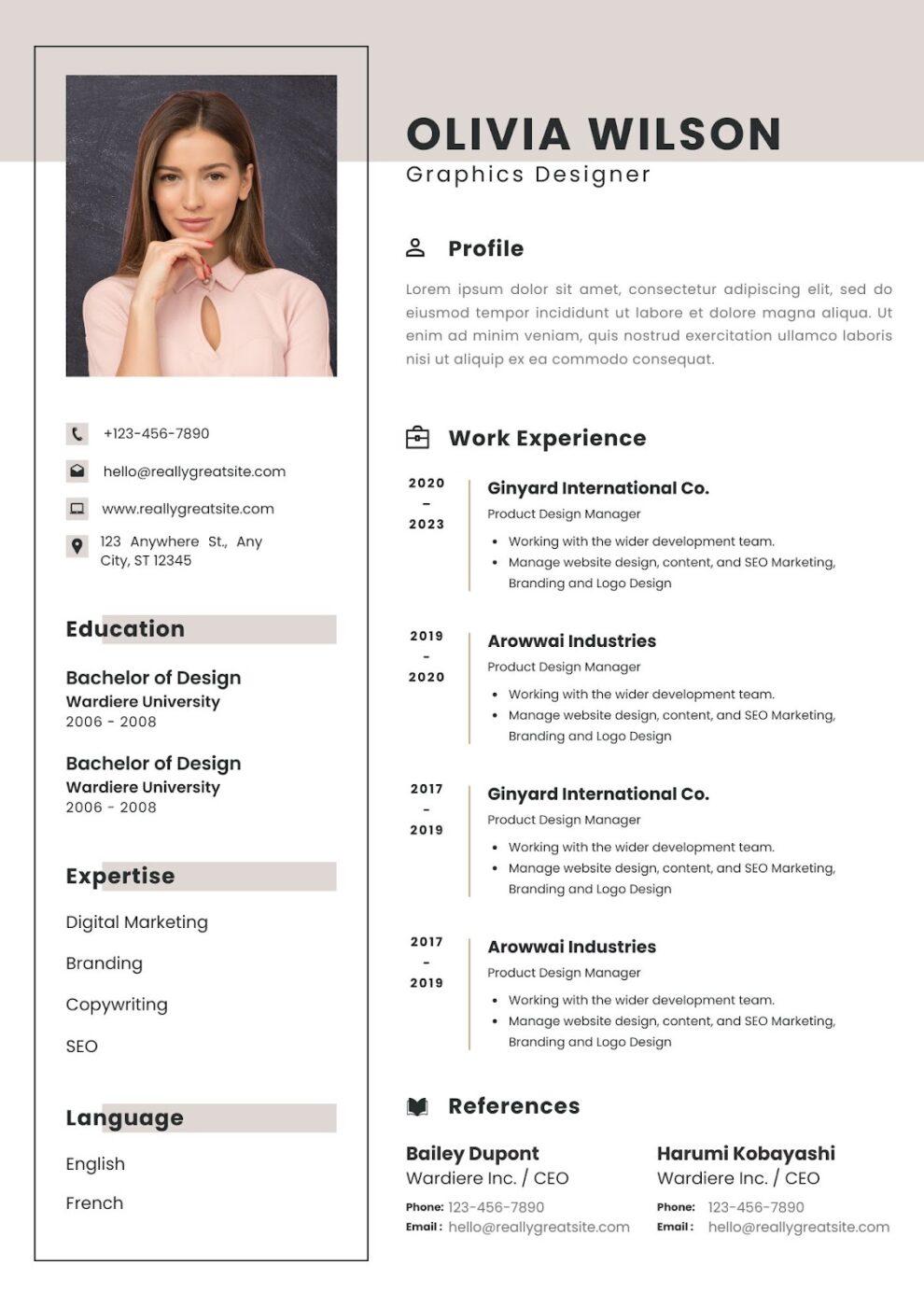
Land your first job confidently using a beautifully designed and easy-to-use Simple Professional CV Resume Template by Canva.
Here’s what it offers:
Cover Letter Template:
As an entry-level applicant, it’s crucial to showcase your potential and avoid common mistakes that could land your resume in the rejection pile.
Here are some pitfalls to watch out for and how to fix them:
Mistake #1: Lack of focus
Mistake #2: Duties vs. achievements
Mistake #3: Typos and grammatical errors
Mistake #4: Irrelevant information
Mistake #5: Unprofessional formatting
Pro tip: Don’t underestimate the power of a strong cover letter! Briefly reiterate your qualifications and enthusiasm for the position, further personalizing your application.
Crafting an entry-level resume can feel like building a bridge from scratch—you have the drive and materials, but the process can be daunting. It’s your first chance to showcase your potential, and nailing it is crucial.
That’s where a comprehensive tool like ClickUp comes in. It goes far beyond resume templates.
The platform equips you with AI-powered writing assistants to craft compelling content, task management features to keep your job search organized, and document management to facilitate the process.
Sign up to ClickUp today!

© 2026 ClickUp

There’s an easier way. Try a free AI Agent in ClickUp that actually does the work for you—set up in minutes, save hours every week.