
Sorry, there were no results found for “”
Sorry, there were no results found for “”
Sorry, there were no results found for “”
Remember Nike’s ‘Dream Crazy’ campaign? It featured icons like Serena Williams and LeBron James—and went viral. Behind the scenes, though, it likely took dozens of scripts, visuals, and real-time collaboration to pull it off.
You might not be launching a global ad, but if you’ve ever coordinated a blog post, email series, or landing page, you know how messy content creation gets. Files everywhere. Feedback scattered. Confusion over what’s final.
That’s where a solid content collaboration platform comes in. These tools bring your docs, comments, tasks, and approvals into one place so you can create, review, and publish—faster and with less chaos.
I’ve tested dozens of tools and dug through the top reviews and features. Based on all that (plus what we use at ClickUp), here are the top 12 content collaboration platforms worth trying.
If you’re constantly juggling docs, approvals, and team feedback, the right platform can make or break your content workflow
Here’s what to look for when choosing a tool that actually fits your team
Once you’ve identified what matters most to your team, it becomes a lot easier to narrow down the platform that actually helps you move faster, not just stay organized.
📮 ClickUp Insight: 48% of employees say hybrid work is best for work-life balance. Yet, with 50% still working mostly in the office, staying aligned across locations can be a challenge. But ClickUp is built for all kinds of teams: remote, hybrid, async, and everything in between.
With ClickUp Chat & Assigned Comments, teams can quickly share updates, give feedback, and turn discussions into action—without endless meetings. Collaborate in real time via ClickUp Docs and ClickUp Whiteboards, assign tasks directly from comments, and keep everyone on the same page no matter where they work from!
💫 Real Results: STANLEY Security saw an 80% increase in teamwork satisfaction thanks to ClickUp’s seamless collaboration tools.
| Tool | Best Feature | Primary Use Case | Pricing |
|---|---|---|---|
| ClickUp | AI-powered Docs, Content workflows, Built-in AI assistant (ClickUp Brain) | Teams creating and managing content workflows, from ideation to publishing, with AI and real-time collaboration | Free forever; Customization available for enterprises |
| Google Workspace / Drive | Real-time co-editing, Easy sharing, Gemini AI integrations in Docs & Meet | Teams already using Google tools needing seamless doc collaboration and smart suggestions | Free for personal use; Business plans start at $8.40/month per user |
| Notion | Custom content databases, Synced pages, Notion AI for summaries and generation | Teams building a flexible hub for docs, wikis, and content collaboration | Free plan; Paid plans start at $12/month per user |
| Miro | Visual whiteboards, Brainstorming templates, AI to summarize and structure ideas | Teams ideating visually and turning concepts into structured workflows | Free plan; Paid plans start at $8/month per user |
| Planable | Pixel-perfect previews, Approval workflows, AI post drafting and summarization | Marketing teams collaborating on social posts, blogs, and newsletters | Free (up to 50 posts); Paid plans start at $39/month per user |
| Asana | Editorial pipelines, Timeline views, AI for summaries and task suggestions | Teams managing content operations across multi-step projects and campaigns | Free plan; Paid plans start at $10.99/month per user |
| Smartsheet + Brandfolder | Asset management, Metadata tagging, AI-powered creative workflows | Creative teams managing brand assets, timelines, and approval flows at scale | Custom pricing |
| Confluence | Structured docs, Inline feedback, Atlassian Intelligence for smart docs | Teams documenting knowledge, policies, or specs with async collaboration | Free plan; Paid plans start at $5.75/month per user |
| Dropbox | Secure file sharing, Dropbox AI for doc Q&A, Real-time previews and comments | Teams handling large files or collaborating with external stakeholders | Paid plans start at $11.99/month per user |
| Bitrix24 | All-in-one suite, CRM + content, AI assistant for task and content help | Small teams managing content, CRM, and communication in one platform | Free plan; Paid plans start at $49/month for 5 users |
| Box | Enterprise security, File workflows, Box AI for summarizing and metadata | Enterprises needing secure, scalable document collaboration and compliance | Paid plans start at $20/month per user |
| Zoho WorkDrive | Zoho integration, Zia AI for search and summaries, Real-time doc collaboration | SMBs using Zoho suite to organize, edit, and collaborate on files | Paid plans start at $3/month per user |
🎉 Fun Fact: One of the earliest forms of remote document collaboration? The fax machine. Yes, really. We’ve come a long way.
We’ve identified the 12 best content collaboration platforms to consider today—each offering unique features to enhance teamwork, streamline tasks, and drive exceptional results.
If you’re juggling multiple content projects at once, ClickUp can quickly become your go-to platform. From early brainstorming to final approvals, it helps you streamline every stage of the content creation process.
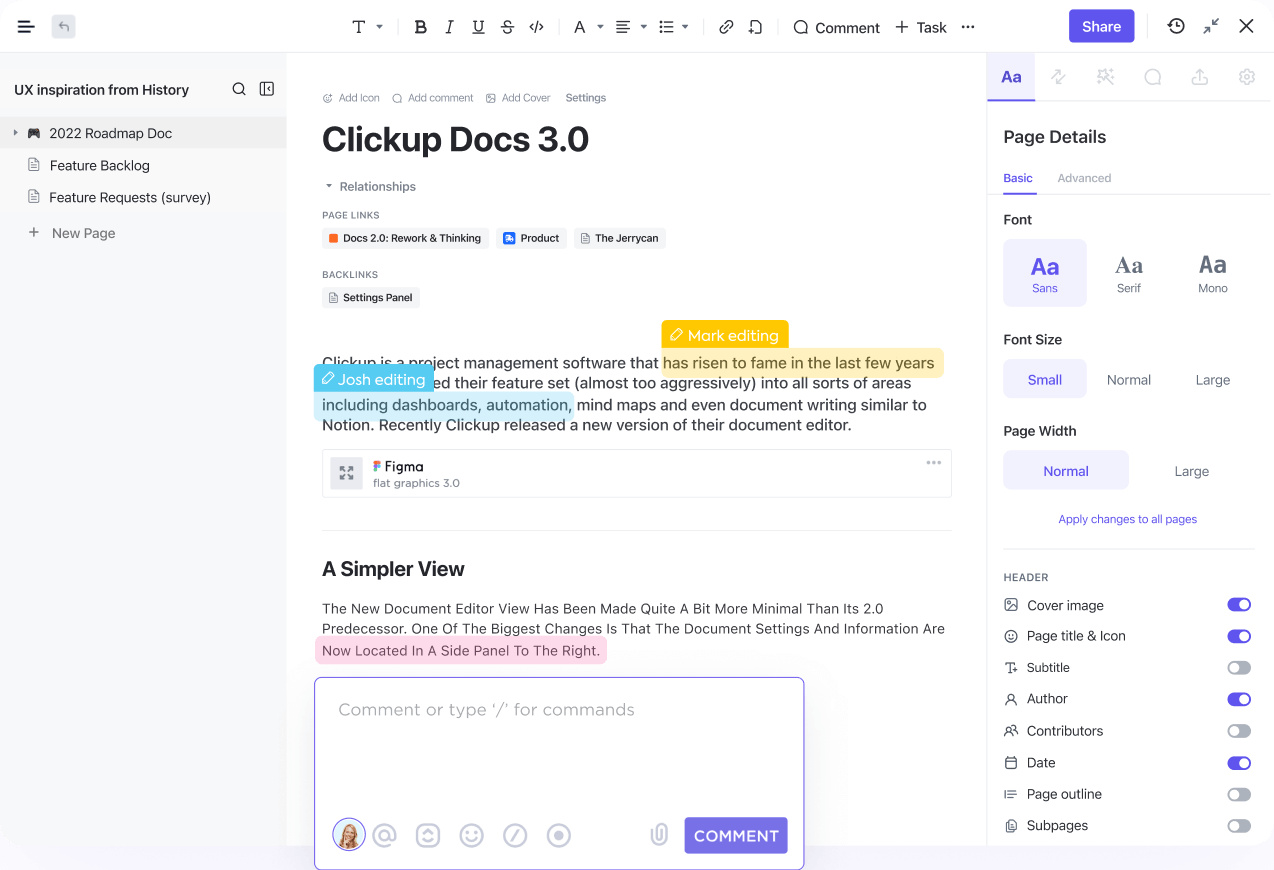
With ClickUp Docs, you can create, edit, and collaborate in real time—whether you’re drafting blog posts, planning content calendars, or sharing feedback with editors.
You can link Docs directly to tasks and workflows, so every piece of content is tied to action. ClickUp keeps your Docs organized in one place, with Docs Home and powerful search, while permissions and privacy controls ensure sensitive work stays protected.
Make the most of Docs by:
💡 Pro Tip: If you’re using ClickUp Docs, pair it with ClickUp AI to summarize comment threads or suggest action items based on edits.
ClickUp Brain takes it even further. This built-in AI adapts to your role and needs—helping you create, manage, and improve content fast.

Hit a creative block? Use ClickUp Brain to generate ideas or draft high-quality content based on your inputs. It’s a huge help when you’re working on tight deadlines or need a head start.
🔁 Real-World Workflow Example
Let’s say you’re drafting a blog post.
You open a ClickUp Doc, jot down your ideas, and @mention your editor to review. They hop in, leave comments in real time, and once everything’s polished, you link the Doc to a Task in your content pipeline.
From there, ClickUp Automations kick in—moving the task to “Review,” notifying stakeholders, and assigning it to your designer. They add visuals, tag marketing, and now your post is queued for publishing—all without ever switching tools.
Everything stays visible, actionable, and on track. That’s true end-to-end collaboration in ClickUp.
Collaborate seamlessly with Chat, Comments, and Mentions
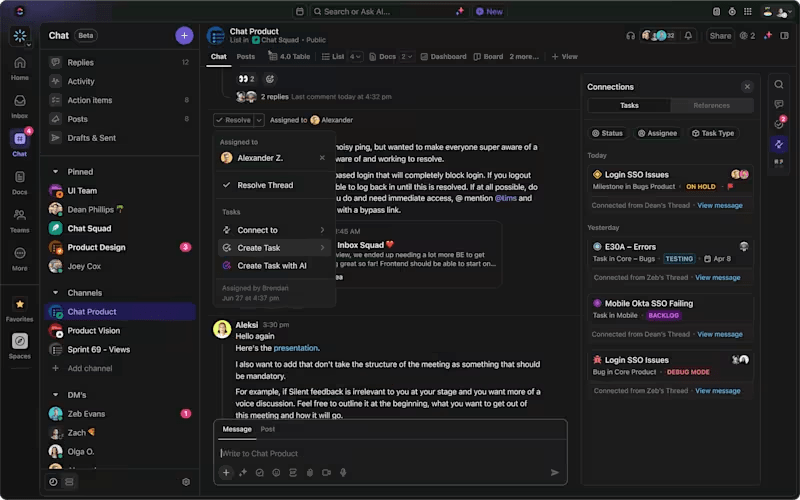
Communicate in real time with ClickUp Chat—create channels or direct messages to share updates, brainstorm, and keep all project conversations actionable and organized. Leave comments anywhere (on tasks, Docs, or Whiteboards) to provide feedback, ask questions, or clarify requirements.
Turn feedback into action with Assigned Comments by assigning them as to-dos, which are automatically marked complete once resolved.
Use @mentions in tasks, Docs, comments, and Chat to instantly notify teammates, assign responsibility, or loop in stakeholders—ensuring nothing slips through the cracks. With unified, searchable collaboration, your team can work together in context and never lose track of important conversations.
You’ll also stay in sync with ClickUp Collaboration Detection, which shows you when teammates are typing, commenting, or viewing a doc. No refreshes, no delays—just seamless co-editing in real time.

⏩ AI Capability: ClickUp Brain leverages the latest GPT, Claude, and Gemini models to automate content briefs, summarize comment threads, generate blog drafts, and even answer workspace questions. You can also use Autopilot Agents to handle repetitive tasks—like moving docs through review stages or assigning follow-ups—so your team stays focused on creativity, not admin work.
Pros:
We use ClickUp to manage and track our social and digital media content creation pipeline. This allows us to see the status of each content piece (in progress, needs edits, scheduled, etc.) along with who the lead designer is. It also eliminates all the back-and-forth email communication as the comments section for each task can be used to deliberate and delegate tasks/next steps (serving the need for tracking and following up on our content creation cycle). ClickUp has reduced the need for email communication and streamlined collaboration for our content creation team. We can now go from ideation/brainstorming to the first draft up to 2-3x faster.
Cons:
Like any robust platform, there’s a learning curve — especially when setting up advanced automations or nesting structures. But once it’s dialed in, it’s incredibly efficient. We’d love to see even deeper integrations with finance tools and smoother mobile experience for heavy users.
Absolutely. ClickUp is my go-to for managing the entire content creation process without hopping between five different tools. Whether I’m drafting blog content in Docs, tagging a designer in a Whiteboard, or letting Brain help with repurposing old posts, everything stays connected and on track. If you’re serious about content collaboration—from rough ideas to published campaigns—ClickUp is hands-down the most complete solution I’ve used.
Google Drive is a widely used cloud storage and file-sharing service. It allows storing, accessing, and sharing files from any device with an internet connection. The platform’s user-friendly interface and integration with other Google services like Gmail, Docs, and Sheets make it a popular choice for personal and professional use.
Real-time co-editing is a standout feature of Google Drive that significantly enhances seamless content collaboration.
⏩ AI Capability: Google Docs now includes AI-powered features from Gemini (formerly Duet AI), which help you draft content, rewrite sentences for clarity or tone, generate summaries, and even automate formatting. Gmail and Google Meet integrations also use AI to suggest replies, surface context, and transcribe meetings into editable Docs—making collaboration more intelligent and efficient.
Pros:
What I like best about Google Workspace is its seamless collaboration and real-time editing capabilities across tools like Docs, Sheets, and Slides. It makes teamwork incredibly efficient, whether you’re working remotely or in the same room. The tight integration between Gmail, Calendar, Drive, and Meet also streamlines communication and scheduling, reducing friction in day-to-day workflows. Its cloud-based nature ensures everything is accessible from anywhere, on any device, which is especially valuable for distributed teams. Overall, it’s intuitive, reliable, and built for productivity.
Cons:
Sometimes the formatting gets messed up when I download a file from Google Docs or Slides into Microsoft Word or PowerPoint. Also, when a lot of people edit at the same time, it can lag a bit. But overall, it works great.
Yes. Google Docs is still the fastest way to co-write and collaborate on content in real time. If you’re already using Gmail or Calendar, it’s a no-brainer. For more advanced workflow and task management, though, you’ll want to pair it with something like ClickUp.
🧐 Did You Know? Google Docs is still the most widely used document collaboration tool—but it’s rarely the most complete solution for creative teams with project workflows
Notion is an all-in-one workspace that combines note-taking, task management, and content collaboration. It’s ideal for teams that need a flexible platform to manage content projects and collaborate on documents. It can be beneficial when organizing content ideas, collaborating on drafts, and managing content calendars, and it’s a versatile tool for any team.
⏩ AI Capability: Notion AI helps you generate summaries, brainstorm blog titles, rewrite sections for tone or clarity, and extract action items from meeting notes. You can also autofill tables, translate text, and convert raw thoughts into structured content—all within your Notion workspace.
Pros:
Notion replaces a lot of the Google suite tools, and because it’s not made by Google, it’s visually pleasant and user-friendly easy to to work with. It has advanced features but lightweight enough none of these are a barrier to using it immediately.
Notion is also good for collaboration — each document has easy to understand, fine-grained permissions and it’s easy to comment, link to or mention internal and external documents.
Cons:
While powerful, Notion can have a bit of a learning curve—especially for new users who aren’t familiar with its block-based system. It can also feel a little slow or clunky with larger pages or databases, and some advanced features require a bit of workarounds. Offline functionality could be better.
Yes—especially if you’re looking for a flexible content hub that adapts to how your team thinks and works. Notion is perfect for managing content alongside tasks, meetings, and documentation, without bouncing between multiple platforms.
💡 Pro Tip: Don’t wait till the final draft to ask for feedback. Commenting in real time (even on messy docs) speeds up approvals and builds stronger alignment.
Miro is a digital whiteboard platform that helps teams visualize, plan, and collaborate in real time. It’s particularly helpful during the early stages of the content creation process—when you’re brainstorming campaign ideas, mapping out editorial workflows, or building creative concepts with your team.
⏩ AI Capability: Miro’s new AI tools help accelerate brainstorming, generate sticky note clusters, suggest next steps during diagramming, and summarize whiteboard sessions. AI also assists with converting freeform discussions into structured workflows, so nothing gets lost after a creative meeting.
Pros:
Its flexibility and how easily it adapts to different types os projects and teams. The ability to fully customize boards and the wide variety of templates help us kick off any activity efficiently. Real-time collab is one of its strongest features.
Cons:
Although Miro offers many benefits, it can have a bit of a learning curve for new users who are not used to visual tools. Also, performance may slow down slightly whe many people are working on a complex board with a large number of elements.
Yes—especially for teams that ideate visually or run frequent workshops. Miro is one of the best ways to get your content ideas out of people’s heads and into a format you can build from.
Planable is an online collaboration platform built specifically for content teams. It’s designed to help you create, review, and approve social media posts, blog content, newsletters, and marketing campaigns. With a drag-and-drop calendar, pixel-perfect previews, and real-time feedback features, it’s one of the easiest ways to get written content out the door faster.
⏩ AI Capability: Planable now includes built-in AI assistance to help you draft posts, generate campaign variations, suggest hashtags, and summarize feedback. Its AI helps speed up reviews, making it easier to go from draft to approval without delays.
Pros:
It replaced so much of my manual content creation process between me and my team and our clients. There’s no other software that lets you draft, approve, and schedule content on multiple platforms. We use Planable daily and set up our monthly campaigns with ease. It has saved us so much time!
Cons:
While Planable is strong in collaboration and planning, it falls short in several areas. The lack of advanced analytics or reporting features is a major drawback for users who need to track performance or generate client reports-currently, you have to rely on external tools for insights. The platform also does not support direct publishing to Instagram Stories or Pinterest, and there are limitations around bulk importing content, evergreen post recycling, and content libraries for reusing posts
Yes—especially if you’re managing social or editorial workflows and want a faster, more collaborative way to plan and publish. Planable fills the gap between content creation and distribution with clean, structured feedback tools and solid AI support.
🎉 Fun Fact: The term “collaboration” comes from the Latin collaborare, which literally means “to work together”—something your tools should actually help you do.
Asana is a work management tool that helps teams stay organized and on schedule. While it’s not built specifically for content collaboration, it’s widely used by marketing and content teams to manage editorial calendars, track approvals, and coordinate campaign assets. Its visual boards, calendar views, and automation tools make it ideal for keeping multi-step content workflows moving forward.
⏩ AI Capability: Asana now includes AI-powered tools to auto-prioritize tasks, generate project summaries, suggest next steps, and highlight risks. Its AI integrations also support smart goal tracking and can recommend adjustments to content timelines based on workload or bottlenecks.
Pros:
Asana is a powerful platform for managing cross-functional work. Its flexibility allows us to design templates, workflows, and automation rules that support both internal and client-facing needs. The ability to use different views (list, board, timeline, etc.) makes it easy to adapt to different project types and stakeholder preferences. We also appreciate its strong collaboration features (comments, subtasks, and integrations) which keep teams aligned and transparent.
Cons:
I think it lacks a little more detail in terms of data security and collaboration. You should be able to adjust which fields you give editing/visibility access to a third party. I also think there is a lack of flexibility in the type of fields that can be created.
Yes—if you’re managing complex, multi-step content projects across multiple stakeholders. While you’ll need a separate doc tool, Asana makes it easy to see who’s doing what, when it’s due, and what’s holding it up.
💡 Pro Tip: If you’re collaborating on long-form content, break your doc into sections using collapsible headings in ClickUp Docs or Notion. It helps reviewers stay focused and speeds up approvals.
Smartsheet is a spreadsheet-style work platform, and when paired with Brandfolder (its digital asset management solution), it becomes a powerful tool for marketing and creative teams managing content operations. This combo helps you keep campaign plans, timelines, approvals, and brand assets all in sync—perfect for teams juggling high volumes of creative requests and deliverables.
⏩ AI Capability: Smartsheet’s AI can auto-classify content types, suggest metadata for assets in Brandfolder, and recommend workflows based on historical activity. AI also powers document summaries, predictive task assignments, and anomaly detection across content campaigns.
Pros:
There is such a variety of ways to filter and parse search results. By setting up labels, tags, and more, it’s easy to find exactly what you are looking for in a sea of digital assets. This has worked so much better than using a folder structure on one of our local servers.
Cons:
It was a little tricky to figure out how to use Brandfolder initially, I did have to be walked through it with a team member. Compared to file storing services like Box or DropBox, it was a little harder to navigate. I also don’t like sometimes when I need to share items to outside users, it will sometimes show other companies in my organization to my reviewers, we had to work around by creating links of specific assets to people, and it can get tricky- especially if you need to add something to an existing link.
Yes—for content teams working with a lot of multimedia, especially those handling external approvals, rights management, or brand compliance. The two tools together create a structured, scalable hub for content delivery.
🎉 Fun Fact: ClickUp Docs aren’t just for words—you can embed GIFs, code blocks, Figma files, and even spreadsheets to keep everything in context.
Confluence by Atlassian is a powerful content collaboration platform that helps teams build a shared knowledge base. It’s especially useful for internal documentation, wikis, meeting notes, and long-form content that needs to stay organized. With customizable templates and structured layouts, you can maintain clear, searchable documentation across projects and teams.
⏩ AI Capability: Atlassian Intelligence, built into Confluence, helps auto-summarize pages, generate documentation from prompts, extract action items from notes, and provide smart answers to team questions—turning your wiki into an intelligent knowledge assistant.
Pros:
I have been using Confluence for the past couple of years for both personal and professional use, and I’m very happy with it. It is an excellent way for me and my colleagues to collaborate and edit the documentation for our software product. Having the ability to do version control on all of our documentation makes it easier to manage our information flow and see what changed and why.
Cons:
Confluence, especially the Confluence Cloud, can be difficult to customize its look and feel. If you want to make Confluence look like something other than a documentation platform, you would often need to rely on 3rd party apps to do that.
Yes—for teams that prioritize documentation clarity and internal knowledge sharing. Confluence excels when you need a shared source of truth that scales with your organization.
💬 Ask Yourself
Feeling like your content process could be smoother? Start here:
💡 Pro Tip: If you paused at any of those, it’s probably time to rethink your setup. Start by choosing one tool that brings everything together—ideas, edits, comments, and tasks. Like ClickUp!
Dropbox is synonymous with file sharing, and for a good reason. It’s one of the most user-friendly platforms available, making it easy to share files, collaborate on documents, and store content securely. You can use Dropbox to share large files with clients and collaborate on content drafts with team members.
⏩ AI Capability: Dropbox now includes Dropbox AI, which summarizes documents, previews content with smart highlights, and answers questions based on file content—helping you get key information faster without opening every file.
Pros:
-It is very practical for sharing files: Upload a document and in seconds you can send it with a link. It is perfect for working in a team without complications.
-It syncs well between devices: I can start something on the computer and continue on the phone without any problem. That has saved me several times.
-It has a good version history: If you delete something by mistake or need to revert to a previous version, you can recover it without stress.
Cons:
The search feature could be more intelligent—finding files in deeply nested folders isn’t always as quick as I’d like. Also, while Dropbox Paper has potential, we tend to use other tools for documentation and collaboration because Paper doesn’t fully match the speed and flexibility of Google Docs or Notion yet.
Yes—especially if your team deals with large files or frequent client collaboration. It’s not a full content workspace, but as a file-sharing platform, Dropbox remains best-in-class.
Bitrix24 is a comprehensive platform that enables content collaboration. It offers tools for project and content marketing management, CRM, and communication. It’s a great option if you’re looking for a single solution to manage multiple aspects of your business.
I appreciate Bitrix24’s social intranet feature, which fosters team communication and collaboration in a more informal setting.
⏩ AI Capability: Bitrix24 has added generative AI for smart email replies, automated CRM follow-ups, and content suggestions. Its AI assistant also helps summarize chats, suggest task titles, and draft client-facing documents inside the platform.
Pros:
Its a really good platform for small business to use as an enterprise quality communications and collaboration tool without the costs and pains of such platforms as Jira, Confluence, and MS teams. I particularly like the collaboration, the website developer wizard with templates.
Cons:
It’s a bit complex for a newbie. A lot of things are added to it, making it look like a bulky program. As it is quite heavy program, it slows down PC/laptop.
Yes—if you’re looking for a do-it-all platform that unifies content, CRM, and communication. Just be ready for a short learning curve.
Box is a cloud-based platform designed for enterprise content management and collaboration. It’s particularly well-suited for large organizations with complex content project collaboration needs. Box is an excellent tool for managing large volumes of content, especially when strict compliance and security measures are required.
⏩ AI Capability: Box AI (powered by GPT) can now summarize lengthy documents, extract key points from contracts, and answer questions based on content stored in your Box Drive. It also suggests metadata and automates content classification for faster search and compliance.
Pros:
Box is great for file sharing and collaboration, one, for our distributed team, and two, for the customers we’re sharing with. The interface is clean and easy to use. The integration with Google Workspace has been seamless, and it’s been a lifesaver for organizing all our documents and for collaboration
Cons:
The syncing while using using offline features can be a little slow and challenging. The mobile app is also not very user friendly. Bigger documents don’t sync well with the desktop version.
Yes—if you’re working in a high-compliance environment and need robust admin controls. But for smaller teams, it’s likely overkill.
Zoho WorkDrive is a cloud-based document management and collaboration tool tailored for teams already using Zoho products like Zoho CRM, Zoho Projects, and Zoho Mail. It offers strong file organization, secure sharing, and built-in tools for team collaboration—without overwhelming you with complexity.
⏩ AI Capability: Zoho WorkDrive has integrated Zia AI to automatically classify files, detect document anomalies, and offer smart search results. Zia can also summarize long documents and suggest metadata for faster retrieval.
Pros:
Zoho Docs collaboration offers real-time editing, commenting, and version control. The ability to tag team members and assign tasks directly within documents streamlines workflows significantly. Zoho’s tutorials on how to navigate this application is very helpful.
Cons:
On the downside, working offline can be tricky since the offline access is pretty basic. If you’re new to Zoho, it might take some time to get used to because the system can feel a bit complex at first. The mobile app also doesn’t have all the features you get on a computer
Yes—if your team already uses Zoho tools, WorkDrive ties everything together nicely. If not, you might find better standalone alternatives.
Perfect. Here’s the revised Honorable Mentions section with 4 thoughtfully selected tools based on our shortlist—each with strong niche utility, SERP presence, or unique AI enhancements:
These tools didn’t make the core list but are still excellent content collaboration platforms, especially for specific workflows or smaller teams.
If your team lives in Microsoft Word, Excel, or PowerPoint, OneDrive for Business makes document collaboration seamless. It offers co-authoring, version history, and tight integration with Teams and SharePoint.
AI capability: Microsoft Copilot now helps generate summaries, action points, and content drafts directly within Office documents.
OnlyOffice combines collaborative docs, sheets, and presentations with deployment flexibility. It’s open-source and lets teams run the platform on-premise or in the cloud.
AI capability: Built-in AI assistant supports summarization, translation, grammar fixes, and autocomplete for content blocks.
Slite is a modern knowledge base and collaboration platform with a clean interface, built for async-first teams. It’s especially useful for meeting notes, project documentation, and remote team alignment.
AI capability: Slite’s AI assistant drafts docs from prompts, summarizes Slack threads, and helps turn messy notes into polished content.
If your content team works in Google Docs and publishes to WordPress, Wordable streamlines the entire handoff. One-click export, clean formatting, and image compression included.
AI capability: Wordable now uses AI to clean up messy formatting, compress assets, and auto-optimize posts for SEO during export.
Whether you’re managing a content calendar, reviewing client proposals, or coordinating with a distributed team—the right content collaboration platform helps you bring everything together. No more digging through emails or switching between tools just to keep content moving.
Each of the platforms in this list brings something different to the table—from Notion’s flexible pages to Miro’s whiteboards and Planable’s social workflows. But the best choice depends on your team’s size, speed, and style.
If you want a tool that combines content creation, project tracking, file sharing, and real-time collaboration in one place, ClickUp is a game-changer. You can draft in Docs, assign content tasks, automate reminders, and even let AI help you summarize, edit, and publish faster.
👉 Ready to streamline your content workflow?
Try ClickUp today! You won’t regret it.

Manasi Nair
Max 26min read
Manasi Nair
Max 26min read
Manasi Nair
Max 20min read

© 2026 ClickUp