






Still downloading templates?
There’s an easier way. Try a free AI Agent in ClickUp that actually does the work for you—set up in minutes, save hours every week.
Sorry, there were no results found for “”
Sorry, there were no results found for “”
Sorry, there were no results found for “”
Archimedes’ famous “eureka” moment is still shorthand for the instant a hard problem finally makes sense. In sales, that same feeling shows up as the “aha” moment, when a user discovers a specific feature or outcome and suddenly sees the product’s value in their real work.
Sales managers are actively pursuing that moment. It looks simple from the outside, but usually comes after weeks of calls, follow-ups, user interactions, and careful listening to user feedback.
AI lightens that load. It handles repetitive work, giving your team more time to solve problems that truly matter. In fact, sales professionals believe that using AI tools can increase leads by more than 50%.
In the upcoming sections, we’ll explore how AI creates aha moments for sales managers by interpreting signals throughout the user journey and guiding new users through the onboarding process at their own pace.
📖 Also Read: Generative AI in Sales: Use Cases & Examples
81% of revenue leaders say their team’s deals are more complex than ever, which means the aha moment matters even more now.
Below are four types that show up often, with real prompts, signals to watch, and how AI helps guide users through the user journey at their own pace.
What it looks like: The win rate drops for one channel, even though the volume seems healthy. First meetings are up, but second meetings fall off a cliff.
Signals to watch: Source channel, time to first reply, first meeting set rate, second meeting conversion, notes from calls, and session replays on your demo page.
How AI helps:
🌟 Aha moment for the manager: We are fishing in the right pond but using the wrong bait after the first call.
✨ Aha moment for the user: I see how this technique solves my exact pain point, not just a general one.
🧠 Did You Know? McKinsey estimates “agentic AI” could generate more than 60% of the added value AI creates in marketing and sales, with generative AI worth up to $4.4 trillion in annual value across industries.
What it looks like: A deal sits in the same stage for ten days. Sentiment in emails cools. Product trial activity drops.
Signals to watch: Stage age, unanswered questions in notes, session recordings that show repeated clicks in one area, and customer sentiment trends.
How AI helps:
🌟 Aha moment for the manager: This deal is not cold. It is confusing.
✨ Aha moment for the user: There is a clear path to success, and the team is helping me walk it.
📖 Also Read: How To Use AI In Sales (Use Cases & Tools)
📮 ClickUp Insight: 16% want to run a small business as part of their portfolio, yet only 7% actually do. Going it alone can feel overwhelming, and that hesitation is real. If you are a solo founder, ClickUp BrainGPT steps in like a partner. Ask it to prioritize sales leads, draft outreach emails, or track inventory, while your ClickUp AI Agents take care of the busywork. Every task, from marketing to order fulfillment, can run on AI-powered workflows so you can spend more time growing the business.
What it looks like: One email sequence quietly outperforms. A short demo with two key features beats a long overview. Within the first five minutes, a real-world example reduces the sales cycle.
Signals to watch: Reply rate by template, time spent on specific demo sections, which feature tours users complete, and notes where customers request the same proof points.
How AI helps:
🌟 Aha moment for the manager: Two moments move everything forward. Let us focus there.
✨ Aha moment for the user: This solves my day-to-day work in a way I can use now.
What it looks like: Reps copy data between tools, book meetings by hand, and chase approvals in long threads.
Signals to watch: Time spent on admin, bounce between systems, average time from demo request to booked call, and repeated internal pings.
How AI helps:
🌟 Aha moment for the manager: We did not need more hours. We needed fewer steps.
✨ Aha moment for the user: Everything moves smoothly, and I can see progress without asking.
📖 Also Read: Top 10 AI Sales Tools for Faster Conversions
Aha moments feel spontaneous, but you can engineer them with a repeatable loop:
Signals → Insight → Next step → Outcome
Here’s what that looks like in practice:
| Signal (what changed) | AI insight (what it means) | Next best step (what to do) | Outcome to track |
|---|---|---|---|
| Deal stage hasn’t moved in 7–10 days | Missing stakeholder / unclear decision path | Ask who owns approval + schedule a 10-min admin setup | Next meeting booked; stakeholder added |
| Usage drops after first demo | Value not tied to a real workflow | Send a 2-min walkthrough of the exact workflow for their role | Feature activated; time-to-value down |
| Emails get shorter and colder | Hidden objection or competing priority | Surface objections + share 1 proof point relevant to their industry | Reply rate up; cycle time down |
| Reps repeat the same follow-up patterns | Playbook is generic, not segment-specific | Swap in the best-performing sequence for that segment | Win rate improves; fewer touches |
The goal is not “more AI.” The goal is faster clarity: one insight that reliably produces one next step a human can execute.
The fastest aha moments appear when AI turns scattered activity into a clear next step a sales manager can use right now.
Bain notes sellers spend only about a quarter of their time actually selling, and agentic AI can both free selling time and lift win rates by 30% when paired with process redesign.
So, let’s look at some of the use cases that offer such outputs.
When lead scoring accurately reflects real user behavior, rather than relying on intuition, it becomes a transformative experience.
Modern models read touchpoints across email, chat, calls, and product usage to identify patterns that separate casual interest from real intent. That helps your team focus on key actions in the user journey and show core features that match each role, so users understand the product’s value sooner.
McKinsey’s latest State of AI shows adoption is rising fast across marketing and sales, which means your competitors are already training models on the same market you share.
The advantage goes to teams that pair data with plain-language rules, like “if the first meeting is booked but usage is low, send a two-minute Loom video that answers the top question for this segment. ” Over time, feedback loops improve the model as user feedback flows back into scoring.
🧠 Did You Know? As per a recent report by Salesforce, 83% of sales teams with AI saw revenue growth this year vs. 66% without AI.
Good forecasts are a string of small aha moments that arrive in time to act. AI watches stage age, engagement dips, sentiment in notes, and even session recordings, then flags quiet risk before a deal slips.
McKinsey estimates GenAI can add hundreds of billions in productivity across sales and marketing, but only when insights lead to action, not just another dashboard.
Use risk alerts to guide users at their own pace with helpful nudges, like inviting the admin to a 10-minute setup or sending a proof-of-value checklist when activity stalls. This reduces last-minute escalations, shortens the sales cycle, and gives leaders context they can trust.
To stay grounded, remember Gartner’s warning that many “agentic” projects get scrapped for unclear value, which is why simple, testable alerts beat sprawling automations. Keep the loop tight: alert, act, learn, repeat.
💡 Pro Tip: Pair ClickUp Automations with ClickUp Notifications to turn risk into a task the second it appears. For example, if a deal sits in a stage for seven days or a field changes to “blocked,” auto-assign a rescue step and ping the owner by desktop, mobile, or email so nothing stalls in silence. You choose the triggers, the channel, and who receives the alert.
Most teams lose selling time to notes, scheduling, and status pings. Agentic AI can take over multi-step routines like logging calls, drafting follow-ups from transcripts, and booking the next step, which Bain ties to more time with customers when paired with better processes.
These light touches create helpful moments for users, such as sending a one-page setup guide right when a blocker appears, so users experience progress without extra meetings.
📖 Also Read: Exploring a Day in the Life of a Sales Manager
Raw fields say what happened. AI fields explain what it means right now.
Short summaries like “likely blocker,” “primary pain points,” and “next best step” give managers data-driven insights tied to the product’s aha moments, not just a list of activities.
BCG finds that companies using agents and contextual AI are pulling ahead because they decide faster with cleaner signals, not more noise. Fold these insights into the onboarding flow so new users realize value in earlier stages of the customer journey.
💡 Pro Tip: Use ClickUp Brain to turn meetings, chats, and docs into structured fields inside your workspace. It can pull action items, fill an AI-ready “next step” field, and create tasks from conversation context so follow-through happens without extra typing.
Coaching lands best in the moment, not a week later. AI summarizes call notes and transcripts, highlights objections, and spots where attention dipped, so a rep can adjust the very next call.
This creates a clear eureka moment for both sides: managers see what to coach, and customers hear a sharper story tied to their pain points.
As clips and summaries roll into tasks, you build a library of real-world examples that guide users without heavy meetings.
Gartner’s hype cycle reminds us to keep one foot on the ground, so start with a single use case, such as objection handling, and measure the impact on conversion. When this loopis effectives, new userstransitione from interest to user activationmore quicklyr, and many users deepen their engagement with fewer touches.
Sales leaders rarely struggle because they lack data. They struggle because that data is scattered.
Work sprawl spreads deals and to-dos across CRMs, spreadsheets, email threads, and handmade dashboards. Context sprawl hides the real story in call recordings and user feedback that live in different tools. And AI sprawl adds separate copilots for email, forecasting, and coaching that each see only a slice of the sales cycle.
When all three show up at once, it’s almost impossible to see where users actually realize value or what really triggered that aha moment in the customer journey.
That’s where ClickUp comes in. It acts as a converged AI workspace for sales teams, one place where work, context, and AI sit together. This makes it easier to spot signals and act on them.
Let’s take a look at how ClickUp enables this.
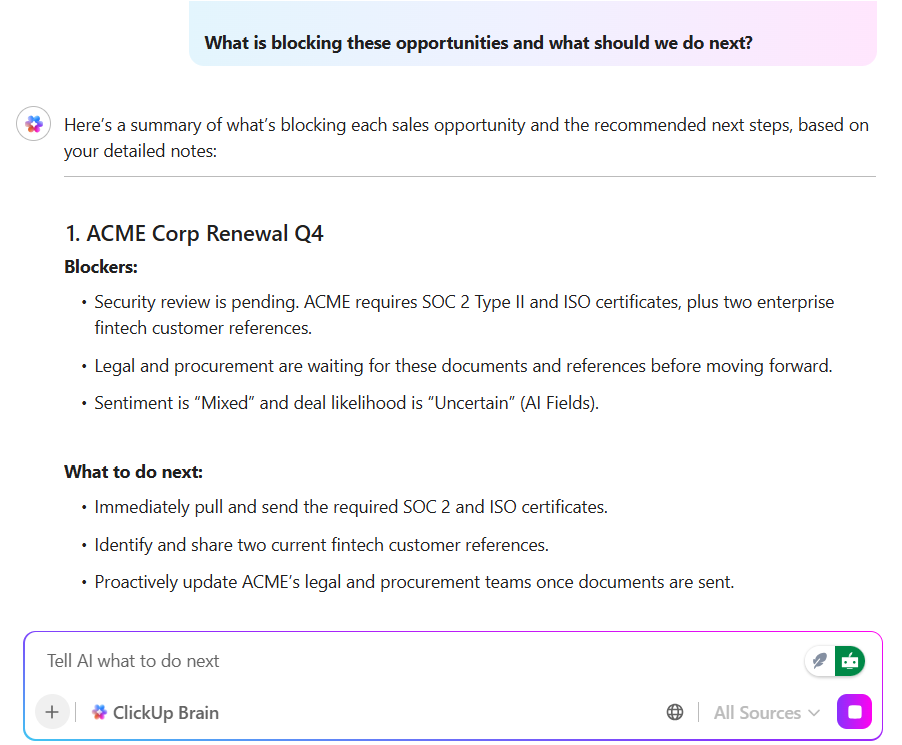
Sales managers get the clearest aha moments when the complete picture appears without digging. You want to open a deal and instantly see what changed, where a user hesitated, and which key actions will help the user realize value.
It also builds trust because the team focuses on real pain points instead of chasing status. Over time, patterns form across user segments.
First-time users often need simple proof, while power users want depth and speed. Seeing these patterns in one place is how AI creates aha moments for sales managers without adding more meetings.
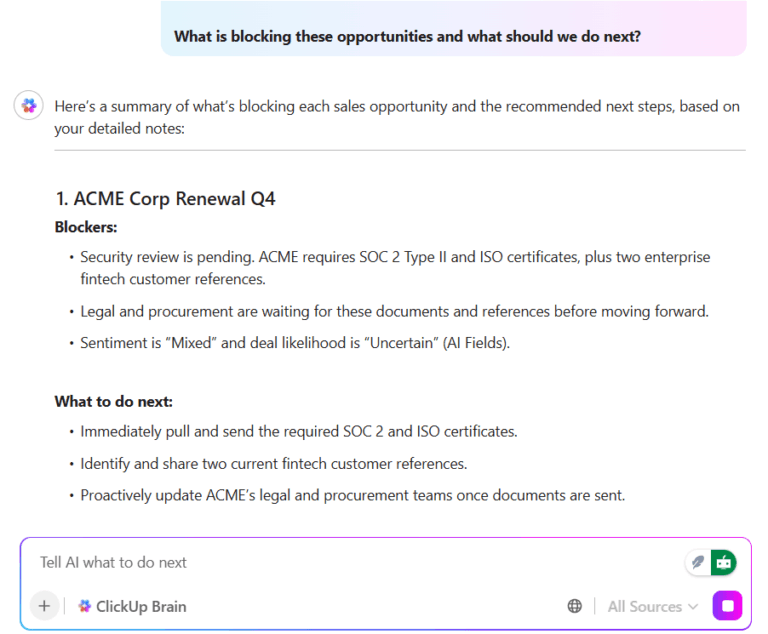
✅ ClickUp’s intervention: ClickUp Brain lives where your work lives. Ask a plain question like, “What is blocking these opportunities, and what should we do next?” and it summarizes activity, pulls in user feedback, and suggests the next step you can assign right away.
The AI can turn call notes into tasks, draft a quick follow-up, and guide users toward the product’s aha moments based on what similar customers did. Because it keeps context from tasks, docs, and chats, many users reach user activation faster with fewer handoffs.
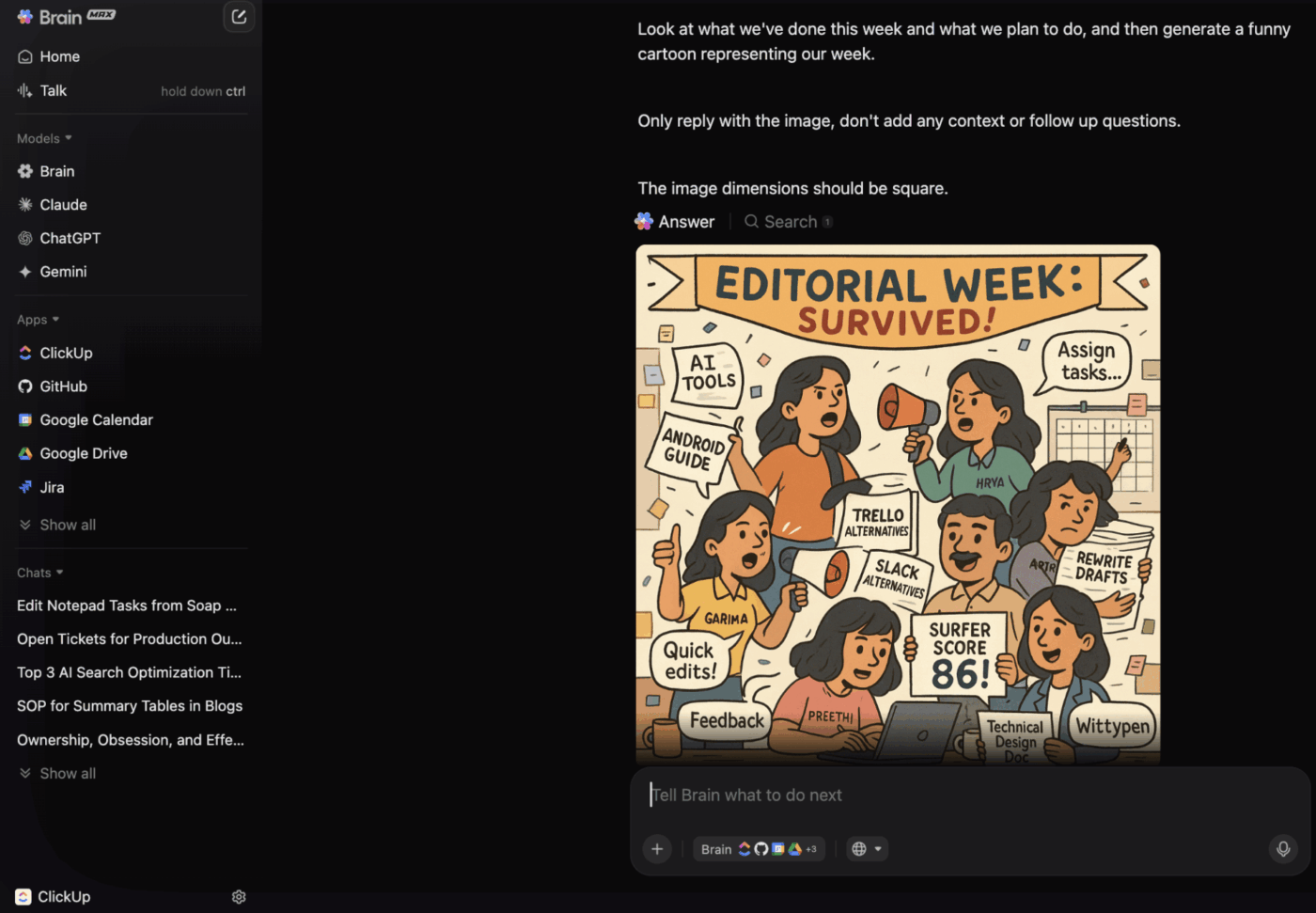
Important details sit across CRM notes, docs, emails, and competitor pages. Hunting for them breaks momentum and delays the moment when users realize they are on the right path.
Managers need a short brief that connects the dots so data-driven insights fit into everyday decision-making.
✅ ClickUp’s intervention: ClickUp BrainGPT is your companion on desktop and browser. It searches across ClickUp, connected apps, and the web, then gives you an answer in seconds.
Before a call, you can ask the AI for a one-minute recap, including the last demo, objections, and the next best step. ClickUp BrainGPT pulls a clean summary with links, adds a quick competitor snapshot, and suggests a short checklist to guide users through the next milestone.
Its Home Cards keep recent items and suggested actions at your fingertips, and users experience steady progress at their own pace.
📖 Also Read: How to Do Project Management for Sales Teams
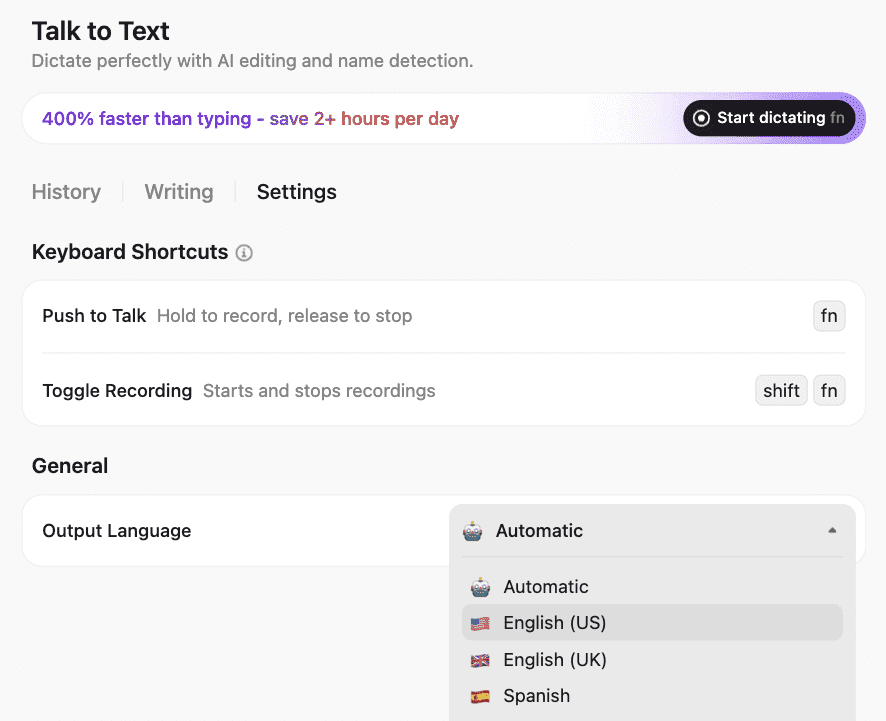
Many aha moments vanish because notes never make it from a rep’s head to the record. After a busy day, typing call summaries and action items slows everyone down. If teams capture user experiences while they are fresh, coaching improves, and users understand the product’s value sooner. Voice capture also helps during ride-alongs or field visits when typing is difficult.
✅ ClickUp’s intervention: ClickUp BrainGPT’s Talk to Text turns your voice into polished text anywhere you work. Speak your discovery notes once, and Talk to Text cleans them up, adds structure, and drops them into the right task or Doc.
You can dictate follow-ups, mention teammates, and tag the moment a user discovers a key feature. These details flow into coaching and outreach, helping many users experience the product’s breakthrough moments without unnecessary back-and-forth.
📖 Also Read: How To Improve Your Sales Productivity
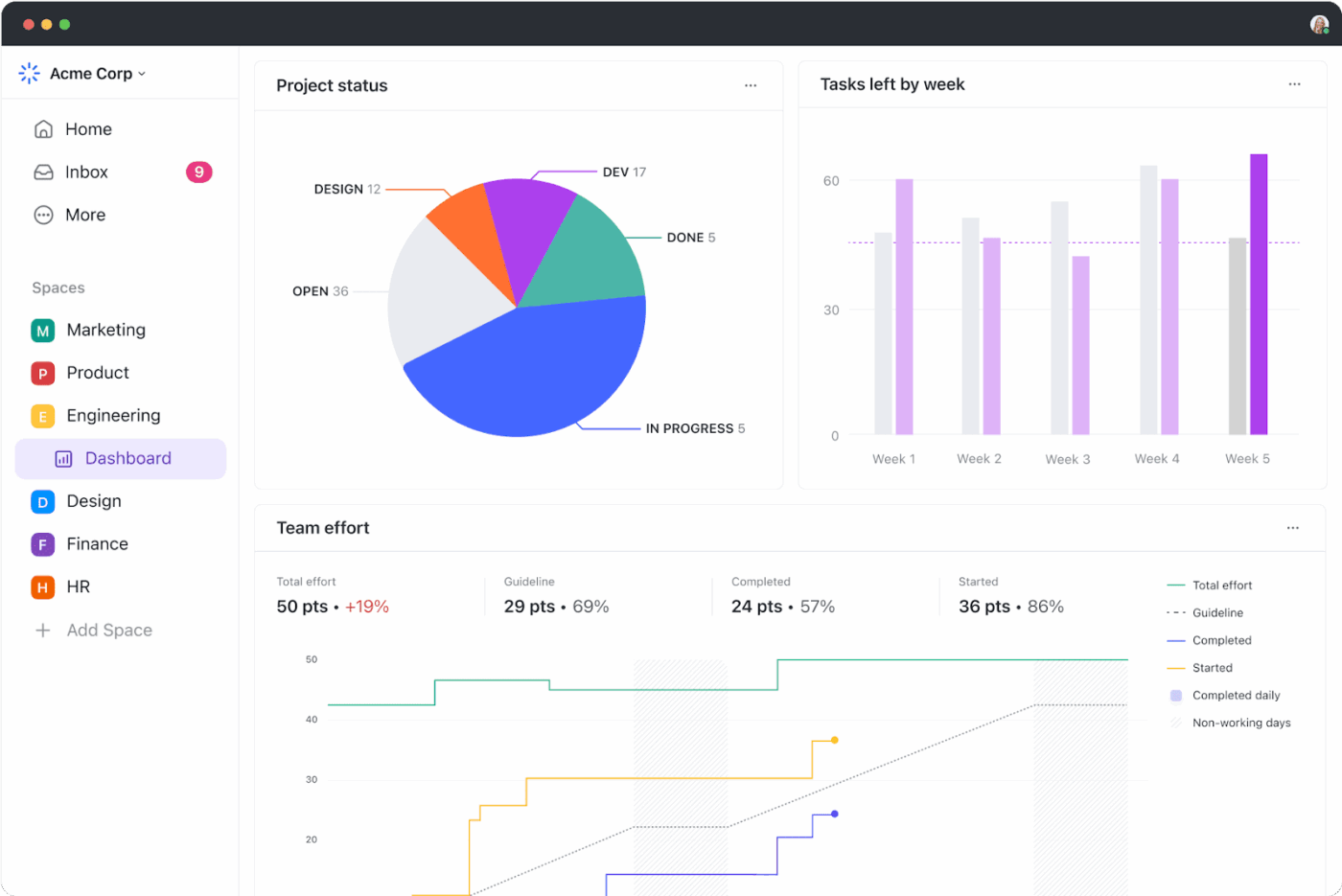
Managers need to see risk early, not at the end of the quarter. A simple view of win rate, stage age, and engagement trends helps you identify patterns and guide users before deals slip. Alerts should be specific and kind.
For example, if the stage is unchanged for seven days, invite the admin to a short setup. When insights reach the right person at the right time, users realize value sooner, and the team’s decision-making improves.
✅ ClickUp’s intervention: ClickUp Dashboards turn workspace data into living reports, and ClickUp alerts keep you ahead of stalls. Add cards for pipeline health, velocity, and key actions completed, then set alerts that fire when activity dips or sentiment turns.
Each alert can create a task, assign an owner, and add enough context so the rescue step is clear. Pair this with a short weekly review, and you’ll spot friction early, help churned users re-engage, and keep new users moving through the onboarding flow.
What ClickUp users say
We are amazed by ClickUp’s customization and integration capabilities. Most importantly,ClickUp’s Dashboards have transformed our reporting process. We can now easily monitor workload, present data, and get a high-level overview of all our projects in one single view.
💡 Pro Tip: Combine a Stage Age chart with an Executive Summary card. Let the summary explain why movement slowed and which single action will help this user segment today.
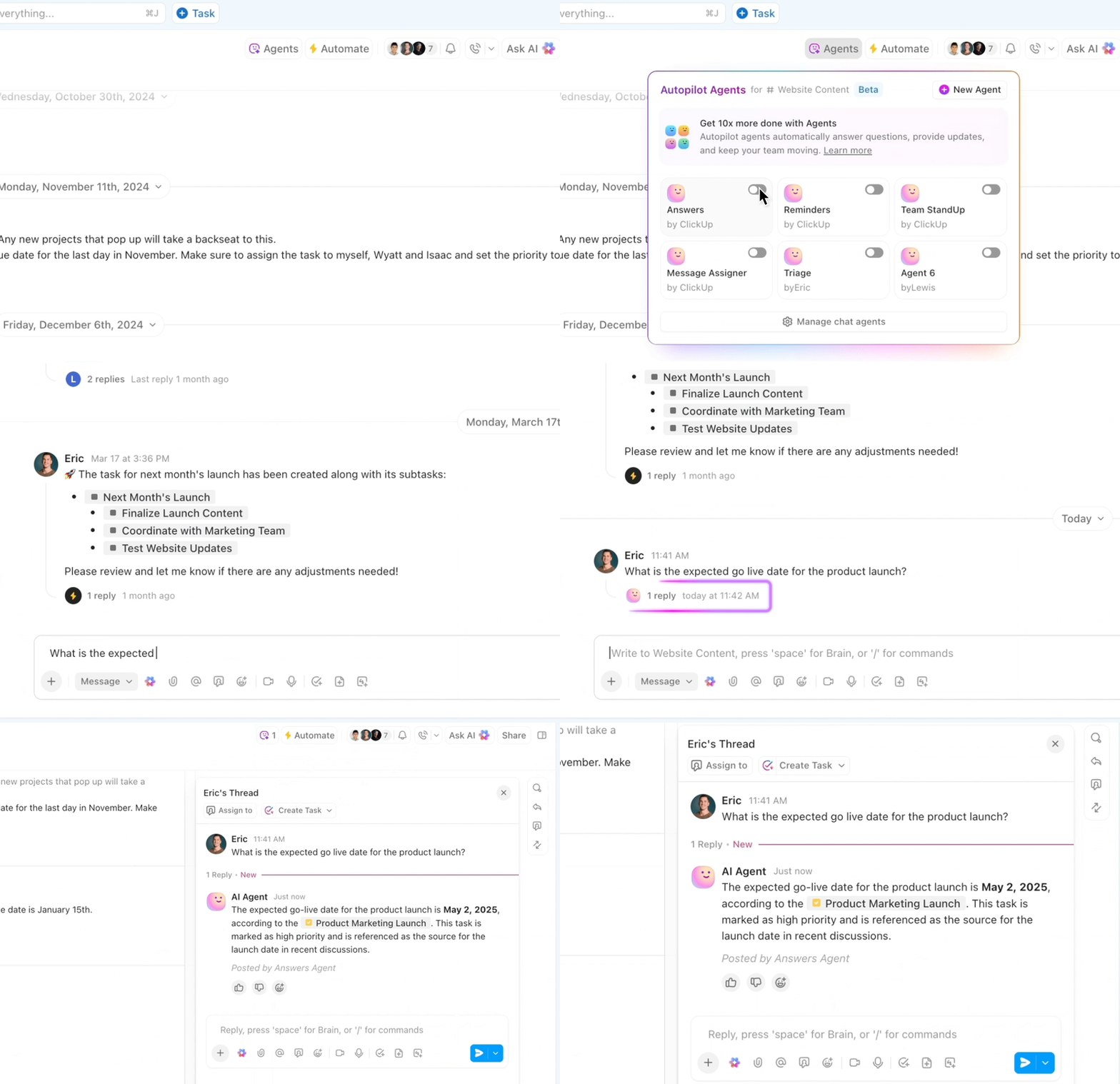
Repetition steals time from coaching and creativity. If an agent handles routine follow-ups, status rollups, and simple questions, the team can focus on moments that truly matter, such as refining a sales pitch with real-world examples or unblocking a security review.
AI agents are most helpful when they operate within your workspace and log their actions,, so nothing feels like a black box.
✅ ClickUp’s intervention: ClickUp AI Agents work in the background using your workspace and connected tools to act, respond, and execute.
Set up a Stalled Deal Rescuer that watches stage age, posts a brief reason summary, drafts a friendly nudge, and assigns a checklist.
Build a Live Answers agent that replies to common internal questions like “Where is the latest deck?” so reps move faster. Over time, these agents create a steady rhythm where users experience progress with fewer touches, and managers see clear, repeatable plays that drive user activation.
For sales teams, the best moments are when a deal moves forward and nobody had to chase it. Super Agents make those moments routine. They’re AI coworkers that live inside your ClickUp Workspace, assigned to deals, @mentioned in threads, and on the hook for the repetitive work that normally clogs everyone’s day.
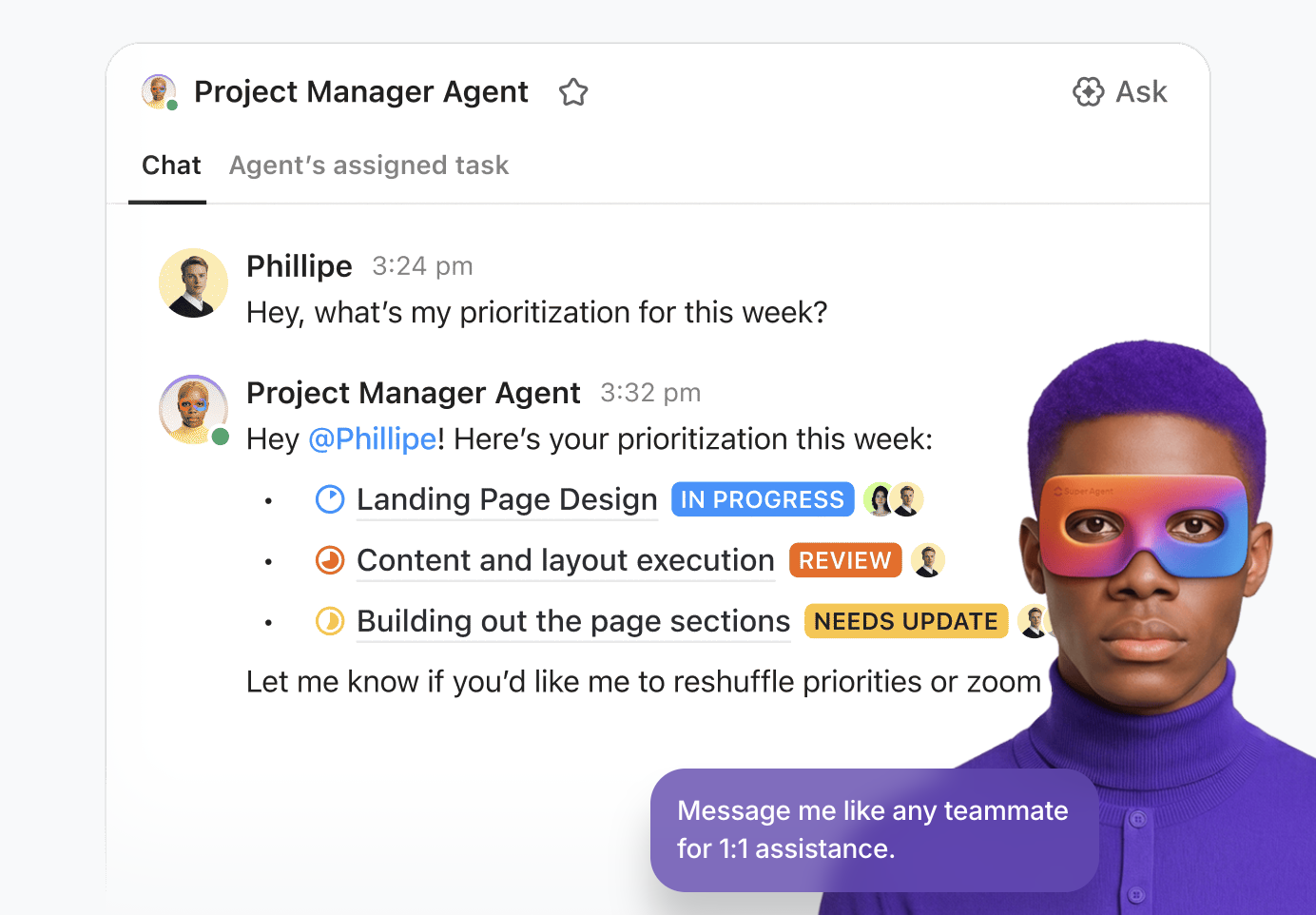
Unlike generic bots that just answer questions, Super Agents see your entire sales motion. They pull live context from tasks, Docs, chats, and connected tools so they understand deal movement, spot blockers, prep next steps, and run workflows end to end. You define the playbook, guardrails, and tools — they execute on repeat.
The payoff:
Super Agents don’t replace the human connection in sales. They strip out the friction so your team can spend time where it matters: building relationships and closing revenue.
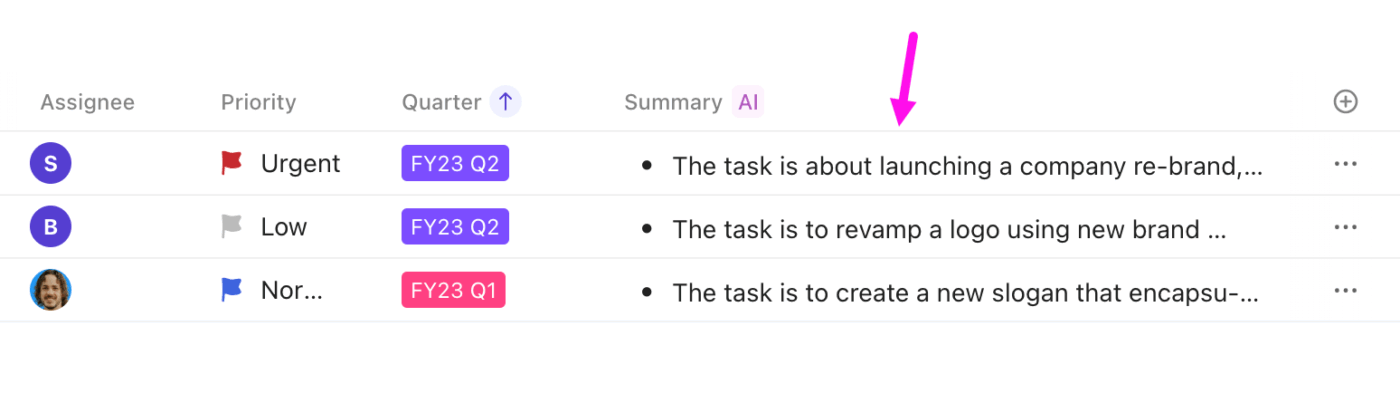
Raw fields tell you what happened. Sales managers also need to know why it happened and what to do next. A strong aha moment is opening a record and seeing that the likely blocker is missing admin approval, plus a suggested next best step like “share the setup clip.”
That kind of clarity helps guide users quickly, especially for first-time users who need one focused next step instead of more noise.
✅ ClickUp’s intervention: ClickUp AI Fields fill themselves with summaries, progress updates, sentiment, categories, and action items at scale. You can bulk generate before pipeline reviews, auto-refresh on updates, and plug AI Fields into automations that assign tasks when certain values appear.
Add a “Next Best Step” AI Field and a “Deal Likelihood Reason” AI Field so every opportunity carries its own mini coaching note. Patterns across user segments become visible, and different aha moments stand out clearly.
💡 Pro Tip: Keep formats short. For example, set Summary to short, Progress to the last seven days, and Action Items to one to three bullets. Short fields are read and acted on.
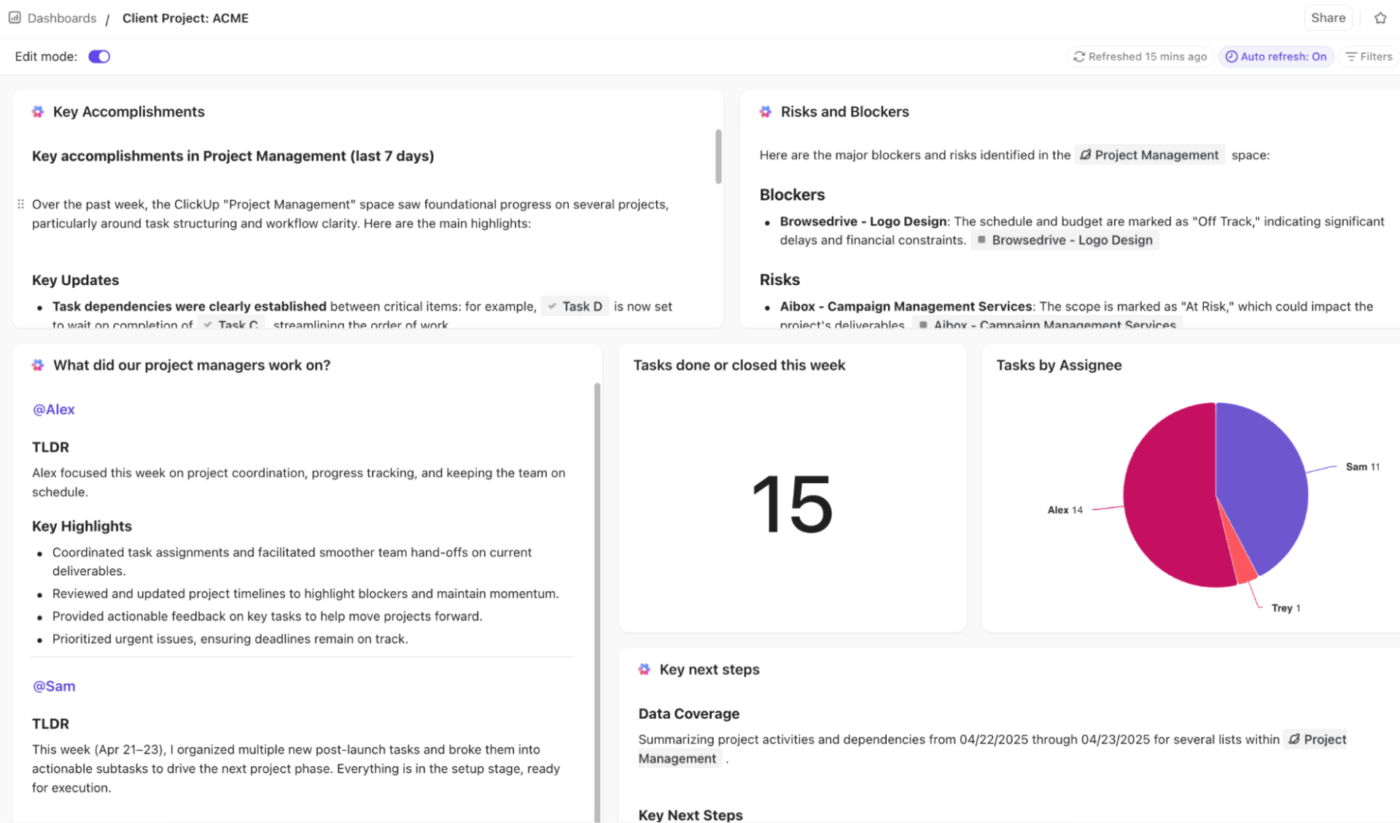
Leaders usually need a focused and current view of sales and revenue without digging into every task. The right snapshot explains what happened, where value appeared in the customer journey, and which key actions deserve attention now. When that summary lives on a shared dashboard, users experience a smoother path, and teams stay aligned.
✅ ClickUp’s intervention: ClickUp AI Cards add living summaries to your Dashboards and Overviews. Drop in an AI Executive Summary for your Sales Overview to provide a clear readout on movement, blockers, and wins by user segments. Add AI StandUp to generate daily highlights without a meeting and AI Project Update to frame the week’s plan.
These cards make user feedback visible, highlight where many users become stuck, and point you to the next step so aha moments happen often—not by accident.
Automate your sales record and more with ClickUp. Watch the video to see how:
Most sellers spend only about 28% of their week actually selling. The rest goes to admin, hunting for info, and internal updates.
Identify the areas where notes and deal details disappear among various tools. Those messy handoffs are the first places where AI can tidy the clutter and create the “aha” moment you are looking for.
If reps are stuck updating fields, use summarization and autofill. If managers lack a clear risk view, use scoring and address risk signals.
The aim is simple. Transition manual tasks to AI, allowing sellers to dedicate more time to engaging with customers. Deployed well, teams see time with customers double and win rates climb by 30%.
Pick one squad or region and wire up a single use case, such as lead scoring plus risk alerts. Define what good looks like before you begin. That could be faster stage movement, fewer stalls, or one useful insight per rep per day that turns into action. The big gains come when you redesign the steps around AI rather than just adding a tool.
Track before and after sales time, pipeline velocity, stalled stage days, and forecast accuracy.
Gen AI can lift sales productivity by about 3% to 5% of current sales spend. Your dashboard should indicate where that lift originates, such as fewer touches required to reach the next stage or quicker follow-ups.
🧩 Fun Fact: The World Federation of Direct Selling Associations estimates global direct selling retail sales at around $167–173 billion in recent years, with more than 110 million independent representatives involved across markets.
Collect short stories that show the moment a user realizes value. It could be a pattern a manager spotted in stage-age outliers, a message that moved enterprise deals faster, or user feedback that revealed a blocker.
Share these wins weekly so they spread. Many teams still spend more than 70% of their time on non-selling tasks, so showing real progress helps adoption stick.
Here are three recent, real-world examples where AI sparked clear aha moments for sales leaders and lifted results.
Ironclad rolled out Gong’s AI to mine sales calls, emails, and pipeline activity for the patterns behind stalled deals and successful closes.
Leaders began spotting the talk tracks and objection-handling moments that separated wins from losses, then coached reps on those exact behaviors.
The result was a measurable jump in performance, including a 21% increase in win rate and a 36% rise in customer retention.
🧩 Fun Fact: The AIDA model (Attention, Interest, Desire, Action) was first formalized by advertiser Elias St. Elmo Lewis in 1898, and it still guides how modern sales teams think about guiding prospects from first touch to close.
The Italian distributor partnered with IBM to use WatsonX for smarter quoting, pricing, and follow-ups across thousands of partners.
AI summarized the context of previous orders, suggested the best next steps, and flagged risks in approval cycles so that managers could step in.
They reported a 20% increase in quote-to-order conversion and a 30% reduction in time-to-cash. The team also gained a more complete picture of pipeline health without extra manual reporting.
After consolidating tools and adopting Amplemarket’s AI for targeting and outreach, DataStax focused on key actions that actually moved accounts forward.
AI analyzed user behavior signals and market context to prioritize buying groups and personalize sequences at scale.
In eight months, they created 150+ enterprise opportunities, won 16 deals, and generated over $205K in new ARR.
The fastest way to miss aha moments is to add tools without fixing the habits that hide user behavior and mute user feedback.
Keep an eye on these traps:
If there is one takeaway, it is this: the best sales teams don’t chase noise. They look for those small, clear signals where users understand the product’s value and momentum follows.
AI creates aha moments for sales managers in the real world. One useful insight, one next step, and a kinder workday for the team.
Why ClickUp wins here is simple. Everything lives in one place, so user behavior, user feedback, and pipeline context show up together. ClickUp Brain turns scattered notes into plain next steps. ClickUp AI Fields and AI Cards keep the complete picture fresh without extra effort. ClickUp Dashboards and alerts guide users at the right point in the user journey.
Sign up for ClickUp for free, and let your first aha moments happen in days, not months.
It is the instant a sales manager sees a clear next step from noisy data. Consider the equation “user behavior + feedback + context = one obvious action.” In practice, AI transforms user interactions and user research, notes, and activity into simple insights such as “loop legal now” or “send the case study that moved similar user segments.
AI spots patterns humans miss, such as stage age spikes, user engagement, stalled replies, or negative user satisfaction in emails and calls. It flags churned users at renewal risk and highlights where users understand less value in the user journey. You get data-driven insights before a deal slips, so you can guide users with the right key actions at the right point.
You can use ClickUp Brain to instantly summarize pipeline health and next steps, ClickUp Brain MAX to search across your workspace and connected apps, and ClickUp Talk to Text to capture call notes as they happen. Add AI fields to auto-generate status and action items, and place AI cards on dashboards to see an executive summary without digging. Together, these tools reveal the product’s breakthrough moments and its true value in real-time.
Tie every insight to one owner, one due date, and one follow-up. Keep fields clean, use shared definitions, and capture short “problem → insight → action → outcome” notes so many users see what worked. Over time, your team builds a deep understanding of which signals create the most value for different user segments.
It can shrink them. Summaries, AI cards, and dashboards give a complete picture before you meet, so reviews focus on decisions, not status reads. Many users prefer short async updates, rather than a focused call only when the team needs to solve problems or approve new features in the onboarding process.

© 2026 ClickUp

There’s an easier way. Try a free AI Agent in ClickUp that actually does the work for you—set up in minutes, save hours every week.