

As an HR or team manager, it’s on you to create a workplace where talent thrives, productivity soars, and innovation flourishes.
But how do you build such a workplace? A quick and effective way to get started is to run employee satisfaction feedback surveys. Quarterly or bi-annual feedback surveys will help you spot critical concerns faster and work on resolving them right away.
In this article, we’ll explain the significance of improving employee satisfaction, explore key dimensions of employee satisfaction surveys, and discuss survey questions.
25 Employee Satisfaction Survey Questions to Pulse Check the Team
- Understanding Employee Satisfaction
- Employee Satisfaction vs. Employee Engagement
- Key Dimensions of Employee Satisfaction Surveys
- Signs that You Need Employee Satisfaction Surveys
- 25 Examples of Employee Satisfaction Survey Questions
- Benefits of Employee Satisfaction Surveys
- How to Run an Employee Satisfaction Feedback Survey
- Boost Employee Engagement with ClickUp

 Summarize this article for me please
Understanding Employee Satisfaction
Employee satisfaction refers to the level of contentment or fulfillment employees experience in their organizational roles. Employees should also feel valued and supported within the company.
Satisfied employees are a powerhouse of productivity, loyalty, and innovation. Managers play a key role in this by nurturing a positive work environment and meeting employee expectations.
By ensuring respect, recognition, empowerment, and perks at work, you can keep your employees satisfied and motivated to do more. Factors like meaningful relationships with colleagues, fair compensation, and growth opportunities also play a starring role in boosting employee morale.
High levels of employee satisfaction indicate that employees feel valued, engaged, and motivated to contribute their best efforts. But it is not just a soft metric.
Low satisfaction levels can lead to disengagement, decreased productivity, higher turnover rates, and a negative impact on organizational performance.
Summarize this article for me pleaseEmployee Satisfaction vs. Employee Engagement
When it comes to understanding the dynamics of aworkplace, there’s a fine difference between employee satisfaction and employee engagement. These terms are often used interchangeably, but carry distinct meanings and implications.
Employee satisfaction is related to contentment with job aspects, whereas engagement involves emotional connection, commitment, and alignment with organizational goals. Satisfaction addresses immediate needs, while engagement encourages proactive contribution and long-term dedication.
To bridge the gap, you should:
- Foster a positive culture
- Provide meaningful work
- Invest in training and development
- Acknowledge employees’ contributions
- Promote healthy work-life balance
- Conduct annual performance reviews
By understanding and addressing both satisfaction and engagement, you can cultivate an environment where your employees are fulfilled, committed, and driven to achieve their full potential. This will ultimately lead to sustained productivity and performance.
Summarize this article for me pleaseKey Dimensions of Employee Satisfaction Surveys
You can measure employee satisfaction using four pillars:
1. Job satisfaction
As an employer, you need to keep track of how your employees feel about their specific roles and responsibilities within the company. Assess factors such as the complexity of their tasks, the degree of autonomy they have, and the sense of accomplishment they derive from their work.
Higher job satisfaction drives engagement, productivity, and commitment to achieving organizational goals
2. Growth opportunities
This dimension explores how employees feel about career growth opportunities within the organization. It includes factors such as access to training programs, mentorship opportunities, chances for promotion, and the clarity of career progression within the company.
Better growth opportunities attract and retain top talent, as employees feel invested in their future within the company.
3. Workplace culture
Culture gives you a clear picture of the quality of relationships and interactions within the workplace, including those between managers and subordinates. Examine the effectiveness of your communication channels, feedback mechanisms, managerial support, team dynamics, personal accomplishment, and company culture.
Positive relationships and a supportive work environment contribute to higher levels of job satisfaction, engagement, and well-being among employees
4. Benefits package
Fair compensation is an important motivating factor for employees. Review whether employees feel adequately rewarded for their contributions to the organization with their current benefits package. It includes salary levels, bonuses, incentives, employee benefits (health benefits, retirement plans, and wellness programs to improve mental health), and other recognition and rewards.
To ensure all four pillars stand upright within your organization, you must capture your employees’ honest feedback in your employee satisfaction survey. It helps provide valuable insights into solid areas and areas needing improvement, allowing managers to tailor strategies for enhancing overall job satisfaction.
Summarize this article for me pleaseSigns that You Need Employee Satisfaction Surveys
The need for an employee satisfaction survey manifests in various ways. One such sign is a decline in employee morale and engagement, evidenced by decreased productivity, increased absenteeism, and a rise in turnover rates.
Frequent complaints by employees on various aspects of their work environment—such as unclear expectations, lack of professional and personal growth opportunities, or poor communication channels—indicate the need for a deeper assessment of employee satisfaction.
If you see a noticeable decrease in the quality of work or increased errors, it might be due to underlying dissatisfaction or frustration among employees. Another telltale sign is a disconnect between management and employees, characterized by a lack of trust, communication barriers, or perceived favoritism, which can erode morale and hinder collaboration.
You may also be struggling to attract and retain top talent. Recognizing these signs early on and proactively implementing an employee satisfaction survey helps you identify areas for better employee management, foster a positive work environment, and ultimately drive organizational success.
Summarize this article for me please25 Examples of Employee Satisfaction Survey Questions
You must create an effective survey questionnaire to gather meaningful data and actionable insights for your company and employees’ well-being.
If you’re running your first employee satisfaction survey, a simple and effective way to conduct a survey is to provide a linear scale for your employees to choose. For example, you can keep a scale from one to five, where one could mean extremely dissatisfied and five could mean extremely satisfied.
Breaking down the four pillars of employee satisfaction that we talked about earlier, you can check the following examples for employee satisfaction survey questions:
Job satisfaction
1. How satisfied are you with your current job responsibilities?
2. Are your skills and talents effectively utilized in your role?
3. How satisfied are you with the level of autonomy and decision-making authority in your job?
4. Do you have all the resources and materials to excel in your role?
5. Do you think your opinions and inputs are valued within the organization?
Workplace environment
6. Rate the comfort and functionality of your workspace.
7. Are you satisfied with the amenities and facilities provided in the workplace?
8. Do you feel safe and supported in your work environment?
Compensation and benefits
9. Do you feel satisfied with your current salary and benefits package?
10. Do you believe your compensation is fair compared to industry standards?
11. Do you think your salary fairly matches your skill set?
12. How satisfied are you with the opportunities for performance-based bonuses or incentives?
Career development
13. Are you provided with sufficient professional growth and development opportunities?
14. Are you supported in pursuing further education or certifications related to your role?
15. How satisfied are you with the clarity of career advancement paths within the organization?
16. How often do you receive detailed performance reviews and coaching from your immediate managers?
Work-life balance
17. Are you able to maintain a healthy work-life balance in your current role?
18. Are you satisfied with flexible work arrangements and remote work options?
19. How often do you feel overwhelmed by work-related stress?
Company culture
20. Do you believe the organization’s values align with your own?
21. How inclusive and diverse do you perceive the organization to be?
22. Do you feel a sense of belonging and camaraderie with your colleagues?
Relationships and communication
23. How satisfied are you with management’s communication level regarding company updates and decisions?
24. Are you comfortable providing feedback to your supervisor or management team?
25. Are conflicts and disagreements effectively resolved within your team or department?
These questions can act as a starting point for designing a comprehensive employee satisfaction survey tailored to your company’s specific needs and dynamics.
Summarize this article for me pleaseBenefits of Employee Satisfaction Surveys
Conducting regular employee satisfaction surveys will help you:
- Identify areas for improvement: Employee satisfaction surveys highlight areas of concern and dissatisfaction, allowing you to proactively address issues within your company
- Boost employee engagement: By soliciting employee feedback and involving them in the decision-making process, you demonstrate a commitment to your employees’ well-being and engagement, boosting employee morale
- Increase retention: You can improve employee retention rates and reduce turnover by addressing concerns raised in surveys
- Enhance productivity: Employee surveys help you find relevant solutions to any potential productivity blockers, like inefficient workflows or lack of transparency
- Make strategic decisions: You get valuable insights for strategic planning and decision-making
Summarize this article for me pleaseHow to Run an Employee Satisfaction Feedback Survey
Effective employee pulse surveys require careful planning, thoughtful execution, and transparent communication. Your goal should be to receive the most authentic and honest responses that you can turn into actionable solutions in your company.
Here are the key steps to run an employee satisfaction survey:
1. Define objectives
Outline the survey objectives and the specific areas you aim to assess and improve.
Survey objectives can include:
- Assess overall employee job satisfaction to gauge morale and engagement within the organization
- Identify specific factors influencing employee satisfaction and areas for improvement
- Gather feedback on organizational policies, procedures, and practices to ensure alignment with employee expectations
- Understand employees’ perceptions of job roles, responsibilities, and opportunities for growth and development
- Evaluate the effectiveness of communication channels, leadership styles, and managerial support in fostering and boosting employee satisfaction
- Identify any issues or concerns related to compensation, benefits, and work-life balance
- Gather insights into the employer-employee relationship and collaboration among colleagues and with management
2. Choose the Survey format
You need to structure the survey correctly to get detailed survey responses. Try reframing core questions into one of the following established survey formats:
- Sliding scale: It allows participants to rate their satisfaction or agreement using numerical values along a sliding scale. It provides a range of options, typically from low to high or strongly disagree to strongly agree, enabling participants to express their level of satisfaction quantitatively
- Matrix: The matrix format is ideal for presenting Likert-scale questions, where respondents are asked to rate multiple statements on the same scale. It organizes several related questions into a grid-like structure, streamlining the survey process and making it easier for respondents to provide feedback on multiple items efficiently
- Yes/No: The Yes/No format presents respondents with straightforward binary choices, typically used for segmentation or classification of respondents based on specific criteria. You can use it to collect categorical data or determine the presence or absence of particular characteristics or preferences
- Nominal multiple answers: This format allows participants to select multiple options from a list of choices, effectively grading responses and segmenting them based on various criteria. It’s suitable for gathering diverse input on topics where respondents may have multiple preferences or experiences
- Dropdowns: Dropdown menus present respondents with a list of predefined options from which they can select a single choice. You can use this format for questions like ‘How satisfied are you with overall employee experience?’ where the options can range from very satisfied, satisfied, neutral, and so on
- Ranking slots: This format requires survey participants to prioritize or rank a set of options according to their preferences. This format is handy for tasks like ranking preferred benefits or workplace preferences, providing valuable insights into respondents’ relative priorities
Pro tip: You can use closed-ended questionnaire templates for further analysis of trends over time. Incorporating one open-ended question at the end offers insight into employee expectations from the survey. However, it’s important to note that data from open-ended questions is more challenging to quantify compared to questions with finite answers.
3. Design the survey
Craft survey questions that are clear, concise, and relevant to the company culture and goals. You can also use pre-built templates to save time. For example, the ClickUp Employee Engagement Survey template is a perfect tool for accurately assessing employee satisfaction and engagement. It helps you:
- Develop clear, actionable insights about your team’s perception toward your company as an employer
- Create personalized employee surveys with customizable questions
- Gather real-time feedback from employees

4. Communicate expectations
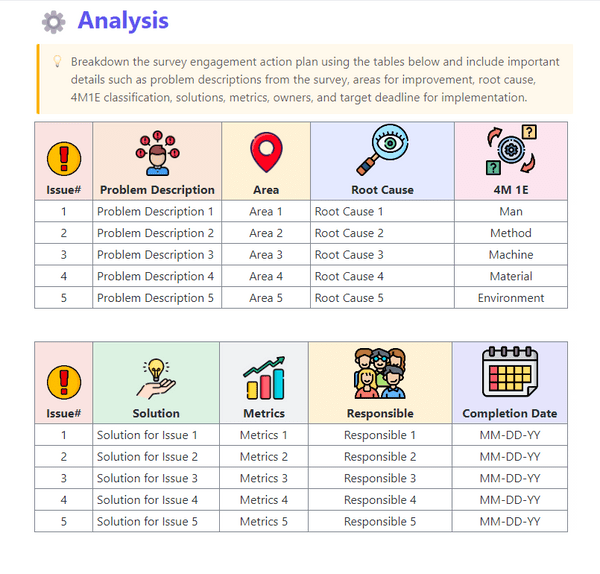
Inform your employees about the survey’s purpose, how their feedback will be used, and the timeline for completion. You can use ClickUp Engagement Survey Action Plan Template to determine and discuss the primary factors influencing employee engagement. It helps:
- Identify improvement areas and plan strategies
- Convert feedback into actionable tasks
- Track and monitor employee well-being initiatives and company policies
5. Encourage participation
You must emphasize the importance of participation and assure your employees that their feedback is valued and anonymous. Try these strategies to increase engagement:
- Ensure all levels of management understand and support the survey’s significance, enhancing its promotion
- Communicate the survey’s purpose and potential impact on organizational changes
- Schedule employee satisfaction surveys during low-workload periods to facilitate participation
- Provide sufficient time for employees to complete the survey at their convenience
- Make the survey easily accessible and concise, with an average completion time of 5-20 minutes
- Avoid using excessively optimistic language that may trivialize the survey’s importance
- Refrain from asking intrusive questions about sensitive or private matters
- Maintain an appropriate survey frequency to avoid survey fatigue
- Consider conducting focus groups in larger companies to assess survey design effectiveness before implementation
6. Analyze results
After you have collected the survey data, thoroughly analyze it to identify trends, patterns, and areas requiring attention. Share the survey results with the team to build and retain trust and consider adjusting company policies if needed.
You should also benchmark your surveys. Create an employee database for surveys to maintain all records. The initial survey should be the first step toward understanding long-term employee satisfaction. Subsequent surveys become increasingly valuable as you analyze and compare them to previous ones.
Seeking external benchmarks is also beneficial. For instance, if 67% of employees report feeling inspired to achieve their goals at work, is that satisfactory? You gain valuable context by comparing against external benchmarks from your industry peers, such as being in the 99th percentile among companies with the highest employee satisfaction rate.
7. Develop action plans
After you have analyzed the survey results, based on your findings, develop actionable strategies and initiatives to fix the identified issues and improve employee satisfaction. You can follow the systematic approach given below:
- Identify priority areas: Prioritize the areas that require immediate attention. Emphasize the aspects having the most significant impact on employee engagement and organizational performance
- Set clear objectives: Establish crystal-clear and measurable objectives for each priority area. Set specific goals that align with overall organizational objectives
- Develop actionable strategies: Brainstorm actionable strategies to address each priority area. Consider input from your employees and managers to ensure buy-in and effectiveness. These strategies should be practical, realistic, and aligned with the company culture and values
- Assign responsibilities: Assign definite roles and responsibilities to individuals or teams to implement the action plans. Ensure accountability by specifying who is responsible for each task and setting deadlines for completion
- Allocate resources: Allocate necessary resources, including budget, time, and workforce, to support the implementation of action plans.
- Communicate the action plan: Communicate the action plan to all employees to ensure transparency and foster engagement. Clearly explain the objectives, strategies, and expected outcomes. You must push your team to provide any feedback and questions to address any concerns or uncertainties
- Implement the plan: Execute the action plan according to the defined timeline and milestones. Monitor the progress of your plan regularly and adjust as needed to overcome challenges and ensure success
You can use a Gantt Chart in ClickUp to visually present the timeline for each action item.

- Offer support and training: Provide support and training to employees and managers involved in implementing the action plan. Equip them with the necessary skills and resources to effectively perform their roles.
- Follow-up and evaluation: Continuously monitor and evaluate the effectiveness of the action plan and measure progress against established goals and key performance indicators. Solicit employee and stakeholder feedback to identify improvement areas and make necessary adjustments to the plan.
By following these steps, you can effectively conduct employee satisfaction surveys to foster a positive work culture, drive employee engagement, and achieve long-term success for your organization.
Summarize this article for me pleaseBoost Employee Engagement with ClickUp
Employee satisfaction surveys play a vital role in understanding employee sentiment, identifying areas for improvement, and enhancing organizational performance. By leveraging the insights from these surveys, leaders can cultivate a workplace where employees feel like they belong, are valued, supported, and motivated to contribute their best efforts.
You can pave the way for sustained business success through strategic planning, transparent communication, and a commitment to continuous improvement.
ClickUp offers a wide range of features and templates to develop clear, actionable insights into your team’s sentiments. From capturing valuable feedback to tracking changes over time, it optimizes the entire survey process.
Sign up on ClickUp for free to conduct your employee satisfaction survey!


Everything you need to stay organized and get work done.

Recent Articles
8 Communication Strategies That Actually Fix Team Chaos 
8 Communication Strategies That Actually Fix Team Chaos
ADHD Task Management: How to Build a System You’ll Still Use in a Month 
ADHD Task Management: How to Build a System You’ll Still Use in a Month
Managing Creative Teams: How to Lead Your Team to Success
Managing Creative Teams: How to Lead Your Team to Success
