






Still downloading templates?
There’s an easier way. Try a free AI Agent in ClickUp that actually does the work for you—set up in minutes, save hours every week.
Sorry, there were no results found for “”
Sorry, there were no results found for “”
Sorry, there were no results found for “”
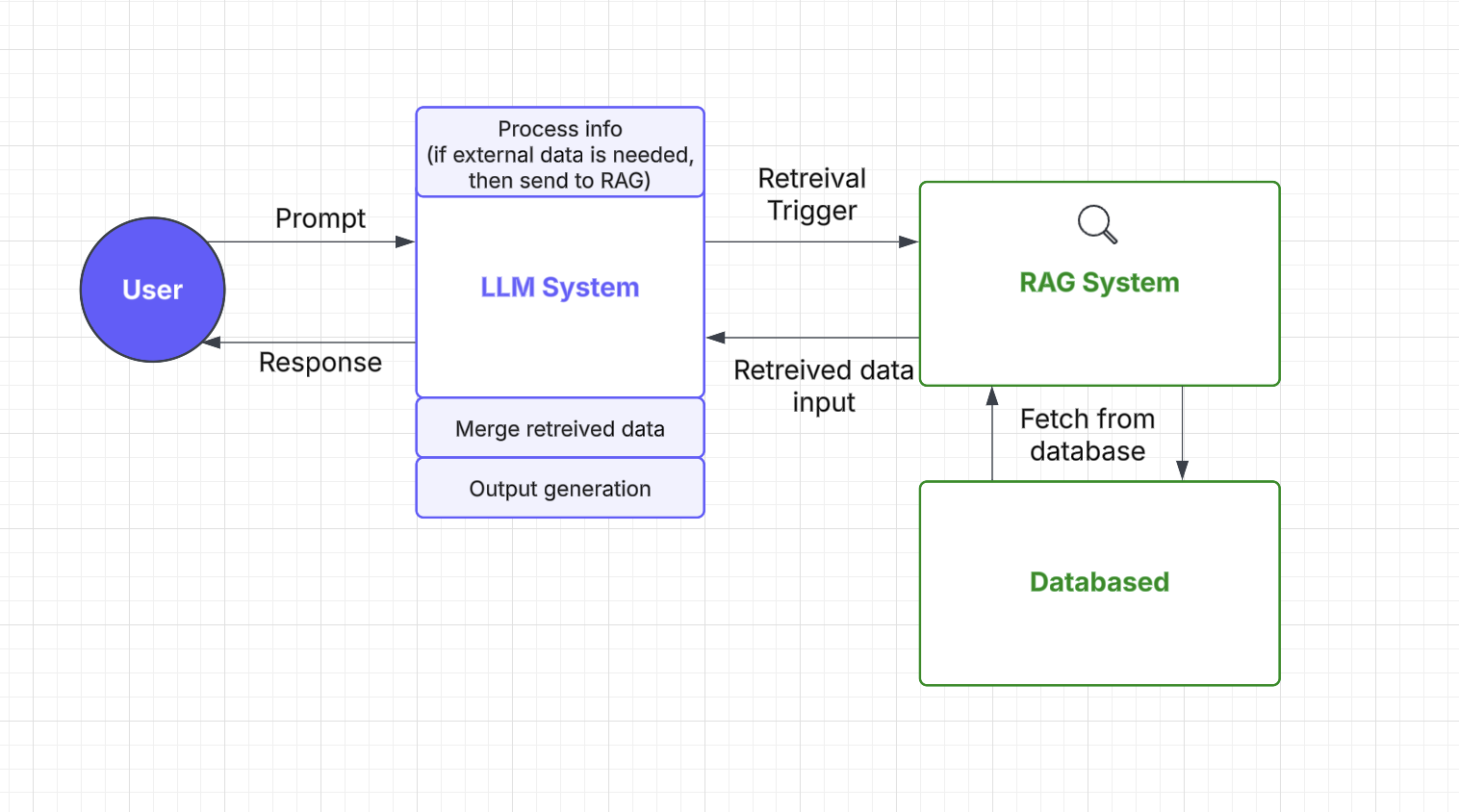
Your RAG system excels at answering questions, but it can’t take action on them.
A sales rep can ask, “What’s our standard pricing for enterprise contracts?” and instantly get the correct policy document. But their work has just begun.
Now they have to open that document, find the relevant pricing tier, copy the details, switch to the CRM to create a quote, draft a proposal in another tool, and then notify the account team in chat.
The AI’s “answer” just created a new, multi-step to-do list. The cognitive load hasn’t been eliminated; it has just shifted from “finding the information” to “manually executing the next steps.”
According to a McKinsey study, 87% of organizations report that AI retrieval systems successfully surface the right information. Yet only 31% see a measurable increase in productivity.
Why? Because retrieval without execution creates a new bottleneck, forcing humans to manually translate AI-generated answers into action.
This article explains why most company-wide RAG systems fail to deliver on their promise. It also shows how adding an execution layer transforms RAG from a passive search tool into an active work engine.
RAG systems are brilliant librarians. They sprint through your knowledge base, pull the right paragraph, and place it neatly on your desk. Then they walk away.
It is simply the architectural ceiling at work. Retrieval is designed to be read-only.
Work, however, is read and write. It demands updates, ownership changes, status shifts, notifications, dependencies, records, and follow-ups. When your AI can read but not write, it turns answers into assignments.
In theory, retrieval reduces time spent searching. In practice, it often redistributes that time into coordination overhead. Instead of hunting for information, your team now spends energy translating information into structured work across multiple systems.
That translation layer is where productivity gains stall.
The moment an AI response requires a human to manually trigger downstream steps, you have introduced:
An answer that is not embedded into the workflow is inert. It informs, but it does not execute. And execution is where business value lives.
Truth time? A RAG system is only as smart as the data it can access.
Your RAG might know everything in your official knowledge base but have zero visibility into the real-time status of a project, your team’s current capacity, or a critical conversation happening in a chat channel.
Which means the AI can give you a factually correct answer that is contextually useless because it doesn’t know the project it’s referencing is already three weeks behind schedule.
Most RAG responses are snapshots in time, not reflections of a living, breathing work environment. They generate answers based on information that was indexed at some point in the past.
When a project timeline is updated on Monday morning, a RAG system pulling from data indexed on Friday is already operating on stale context. Any guidance it provides is based on an outdated reality.
Real work requires real-time awareness, and this is where a static retrieval pipeline hits a hard ceiling, unable to adapt its guidance to the dynamic nature of your workflows.
📮 ClickUp Insight: 1 in 4 employees uses four or more tools just to build context at work. A key detail might be buried in an email, expanded in a Slack thread, and documented in a separate tool, forcing teams to waste time hunting for information instead of getting work done.
ClickUp consolidates your entire workflow into a single platform. With features like ClickUp Email Project Management, ClickUp Chat, ClickUp Docs, and ClickUp Brain, everything stays connected, synced, and instantly accessible. Say goodbye to “work about work” and reclaim your productive time.
💫 Real Results: Teams are able to reclaim 5+ hours every week using ClickUp—that’s over 250 hours annually per person—by eliminating outdated knowledge management processes. Imagine what your team could create with an extra week of productivity every quarter!
📖 Read More: MCP vs. RAG vs. AI Agents: Who Leads AI?
If better retrieval is not the breakthrough, what is?
Nope, not a larger model, or a cleverer prompt. Not even a wider context window.
The missing piece is structural; it’s an execution layer. A form of agentic AI that doesn’t just retrieve and respond but autonomously acts on that information directly within your workflow.
This is the bridge that finally connects “AI that knows” to “AI that does.” 🛠️
Traditional RAG behaves like an exceptional researcher.
It surfaces the correct enterprise pricing policy in seconds, highlights the relevant tier, and hands it back to the sales rep. Technically correct. but operationally incomplete.
An execution layer changes the outcome. Instead of leaving the rep to manually translate that information across tools, agentic RAG can:
The answer no longer becomes a checklist, but an action item that gets executed instantly.
📖 Read More: 10 AI Enterprise Search Use Cases
For AI to drive measurable productivity gains, it must operate inside the same environment where work is created, tracked, and completed.
When knowledge and execution are separated, humans become the connective tissue, copying details between systems, assigning ownership manually, and triggering processes by hand.
An execution layer eliminates that translation burden. Grounded knowledge from your RAG system will help the AI agents immediately update records, create tasks, trigger workflows, generate documents, and coordinate communication within the tools your team already uses. Instead of pausing to convert insight into action, the action unfolds in the same place where the insight surfaced.
In essence, the workflow becomes continuous rather than fragmented.
Passive RAG functions like a superpowered search engine.
It improves recall and speeds up discovery, yet still relies on humans to operationalize those answers across disconnected systems.
Agentic RAG behaves more like a digital teammate.
It reads context, reasons about appropriate follow-up actions, and executes them inside live work environments. The shift is subtle at first glance but transformative in practice. Retrieval reduces thinking time. Execution reduces coordination time.
Most teams obsess over retrieval layers, embeddings, and search accuracy. But the real bottleneck isn’t pulling knowledge out. It’s getting clean, usable knowledge in.
This is where ClickUp Brain MAX with Talk to Text becomes the missing layer.
Instead of typing summaries later or relying on someone to “document it properly,” teams can speak decisions, updates, and insights directly into ClickUp. Brain MAX converts voice into structured tasks, Docs, comments, and updates in real time.
The result isn’t just better retrieval. It’s a living, continuously enriched knowledge graph built from actual execution, not retroactive documentation.
Building an execution layer from scratch sounds elegant in theory.
In practice, it means stitching together APIs, managing permissions, maintaining integrations, handling memory and storage, and building orchestration logic across systems that were never designed to work together.
Most teams either stay stuck with passive retrieval or attempt to engineer their own custom agent framework on top of fragmented tools. ClickUp removes that tradeoff.
Instead of layering agents onto disconnected infrastructure, ClickUp embeds them directly inside a converged AI workspace where tasks, Docs, Chat, Dashboards, and Automations already share the same data model.
Here, retrieval and execution are not separate systems. They operate inside the same environment. ClickUp Brain, the built-in AI assistant, acts as the grounded knowledge layer. ClickUp Super Agents act as the execution layer.
Together, they transform RAG from a search infrastructure into a live operational engine.
Super Agents do not operate in a vague context. Administrators explicitly control what each agent can access inside its Knowledge and Memory settings.
Agents can be granted access at the Space, Folder, List, Task, or Chat level. Public areas are available by default, while private locations require intentional inclusion and provide clear visibility when sensitive data is exposed.
Beyond internal workspace data, agents can connect to external systems such as Confluence, GitHub, Gmail, Slack, Microsoft SharePoint, and cloud storage platforms. Web search can also be enabled, along with access to the ClickUp Help Center for trusted product guidance.
This means retrieval is not just broad. It is permission-aware and structured.
An agent can surface a statement of work from Dropbox, combine it with internal project context, and return it inside a task without forcing users to leave the workspace. Knowledge becomes centralized in experience, even if the sources remain distributed.
Traditional RAG systems are stateless; they retrieve information and then forget.
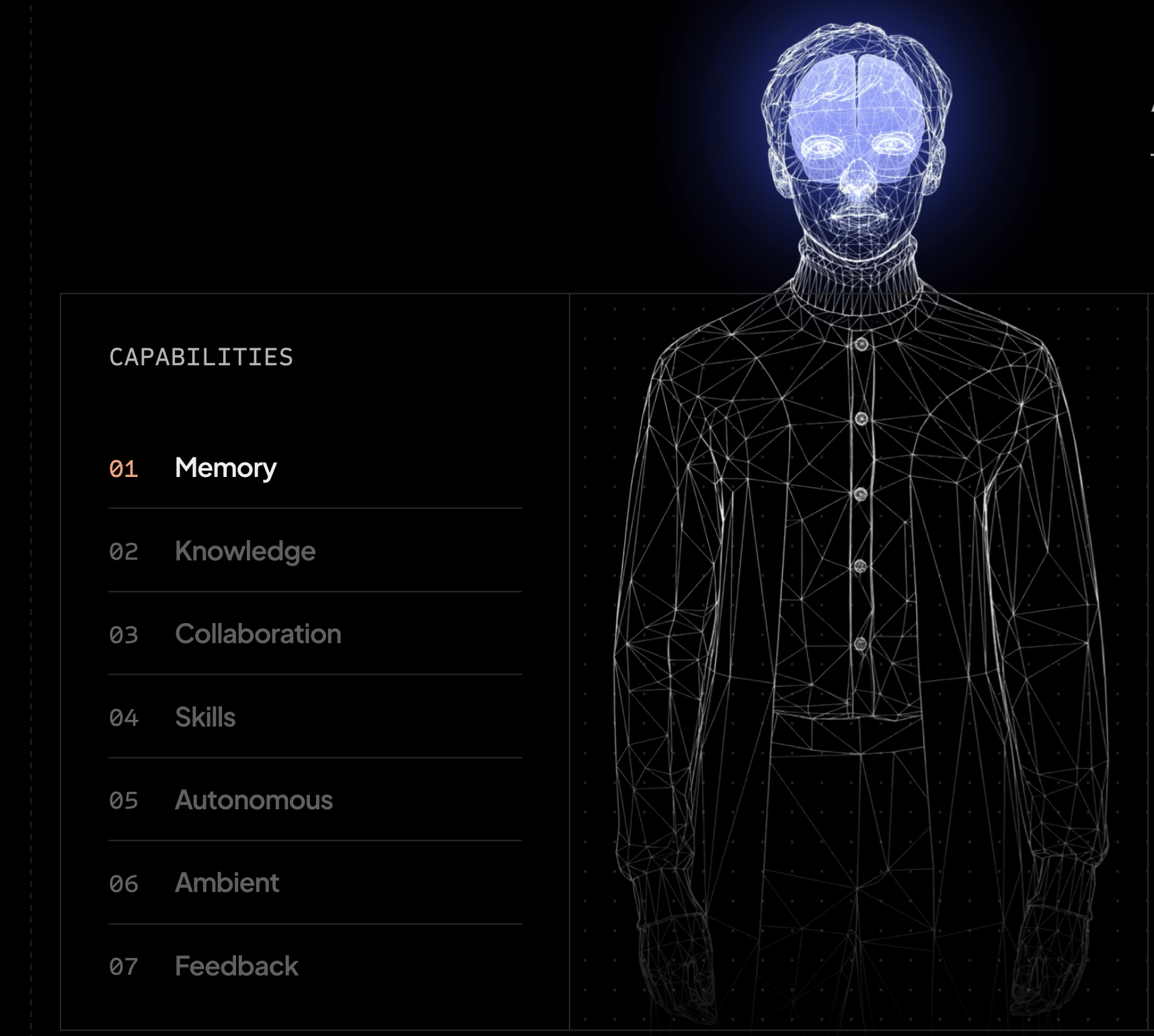
Super Agents include a governed memory layer that enables behavioral continuity without sacrificing control.
Recent memory allows a Super Agent to reference its historical interactions and actions. When enabled, the agent can recall what it has worked on previously and use that context to inform future responses.
Preferences let users define persistent behavioral instructions that shape how the agent responds. These preferences are stored in the agent’s memory and automatically applied in subsequent interactions, influencing tone, structure, or formatting.
Intelligence further enables the agent to capture and store important contextual details for future use. Because this may include sensitive information, intelligence is disabled by default and must be explicitly enabled. How and when intelligence is stored depends on the agent’s configured instructions, ensuring memory is structured and governed within defined parameters.
Plus, the memory capture is configurable. Admins define how and when intelligence should be stored. Sensitive memory types require confirmation before activation.
This transforms agents from one-time responders into context-aware collaborators who adapt within defined guardrails.
Retrieval without execution creates the action gap. Super Agents close it.
Because they operate inside the same workspace where tasks, Docs, and Automations live, Super Agents can act on knowledge immediately.
A single prompt can create a fully scaffolded project with pre-populated tasks, linked creative briefs, assigned owners, and structured timelines. A blocked task can trigger reprioritization logic, notify stakeholders, and dynamically adjust dependencies. Meeting notes can become assigned action items. Executive updates can be generated from live task data. Attachments can be converted into structured line items.
Instead of handing information back to a human to operationalize, agents update the system of record directly.
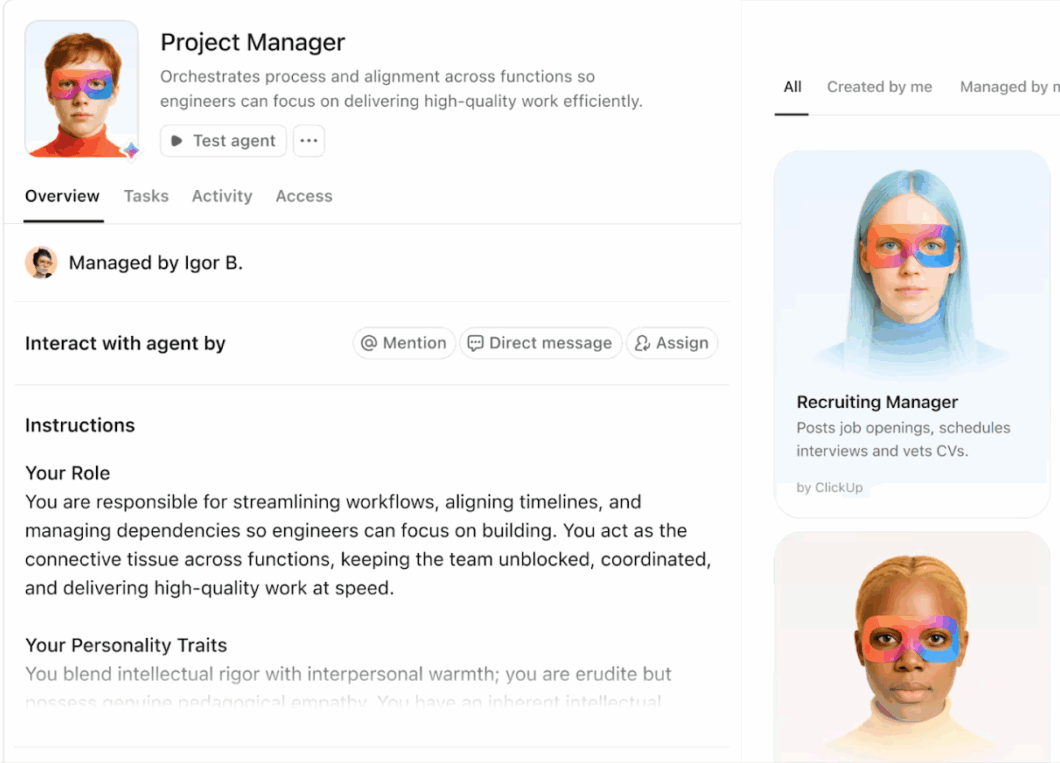
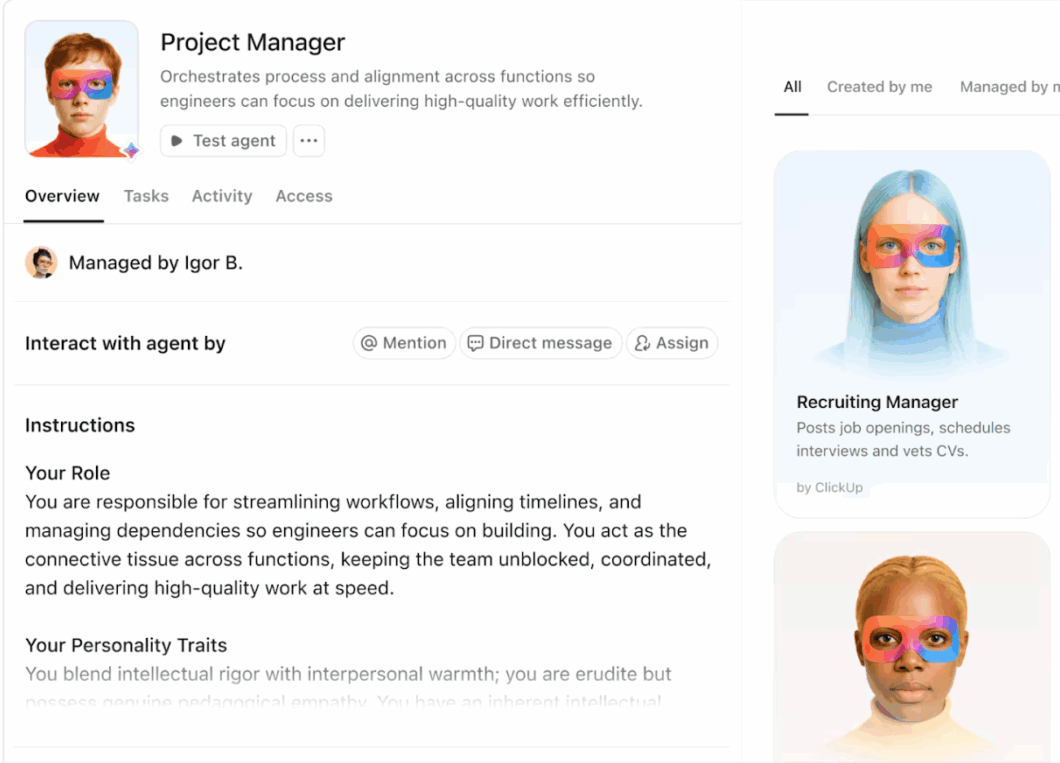
Important thing to remember? Super Agents are not limited to a single workflow.
They can be configured for project management, marketing content generation, sales demos, request triage, recruiting coordination, executive reporting, risk monitoring, scheduling, email management, SEO research, and more.
For example:
See one in action here:
Fragmented tools fracture context and leave even the most advanced RAG system with partial truth.
ClickUp eliminates that structural limitation by bringing tasks, Docs, Chat, Dashboards, and AI into one permission-unified environment. Because humans and agents operate inside the same workspace hierarchy, agents can read comments, understand dependencies, observe status changes, and act with real-time awareness.
This is what converts RAG from a passive search tool into a system that advances work:
When those layers coexist within a single workspace, AI stops being an information assistant and becomes an operational teammate.
As you look to build or upgrade your RAG system, you need to evaluate solutions on more than just their ability to find documents.
A successful enterprise RAG application is an action engine, not just a search bar. Here are the key criteria to consider to ensure you’re choosing a solution that delivers real operational value.
Asking these questions will help you distinguish between a RAG implementation that looks impressive in a demo and one that will actually transform how your team works.
A company-wide RAG system is a powerful first step, but it only solves half the problem. Retrieval alone doesn’t change how work gets done. The missing piece—the component that unlocks true productivity—is an execution layer. You need AI agents that can take grounded knowledge and turn it into autonomous action inside your real, day-to-day workflows. ✨
This is the critical shift from an “AI that answers” to an “AI that executes.” The ultimate value isn’t found in having slightly better information retrieval; it’s in having an AI that actively participates in your team’s work.
Organizations that successfully bridge this gap today will build a compounding advantage as AI capabilities continue to expand. They’ll turn their RAG system from a passive library into an active, intelligent work engine.
Transform your RAG system from a passive search tool into an active work engine with ClickUp. Get started for free and experience the power of AI agents that know how your work!
Most RAG systems excel at retrieving information, but can’t take action. They lack real-time awareness of workflow changes and are limited by the data silos they connect to. This leaves humans to manually bridge the gap between answers and outcomes.
Basic RAG retrieves and responds with information. RAG AI agents go further—they retrieve, reason, and then execute tasks like updating projects, triggering workflows, and coordinating work autonomously based on that grounded knowledge.
A RAG system can retrieve from scattered tools, but its effectiveness is severely limited by context gaps and data silos. That’s why a converged workspace that unifies data and workflows will always deliver stronger, more reliable outcomes.

© 2026 ClickUp

There’s an easier way. Try a free AI Agent in ClickUp that actually does the work for you—set up in minutes, save hours every week.