

Sorry, there were no results found for “”
Sorry, there were no results found for “”
Sorry, there were no results found for “”
The Constructivist Learning Theory states that we construct knowledge or learnings by reflecting on our experiences. This theory is largely based on metacognition, which refers to ‘reflecting on our thinking.’
Metacognition involves analyzing our thoughts or being self-aware of how we process our thoughts. By improving our metacognition skills, we can identify gaps in our prior knowledge, enhance our learning, and cultivate a growth mindset.
Whether you’re a student preparing for an exam or a professional looking to accomplish your career goals, metacognition skills can help you grow significantly in both aspects of life.
Let’s look at what metacognition skills are and how you can develop these skills to achieve success.
Metacognition skills is an umbrella term for several techniques that enhance self-awareness abilities; to identify and improve your current thinking process. It focuses on how we channel our thinking to set goals, solve problems, and achieve objectives through self-directed learning processes.
Think of metacognition as the science behind our thinking process where we intentionally monitor and try to understand our thoughts.
It involves three simple steps:
Two vital elements contribute to your metacognition process. They are:
It tells you about your cognitive abilities and thought processes—whether you are good at memorizing complex concepts, how much time you take to read and understand a page, how long you can focus before your attention drifts, whether or not you struggle with decision-making, etc.
Applying metacognitive knowledge to a task helps you learn about your strengths, weaknesses, and thinking patterns and how you can leverage them to finish the task effectively.
Metacognitive strategies involve monitoring and managing your cognitive processes to ensure you are on the right track to meet your objectives. You can practice these metacognitive strategies to improve efficiency and achieve your goals:
Metacognition skills develop based on different learning styles and how you take in and process the information. There are four predominant learning styles educators use to help students develop metacognitive skills:
Let’s see the 10 metacognition examples to improve your productivity and enhance your cognitive processes:
Goal-setting is one of the vital habits of highly effective people. When you set goals, you intentionally focus on your ambitions and plan steps, processes, or milestones to achieve your objectives. This gives you clarity on the possible challenges and helps you find the most effective strategies for success.
But goal setting is not coming up with some random plan of attack. You need to set goals that are:
Sometimes, you may feel stuck with a work problem, unable to find a way out. That’s probably because you’re assessing the issue at the surface level, trying to find band-aid solutions. However, metacognition skills make you consciously think of your problems, find their root cause, and devise the best possible way to solve them.
Taking time to reflect upon past actions and thoughts helps you gain meaningful insights. In metacognition, reflection is a three-step cyclical process:
Once you become good at self-reflection, you become flexible, and it becomes easier to adapt to new and appropriate cognitive strategies while working on a task.
The planning phase is one of the best examples of metacognitive skills for educators and leaders. You assess available resources and implement the best methods of learning or leading.
When you prepare a clear roadmap for project management or learning, you anticipate potential growth opportunities and challenges and can act on them to achieve your goals faster.
Self-assessment is the foundation for analyzing one’s strengths and weaknesses, an idea central to the metacognition strategy.
Knowing your strengths and weaknesses helps you enhance your performance and overcome challenges easily.
You can use a SWOT analysis for self-assessment. It stands for:
Asking questions to yourself while learning new concepts involves self-awareness and reflective thinking skills, which makes it a perfect metacognition example.
Self-questioning piques curiosity and interest and helps you analyze concepts better.
How do you assess whether you are on track to achieving your goals? By continuous observation and analysis.
It’s one of the classic metacognition examples involving self-assessment, analyzing strengths and weaknesses, and self-regulating activities.
Using reflective questions to monitor your thinking, you can identify factors that are holding you back from new learnings and find ways to overcome them.
Active reading is more than just reading for pleasure. It involves monitoring your comprehension abilities and requires total concentration. You can improve your reading strategies by summarizing chapters or finding deeper connections between different chapters.
Concentration is about ‘saying no to everything’ to ‘say yes to the one thing.’ It helps you build self-discipline keeping aside the mental discomfort caused by it.
However, concentration doesn’t mean only focusing on a specific task. It also requires continuous self regulation of your attention, which is a metacognition skill.
Self-testing is slightly different from self-assessment. In assessment, you analyze your strengths and weaknesses. In self-testing, you challenge yourself with questions to review your learning.
Here are the top three ways to enhance your metacognition skills:
Introduce questions into your learning process to help process thoughts consciously. When you ask yourself questions like, “What was my thought process behind learning this?” or “How can I improve my approach next time?” you are prompting yourself to reflect upon your knowledge and strategies.
This stimulates deeper thinking of our mental states and helps to make adjustments for further exploration.
Self-reflection, on the other hand, involves consciously thinking about your past experiences to gain meaningful insights and improve future performances.
Journaling is an excellent reflective practice that involves recording your feelings and observations. It enhances self-awareness, allowing you to understand your cognitive process and change it accordingly.
Active reading requires a more strategic approach than just skimming through the texts. Use these simple techniques to make reading more fun and fast:
Setting goals gives you clarity and helps overcome mental blocks before starting a new project.
However, set realistic time-bound goals so that you can monitor their progress effectively.
For instance, learners who plan ahead by developing study schedules and checklists tend to stay more focused and manage their time wisely.
Here are a few effective techniques you can use to sharpen your critical thinking and creativity:
Beware of these potential obstacles that can be a roadblock in developing metacognition skills:
Constructive feedback plays a vital role in developing metacognition skills. We can better analyze and improve our learning strategy and management processes by receiving specific feedback about our performance and strategies.
Technology has transformed our learning and work processes, making them more personalized and automated.
We can use tools to plan our days, set task reminders, collaborate with others, and monitor our progress. This helps us build focus and achieve our objectives.
With ClickUp, an all-in-one project management tool, you can simplify goal setting.
Whether you’re managing personal or team goals, ClickUp can help you break down problems into an actionable plan and apply metacognitive strategies. It helps you improve all three aspects of metacognition: planning, monitoring, and evaluation.
Setting realistic goals is key when working with metacognition strategies. ClickUp Goals can help you set high-level goals and break them down into smaller targets, which you can then use to track progress. This helps build a productive mindset. When implemented in a work scenario, this empowers your coworkers to track their progress and evaluate whether they’re on the right path.

If you want to apply metacognition strategies at a project level, try ClickUp’s Personal Project Management Software to plan and prioritize your projects using tasks and sub-tasks, and streamline workflows. From planning out each individual step to staying on track and monitoring progress, ClickUp can help build metacognition strategies into your personal projects.

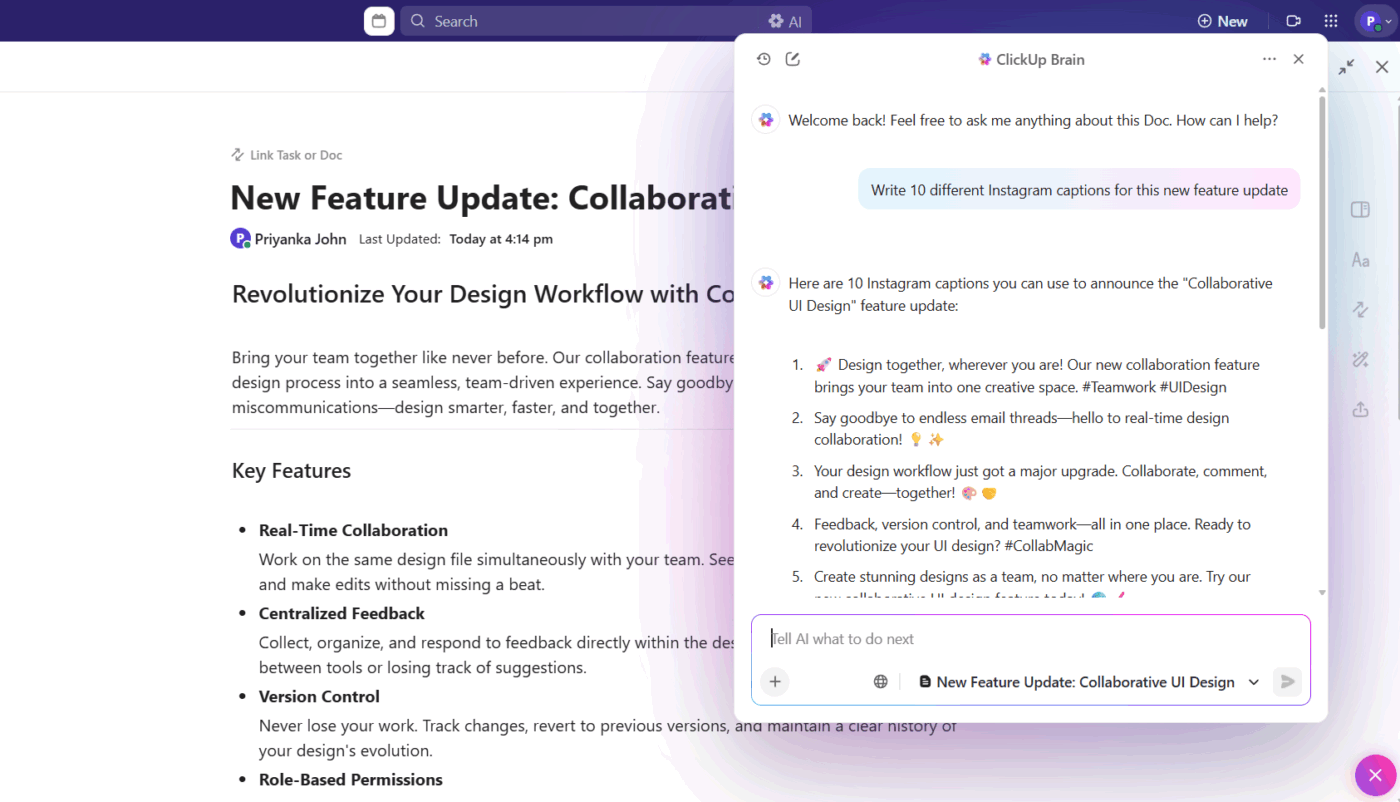
If you often run into blockers at work because your documents are scattered across different workflows. Use ClickUp Docs to access all the information in one place, spot any critical gaps and collaborate with your team members in real time.
When combined together, these three ClickUp features can help you practice metacognition in your personal and professional lives. Whether you need to improve your goal-setting skills or monitor your strategies better, we’ve got you covered.
Pro tip: Try our ready-to-use goal setting and tracking templates for some inspiration.
Let’s see how metacognitive skills impact different aspects of our lives:
Several studies show that students with high metacognitive skills achieve greater academic excellence.
The metacognitive process includes self-awareness and self-evaluation, both of which are essential for academic growth. This helps students understand their cognitive process, leading to improved attention and comprehension abilities.
In an academic setting, metacognition is all about students taking charge of their own learning process. However, the role of a teacher is undeniable in helping them develop those particular strategies.
Defining learners’ levels is the foremost step in developing metacognition skills. To assess their intellectual thinking and problem-solving skills, give them challenging tasks slightly beyond their reach. Performing difficult tasks encourages students to expand their knowledge and indulge in higher-order thinking, which reflects their metacognitive abilities.
Once you’ve determined their learning abilities, you can devise a lesson plan that encourages your students to develop metacognitive skills.
Metacognition examples are not limited to academia. It’s one of the fundamental life skills that offers several real-life advantages that result in:
Actively engaging in metacognition examples improves your cognitive capabilities. However, it’s not always as helpful as you would think.
Here are four potential drawbacks of using metacognitive practices that you should know:
The Dunning-Kruger effect is a cognitive bias that explains why low-ability people often claim they’re the smartest in a room. The theory explains that low-ability people don’t possess the necessary metacognition skills to evaluate their and others’ strengths and weaknesses. That’s why they overestimate their capabilities and skills and underestimate others. This can mislead people into thinking they have superior abilities.
The greatest advantage of learning metacognition skills is that once you learn them, you can apply them in all walks of life, whether it’s education, professional development, or personal growth.
However, learning metacognitive skills requires consistent practice. Self-reflection ain’t easy! You can start by writing down your thoughts and ideas to process them better, set goals, manage tasks, and monitor progress. ClickUp helps you do all of this and a lot more. It provides a wide range of tools and templates to plan, assess, and track your tasks, enabling you to achieve your goals faster.
Sign up for ClickUp for free to enhance your metacognitive skills!

Sudarshan Somanathan
Max 22min read
Sudarshan Somanathan
Max 23min read
Sudarshan Somanathan
Max 29min read

© 2026 ClickUp




