

Around 51% of organizations have restructured their teams in 2023.
Unsurprisingly, managers are focusing on team reset in 2024.
Team development is a continuous exercise for a good reason. Teams keep changing, evolving, and growing due to various factors. As a result, you need to keep focusing on the multiple aspects of team development to ensure the team is high-performing and motivated.
A well-managed team:
- Encourages creativity and communication among team members
- Improves the team’s decision-making prowess
- Breaks down silos between departments and teams
- Offers enhanced learning opportunities where juniors learn from their seniors
- Reduces fatigue and improves engagement levels, leading to successful outcomes
- Allows managers to capitalize on the team’s complete potential
- Increases employee workplace well-being and connection with each other
- Enables organizations (50%) to attain their operational goals
A Stanford study claims that working together can motivate a team, turning work into play. This guide will take you through eight simple and proven steps to develop a high-performing team.
How to Develop a Team in Eight Easy Steps
- How to Develop a Team in Eight Easy-to-Follow Steps
- Step 1: Build goals to get people in sync
- Step 2: Think—What’s your company culture like?
- Step 3: Focus on training
- Step 4: Create a well-rounded development plan
- Step 5: Drive 24×7 communication and effortless collaboration
- Step 6: Invest in 360-degree project management software
- Step 7: Support, don’t micromanage
- Step 8: Ask—Is your feedback visually driven?
- Key Challenges in Developing a Successful Team
- 6 Common Characteristics of a High-Performing Team
- Engineer Better Teams With the Right Solution
- Common FAQs

 Summarize this article for me please
How to Develop a Team in Eight Easy-to-Follow Steps
We’ve all heard the phrase: “Teamwork makes the dream work.”
But how do you get there? Building a team is a process—and a mindful one at that.
Let’s dive into what it takes to develop a sound, high-performing agile team.
Step 1: Build goals to get people in sync
Vague goals leave room for misinterpretation.
So, before you categorize your employees into groups, make sure to:
- Outline precise organizational objectives and goals for the team to follow
- Communicate the task goals (what needs to be done) and process goals (how the work needs to be done) right at the beginning
- Highlight individual responsibilities for every role, use-cases, and how cross-functional teams will work together
- Align the team’s ability with the overall organizational goals
Well-articulated and clear goals make everyone’s life easier—employees are on the same page, and a team leader can track progress effectively.
This alignment ensures that everyone is working towards the same overarching objectives from start to finish.
If you need a helping hand in setting up an effective team objectives, try ClickUp Goals.
Use ClickUp Goals to map your objectives with clear timelines, measurable targets, and automatic progress tracking:
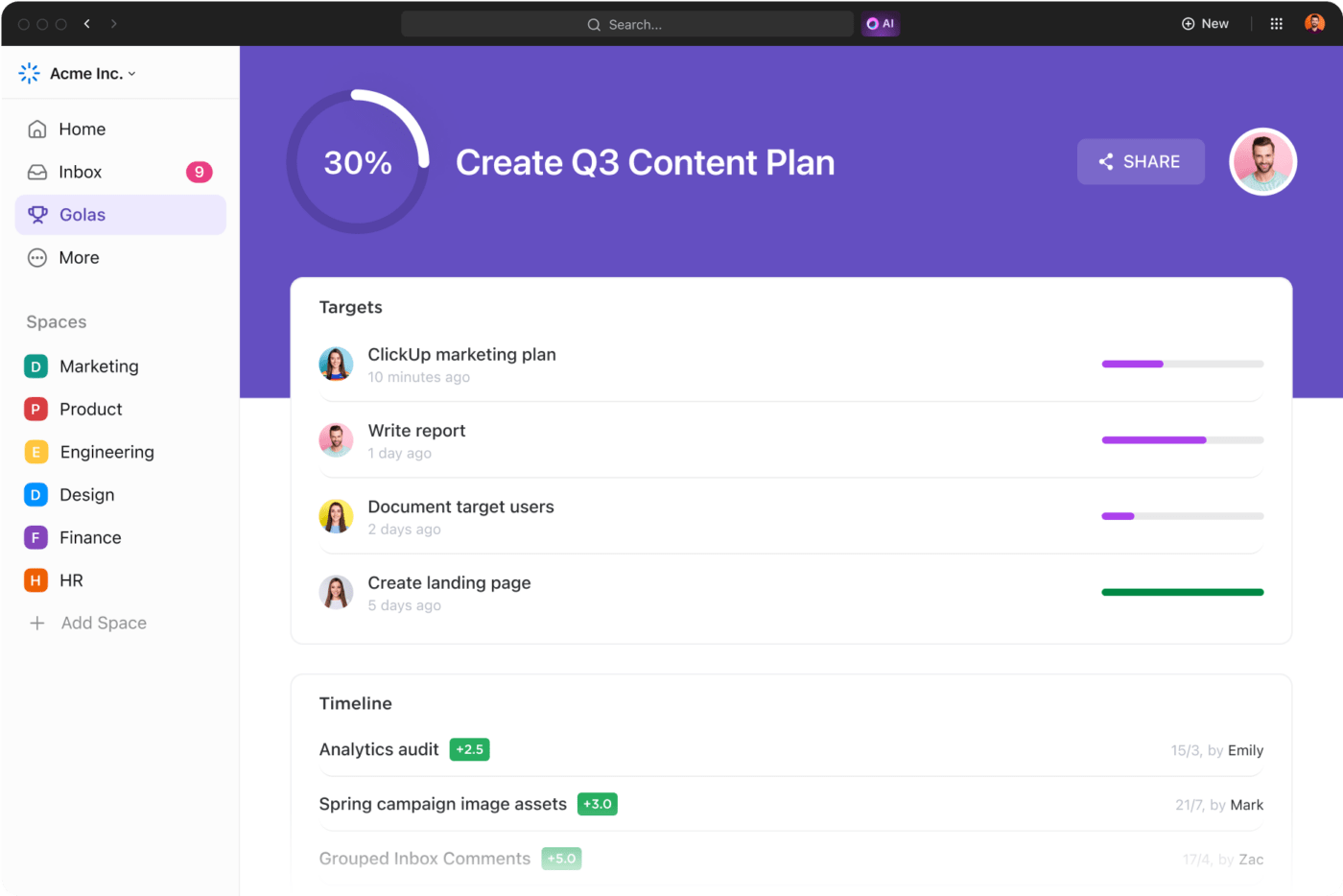
View goals in the format of your choice and sort them into specific folders to streamline the work.
Include the following touchpoints when writing your goals:
- Key activities
- Contingencies and backup plans
- Checkpoints for tracking work
- Rules for keeping stakeholders informed
- Who is responsible for what
- Deadlines for each task/action
- Metrics to measure progress
Step 2: Think—What’s your company culture like?
Your team should know what’s expected of them at all times.
Naturally, establishing your company culture should be high up on your agenda.
Use these tips to develop a positive company culture:
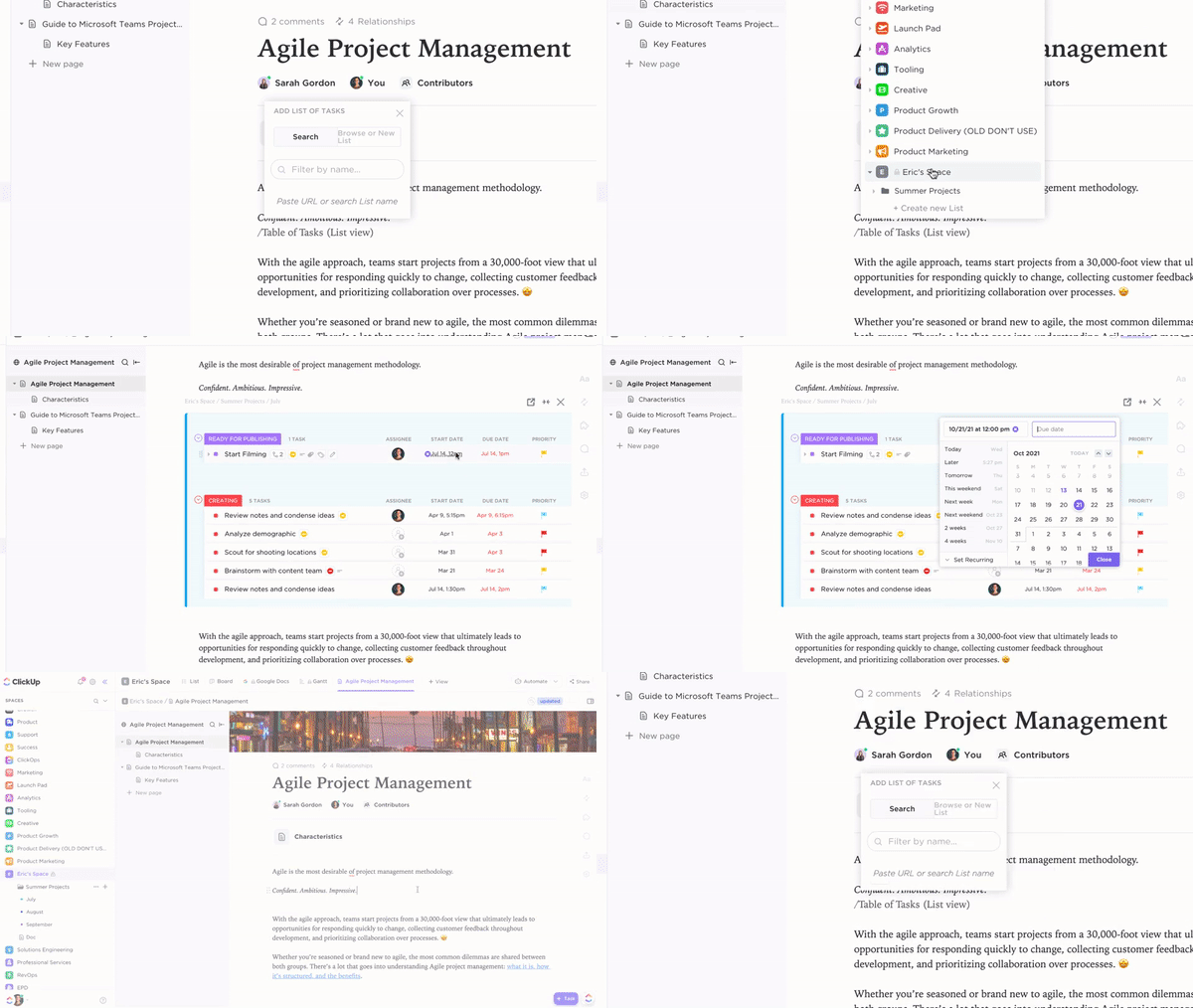
- Positive behavior: Openly discuss what constitutes positive behavior and set up best practice guidelines for your team. Use ClickUp Docs to instantly share these benchmarks and get the team on the same page:
- Team-building exercises: To help team members get better acquainted, try the ‘artifact exercise’—where you ask each employee to share a 5-minute personal story about a challenge and achievement they’ve faced in their career. You must also ask the employee to showcase an artifact that symbolizes their achievement (trophy, certificate, etc.). Once everyone completes their stories, start a discussion on how team members felt after hearing the anecdotes and what particular skills each member brings to the table
- Work style: As a responsible manager, it is essential to learn about how your team works best:
- Do employees like working independently?
- Would they like to collaborate on a hybrid model?
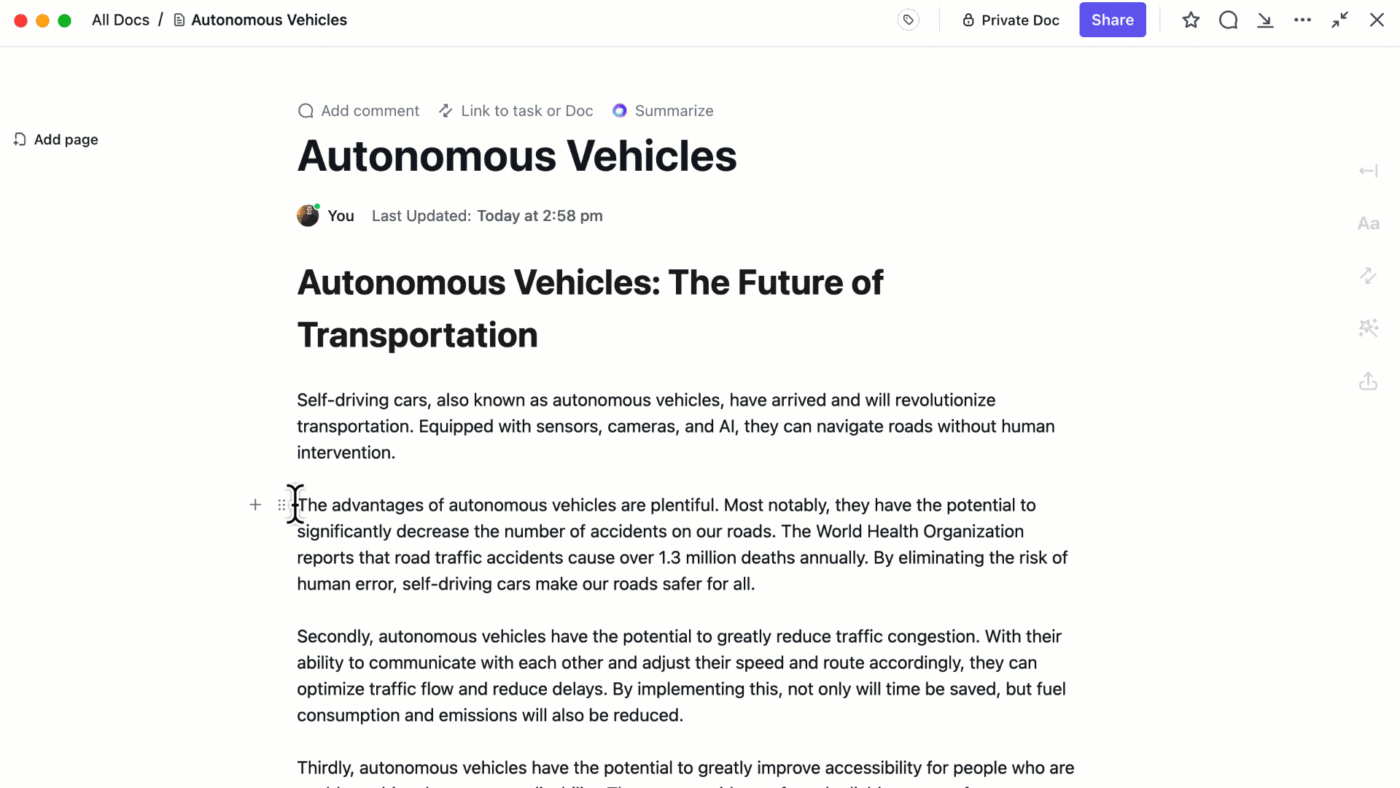
Ask direct questions and create a work style that works for everyone. You can use ClickUp Brain to jot down the discussion points and get everyone up to speed.
Step 3: Focus on training
It’s crucial to assess your team’s current skills and design jobs around said skills.
But if you want to take your team to the next level, focus on skills they’ll need to be an asset tomorrow.
Continuous learning opportunities pave the way for better morale and performance.
Here’s how to make coaching and learning an intrinsic part of your organization’s learning culture:
- Strategize and line up fresh future challenges to keep your team interested
- Create learning modules for unique skill sets
- Develop a framework that keeps the training courses on track
- Experiment with new learning ideas to get better results and help team members grow
Step 4: Create a well-rounded development plan
Building a new team takes multiple factors into account.
You need to ensure every team member feels respected and heard.
You need to be organized and calm when things go south.
You need to check in to see how your employees are faring regularly.
Managing all these aspects requires exceptional project management and time management skills.
So, include all these factors when creating a cohesive team development plan.
Once your plan is ready, it’s time to put it into action and follow these four stages of team development:
- Stage 1: Meet the team and drive ice-breaker sessions where people get to know each other and learn how each member wants to work
- Stage 2: Conduct team-building exercises to build trust and problem-solving skills among peers
- Stage 3: Prepare and brief the team for their first assignment, which must be challenging. Encourage team members to work together and think outside the box
- Stage 4: Regroup and analyze the results; look at what went wrong with the challenge and celebrate the wins
Step 5: Drive 24×7 communication and effortless collaboration
Capitalizing on each other’s skills will bring better results than one can achieve alone.
And taking advantage of the team’s collective strengths starts with a good project management tool at your fingertips.
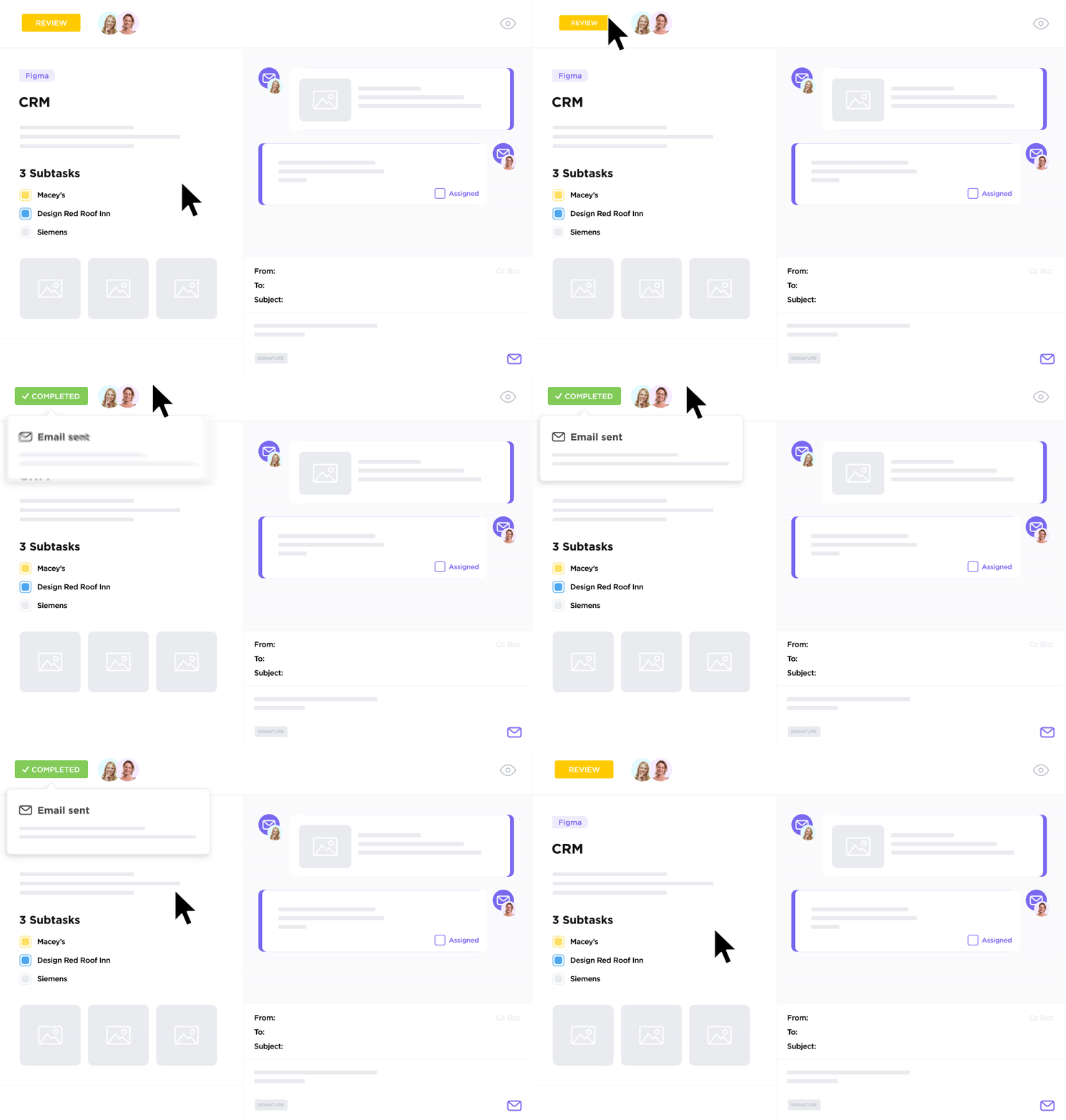
ClickUp offers robust team collaboration and communication features to help teams stay on track and updated with each other’s tasks, updates, and progress.
Take, for instance, ClickUp’s Email feature, which allows you to send essential emails at one click:
The ClickUp Chat View feature also comes in handy if you wish to collaborate with a geographically dispersed team and share live updates.
Another feature you might find helpful is the ClickUp Collaboration Detection functionality, which allows you to:
- Edit docs together in real-time
- Receive instantaneous feedback on status changes, new comments, and other critical task details
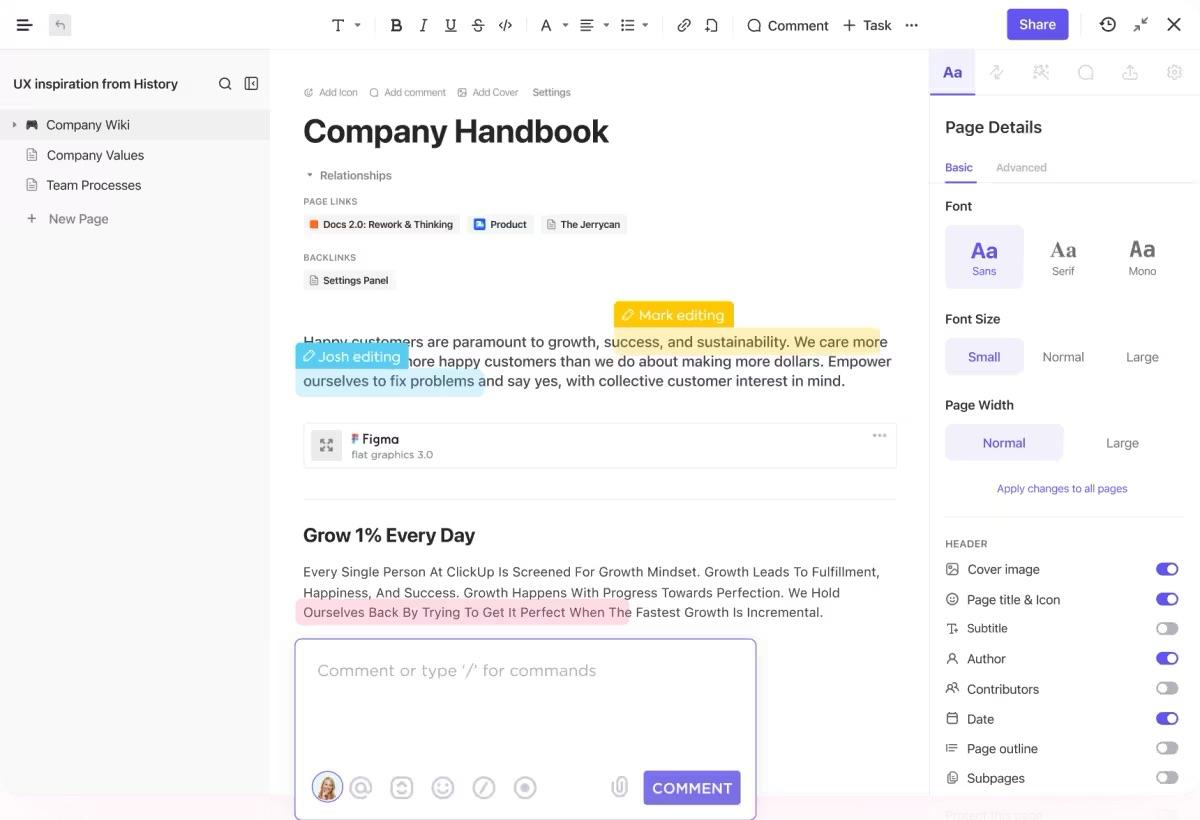
In addition to the features mentioned above, it helps to
- Schedule kickoff team meetings before a task or project begins
- Explain job roles and what other team members need to do to be successful
- Encourage the team to ask probing questions and clarify queries
Without proper communication, your team may have to redo work and may miss deadlines in the process.
Step 6: Invest in 360-degree project management software
Your team needs support when tackling multiple projects at once.
This is where the ClickUp project management platform becomes a game-changer.
The tool offers a suite of features to bring your teams closer, such as:
- Connected workflows and documents easily viewable in real-time ClickUp dashboards:

- Automatically generate subtasks based on task descriptions, summarized comment threads, etc., thanks to the AI project manager:

Get prioritized plans and action items with instant visibility into project details and how they align with company goals using Gantt charts:

Mapped process workflows and increased collaboration on strategic initiatives using ClickUp Whiteboards, a visual canvas for all intents and purposes:

Step 7: Support, don’t micromanage
From the employee’s viewpoint, managers are often seen micromanaging projects instead of lending support.
To put an end to the micromanagement style of leadership:
- Learn to let go: Delegate work intelligently, particularly your low-stakes tasks, and don’t let the team under-function
- Embrace a change in mindset: Shift gears from a doer to a leader by demonstrating greater trust in the team
- Keep learning: Much like your employees, as a manager, you need to keep honing your leadership skills and be curious
- Hire thoughtfully: Instead of mindlessly filling roles, hire a diverse group of people who can work harmoniously and boldly
- Think soft skills: In addition to focusing on the hard skills, you must take ownership of the team’s behavior and foster soft skills such as greater collaboration, empathy, and trust
- Encourage the 85% effort formula: The Harvard Business Review claims that to create high-performance teams, managers must encourage team members to give 85% effort (as opposed to 100% effort all the time) and prevent burnout
Step 8: Ask—Is your feedback visually driven?
To drive objective feedback sessions and engage in productive conflict resolution, use:
- Visualization as a training tool: Visual feedback shows people what to improve on—much like a football team watching themselves play. One tool that can make this process drastically fun and engaging is ClickUp Mind Maps, which allows you to draw connections between tasks and ideas:
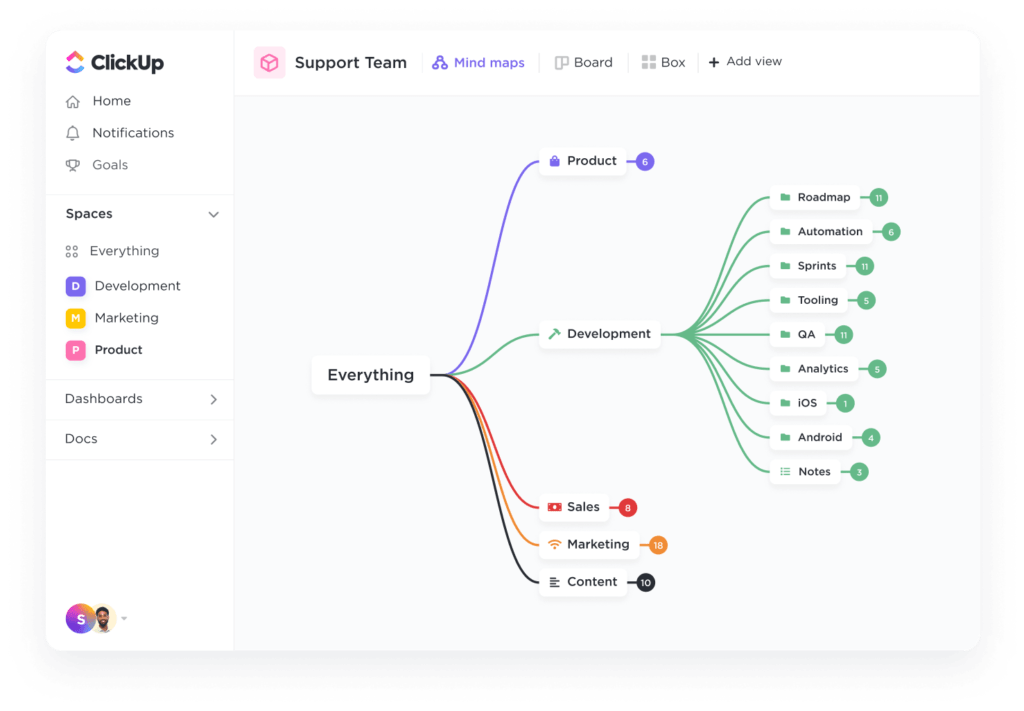
- Track time to assess how well your team works together: Tracking how your team spends their time uncovers invaluable insights into what’s working and what isn’t. Pay close attention to your team’s time management skills
- Performance management tools: Drive regular employee performance reviews with performance management tools and free performance review templates to assess how well your employees are working and develop improvement plans accordingly. Use ready-made performance improvement plan templates and help your teams boost performance on the go
While you’re at it, give a descriptive feedback that must include:
- Your team’s behavior, not their personality
- Your team’s skills to do the task at hand
- Whether or not the teams have the necessary resources to succeed
- What motivates each team member
- The team’s actions—ones that are based on facts, not assumptions
- Clear, specific examples of what the team is doing right (and where it’s going wrong)
- Where the team should be heading next
- Who to speak to if they face any obstacles
- What each individual’s purpose is in the larger scheme of things
The idea is to create a safe space where employees can honestly contribute their opinions.
Summarize this article for me pleaseKey Challenges in Developing a Successful Team
If your team struggles, it’s only natural to want to step in.
But developing a successful team is an uphill task for many reasons:
- Not everyone may be interested in contributing to the team’s success equally
- Team members may lack trust in connecting with one another and with team leaders
- Too many back-channel and side conversations may be creating informational gaps
It is possible to eliminate these challenges and set up a successful team with six essential characteristics.
Summarize this article for me please6 Common Characteristics of a High-Performing Team
Decoding the team dynamics of a high-performing team is more attainable than it seems.
The following six characteristics are observable, measurable, and quantifiable, making it easier to inculcate over time.
Integrate these qualities within your team and strengthen their bonding from day one:
1. Diversity, equity, and inclusion (DEI)
Is there a clear link between your DEI strategy and the business strategy? If not, then you must:
- Be more systematic early on, and tie your organizational objectives to the desired level of impact from your DEI program
- Identify opportunities for having the right infrastructure for your DEI aspirations—a reality for only 47% of organizations today
- Hire diverse employees with a multitude of skills and perspectives
2. Energy levels
Is your team exhibiting higher energy levels and a greater sense of accountability? Both of these are direct indicators of the team’s engagement levels. The higher the energy, the more the engagement and vice-versa
3. Creative and goal-oriented mindset
Each team member must consider the company’s goals as their true North Star and work with creativity and support
4. Shared commitment toward company culture
Your employees must understand what drives the organization forward in terms of its vision, culture, and beliefs
5. Learning mindset
Each team member you choose must be eager to learn and adapt to changing situations. McKinsey claims that the highest performers in a role are 800% more productive than average performers in the same role!
6. Communication
Mapping your team’s communication is as essential as understanding what they discuss. It shapes how your team drives decision-making and works together as a well-oiled machine. As such, note the following when assessing the team’s communication skills:
- What is each member’s tone of voice?
- Do the team members face one another while talking, virtually or in person?
- What kind of gestures do the members demonstrate?
- What’s the frequency with which team members talk, listen, and interrupt each other?
- How do team members exhibit extroversion and empathy?
Summarize this article for me pleaseEngineer Better Teams With the Right Solution
That’s a wrap on how to develop a flexible and productive team.
Use the insights outlined here to combine high-performing teams with multi-faceted skills—individual intelligence, communication, empathy, and talent.
It’s also good practice to arm the team with the right tools, strategies, and techniques you’ve mastered over the years.
Consider investing in a project management tool like ClickUp and empower your team to deliver their best.
An all-in-one tool like ClickUp streamlines workflows, tracks progress, drives collaboration and guides the team toward a common goal.
Summarize this article for me pleaseCommon FAQs
1. What is the best way to develop a team?
Developing a team is an eight-step process that requires patience and time:
- Step 1: Work on your task and process goals to get people in sync
- Step 2: Focus on creating your company culture, which includes team values, beliefs, etc.
- Step 3: Include opportunities for employee and team learning at every step of the way
- Step 4: Pen a holistic team development plan, including a focus on the hard and soft skills of the team members
- Step 5: Drive instant communication and collaboration with the right tools
- Step 6: Invest in project management software to accelerate your team’s productivity
- Step 7: Change your leadership style from micromanagement to supportive
- Step 8: Give feedback visually for better comprehension
2. What are the five stages of team development?
According to Tuckman’s model, team development comprises of five stages:
- Forming: Group members are polite and try to get to know each other; they are often uncertain about their roles and objectives in this stage
- Storming: Conflict and competition arise as group members begin to express their opinions and push against the boundaries established in the forming stage
- Norming: Group norms and values form, creating a sense of unity and collaboration. Moreover, roles and responsibilities become clearer, and trust begins to develop among group members
- Performing: The group is highly functional, with clear goals and a sense of shared purpose. Members work together effectively to achieve their objectives
- Adjourning: Also known as the “deforming” stage, this phase involves dissolving the group as the goals are achieved. By extension, members may feel a sense of loss or sadness as the group disbands
3. How do we develop teamwork?
Developing teamwork can take time to happen. It requires a systematic approach and ongoing effort to:
- Establish clear goals: Everyone on the team should understand the role they play in achieving the organization’s goals, creating a sense of purpose and direction
- Encourage open communication: The team members must engage in active listening and share information in real-time
- Build trust: Trust-building activities and leading by example are powerful ways to build a trusting environment
- Foster collaboration: A collaborative environment motivates team members to work together and achieve common goals
- Provide support: Honest encouragement from the executive team boosts employee morale and motivation
- Celebrate successes: Acknowledging and celebrating the team’s achievements helps build team spirit
- Drive continuous improvement: A culture of continuous improvement is essential to helping team members be open to feedback and willing to learn from their experiences


Everything you need to stay organized and get work done.

Recent Articles


How to Use the ClickUp Desktop App for Maximum Productivity 
How to Use the ClickUp Desktop App for Maximum Productivity
