






Still downloading templates?
There’s an easier way. Try a free AI Agent in ClickUp that actually does the work for you—set up in minutes, save hours every week.
Sorry, there were no results found for “”
Sorry, there were no results found for “”
Sorry, there were no results found for “”
According to MIT, 95% of AI projects fail.
That’s disappointing, but not surprising.
Why? Because most companies equate “ChatGPT” and “Generative AI” with “AI Strategy.” While introducing chat-based AI tools will definitely help, it’s not enough to realize the transformative value of AI and machine learning.
This guide aims to open your mind to a different way of thinking about the future of work. A more comprehensive, contextualized way to get lasting value out of artificial intelligence.
There are two main vectors that will bring your AI future to life and maximize your productivity.
The future of digital transformation belongs to companies that operate well on both axes. Successful companies that centralize their work in a single, converged AI workspace, where usability, context, and intelligent automation compound to unlock exponential gains.
Successful AI transformation isn’t just an IT decision. It’s a strategic imperative for CEOs and leaders who want to align their teams, accelerate execution for complex projects, and stay ahead in the AI-powered era.
Let’s dive in.
The AI Transformation Matrix is your roadmap to unlocking the true potential of AI technology for every business unit in your company.
By understanding where you stand on each axis, you’ll gain clarity on the barriers holding your teams back, the opportunities for exponential productivity, and actionable steps to move toward a future where AI seamlessly amplifies every aspect of your work.
Take a moment to ask yourself the following series of questions to get a sense of where you land on the matrix.

Remember the 95% of AI projects that fail? It’s likely that they were in the bottom left quadrant. But they’re not exclusively there.
Failed projects also exist in the top left and bottom right. Let’s explore each quadrant and discuss the pathway to the top right: Ambient AI.
❗️Symptoms:
✅ How to move forward:
❗️Symptoms:
✅ How to move forward:
❗️Symptoms:
✅ How to move forward:
Think back to the 95% of AI projects that fail. They’re not in the Ambient AI quadrant. The graveyard of failed AI projects exists in the other three quadrants.
So, what is Ambient AI?
Imagine a workspace where AI isn’t just a tool you use. Rather, it’s the invisible fabric that connects, understands, and amplifies everything you do. It’s a single ecosystem where humans and AI work, together. This creates an environment where intelligence is seamlessly woven into every workflow, every document, and every conversation.
A truly converged AI workspace unlocks this kind of Ambient AI:
Rather than being a distant vision, this future is rapidly becoming a necessity for organizations that want to thrive in the AI era and keep pace with the global AI market.
Ambient AI is not about adding more complexity or requiring a massive leap in technical sophistication. In fact, the journey to ambient intelligence is surprisingly accessible, especially for organizations that have already begun to centralize their work and knowledge.
By unifying your tools, data, and collaboration in a single, converged workspace, you create the foundation for AI to operate in the background: surfacing insights, automating routine tasks, and proactively supporting your team’s goals.
The result is a compounding effect: each step toward convergence and AI maturity makes the next easier, more impactful, and more intuitive for everyone involved.
The stakes couldn’t be higher.
⚠️ As AI accelerates the pace of change, organizations that cling to fragmented systems and siloed knowledge will struggle to keep up.
🚀 But those who embrace the promise of an Ambient AI system, where intelligence is ever-present, context-rich, and effortlessly accessible, will unlock a new era of productivity, innovation, and resilience.
The path forward isn’t reserved for tech giants, data engineers, or AI specialists; it’s open to any company willing to take the first step toward convergence. By making the shift now, you’re not just surviving the future of AI—you’re shaping it, and ensuring your organization is the best place to exist and excel in the years ahead.
Convergence is the process of eliminating work sprawl and unifying all critical work, knowledge, and collaboration into a single, integrated workspace. Rather than simply reducing the number of apps used, true convergence is about centralizing context, streamlining workflows, and ensuring that information and processes are accessible and actionable in one place.
This approach minimizes the “toggle tax” of switching between tools, reduces costs, and enables teams to operate with greater efficiency and clarity. The goal is not just fewer apps, but a more performant, context-rich environment where work happens seamlessly and teams are able to preserve and leverage knowledge across the organization. 🗂️
In the age of AI, convergence becomes a foundational requirement for unlocking the full potential of intelligent automation and augmentation. As organizations mature in their use of AI, from sporadic, siloed applications to the codification of complex processes, having all work centralized in a converged workspace amplifies the impact of AI. When AI operates within a unified environment, it can access complete context, deliver more accurate insights, and automate workflows end-to-end.
The compounding value emerges when both convergence and AI maturity are high: AI becomes ambient and invisible, embedded deeply into daily business operations, driving real productivity gains and enabling teams to focus on high-value, creative work.
The spectrum of Context Maturity spans across three main sections:
The path to full context requires a thorough audit of current workflows, tools, and information silos to identify redundancies and inefficiencies. The tooling audit should prioritize solutions that enable seamless collaboration, knowledge sharing, and process automation across teams and departments.
Companies should establish clear governance for data and workflow integration in their operating models, ensuring that all critical information and processes are centralized and accessible. By continuously monitoring usage patterns and gathering feedback, orgs can refine their approach, drive further adoption, and unlock the full benefits of a converged AI workspace—setting the stage for more advanced AI integration and greater productivity gains.
AI maturity is the journey organizations take as they evolve from using isolated, task-specific AI solutions to operating within a fully unified, intelligent workspace.
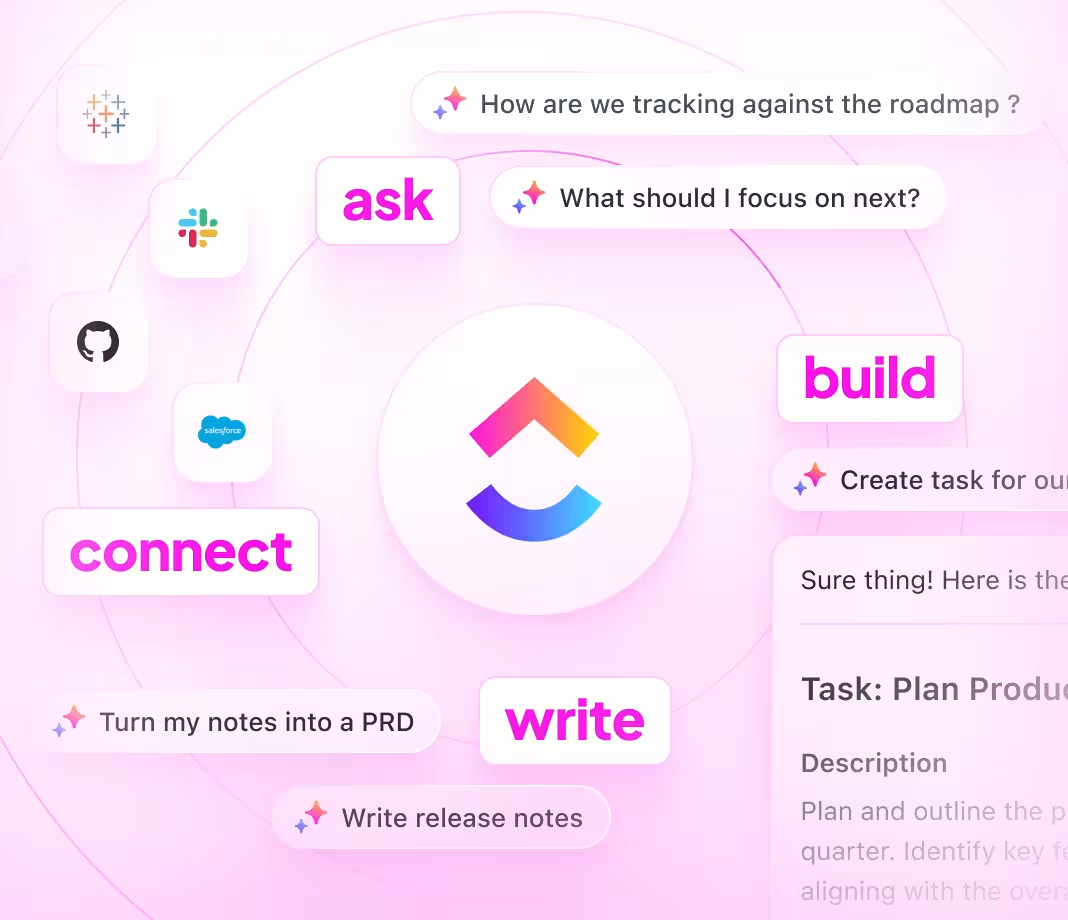
Rather than simply adopting AI features, true AI maturity is about integrating automation, intelligence, and collaboration into the very fabric of daily work. This progression transforms how teams operate, moving from fragmented workflows to seamless, context-rich environments where AI can deliver its greatest value.
The spectrum of AI Maturity breaks down into three main sections:
Achieving AI maturity doesn’t require you to build AI models tailored to your organization—it’s about creating the conditions for AI to amplify human potential. By progressing through these stages, organizations unlock the compounding benefits of unified work and intelligent automation, setting the stage for transformative productivity and innovation through informed AI adoption.
No business transformation of this magnitude succeeds without unwavering commitment from the top. A true AI-powered future demands more than grassroots experimentation or isolated departmental pilots. It requires a clear, company-wide mandate from executive leadership.
CEOs and their teams must set the vision, define the strategic imperatives, and hold the organization accountable for progress. This means not only evaluating and selecting the right technology stack—one that enables convergence, context, and intelligent automation—but also ensuring that every investment aligns with the broader business objectives.
When business leaders champion the shift to a unified, AI-driven workspace, they signal to the entire company that this is not just an IT project, but a core driver of competitive advantage and long-term growth.
Equally important is the executive’s role in driving change management across the finish line. The best technology in the world will fail to deliver value if teams are not empowered, enabled, and inspired to adopt new ways of working.
Leaders must proactively address resistance, communicate the “why” behind the transformation, and model the behaviors they expect from their teams. This includes investing in enablement, celebrating early wins in the AI lifecycle, and continuously reinforcing the vision for a converged, AI-powered organization.
By making AI-driven transformation a leadership priority, supported by clear data governance, cross-functional collaboration, and relentless focus on outcomes, executives ensure that change is not just initiated, but sustained, unlocking the full potential of both their people and their technology.
A converged AI workspace is the foundation that turns Ambient AI into an everyday reality.
By unifying all your work, knowledge, and collaboration in a single platform, you give AI the context it needs to automate intelligently, surface relevant insights, and proactively support your team. No more fragmented data or disconnected workflows. Just a seamless environment where every task, document, and conversation is connected and accessible.
This convergence creates a compounding effect: as more of your organization’s work and knowledge are brought together, your own AI model becomes more powerful and valuable. It can anticipate needs, eliminate manual busywork, and empower teams to focus on high-impact, creative work. The result is faster execution, better decision-making, and a culture of innovation—driven by an intelligent partner that understands your unique context.
Organizations that embrace this shift aren’t just keeping up with change—they’re leading it, building workplaces where people and AI achieve more together, and setting the standard for productivity and innovation in the era of AI development.

© 2026 ClickUp

There’s an easier way. Try a free AI Agent in ClickUp that actually does the work for you—set up in minutes, save hours every week.