






Still downloading templates?
There’s an easier way. Try a free AI Agent in ClickUp that actually does the work for you—set up in minutes, save hours every week.
Sorry, there were no results found for “”
Sorry, there were no results found for “”
Sorry, there were no results found for “”
Most marketing teams have more customer data than they know what to do with—IDC finds data workers waste 12 hours weekly just finding and preparing it. But all those spreadsheets rarely reveal why people buy or when they’re about to leave.
This guide walks you through how AI customer segmentation works, why it beats traditional methods, and how to connect those insights directly to executed campaigns using tools like ClickUp Brain so your segments don’t die in a PowerPoint deck!
If you’re still grouping your customers by age, gender, and location, you’re leaving money on the table. Marketing teams often struggle because these basic demographic buckets treat customers as monolithic groups, ignoring the unique behaviors and preferences that actually drive purchasing decisions.
This leads to generic messaging that fails to resonate, wasting your budget and frustrating your audience, with 52% of consumers stopping purchases after a bad brand experience.
AI customer segmentation is the solution. It uses machine learning algorithms to automatically group customers into highly specific segments based on how they actually behave—far beyond what any manual spreadsheet analysis can achieve.
While traditional methods rely on static rules and human assumptions, AI discovers hidden patterns and dynamically updates your customer segments as their behavior changes.
Here’s the cool part: AI analyzes multiple data types at once to build a complete picture of your customer personas. ✨
While you’re stuck with outdated personas, your competitors are using AI to deliver hyper-relevant experiences that feel genuinely personal.
Let’s be real: your team is wasting budget on broad campaigns that don’t land because traditional segmentation just can’t keep up with how fast customer preferences shift.
You’re constantly working with outdated information, which leads to low conversion rates, high churn, and a sense that you’re always one step behind. AI segmentation directly addresses these limitations, and its advantages translate into real-world growth.
By the time your team compiles the quarterly segmentation report, customer behavior has already changed. The “price-sensitive” segment you identified three months ago is now full of people who got promotions and are ready to buy premium products.
Your discount-heavy campaigns aren’t just ineffective—they’re actively annoying your best new prospects.
This is where AI changes the game. AI-powered segments aren’t static snapshots; they’re living, breathing groups that update continuously as new data flows in. The system automatically moves customers between segments based on their latest actions, ensuring your marketing is always relevant.
But here’s the catch: real-time insights are useless if you can’t act on them in real-time. If your new segment data is trapped in a separate analytics tool, you’re still too slow to capitalize on the opportunity. This is where having your work and data connected in one place becomes a superpower.
📮 ClickUp Insight: 1 in 4 employees uses four or more tools just to build context at work. A key detail might be buried in an email, expanded in a Slack thread, and documented in a separate tool, forcing teams to waste time hunting for information instead of getting work done.
ClickUp converges your entire workflow into one unified platform. With features like ClickUp Email Project Management, ClickUp Chat, ClickUp Docs, and ClickUp Brain, everything stays connected, synced, and instantly accessible. Say goodbye to “work about work” and reclaim your productive time.
💫 Real Results: Teams are able to reclaim 5+ hours every week using ClickUp—that’s over 250 hours annually per person—by eliminating outdated knowledge management processes. Imagine what your team could create with an extra week of productivity every quarter!
Most marketing teams are stuck playing defense. You’re trying to win back customers after they’ve churned or sending cart abandonment emails hours after they’ve already bought from a competitor. You’re reacting to the past instead of shaping the future.
Propensity modeling, a key feature of AI segmentation, is like a crystal ball for customer behavior. 🔮 It analyzes past customer behavior to predict what your current customers are likely to do next.
This allows you to get ahead of the curve with proactive campaigns.
Here are a few game-changing examples:
Plot twist: having these predictions is only half the battle. If your sales team never sees the “high purchase likelihood” score or your marketing team can’t easily trigger a campaign for “at-risk” customers, the prediction is worthless. The insight has to be connected to the action.
Your team faces a frustrating choice: send a perfectly personalized email to ten VIPs or a generic blast to 10,000 people. You can’t have both. Manual processes mean you have to sacrifice either personalization or scale, but today’s customers demand both.
Let’s be clear about the difference:
AI is what finally makes hyper-personalization at scale a reality. It enables a one-to-one approach across millions of customers by automating the complex decision-making for each individual, something that would require an army of analysts to do manually.
Everyone now expects the “Netflix effect” from every brand they interact with, and companies that can’t deliver this level of relevance will be left behind.
Your team is likely segmenting customers based on the same old criteria because you’re limited by your own assumptions and biases. You’re looking for segments you already believe exist, which means you’re missing out on profitable niches hiding in plain sight.
This is where the real magic of AI comes in. 🤩
Unsupervised learning is a type of AI where you don’t tell the algorithm what to look for. You just point it at your data and say, “Find something interesting.” The results can be astonishing.
For example, AI might discover a highly profitable segment of customers who only buy on rainy days, or a group of users who are most likely to convert when they receive a marketing message during their morning commute.
These are non-intuitive but incredibly valuable patterns that no human would ever think to test. This is where you go from just being more efficient to being genuinely smarter than your competition.
The term “machine learning” can be intimidating. Many teams think they need a data scientist on staff to even get started, so they stick with their familiar (but ineffective) spreadsheets.
This “analysis paralysis” keeps them from adopting powerful tools that are actually designed to be user-friendly. The process isn’t as scary as it sounds. Let’s break it down into three simple parts. 🛠️
Your customer data is a mess, isn’t it? It’s scattered across your CRM, email platform, analytics tools, support desk, and social media accounts. This is a classic case of Context Sprawl—when teams waste hours searching for information across disconnected apps and platforms.
This is a problem ClickUp’s Converged AI Workspace—a unified platform where all work, data, and AI capabilities live together—is built to solve by unifying your data and workflows.
To work its magic, AI needs a clean, unified view of the customer. This means bringing together all your different data sources:
This data fragmentation is the single biggest hurdle for most teams. The good news is that you probably already have all the data you need—it’s just not in one place.
When your data and workflows are unified in a single workspace, you finally get a complete view of your customer—something no standalone AI tool can deliver.
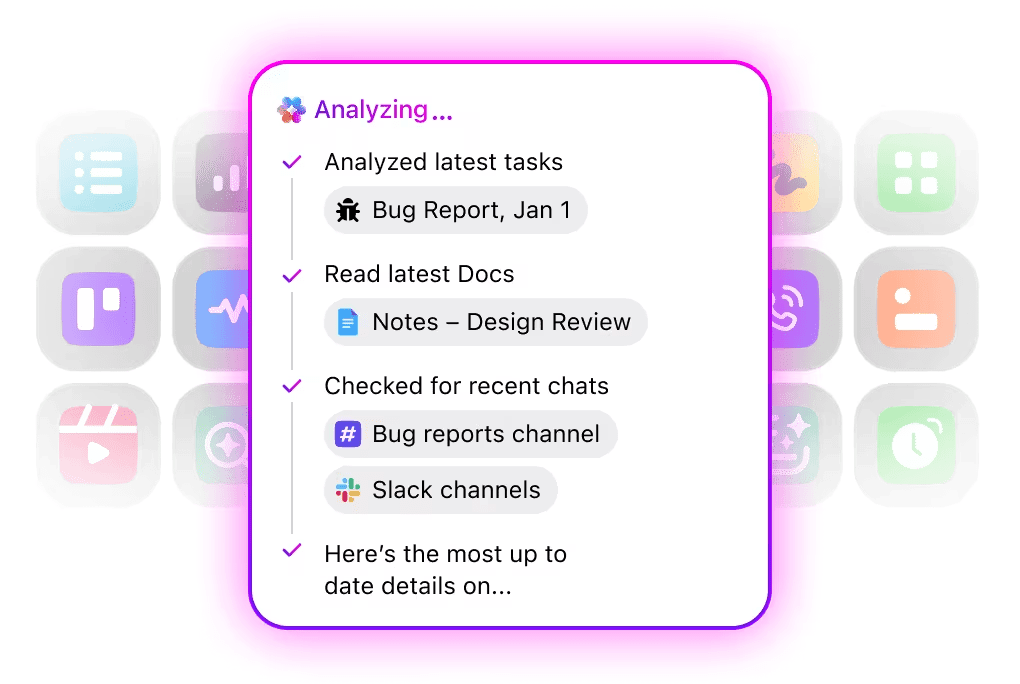
💡 Pro Tip: ClickUp BrainGPT acts as an AI-powered search assistant that lets you search across ClickUp, the web, and all your connected apps (like Google Drive, SharePoint, GitHub, and more) from a single interface.
Let’s address the “black box” problem. Teams are often afraid to trust an algorithm they don’t understand. But you don’t need to know the complex math behind it to use it effectively.
Clustering algorithms are simply an automated way of sorting customers into groups based on their similarities. An algorithm like K-means can analyze dozens of variables at once to find natural groupings in your data that you would never spot on your own.
The key is to focus on the outcome, not the mechanics. You don’t need to be a data scientist to understand a segment labeled “High-Value, Low-Frequency Shoppers.”
Modern AI tools don’t just give you “Cluster A”; they provide explainable segments with clear characteristics, like “This group buys on mobile, spends over $100, and hasn’t logged in for 30 days.”
Remember that big segmentation project from last year? The one that produced a beautiful report that’s now gathering digital dust in a folder somewhere? That’s the problem with traditional segmentation—it’s a “set it and forget it” exercise that becomes stale almost immediately.
AI segmentation, on the other hand, is a living system. It operates on a feedback loop, constantly learning and improving over time. As it gets new data from your campaigns, it refines the segments. If a group of customers stops responding to a certain type of messaging, the algorithm adjusts.
This doesn’t mean you’re out of a job. It means you get to stop being a data janitor and start being a strategist. Marketers still guide the overall strategy and validate that the segments AI discovers make business sense.
Now that you understand how AI customer segmentation works, let’s look at what you can do with it.
“Okay, I get the theory, but what do I actually do with these segments?” This is where most teams get stuck. The analytics team delivers a report, but the marketing team doesn’t know how to translate it into actual campaigns. With the right approach, you can turn the information into actionable insights.
Here are some practical, ready-to-go campaign ideas you can launch once you have AI-powered segments:
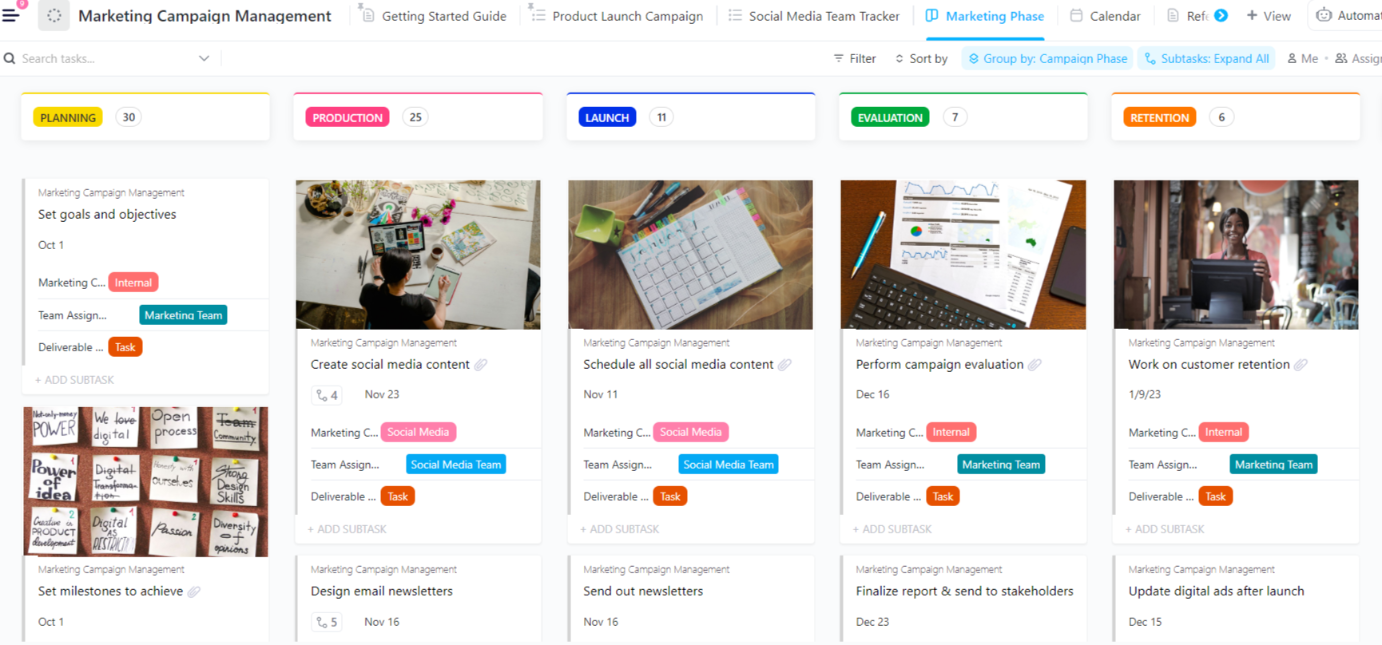
🌟ClickUp’s Marketing Campaign Management Template helps you manage marketing campaigns from start to finish. With it, you can:
For e-commerce teams, this level of automated customer segmentation can directly increase average order value (AOV) by identifying which customers respond best to bundles, which prefer single items, and which need to see customer reviews before making a purchase.
To see how other e-commerce businesses are leveraging AI tools to enhance customer segmentation and drive growth, watch this practical overview of AI implementation strategies:
📚 Also Read: Which AI Stack Is Right for E-Commerce Brands?
Here’s the biggest problem with AI for customer segmentation: the insights are created in one tool, but the campaigns are planned and executed in another.
This is Work Sprawl—the fragmentation of work across multiple disconnected tools—and AI Sprawl—the uncontrolled proliferation of AI tools with no oversight or strategy—in action, challenges that ClickUp’s Converged AI Workspace is designed to eliminate by connecting insights directly to your workflows.
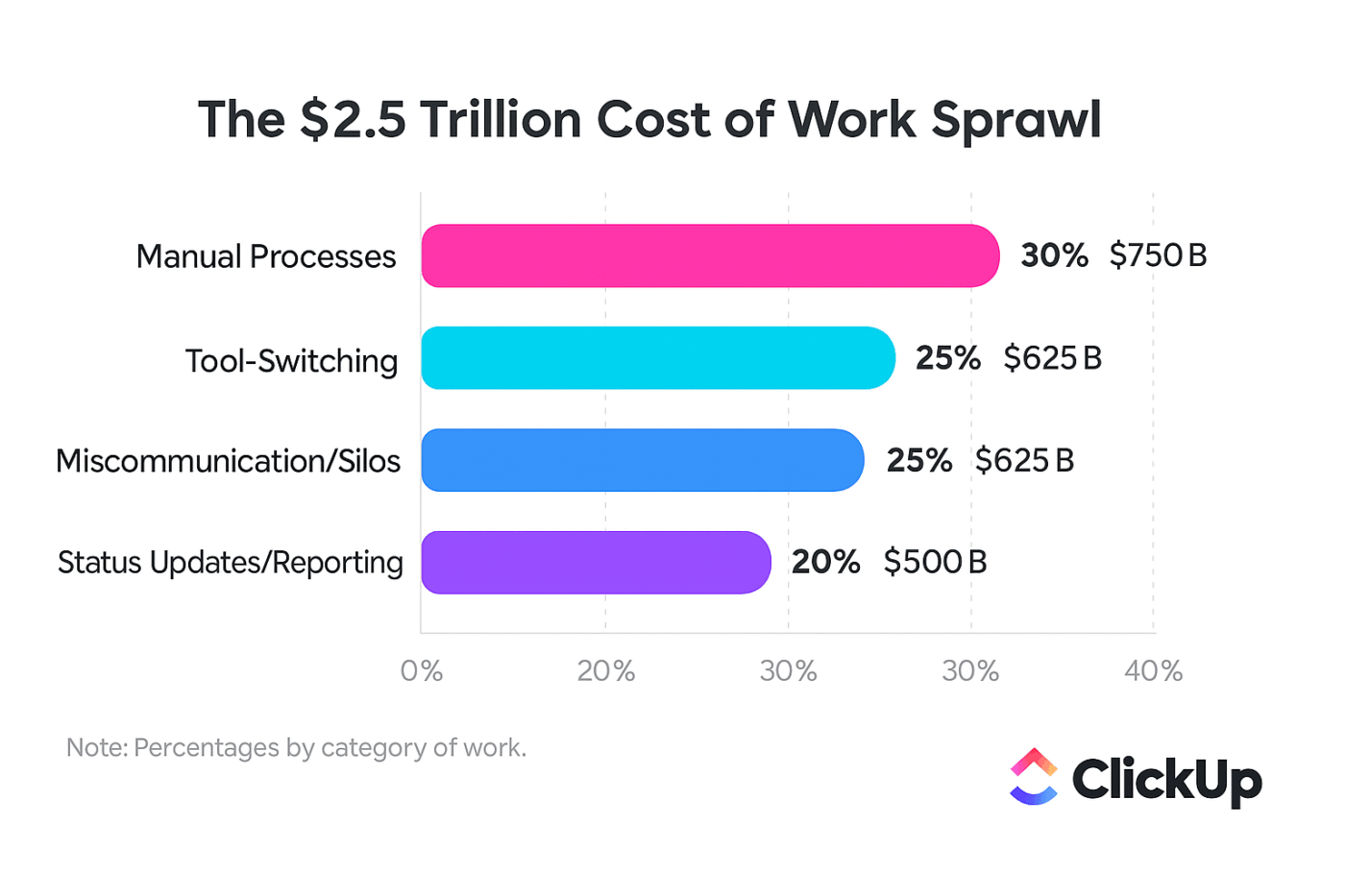
Segmentation reports get emailed around, insights are manually copied and pasted into spreadsheets, and brilliant ideas get lost in the handoff between the data team and the creative team. This gap between insight and action leads to slow execution, miscommunication, and missed revenue.
With ClickUp, you eliminate this gap.
Get AI-powered insights and actions right where your team works with ClickUp Brain, ClickUp’s native AI that spans your entire workspace and draws on knowledge from your tasks, documents, work conversations, and more.
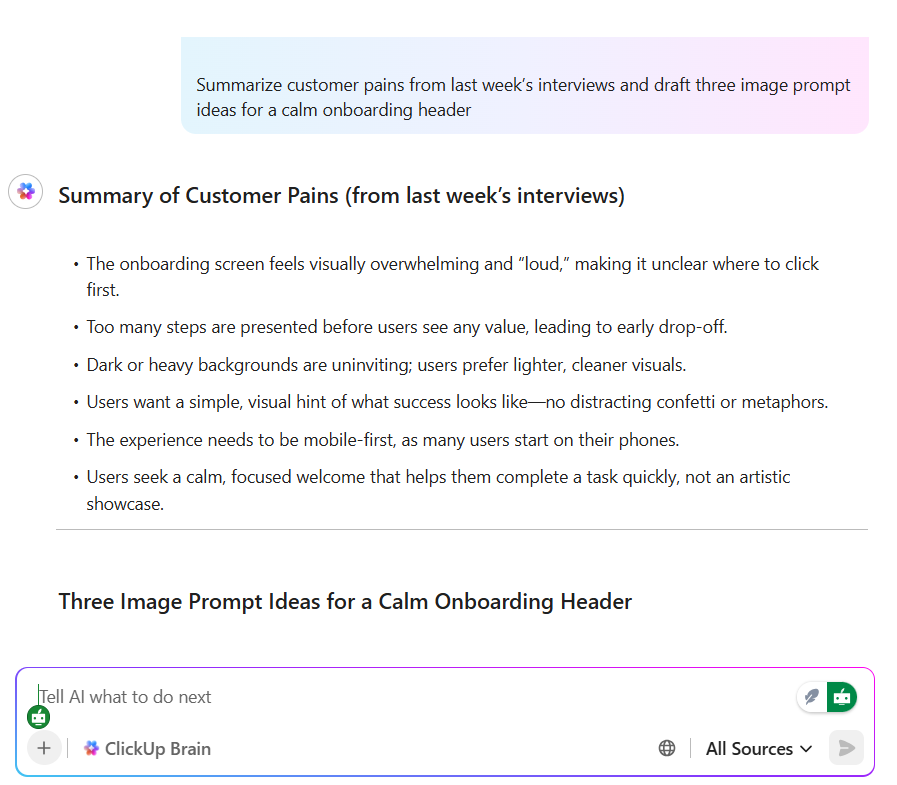
It’s designed for teams who want AI that understands their actual work context, not a standalone tool that requires constant copy-pasting.
The key difference: ClickUp Brain connects AI capabilities directly to your execution workflows, closing the gap between knowing and doing. You can turn your AI customer segments into actionable campaigns instantly.
Here’s how you can use ClickUp Brain to turn segmentation insights into executed campaigns faster:
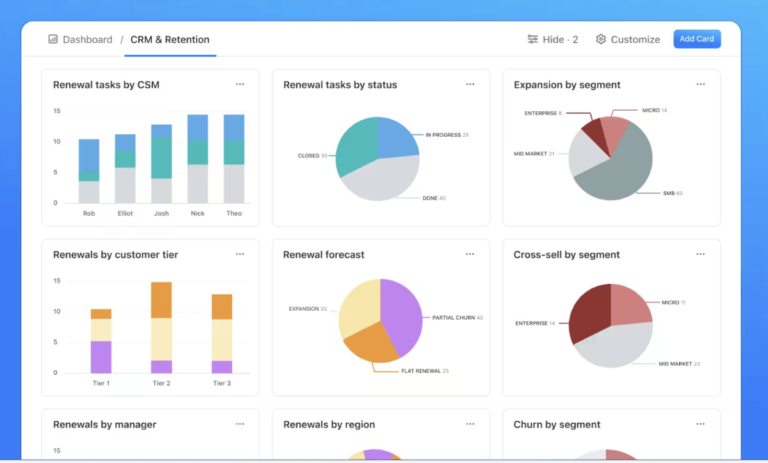
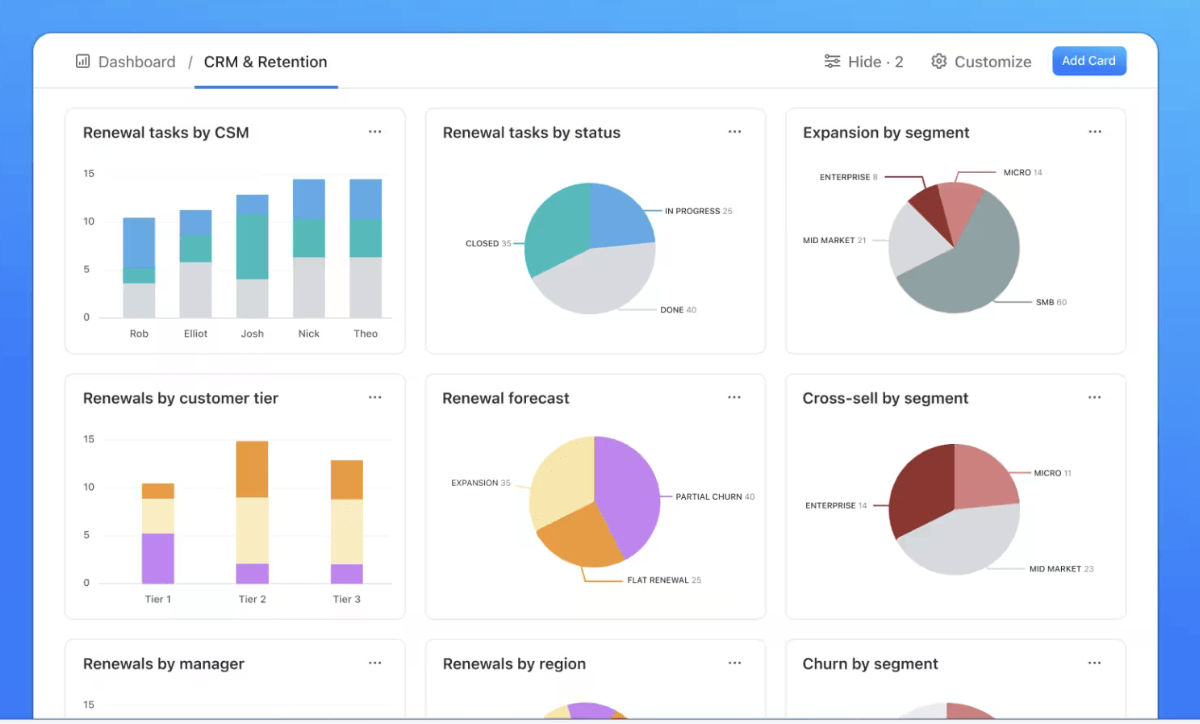
And that’s not all. With the AI-powered ClickUp Dashboards, teams can track campaign performance in the same place where work is happening.
This is the power of a converged workspace. You’re not just analyzing data; you’re turning it into work, instantly.
For more helpful tips on how to use AI in marketing, watch this video 👇
AI customer segmentation is a fundamental shift from creating static demographic buckets to building dynamic, behavior-driven audiences that evolve with your customers. The technology itself is becoming more accessible every day. The real differentiator is how fast you can connect those AI insights to your execution workflows.
The teams that win aren’t just the ones with the best data; they’re the ones who can act on that data the fastest. The brands pulling ahead are those treating segmentation as a continuous, AI-powered capability that’s embedded in their daily work—not a one-off analytics project that gets forgotten.
Ready to bring AI-powered insights directly into your marketing workflows? See how ClickUp Brain can help your team move from segmentation insights to executed campaigns faster. Get started for free with ClickUp.
AI analyzes vastly larger datasets, discovers non-obvious patterns humans would miss, and updates segments in real-time as behavior changes—while manual methods rely on static rules and periodic analysis that quickly become outdated.
Yes—modern AI segmentation tools are designed for marketers, not data scientists, with intuitive interfaces that surface actionable segments without requiring coding or statistical expertise.
Eliminate the handoff gap and keep opportunities moving by connecting segmentation insights directly to tasks, docs, and workflows with AI built into a workspace platform like ClickUp—instead of manually transferring insights from standalone tools.

© 2026 ClickUp

There’s an easier way. Try a free AI Agent in ClickUp that actually does the work for you—set up in minutes, save hours every week.