
Sorry, there were no results found for “”
Sorry, there were no results found for “”
Sorry, there were no results found for “”
Last quarter, one task slipped on a timeline I’d spent all day building, and nothing else moved with it. I re-dragged every task behind it by hand, and half the dates were wrong again by the time I finished. That was the day I went looking for software that could hold a schedule together on its own.
Turns out Harold Kerzner called it decades ago: skip systematic planning, and you get reactive, crisis-driven management.
So I tested nine tools the same way: build a real plan, move one task, and watch whether the rest of the schedule follows. I compared them in terms of how they handle dependencies, whether they show a critical path, what you really get at each tier, pricing, and how far their AI goes.
The right tool depends on your workflow. Meaning:
| Tool | Best for | Standout feature | Pricing* | Where it taps out |
|---|---|---|---|---|
| ClickUp | All-in-one timelines on a free plan | Critical path and dependencies on the free tier | Free; paid plans from $7/seat/mo | More depth than a solo, single-list user needs |
| monday.com | Visual, board-first planning | Drag-to-reschedule Timeline and Gantt | Free (2 seats); paid from $9/seat/mo (Gantt on Standard, $12) | Lighter on deep scheduling analytics; critical path is still a trial feature |
| Asana | Collaboration-led teams | Timeline that doubles as a Gantt | Free (up to 10 users); paid from $10.99/user/mo | No timeline on the free plan |
| Wrike | Enterprise portfolios | Real-time reports against a baseline | Free; paid from $10/user/mo | More structure than a small team needs; price cliff at 15 users |
| Smartsheet | Spreadsheet-native scheduling | Formula-driven dates with dependencies and baselines | Paid from $9/user/mo | Grid-and-formula model has a learning curve |
| TeamGantt | Dedicated Gantt planning | Drag-and-drop Gantt with baselines, priced per project | Paid from $240/year (2 projects) | Critical path only on Business; light on broader PM features |
| GanttPRO | Gantt-first scheduling | Import from Excel, MS Project, and Jira | Paid from $7/user/mo | Scheduling only, not a full execution platform |
| Microsoft Project | Microsoft 365 organizations | Classic CPM scheduling with Copilot | Paid from $10/user/mo (Planner Plan 1) | Complex; real depth starts at Plan 3 |
| Jira | Software and agile teams | Timelines tied to sprints, issues, and epics | Free (up to 10 users); Standard $900/year for 1-10 users | Built around dev workflows |
Our editorial team follows a transparent, research-backed, and vendor-neutral process, so you can trust that our recommendations are based on real product value.
Here’s a detailed rundown of how we review software at ClickUp.
Project timeline software is a tool that maps tasks, durations, dependencies, and milestones across a calendar so a team can plan, sequence, and track work against fixed dates. It answers one question continuously: what is happening when, and what moves if something slips?
Don’t confuse project timeline software with a simple calendar or a spreadsheet. For instance, a calendar shows due dates. Meanwhile, project timeline software shows the relationships between dates and keeps them accurate as the work changes. The project schedule in this case is a whole new ball game. Meaning you can defend it to a stakeholder in real time as work evolves, which doesn’t always hold true for a plain calendar or spreadsheet.
Fun Fact: The timeline view used by many project tools today traces back to the Gantt chart, named after Henry Gantt. He was an American mechanical engineer who used visual charts in the early 1900s to help supervisors track work and spot delays. In other words, the “modern” project timeline is more than a century old.
Match the tool to the work, not to the longest feature list. The right project timeline software should help you plan, adjust, and explain the schedule without turning every change into manual cleanup.
I tested nine project timeline software tools for this list: ClickUp, monday.com, Asana, Wrike, Smartsheet, TeamGantt, GanttPRO, Microsoft Project, and Jira.
And the key takeaway: some tools are better for live dependencies and critical paths, while others fit visual planning, spreadsheet-style control, or software delivery.
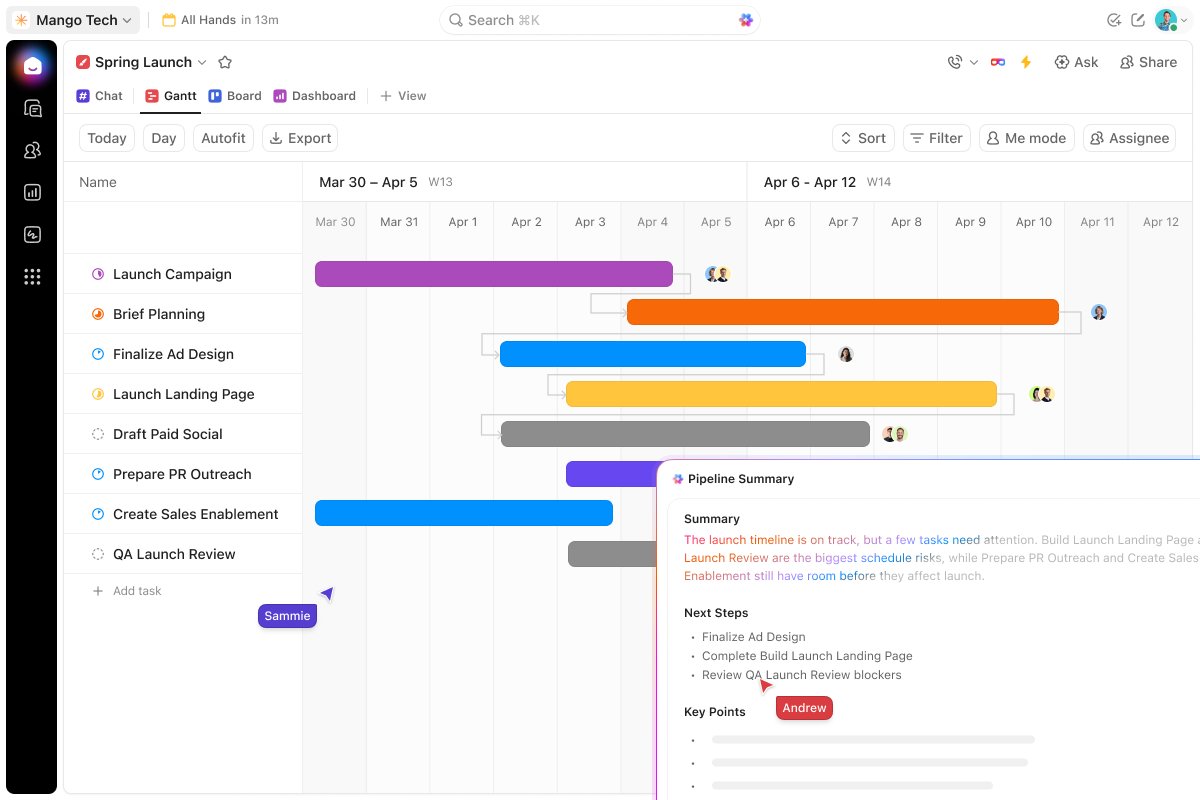
ClickUp earns the top spot because it maintains a schedule that automatically recalculates as work changes. It’s a full AI-powered work and project timeline software with a built-in scheduling engine. Meaning the timeline here sits next to the tasks it tracks. And it puts dependencies, drag-to-reschedule, and a live critical path.
If you’re a team of 5 to 200+ who plan work in parallel (project managers, marketing leads, and IT teams) with several projects under your hood, then this one’s for you. The ClickUp Gantt View handles all four dependency types (finish-to-start, start-to-start, finish-to-finish, start-to-finish). Plus, with Reschedule Dependencies on, one dragged date ripples down the whole chain.
Critical Path highlights the tasks that push your finish date, and Slack Time shows where you still have buffer. You also get a dedicated Timeline view plus more than 15 views in total, so the same work reads as a calendar, board, or list whenever the project calls for it.
All of this connects to ClickUp Brain, the native AI layer, which reads the Gantt directly, so a quick question comes back answered from the live plan. ClickUp Super Agents further watch the timeline, flag a task the moment it slips, nudge the owner, and draft the update while the change is fresh.
A G2 reviewer pointed to the timeline as a standout:
I use ClickUp for work with my colleague, and I find it really easy to use. It centralizes our tasks and allows us to give each other directions via chats while keeping track of how many tasks we did and with whom. My favorite features are the calendar and timeline. The initial setup was quite easy too.
Where it taps out: The depth that helps a cross-team plan is more than you need if you’re a solo user with a short list. And there’s a broad feature set that takes a little longer than a lighter tool would. Also, the free plan includes limited usage of Gantt and Timeline views; heavy users of these features may need to upgrade.
Best for: Teams who want a timeline they can trust, plus the rest of their work (tasks, docs, dashboards) in one place, starting free.
Skip it if: You just want a single-purpose Gantt tool and will never touch the workspace around it.
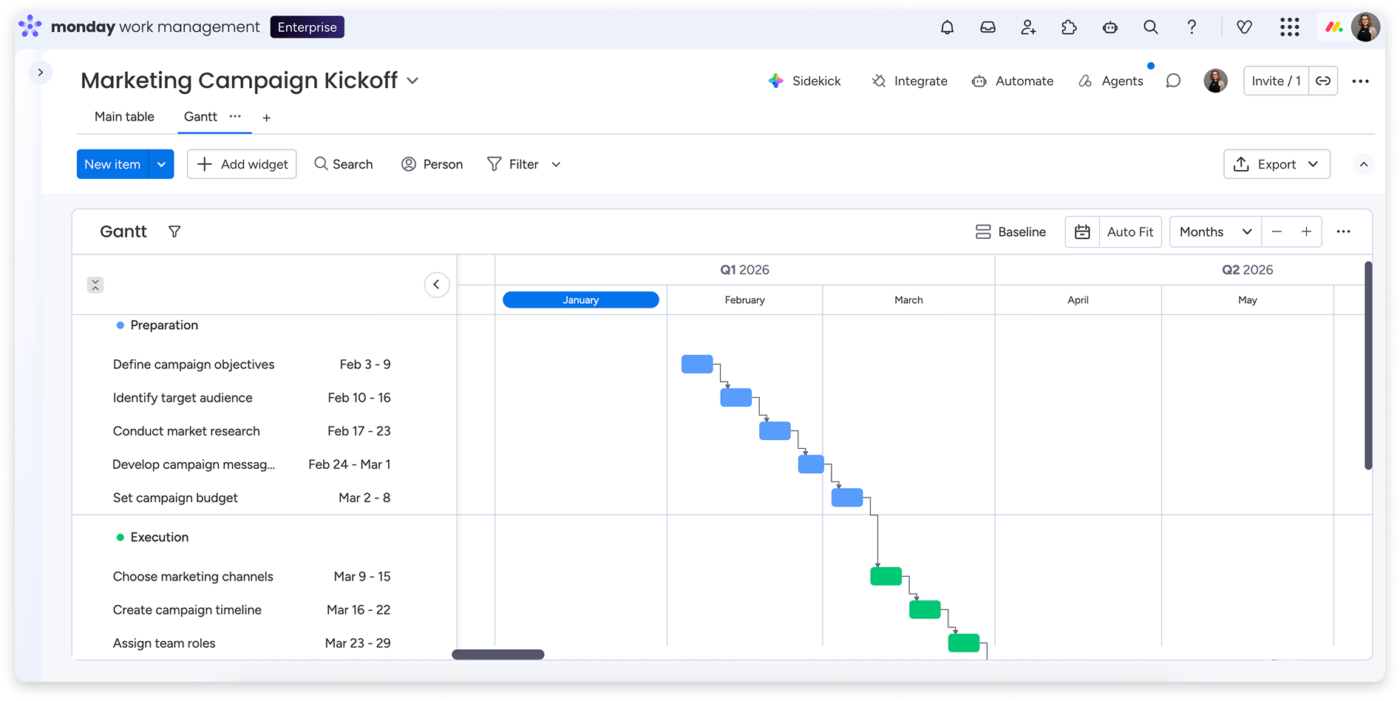
When I tried monday.com, what stood out was that it builds the timeline from the board outward. I set work up as colorful items first, then flipped them into a Timeline or Gantt view. Halfway through, scheduling started to feel more like arranging blocks than a project grid. If your team thinks visually, this would be a great match. I’d point operations, marketing, and creative teams of roughly 5 to 100 here first.
Once I set dependencies in the Gantt view, it handled the chain properly, including lead and lag times. Critical path is available too, currently as an open trial feature rather than a settled part of any plan. Meaning monday flags that it may become paid later and hasn’t said which tiers will include it.
The AI is where monday has moved fast, and I felt it. Its Sidekick assistant reads across boards and docs to draft content and answer questions. And with Agent Factory, you can spin up AI agents (monday calls it a “digital workforce”) that monitor a board and execute routine steps on their own. In practice, it leans toward suggesting tasks and automating updates rather than reading the critical path for risk, the way I’d want in a pure scheduler. But, again, for a board-first team, it fits the workflow naturally.
A G2 reviewer pointed to the timeline and scheduling as the draw:
I like that monday Work Management is constantly evolving to address project management needs. I use features like timeline overviews, budget reporting, and scheduling, which help track budgets versus actual costs from pipeline to post-production all in the same board.
Where it taps out: Its timeline is excellent for visualizing a schedule, but lighter on the deeper scheduling analytics some project managers expect.
Best for: Visual teams on Standard or above who want an attractive, collaborative timeline.
Skip it if: You need critical path analysis you can count on long-term, since monday’s is still a trial feature that may change or move behind a paywall.
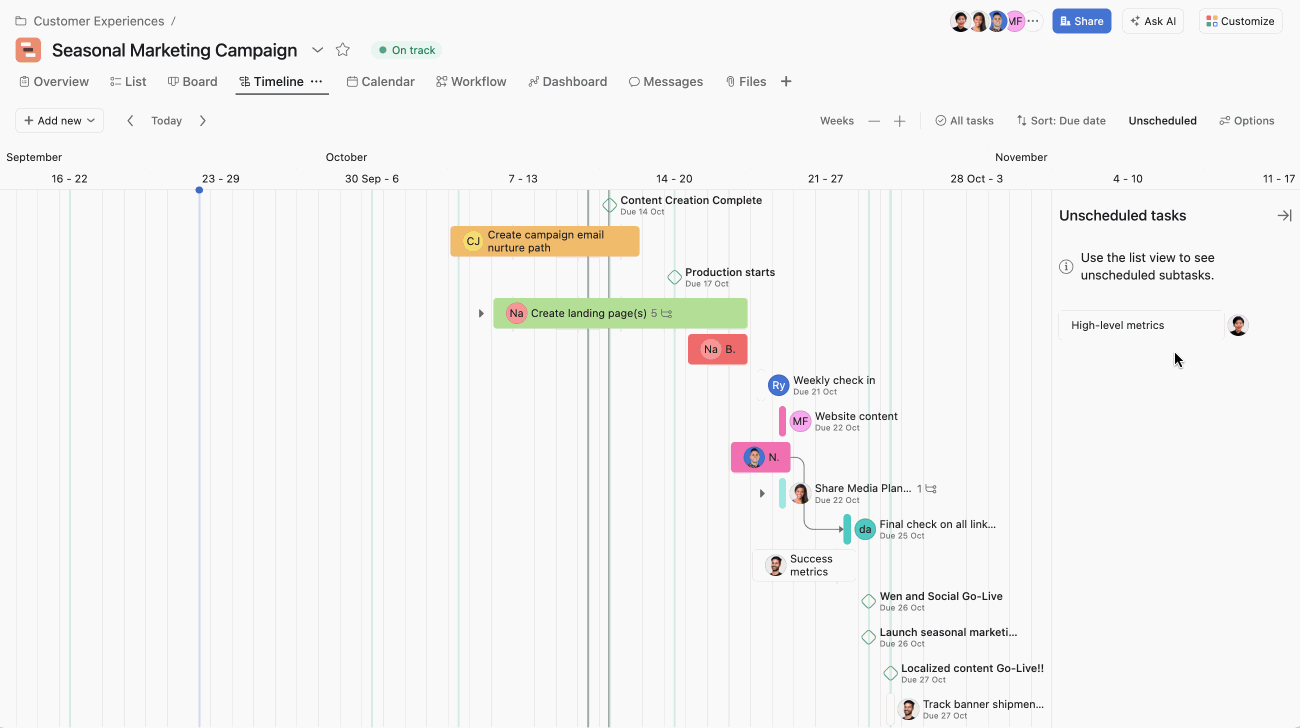
The polish is what separates Asana from many other tools. Its Timeline and Gantt views map dependencies, durations, and phases. If you’ve got a cross-functional team of roughly 5 to 50 already using Asana, this would be your perfect match.
Dragging a connector between two tasks sets a dependency, and I can pick the type from a dropdown or chain an entire sequence in bulk by multi-selecting. Auto-scheduling saved me real setup time: new tasks land on consecutive dates instead of stacking on day one. I also color-coded the bars by a custom field, so at a glance I could see which team owned what and where the high-priority work sat.
Asana also supports the critical path, so you can see which tasks drive the finish date. Baselines let me snapshot the original plan and lay it over live progress, with the hashed bars showing where the project drifted. All of it needs a paid plan, though.
I also tested out the AI. Asana AI drafted my project status updates and summarized progress and risks straight from the timeline and task activity, which pulled real weight off my reporting. AI Studio builds no-code workflows, and AI Teammates are prebuilt agents that sit inside your projects to handle intake, routing, and follow-ups. If you spend half your week chasing status, I think that layer pays for itself.
A G2 reviewer pointed to the timeline and dependencies for staying ahead of delays:
I like how Asana keeps projects organized without feeling overwhelming. The timeline and task dependency features make it easy to see what needs to happen next and where delays might impact the team. I also appreciate being able to assign priorities, add comments directly within tasks, and keep all updates in one place instead of scattered across emails or chats.
Where it taps out: The scheduling I actually wanted lives behind the paywall. The free plan has no Timeline at all, so any real timeline work means paying.
Best for: Collaborative teams already standardized on Asana and ready to move onto a paid plan.
Skip it if: You need a free timeline, or you want a formal, highlighted critical path.
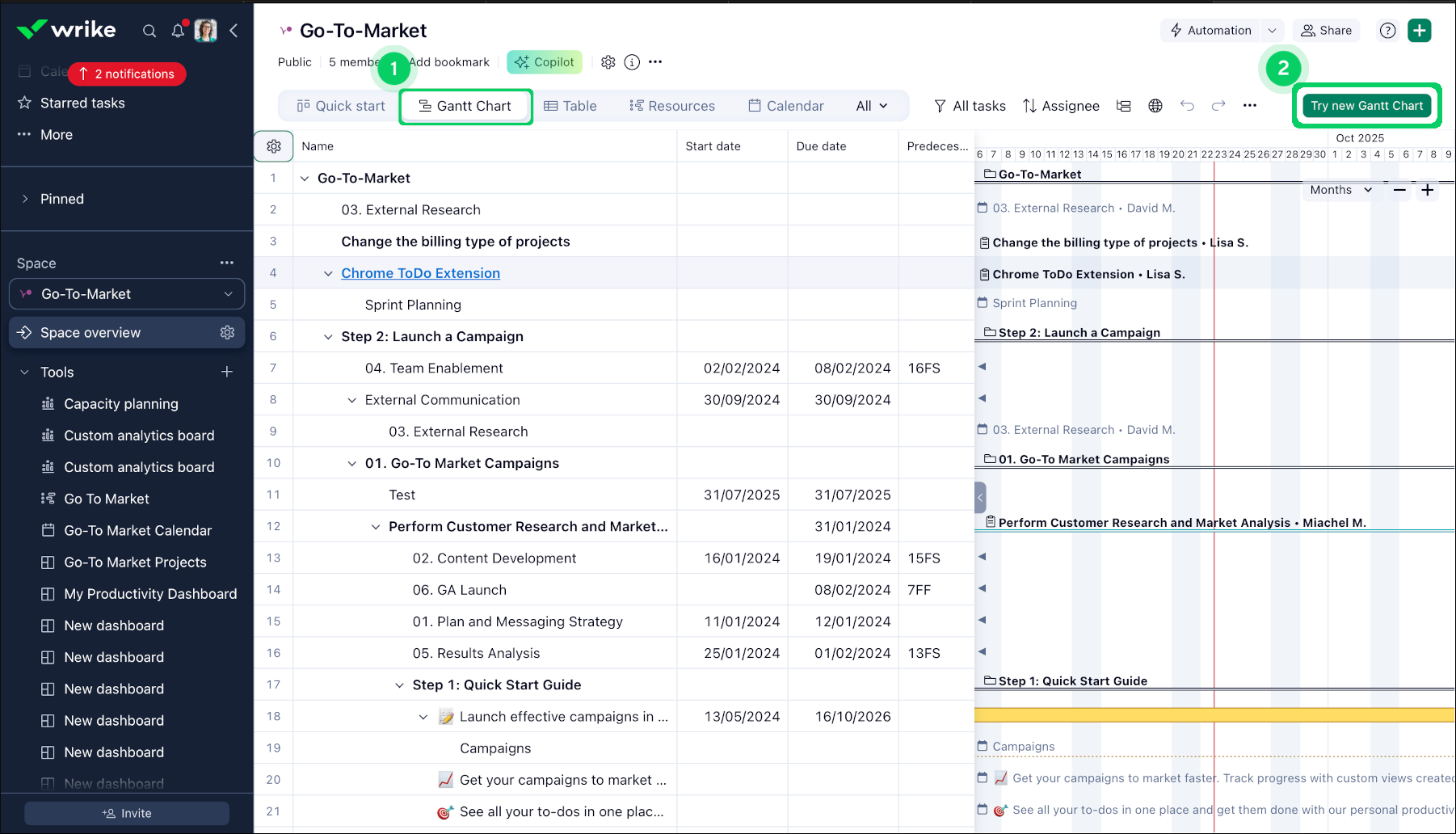
Wrike is great for managing several projects simultaneously across a large organization. When I loaded up parallel workstreams, its Gantt chart kept them all readable on one screen. Large teams, agencies, and enterprise operations groups are the natural fit, and the top tiers add the resource planning and governance a PMO needs.
Where Wrike pulls ahead is in sharing and reporting at scale. Public Snapshots let me hand a client a read-only, watermarked Gantt through a link, no login, and an expiry date I set. Real-time dashboards roll up status across every project, so a program lead can see the whole portfolio without pinging anyone.
The scheduling supports all four dependency types with lead and lag times, a critical path that now spans up to 50 projects in a single view, and stacked baselines with color-coded variance.
Wrike Copilot answers questions about project status in seconds, and its AI Agents watch the work, flag tasks heading for delay based on dependency chains and workload, then take action. The agents sit on the Business plan and up.
A G2 reviewer pointed to the Gantt chart as a favorite:
Keeping track and recording assigned tasks on Wrike is much easier than with other tools. I especially like the Gantt chart and the task re-occurrence features the most.
Where it taps out: The structure that carries a large operation is more than a small team needs, and that depth carries a real setup cost. The pricing cliff between Team and Business also kicks in the moment you hit 15 users.
Best for: Enterprise portfolios and cross-team programs that need real-time status against a baseline.
Skip it if: You’re scheduling a single small project and don’t need portfolio-level structure.
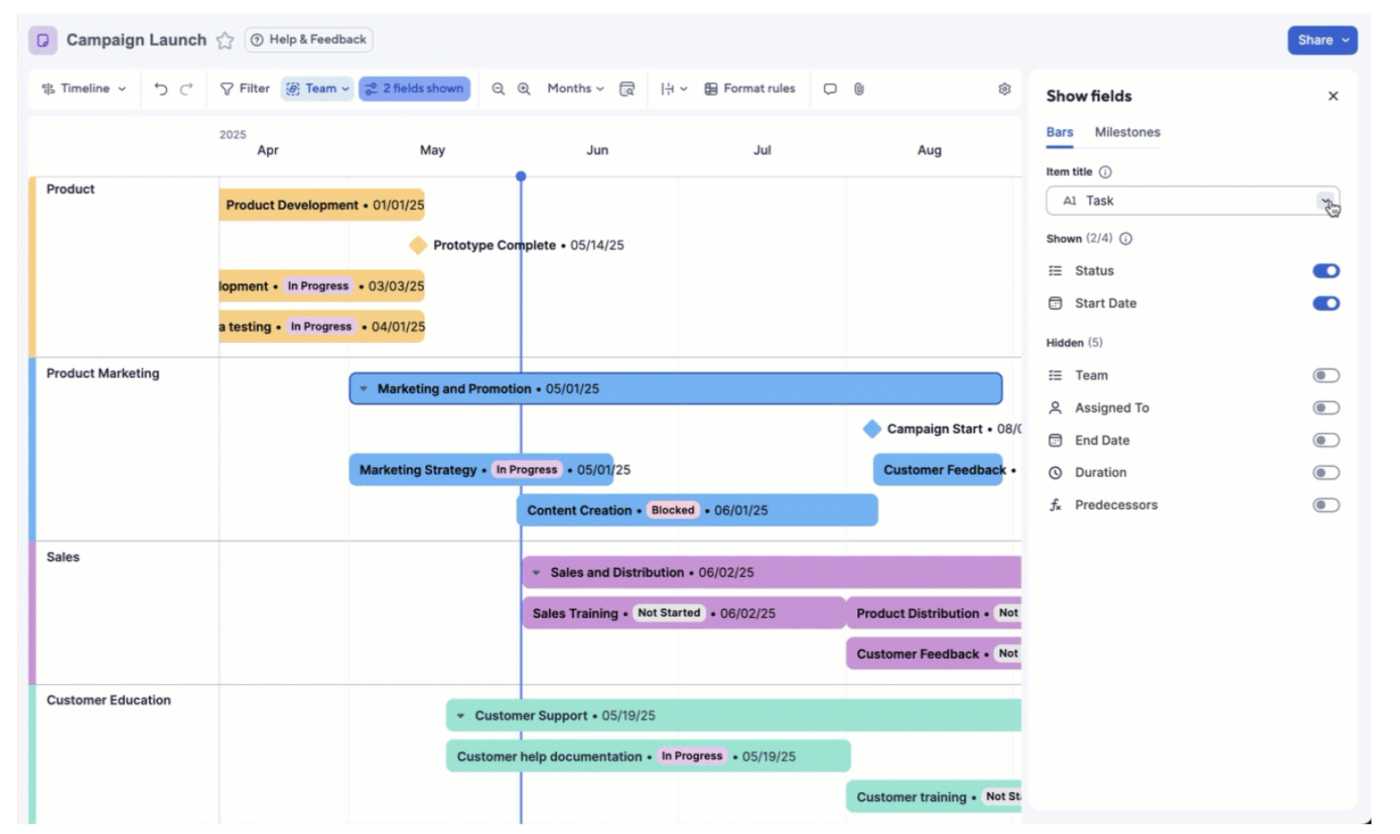
If your team already lives in spreadsheets, Smartsheet is the timeline tool that asks the least of you. It runs scheduling on a grid of rows and columns. Managers and PMOs of 10 or more who want Gantt and portfolio views layered on that grid are a good fit.
The scheduling sits right on top of the grid. Flip a sheet into Gantt view, set predecessor columns, and it calculates dependencies. Plus, it also adjusts dates down the chain when one moves, highlights the critical path, and tracks a baseline against your live dates. Because everything is a column, I could drive dates and durations with formulas the way I would in a spreadsheet, which is the whole appeal.
The AI plays to that grid identity. Smart Columns run translation, summarization, and sentiment analysis across a sheet as the data changes. Smart Assist answers questions about a sheet, surfaces what’s at risk, and drafts a stakeholder update in seconds.
Smartsheet also lets you connect to external models like Claude, Copilot, or Gemini through its MCP server, so a team can bring in the AI it already uses.
A G2 reviewer pointed to the spreadsheet feel and dependency tracking:
I like how Smartsheet keeps the familiar spreadsheet feel of Excel while adding real-time collaboration, automated workflows, and built-in reporting. It’s been especially useful for tracking multi-site projects, managing dependencies, and sharing live status updates with clients and contractors, without the hassle of constant file exchanges.
Where it taps out: The grid-and-formula model is powerful, but it carries a learning curve, especially for anyone who expected a lighter visual planner. Setup is more involved than a drag-and-drop timeline.
Best for: Spreadsheet-native teams and PMOs managing structured, schedule-driven portfolios.
Skip it if: You want a lightweight visual timeline with minimal or flexible configuration.
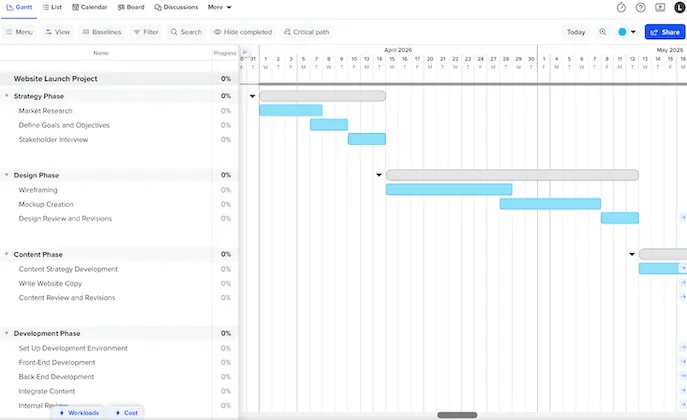
TeamGantt does one thing well: online Gantt charts for planning and tracking a schedule. There’s no sprawling platform wrapped around it, which is exactly why planners who want a timeline and nothing else reach for it. Small teams and project planners who value speed and clarity are a good fit.
Building a schedule is fast, too. Drag tasks into place, link them to manage handoffs and phases, and, on the Business tier, the critical path recalculates automatically whenever dates or dependencies change. The same schedule shows up as a Gantt, list, board, or calendar, all synced, with baselines and progress tracking alongside.
In terms of the pricing model, you pay per project rather than per seat, and public share links drop clients straight into the plan. The Business plan allows unlimited managers and collaborators, but Basic caps you at one manager and ten collaborators. Either way, it’s the rare planning tool a non-PM can pick up in an afternoon.
TeamGantt’s free AI Gantt Chart Maker spins up a starting timeline you can then manage as a real project, so you skip the blank canvas setup.
A G2 reviewer pointed to the drag-and-drop scheduling and easy setup:
I really like that TeamGantt offers an intuitive drag-and-drop Gantt chart interface, making project scheduling and timeline adjustments super easy. It also enables seamless team collaboration with task assignments, file sharing, and real-time progress tracking. The initial setup was very easy, not painful at all.
Where it taps out: It’s lighter on the broader PM features (reporting depth, integrations, business workflows) that sit outside core timeline planning. And the critical path sitting behind Business means the cheapest paid tier won’t give you a true scheduling readout.
Best for: Planners who want a clean, dedicated Gantt and nothing extra to maintain.
Skip it if: You need a full work platform around the timeline.
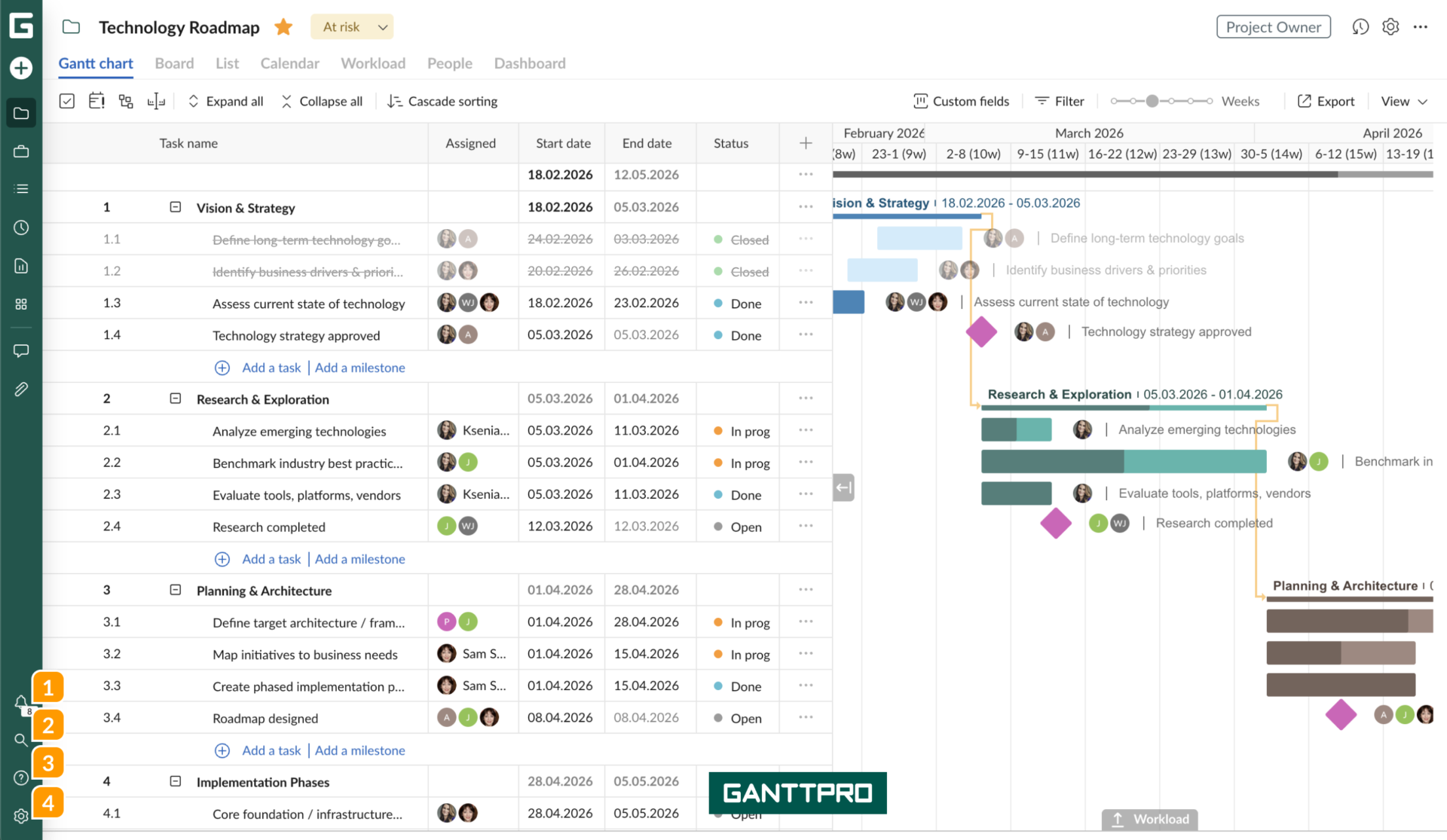
GanttPRO is built around professional scheduling, and it suits managers who want to plan tasks, set dependencies and milestones, and manage resources in one focused tool. The learning curve is gentle enough that people newer to formal scheduling can get going quickly. Project managers and planners who want Gantt-first planning are the fit.
Where it earns attention is in migration and speed. It imports projects from Excel, MS Project, and Jira, so moving off a spreadsheet takes minutes. And the pre-made templates give you a running start, too.
The scheduling itself covers the essentials well: task dependencies, milestones, auto-scheduling, critical path, and baselines. Workload and resource management sit on the Business tier for teams that need to balance who’s doing what.
GanttPRO’s AI Gantt Chart Maker turns a plain description into a structured timeline in seconds, so you don’t struggle with a blank chart. It’s built to speed up planning rather than to run risk analysis across your schedule, which fits a tool this focused.
A G2 reviewer pointed to the visual timeline and dependency tracking:
What I like best about GanttPRO is its intuitive interface and clear visual project timelines. The Gantt chart layout makes it easy to organize tasks, set dependencies and track progress in a structured way. I also appreciate how simple it is to assign tasks and manage deadlines, which helps keep projects well organized and easy to follow.
Where it taps out: It’s a scheduling tool, not an end-to-end execution platform, so the work, docs, and conversations that surround a plan live elsewhere. Teams wanting a single tool for scheduling and delivery will feel that gap.
Best for: Managers who want Gantt-first planning with easy import from Excel or MS Project.
Skip it if: You want one platform for scheduling and execution in the same place.
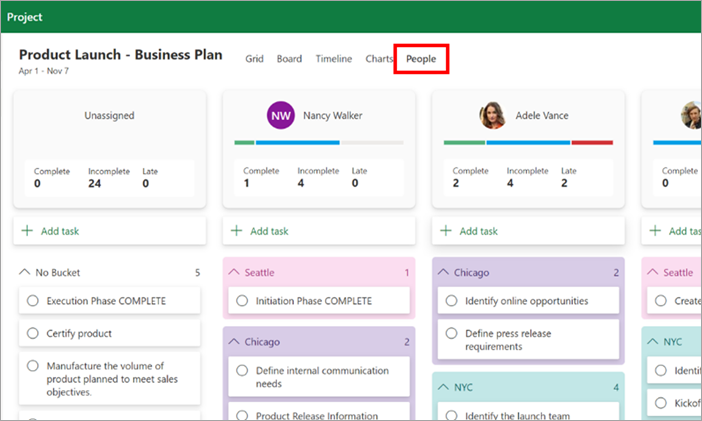
Microsoft Project is the long-standing classic for formal scheduling, with Gantt charts, task dependencies, critical path analysis, and resource management built in. It’s the natural fit for larger organizations already invested in Microsoft 365 that want their scheduler inside that ecosystem. Program managers and PMOs in enterprise settings are the audience.
It handles dependencies and the critical path natively and produces detailed reports on progress, resource usage, and timeline performance. The real depth (advanced dependencies, baselines, and critical path) starts at Plan 3, while the cheaper Plan 1 is closer to lightweight task tracking.
The AI arrives via Microsoft Copilot, so you don’t need a separate scheduling assistant. Copilot inside Project can generate a task plan, assess schedule risk, and draft status reports. The newer Copilot Cowork can build a full Gantt (owners, dates, work tracks) from something as loose as meeting notes. For a team already living in Microsoft 365, that intelligence lands where they already work.
Perpetual desktop licenses (one-time):
A G2 reviewer pointed to its portfolio and Gantt depth inside the Microsoft stack:
The ability to manage projects (primarily portfolios, resources, and costs), generate Gantt charts, assign programmers to projects, along with the native integration with other Microsoft tools is great (Power BI). Additionally, I can group several municipal Smart Cities initiatives into a single unified vision.
Where it taps out: Project is powerful but can be complex, and the interface is heavier than occasional planners need. It’s a little expensive for small teams and carries licensing weight as you add users. The real scheduling also lives on Plan 3 and up.
Best for: Enterprises in the Microsoft stack with formal scheduling needs.
Skip it if: You want something approachable that a non-specialist can pick up quickly.
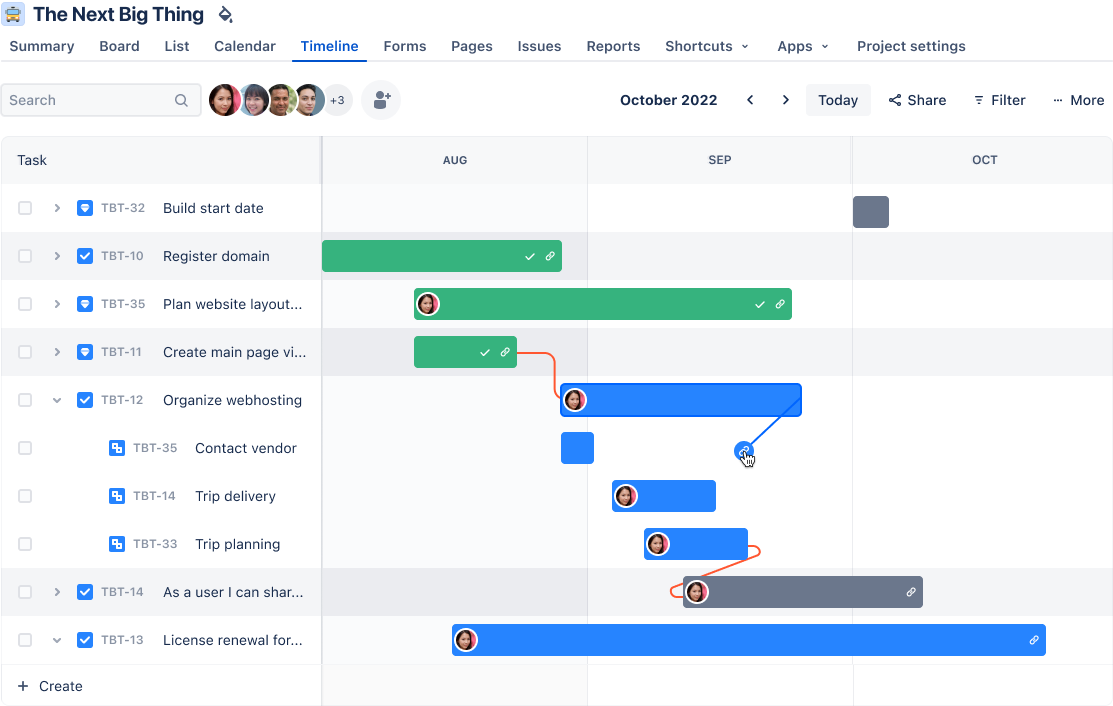
Jira anchors this list for engineering teams because its timeline ties directly to sprints, issues, and epics. Software teams and agile shops of any size already running on Jira are a natural fit.
Its timeline and Plans visualize epics and dependencies across sprints, and it supports all four dependency types within a dev-centric workflow. For a team whose “project” is a product backlog, that tie between the schedule and the actual issues being built is the whole point. Where it’s less natural is anything outside that model: the schedule speaks in epics and stories, not classic Gantt bars.
The AI is where Jira has moved fast. Atlassian’s Rovo agents are now generally available in Jira: you can assign work items to them, @mention them in comments, and embed them in workflow statuses so they trigger automatically as work progresses. You can even bring in third-party agents like GitHub Copilot or Cursor, which fits a tool built around the software-delivery lifecycle. Every agent action is logged with an audit trail, so a lead stays in control.
A G2 reviewer pointed to tracking project progress on the timeline:
I like almost everything about Jira. I find the flexible workflows very appealing because we can design our own workflows easily as per our needs. The clear and transparent picture of project progress is helpful as project progress can be easily tracked with a timeline and the stage of completion with reports. Bug tracking and handling are simple since bug logging is straightforward, and it gets assigned to the responsible team member. Overall, it’s simple to use.
Where it taps out: Jira is built around software development, so non-technical teams often find its model heavier than their work requires. If your projects aren’t software delivery, the sprint-and-issue framing gets in the way.
Best for: Engineering teams that want timelines tied to their existing Jira workflow.
Skip it if: Your projects aren’t software delivery.
Start with how your team plans work today. The best project timeline software is not always the tool with the most views, dashboards, or AI features. It is the tool that matches your work without making the team update the same plan twice.
Three questions do most of the sorting.
How often do your dates move? If the answer is “constantly,” dependencies, auto-rescheduling, and baseline tracking stop being nice-to-haves; they’re the whole point.
Where does your team already live? A board-first team, a spreadsheet team, and an engineering team will each fight a tool built for one of the others.
How much platform do you actually want? More views and dashboards aren’t better if you’ll never open them; a focused Gantt beats a suite you half-use.
One more fork before you shortlist: some people don’t need a platform at all, just a timeline they can build fast and share. If that’s you, a full PM tool is overkill. A free Gantt chart maker or timeline maker lets you sketch tasks, set dependencies, and export to PNG or CSV in the browser, no signup.
Excel and Google Sheets can do a static timeline too, but they don’t recalculate: move one task, and you’re fixing every downstream date by hand. And PowerPoint (or an add-in like Office Timeline) is for presenting a plan to leadership, not running it. The rule: build and manage the schedule in real software, then export a snapshot when you need a slide.
Use this quick filter before you build your shortlist:
| If… | Best-fit tools |
|---|---|
| You want one place for tasks, timelines, docs, dashboards, and AI | ClickUp |
| Your team plans best from visual boards | monday.com, Asana |
| You manage large programs or client-facing work | Wrike, Microsoft Project |
| Your team already runs projects in spreadsheets | Smartsheet |
| You want a focused Gantt tool, not a full work platform | TeamGantt, GanttPRO |
| Your timeline is tied to software delivery | Jira |
| You just need to build a simple, static timeline to show stakeholders | Excel or Google Sheets |
A timeline view and a Gantt chart are like cousins wearing the same shirt, but they do not do the same job. A timeline view plots tasks on a calendar by start and end date. It gives teams a visual way to see what happens when. A Gantt chart further connects tasks through dependencies, shows how delays affect later work, and may highlight the critical path.
| Aspect | Timeline view | Gantt chart | Why it matters |
|---|---|---|---|
| Basic function | Shows tasks across a calendar using start and end dates | Shows tasks across time, plus the relationships between them | A timeline helps you see the plan. A Gantt chart helps you manage the schedule |
| Task relationships | Usually shows tasks as separate bars | Connects tasks with dependencies, such as finish-to-start or start-to-start | This shows which task blocks another task from starting or finishing |
| Scheduling power | Often requires manual updates when dates change | Can shift downstream tasks when an earlier dependent task moves | This is what separates a visual timeline from a real scheduling tool |
| Critical path | Usually absent | Often highlights the chain of tasks that directly affects the project deadline | Teams can see which delays will actually push the whole project back |
| Best use case | Simple projects, campaign calendars, content plans, launch checklists, and lightweight task planning | Complex projects with dependencies, handoffs, resource constraints, and strict deadlines | Buying the wrong one creates manual work later |
| Common setup issue | A task may need both a start date and a due date to appear as a bar | Dependencies often need dated tasks to calculate schedule changes | Undated dependent tasks may sit in the sidebar or fail to move when dates change |
Many tools market any horizontal date-based view as a Gantt chart. But without dependency management, automatic rescheduling, and critical path visibility, it is closer to a visual calendar than a true scheduling engine.
Run this test before you buy. Build a sample project with 20 tasks, add five dependencies, then push one early task back by three days. If the dependent tasks move with it and the affected path becomes clear, the tool supports real schedule planning. If you have to drag every later task by hand, the Gantt view will likely create more manual work as the project grows.
One setup detail also catches teams early. In many tools, a task needs both a start date and a due date to appear as a timeline bar. A task with only a due date may sit in the sidebar instead of showing on the chart.
Dependencies can behave the same way. Some tools only shift dates that already exist. If your dependent tasks have no start or end dates, the chain may not move until all tasks have valid start or end dates.
Here’s a quick video roundup of the best Gantt tools (some of which are explored above in this blog post) and how they stack up:
Pick the format based on the question your project plan needs to answer.
| Format | Best for | What it answers | Use it when |
|---|---|---|---|
| Timeline | Simple date-based planning | What happens when? | You need to show launches, content plans, events, or project phases in order. |
| Gantt chart | Schedule management | What moves if one task slips? | Your tasks have dependencies, milestones, owners, and deadlines that affect each other. |
| Roadmap | Strategic planning | Where are we headed? | You need to show goals, phases, releases, or priorities without listing every task. |
| PERT chart | Early planning and uncertainty | What depends on what? | You need to map task relationships, estimate paths, and spot risk before locking dates. |
The simple rule: use a timeline to show sequence, a Gantt chart to manage the schedule, a roadmap to align strategy, and a PERT chart to shape the plan before execution starts.
Building a project timeline involves five steps: list work, estimate durations, map dependencies, schedule tasks, and set milestones and baseline to track progress. The process is the same whether using software or a spreadsheet.
The tool you use changes how much of this work stays manual.
Excel and Google Sheets can create a project timeline, but you still need to maintain the dates yourself. Move one early task, and the later tasks will not shift unless you update them by hand. PowerPoint and Word work better for static timelines you need to present, not timelines you plan to manage every week.
Dedicated project timeline software is different because it keeps dependencies live. When one task moves, the rest of the schedule can move with it.
After testing all nine, I’ll be honest: the choice can start to blur. They all demo well, they all show pretty bars, and on the surface, they start to look interchangeable.
Cut through it with three checks. Run the buyer test from earlier on your shortlist. See where the critical path actually unlocks, since nearly every tool gates it a tier or two up. And think about how your team already works, because a spreadsheet crowd and an engineering team don’t want the same tool.
If you want a place to start, start with ClickUp. The timeline or Gantt you build stays anchored to the tasks, docs, and dashboards around it, with native AI and automation in the same workspace.
Get started with ClickUp for free.
Most paid plans run $7 to $25 per user per month, billed annually. Entry tiers start around ClickUp $7, monday.com $9, Wrike $10, and Asana $10.99 per user per month; TeamGantt bills per project from $240/year. The feature you actually want (critical path, baselines) usually sits one or two tiers above entry, so price the plan that unlocks it, not the headline.
Project timeline software focuses on scheduling: mapping tasks, durations, dependencies, and milestones across dates. Project management software is broader, adding task boards, docs, workloads, and reporting around that schedule. Platforms like ClickUp, monday.com, and Wrike do both, while dedicated tools like TeamGantt and GanttPRO handle timelines alone. Pick the platform when more than one team touches the plan.
You may not need project timeline software if your project has a few tasks, no real dependencies, one owner, and a deadline that does not move. A shared spreadsheet, calendar, or simple Kanban board may be enough. Timeline software becomes worth it when delays cascade, several people own work, stakeholders need visibility, or the plan changes often.
Yes, but read the fine print, because most tools reserve the real scheduling for paid tiers. ClickUp’s free plan includes task dependencies and critical path, with capped use of the Timeline and Gantt views. Asana’s free plan has no Timeline view at all, and some “free” Gantt tools cap projects or users. Confirm the specific feature you need is free, not just the account.
Yes, but with different catches. monday.com’s critical path is currently an open trial feature, not tied to a specific plan, and monday notes it may move behind a paywall later. Asana gates the critical path behind its Advanced plan and up. On both, the Gantt view that the critical path depends on already requires a paid tier, so budget for a mid-tier plan and confirm the feature is live before you commit.
Yes. Excel can build a timeline using a stacked bar chart or a Gantt template, and it’s free if you already have Microsoft 365. The catch is that Excel timelines are static: move one task, and dependent tasks won’t shift unless you re-edit every date by hand. It works for a one-off visual or a small fixed plan, not for schedules with dependencies or moving deadlines.
AI reads the schedule to flag at-risk tasks, predict slippage before it cascades, and draft status updates without a meeting. Newer agents go further, watching the timeline and acting on it. Quality varies widely between tools, so treat AI forecasting as a tiebreaker on top of solid dependency handling, not a replacement for it.

Arya P Dinesh
Max 16min read

Praburam Srinivasan
Max 25min read

Manasi Nair
Max 27min read

© 2026 ClickUp




