






Still downloading templates?
There’s an easier way. Try a free AI Agent in ClickUp that actually does the work for you—set up in minutes, save hours every week.
Sorry, there were no results found for “”
Sorry, there were no results found for “”
Sorry, there were no results found for “”
In late 2025, a coalition led by former U.S. Vice President Al Gore launched a powerful new AI-driven global pollution tracking system.
🏭 Climate TRACE fuses data from 300 satellites and 30,000 ground sensors to pinpoint over 137,000 pollution sources in thousands of cities worldwide. It updates daily and identifies the sources of emissions in near real time.
For air quality analysts and environmental compliance teams, this was a breakthrough moment. What once took months of sampling, audits, and manual reconciliation now happens continuously. AI doesn’t just show that air quality worsened—it reveals where, when, and likely why, while conditions are still unfolding.
This is the real promise of AI for environmental monitoring. Not abstract climate models or one-off dashboards, but systems that transform fragmented environmental data into timely, decision-ready intelligence.
And in this blog post, we’ll explore this promise and how you can benefit from it, too.
AI for environmental monitoring uses machine learning to turn continuous streams of environmental data into actionable insights. Not reports weeks later. Not static dashboards. Insight that updates as conditions change.
These systems collect data from environmental sensors, satellites, drones, and IoT devices. They track air quality, water chemistry, land use, biodiversity, and climate signals at a scale no human team could manage alone. Machine learning models then analyze this data to detect patterns, flag anomalies, and surface risks that would otherwise stay hidden.
Because environmental data is messy and fragmented. Weather stations, satellite feeds, field surveys, industrial sensors, and lab results all live in different systems, arrive at different speeds, and follow different formats. Without AI, teams spend more time battling Work Sprawl and stitching data together than responding to what it reveals.
The result? Critical context gets lost. Decisions get delayed.
| Aspect | Traditional monitoring | AI monitoring |
|---|---|---|
| Data collection | Periodic sampling | Continuous streams |
| Analysis speed | Days to weeks | Real-time |
| Response type | Reactive | Predictive |
| Scalability | Limited by staff | Scales with data |
⚠️ Manual monitoring creates dangerous blind spots. You can’t process satellite imagery fast enough to catch illegal deforestation. Your sensor networks generate more data than your analysts can possibly review. By the time a pattern emerges, the environmental damage has already been done.
✅ AI continuously ingests time-series and geospatial data. It correlates signals across sources and learns what “normal” looks like for a specific environment. When conditions shift—pollution spikes, ecosystems degrade, or thresholds are crossed—teams are alerted early, while there’s still time to act.
📮 ClickUp Insight: While 35% of our survey respondents use AI for basic tasks, advanced capabilities like automation (12%) and optimization (10%) still feel out of reach for many.
Most teams feel stuck at the “AI starter level” because their apps only handle surface-level tasks. One tool generates copy, another suggests task assignments, a third summarizes notes—but none of them share context or work together.
When AI operates in isolated pockets like this, it produces outputs, but not outcomes. That’s why unified workflows matter.
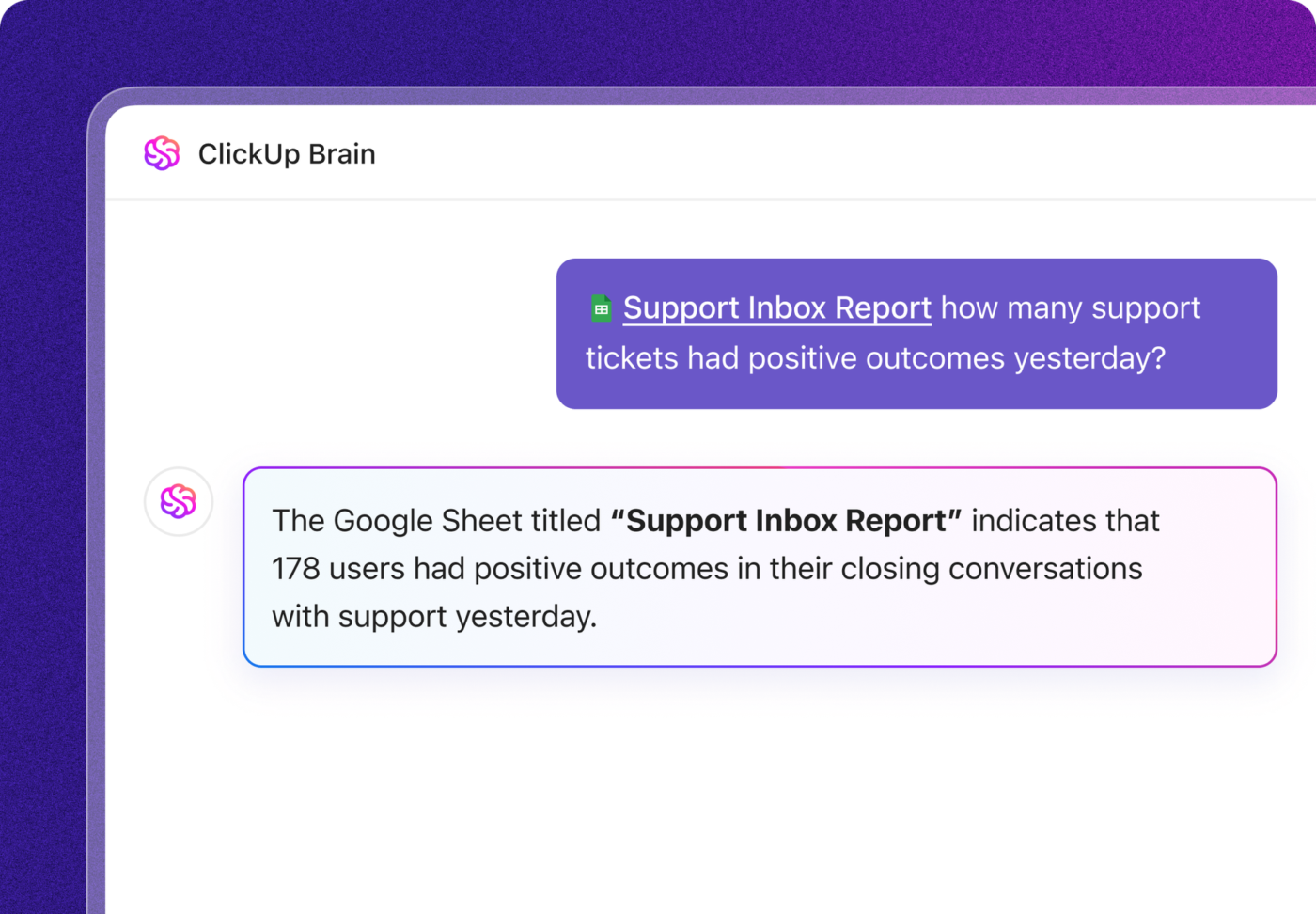
ClickUp Brain changes that by tapping into your tasks, content, and process context—helping you execute advanced automation and agentic workflows effortlessly, via smart, built-in intelligence. It’s AI that understands your work, not just your prompts.
Having data means nothing if you can’t act on it fast enough or see what’s coming. The lag between data collection and insight makes monitoring feel like you’re always one step behind. You’re stuck in a cycle of expensive cleanup, compliance fines, and damage control. AI speeds up your existing processes by shifting your team from reactive cleanup to proactive prevention. ✨
Here are the top benefits of using AI for environmental monitoring:
Environmental conditions can change in an hour. A pollution spike happens overnight, but traditional weekly sampling misses it entirely. Your team finds out days later. This delay means you’re always responding to a crisis that has already unfolded, making it impossible to get ahead.
AI-powered systems process data continuously from IoT sensors and satellite feeds. When air quality drops or water contamination appears, you know immediately.
Here’s how that looks:
This immediate detection enables an immediate response, reducing environmental damage and helping you avoid costly compliance violations.
📌 Real-world example: Early wildfire detection 🔥
Breeze Technologies has developed air quality sensors for forests that can detect wildfires up to 60 kilometers away. Advanced algorithms and AI analytics help differentiate wildfire emissions from other sources, such as industry and traffic.
The most surprising part? The average time-to-detection is as fast as five minutes, especially for fires in close proximity. This means that the sensors can alert response teams and authorities within minutes, long before traditional visual or manual monitoring would register an event.
Reacting to environmental problems after they occur is expensive and often too late. Think about it. What do you do when contaminated water has already spread downstream? When a wildfire has already started to burn out of control? And an endangered species has already migrated from a degraded habitat?
AI models can analyze historical data alongside real-time inputs to forecast future conditions. With AI, you get to prepare for floods, predict erosion patterns, and identify high-risk areas for forest fires before they even ignite.
Why does this matter? It’s obvious: Prevention costs a fraction of remediation. Predictive AI models transform your environmental team from reactive responders into proactive planners.
📌 Real-world example: Predicting extreme weather events ⛈️
DeepMind’s GenCast model predicts weather and extreme-condition risks up to 15 days in advance. Its forecasts outperform traditional models, giving agencies more accurate and earlier warnings. These AI-driven predictions are now being integrated into national forecasting systems, including the UK Flood Forecasting Centre, to strengthen flood preparedness and emergency planning.
Manual data analysis isn’t only slow but also prone to human error. Reviewing thousands of satellite images makes it easy to miss subtle shifts in land use. Sensor calibration issues can linger undetected, quietly degrading data quality. And even experienced analysts are vulnerable to fatigue, increasing the risk that early warning signals slip through unnoticed.
AI processes data at scale with unwavering accuracy. Computer vision can detect deforestation changes that a human reviewer might miss. Algorithms can automatically flag sensor malfunctions, allowing them to be fixed immediately. This frees up your team to focus on high-impact decision-making and response rather than tedious data processing.
📌 Real-world example: Monitoring marine wildlife for faster conservation decisions 🐳
Monitoring marine wildlife at scale has always been slow and labor-intensive.
To change that, the NOAA Geospatial Artificial Intelligence for Animals (GAIA) initiative uses machine learning to analyze very-high-resolution satellite imagery. The models automatically flag locations for whales and other marine species across vast ocean areas. What once took months of human review now runs through automated detection pipelines, enabling more timely conservation decisions.
Traditional monitoring approaches simply don’t scale without proportional increases in staff.
AI systems, however, scale horizontally. You can add new sensor networks or expand your geographic coverage without hiring more analysts.
📌 For instance, adding hundreds of additional river sensors or expanding satellite tasking to new regions does not require hiring hundreds more analysts. Models and pipelines handle the extra load.
🌍 Over 2.5 quintillion bytes of data are created every day, yet most IoT and sensor data streams remain largely unprocessed until AI systems automate them.
AI environmental monitoring isn’t a single technology. It’s a stack of interconnected systems working together. 🛠️
Machine learning algorithms are what allow AI to identify patterns in environmental data that would take a human analyst months to discover. These models can process unstructured data like images and audio to forecast future conditions based on historical patterns.
📌 Example: A model trained on years of water quality data can learn which combinations of temperature, pH, and chemical levels precede algal blooms. It can then flag at-risk water bodies before a bloom ever occurs, and it gets more accurate with each new data point it processes.
Here are some key techniques:
📚 Also Read: Supervised vs. Unsupervised Machine Learning
You can think of Internet of Things (IoT) sensors as the eyes and ears on the ground. They continuously collect data from the environment. It could be air quality, water chemistry, soil moisture, noise levels, temperature, and other parameters. Then, they transmit it to central systems for AI processing.
Sensor networks can create a mesh of coverage across large areas. And you’ve also got low-power devices that can be deployed in remote locations without access to a power grid.
Without these continuous, high-quality data streams, even the best algorithms can’t deliver accurate insights. These systems often use edge computing, which processes data locally on the sensor itself before transmitting it.
👀 Did You Know? Edge computing reduces bandwidth needs and enables faster alerts. However, only 0.4% of organizations achieve >98% connectivity across their IoT sensor fleets, highlighting the ongoing challenge of reliable data collection.
Satellites let us see what’s happening in places we can’t easily reach. Dense forests. Open oceans. Remote or hazardous terrain. They capture environmental data at a scale that ground sensors simply can’t match.
AI makes sense of that flood of imagery. It spots changes the human eye would miss—sometimes long before they show up on the ground. With multispectral imaging, AI looks beyond visible light to detect vegetation stress, shifts in water quality, and subtle atmospheric signals.
By comparing images over time, change-detection models reveal what’s really happening: deforestation, urban expansion, or ecosystem shifts.
📌 Example: AI can analyze satellite imagery to track illegal mining operations in protected forests, identifying new clearings within days of their creation.
AI environmental monitoring is already deeply embedded in how cities manage air quality, how conservation teams track biodiversity, and how governments prepare for climate-driven disasters. Let’s take a look at some real-world applications:
Air and water conditions don’t change on reporting schedules. They shift hour by hour—sometimes minute by minute. You’re constantly playing catch-up with compliance reporting and public health alerts.
AI changes this by providing real-time insights.
🎯🌟 Case in point: Singapore is using AI to tackle one of urban sustainability’s hardest problems: traffic congestion and transport emissions. Through an AI-driven traffic management system, the city analyzes real-time traffic data to predict congestion and dynamically adjust traffic signals.
The result: 20% lower peak-hour delays and 15% faster rush-hour speeds, while reducing stop-and-go traffic that drives emissions.
Taken together, AI-enabled traffic and transport systems have delivered an estimated 15% reduction in citywide emissions, improving air quality while saving the city up to $1 billion annually.
Industrial operators use similar systems to maintain continuous compliance, automatically documenting emissions and discharge.
Monitoring biodiversity has always been constrained by time and terrain. Camera traps generate millions of images. Acoustic sensors capture endless hours of audio. Of course, human review simply can’t keep up.
AI-powered cameras and audio sensors can automatically identify species, count populations, and track movement patterns.
📌 For example, computer vision can recognize individual animals by their unique markings, while acoustic analysis can identify specific bird and marine mammal calls.
🎯🌟 Case in point: Projects like Wildlife Insights, backed by WWF and partners such as Conservation International, use AI to process camera-trap data from protected areas worldwide. They help teams detect population declines and habitat stress earlier, when intervention still matters—especially for endangered species.
Extreme weather is becoming more frequent—and less predictable. Traditional models struggle to keep up with the speed and complexity of these changes.
If you need better tools to forecast risks and coordinate an effective response when disaster strikes, you could turn to AI. AI processes massive climate datasets to improve weather forecasts, model long-term climate trends, and predict regional impacts.
🎯🌟 Case in point: A major breakthrough in AI-powered climate research and disaster prediction comes from Microsoft Aurora. Aurora is a foundation model trained on diverse global datasets that represent atmospheric, oceanic, and environmental conditions. It can be fine-tuned to forecast a variety of phenomena, including medium-range weather, air quality, and ocean conditions.
In testing, Aurora outperformed traditional models across most forecasting targets, especially for high-impact events like storms and heat extremes. For researchers and emergency planners, speed matters. Faster forecasts mean earlier warnings, more time to prepare, and better coordination when conditions start to turn dangerous.
But insight alone isn’t enough.
Each of these applications depends on teams coordinating sensors, data quality checks, alerts, response protocols, and compliance workflows—often across multiple organizations. Without a system to connect insights to action, even the most advanced AI monitoring programs fall back into the same silos they were meant to replace.
👉 This is where managing AI environmental monitoring projects becomes just as important as deploying the technology itself.
AI monitoring systems are good at one thing: surfacing signals. What they don’t do is decide what happens next.
This is where many environmental monitoring programs break down. It’s less due to AI failure and more because the work around them is fragmented.
Environmental teams juggle sensor deployments, data validation, response playbooks, regulatory deadlines, and cross-agency coordination. When those pieces live in separate tools, teams lose time hunting for context instead of acting on it.
This is where a Converged AI Workspace becomes essential. You need a single system that connects environmental data to tasks, decisions, and documentation—so insights turn into action without friction.
ClickUp acts as your command center by bringing it all together: from data collection protocols to incident response and compliance reporting.
🔑 What this looks like in practice:
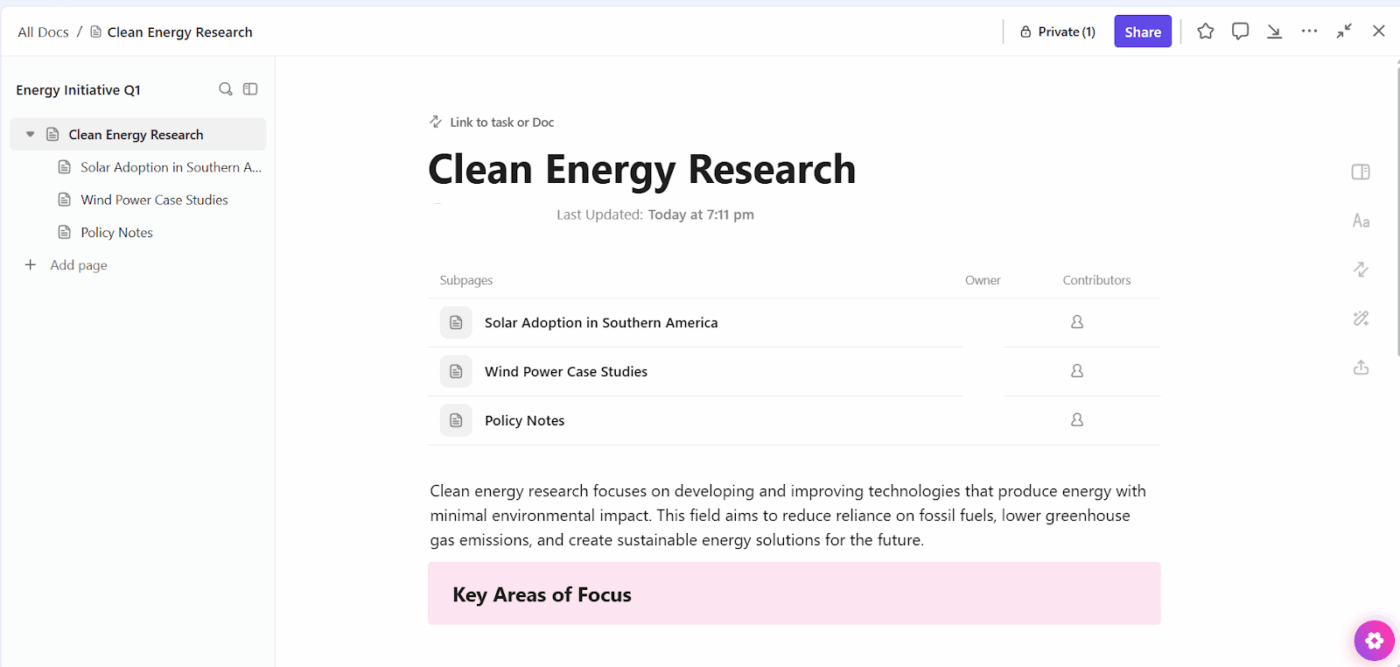
An air quality sensor detects a PM2.5 spike. A ClickUp Automation instantly creates an incident task with all the relevant context. The assigned team member sees the alert in their workflow, and ClickUp Brain surfaces similar past incidents and the correct response protocol. The team documents their response in a linked ClickUp Doc, and the project Dashboard updates to reflect the resolution—all in one place.
🎥 Bonus: Curious about managing these workflows with AI? Watch this short video guide to get started!
🔑 Why this matters:
Environmental monitoring only delivers value when insight leads to action. ClickUp helps teams eliminate the gap between the two—so AI doesn’t just inform decisions, it enables outcomes.
Staying ahead requires understanding what’s next in AI environmental monitoring.
The capabilities of AI are expanding rapidly. Models will become more accurate as they are trained on more data. Edge computing will enable even faster local processing on sensor devices. We’ll also see better integration between different monitoring systems, which will help reduce the data silos that currently fragment environmental intelligence.
Here are some emerging applications to watch:
However, challenges remain. AI systems require significant energy, so you’ll need to consider the environmental footprint of your monitoring infrastructure. As AI monitoring becomes standard, you can also expect increased regulation around data quality, model validation, and accountability.
Finally, remember that AI augments environmental expertise—it doesn’t replace it. The most effective programs will always combine AI capabilities with human judgment and local knowledge.
The environmental challenges we face today are too complex and fast-moving for manual monitoring alone.
AI can surface risks earlier and with greater precision—but outcomes still depend on what happens next. Environmental monitoring programs succeed or fail in the handoff between detection and response.
That handoff is where many teams struggle. Alerts arrive without context. Tasks live in one system, protocols in another, and reporting in a third. Disconnected tools only create the same Context Sprawl that AI monitoring is designed to eliminate.
Managing AI-driven monitoring means giving teams a clear, shared place to coordinate work, document decisions, and track follow-through. When workflows are connected, insights move faster.
Bring your environmental monitoring workflows together in ClickUp, and close the gap between signal and response.
Get started for free with ClickUp.
Traditional monitoring relies on periodic, manual data collection, with analysis happening days or weeks later. AI monitoring uses continuous sensor data and automated pattern recognition to provide real-time alerts, enabling a proactive response.
AI systems require significant computing power, which consumes energy. You can mitigate these impacts by using energy-efficient edge computing, choosing cloud providers that use renewable energy, and optimizing your models to reduce processing requirements.
Environmental monitoring is about collecting and analyzing real-time data on environmental conditions. Sustainability reporting uses AI to aggregate and present an organization’s sustainability metrics to stakeholders and regulators, often drawing on data from monitoring systems.

© 2026 ClickUp

There’s an easier way. Try a free AI Agent in ClickUp that actually does the work for you—set up in minutes, save hours every week.