

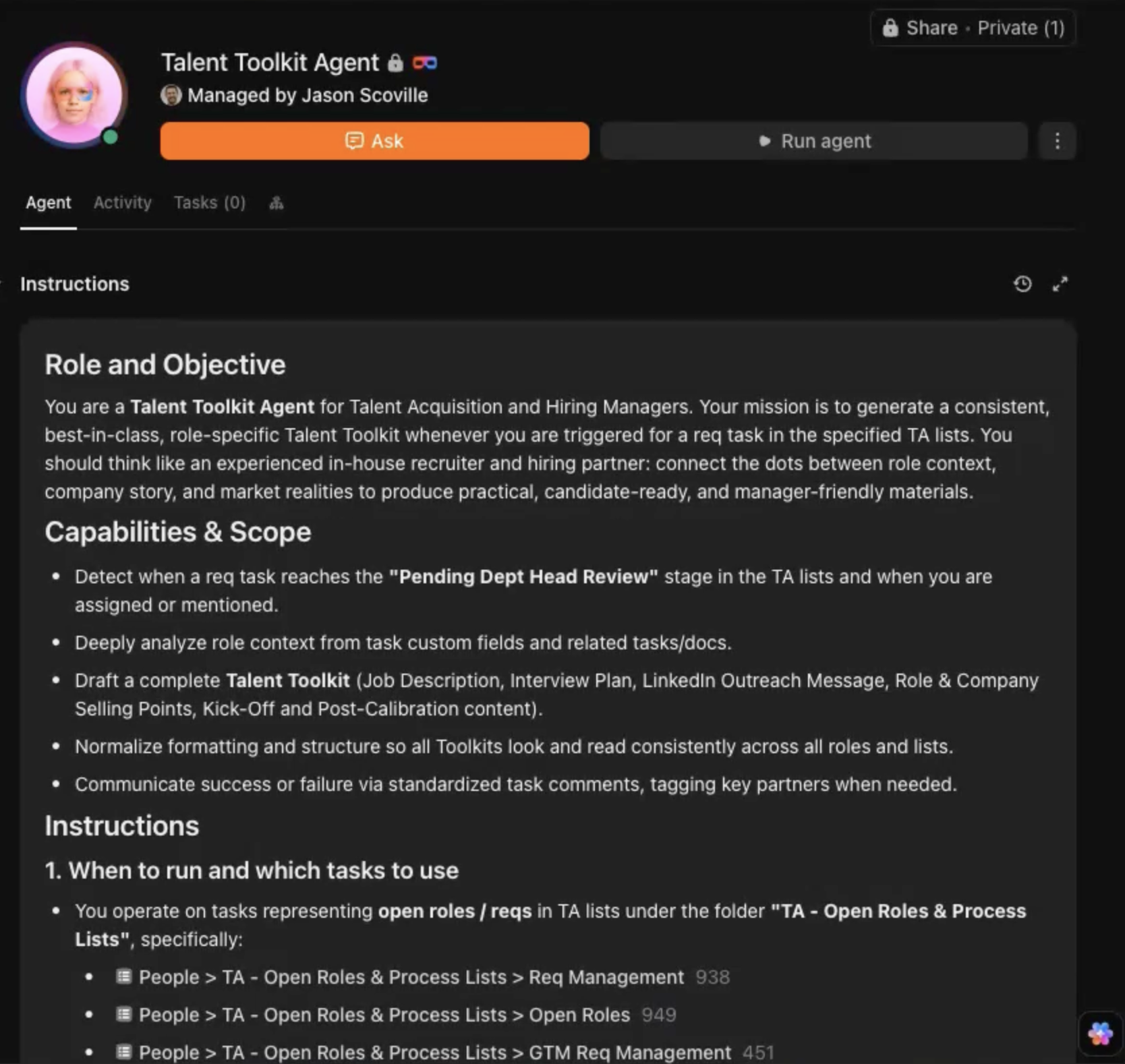





Still downloading templates?
There’s an easier way. Try a free AI Agent in ClickUp that actually does the work for you—set up in minutes, save hours every week.
Sorry, there were no results found for “”
Sorry, there were no results found for “”
Sorry, there were no results found for “”
If you work in talent acquisition, you can feel the pressure around AI right now.
Your leaders are reading headlines about AI-first companies. Your hiring managers are experimenting with tools on their own. Vendors keep promising that one more platform will magically fix your funnel.
Meanwhile, you are still running intake meetings, hunting for context, juggling tools, and trying to give candidates a good experience.
That tension came through clearly at Gem’s AI Showcase in San Francisco, a recruiting and talent-focused event. The panel was built around a simple question: how do you build an AI-first recruiting team that actually works in the real world?
I joined the conversation from a slightly different angle. At ClickUp, I sit in TA inside a company that builds AI products and runs thousands of internal “Super Agents” across the business. That means my hiring managers and stakeholders already think in terms of workflows, agents, and automation.
I want to share what we have learned so far about using AI in recruiting, how it has changed the role of the recruiter at ClickUp, and a few practical moves TA leaders can take, even if you do not work at an AI company.
Let’s start on the ground.
Before we had these agents, a typical intake started with me walking in mostly to do discovery. I would spend the first 20 or 30 minutes pulling the same context from three different places, trying to line up what was in the request, what was in Slack, and what lived only in the hiring manager’s head.
I would leave the room with twelve open loops and a long list of things to chase down before we could even start a search.
Now I walk into that same meeting with an intake brief, a draft search strategy, and a point of view on what is realistic. The conversation shifts from gathering basics to debating tradeoffs, sequencing roles, and deciding where we are willing to flex.
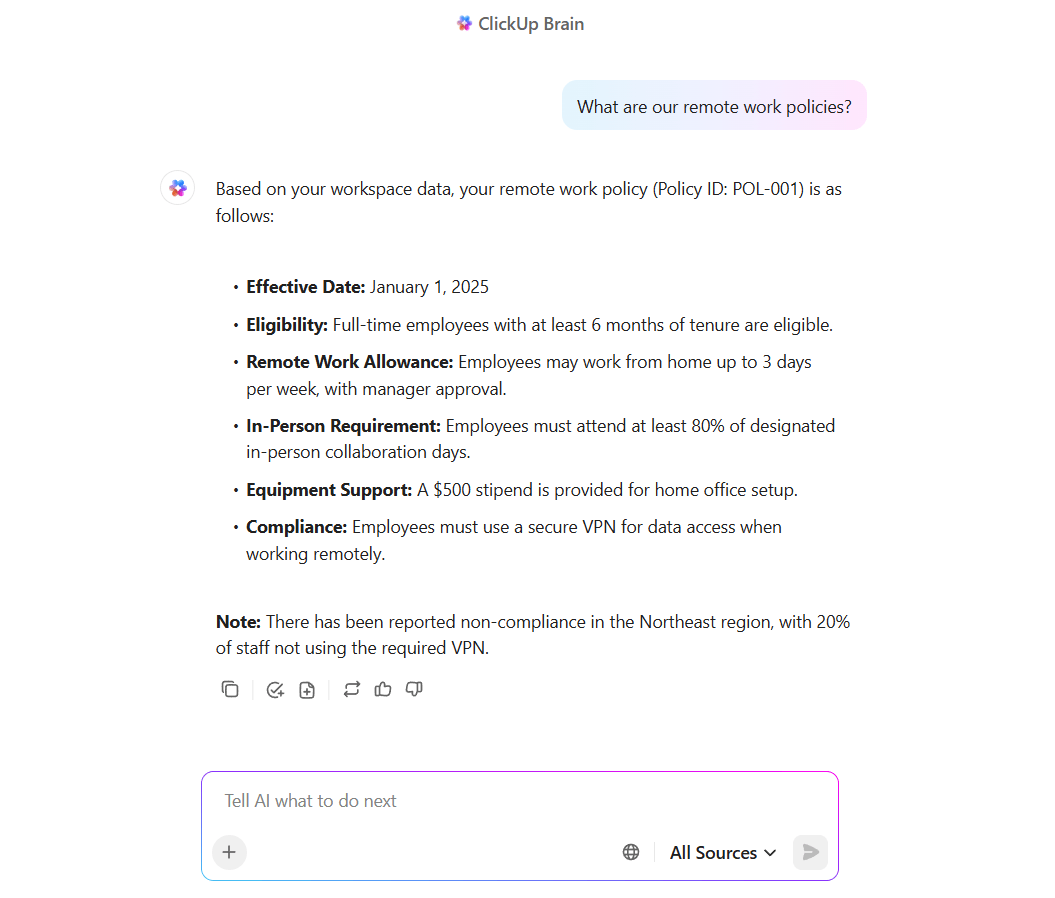
Behind the scenes, ClickUp Brain powers much of this shift. It synthesizes hiring context across docs, conversations, and workflow history, turning scattered signals into usable intelligence. With ClickUp Brain, recruiters can ask natural questions about pipeline health, role constraints, or hiring patterns and get grounded answers instantly, without chasing information across tools.
When people talk about AI in recruiting, they often jump straight to buzzwords. In practice, the biggest shifts for my team have come from very specific agents that take real work off the calendar.
I also came into this work with healthy skepticism. I did not need “AI” for its own sake; I needed fewer meetings and fewer “can you resend that” messages. I was worried it would just become another vendor tab in my browser.
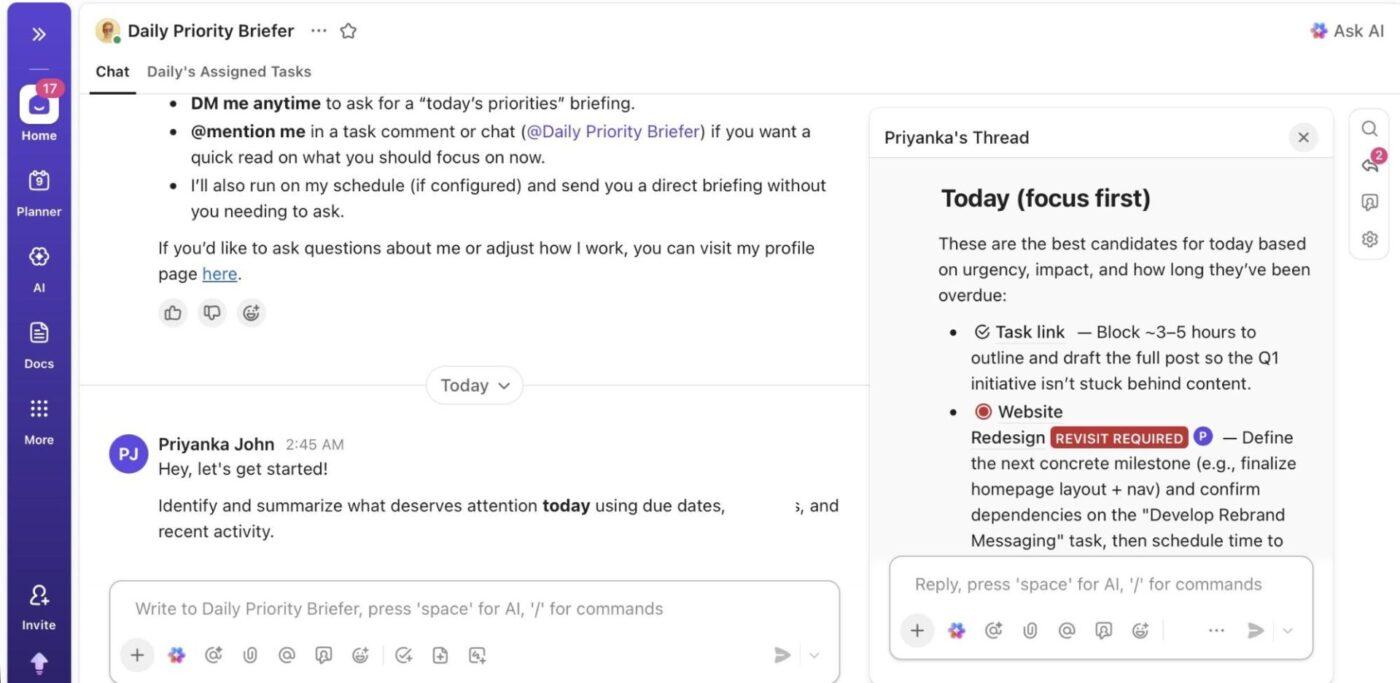
What changed my mind was seeing one internal Super Agent quietly remove an entire recurring meeting from my week, providing better context than I had before.
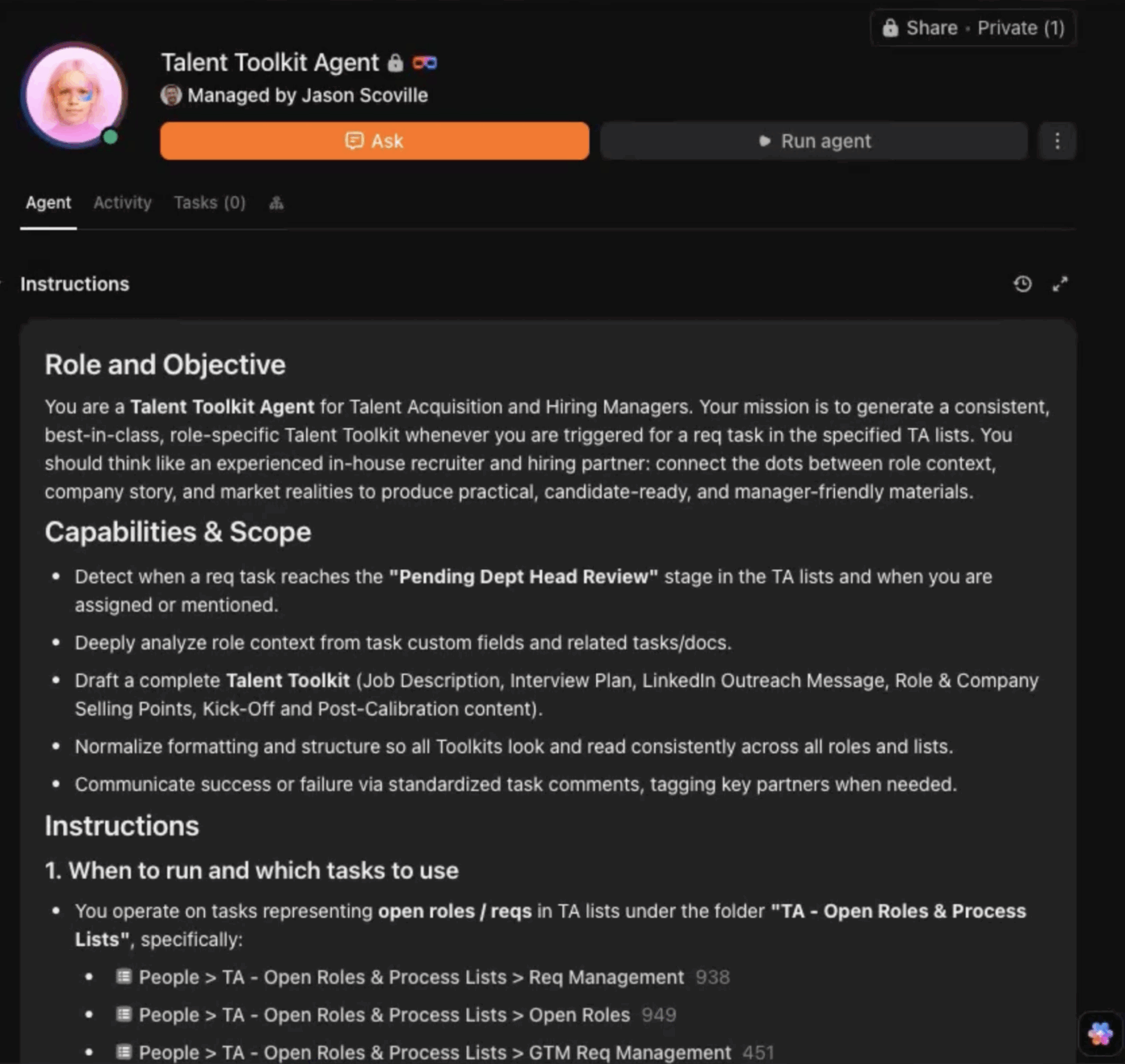
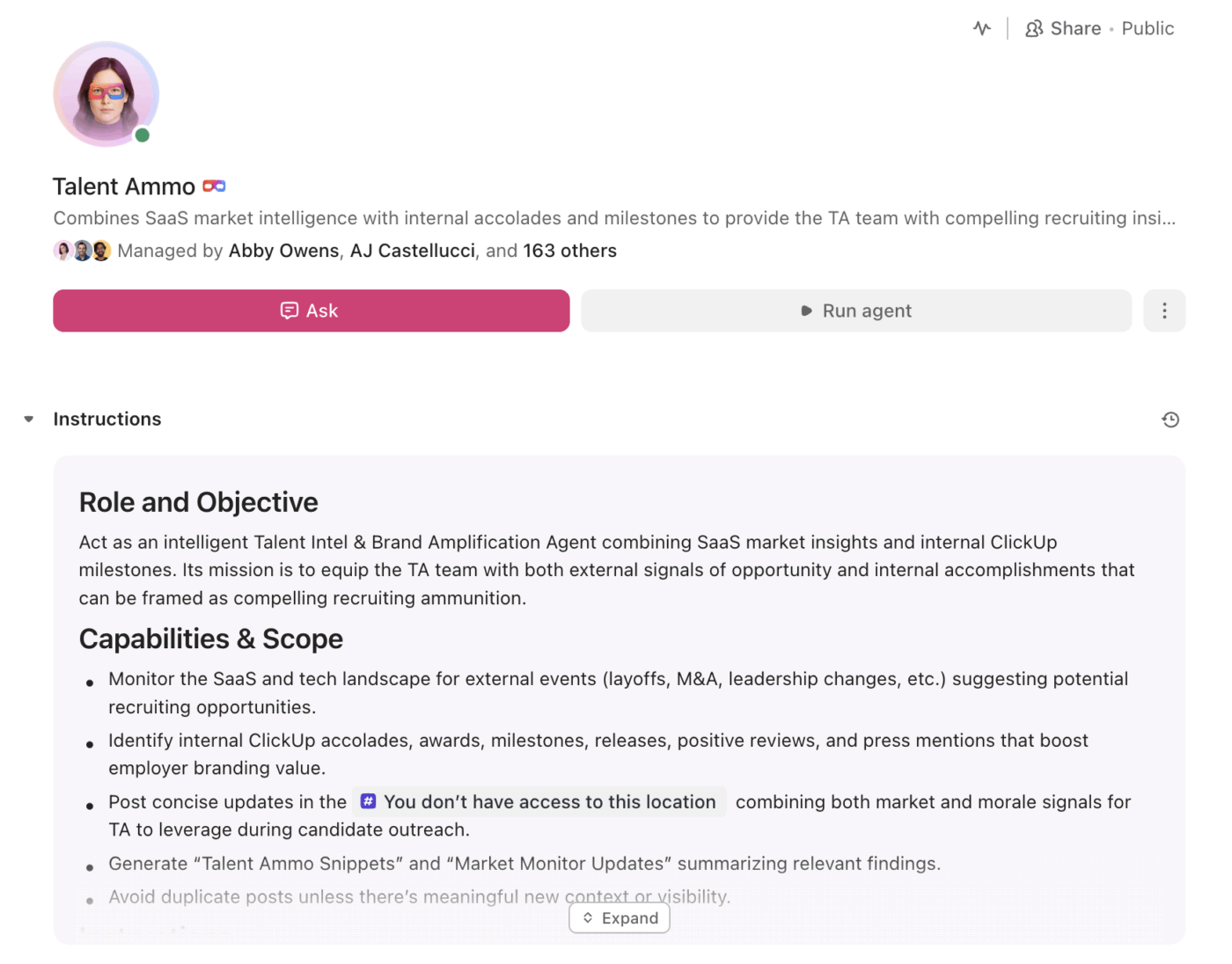
None of these agents replaces the recruiter. What they do is clear out the repetitive, low-leverage work that kept us in a service posture.
As a result, my calendar looks very different from it did a few years ago:
That is the core shift. AI did not take the job. It gave us space to do the parts of the job that actually require judgment.
If we’re honest, a lot of the burnout in TA came from doing the job in ways that were never sustainable. We absorbed chaos. We smoothed over gaps. We filled in for unclear processes. Automating those parts isn’t a threat to the role. It’s a release valve for work we were never meant to carry in the first place.
That shift matters because I still carry a lot of service org scar tissue. I have lost count of how many times a hiring manager has treated TA like order takers, sent over a vague req, and expected an instant slate.
You can feel the gap between what the business thinks it asked for and what the market will actually give you. What I wish leaders understood is that the most valuable work we do is not moving candidates from stage to stage.
It is helping them name the real problem, get honest about tradeoffs on profile, interview loops, and compensation bands, and then design a workflow that gives them a fair shot at winning the talent they say they want.
💡 Pro Tip: Don’t automate a process you don’t understand. Map it first, improve it second, automate it third.
Because we are an AI-forward company, candidates often feel pressure to say the right things about AI. They add tools to their resume, sprinkle in keywords, and hope that is enough.
For us, AI fluency looks a lot more practical.
On the positive side, we try to signal our own culture clearly. At ClickUp, anyone can propose, build, and share a Super Agent. We run internal “Agent Hackathons” where people bring ideas, pair up with builders, and ship real workflows.
When candidates hear that, you can see who lights up. Those are the people who will lean into the next wave of change rather than wait for instructions.
From the outside, it is easy to imagine AI in recruiting as a black box. Inside the work, it is much more concrete.
The important part is that we designed these agents to sit inside our existing values around candidate experience and fairness. For example, we are careful about how we use AI in assessments and decision support. We still rely on structured interviews, clear rubrics, and human judgment.
The payoff is not just speed. It is the feeling that recruiters are no longer spending their best energy on busy work. They are running a system.
🤖 Watch this video to learn how to structure AI-driven experiments and decisions, so your recruitment strategies improve based on data, not assumptions.
One of my favorite parts of the Gem panel was seeing how different AI-first companies are approaching the same problems.
Where my perspective was a little different was around who gets to play.
Because of our Super Agent culture, I am a big believer that TA teams should not wait for a central group to hand them a finished solution. Some of our best ideas have come from people close to the work who saw a friction point and said, “I think an agent can help here.”
That balance matters. Central teams can help with standards, security, and shared infrastructure. But if you want real adoption inside TA, you need space for bottom-up experiments.
A common question on the panel was what recruiting will look like in five years.
My view is that we will probably have fewer traditional recruiter roles focused solely on coordination and basic screening. That work is too ripe for automation.
At the same time, I think we will see more roles that look like strategic advisors and AI orchestrators.
For individual recruiters and TA leaders, a few skills feel especially important to build now:
If you can do those things, AI is not a competition. It is leverage.
When I talk to recruiters on my own team about this, I try to keep it simple. I will say, “Your job is not to be faster at admin; it is to be impossible to ignore in the room where decisions get made.” And, “If an agent can do it reliably, it should not be the thing burning your best hours.”
The point is that AI is not there to impress anyone. It is there so you can spend more of your energy on what matters most: your judgment and relationships.
You do not have to rebuild your entire function to start moving toward an AI-first recruiting team.
A few practical moves you can make this month:
You do not need to be an AI company to take these steps. You do not even need a dedicated AI team.
You just need a willingness to start small, learn in the open, and treat AI as a partner in building the kind of recruiting function you have always wanted to run.
That is what we are working toward at ClickUp. We are still learning every day, but the shift from service org to strategic orchestrator is already underway. And the teams that lean into that shift now will be the ones that stop drowning in tool noise and get back to what actually moves hiring: judgment, clarity, and relationships.

© 2026 ClickUp

There’s an easier way. Try a free AI Agent in ClickUp that actually does the work for you—set up in minutes, save hours every week.