

Sorry, there were no results found for “”
Sorry, there were no results found for “”
Sorry, there were no results found for “”
Writing a salary increase letter might feel intimidating, but it’s one of the most powerful tools you have to advocate for your value.
💰 Ask for what you deserve! Research shows that 70% of employees who ask for a raise get it!
A salary increase letter is where you outline the why behind the raise you’re requesting, not just the number. And when done right, it shows your contributions, reflects your growth, and opens the door to the compensation you’ve earned.
Whether you’re helping a manager recognize a team lead’s exceptional performance or standardizing salary adjustments across departments, the goal’s the same: clear, professional communication that actually works and is NOT awkward!
Let’s break down the nitty-gritty of writing a professional salary increase letter. We’ll share tons of examples and free tools to simplify this task. Let’s go! 🚀
A salary increase letter is a formal written request that outlines why you believe a raise is appropriate. It presents your contributions, highlights your performance, and provides clear reasoning for the pay increase you’re asking for.
Documenting the change gives your HR team clarity, protects them from confusion later, and maintains consistent communication across teams. This isn’t paperwork for the sake of it. It defines how your company recognizes and records growth.
When someone earns a raise, the decision should reflect more than a number. It should acknowledge employee contributions and signal future expectations. A formal increase letter does exactly that.
It helps you:
For HR teams, it also strengthens the employer-employee relationship. Employees see a raise as a response to their work, not a one-time gesture. That’s the kind of clarity that builds trust and supports ongoing success.
While there’s no universal timeline, the right moment usually connects back to measurable outcomes or a shift in scope. Here’s when it typically makes sense to initiate a pay raise discussion:
These aren’t just financial shifts but reflect the evolving value of an employee’s role. And when that happens, your salary increase letter formalizes it with transparency and consistency.
👀 Did You Know? In ancient Egypt, beer wasn’t just for toasting, rather it was part of your paycheck. Laborers, including pyramid builders, were often paid in daily beer rations. Turns out, negotiating compensation has always been part of the job.
A good salary increase letter balances clarity with structure. A salary increase letter communicates the raise clearly and ensures everyone stays aligned.
This includes the employee’s salary change, the reason behind it, and the timing. When done right, it becomes part of your compensation history, not just another document floating around HR folders.
Keep it simple. Every increase letter should have the basics covered:
💡Pro Tip: Use ClickUp AI to showcase your contributions and wins over the year and make a strong case for a pay raise.
Covering these ensures there’s no ambiguity on paper or in follow-up discussions.
⚡ Template Archive: Top Google Docs Cover Letter Templates
The words you choose communicate a raise as well as shape how that raise is perceived.
If you’re in HR, the tone should reflect clarity, fairness, and recognition. If you’re a department lead or executive, it reflects leadership and how your team sees value in your decisions. The wrong tone can make a thoughtful salary adjustment feel mechanical or worse, insincere.
What often goes wrong? Letters become overly formal or vague. The employee’s efforts get buried in boilerplate language. The performance review that led to the raise? Summarized in a single line. The result? A raise that feels transactional instead of earned.
Here’s how to make it count:
If you’re managing multiple letters across departments, ClickUp Brain can help you refine tone, tailor structure, and ensure consistency, without duplicating effort or losing the human touch.
Even when the raise decision is spot-on, a poorly written letter can derail how it’s received.
Here’s where things often go wrong:
This isn’t about being flowery. It’s about making sure recognition lands on paper and in practice.
You’ve done the work. Now it’s time to make the ask.
Whether you’re driving high-impact projects, stepping into new responsibilities, or realizing your pay no longer reflects your role, your salary increase letter is where you put it all into words.
The goal? Make it easy for your manager to see the value you’re bringing and why the timing makes sense.
Below are four examples to help you get started. Use the one that fits your situation best, then tailor the tone and details to match your voice and outcomes.
When to use it: You’ve exceeded expectations in your role and want to initiate a conversation after a strong performance or recent milestones.
Why it works: It leads with results, ties success to business goals, and positions the raise as a logical next step.
Subject: Request for Salary Adjustment Discussion
Hi [Manager’s Name],
I’d like to request a formal review of my current compensation based on the contributions I’ve made over the past [Time Period].
Specifically, my work on [Key Project or Initiative] helped [measurable outcome], and I’ve consistently met or exceeded performance goals outlined in our last review. I’ve also taken initiative in [Secondary Task or Support Role], contributing to our team’s success beyond my core responsibilities.
Given this performance, I’d appreciate the opportunity to revisit my salary and discuss a potential adjustment that reflects my contributions.
Looking forward to discussing this further.
Best regards,
[Your Name]
📖 Also Read: How to Measure Employee Engagement?
When to use it: You’ve assumed more responsibility, whether through team leadership, new projects, or scope expansion, but your salary hasn’t changed.
Why it works: It’s clear, proactive, and acknowledges the evolution of your role without sounding transactional.
Subject: Request for Salary Review Based on Expanded Role
Hi [Manager’s Name],
Since [Month or Event], I’ve taken on additional responsibilities, including [New Duties or Teams]. These changes have expanded my role and increased my impact across [Department or Initiative].
While I’ve appreciated the opportunity to grow in this direction, my current compensation no longer reflects the scope of my contributions. I’d like to request a review of my salary and explore a potential adjustment that aligns with my current responsibilities.
Happy to discuss further at your convenience.
Best,
[Your Name]
⚡ Template Archive: Free Employee Verification Letter Templates for HR Excellence
When to use it: You’ve researched your job title and found that your compensation is below industry averages for your role, experience, or location.
Why it works: It’s professional, grounded in data, and invites a conversation rather than making demands.
Subject: Compensation Benchmark Discussion
Hi [Manager’s Name],
I wanted to initiate a discussion around my current salary based on recent market benchmarks for roles similar to mine.
According to [Source or Report], the typical salary range for [Job Title] in [Region/Industry] is [Range], which is higher than my current compensation. Considering my tenure, performance, and contributions—especially around [Key Initiative or Result]—I’d like to request a review and discuss a potential adjustment.
I understand that many factors go into compensation planning, and I appreciate your consideration.
Best,
[Your Name]
When to use it: You’ve received another job offer but would prefer to stay, if your compensation package reflects your value and long-term growth.
Why it works: It’s honest, non-combative, and allows your manager to retain you without pressure.
Subject: Compensation Discussion
Hi [Manager’s Name],
I’ve recently received an external offer that reflects a higher compensation package. While I’m not actively seeking to leave, it’s prompted me to think more seriously about my long-term role and growth here.
I truly value the work we’re doing and the direction of our team. That’s why I’d like to revisit my current salary and see if there’s an opportunity to align it more closely with my responsibilities and the market.
I’m happy to discuss further and appreciate your consideration.
Best,
[Your Name]
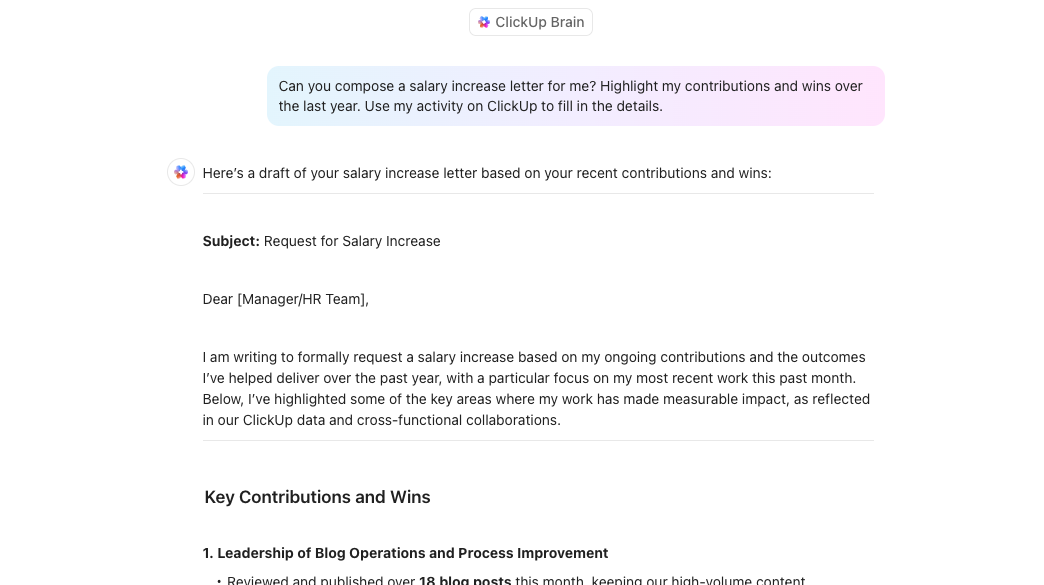
Here too, your handy AI assistant ClickUp Brain comes to the rescue to instantly generate convincing and high-quality salary increase letters. Simply put in you major requirements and Brain will draft you a letter tailored to your needs.
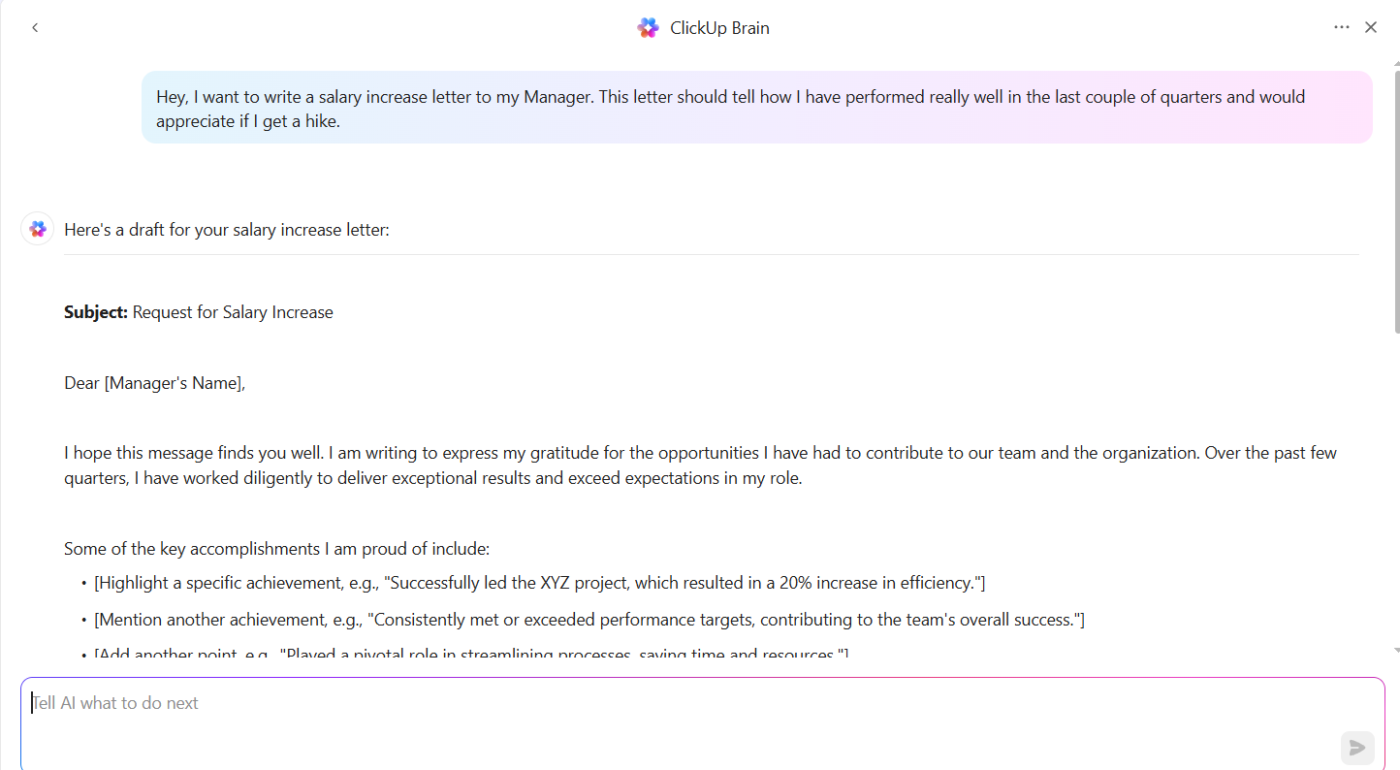
✨ Bonus: Now, ClickUp Brain can use external AI models such as GPT-4o and Clause, right from within your ClickUp Workspace. Meet all your Work AI needs with ClickUp.
Each of these salary increase letter templates is designed to help you start a productive, professional conversation around your pay increase. Adapt them based on your situation, whether you’re highlighting employee contributions, referencing a recent performance review, or navigating salary negotiations.
A well-crafted pay increase letter highlights the employee’s performance, emphasizes the employee’s specific contributions, and sets the stage for approval. But even the strongest letter needs the right mix of strategy, timing, and perception to land well.
Here are practical, expert-level tips to give your request real traction, not just visibility.
The approval process doesn’t begin with your letter, it begins with how people talk about you in the room when you’re not there.
Before making the ask, make sure:
When your name already carries weight, the letter becomes a formality, not a debate.
💡 Pro Tip: Use ClickUp Dashboards to track and visualize your impact across projects and teams. When you’re ready to request a raise, you’ll have a clear story backed by results, already visible to your manager.
Don’t blindside your manager with a formal letter. Let them know you’re planning to revisit your current salary in your next check-in.
This:
Surprise raises rarely get approved. Strategic heads-ups do.
Raises often get blocked, not because they’re undeserved, but because the budget cycle isn’t open, or leadership focus is elsewhere.
Ideal windows include:
Pro Tip: If you don’t know when those cycles happen, ask your manager when salary discussions typically take place. That alone shows strategic awareness.
⚡ Template Archive: Career Map Templates to Create a Clear Career Roadmap
This means:
Raises that are clear, grounded, and easy to explain to finance or HR are the ones that move.
One of the top reasons requests get delayed or rejected: they break the balance.
If your raise amount would make you the highest-paid person in your tier without a title change, it puts pressure on your manager to explain the exception.
Instead, suggest a number that reflects your growth, but still fits within the compensation package logic the company uses.
Yes, you should reference results, but also connect your ask to what’s ahead.
Are you about to lead a new team? Own a strategic account? Move into a mentorship role?
Raises are often easier to approve when they feel like an investment in what’s next, not just a reward for what’s done.
Your manager might agree with you, but still needs to sell your case to others.
Your job is to give them the story, data, and language to do that.
When your ask makes them look smart for supporting you, you’re much closer to hearing “approved.”
A well-written salary increase letter does more than request a pay raise, it reflects your efforts, highlights significant contributions, and signals readiness for additional responsibilities.
Whether you’re referencing a recent performance review, making a case based on rising living costs, or aligning with market adjustments, your letter should clearly present the reasoning, outline the raise amount, and express appreciation for your compensation package so far.
Communicating salary changes with the right tone and structure strengthens the employer-employee relationship and shows your ongoing commitment to the role.
Try ClickUp today to organize your performance wins, track milestones, and prepare for your next big move.
© 2025 ClickUp



