Smartsheet is built for teams that already think in spreadsheets and need rigorous portfolio governance: PMOs, construction teams, and regulated organizations. ClickUp is built for teams that need tasks, docs, chat, reporting, and AI in one connected workspace.
Pick the wrong one, and your team either inherits spreadsheet rigidity or spends time configuring features it does not need.
This comparison covers AI, task management, collaboration, integrations, reporting, and ease of use, with a clear verdict on each.
If you want the short answer, it’s at the bottom under “Should You Choose ClickUp or Smartsheet?”
Did You Know? Project professionals rely on project management software 66% of the time. That makes the choice of which tool you use more important than ever.
Summarize this article with AI ClickUp Brain not only saves you precious time by instantly summarizing articles, it also leverages AI to connect your tasks, docs, people, and more, streamlining your workflow like never before.
Summarize this article for me please
ClickUp vs. Smartsheet at a Glance
Feature / Category
ClickUp
Smartsheet
Best for
Teams that want an all-in-one workspace with AI-powered task management, docs, and communication in one place
Teams that prefer spreadsheet-style project tracking with advanced reporting and portfolio governance
Team size
Individuals to enterprise teams of any size
SMBs to large enterprises, especially PMOs and data-driven teams
AI capabilities
ClickUp Brain: native AI for writing, summarizing, and searching across workspace; Super Agents to execute complex tasks autonomously
Basic AI features; advanced automation requires Bridge (premium add-on)
Views
15+ views, including List, Board, Gantt, Calendar, Timeline, Mind Maps, Whiteboards
Grid, Gantt, Calendar, Card, Timeline views
Collaboration
Built-in Docs, Whiteboards, Chat, and real-time editing
Comments, proofing, and attachments; require external tools for better collaboration
Choose ClickUp if your team wants projects, docs, chat, dashboards, automations, and AI in one connected workspace. ClickUp is the stronger choice for teams that need flexible execution and less tool-switching.
Choose Smartsheet if your team already works in spreadsheets and needs structured portfolio governance, advanced reporting, and strict process control. Smartsheet is strongest for PMOs, construction teams, and regulated organizations.
How we review software at ClickUp
Our editorial team follows a transparent, research-backed, and vendor-neutral process, so you can trust that our recommendations are based on real product value.
Summarize this article with AI ClickUp Brain not only saves you precious time by instantly summarizing articles, it also leverages AI to connect your tasks, docs, people, and more, streamlining your workflow like never before.
Summarize this article for me please
ClickUp Overview
Manage your projects, docs, and chat in one place—all powered by AI
ClickUp is a Converged AI Workspace that brings your projects, docs, conversations, and reporting into one system. It helps teams reduce Work Sprawl by replacing disconnected project trackers, documents, chats, and reporting tools with one connected workspace.
ClickUp Brain sits at the core as the intelligence layer. It understands the context across your workspace and helps you move work forward. You can summarize notes, extract action items, or get quick answers pulled from your tasks and docs without digging around.
The impact shows up in how work flows day to day. Notes turn into tasks without friction. Conversations stay tied to the work they relate to. Teams across product, marketing, engineering, and operations operate with shared visibility and fewer gaps between planning and execution.
Pros:
ClickUp Brain: Use native AI to write content, summarize long task threads, get answers to questions about your projects, and automate repetitive work without leaving your workspace
ClickUp Docs: Create, edit, and collaborate on documents and wikis that are directly connected to your tasks and projects
ClickUp Automations: Build powerful, custom automations using a simple builder with triggers, conditions, and actions to handle the busywork for you
Cons:
Learning curve: With so many powerful features, it can take time for new users to explore everything ClickUp has to offer
Mobile experience: While the mobile app is fully functional for on-the-go work, some of the more advanced configurations and views are best experienced on a desktop
ClickUp Insight: 1 in 4 employees uses four or more tools just to build context at work. A key detail might be buried in an email, expanded in a Slack thread, and documented in a separate tool, forcing teams to waste time hunting for information instead of getting work done.
ClickUp converges your entire workflow into one unified platform. With features like ClickUp Email Project Management, ClickUp Chat, ClickUp Docs, and ClickUp Brain, everything stays connected, synced, and instantly accessible. Say goodbye to “work about work” and reclaim your productive time.
Summarize this article with AI ClickUp Brain not only saves you precious time by instantly summarizing articles, it also leverages AI to connect your tasks, docs, people, and more, streamlining your workflow like never before.
Smartsheet is an enterprise project management platform that organizes work in a familiar spreadsheet-style grid. If your team lives in Excel, the row-and-column interface will feel instantly intuitive, which simplifies adoption for data-centric workflows.
The platform is a strong choice for organizations that need highly structured project tracking, project portfolio management, advanced reporting, and resource management. It’s especially common inside project management offices (PMOs), construction firms, and operations teams.
Its biggest tradeoff is that collaboration, documentation, and advanced automation often depend on add-ons or external tools.
Pros:
Spreadsheet-style interface: The grid view is easy for Excel users to adopt, which can significantly shorten the initial training period
Control Center: This premium add-on allows organizations to standardize and scale project templates and processes, and maintain consistency
Advanced reporting: You can pull data from different sheets into a single dashboard with real-time widgets, charts, and detailed analytics
Resource management: The platform provides tools to track team capacity and allocate resources across multiple projects, giving leaders a clear view of workloads
Compliance credentials: Smartsheet holds FedRAMP Moderate and DoD IL4 authorization. It’s suitable for government agencies and other regulated industries that must meet strict compliance standards
Cons:
Premium features require add-ons: Key capabilities like Dynamic View, Data Shuttle, Control Center, and the Bridge automation engine are all priced separately
Performance with large sheets: Some users report that the platform can become slow when a single sheet grows to include thousands of rows of data
Summarize this article with AI ClickUp Brain not only saves you precious time by instantly summarizing articles, it also leverages AI to connect your tasks, docs, people, and more, streamlining your workflow like never before.
Summarize this article for me please
ClickUp vs. Smartsheet Feature Comparison
Both tools are powerful, but they solve problems in fundamentally different ways. Here’s how they break down across AI and automation, task management, collaboration, integrations, reporting, and usability.
Which tool has stronger AI and automation?
ClickUp wins on AI; Smartsheet wins inside sheets. ClickUp Brain is a context-aware AI assistant built directly into your workspace. It understands your tasks, docs, and conversations, so it can:
Automate workflows: Use ClickUp Automations to build custom “if-this-then-that” rules with triggers, conditions, and actions that handle repetitive steps for you
Get answers fast: Ask ClickUp Brain questions about any project, and it will search your entire workspace to find the answer. No need to dig through hundreds of tasks and docs
Use ClickUp Brain to summarize long chat threads and extract answers related to your tasks, docs, and projects instantly
ClickUp Super Agents go a step further by acting on work like real teammates. They live inside your workspace, understand how work connects across tasks, ClickUp Docs, ClickUp Chats, and tools, and execute end-to-end. You can assign tasks, @mention them, or message them directly. They run continuously, collaborate with your team, and handle multi-step tasks within your workspace’s permissions.
In practice, a ClickUp Super Agent can summarize weekly project risks, draft stakeholder updates, assign follow-up tasks, and keep reporting workflows moving without manual status chasing.
Pro tip: Treat Super Agents like owners, not helpers. Assign them recurring responsibilities, such as weekly reporting or follow-up tracking, so they run in the background without constant prompts. That’s where you start saving real time.
Smartsheet has introduced AI features to improve how you work inside sheets. You can generate formulas, analyze data patterns, create text and summaries, get suggested descriptions, and speed up inputs with intelligent form filling.
These features reduce manual effort when you’re working with structured data. But that’s where the benefit ends. Smartsheet’s AI doesn’t carry context across tasks, conversations, or documents, and it doesn’t act beyond what’s in front of it. For multi-step workflow automation, you need Bridge, a separate add-on with its own pricing.
The verdict: ClickUp wins with its native, context-aware AI that works across your entire workspace from day one. Smartsheet’s automation is functional but requires expensive add-ons for the kind of advanced workflows that ClickUp includes out of the box.
ClickUp Insight: 88% of our survey respondents use AI for personal tasks, yet over 50% shy away from using it at work. The three main barriers are a lack of seamless integration, knowledge gaps, and security concerns. ClickUp Brain is built into the workspace and uses your existing permissions, which addresses all three at once.
Which tool handles task management and project views better?
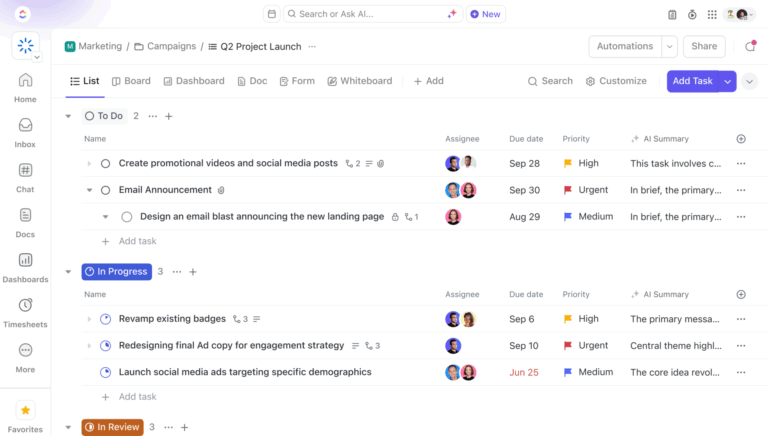
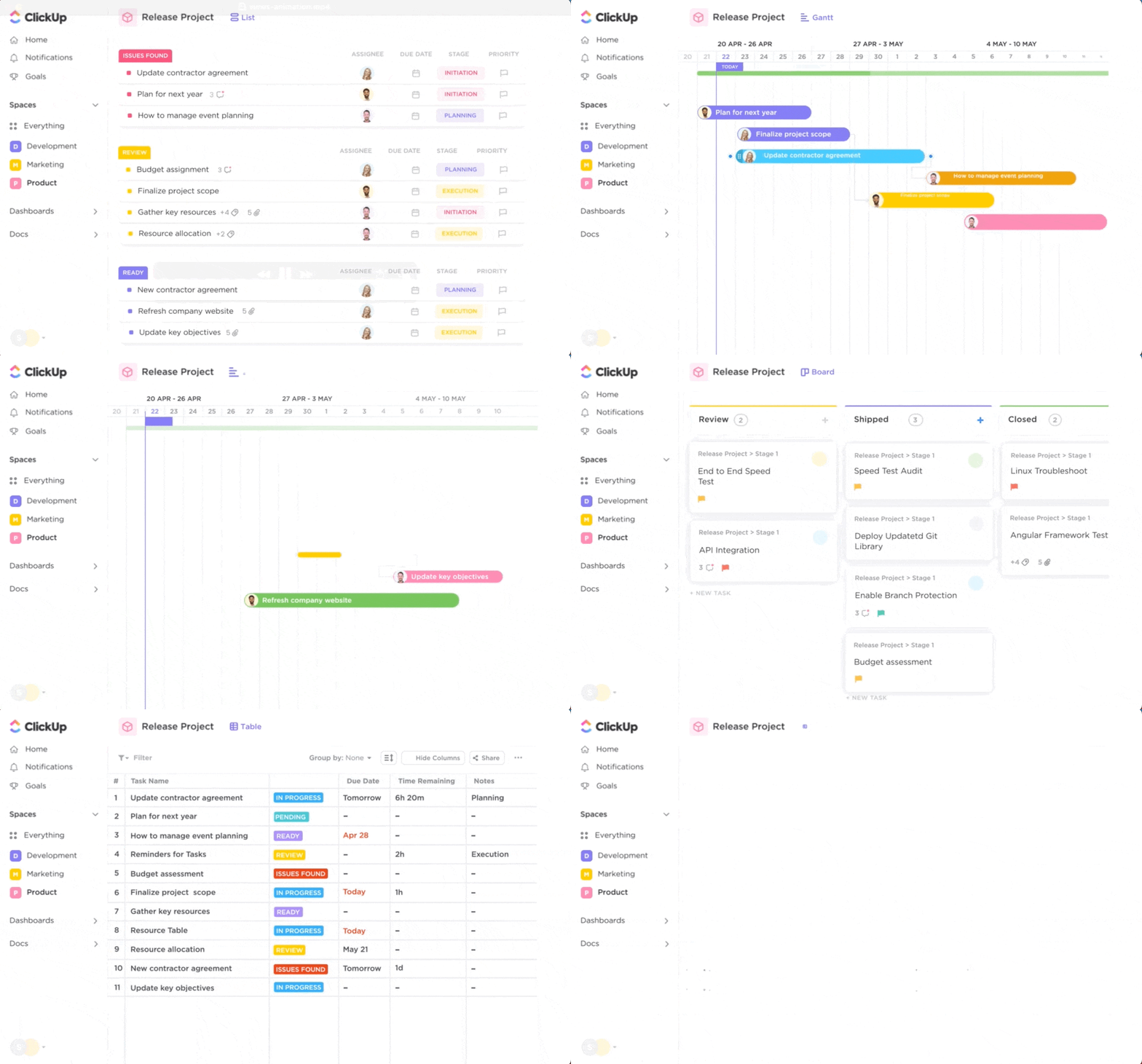
ClickUp wins on flexibility; Smartsheet wins on structured, data-heavy workflows. ClickUp gives access to 15+ project views:
List View: A classic, powerful to-do list for organizing and prioritizing tasks
Board View: A Kanban-style board, perfect for visualizing workflows and moving tasks through stages
Gantt View: A timeline for planning complex projects and managing dependencies
Calendar View: The ideal view for scheduling and managing time-sensitive work, like a social media calendar
Mind Maps and Whiteboards: Freeform canvases for brainstorming and planning out ideas visually
Organize and track partner engagement programs with ClickUp’s flexible views
You can switch between these views with a single click, and your data stays in sync. ClickUp Custom Fields let you track any data you need, from budgets to client contacts. Break down large projects with a flexible task hierarchy, use ClickUp Dependencies to sequence work, and use ClickUp Multiple Assignees to clarify shared responsibility.
I was looking for a project management platform and I found the best. Right away, it felt like ClickUp could solve all of our problems and create out-of-the-box solutions to benefit us in ways that I hadn’t even imagined.
Smartsheet is built around a grid-based system where rows are tasks and columns are data fields. It offers Grid, Gantt, Calendar, and Card views, all powered by the same underlying data. Any update in one view reflects instantly across the others.
Each view serves a specific purpose. Grid is best for managing large datasets, Gantt visualizes timelines and dependencies, Card view organizes work into Kanban-style lanes, and Calendar maps tasks by date. This works well for teams that rely on structured, data-heavy workflows.
But the experience still revolves around the spreadsheet at its core. Even when you switch views, you’re working off the same grid logic, which can feel rigid for creative or agile teams.
The verdict: ClickUp offers more visual flexibility and adapts to almost any team’s preference. Smartsheet is the better choice if your team thinks in spreadsheets and wants project management layered on top.
Which tool is better for collaboration and communication?
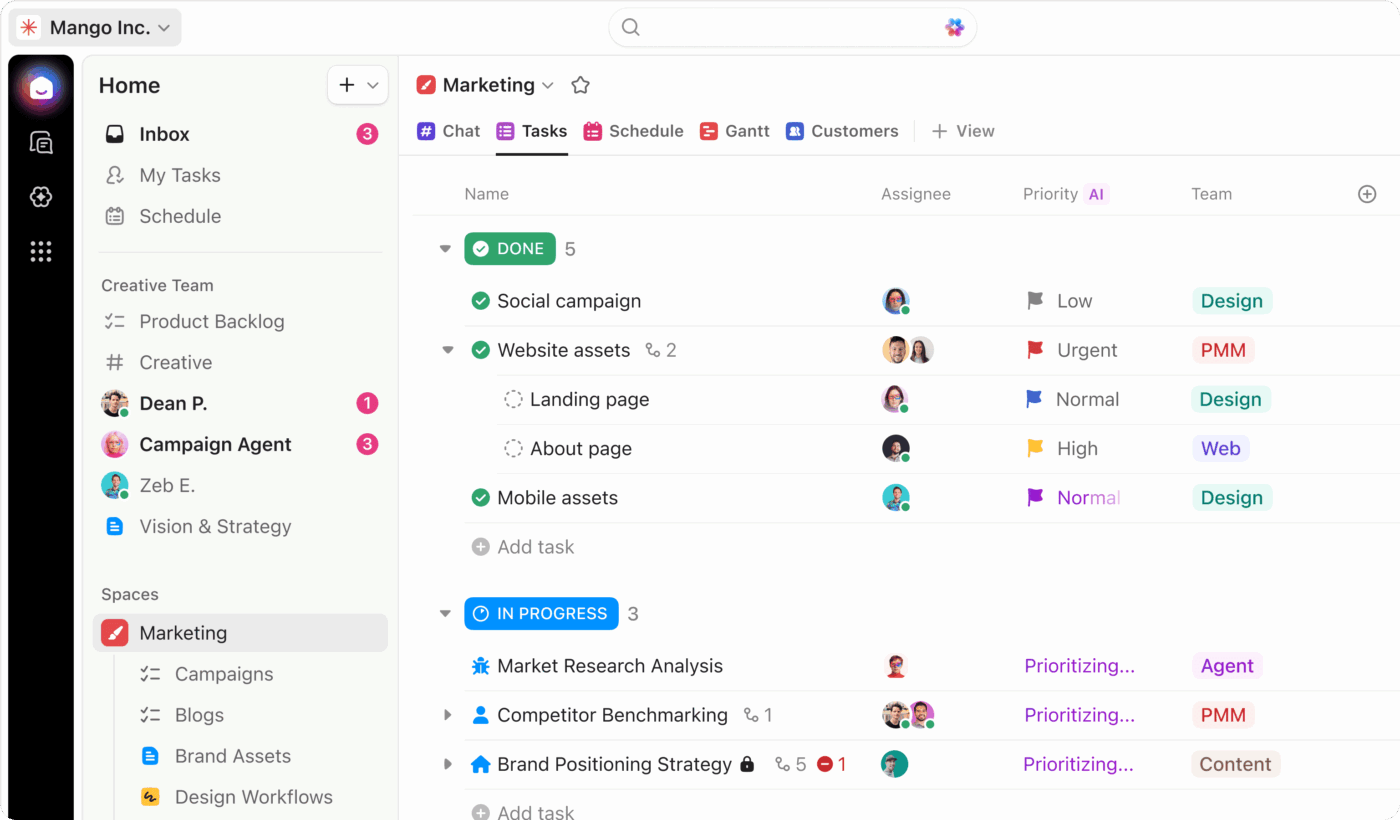
ClickUp is stronger for collaboration because Docs, Chat, Whiteboards, comments, and tasks live in the same workspace.
ClickUp Docs: create and edit project plans, wikis, and meeting notes linked directly to tasks. Real-time editing lets the whole team contribute at once
ClickUp Whiteboards:brainstorm ideas, map workflows, and plan projects on a visual canvas without leaving the workspace
Comments and @mentions: keep feedback tied to the relevant task or doc. Use ClickUp Assigned Comments to turn a conversation into an actionable to-do
Collaborate on documents with your team and keep notes with ClickUp Docs
One of our customers shared their experience on TrustRadius:
ClickUp has a lot to offer in one place such as project management, brainstorming options, task management, project planning, documentation management, etc. It has definitely made life comparatively easier as it’s easy to use, UI is well designed, and collaboration within the team and with other teams is easier. We were able to manage work better, track and report work easily, and based on progress daily huddles, future planning was easy.
Ansh Prabhakar, Business Process Improvement Analyst, Airbnb
In Smartsheet, collaboration happens through comments on individual rows and proofing tools for attachments.
Smartsheet lacks native document creation or built-in chat. You have to rely on external tools like Google Docs and Slack, which reintroduces the tool sprawl you were trying to escape.
The verdict: ClickUp is the clear winner for collaboration, offering a truly converged workspace where your documents, whiteboards, and chat are connected to your work. Smartsheet handles basic collaboration but ultimately requires you to rely on other tools for communication.
How do they compare on integrations?
When tools don’t talk to each other, your team has to manually transfer information. That is inefficient and error-prone. A unified platform should reduce your reliance on other tools, not just connect to them.
ClickUp consolidates docs, chat, whiteboards, and ClickUp Project Time Tracking into a single workspace. For external tools you still need, ClickUp offers hundreds of native integrations with Slack, Google Drive, GitHub, and Figma. You can also build custom connections with the ClickUp API or use ClickUp Zapier support.
Smartsheet offers native connectors for Salesforce, Jira, Microsoft Dynamics 365, Microsoft 365, Google Workspace, Slack, and Tableau. It also offers API access and a marketplace of partner-built integrations.
That said, the more powerful integrations are not in the base plans:
Data Shuttle, which automates bulk data imports and exports, is a paid premium add-on in Advanced Work Management
Bridge, the no-code cross-platform automation builder, is also part of the Advanced add-on suite.
The Salesforce connector is a standalone premium offering rather than something bundled into standard plans
The verdict: Both platforms connect well. ClickUp consolidates more of your stack into a single tool. Smartsheet’s most powerful integrations often require additional spend.
Which tool wins on reporting and dashboards?
Smartsheet has an edge for portfolio-level PMO reporting. ClickUp is stronger when teams want reporting connected to tasks, docs, time tracking, workload, and AI summaries.
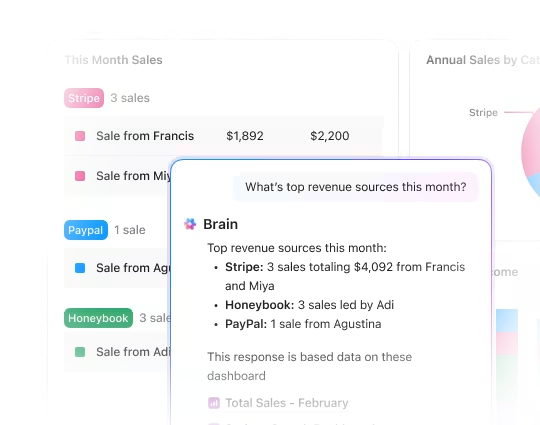
Summarize dashboard insights, project updates, and blockers with ClickUp AI Cards
You can share dashboards with stakeholders for visibility without granting full workspace access. You can also ask ClickUp Brain, “What’s the status of the Q3 marketing campaign?” and get an instant summary.
Smartsheet’s dashboards pull real-time data from multiple sheets into a single view, using widgets like charts, metrics, and reports. You can also build cross-sheet reports based on specific criteria, which makes it easier to track project status, identify risks, or get a portfolio-level view without manually combining data. That is why PMOs and operations teams running 50+ projects often prefer Smartsheet here.
Pro tip: Before building Smartsheet reports, standardize key fields like status, owner, and priority across all sheets. Reports rely on consistent column names, and minor differences will break filters or return incomplete data.
The verdict: Smartsheet has the edge for complex, multi-sheet enterprise reporting. ClickUp wins for flexible reporting with AI-powered insights on demand.
Which tool is easier to learn and adopt?
Smartsheet wins on day-one familiarity for spreadsheet users; ClickUp catches up fast once you’re past the first week.
ClickUp is powerful, and that comes with an initial learning curve. The platform offers resources to get teams up to speed:
Templates: Start with a pre-built template for hundreds of common use cases
ClickUp University: Access free courses, videos, and certificate programs to master your workflow
Smartsheet’s spreadsheet interface is its biggest advantage for usability—if you know Excel, you’ll feel right at home. It significantly lowers the adoption barrier for many teams.
However, advanced features like complex formulas and the Control Center add-on require dedicated training. If you prefer a visual, less grid-like approach, the interface can feel restrictive.
The verdict: Smartsheet is easier for spreadsheet-native teams to get started with. In comparison, ClickUp has a steeper initial learning curve. But ClickUp rewards you with a more comprehensive, customizable workspace tailored to your team’s needs.
Summarize this article with AI ClickUp Brain not only saves you precious time by instantly summarizing articles, it also leverages AI to connect your tasks, docs, people, and more, streamlining your workflow like never before.
Summarize this article for me please
Should You Choose ClickUp or Smartsheet?
Still on the fence? Here’s a walkthrough that shows how both tools actually feel in a real setup:
Choose Smartsheet if your team lives in spreadsheets, you need a familiar grid interface for structured, data-heavy workflows, and you need portfolio governance with FedRAMP or DoD-level compliance. It’s a strong fit for PMOs, construction firms, and government organizations.
Choose ClickUp if you want to stop work from being scattered across too many apps. ClickUp brings tasks, docs, chat, whiteboards, and AI into one workspace. It’s a strong fit for marketing, product, engineering, and operations teams that want flexibility and want to eliminate tool sprawl.
Honest caveat: if your team has 10+ years of muscle memory in Excel and runs deeply formula-driven workflows, Smartsheet’s grid will feel native in a way ClickUp won’t, even after onboarding. ClickUp’s payoff is in everything that surrounds the grid: docs, chat, AI, and dashboards. If you don’t need that surround, you don’t need ClickUp.
Summarize this article with AI ClickUp Brain not only saves you precious time by instantly summarizing articles, it also leverages AI to connect your tasks, docs, people, and more, streamlining your workflow like never before.
Summarize this article for me please
The Practical Take
The best work management platform is the one your team can settle into quickly and keep using as work gets more complex.
Smartsheet’s spreadsheet-centric approach works well for organizations with structured processes, tighter governance, and formal reporting. ClickUp’s converged workspace works for teams that want more visibility and less tool-switching.
If the second sounds closer to how your team wants to work, try ClickUp for free.
Summarize this article with AI ClickUp Brain not only saves you precious time by instantly summarizing articles, it also leverages AI to connect your tasks, docs, people, and more, streamlining your workflow like never before.
Summarize this article for me please
Frequently Asked Questions
Can you integrate ClickUp with Smartsheet?
Yes, you can connect ClickUp and Smartsheet using third-party automation tools like Zapier. This allows you to sync data between the two platforms, which can be useful during a migration or if different teams in your organization use different tools.
Is ClickUp better than Smartsheet for workflow automation?
ClickUp is stronger for teams that want native automation and AI-driven workflows without relying on premium add-ons. Smartsheet’s more advanced automation capabilities are part of its Bridge add-on, which comes at an additional cost, making ClickUp a more accessible choice for teams that want to automate workflows out of the box.
Which tool works better for marketing teams managing content calendars?
Marketing teams managing content calendars will find ClickUp exceptionally well-suited to their needs. Its combination of a flexible Calendar View, integrated ClickUp Docs for content briefs, and built-in collaboration tools creates a seamless workflow. Smartsheet often requires external document tools and lacks native content management features.
Everything you need to stay organized and get work done.